




Caught Our Eye Archives
Assorted Links 6/27/10
Brown Bailout
- Drafting Effective Federal Legislation and Amendments, July 21, 2010
- Preparing and Delivering Congressional Testimony, July 22, 2010
- Advanced Federal Budget Process, August 2-3, 2010
- Advanced Legislative Strategies, August 4-6, 2010
- Mark Twain on Copyright - "Remarks of Samuel Langhorne Clemens Before the Congressional Joint Committee on Patents, December, 1906 (Mark Twain on Copyright)"
- Persuading Congress: Candid Advice for Executives - "Persuading Congress, by Joseph Gibson, is a very practical book, packed with wisdom and experience in a deceptively short and simple package.
This book will help you understand Congress. Written from the perspective of one who has helped put a lot of bills on the president's desk and helped stop a lot more, this book explains in everyday terms why Congress behaves as it does. Then it shows you how you can best deploy whatever resources you have to move Congress in your direction."- Undercover Operation: Strippers Take Clothes Off! - "Here is a truly wonderful story: After a six-month (!!) undercover sting operation, the men of Charlottes's finest have concluded that strippers take. their. clothes. off.
Thank goodness we have a police force, to protect us from dangerous naked women. I think Mr. Fall has it right, below:"- Rolling Stone - "This sort of thing is what happens when a senior officer and his aides, under pressure, blurt out the truth. Biden is indeed something of a stuffed shirt, and the president has been disappointing to many people who once hoped for more.
Update: Most of the general’s dissatisfaction appears to have been generated by friction with US ambassador Karl Eikenberry, who was himself a 3-star general and former commander of US forces in Afghanistan. The sometimes controversial COIN changes that McChrystal has instituted are changes to Eikenberry’s policies, while the ambassador has declined to release funds to sponsor the kind of local anti-Taliban militias and infrastructure upgrades in Kanduhar that made the Sons of Iraq game changers in the Sunni-dominated Iraqi province of Anbar. As for Holbrooke and Jones, well: Too many cooks spoil the broth.
. . .
Update 5: The Rolling Stone article itself. Read for content -- and not for the reporter’s reflexively anti-military spin -- it’s not so bad, really. The 'Biden who?' thing was about keeping his mouth shut if he had to answer a question about his previous disagreement with the vice president at a dinner party in Paris."- Does McChrystal Rhyme with MacArthur? - "Look past McChrystal, a man who has given his life to the military, and has much to show for it. Look at the enlisted guys who are just beginning their careers, or the NCOs or junior officers who are in the third or fourth tours (in either Iraq or Afghanistan). They’re growing frustrated. They’re in an impossible situation. They are fighting a war that depends upon strong support here in the United States, and that aims to boost support for a government that no one believes in. And while they understand COIN as preached by McChrystal, they struggle with the rules of engagement that COIN requires."
- Greenberg: For-Profit Schools ... Subprime Redux? - "But [Steve Eisman of FrontPoint Partners]’s comments were the most direct. Key claims include:
* 'Until recently, I thought that there would never again be an opportunity to be involved with an industry as socially destructive as the subprime mortgage industry. I was wrong. The for-profit education industry has proven equal to the task.'
* With Title IV student loans, 'the government, the students and the taxpayers bear all the risk and the for-profit industry reaps all of the rewards.'
* 'We have every expectation the industry’s default rates are about to explode.'
* 'How do such schools stay in business? The answer is to control the accreditation process. The scandal here is exactly akin to the rating agency role in subprime securitizations.'"
Steve Eisman & FrontPoint Partners Ira Sohn Presentation: Subprime Goes to College
- Without Good Evidence, Bad Evidence Must Do - "Lawyers fight tooth and nail over the admissibility of evidence in a typical case. The reason they fight is simple: There's evidence to be had and rules to apply in determining its admission. Thanks to Mr. Richardson, we can argue the nuanced points all day long.
. . .
Prosecutions alleging domestic violence are fraught with arguments, and decisions, that wreak havoc with the rules of evidence. Proponents argue that the nature of the relationship, private and personal, precludes the availability of reliable evidence, and thus gives rise to a different set of rules that should permit evidence that would otherwise be laughed out of court. The use of rampant hearsay evidence is indefensible, but proponents contend that a murderer shouldn't get away with it just because they've killed the only competent witness.
The only thing truly required to feel comfortable with the concept of convicting in the absence of good evidence is the certainty of the defendant's guilt, thereby justifying anything needed to obtain the verdict to validate that belief. When the defendant's guilt is prejudged, the absence of good evidence gives way to the admission of bad. After all, we can't let a man like Drew Peterson get away with it."- Grassroots Lobbying, Campaign Finance Laws and the Integrity of Democracy - "It’s been my pleasure to guest blog this week on the topic of grassroots lobbying regulations. In the four previous posts, I’ve summarized the lessons from Mowing Down the Grassroots: existing lobbying regulations in 36 states are so broad as to cover situations in which individuals or groups communicate to other citizens about public issues (i.e., grassroots lobbying) and such regulations have costs that have gone largely unrecognized.
The traditional rationales for regulating lobbyists -- corrupting or buttonholing public officials -- do not apply to grassroots lobbying; instead, states have asserted a right to know 'who is speaking' for the furtherance of the 'integrity of democracy.' I leave for others to debate whether such a purpose is a legitimate reason to burden political speech, association and the right to petition."- Learning the rules of an unengaged president - "What do Gen. McChrystal and British Petroleum have in common? Aside from the fact that they're both Democratic Party supporters.
Or they were. Stanley McChrystal is a liberal who voted for Obama and banned Fox News from his HQ TV. Which may at least partly explain how he became the first U.S. general to be lost in combat while giving an interview to Rolling Stone: They'll be studying that one in war colleges around the world for decades. The management of BP were unable to vote for Obama, being, as we now know, the most sinister duplicitous bunch of shifty Brits to pitch up offshore since the War of 1812. But, in their 'Beyond Petroleum' marketing and beyond, they signed on to every modish nostrum of the eco-Left. Their recently retired chairman, Lord Browne, was one of the most prominent promoters of cap-and-trade. BP was the Democrats' favorite oil company. They were to Obama what Total Fina Elf was to Saddam.
. . .
Only the other day, Florida Sen. George Lemieux attempted to rouse the president to jump-start America's overpaid, overmanned and oversleeping federal bureaucracy and get it to do something on the oil debacle. There are 2,000 oil skimmers in the United States: Weeks after the spill, only 20 of them are off the coast of Florida. Seventeen friendly nations with great expertise in the field have offered their own skimmers; the Dutch volunteered their 'super-skimmers': Obama turned them all down. Raising the problem, Sen. Lemieux found the president unengaged, and uninformed. 'He doesn't seem to know the situation about foreign skimmers and domestic skimmers,' reported the senator.
. . .
'The ugly truth,' wrote Thomas Friedman in The New York Times, 'is that no one in the Obama White House wanted this Afghan surge. The only reason they proceeded was because no one knew how to get out of it.'
Well, that's certainly ugly, but is it the truth? Afghanistan, you'll recall, was supposed to be the Democrats' war, the one they allegedly supported, the one the neocons' Iraq adventure was an unnecessary distraction from. Granted the Dems' usual shell game -- to avoid looking soft on national security, it helps to be in favor of some war other than the one you're opposing -- Candidate Obama was an especially ripe promoter. In one of the livelier moments of his campaign, he chugged down half a bottle of Geopolitical Viagra and claimed he was hot for invading Pakistan.
Then he found himself in the Oval Office, and the dime-store opportunism was no longer helpful. But, as Friedman puts it, 'no one knew how to get out of it.' The 'pragmatist' settled for 'nuance': He announced a semisurge plus a date for withdrawal of troops to begin. It's not 'victory,' it's not 'defeat,' but rather a more sophisticated mélange of these two outmoded absolutes: If you need a word, 'quagmire' would seem to cover it.
Hamid Karzai, the Taliban and the Pakistanis, on the one hand, and Britain and the other American allies heading for the check-out, on the other, all seem to have grasped the essentials of the message, even if Friedman and the other media Obammyboppers never quite did. Karzai is now talking to Islamabad about an accommodation that would see the most viscerally anti-American elements of the Taliban back in Kabul as part of a power-sharing regime. At the height of the shrillest shrieking about the Iraqi 'quagmire,' was there ever any talk of hard-core Saddamite Baathists returning to government in Baghdad?
. . .
Likewise, on Afghanistan, his attitude seems to be 'I don't want to hear about it.' Unmanned drones take care of a lot of that, for a while. So do his courtiers in the media: Did all those hopeychangers realize that Obama's war would be run by Bush's defense secretary and Bush's general?
Hey, never mind: the Moveon.org folks have quietly removed their celebrated 'General Betray-us' ad from their website. Cindy Sheehan, the supposed conscience of the nation when she was railing against Bush from the front pages, is an irrelevant kook unworthy of coverage when she protests Obama. Why, a cynic might almost think the 'anti-war' movement was really an anti-Bush movement, and that they really don't care about dead foreigners after all. Plus ça change you can believe in, plus c'est la même chose.
Except in one respect. There is a big hole where our strategy should be."
How to make a liberal case for Israel
- New Or Used?: The Third Car Edition (teen driver) - " My soon to be 16 year old daughter will be driving soon. She is heavily involved in sports and marching band, so a car for her to get to such things would be a great relief for mom and dad. That’s 1000’s of miles to and from school, and whatnot! We will have NO car payments around the same time (wife’s 2005 Exploder will be paid-off in July).
So what to get??? A 3rd car to use as a city car? A newer used car for wife, I jump into the Explorer and share it with daughter?
A car for daughter solely??? We will not be getting rid of my truck or wife’s explorer. It has to be used, domestic brand prefered, but V-Dubs are OK. And no more than 8 grand."
Lots of good advice in the comments.- The Search World Is Flat - "How does Google’s unchallenged domination of Search shape the way we retrieve information? Does Google flatten global knowledge?
I look around, I see my kids relying on Wikipedia, I watch my journalist students work. I can’t help but wonder: Does Google impose a framework on our cognitive processes, on the way we search for and use information?
. . .
-- Students who bring academic experience to an online research task are more likely to succeed than those with technical expertise alone:
. . .
--The highest performing students use copy/paste to organize their thoughts.
. . .
--Younger students tend to be more opinionated than their elders; they begin to write their essay after only seeing 5 URLs, and they extract sources mostly to support their beliefs
. . .
--Google is the source.
. . .
--Search processes showed a definite lack of imagination on the students part. For instance, they made little or no effort to restructure search terms.
. . .
--Most of the students performed rather a small number of actions, going though 18 different web sites to find 2 or 3 quotable sources, this without much difference between graduates and undergraduates.
. . .
There is little doubt that the overwhelming use of technology such as search engines -- and the preeminence of Google in that field -- tends to flatten global knowledge. Let’s not forget that Google’s algorithm is based on popularity rather than relevance; the PageRank system acts as some kind of popular voting in which links are the ballots. The consequence is a self-sustaining phenomenon in which superficial research will value the most popular results which, in turn, are linked and gain in popularity, and so on.
And, unfortunately, most of the searches are superficial. ‘It is certain that an overwhelming amount of information reduces serendipity’, says Monica Bulger. ‘Over a thousand of results, we tend to select the top five’."- The Age of the Infovore - "Tyler Cowen’s 'Create Your Own Economy' is now out in paperback entitled 'The Age of the Infovore', perhaps an acknowledgement that the initial title wasn’t working out.
I liked the book at lot. As suits the infovoracious it is wide-ranging, somewhat scattershot but extremely creative, original and thought-provoking. If the book has a theme it is that different people think very differently - not just that they have different tastes or different beliefs but that the entire way they organise the world is different - and that the internet offers some people a much better way to order their encounters with the world than they have previously been offered. It changed the way I think."- Wheat Ridge High School Class of 1970 - "The reonion committee is working away planning the 40th reunion the weekend of August 13-15, 2010. Wheat Ridge, Colorado WRHS1970.com"
- Common Market Food Co-op - "Common Market Food Co-op was a 'new wave food co-op' located at 1329 California Street in Denver, Colorado, from 1975 - 1980. It started as a buying club at the University of Denver in the early 1970s, and for a few years prior to moving to the old Safeway at 13th and California Streets, Common Market operated out of a small storefront on Champa Street."
- Mickey Foley: The Doomer's Curse - "Mickey Foley takes a look at the underlying motivations of people who predict collapse of society as a result of Peak Oil, Anthropogenic Global Warming, or other causes. Foley sees Doomers motivated by an underlying desire to lower the status of others in order to boost their own relative status.
'The Doomer is motivated by much more than a perverse sense of altruism. He mainly desires to see everyone brought down to his level. His fondest wish is for everyone to be as emotionally crippled as he is, and, if they could also be paralyzed fiscally, that would be great too. The argument for the necessity of disaster is merely an excuse for his vindictive fantasies. This is the Doomer's Curse: to wallow in despair, to sneer at the happiness of others, to revel in schadenfreude and to believe that he has humanity's best interests at heart. The Doomer honestly thinks that a universal depression (in the emotional sense) would lay the foundation for a better world, but this belief is rooted in his own selfishness, not in a rational socioeconomic analysis.'"- Why Engineers Hop Jobs - "People in my generation have a very low tolerance for bullshit, and software engineering, in general, is a very high bullshit career. If you couple that with the standard load of bullshit you would get from a non-technical Harvard MBA type boss -- like many CEOs that you find trying to get rich in Silicon Valley by hiring some engineers to 'code up this idea real quick' -- it's no wonder that a good engineer will walk off the job after his one year cliff vesting.
. . .
I recognize the value of business people and management. Somebody has to sell the code that I write, which in turn puts food on my table. Since I am an engineer, I like iterative optimization. Every time I have left a job, I have further refined the requirements that a person must fill before I agree to work for him. After every job, I add one or two requirements to the list, and I have found that my happiness at work improves dramatically with every step."- Toyota To Produce Small Subarus. And A FT-86baru? - "Toyota will supply small Subarus to Fuji Heavy, so that Fuji Heavy and Subaru can focus on midsize cars. According to information developed by The Nikkei [sub], 'Toyota and Fuji Heavy intend to release a jointly developed sports car under their respective brands as early as the end of 2011.' If the Nikkei has its stuff together, then we might finally see the often delayed FT-86 next year. As a Toyota and a Subaru."
- Anti-virus is a Poor Substitute for Common Sense - "A new study about the (in)efficacy of anti-virus software in detecting the latest malware threats is a much-needed reminder that staying safe online is more about using your head than finding the right mix or brand of security software.
. . .
'People have to understand that anti-virus is more like a seatbelt than an armored car: It might help you in an accident, but it might not,' Huger said. 'There are some things you can do to make sure you don’t get into an accident in the first place, and those are the places to focus, because things get dicey real quick when today’s malware gets past the outside defenses and onto the desktop.'"- 800 Watt Portable Generator - "I've owned this generator for two years and it's great for light field work. Turn all your electric tools (weed trimmer, hedge trimmer, leaf blower, even electric chain saws) into gas tools. This generator is OEM'ed to a lot of distributors, who then put their own facade on it. The cheapest version appears to be available at Harbor Freight for $99.
It's very robust and endures overload gracefully (it just peters out without any damage.) It's the antithesis of the previously reviewed Honda EU Series. You could wear out and throw away a lot of these generators for the price of one of the Honda inverter generators."- Bringrr Ensures That You Never Leave Your Phone At Home - "Bringrr is a small Bluetooth accessory that detects when your phone is nearby. If you start your car and the phone isn’t present, it will emit a sound to let you know. It’s small, rather cheap ($35) and helps to ensure that you never leave home (or anywhere else, for that matter) without your phone."
- How To Recycle An Airplane - "A recycled jetliner produces tons of metal and millions of dollars in parts, but a mistake could cost hundreds of lives. Here's how the company that salvaged the plane from Lost does its destructive business.
A car's typically just parted out once and then scrapped at the end of its life, but a jumbo jet is full of thousands of valuable parts that will be salvaged or recycled numerous times. One passenger plane may transition into service transporting packages, or off to commercial service in Africa, and then the fuselage used for training purposes.
Approximately 450 large aircraft are completely scrapped and disassembled each year, according to the Aircraft Fleet Recycling Association, with another 5,900 passenger jets to be recycled by 2028 according to Boeing. Given the high prices for parts, dangerous materials, and the risk involved in recycling airplane parts it's not a job for any dismantling yard.
'In short, it's not like the auto [recycling] business,' says aviation archeologist and plane recycling expert Doug Scroggins, who was responsible for recycling the airliner that's the centerpiece for ABC's Lost and serves as managing director for ARC Aeropsace Industries. 'If you sell an engine off an aircraft and it crashes, you're going to be spending a great deal of time in jail.'"- 'I Hate My Room,' The Traveler Tweeted. Ka-Boom! An Upgrade! - "You might think that the only ones following your online musings are your mom and college pals. But if they include a gripe about a hotel, the front-desk clerk at the offending property may be listening, too.
Hotels and resorts are amassing a growing army of sleuths whose job it is to monitor what is said about them online--and protect the hotels' reputations. These employees search social networking sites like Facebook and Twitter for unhappy guests and address complaints. They write groveling apologies in response to negative reviews on TripAdvisor. And they keep tabs on future guests who post about upcoming stays--and sometimes offer them extra perks or personalized attention at check in.
For travelers, the upshot is that if you use social media, your complaints could have more power. In years past, guests unhappy about a lumpy bed, grimy bathroom or an awful view had to take their frustrations to the front desk or hotel manager and hope for some restitution. Now, with some guests having hundreds--and even thousands--of followers on Twitter and Facebook, complaints can have a big audience. It's like every guest has a virtual megaphone."- One Droid X killer feature the iPhone 4 lacks - "Though the 4.3-inch display (in the case of already-small smartphone displays, bigger is better), the Flash 10.1 support, DLNA streaming, and the Texas Instruments 1GHz ARM processor are nice, the icing on the cake is the built-in Wi-Fi hotspot--or what Verizon calls the 3G Mobile Hotspot."
- World Cup 2010: Kenya's field of dreams – if you inflate it, they will come - "The screen is inflated – it blows up like a bouncy castle – the PA system is cranked up and suddenly the sights and sounds of the World Cup are beamed into an African community that might otherwise have missed out.
Within a few minutes the screen, the brightest thing for miles around, draws a crowd and the spectacle of the world's best players strutting their stuff is greeted with whoops and cheers.
England fans may feel hard done by following the team's poor performance on Friday but they could learn patience and optimism from the people watching this temporary screen in the town of Kilifi and surrounding areas just north of Mombasa thanks to a project called Kenya Field of Dreams."- Verizon Motorola Droid X Hands-On Review - "Still, the Droid X's closest kin is the Sprint Evo. Both devices run on Android, both offer mobile hotspot functionality, and both have very similar screens, physical dimensions and feels. As for which one is better for you, it really comes down to a few simple questions: Do you demand 4G network access, and how much are you willing to pay each month?
The Sprint Evo is a tricky device. Yes, it offers Wimax and mobile tethering, but these things do not come cheap--the mobile hotspot feature costs users an extra $30 per month, and users must pay $10 extra per month to use the Evo over any other Sprint phone, whether or not they live in a Wimax-covered city. (Sprint attributes this surcharge to a 'premium multimedia experience,' vague language that has many tech critics screaming shenanigans.) Verizon doesn't charge users a premium to use the Droid X over their other phones (although their network isn't the cheapest to use either), and the mobile hotspot fee is just $20 on top of your bill.
So which phone is for you? The answer is actually quite simple: If you're already locked to Verizon on contract, go with the Droid X. If you've signed to Sprint, go with the Evo. And if you're on AT&T, there's always a little device called the iPhone 4."- Top 10 Clever Google Voice Tricks - "Earlier this week, Google Voice opened to everyone in the U.S.. The phone management app is great, but even cooler hacks exist just under the hood. Here are our favorite tricks every Google Voice user should know about.
If you're just signing up for Google Voice, and wondering, in general, what it's good for, we've previously offered our take on whether Google Voice makes sense for you, and how to ease your transition to your new number and system. Google Voice also offers the option to just use it for voicemail and keep your number, but you won't get use of much of the SMS features touted here. Now, onto Voice's lesser-known perks and features:"- Set Google Voice as Your Skype Caller ID - "A Google Voice number, one that rings all your phones, makes good sense as the caller ID number for outgoing Skype calls. Google Voice blocked the verification SMS that Skype needed until recently, but Google's flipped the switch and made it convenient."
Continue reading "Assorted Links 6/27/10"
June 27, 2010 07:37 PM Link Comments (0)
Assorted Links 6/20/10
Here Come Da Judge! Andrew Napolitano on Lies The Gov't Told You & His New Fox Business Show
- Wi-Fi Classroom - How to Find, Track, and Monitor Congressional Documents: Going Beyond Thomas, June 24, 2010
- Wi-Fi Classroom - How to Research and Compile Legislative Histories: Searching for Legislative Intent, June 25, 2010
- Drafting Effective Federal Legislation and Amendments, July 21, 2010
- Preparing and Delivering Congressional Testimony, July 22, 2010
- Advanced Federal Budget Process, August 2-3, 2010
- Advanced Legislative Strategies, August 4-6, 2010
- Mark Twain on Copyright - "Remarks of Samuel Langhorne Clemens Before the Congressional Joint Committee on Patents, December, 1906 (Mark Twain on Copyright)"
- Persuading Congress: Candid Advice for Executives - "Persuading Congress, by Joseph Gibson, is a very practical book, packed with wisdom and experience in a deceptively short and simple package.
This book will help you understand Congress. Written from the perspective of one who has helped put a lot of bills on the president's desk and helped stop a lot more, this book explains in everyday terms why Congress behaves as it does. Then it shows you how you can best deploy whatever resources you have to move Congress in your direction."- DWI Convictions Due to Faulty Breathalyzer Calibration - "There is good reason to question the foundation of DWI laws and enforcement. Radley Balko makes the case that the federal push for reducing the national DWI BAC standard from .10 to .08 achieved little for public safety in Back Door to Prohibition: The New War on Social Drinking. Even Mothers Against Drunk Driving (MADD) founder Candy Lightner regrets the no-tolerance direction her organization has taken: '[MADD has] become far more neo-prohibitionist than I had ever wanted or envisioned… I didn’t start MADD to deal with alcohol. I started MADD to deal with the issue of drunk driving.'"
- Now they finally have something to fight about - "
The United States has discovered nearly $1 trillion in untapped mineral deposits in Afghanistan, far beyond any previously known reserves and enough to fundamentally alter the Afghan economy and perhaps the Afghan war itself, according to senior American government officials.The previously unknown deposits -- including huge veins of iron, copper, cobalt, gold and critical industrial metals like lithium -- are so big and include so many minerals that are essential to modern industry that Afghanistan could eventually be transformed into one of the most important mining centers in the world, the United States officials believe.
People, this could make the Dutch disease and blood diamonds look like kid's stuff, no? We have already seen all the years of violence, all the corruption and now there is actually something valuable in play. Kudos to the NYT reporter for recognizing this:Instead of bringing peace, the newfound mineral wealth could lead the Taliban to battle even more fiercely to regain control of the country.
Not to mention how it will affect the US and our willingness to keep soldiers fighting and dying there."- Congress to Big Biz: Lobby more, or else - "Congressmen, especially Democrats, like to attack lobbyists and lobbying. They also supposedly hate corporate influence through campaign spending. Why, then, are they always criticizing businesses that don’t lobby or give enough in the form of campaign contributions?
Apple is the latest corporation in the crossfires for insufficient influence peddling/brown-nosing. Check out these nuggets from today’s Politico story:While Apple’s success has earned rock-star status in Silicon Valley, its low-wattage approach in Washington is becoming more glaring to policymakers….
It is one of the few major technology companies not to have a political action committee….
Compared with other tech giants, Apple’s lobbying expenditures are small. In 2009, Apple spent only $1.5 million to lobby the federal government, less than Amazon, Yahoo and IBM. In 2009, Google, for example, spent $4 million, Microsoft $7 million and AT&T $15 million….
More lobbying benefits lawmakers. More lobbying means more people begging you for favors. It means more people hiring your staffers as lobbyists -- staffers who then become your fundraisers. It also means more job prospects for you when you call it quits."- No Keynesianism in the Berliner Morgenpost - "Germany, of course, is one of the most successful countries in the world since its postwar reconstruction. (You could make a good case for giving Germany the 'best country award' for the last fifty or sixty years.) Yet German policymakers adhere reasonably consistently to the following views:
1. It is the long run which matters and we should be obsessed with the long run consequences of our choices.
2. Economic growth comes from high productivity, most of all in quality manufacturing.
3. Borrowing to finance consumption is a nicht-nicht. Savings is all-important.
4. If we need to make a big change, we'll all grit our teeth and do it. For instance Germany has done a good deal, on the real side, to restore its export competitiveness in the last ten years, not to mention unification and postwar recovery.
5. These strictures should be enforced by rigorous rules, to limit temptation, because indeed you will find cases where it appears to make sense to break the rules.
6. Values matter, as do norms of cooperation.
7. Don't obsess over the creation of too many low-wage jobs, because in the longer run it will be bad for your cultural capital. If need be, pay people to be unemployed, but hold high human capital. In the longer run, try to educate them up to higher productivity and thus employment.
8. Be obsessed with self-improvement, most of all at the personal level.
. . .
I'm a fan of the northern European social democracies, but in part they succeed because those countries don't follow all of the prescriptions you might hear coming from their boosters in the United States. For instance American liberals often admire the activist government in such countries, but it's built upon a very different set of cultural foundations. I hear or read liberals calling for the comparable interventions but usually remaining quite silent about the accompanying cultural foundations or in some cases actively opposing them.
The cultural elements of the current Keynesian debates remain underexplored in the United States, but they are fairly well understood in Germany."- Obama Oval: Nothing but nets - "President Obama has waited all this time to throw down the big Oval Office address to the nation. Tuesday night at 8 p.m. will be the debut Oval chat of his presidency -- carried live on all four networks, says Yahoo.
Because nothing says 'I mean business' like wooden, artificial remarks to the pool camera from behind the Resolute desk to an impatient, non-cable audience who thought they were tuning into 'Losing it with Jillian.'"- How Illinois is that? Testimony at Blagojevich trial: Barack, Rod and Tony hanging with Big Bob - "Hopium smokers might consider it a buzzkill, but Wednesday's testimony in the Blagojevich corruption trial sure gave me the munchies.
What could be tastier than two Democrats -- President Barack Obama and former Gov. Rod Blagojevich -- hanging out with the treasurer of the Republican National Committee at a Wilmette fundraiser hosted by a political fixer who would soon be in federal prison?
According to testimony by businessman Joseph Aramanda (who later wrote a $10,000 campaign check to Obama), it happened in 2003 as Obama was mounting a campaign for the U.S. Senate.
Obama was there. So was Gov. Dead Meat. And their buddy, the political fixer they had in common, Tony Rezko, was there, too, because it was Tony's house.
It's not unusual to see a bunch of suave Democrats at a Democratic fundraiser. But what about the chunky Illinois Republican boss, just chillin', shaking Aramanda's hand?
. . .
We're so focused on the criminal aspects, but what about the fascinating political aspects?
Big Bob Kjellander, Republican bigwig and buddy of Bush White House Rasputin Karl Rove, was hanging at Tony's crib with Obama and Dead Meat. How cool is that?
Was it the appetizers? Maybe fresh figs wrapped with prosciutto? Empanadas? A pitcher of Peach Bellini?
Whatever the refreshments and sweet meats, Illinois political bosses are always hungry to cross party lines in order to score. Just the other day, in writing about the trial, I said party affiliation means nothing to them."- I asked Helen Thomas about Israel. Her answer revealed more than you think. - "I merely asked a question with a video camera to a columnist. She answered me with an opinion that was unacceptable not just to me but to former and current press secretaries, politicians, the president, her agent and a great many other people. Her freedom of speech was not stifled; on the contrary, it was respected.
She didn't say that the blockade was unjust, or that aid was not getting to Gaza, or that there was a massacre on the high seas, or that East Jerusalem is occupied, or that the settlements are immoral . . . and get out and go back to West Jerusalem, Tel Aviv, Haifa and Eilat. No. This was not the two-state solution. This was get the hell out and go back to the places of the final solution, Poland and Germany. The Jew has no connection with the land of Israel.
And why? Because, as Thomas went on to explain to me, 'I'm from Arab descent.' That's it? That's all you got? Do we all travel with only our parents' stereotypes to guide us, never going beyond them to get to a peaceful destination?
In the past weeks I have relived this moment over and over, on television and radio, in newspapers and blogs. I've listened to a constant stream of commentary. And my sharpest impression is this: Where before I saw a foggy anti-Israel, anti-Jewish link, it's now clear. This feeling is not about statehood. It's about an ingrown, organic hate. It's a sentiment that bears no connection to history, dates, passages or verses. Erase the facts, the dates and the lore. Erase the Jew. Incredibly, even the Nazis said to the Jews, 'Go home to Palestine.' But Thomas and a babbling stream in our world and country dictate to Jewish people to 'go home to Poland and Germany.' Yeah, I said 'oooh.'"
Radley Balko Discusses SWAT Teams and the Drug War on John Stossel's Show
- Try, Try Again - "The saga of Dr. Jayant Patel is that of a man who concealed his incompetence by never staying in one place long enough for consequences to catch up to him. But though he buried his true track record, Patel took care to bring with him enough social proof to persuade a new set of victims to trust him. As long as he could stay one step ahead, he was gold. It wasn’t as if nobody suspected Patel wasn’t all he claimed to be. One gets the sense that many of his patients had doubts even as they looked up to him from the operating table, but never enough to challenge him openly; to impel them to say the one thing that would have saved them: ‘I don’t want this doctor, get me another’. And yet the truth was that he was probably trying; trying hard to be a doctor. One of the charges against him was that he treated patients that’s weren’t even his. Maybe he figured he needed practice. If at first you don’t succeed, try, try again. But that didn’t help him because the basic problem was that Patel was incompetent. He should have been something else. And getting an incompetent to try harder only gets you more incompetence.
Patel killled 17 people and removed many more organs and limbs than can easily be counted, often for no medical reason whatsoever. Wikipedia has a summary of his career. At each stage, 'Dr. E. Coli' as he came to be known in Australia, was suspected of being a dud. Yet such was the system of deference built into the medical system that he went on long after he should have been stopped."- Book review: History and the Enlightenment by Hugh Trevor-Roper - "It was military service that taught Trevor-Roper his attitude of quizzical amusement about everything (or almost everything). He spent most of the Second World War in Britain decrypting German intelligence, but in 1945 he went to Berlin to write a report -- later a best-selling book -- demonstrating that, contrary to widespread belief, Hitler had indeed died in his bunker. These out-of-the-academy experiences turned him against the narrow disciplines in which he had been trained. Professional historians were in danger of killing off history, he wrote, just as philosophers were killing off philosophy, through a misplaced zeal for 'unimportant truth'. He therefore committed himself to promoting history as a public discourse aimed at helping ordinary readers to understand the world in which they live.
During the war Trevor-Roper had fallen under the spell of Edward Gibbon, the 18th-century sceptic and author of The History of the Decline and Fall of the Roman Empire. If there was such a thing as a perfect work of history, he thought, Decline and Fall was it, and if there was such a thing as a 'science of history', then its founder was not Marx but Gibbon, or rather Gibbon standing on the shoulders of the French social theorist Montesquieu. For the rest of his life, Trevor-Roper kept trying to persuade his fellow historians to recognise that their own discipline had a significant past, and the essays and lectures that he devoted to the task have at last been gathered together under the title History and the Enlightenment.
He was not interested in the rather threadbare notion (doted on by some humanists) that the lights of truth were suddenly switched on in Europe at the beginning of the 18th century, revealing that the demons which people had spooked themselves with in the past were mere figments of their superstitious imaginations. The Enlightenment that Trevor-Roper celebrates is historical rather than philosophical: it is marked by Gibbon’s creation of a new kind of history, dedicated not to pointless facts or edifying examples but to 'sociological content' -- in other words, to the revolutionary notion that 'human societies have an internal dynamism, dependent on their social structure and articulation.' By bringing history 'down to earth', Gibbon and the other Enlightenment historians had contributed more to the discombobulation of know-nothing theologians than any number of philosophers would ever be able to do.". . . . . .
- Message to Freshmen: Let's Start with Kafka and Darwin - "For the past two years, Bard College has asked first-year students to read works by Kafka and Darwin over the summer. These texts then become subjects of analysis when the students arrive on campus in August for an intensive three-week program of reading and writing before the fall semester begins. Let me explain the thinking behind this approach.
The idea of assigning summer readings to students entering college has three justifications. First, since American high school students usually take more of a vacation from serious thinking and study during the summer months than is warranted, readings remind them that college promises to be demanding and difficult and that it would therefore behoove them to stay in some sort of intellectual shape. This exercise is especially welcome because once high school seniors learn what college they will attend, they often cease to study seriously so that the final months of high school are wasted.
The second reason for summer readings is that most colleges have a program of general education that complements the normal process of choosing a major.
. . .
In the case of Bard College, to some extent all three reasons inform our decision to assign summer readings to incoming first-year students. We have staked out a clear position against the conventional high school curriculum in the sense that we believe high school is not sufficiently rigorous and takes too long."
. . .
- Wheat Ridge High School Class of 1970 - "The reonion committee is working away planning the 40th reunion the weekend of August 13-15, 2010. Wheat Ridge, Colorado WRHS1970.com"
- Common Market Food Co-op - "Common Market Food Co-op was a 'new wave food co-op' located at 1329 California Street in Denver, Colorado, from 1975 - 1980. It started as a buying club at the University of Denver in the early 1970s, and for a few years prior to moving to the old Safeway at 13th and California Streets, Common Market operated out of a small storefront on Champa Street."
- Future of Real Estate, Part 1 - "Anyone who has ever had a beef with a real estate agent should take a look at the website ReallyRottenRealty.com. It’s all in fun, but the name suggests what some buyers and sellers believe to be true — that their agents failed to earn their pay for one reason or another."
A scene from Mr. Hulot's Holiday
- To Err Is Human. And How! And Why. - "Despite their titles, the two books in front of us today -- 'Being Wrong,' by Kathryn Schulz, and 'Wrong,' by David H. Freedman -- are not biographies of Alan Greenspan. They’re not accounts of the search for Saddam Hussein’s W.M.D. They’re not psychological profiles of Nickelback fans or the imbibers of chocolate martinis, either.
Here’s what they are instead: investigations into why, as Ms. Schulz writes, with a Cole Porterish lilt in her voice, 'As bats are batty and slugs are sluggish, our own species is synonymous with screwing up.'
Bookstores will shelve these two volumes side by side, and critics like me will think, bingo!, and set them up for a blind date too. But they could not be more unalike. Ms. Schulz’s book is a funny and philosophical meditation on why error is mostly a humane, courageous and extremely desirable human trait. She flies high in the intellectual skies, leaving beautiful sunlit contrails. God isn’t her co-pilot; Iris Murdoch seems to be.
Mr. Freedman’s book is a somewhat cruder vehicle. It’s a John Stossel-like exposé of the multiple ways that society’s so-called experts (scientists, economists, doctors) let us down, if not outright betray us. It’s a chunk of spicy populist outrage, and it can be a hoot to watch Mr. Freedman’s reading glasses steam up as he, like Big Daddy in 'Cat on a Hot Tin Roof,' sniffs mendacity around the plantation. But Ms. Schulz’s book is the real find here; forgive me if I spend more time with it."
. . .
- The bright side of wrong - "There are certain things in life that pretty much everyone can be counted on to despise. Bedbugs, say. Back pain. The RMV. Then there’s an experience we find so embarrassing, agonizing, and infuriating that it puts all of those to shame. This is, of course, the experience of being wrong.
Is there anything at once so routine and so loathed as the revelation that we were mistaken? Like the exam that’s returned to us covered in red ink, being wrong makes us cringe and slouch down in our seats. It makes our hearts sink and our dander rise.
. . .
If we hope to avoid those outcomes, we need to stop treating errors like the bedbugs of the intellect -- an appalling and embarrassing nuisance we try to pretend out of existence. What’s called for is a new way of thinking about wrongness, one that recognizes that our fallibility is part and parcel of our brilliance. If we can achieve that, we will be better able to avoid our costliest mistakes, own up to those we make, and reduce the conflict in our lives by dealing more openly and generously with both other people’s errors and our own.
To change how we think about wrongness, we must start by understanding how we get things right.
. . .
You use inductive reasoning when you hear a strange noise in your house at 3 a.m. and call the cops; when your left arm throbs and you go to the emergency room; when you spot your spouse’s migraine medicine on the table and immediately turn on the coffee, turn off the TV, and hustle your tantrumming toddler out of the house. In situations like these, we don’t hang around trying to compile bulletproof evidence for our beliefs -- because we don’t need to. Thanks to inductive reasoning, we are able to form nearly instantaneous beliefs and take action accordingly."- The Mother of All Invention: How the Xerox 914 gave rise to the Information age - "The struggles, obstacles, and ultimate triumph of its principal inventor, Chester Carlson-- beginning with his frustrations as a patent analyst in the late 1930s--seem ripped from a Frank Capra film. Few people thought a market existed for the machines, which went on to become ubiquitous. In fact, the 914’s 17-year production run, which ended in 1976, was Methuselahian compared with today’s technology product cycles. No wonder Fortune later called the 914 'the most successful product ever marketed in America measured by return on investment.' Yet David Owen, the author of the well-received 2004 book Copies in Seconds: Chester Carlson and the Birth of the Xerox Machine, was not asked for any interviews to commemorate the anniversary--and both The New York Times and The Wall Street Journal ignored the milestone.
Why no champagne? Although Xerox celebrated the 914 in fall 2009, it wants to move on from hardware-manufacturing alone to being what its Web site calls 'a true partner in helping companies better manage information'--that is, a provider of business services, software, and new forms of paperless imaging. The 914 is a classic brand, but not a living one like the Swingline stapler or Bic pen. And although millions still make photocopies, the practice has been in decline."
. . .
Continue reading "Assorted Links 6/20/10"
June 20, 2010 04:27 PM Link Comments (0)
Assorted Links 6/11/10
Battleship Island & Other Ruined Urban High-Density Sites
- Wi-Fi Classroom - How to Find, Track, and Monitor Congressional Documents: Going Beyond Thomas, June 24, 2010
- Wi-Fi Classroom - How to Research and Compile Legislative Histories: Searching for Legislative Intent, June 25, 2010
- Drafting Effective Federal Legislation and Amendments, July 21, 2010
- Preparing and Delivering Congressional Testimony, July 22, 2010
- Advanced Federal Budget Process, August 2-3, 2010
- Advanced Legislative Strategies, August 4-6, 2010
- Mark Twain on Copyright - "Remarks of Samuel Langhorne Clemens Before the Congressional Joint Committee on Patents, December, 1906 (Mark Twain on Copyright)"
- Persuading Congress: Candid Advice for Executives - "Persuading Congress, by Joseph Gibson, is a very practical book, packed with wisdom and experience in a deceptively short and simple package.
This book will help you understand Congress. Written from the perspective of one who has helped put a lot of bills on the president's desk and helped stop a lot more, this book explains in everyday terms why Congress behaves as it does. Then it shows you how you can best deploy whatever resources you have to move Congress in your direction."- Impact of Decennial Census on Unemployment Rate - "My estimate was that the 2010 Census would add 417,000 payroll jobs in May; the actual was 411,000 payroll jobs.
My preliminary estimate is the Census will subtract 200,000 payroll jobs in June - and most of the remaining temporary Census jobs (564,000 total in May) will be unwound by September."- Baltimore Police Officer Fires 13 Shots, Kills Unarmed Man - "An off-duty Baltimore police officer and a former Marine had a disagreement about the Marine’s advances toward the officer’s girlfriend. The officer ended it with thirteen rounds fired from his service pistol, six hitting the Marine and killing him. Baltimore police have confirmed that the Marine was unarmed. The officer refused a breathalyzer at the scene. (HT Instapundit)
It gets better. The officer was involved in another shooting five years ago, which was determined to have been justified, but the officer was disciplined… for being intoxicated.
. . .
Of course, anyone recording the exchange that led to the shooting could be prosecuted for a felony under Maryland’s wiretapping law. Just ask Anthony Graber."- The education of Peter Beinart - "Perhaps you haven't paid attention that in the last 25 years, since this older generation has faded, you've seen the growth of Islamic extremism on a global scale, much of it aimed at Israel. And they are not so much interested in the territories, as such. They are interested in the very existence of Israel, as they openly state. So I don't see how you can dismiss the sea of hostility. It’s in front of your face every day. It’s not the professors at the Sorbonne and it’s not The New York Review of Books that we're talking about. It’s Hamas and Hezbollah and Iran and Syria and Islamic extremists from one end of the globe to the other.
So you’re talking about a very deeply threatened country. It’s not threatened because of one policy or another or the personality of Bibi Netanyahu or any other single thing. The pro-Israel organizations -- I worked for one, AIPAC, for 23 years, I ought to know -- see themselves as part of an activist effort to fight against that tidal wave."- U.S. Intelligence Analyst Arrested in Wikileaks Video Probe - "Federal officials have arrested an Army intelligence analyst who boasted of giving classified U.S. combat video and hundreds of thousands of classified State Department records to whistleblower site Wikileaks, Wired.com has learned.
SPC Bradley Manning, 22, of Potomac, Maryland, was stationed at Forward Operating Base Hammer, 40 miles east of Baghdad, where he was arrested nearly two weeks ago by the Army’s Criminal Investigation Division. A family member says he’s being held in custody in Kuwait, and has not been formally charged.
Manning was turned in late last month by a former computer hacker with whom he spoke online. In the course of their chats, Manning took credit for leaking a headline-making video of a helicopter attack that Wikileaks posted online in April. The video showed a deadly 2007 U.S. helicopter air strike in Baghdad that claimed the lives of several innocent civilians.
He said he also leaked three other items to Wikileaks: a separate video showing the notorious 2009 Garani air strike in Afghanistan that Wikileaks has previously acknowledged is in its possession; a classified Army document evaluating Wikileaks as a security threat, which the site posted in March; and a previously unreported breach consisting of 260,000 classified U.S. diplomatic cables that Manning described as exposing 'almost criminal political back dealings.'
'Hillary Clinton, and several thousand diplomats around the world are going to have a heart attack when they wake up one morning, and find an entire repository of classified foreign policy is available, in searchable format, to the public,' Manning wrote."- Ninja Bureaucrats on the Loose - "Quinn Hillyer has an excellent piece at the Washington Times highlighting the simultaneously farcical and frightening use of armed agents in enforcing suspected regulatory violations.
”The government,” wrote 50-year-old Denise Simon, “is too big to fight.” With those words, in a note to her 17-year-old son, Adam, she explained why she was committing suicide (via carbon monoxide) three days after 10 visibly armed IRS agents in bulletproof vests had stormed her home on Nov. 6, 2007, in search of evidence of tax evasion. Her 10-year-old daughter, Rachel, was there with Simon when the agents stormed in.
“I cannot live in terror of being accused of things I did not do,” she wrote to Adam. To the rest of the world, in a separate suicide note, she wrote: “I am currently a danger to my children. I am bringing armed officers into their home. I am compelled to distance myself from them for their safety.”
The IRS is not the lone culprit. The EPA, National Park Service, Small Business Administration and even the Railroad Retirement Board have acquired a taste for tactical enforcement of administrative sanctions."- ObamaCare's Defenders to the Public: Trust Us, You Really Like This Law! - "Before the Affordable Care Act passed, many of its supporters argued that, despite the law's not-so-great poll numbers, passing it would give the president a popularity boost, and the law would become more popular over time. It was a public policy version of the "try it, you'll like it" argument that parents use to get finnicky kids to eat weird casseroles. But it didn't seem likely at the time, and, sure enough, it turns out there was no bounce for Obama. Similarly, most polls since passage show that the law's popularity has not improved, and slightly more people still dislike it than like it. In fact, Rassmussen (which is an outlier amongst pollsters), says the law has become less popular since passage, though its numbers also show opposition receding slightly in recent weeks.
. . .
And at this point, I suspect it will be more difficult to defend the law than before it was passed. Since its passage, bad news has continued to pile up, and many the claims made about it have become increasingly difficult to maintain. We've already seen reports that the total cost will be more than expected, that the administration isn't hitting its deadlines, that it won't bring overall health care spending down, that some health insurance premiums will probably rise, that Medicare benefits for many seniors are scheduled to go on the chopping block, that it will strain emergency rooms, and that employers expect medical costs to rise and are looking at dropping millions from their health care plans--all of which is to say that what the law's advocates sold to the public isn't quite what they delivered. If protecting the public from distortions and misrepresentations is really what these folks hope to do, maybe they ought to start with their own side."- Report: More than 1,400 former lawmakers, Hill staffers are financial lobbyists - "Even for Washington, the revolving door between government and Wall Street spins at a dizzying pace. More than 1,400 former members of Congress, Capitol Hill staffers or federal employees registered as lobbyists on behalf of the financial services sector since the start of 2009, according to an exhaustive new study issued Thursday.
The analysis by two nonpartisan groups, Public Citizen and the Center for Responsive Politics, found that the "small army" of financial lobbyists included at least 73 former lawmakers and 148 ex-staffers connected to the House or Senate banking committees. More than 40 former Treasury Department employees also ply their trade as lobbyists for Wall Street firms, the study found."- Verizon Strives to Close iPhone Gap - "'The carrier model is an established model,' Google Android chief Andy Rubin said in an interview. 'Consumers can walk in off the street and put their hands on a device and feel it. When you're choosing among three devices, it's best to use them side by side, and that's something you can't do on the Web.'"
Doh!
- California: Appellate Decision Strikes Down Red Light Camera Evidence - "Appellate courts in California are becoming increasingly upset at the conduct of cities and photo enforcement vendors. On May 21, a three-judge panel of the California Superior Court, Appellate Division, in Orange County tossed out a red light camera citation in the city of Santa Ana in a way that calls into question the legitimacy of the way red light camera trials are conducted statewide. Previously, a string of brief, unpublished decisions struck at illegal contracts, insufficient notice and other deficiencies. This time, however, the appellate division produced a ten-page ruling and certified it for publication, setting a precedent that applies to the county’s three million residents.
. . .
'The photographs contain hearsay evidence concerning the matters depicted in the photograph including the date, time and other information,' the ruling summarized. 'The person who entered that relevant information into the camera-computer system did not testify. The person who entered that information was not subject to being cross-examined on the underlying source of that information. The person or persons who maintain the system did not testify. No one with personal knowledge testified about how often the system is maintained. No one with personal knowledge testified about how often the date and time are verified or corrected. The custodian of records for the company that contracts with the city to maintain, monitor, store and disperse these photographs did not testify. The person with direct knowledge of the workings of the camera-computer system did not testify.'"
- Repeal the 17th Amendment? - "Quick, what's the 17th Amendment? Good on you if you didn't need a lifeline: It's the one that mandated direct election of senators, instead of having them appointed by state legislatures."
17th Amendment
- Taliban hang 7-year-old boy accused of being a spy, suicide bomber kills 40 at Afghanistan wedding - "A 7-year-old boy accused of being a spy was hanged by Taliban militants, according to published reports Thursday.
The child was allegedly put on trial by the militant group and later found guilty of working for Afghanistan President Hamid Karzai's government, reports the Daily Mail.
Karzai called the act a 'crime against humanity.'
'I don't think there's a crime bigger than that that even the most inhuman forces on earth can commit,' Karzai said.
The child was publicly hanged in the Taliban stronghold of Helmand province, a local official told The Associated Press.
'A 7-year-old boy cannot be a spy,' Karzai added. 'A 7-year-old boy cannot be anything but a seven-year-old boy, and therefore hanging or shooting to kill a seven-year-old boy... is a crime against humanity.'"- Democrats not only party in trough with Blago - "Those foreign correspondents covering the corruption trial of our former Gov. Dead Meat are sending dispatches back East, warning of a big problem for the Democrats.
According to common wisdom, Republicans are ready to hop on Dead Meat's back, whomp him with a stick and ride to power just as fast as you can say Rod Blagojevich.
Except for one thing.
It was that photograph shown to the jury on Wednesday, during the first day of testimony by Lon Monk, the admittedly corrupt former chief of staff to Blagojevich.
The photograph was of a large-headed, middle-aged man half smiling through an open mouth. He's no Democrat.
'That's Bob Kjellander (pronounced $hell-an-der),' said Monk from the witness stand. 'He's a lobbyist and head of the Illinois Republican Party.'
Kjellander was a de facto Illinois Republican boss who'd gone national as treasurer of the Republican National Committee. He's also a buddy of former Bush White House adviser Karl Rove."
Misconceptions about Israel on the college campus
Jihad on US campuses
16-yr old "Daniel" confronts lion's den of haters to stand for the honor of Israel
- Genetic Evidence Shows Common Origins of Jews - "I don’t think that Zionism, etc., depends on whether Jews really have common genetic origins or not, anymore than Palestinian identity is any more or less real depending on whether, as some claim, a large percentage of “Palestinian Arabs” had immigrated rather recently from other countries in the Middle East. But I do think that manipulating history for ideological purposes is bad..."
- Rabbi Receives Death Threats Over Helen Thomas Video - "The New York rabbi who videotaped veteran White House correspondent Helen Thomas telling Jews to 'get the hell out of Palestine' says he has received numerous death threats and thousands of pieces of hate mail in the days since Thomas' abrupt retirement.
Rabbi David Nesenoff said he is facing an 'overload' of threatening e-mails calling for a renewed Holocaust and targeting his family -- a barrage of hate he said he planned to report to the police on Wednesday.
'This ticker tape keeps coming in,' Nesenoff told FoxNews.com. 'We got one specific one saying, 'We're going to kill the Jews; watch your back.''
Nesenoff said he was shocked not only by Thomas' original remarks -- which he called anti-Semitic -- but by the wave of insults and threats he has received since his videotape brought about her public shaming and the end of her 50-year career at the White House.
'This is something that I thought was a couple of people here or there, [but] it's mainstream and it's frightening," the Long Island rabbi said. '[Thomas] is just a little cherry on top of this huge, huge sundae of hate in America.'"
To see a few samples of the email being sent to Rabbi Nesenoff, see his web site at RabbiLive.com. Wonder how many of the death-threat haters are in violation of the terms of service (ToS) of their ISPs and email providers....
- Hebrew origin of Palestinians theory - "According to [Tsvi] Misinai, unlike the ancestors of the modern day Jews who were city dwellers to a large extent, the Hebrew ancestors of the Palestinians were rural dwellers, and were allowed to remain in the land of Israel to work the land and supply Rome with grain and olive oil. As a result of remaining in the Land of Israel, the Palestinians partially converted to Christianity during the Byzantine era. Later, with the coming of Islam, they were Islamized through a combination of conversions, mostly forced conversions, mainly to avoid dhimmi status and less frequently out of genuine conviction.
Conversion to Islam occurred both in large numbers and progressively throughout the successive periods of foreign elite minority rule over Palestine, starting with the various dynasties of Arabian Muslim rulers from the initial Muslim conquest of Palestine"- Kaifeng Jews - "According to historical records, a Jewish community lived in Kaifeng from at least the Northern Song Dynasty (960–1127) until the late nineteenth century and Kaifeng was Northern Song's capital. It is surmised that the ancestors of the Kaifeng Jews came from Central Asia. It is also reported that in 1163 Ustad Leiwei was given charge of the religion (Ustad means teacher in Persian), and that they built a synagogue surrounded by a study hall, a ritual bath, a communal kitchen, a kosher butchering facility, and a sukkah.
During the Ming Dynasty (1368-1644), a Ming emperor conferred seven surnames upon the Jews, by which they are identifiable today: Ai, Shi, Gao, Jin, Li, Zhang, and Zhao. Interestingly, two of these: Jin and Shi are the equivalent of common Jewish names in the west: Gold and Stone.
The existence of Jews in China was unknown to Europeans until 1605, when Matteo Ricci, then established in Beijing, was visited by a Jew from Kaifeng, who had come to Beijing to take examinations for his jinshi degree."- My favorite things *Modern Principles* (Cowen and Tabarrok) - "Here are a few of my favorite things Modern Principles:
1. It has the most thorough treatment of the interconnectedness of markets and the importance of the price system; most texts only pay lip service to this.
2. It is the most Hayekian of the texts on micro theory without in any way ignoring the importance of externalities, public goods and other challenges to markets.
. . .
10. The financial crisis was written into the core of the book, rather than being absent or treated as an add-on. This means for instance plenty of coverage of financial intermediation and asset price bubbles.
11. The book's blog, a teaching tool with lots of videos, powerpoints and other ideas for keeping teaching exciting, is lots of fun and updated regularly (FYI, this is a great resource for any instructor of economics.)"- Peter Suderman on Helen Thomas and the FTC's Push to Reinvent Journalism - "Helen Thomas wasn't celebrated as a journalist so much as a monument to journalism's historical legacy. She kept her front-row seat, her column, and her steady stream of awards for no reason other than she always had. And the reverence she inspired had little to do with her work and far more to do with the political media's sense of institutional self-importance. Thomas wasn't a very good writer, but she was a living symbol of a media age past--and the press corps couldn't let her go.
These days, journalists have successfully inculcated a similar sense of sentimental reverence for the media in the federal government. As the media transitions into the digital age and old business models look increasingly shaky, both the Federal Trade Commission and the Federal Communications Commission are investigating how the government can prop up journalistic institutions edging past their prime. And, writes Associate Editor Peter Suderman, the spirit that drove Washington's press corps to endlessly celebrate Helen Thomas despite her thoroughly mediocre output is the same one driving these agencies' efforts."- Wheat Ridge High School Class of 1970 - "The reonion committee is working away planning the 40th reunion the weekend of August 13-15, 2010. Wheat Ridge, Colorado WRHS1970.com"
- Common Market Food Co-op - "Common Market Food Co-op was a 'new wave food co-op' located at 1329 California Street in Denver, Colorado, from 1975 - 1980. It started as a buying club at the University of Denver in the early 1970s, and for a few years prior to moving to the old Safeway at 13th and California Streets, Common Market operated out of a small storefront on Champa Street."
- An 800-Pound Gorilla? Google Gets Into Case Law Search - "Even so, I am lulled into complacency by the simple fact that Google does what it does so well. So it is with Google’s entry into case law research with its recent announcement that Google Scholar, http://scholar.google.com, now allows users to search full-text legal opinions from U.S. federal and state appellate and trial courts.
Even before the cases were added, Google Scholar was a useful research tool for lawyers. It allows researchers to search a broad selection of scholarly books and articles, including law journals, drawn from the web and from academic and library collections.
But case law takes Scholar to a whole new level of usefulness. As you would expect from Google, the search interface is simple and familiar. Enter any name, word or phrase and hit 'search.' The default search covers all of Scholar’s collection of federal and state cases and law review articles.
An advanced search page lets you tailor your search more precisely. You can specify words and phrases to include and exclude and set a date range. You can choose to search just federal cases, just a single state’s cases or across multiple states. Searching multiple states requires you to check a box for each state, so if you want to search a significant number of states, you’ll have a lot of checking to do."
Crazy underwater base jump
In Dean's Blue Hole
- Phone 4 vs. the smartphone elite: EVO 4G, N8, Pre Plus, and HD2 - "You might be surprised by some of the results -- and sorry, RIM, you don't get to play until you bring some fresh, media-heavy hardware to the table."
- Should I Buy an iPhone 4? - "The one question Apple never answers at keynotes—their opinion is implicit—is always the most pertinent: Should I buy this new thing? Here's a simple guide:
Steve Jobs lobbed a few surprises today, but the majority of iPhone 4's new features were established back when we published it in April, and when Apple showed the world OS 4 (now known as iOS). Now as it was then, it's an impressive piece of hardware—but is it worth your money?
. . .
So, Who Should Buy an iPhone 4?
The answer is actually pretty simple: If you're eligible for the advertised prices of $199 and $299, don't mind signing up for another two years with AT&T, and don't have any anxiety about Android's rate of progress leaving your iPhone 4 feeling behind the curve, it's a recommended buy, especially if you're currently using a 3G.
But it's hard to swallow at higher prices, and compared the the 3GS, the upgrades feel kind of marginal. For the 3GS user trapped in limbo, waiting for his contract to come to an end, take comfort at just how fast the world (read: Android) is moving and that you're not losing out on too much by waiting."- Five Best Web-Based Conferencing Tools - "Increasingly sophisticated but inexpensive webcams, microphones, and speedier broadband make web-based conferencing more economical and attractive than ever. Here's a look at five excellent solutions for web-based conferencing."
- The Step-by-Step Guide to Digitizing Your Life - "Your increasingly digital lifestyle has left your analog media collecting dust. Save it from obsolescence and digitize your life.
This guide covers many different kinds of media, so feel free to skip to the section(s) that interest you the most:1. Paper
2. Images
3. Audio
4. Video
5. Storage and Organization
"- Microsoft, Apple Ship Big Security Updates - "In its largest patch push so far this year, Microsoft today released 10 security updates to fix at least 34 security vulnerabilities in its Windows operating system and software designed to run on top of it. Separately, Apple has shipped another version of Safari for both Mac and Windows PCs that plugs some four dozen security holes in the Web browser.
Microsoft assigned three of the updates covering seven vulnerabilities a 'critical' rating, meaning they can be exploited to help attackers break into vulnerable systems with no help from users. At least 14 of the flaws fixed in this month’s patch batch are in Microsoft Excel, and another eight relate to Windows and Internet Explorer."- How Does Office Web Apps Compare to Google Docs? - "Microsoft rolled out its free Office Web Apps earlier this week, introducing a free, basic Office suite for the web. How does it compare to Google's own Docs offering? Here's a rundown of each webapp's strengths and weaknesses."
Continue reading "Assorted Links 6/11/10"
June 11, 2010 08:07 AM Link Comments (0)
Assorted Links 6/7/10
Richard Feynman on Bigger is Electricity!, from the BBC TV series 'Fun to Imagine' (1983)
- Capitol Hill Workshop, June 9-11, 2010
- Wi-Fi Classroom - How to Find, Track, and Monitor Congressional Documents: Going Beyond Thomas, June 24, 2010
- Wi-Fi Classroom - How to Research and Compile Legislative Histories: Searching for Legislative Intent, June 25, 2010
- Drafting Effective Federal Legislation and Amendments, July 21, 2010
- Preparing and Delivering Congressional Testimony, July 22, 2010
- Advanced Federal Budget Process, August 2-3, 2010
- Advanced Legislative Strategies, August 4-6, 2010
- Mark Twain on Copyright - "Remarks of Samuel Langhorne Clemens Before the Congressional Joint Committee on Patents, December, 1906 (Mark Twain on Copyright)"
- Persuading Congress: Candid Advice for Executives - "Persuading Congress, by Joseph Gibson, is a very practical book, packed with wisdom and experience in a deceptively short and simple package.
This book will help you understand Congress. Written from the perspective of one who has helped put a lot of bills on the president's desk and helped stop a lot more, this book explains in everyday terms why Congress behaves as it does. Then it shows you how you can best deploy whatever resources you have to move Congress in your direction."- The Hard Truth About Residential Real Estate - "Anyone who believes that housing is on the rebound, and that now is the time to buy, should take a very hard look at the numbers I dredged up for my spring lecture and luncheon tour.
There are 140 million personal residences in the US. Today, there are 19 million homes either directly or indirectly for sale. According to a survey by Zillow.com, a real estate appraisal website, 5 million homeowners plan to sell on any improvement in prices. Add to that 4 million existing homes now on the market, 1 million new homes flogged by companies like Lennar (LEN) and Pulte Homes (PHM), and 1 million bank owned properties. Another 8 million mortgage owners are late on their payments and are on the verge of foreclosure, bringing the total overhang to 19 million homes.
Now, let’s look at the buy side. There are 35 million who are underwater on their mortgages and aren’t buying homes anytime soon, nor are the 35 million unemployed and underemployed. That knocks out 50% of the potential buyers.
Here is where it gets really interesting. There are 80 million baby boomers retiring at the rate of 10,000 a day. Assuming that they downsize over time from an average 2,500 sq ft. home to a 1,000 sq. ft. condo, and eventually to a 100 sq. ft. assisted living facility, the total shrinkage in demand is 4.3 billion sq.ft. per year, or 1.7 million average sized homes. That amounts to a shrinkage of aggregate demand for a city the size of San Francisco, every year. You can argue that the following Gen-Xer’s are going to take up the slack, but there are only 65 million of them with a much lower standard of living than their parents."- Buy Vs. Rent - "Rent in Manhattan: Home prices there are way too high, says Trulia. (Ditto San Francisco.)
Buy in Miami. And Phoenix. And Las Vegas. And most of the other places that have been flattened by the crash. Homes there are cheap compared to rents.
The cross-over point is about 15 times annual rent, the company believes. In other words, as a rough rule of thumb, homes are probably fairly valued in a city when they cost about 15 times a year’s rent. So, for example, if you’re paying $10,000 a year to rent a place, think twice about buying a home that costs more than $150,000. Dean Baker, economist at the Washington, D.C. think-tank The Center for Economic and Policy Research, came to a similar conclusion in research on the subject in recent years. Fifteen times is the historic average, he said."- DOD’s Guns Versus Butter Debate - "The Center for Strategic and Budgetary Assessment’s Todd Harrison has a new paper out warning that DOD is fast approaching a difficult choice: either fund the people or the weapons they operate, it will soon reach the point where it can’t do both.
Harrison has been warning anybody who will listen about the labor cost challenges at DOD for some time now. Last fall, he wrote a piece warning that DOD potentially faces a GM sized fixed labor cost problem, necessitating a massive increase in federal dollars, a 'bailout' in essence.
His latest paper lays out what he calls DOD’s internal 'guns versus butter' debate. The butter includes pay and benefit increases that have what economists call 'stickiness': they are almost impossible to rollback. The increase in pay and benefits that congress allots DOD each year will crowd out investment in research and new weapons.
First a sense of the scale of the problem: with some 2,250,000 people on the payroll, DOD is the single biggest employer in the U.S., public or private sector. In fact, DOD has more people on its payroll than Wal-Mart (1.1 million) and the Post Office (600,000) combined. The size of the payroll means any changes, even seemingly minor year-to-year increases in pay or benefits, have an outsized effect on the defense budget because of the compounding and cumulative effects of pay hikes.
Since 2000, the cost to pay and care for one active-duty serviceman has increased 73 percent in real terms: from $73,300 to $126,800 today."- Law entrepreneurs - "My presentation will continue my speculation, begun in Death of Big Law, on the 'legal information industry' that could develop in the aftermath of the demise of current models of delivering legal services. Consistent with the theme of the mini-conference, I focus on opportunities for entrepreneurship in this new industry. So the project might be especially intriguing for those, including the law school class of 2010, who might appreciate alternative employment opportunities.
The paper begins by discussing the forces that are giving birth to the new industry: globalization, new information technologies, clients’ demand for cheaper law, and deregulation of legal services.
I then examine some possible ways to tweak the existing industry model based on customized advice to clients. We can expect to see new ways to connect lawyers and clients, and ways such as outsourcing to substitute contracts for firms. Also expect new kinds of firms that can be sold to the capital markets and that combine law with other disciplines.
Then I look beyond legal advice to refashioning legal information into products. Entrepreneurs might develop new ways to sell legal ideas, uses for contract templates, ways to standardize contract drafting, private development of new business associations, mechanized contract review and investments in legal think tanks that engage in research and development.
The r & d idea could be of particular interest to law professors. I consider the potential for a law version of “Bell Labs” that could privatize some of the research now happening in academia. Good thing, too, because I’m not sure how much room will be left in the brave new world of legal information for research subsidized by law school tuition based on big law jobs that no longer exist."- Our 1979: The Year That Was - "It has been sort of a topos to evoke the specter of 1979. I’ve done it repeatedly, as have other observers.
Aside from the growing stagflation in the U.S. (I remember farming that year at the ending of an inflation-driven boom), that was the year that China invaded Vietnam. Muslims assassinated the U.S. ambassador to Afghanistan. Russia later invaded Afghanistan. The world seemed to have become unhinged. And there was more still.
The shah was abandoned and soon fell, amid American proclamations of support for him on Monday, and then denunciation of his dynasty by Tuesday, and yet more leaked reports on Wednesday of reaching out to Khomeini in Paris. Soon in his death throes he would jet the globe looking for a home and a doctor, as the U.S. let the phone ring when he called.
Soon Ayatollah Khomeini arrived in Teheran from Paris and proclaimed an Islamic revolution. Iranian students (Ahmadinejad probably among them) stormed our embassy and took hostages. In no time Ramsey Clark was denouncing America on Iran’s behalf, and rumors abounded of Carter’s backdoor deal-making to get them home at any cost before the 1980 election. (In 1980 a humiliating and disastrous rescue mission would see imams desecrating American dead on worldwide television. I recall an odious Ayatollah Sadegh Khalkhal, the hanging judge who sent thousands to the gallows, zipping open the body-bags to poke and probe the charred American corpses.)
The Sandinistas also took over Nicaragua. Radical Islamists torched the U.S. embassy in Pakistan. I could go on, but you get the picture. In all these cases, a baffled Mr. Carter sermonized a lot, blamed a lot -- and in the end retired to the Rose Garden or fought rabbits from a canoe. He seemed petulant that he had come into the world in divine fashion to save us, and we flawed mortals were unwilling to be saved by him. The so-called “malaise speech” summed up his disappointment in the rest of us.
And after such a wonderful beginning…
So 1979 followed two years of Carteresque utopian proclamations. Do we remember them all still? There was Cy Vance, in perfect aristocratic style, and in perpetual atonement for his earlier support of the Vietnam War, with his creased brow and sermonizing tone, bringing in the kinder, gentler order. He resigned over the failed hostage rescue, replaced by a stoic Ed Muskie. And there was Andrew Young at the UN trying to be a sort of proto-Barack Obama, reaching out to the radical Palestinians, and so on.
Remember the commandments? No more inordinate fear of communism; human rights governing U.S. foreign policy; no more nuclear weapons housed in South Korea which was to be free of U.S. troops; outreach to the terrorist/rebel/reformer Mugabe, and so on.
In other words, it took a flawed world about 24 months to size up the new idealistic administration, and to determine that it either could not or would not continue U.S. foreign policy of the previous three decades. Soon the more daring then decided to make 'regional adjustments.' Finally a panicked Carter was attempting everything from boycotting the Olympics and arming Islamists in Afghanistan to threatening to use nuclear weapons in the Middle East and restoring draft registration to reclaim lost U.S. deterrence."- How Free Explains Israel’s Flotilla FAIL - "The organizers of the “Free Gaza” flotilla spent almost nothing on their campaign. The government of Israel poured millions into its botched raid on the ships -- and now is in a worse position than when the flotilla launched. How did it happen? Part of the problem is that the Israeli government never bothered to read Wired.
Israeli commandos may not have known that members of the Free Gaza flotilla were carrying knives, guns and metal bars. But they should have known that many in the incoming flotilla were armed with cameras, cellphones, blogs and Twitter accounts. For a country so technologically advanced, and with such acute public diplomacy challenges, to fail so miserably at preparing a communications offensive over new media is a failure of strategic proportions.
And it was all so utterly predictable. In his book Free, Wired editor Chris Anderson lays out a new media model that foreshadowed the flotilla meltdown.It’s now clear that practically everything Web technology touches starts down the path to gratis, at least as far as we consumers are concerned. Storage (unlimited email storage) now joins bandwidth (YouTube: free) and processing power (Google: free) in the race to the bottom. There’s never been a more competitive market than the Internet, and every day the marginal cost of digital information comes closer to nothing.
How much money did it cost the organizers of the Free Gaza flotilla to get their message out across the world?
Answer: Almost nothing. Turkish TV placed a camera on one of the flotilla ships and kept it on all the time to livestream events on the boat, while constantly placing activists in front of the camera to speak about their cause. The costs of a camera, some other technical equipment, and hosting of a website are negligible."- Are Cameras the New Guns? - "In response to a flood of Facebook and YouTube videos that depict police abuse, a new trend in law enforcement is gaining popularity. In at least three states, it is now illegal to record any on-duty police officer.
Even if the encounter involves you and may be necessary to your defense, and even if the recording is on a public street where no expectation of privacy exists.
The legal justification for arresting the 'shooter' rests on existing wiretapping or eavesdropping laws, with statutes against obstructing law enforcement sometimes cited. Illinois, Massachusetts, and Maryland are among the 12 states in which all parties must consent for a recording to be legal unless, as with TV news crews, it is obvious to all that recording is underway. Since the police do not consent, the camera-wielder can be arrested. Most all-party-consent states also include an exception for recording in public places where "no expectation of privacy exists" (Illinois does not) but in practice this exception is not being recognized.
. . .
When the police act as though cameras were the equivalent of guns pointed at them, there is a sense in which they are correct. Cameras have become the most effective weapon that ordinary people have to protect against and to expose police abuse. And the police want it to stop.
Happily, even as the practice of arresting 'shooters' expands, there are signs of effective backlash. At least one Pennsylvania jurisdiction has reaffirmed the right to video in public places. As part of a settlement with ACLU attorneys who represented an arrested 'shooter,' the police in Spring City and East Vincent Township adopted a written policy allowing the recording of on-duty policemen.
As journalist Radley Balko declares, 'State legislatures should consider passing laws explicitly making it legal to record on-duty law enforcement officials.'"- The BP Oil Spill and at Least One Lesson Unlearned from Katrina - "Of course, we want this fixed now, stat. Nobody questions that. However, I don't think you need to be a libertarian zealot to think that BP is in a much better position to plug this more quickly than the government. Just what information or ideas does the White House or Congress have to fixing this problem that they are withholding from BP? Just what relevant resources are owned and operated by the federal government that BP does not have? Frankly, I find Bill Nelson's hubris disgusting at a time like this."
- One of the most touching ‘ads’ you will ever see - "One doesn’t think of emotion when watching ads regardless of how much spin advertisers might like to to wrap their usual dreck in. Nor does one think of seeing a homeless man as the center piece of an ad unless of course it is for some goodie two shoes charity.
While Momentos might not be considered an ad in the typical sense it is one of those new style of ads that we are seeing in a growing number on the web. The only indication that it might even be an ad is that the televisions used are all LG’s but even then it is really a muted appearance.
In truth this is a beautiful human moment that regardless of the fact that it is an extended advertisement for LG is touching and lets you forget that you are being advertised to. Nicely done."- Wheat Ridge High School Class of 1970 - "The reonion committee is working away planning the 40th reunion the weekend of August 13-15, 2010. Wheat Ridge, Colorado WRHS1970.com"
- Common Market Food Co-op - "Common Market Food Co-op was a 'new wave food co-op' located at 1329 California Street in Denver, Colorado, from 1975 - 1980. It started as a buying club at the University of Denver in the early 1970s, and for a few years prior to moving to the old Safeway at 13th and California Streets, Common Market operated out of a small storefront on Champa Street."
DVP Remote App Keyboard works with New Roku Netflix App
- Forget Noisy Blimps, Say Hello To the Airfish - "The next time you're at a music festival and see a giant rainbow trout swishing around in the sky, there's just a chance you might not be intoxicated. It might be scientists testing an airship that moves like a fish.
The materials scientists from Switzerland call it the Airfish.
The 8-metre-long helium-filled prototype glides through air as a fish swims through water – by swishing its body and tail from side to side. As well as moving more gracefully than a conventional blimp, the Airfish is also much quieter and cleaner because it doesn't require the fume-belching engines and noisy propellers normally used for mid-air manoeuvres. As such, TV broadcasters might favour it for capturing aerial footage of music and sports events, the team suggests."
Continue reading "Assorted Links 6/7/10"
June 7, 2010 08:07 AM Link Comments (0)
Assorted Links 6/3/10
89 Dead In The NHTSA Complaint Database? It’s A Sham
- Immigration Law -- Up Close
The vehicle is not stopped on a warrant, probable cause, or reasonable suspicion. As far as I can tell, all the cars are being stopped. The police ask about his immigration status and the driver declines to answer. The man in the car knows the law well and quickly makes it crystal clear that he’s not interested in a “voluntary” encounter with the police -- he wants to be on his way. The police repeatedly evade his attempt to clarify the situation. That is, if the police are detaining him, the driver does not want to flee or resist the officers (that’s a crime) -- but if the police are not detaining him, the driver does not wish to hang out with them and talk -- he wants to be on his way. Watch the police lie and/or illegally threaten that he will be detained -- until he answers their questions. Watch the police threaten to arrest the man for causing a “safety” hazard, or for “impeding” or obstructing their "work." Given those police actions, most people will come to the conclusion that they have no choice in the matter -- answer the questions and produce the ID papers. These are the situations that the courts rarely see. The citizen who was understandably intimidated by the threats may get mad, but it is not worth it to sue. If an illegal is discovered, he would be deported in a matter of hours. This video is thus a real public service announcement -- whatever your view is on the immigration matter, do understand clearly how the police
- Congress in a Nutshell: Understanding Congress, June 3, 2010
- Congressional Dynamics and the Legislative Process, June 4, 2010
- Capitol Hill Workshop, June 9-11, 2010
- Wi-Fi Classroom - How to Find, Track, and Monitor Congressional Documents: Going Beyond Thomas, June 24, 2010
- Wi-Fi Classroom - How to Research and Compile Legislative Histories: Searching for Legislative Intent, June 25, 2010
- Mark Twain on Copyright - "Remarks of Samuel Langhorne Clemens Before the Congressional Joint Committee on Patents, December, 1906 (Mark Twain on Copyright)"
- Persuading Congress: Candid Advice for Executives - "Persuading Congress, by Joseph Gibson, is a very practical book, packed with wisdom and experience in a deceptively short and simple package.
This book will help you understand Congress. Written from the perspective of one who has helped put a lot of bills on the president's desk and helped stop a lot more, this book explains in everyday terms why Congress behaves as it does. Then it shows you how you can best deploy whatever resources you have to move Congress in your direction."- Guest Post: Slouching Toward Despotism - "And the question we keep pondering is, 'Are we there yet?' Are we merely slouching toward despotism, or have we arrived? Are we already so corrupt so as to need despotic government, what with Vampire Squids and corporate/union-bought elections and Congressional bystanders and regulatory capture and Systemically Important Too Big To Fail and Gulf of Mexico oil well disasters?
(Despotism, by the way, describes a form of government by which a single entity rules with absolute and unlimited power, and may be expressed by an individual as an autocracy or through a group as an oligarchy according to Wikipedia, the world's leading source of made-up information, which is good enough for us.)
In previous posts we have observed the growing and discernible disconnect between several types of government-reported economic data such as Retail Sales and actual state sales tax collections, and the Employment Situation and withholding tax collections. Others also have made solid cases for these disconnects between statistical theory and economic reality and it occurs to me that, far from being isolated or random events, they are evidence of much more disconcerting forces at work.
Fudging on unemployment numbers or 'rounding up' retail sales reports may seem like minor infractions, and many of these government data reports have been manipulated for years, maybe half a century, but they represent a pattern of conscious, calculated design of 'don't worry, be happy, the government's in charge, nothing to see here, so move along.'
The Bureau of Labor Statistics (BLS), for example, estimates who is working and who is not, but conveniently excludes millions of people from its composition of the unemployment rate who are not working but neither deeming them 'unemployed' because they are 'marginally attached' to the workforce or are “discouraged” by a lack of job prospects and no longer are looking for employment (2.3 million as of March 2010 plus another 3.4 million 'persons who currently want a job,' who also aren’t counted as unemployed).
Side note: You are well aware, of course, the Social Security Administration probably could tell us monthly almost exactly how many people really are working, not working, working part time, self-employed, and so on based on its receipts of tax withholdings from employers. It is beyond the pale to imagine SSA could not furnish a version of the monthly Employment Situation that would be far more reliable by orders of magnitude than the guesses of the BLS."- Sestak Case Casts Light On Murky Political Boundaries - "When the White House enlisted former President Bill Clinton to see if Representative Joe Sestak would accept a presidential appointment to drop out of a Senate race, there is no question it was committing politics. But was it committing a crime?
The dispute surrounding the White House effort to nudge Mr. Sestak out of the Pennsylvania Democratic primary has once again cast a harsh light on the murky boundaries that govern American political life. When does ordinary horse-trading cross a line? When does behavior that may violate sensibilities actually violate federal law?
The law does ban promising any position to influence an election and Republican lawmakers have called for a special prosecutor or the F.B.I. to investigate whether Rahm Emanuel, the White House chief of staff, or his colleagues made an illegal quid pro quo proposal. So far, the Justice Department has rebuffed such calls and, as of a few days ago, officials said neither the department nor the Office of Special Counsel, which looks at politicking by federal employees, was investigating.
. . .
At the same time, it can depend on just how subtle or explicit the offers are. Political deals offered in a particularly raw way have gotten officeholders in trouble before. In 2004, the House ethics committee admonished Representative Tom DeLay of Texas, then the Republican House majority leader, for offering to support the Congressional campaign of a fellow lawmaker’s son in exchange for a critical vote on a Medicare bill. And in 2008, the authorities arrested Gov. Rod R. Blagojevich of Illinois, a Democrat, accusing him of trying to sell the appointment to fill the vacated Senate seat of President Obama. Mr. Blagojevich is scheduled to go on trial on corruption charges this week."- “Woman sues strip club after her 16-year-old daughter is hired as dancer” - "The girl, described as a chronic runaway, got herself a job at the Emperors Gentleman’s Club in Tampa, and now mom wants damages."
- Nigeria's agony dwarfs the Gulf oil spill. The US and Europe ignore it - "Forest and farmland were now covered in a sheen of greasy oil. Drinking wells were polluted and people were distraught. No one knew how much oil had leaked. "We lost our nets, huts and fishing pots," said Chief Promise, village leader of Otuegwe and our guide. "This is where we fished and farmed. We have lost our forest. We told Shell of the spill within days, but they did nothing for six months."
That was the Niger delta a few years ago, where, according to Nigerian academics, writers and environment groups, oil companies have acted with such impunity and recklessness that much of the region has been devastated by leaks.
In fact, more oil is spilled from the delta's network of terminals, pipes, pumping stations and oil platforms every year than has been lost in the Gulf of Mexico, the site of a major ecological catastrophe caused by oil that has poured from a leak triggered by the explosion that wrecked BP's Deepwater Horizon rig last month.
That disaster, which claimed the lives of 11 rig workers, has made headlines round the world. By contrast, little information has emerged about the damage inflicted on the Niger delta. Yet the destruction there provides us with a far more accurate picture of the price we have to pay for drilling oil today."
Which reminds us of this old joke:A drunk loses the keys to his house and is looking for them under a lamppost. A policeman comes over and asks what he’s doing.
“I’m looking for my keys” he says. “I lost them over there”.
The policeman looks puzzled. “Then why are you looking for them all the way over here?”
“Because the light is so much better”.
We all look for things where the light is better, rather than where we’re more likely to find them. In words of Anais Nin, “we don’t see things as they are. We see things as we are”.
As well as Rudyard Kipling's poem, "White Man's Burden".
- If you like the BP spill, you’ll love cyberwar - "Rather, the BP crisis is giving me a sense of what cyberwar will be like. If it happens, and I think that’s likely, it will be pretty ugly. As I say in Skating on Stilts,
“It’s not just that you could lose your life savings. Your country could lose its next war. And not just the way we’re used to losing – where we get tired of being unpopular in some third-world country and go home. I mean losing losing: Attacked at home and forced to give up cherished principles or loyal allies to save ourselves.”
Hostile nations are probably already seeding our privately owned infrastructure with logic bombs and malware designed to shut down critical services -- power, telecom, Internet, banks, water and sewage. Each private company has a private, and unique, network design. Each private company has a private, and unique, set of defenses and recovery plans.
So when an attack occurs, if it’s successful, some of those defenses will fail. Some citizens will spend days, weeks, maybe months, without power or phones or water or access to their bank. We’ll be at war, under attack, hurting. We’ll look to the Commander in Chief.
And he’ll look pretty much the way President Obama does today.
Helpless.
He won’t be able to send troops to protect, say, Verizon’s network. His troops mostly don’t have the skills, and if they do have the skills, they don’t know the network. Even if a company has screwed up badly, failing to adopt basic backup and malware protections, he’ll have to defer to the idiots who got us into the mess until they find a way to get us out.
Of course, by the time they do, the war may be more or less over.
So, if we expect a replay of the BP experience in the event of cyberwar, can we learn something from the current experience? Maybe. Here are a few ideas that occur to me. First, it’s often the case that private companies can quite confidently get us into trouble that they then can’t fix; when that’s true, we ought to be very dubious about their confident assertions that regulation is excessive or unneeded."
From the comments:
As a cybersecurity expert, I’d have to disagree with this post.
It is based on fear of the unknown. The less people understand hackers, the more they are afraid of them. The idea that hostile nations are seeding our private networks with viruses to cause a black out is a fictional scenario you see in movies, and far different from the reality.
There are reasons why government regulation is unwelcome, and it’s not because it’s “excessive” or “unneeded”.
The first is that government regulators don’t understand the problem. Regulators end up favoring the politically connected rather than addressing the problem. Government networks are far less secure than corporate networks -- there are few in government with any meaningful cybersecurity expertise.
The second is that government places ideology above reason. Phrases like “you can never be too secure” make a fine speech, but it’s wrong. You can be too secure. When the marginal costs of additional security exceed the marginal benefits, then you are too secure. Moreover, ideologues exaggerate the benefits of security, and ignore the costs -- they will gladly take away human rights and crush innovation in the of the Almighty Security. Government ideologues are a greater danger to the Internet than Islamic ideologues.
- I’m dumb and I’m proud! - "It’s not easy being dumb. It never has been. We’re made fun of in school. We’re the butt of jokes. Prejudice has barred us from many vocations.
We in the Dumb Community have always desperately needed role models; people who, despite their unquestionably low intellectual wattage, have still managed to achieve great success. Of course, the Hollywood community has always been an inspiration to us, its members never failing to let their dumb flag fly. But you have to more than dumb to be a movie actor. You have to be good looking, too. So, for a long time now, we’ve hoped for someone who could blaze new trails; who could go where no dummy has gone before. Finally, that role model has mounted the national stage, front and center. I speak, of course, of Attorney General Eric Holder."- ‘Do Something, Superpresident!’ - "Amid the din of James Carville’s screeching, you may have missed a couple of reasonable voices taking issue with the 'do something, Superpresident!' approach that’s dominating the discussion of the Gulf Spill. (They both mention Cato work, which is a bonus).
In the Daily Beast, Tunku Varadarajan writes that this isn’t“Obama’s oil spill,” if by saying so we mean to ascribe culpability to the president. He didn’t run the rigs, or oversee the plans, or grant the licenses to drill, or write the rules that govern the granting of those licenses. He was just president when the bloody thing happened."
Neither Varadarajan nor Greenwald is particularly ready to feel sorry for a president who’s done everything he can to stoke irrational public expectations for presidential salvation in virtually every public policy area. Nor am I. It couldn’t happen to a nicer guy, as they say.
. . .
But it’s not entirely clear what Carville, Palin et al actually want done. A government takeover of the spill site? That’s a stupid idea. Better regulation (retroactively?)? There’s plenty of blame to go around, but color me unsurprised that incompetence and regulatory capture characterize the Minerals Management Service, and that a president who sits atop an 2-million-employee executive branch, pretending to run it, didn’t 'fix' those problems beforehand.
. . .
When the public views the president as the man responsible for curing everything that ails us--from bad weather, to private-sector negligence--presidents are going to seek powers to match those superheroic responsibilities. With Great Responsibility Comes Great Power (to torture one superhero slogan)."- BP oil spill: Who's your daddy? - "'Did you plug the hole yet, Daddy?' 11-year-old Malia demanded Thursday morning while the president was shaving. Poor President Obama: even his kids won't give him a break about the Gulf oil spill.
Tough. It's hard to feel sorry for the 'Yes We Can' candidate, who got the job by stoking the juvenile expectation that there's a presidential solution to everything from natural disasters to spiritual malaise.
But the adults among us ought to worry about a political culture that reacts to every difficulty by screaming 'Save us, Superpresident!'
. . .
When Hurricane Katrina hit, liberals who had spent years calling President Bush a tyrant suddenly decided he wasn't authoritarian enough when he hesitated to declare himself generalissimo of New Orleans and muster the troops for a federal War on Hurricanes.
Now the party of 'drill, baby, drill' -- the folks who warn that Obama's a socialist -- is screaming bloody murder because he's letting the private sector take the lead in the well-capping operation. It's almost enough to make a guy cynical about politics.
. . .
Louisiana Republican Gov. Bobby Jindal may have a legitimate gripe about the feds delaying permission to build protective sand barriers. But most of the complaints dominating the airwaves aren't nearly that specific. They smack of a quasi-religious conception of the presidency. If only Obama would manifest himself at the afflicted area, shed his aura of cool reserve, and exercise the magical powers of presidential concern, perhaps the slick would recede.
. . .
BP will pay dearly for its apparent negligence, ending up poorer and smaller as a result of the spill. Not so with the federal government: disasters are the health of the state."- Wake Me Up When They Actually Put Any Income at Risk - "From the AZ Republic:
Zack de la Rocha has issued a statement on behalf of an organization called the Sound Strike urging music fans and fellow artists to boycott Arizona “to stop SB 1070,” which he labels an “odious” law.
Among those artists joining de la Rocha’s boycott are Conor Oberst, Kanye West, Rage Against the Machine, Rise Against, Cypress Hill, Serj Tankian, Joe Satriani, Sonic Youth, Tenacious D, Street Sweeper Social Club and Michael Moore.
So it turns out that at the local Best Buy here in Phoenix, Arizona, I find many examples of these folks’ work still for sale. Moore’s videos, for example, still seem to be available for purchase. Possibly their requests to have their merchandise removed from store shelves in Arizona have not reached the sales floor yet, but my guess is that these guys have absolutely no intention of actually pulling their product from Arizona stores. My guess (and please tell me if I am being unfair) is that most of these folks, at best, are committing to cancel tour dates that for most of these bands are not even scheduled yet. This is about as much of a sacrifice as me promising to cancel my next date with Gisele Bündchen. This kind of statement is the moral equivalent of Hollywood stars who decry global warming from the steps for their private jet."- Power lunch, alive and well - "The 'steak, oysters on the half shell, asparagus with hollandaise and old men' meal, as former 'Top Chef' contestant and owner of Alchemy Caterers Carla Hall characterized a typical power lunch, has gone the way of the dodo. Indeed, 'the three-martini lunch has not been popular since the ‘90s,' said Adam Williamowsky, general manager of BLT Steak. 'People are eating sandwiches and salads now. You have a mix of guys and girls in golf shirts and khakis having Arnold Palmers and salads.'
. . .
Rep. Shelley Berkley (D-Nev.) is the lead cosponsor on legislation that Rep. Neil Abercrombie (D-Hawaii) introduced last summer that would offer a tax boost to business lunchers. H.R. 3333 would increase the business meal tax deduction from 50 percent to 80 percent -- a move that the National Restaurant Association’s Maureen Ryan says could boost business meal sales by $6 billion nationwide.
For a city that thrives on doing business while noshing, it makes sense.
Business 'definitely improves some when there’s legislation -- you’re going to get a lot more diners,' said Monocle owner John Valanos.
Especially when that legislation is designed to encourage lunching."- Walk Aways, NYT Version - "I would like to read one person make the honest statement:
'I’ve done the math, and it doesn’t make sense to pay the mortgage. I can rent the same house a block over for half of what I am paying. I am so far underwater that if I stay here, struggle, and make all the payments, in 10 years, I will merely be back to break even. Why bother?
Like all the big banks have all done, I’ve made the calculation that it is financially beneficial to default on the loan -- so that is what I am doing. As Sonny was told in the Godfather, 'This is business, not personal…'”
I suspect this will be an ongoing story for the next 5 years . . ."- Housing Bust and Labor Immobility - "Here is a theme we've been discussing for a few years - when a homeowner is underwater, it is difficult to make a career move ...
. . .
Negative equity is impacting one of the historic strengths of the U.S. labor market - the ability of households to easily move from one region to another for a better employment opportunity."- Visualizing the BP Oil Spill - "Centered on DC"
- 89 Dead In The NHTSA Complaint Database? It’s A Sham - "This week, NHTSA came out and said that after a recount of their complaints database, they found 89 dead bodies in their computers, allegedly killed by evil runaway Toyotas. The MSM ate it up. If it bleeds, it leads. Even if it smells. In this article, we will show you the secrets of the incredible killing machine at NHTSA."
- Buffett Expects ‘Terrible Problem’ for Municipal Debt - "Warren Buffett, whose Berkshire Hathaway Inc. has been trimming its investment in municipal debt, predicted a 'terrible problem' for the bonds in coming years.
'There will be a terrible problem and then the question becomes will the federal government help,' Buffett, 79, said today at a hearing of the U.S. Financial Crisis Inquiry Commission in New York. 'I don’t know how I would rate them myself. It’s a bet on how the federal government will act over time.'
. . .
Buffett said last month that the U.S. may feel compelled to rescue a state facing default after the government committed $700 billion to bail out financial firms and automakers.
'It would be hard in the end for the federal government to turn away a state having extreme financial difficulty when they’ve gone to General Motors and other entities and saved them,' Buffett told shareholders in Omaha, Nebraska, at Berkshire’s May 1 annual meeting. 'I don’t know how you would tell a state you’re going to stiff-arm them with all the bailouts of corporations.'
A report by the Pew Center on the States in February estimated that by the end of the 2008 budget years, states had $1 trillion less than needed to pay for future pensions and medical benefits, a gap the center said was likely compounded by losses suffered in the second half of 2008."- Journey of Mankind: the Peopling of the World - "a virtual global journey of modern man over the last 160,000 years."
Witnessing the heart as it cracks
- Another NYU Graduate with Six-Figure Debt. Quelle Suprise! - "Students and their parents invest $100k for a degree from an elite institution because they believe it will land them a job that pays enough to pay off those loans in a reasonable amount of time. No one plans to default or flee the country when they sign up for a student loan. You get a degree from an Ivy League or top tier college and you expect to get a decent paying white collar job. I can't speak for third tier graduates, but back in the good ol' days, the majority of graduates from my college and law school found jobs that paid more than factory line workers. That is why people, and especially working class people with academically gifted children, believe higher education is a good investment - perhaps the only investment - that will allow their children to enter a comfortable upper middle class lifestyle."
- Cyber Thieves Rob Treasury Credit Union - "Organized cyber thieves stole more than $100,000 from a small credit union in Salt Lake City last week, in a brazen online robbery that involved dozens of co-conspirators, KrebsOnSecurity has learned.
In most of the e-banking robberies I’ve written about to date, the victims have been small to mid-sized businesses that had their online bank accounts cleaned out after cyber thieves compromised the organization’s computers. This incident is notable because the entity that was both compromised and robbed was a bank."- Judge convicts mother in Facebook flap with son - "ARKADELPHIA, Ark. -- A woman who locked her son out of his Facebook account and posted vulgarities and other items on it was convicted Thursday of misdemeanor harassment and ordered not to have contact with the teenager.
Judge Randy Hill ordered Denise New to pay a $435 fine and complete anger management and parenting classes. He said he would consider allowing her to see her 17-year-old son, Lane, who lives with his grandmother, if New takes the two courses."- Wheat Ridge High School Class of 1970 - "The reonion committee is working away planning the 40th reunion the weekend of August 13-15, 2010. Wheat Ridge, Colorado WRHS1970.com"
- Common Market Food Co-op - "Common Market Food Co-op was a 'new wave food co-op' located at 1329 California Street in Denver, Colorado, from 1975 - 1980. It started as a buying club at the University of Denver in the early 1970s, and for a few years prior to moving to the old Safeway at 13th and California Streets, Common Market operated out of a small storefront on Champa Street."
- Italian priests' secret mistresses ask pope to scrap celibacy rule: Forty women send unprecedented letter to pontiff saying priests need to 'experience feelings, love and be loved' - "Dozens of Italian women who have had relationships with Roman Catholic priests or lay monks have endorsed an open letter to the pope that calls for the abolition of the celibacy rule. The letter, thought by one signatory to be unprecedented, argues that a priest 'needs to live with his fellow human beings, experience feelings, love and be loved'.
It also pleads for understanding of those who 'live out in secrecy those few moments the priest manages to grant [us] and experience on a daily basis the doubts, fears and insecurities of our men'.
The issue was put back on the Vatican's agenda in March when one of Pope Benedict's senior advisers, Cardinal Christoph Schönborn, the archbishop of Vienna, said the abolition of the celibacy rule might curb sex abuse by priests, a suggestion he hastily withdrew after Benedict spoke up for 'the principle of holy celibacy'.
The authors of the letter said they decided to come into the open after hearing his retort, which they said was an affirmation of 'the holiness of something that is not holy' but a man-made rule. There are many instances of married priests in the early centuries of Christianity. Today, priests who follow the eastern Catholic rites can be married, as can those who married before converting to Roman Catholicism from Anglicanism."- College grads unprepared for workforce - "Many college graduates aren’t prepared for the workforce, concludes a York College study. So the Pennsylvania school is trying to teach professionalism as well as liberal arts, reports NPR.
Business leaders and human resources managers told researchers what qualities they look for in new college graduates.
. . .
Half of college degrees are useless, writes Flypaper’s Mickey Muldoon, citing a New York Times’ story on a slight improvement in job prospects for new grads:"- D.C. drivers among least knowledgeable - "Drivers with District of Columbia licenses rank among the least knowledgeable about the rules of the road in the nation, according to a study by GMAC Insurance.
The insurance company surveyed licensed American drivers from across the country by administering 20 questions taken from Department of Motor Vehicles written exams. DC drivers averaged 71.9 percent on the tests, the third-worst showing in the nation. New York and New Jersey drivers scored the lowest.
Nationwide, GMAC says nearly 20 percent of drivers, or about 38 million Americans, would not pass a written exam."
Lane Bryant, Victoria’s Secret, and arbitrary moral lines
- Mark Twain's Autobiography - "Mark Twain's will stipulated that his autobiography remain unpublished for 100 years after his death, the 100th anniversary of which was April 21st. In November, the University of California Press will release the first volume of what's anticipated to be a rip roaring good time."
- Devious New Phishing Tactic Targets Tabs - "Most Internet users know to watch for the telltale signs of a traditional phishing attack: An e-mail that asks you to click on a link and enter your e-mail or banking credentials at the resulting Web site. But a new phishing concept that exploits user inattention and trust in browser tabs is likely to fool even the most security-conscious Web surfers.
. . .
Google Apps user Matt Jacob explains his frustrations with the Google (Apps) account dichotomy. I love how he refers to Google Apps accounts (lowercase a) versus Google Accounts (uppercase A). Clearly FREE vanilla Google Accounts get more preference than potentially-paid Google Apps accounts, which doesn't make a whole lot of sense."- Google, Gmail, and Google Apps Accounts Explained - "If you've taken the leap and hosted your domain email with Google Apps, no doubt you've noticed that you miss out on services that regular Gmail accounts get: like Google Reader, Voice, Wave, Analytics, and right now, Buzz.
After complaining about the disparities on a recent episode of This Week in Google, a helpful Googler unofficially got in touch to clarify and confirm the problem. Let's call her/him 'Helpful McGoogler.' Here's what HM said.
To the user, it may appear that there are three types of Google accounts: Gmail accounts, Google accounts, and Google Apps (for your domain) accounts. In truth, there's only one kind of account: a Google Account."- America's Most Wired Lunch Trucks: Thanks to Twitter, the culinary star system is hitting the streets. The result: some very unusual treats. - "A plethora of food trucks serving hip and exotic cuisines are rolling into cities and towns across the country, and they're using social media tools like Twitter and Facebook to advertise their gastronomic offerings and provide up-to-the-minute location information."
- The World Cup 2010 is coming - Watch in Washington, DC - "June 11 - July 11, 2010"
- NerdWallet Picks Your Best Match from Hundreds of Credit Cards - "The best credit card isn't the one your bank offers--it's the one that pays back the most and costs the least. NerdWallet, a credit card search and filter app, pulls from over 600 cards to find the best candidate.
NerdWallet's certainly not the first site in this space. BillShrink, a previously covered competitor, comes to mind. Where NerdWallet differs is in its larger database of card offerings--some seriously obscure cards and banks came up in our testing, for sure--and its claim to not limit its database to cards offering affiliate sign-up rewards. "- New Dyson bladeless fan set to make a cool fortune in summer as sales increase by 300% - "Instead of using rotors to chop the air, which causes an uneven airflow and buffeting, the DAM blows out cooling air as a constant smooth stream.
And with the absence of blades, you can safely put your hand through it.
Air is sucked in through the base by a 40 watt electric motor, and then pushed out at high speed through a lip which runs around the inside of its circular head.
As this is forced out, other air is drawn into the airflow, resulting in the epulsion of 405 litres every second.
The fan also has a dimmer-type switch, which means the powerful current can be easily controlled.
Without blades, curious children will not catch their hands in it, and the simple design makes it easy to clean."
$300 for a table fan. Uh huh.
- Five Best Computer Diagnostic Tools - "Below, we've rounded up the top five answers, and now we're back to highlight the most popular computer diagnostic tools among Lifehacker readers.
If things haven't gotten bad enough that you're forced to take refuge with a Live CD, SIW is a Windows-based diagnostic tool that can help you get to the bottom of things.
. . .
Hiren's BootCD is an impressive toolkit rolled into one packed DOS-based Live CD. Sporting over a hundred separate diagnostic and repair tools, Hiren's BootCD can help you do everything from diagnose a memory problem to clone a disk to speed test your video card. If you can't find out what is wrong with your computer after running through all the tools on Hiren's BootCD the diagnostic answer you may end up at is 'Time to buy a new computer.'
. . .
Your first reaction to the phrase "computer diagnostic tool" might not be 'Google!', but every computer diagnosis begins with the user wondering what the error code or chain of events leading up to the error means.
. . .
You'll find no shortage of Live CDs for Linux distributions, but Ubuntu has a particularly user-friendly Live CD and many people have experience with Ubuntu outside of diagnostic work, both make an Ubuntu Live CD extra appealing.
. . .
Ultimate Boot CD for Windows (UBCD4Win) (Live CD, Free)"
Continue reading "Assorted Links 6/3/10"
June 3, 2010 08:17 AM Link Comments (0)
Visualizing the BP Oil Spill
Fascinating little Google Maps mash up allows you to place the BP Oil spill over any city. I tried a few, but San Francisco and NYC drove the size home the most impressively.
Here it is centered on DC:

Also see

Energy: Natural Gas
Energy: Natural Gas
The Production and Use of Natural Gas, Natural Gas Imports and Exports, EPAct Project, Liquefied Natural Gas (LNG) Import Terminals and Infrastructure Security, Underground Working Gas Storage, Fischer-Tropsch Fuels from Coal, Natural Gas, and Biomass, Gas Hydrates, Gas Shales, Hydraulic Fracturing, Alaska Natural Gas Pipelines
Compiled by TheCapitol.Net
Authors: Gene Whitney, Carl E. Behrens, Carol Glover, William F. Hederman, Anthony Andrews, Peter Folger, Marc Humphries, Claudia Copeland, Mary Tiemann, Robert Meltz, Cynthia Brougher, Jeffrey Logan, Henry A. Waxman, Edward J. Markey, Stephen Cooney, Robert Pirog, Paul W. Parfomak, Adam Vann, Salvatore Lazzari, Brent D. Yacobucci, and Stan Mark Kaplan
The main ingredient in natural gas is methane, a gas (or compound) composed of one carbon atom and four hydrogen atoms. Millions of years ago, the remains of plants and animals (diatoms) decayed and built up in thick layers. This decayed matter from plants and animals is called organic material — it was once alive. Over time, the sand and silt changed to rock, covered the organic material, and trapped it beneath the rock. Pressure and heat changed some of this organic material into coal, some into oil (petroleum), and some into natural gas — tiny bubbles of odorless gas.Discussions of U.S. and global energy supply refer to oil, natural gas, and coal using several terms that may be unfamiliar to some. The terms used to describe different types of fossil fuels have technically precise definitions, and misunderstanding or misuse of these terms may lead to errors and confusion in estimating energy available or making comparisons among fuels, regions, or nations.
For oil and natural gas, a major distinction in measuring quantities of energy commodities is made between proved reserves and undiscovered resources.
Proved reserves are those amounts of oil, natural gas, or coal that have been discovered and defined, typically by drilling wells or other exploratory measures, and which can be economically recovered. In the United States, proved reserves are typically measured by private companies, who report their findings to the Securities and Exchange Commission because they are considered capital assets.
In addition to the volumes of proved reserves are deposits of oil and gas that have not yet been discovered, and those are called undiscovered resources. The term has a specific meaning: undiscovered resources are amounts of oil and gas estimated to exist in unexplored areas. If they are considered to be recoverable using existing production technologies, they are referred to as undiscovered technically recoverable resources (UTRR). In-place resources are intended to represent all of the oil, natural gas, or coal contained in a formation or basin without regard to technical or economic recoverability.
Natural gas provided about 22% of U.S. energy requirements in 2007. It will continue to be a major element of the overall U.S. energy market for the foreseeable future. Given its environmental advantages, it will likely maintain an important market share in the growing electricity generation applications, along with other clean power sources.
In 2008, the United States natural gas market experienced a tumultuous year, and market forces appeared to guide consumers, producers and investors through rapidly changing circumstances. Natural gas continues to be a major fuel supply for the United States, supplying about 24% of total energy in 2008.
In the past, the oil and gas industry considered gas locked in tight, impermeable shale uneconomical to produce. However, advances in directional well drilling and reservoir stimulation have dramatically increased gas production from unconventional shales. The United States Geological Survey estimates that 200 trillion cubic feet of natural gas may be technically recoverable from these shales. Recent high natural gas prices have also stimulated interest in developing gas shales. Although natural gas prices fell dramatically in 2009, there is an expectation that the demand for natural gas will increase. Developing these shales comes with some controversy, though.
The hydraulic fracturing treatments used to stimulate gas production from shale have stirred environmental concerns over excessive water consumption, drinking water well contamination, and surface water contamination from both drilling activities and fracturing fluid disposal.
Solid gas hydrates are a potentially huge resource of natural gas for the United States. The U.S. Geological Survey estimated that there are about 85 trillion cubic feet (TCF) of technically recoverable gas hydrates in northern Alaska. The Minerals Management Service estimated a mean value of 21,000 TCF of in-place gas hydrates in the Gulf of Mexico. By comparison, total U.S. natural gas consumption is about 23 TCF annually.
As the price of crude oil sets a record high, liquid transportation fuels synthesized from coal, natural gas, and biomass are proposed as one solution to reducing dependency on imported petroleum and strained refinery capacity. The technology to do so developed from processes that directly and indirectly convert coal into liquid fuel.
As Congress seeks to address energy security issues, the increasing importation of liquefied natural gas (LNG) is also a matter deserving careful attention. In 2007, LNG imports reached a record high and plans are to increase this fuel source.
2010, 628 pages
ISBN: 1587331896 ISBN 13: 978-1-58733-189-3
Softcover book: $27.95
For more information, see TCNNG.com
R40872, R40487, RL34508, R40894, RS22990, R41027, RS22971, RL34133, RS22567, RL33763, RL32205, RL32073, RL33716, RL33212, RL34671
Continue reading "Visualizing the BP Oil Spill"June 1, 2010 07:07 AM Link Comments (0)
Assorted Links 5/28/10
One Track Mind
- Congress in a Nutshell: Understanding Congress, June 3, 2010
- Congressional Dynamics and the Legislative Process, June 4, 2010
- Mark Twain on Copyright - "Remarks of Samuel Langhorne Clemens Before the Congressional Joint Committee on Patents, December, 1906 (Mark Twain on Copyright)"
- Capitol Hill Workshop, June 9-11, 2010
- Wi-Fi Classroom - How to Find, Track, and Monitor Congressional Documents: Going Beyond Thomas, June 24, 2010
- Wi-Fi Classroom - How to Research and Compile Legislative Histories: Searching for Legislative Intent, June 25, 2010
- Persuading Congress: Candid Advice for Executives - "Persuading Congress, by Joseph Gibson, is a very practical book, packed with wisdom and experience in a deceptively short and simple package.
This book will help you understand Congress. Written from the perspective of one who has helped put a lot of bills on the president's desk and helped stop a lot more, this book explains in everyday terms why Congress behaves as it does. Then it shows you how you can best deploy whatever resources you have to move Congress in your direction."- FHA Commissioner: Housing on "Life support", "very sick system" - "'This is a market purely on life support, sustained by the federal government. Having FHA do this much volume is a sign of a very sick system.'
Federal Housing Commissioner David Stevens at Mortgage Bankers Association Government Housing Conference (see Bloomberg, the FHA was involved in more transactions in Q1 than Fannie and Freddie combined)"- Scene from an Airport - "TSA Officer: A beloved name from the blogosphere.
Me: And I always thought that I slipped through these lines anonymously.
TSA Officer: Don't worry. No one will notice. This isn't the sort of job that rewards competence, you know."- Murphy's Law - "[T]he Haitians who interacted with our base was that the locals viewed us with suspicion. In particular, when they would see a team of HODR volunteers engaging in literal hard labor, using sledgehammers and wheelbarrows to remove rubble from a collapsed residence, many of the Haitians apparently resented the fact that we were "stealing their jobs." In other words, the Haitians -- where unemployment is apparently 90 percent -- thought they should be getting paid to remove the rubble from their collapsed homes.
When those who were affiliated with HODR would explain to the people that we were all volunteers, some of them were still suspicious. They speculated that even if we weren't being paid right then, we would probably be paid when we returned back home.
Now here's what struck me about all this: isn't it incredible that after their neighborhoods got wiped out, and hundreds of thousands of Haitians died, that many Haitians were apparently devoting a lot of mental effort to speculating on how much we were getting paid to cart away their rubble?..."- Patrick says Obama critics are ‘almost at the level of sedition’ - "Governor Deval Patrick, even as he decried partisanship in Washington, said today that Republican opposition to President Obama’s agenda has become so obstinate that it 'is almost at the level of sedition.'"
- Mandatory Opinions on Public Campuses - "After serving as a trustee of The Ohio State University at Mansfield for the past nine years though, I have begun to wonder whether, in some very important ways, they are actually undermining and doing significant harm to these essential goals.
Numerous surveys and studies show that the faculty and administrations of America's major public campuses are politically well to the left of the typical American. But it's not just one-sided campus opinion that's the problem. Even more so, it's the highly ideological programs, courses, centers and approaches to teaching and learning that these believers keep imposing on our students.
. . .
During its freshman orientation, Ohio State Mansfield has included Internet-based bias surveys that point out a student's 'bias' if the student believes that the traditional societal perspectives on sexuality and marriage are better and healthier for individuals and for our society and culture. A news article about this also said that the students who believe this were asked to physically identify themselves in front of other students. These exercises were apparently designed to single these students out in front of their peers to try to make them feel as though they are being unfairly discriminatory and prejudicial. Campus 'diversity' tends to isolate and punish dissenters.
. . .
At another Ohio university, in May 2008, Crystal Dixon, a black woman who was the University of Toledo's interim Associate Vice President for Human Resources, wrote a letter objecting to an op-ed in the Toledo Free Press that equated discriminating against someone because they have black skin with disapproving of a person's gay sexual activity. University President Lloyd Jacobs published a letter in Toledo's largest paper, The Blade, repudiating Ms. Dixon for this opinion. A short while later, he fired her.
. . .
What I have seen and learned during nine years as a trustee has convinced me, beyond doubt, that the politicization of the curriculum, programming and scholarship on our nation's public campuses is indisputably real, systemic, and pervasive; and that it is gravely detrimental to the fundamental purposes for which our public colleges and universities were founded and to the well-being of our nation and its citizens. Thomas Jefferson said, 'It is error alone which needs the support of government. Truth can stand by itself.' Fair-minded people do not want to silence the gay activists or the leftist theorists, but we all should mount resistance to the imposed ideology and punishing of dissent that too often flies the flag of 'diversity.'"- Militarizing the Border - "President Obama is sending 1,200 National Guard troops to the border with Mexico. This should not be viewed as an innovative solution; Bush sent 1,600 troops to the border under parallel circumstances in 2002. As Ilya Shapiro recently wrote, sending some Guardsmen is no substitute for substantive immigration policy reform.
The National Guard, and the military generally, should not be seen as the go-to solution for domestic problems. Certainly the role they will play on the border will not be as offensive as policing the streets of an Alabama town after a mass shooting (which the Department of Defense found was a violation of the Posse Comitatus Act, but declined to pursue charges) or using a city in Iowa as a rehearsal site for cordon-and-search operations looking for weapons, but politicians from both major parties have at one point or another suggested using the military for domestic operations that range from the absurd to the frightening."
Richard Feynman on The Mirror, from the BBC TV series 'Fun to Imagine' (1983)
- Zappos Admits Pricing Mistake Cost It $1.6 Million; But Is Upfront About Taking The Hit Itself - "For many years we've seen stories of companies making pricing mistakes at e-commerce stores. The news of those mistakes tends to spread very quickly, with lots of people piling on to order something for way less than it cost. Inevitably, the company realizes the mistake, and usually contacts everyone who ordered to let them know the order won't be fulfilled because it was a mistake. I actually have no problem with this, though some people think it's horribly evil. Either way, what seems to almost always happen is that the negative publicity that follows leads the company to change its mind and honor the original price. Sometimes, it actually takes a lawsuit to make that happen.
However, this weekend, it looks like Zappos had a pretty massive pricing glitch on its sister site 6pm.com. It lasted a few hours. But what's different this time is that once Zappos fixed things, it immediately decided that it would still honor the wrong prices, even though the mistakes would end up costing the company (now owned by Amazon) $1.6 million."- "Little-Noticed" is the New "Unexpected" - ""Unexpected" has become the term of choice for the mainstream media to excuse the Obama administration's economic failures.
Yesterday I read an article in The NY Times about something unexpected in Obamacare, and one term jumped out at me (emphasis mine):
About one-third of employers subject to major requirements of the new health care law may face tax penalties because they offer health insurance that could be considered unaffordable to some employees, a new study says.... It suggests that a little-noticed provision of the law could affect far more employers than Congress had assumed.
That term, 'little-noticed,' sure sounded familiar. It seems that we hear that term a lot.
I didn't intend on this post being so long, but the examples are so numerous:"- Wheat Ridge High School Class of 1970 - "The reonion committee is working away planning the 40th reunion the weekend of August 13-15, 2010. Wheat Ridge, Colorado WRHS1970.com"
- Common Market Food Co-op - "Common Market Food Co-op was a 'new wave food co-op' located at 1329 California Street in Denver, Colorado, from 1975 - 1980. It started as a buying club at the University of Denver in the early 1970s, and for a few years prior to moving to the old Safeway at 13th and California Streets, Common Market operated out of a small storefront on Champa Street."
- Progressive Christianity’s habit of ‘Embracing the Tormenters’ - "Conducting “truth commissions” to denounce American armed forces and organizing divestment campaigns to cripple Israel are vital issues to some American church officials. Raising the banner of Intifada and expressing solidarity with Palestinians are also very important to this collection of liberal leaders. They 'spiritualize' the Democratic immigration and health care reform agendas with pompous prayer, but their social justice-focused prophetic vision has strange blind spots. Leftist church leaders hardly ever see, let alone condemn, the imprisonment, enslavement, torture, and murder of Christians in the Islamic world, North Korea, and China.
Church officials and partner organizations such as the National Council of Churches (NCC) and the World Council of Churches (WCC) issue strident policy statements on such topics as 'eco-justice,' broadband access for 'economically depressed rural areas,' the Israeli 'occupation,' and 'unnecessary Department of Defense spending.' But one is hard-pressed to find these church leaders denouncing the recent appointment of the Islamic Republic of Iran to the United Nations Commission on the Status of Women. One searches in vain for an expression of solidarity with the Christian community in Jos, Plateau State, in central Nigeria, where hundreds of Christians were slaughtered by Fulani jihadists during March and April of 2010. If there are any such statements, they address vaguely 'ethnic conflict' and are masterpieces of moral equivalency.
Such reticence to speak about persecution is not new for liberal church leaders. Downplaying or denying the egregious human rights violations of the Soviet system was symptomatic of Leftist hatred of America and Western values. It was also considered essential to the type of appeasement of tyrants necessary to achieve the liberal Utopian dream of a peaceful, nuclear weapon-free world."- Treat Your Own Neck - "'Treat Your Own Neck' saved my neck! The book is very thin but packed with the info you need to treat your neck pain. The author clearly explains the physiology of the neck, and describes specific exercises to treat specific types of neck pain/injury. The exercises are simple, but not intuitive."
New Definition of Crazy: 120,000-Foot Supersonic Free Fall
- Two more Census workers blow the whistle - " Last week, one of the millions of workers hired by Census 2010 to parade around the country counting Americans blew the whistle on some statistical tricks.
The worker, Naomi Cohn, told The Post that she was hired and fired a number of times by Census. Each time she was hired back, it seems, Census was able to report the creation of a new job to the Labor Department.
Below, I have a couple more readers who worked for Census 2010 and have tales to tell.
But first, this much we know.
Each month Census gives Labor a figure on the number of workers it has hired. That figure goes into the closely followed monthly employment report Labor provides. For the past two months the hiring by Census has made up a good portion of the new jobs.
Labor doesn't check the Census hiring figure or whether the jobs are actually new or recycled. It considers a new job to have been created if someone is hired to work at least one hour a month.
One hour! A month! So, if a worker is terminated after only one hour and another is hired in her place, then a second new job can apparently be reported to Labor . (I've been unable to get Census to explain this to me.)"- How Universities Breed Dependency: Modern universities are providing a failure-free existence that eliminates an important component of a free society: self-reliance. - "Critics of today’s university education typically direct their displeasure at universities’ ideologically infused curriculum or the triumph of identity politics. But the role of a college education in fashioning an independently minded citizenry is central, and our schools are failing in this role.
While independence is difficult to define, it certainly entails self-reliance, a preference for autonomy, a capacity to choose wisely, and the ability to conquer the passions through reason and shoulder responsibility for one’s actions. Such independence links higher education to republican governance: Self-rule is possible only if citizens have acquired the self-determining habits of mind and body; a republic of subjects is unimaginable. Indeed, the term 'liberal' in 'liberal arts' comes from the Latin liberus, which means befitting a free man, as opposed to a slave or craftsman beholden to a master.
I submit that the university’s penchant for breeding dependency is far more pernicious than its tendency to slight Shakespeare. In fact, I prefer the word 'infantilizing' to dependency: it is here, in college, that generations of Americans are 'taught' to surrender liberty to the omnipotent state. It is no accident that college kids so warmly embraced Obama’s socialist vision--they already live in something resembling Sweden.
Today’s academy has become a 'total institution,' a single-ticket admission theme park paid for by parents. When I tell my students that medieval universities only offered lectures, they are dumbfounded. They cannot imagine attending college bereft of school-supervised housing, pre-paid meal plans, multiple school-supplied recreational programs, spectator sports, armies of academic counselors to help write papers, and ample health professionals to cure depression or prescribe birth control devices. The university even provides self-worth, cost-free--by joining a university-funded identity group one can reaffirm one’s homosexuality or blackness.
. . .
There may be good news today, however. The current economic downturn is squeezing many colleges and parents financially. Drastically reducing the university’s bloated paternalism and the hoards of rescue-minded administrators could probably cut tuition in half. But more important than lowering tuition, such educational minimalism might reinvigorate independence among college students. Juvenile-style higher education could be transformed into education to inculcate adulthood. The way to do this is to remove the academic props and crutches. Private gyms, even playgrounds, could replace university bureaucracies while tuition savings could be applied to personal health insurance.
. . .
All and all, colleges should just treat students as responsible, independent adults, people who must choose wisely, whether it is their living arrangements or their academic majors. If they screw up, they screw up, and there will be no interventions from above. Treat them like adults and they will become adults. College graduates will have learned powerful lessons--one, that they have free will and two, perhaps even that it is unnecessary to rely on state rescues."- Surefoot Foot Rubz: Foot massager - "Best $5 I've ever spent for relief of tired and achy feet." Surefoot Foot Rubz
- Super-carbohydrate - "Wheat starches are composed of polymers (repeating chains) of the sugar, glucose. 75% of wheat carbohydrate is the chain of branching glucose units, amylopectin, and 25% is the linear chain of glucose units, amylose.
Both amylopectin and amylose are digested by the salivary and stomach enzyme, amylase, in the human gastrointestinal tract. Amylopectin is more efficiently digested to glucose, while amylose is less efficiently digested, some of it making its way to the colon undigested.
Amylopectin is therefore the 'complex carbohydrate' in wheat that is most closely linked to its blood sugar-increasing effect. But not all amylopectin is created equal. The structure of amylopectin varies depending on its source, differing in its branching structure and thereby efficiency of amylase accessibility.
Legumes like kidney beans contain amylopectin C, the least digestible--hence the gas characteristic of beans, since undigested amylopectin fragments make their way to the colon, whereupon colonic bacteria feast on the undigested starches and generate gas, making the sugars unavailable for you to absorb.
. . .
The amylopectin A of wheat products, 'complex' or no, might be regarded as a super-carbohydrate, a form of highly digestible carbohydrate that is more efficiently converted to blood sugar than nearly all other carbohydrate foods."- Computing smart-scope gunsight for US snipers - "US military boffins are about to produce a field-ready computer gunsight which will let snipers kill people on their first shot from a mile away - even with troublesome winds blowing.
. . .
Modern-day sniper rifles can easily throw their bullets across tremendously long distances, but beyond a certain point it becomes impossibly difficult to adjust the aim to allow for atmospheric effects - in particular for the wind. It can also be a time-consuming business allowing for all the changing factors which can affect the path of a bullet's flight - range, temperature, atmospheric pressure, the spin of the projectile itself, the relative heights of the target and shooter.
Thus it is that very long-range hits beyond 2km do get made, but they are rarities. The current combat sniping record is nowadays generally credited to Corporal of Horse* Craig Harrison of the British Army, who hit and killed two Taliban machine-gunners at a distance of 2,474 metres in November last year in as many shots - and then destroyed their weapon with a third round."
Continue reading "Assorted Links 5/28/10"
May 28, 2010 07:17 AM Link Comments (0)
"Stimulus Surprise: Companies Retrench When Government Spends"
Recent research at Harvard Business School began with the premise that as a state's congressional delegation grew in stature and power in Washington, D.C., local businesses would benefit from the increased federal spending sure to come their way.
It turned out quite the opposite. In fact, professors Lauren Cohen, Joshua Coval, and Christopher Malloy discovered to their surprise that companies experienced lower sales and retrenched by cutting payroll, R&D, and other expenses. Indeed, in the years that followed a congressman's ascendancy to the chairmanship of a powerful committee, the average firm in his state cut back capital expenditures by roughly 15 percent, according to their working paper, "Do Powerful Politicians Cause Corporate Downsizing?" (47-page PDF)
"It was an enormous surprise, at least to us, to learn that the average firm in the chairman's state did not benefit at all from the unanticipated increase in spending," Coval reports.
Over a 40-year period, the study looked at increases in local earmarks and other federal spending that flowed to states after the senator or representative rose to the chairmanship of a powerful congressional committee.
We asked Coval about the relationship between the government and the private sector, and how policymakers should critically evaluate federal stimulus plans to help local companies.
"Stimulus Surprise: Companies Retrench When Government Spends," Q&A with Joshua Coval, HBS Working Knowledge, May 24, 2010
See also

Recession, Depression, Insolvency, Bankruptcy, and Federal Bailouts
Recession, Depression, Insolvency, Bankruptcy, and Federal Bailouts
Compiled by TheCapitol.Net
Authors: Marc Labonte, Mark Jickling, David H. Carpenter, Craig K. Elwell, Baird Webel, N. Eric Weiss, Edward V. Murphy, Bill Canis, James M. Bickley, Hinda Chaikind, Carol A. Pettit, Patrick Purcell, Carol Rapaport, Gary Shorter, and Orice M. Williams
There is no simple rule-of-thumb to determine when recessions begin or end. Recessions are officially declared by the National Bureau of Economic Research (NBER), a non-profit research organization. The NBER defines a recession as a "significant decline in economic activity spread across the economy, lasting more than a few months" based on a number of economic indicators, with an emphasis on trends in employment and income.According to the NBER, the U.S. economy entered a recession in December 2007, making it the longest recession of the post-World War II era. One unique characteristic of this recession was the severe disruption to financial markets. Financial conditions began to deteriorate in August 2007, but became more severe in September 2008. While financial downturns commonly accompany economic downturns, financial markets functioned smoothly in previous recessions.
2009, 316 pages
ISBN: 1587331594 ISBN 13: 978-1-58733-159-6
Softcover book: $19.95
For more information, see 1596Recession.com
R40198, RL34412, R40530, R40007, RS22966, RS22956, RS22963, RL34730, R40003
May 26, 2010 09:37 AM Link Comments (0)
Online Simulation - Stabilize the U.S. Debt: An Online Exercise in Hard Choices
It’s no secret that America’s finances are a mess. So, what can be done about it? The problem has been mounting for a long time and it cannot be fixed overnight, but we need to start addressing it now.The debt of the United States is rising to unprecedented -- and unsustainable -- levels. According to the Peterson-Pew Commission on Budget Reform, under reasonable assumptions, the public debt of the U.S. is projected to grow to 85% of GDP by 2018, 100% by 2022, and 200% in 2038. No country can support debt at these levels without huge costs to its standard of living at a minimum and most likely a severe crisis.
Drastic action now would threaten the already fragile economic recovery. But failing to convince markets and creditors that the U.S. is serious about reducing its debt in the longer term would cause interest rates to rise dramatically and likely trigger a fiscal crisis.
We need to establish a fiscal goal and commit as a nation to achieving it. The Peterson-Pew Commission recommends a goal of stabilizing the debt at 60% of GDP by 2018 in the report, Red Ink Rising. We must set an ambitious, yet attainable, goal that Americans can support. See more about the reasoning behind this goal on the FAQ page.
This simulation was designed to illustrate the tough budget choices that will have to be made and to promote a public dialogue on how we can set a sustainable fiscal course. How do your choices stack up? Good luck.
Online Simulation: Stabilize the U.S. Debt at 60% of GDP by 2018
Also see

The Federal Budget Process
The Federal Budget Process:
A description of the federal and congressional budget processes, including timelines
Compiled by TheCapitol.Net
Authors: Sandy Streeter, James Saturno, Bill Heniff Jr., and Robert Keith
- Budgeting for the federal government is an enormously complex process. It entails dozens of subprocesses, countless rules and procedures, the efforts of tens of thousands of staff persons in the executive and legislative branches, and the active participation of the President, congressional leaders, Members of Congress, and members of the executive branch. This analysis shows the various elements of the federal budget process including the President's budget submission, framework, timetable, the budget resolution, reconciliation, the "Byrd Rule," appropriations, and budget execution.
2009, 319 pages
ISBN: 1587331519 ISBN 13: 978-1-58733-151-0
Softcover book: $19.95
For more information, see FederalBudgetProcess.com
98-721, 98721, RS20175, RS20152, RS20095, 98-472, 98472, 98-815, 98815, RL30862, 97-684, 97684, RL34424, R41097
May 25, 2010 09:17 PM Link Comments (0)
How to Survive a Congressional Hearing
In recent months, we've seen CEOs marched before Congress to explain their roles in the housing crisis, the auto crisis, the Wall Street crisis and - now - the oil spill crisis. Some have performed better than others, but most have made mistakes that tarnished their reputations or created political fallout for their companies.
Not that testifying before Congress is easy. In fact, it can be one of the most difficult public appearances a CEO will ever make. "Lawmakers walk into hearing rooms with a distinct home field advantage," notes Jim Abrams of the Associated Press. "Every committee member gets a shot at the witness, who often are given no time to answer questions or are cut off midway through their replies. Members sitting up on their dais are free to hurl charges and insults, but witnesses are supposed to be deferential."
"I think of these as passion plays and witnesses as supporting characters," says Matt Stearns of Ketchum. "What Congress does best is ‘harrumph' in the spotlight, and it's important to let them do that, and to accept it and survive it."
When executives are in the middle of a crisis - such as the three energy industry leaders who appeared on Capitol Hill last week - it's especially difficult to survive these encounters. Political leaders and the news media have been brutal in their assessment of the oil-spill hearing. President Obama, saying he "did not appreciate what I considered to be a ridiculous spectacle," accused the executives of trying "to point the finger of blame at somebody else." Members of Congress, from Sen. Lisa Murkowski (R-Alaska) to Sen. Robert Menendez (D-N.J.), piled on. Menendez called the performance a "liability chase."
How to Survive a Congressional Hearing
Coming this summer:
Testifying Before Congress: A Practical Guide to Preparing and Delivering Testimony before Congress and Congressional Hearings for Agencies, Associations, Corporations, Military, NGOs, and State and Local Officials

Testifying Before Congress
Testifying Before Congress
A Practical Guide to Preparing and Delivering Testimony before Congress and Congressional Hearings for Agencies, Associations, Corporations, Military, NGOs, and State and Local Officials
By William N. LaForge
- As a practical guide to assist witnesses and their organizations in preparing and delivering Congressional testimony, this book is designed for use by anyone or any organization called upon to testify before a committee of the United States Congress, and for those who are providing assistance in preparing the testimony and the witness. This book can serve as a guide through the unique maze of the Congressional hearings process for virtually any witness or organization, including especially federal departments and agencies, the federal judiciary, members and staff of the legislative branch itself, associations, corporations, the military service branches, non-governmental organizations (NGOs), private and voluntary organizations (PVOs), public interest entities, state and local governmental officials and institutions, and individuals who are chosen to appear as a witness before Congress for any reason on any topic.
2010, 475-plus pages
Hardbound, $77
ISBN 10: 158733-172-1
ISBN 13: 978-1-58733-172-5
Softcover, $67
ISBN 10: 158733-163-2
ISBN 13: 978-1-58733-163-3
For more information, see TestifyingBeforeCongress.com
May 24, 2010 10:37 AM Link Comments (0)
Assorted Links 5/24/10
Radley Balko Discusses SWAT Teams and Police Militarization on Russia Today
- Congress in a Nutshell: Understanding Congress, June 3, 2010
- Congressional Dynamics and the Legislative Process, June 4, 2010
- Mark Twain on Copyright - "Remarks of Samuel Langhorne Clemens Before the Congressional Joint Committee on Patents, December, 1906 (Mark Twain on Copyright)"
- Capitol Hill Workshop, June 9-11, 2010
- Wi-Fi Classroom - How to Find, Track, and Monitor Congressional Documents: Going Beyond Thomas, June 24, 2010
- Wi-Fi Classroom - How to Research and Compile Legislative Histories: Searching for Legislative Intent, June 25, 2010
- Persuading Congress: Candid Advice for Executives - "Persuading Congress, by Joseph Gibson, is a very practical book, packed with wisdom and experience in a deceptively short and simple package.
This book will help you understand Congress. Written from the perspective of one who has helped put a lot of bills on the president's desk and helped stop a lot more, this book explains in everyday terms why Congress behaves as it does. Then it shows you how you can best deploy whatever resources you have to move Congress in your direction."
- Report: Majority Of Government Doesn't Trust Citizens Either - "At a time when widespread polling data suggests that a majority of the U.S. populace no longer trusts the federal government, a Pew Research Center report has found that the vast majority of the federal government doesn't trust the U.S. populace all that much either.
According to the poll--which surveyed members of the judicial, legislative, and executive branches--9 out of 10 government officials reported feeling 'disillusioned' by the populace and claimed to have 'completely lost confidence' in the citizenry's ability to act in the nation's best interests.
. . .
Out of 100 U.S. senators polled, 84 said they don't trust the U.S. populace to do what is right, and 79 said Americans are not qualified to do their jobs. Ninety-one percent of all government officials polled said they find citizens to be every bit as irresponsible, greedy, irrational, and selfishly motivated as government officials are."
- Newspaper Edits Politicians Out Of Bill Signing Photograph; Doesn't Get Why People Think That's Bad - "This is a newspaper that won't run photos of candidates running for election? It makes you wonder how they report on those elections. With illustrations? And then to claim that it's okay to edit a photograph by then calling it a "photo illustration" rather than a photo that's been edited seems a bit questionable no matter where you stand on the question of journalistic ethics."
- Any Excuse Will Do - "There is a law or regulation covering essentially every aspect of human existence. Over time, lawmakers with too little to do create the rules that keep us from bumping into one another by telling us to keep to the right. They protect us from ourselves by telling us to wear seat belts and helmets, and eat less salt. They appease grieving parents and outraged communities by crafting laws named after dead children that duplicate, triplicate, existing laws with minute additional requirements. In isolation, some people applaud these laws as serving a good function. Proponents are always well intentioned, but they become part of the vast mass of laws regulating us.
For every regulation, there must be a consequence for its violation. When Harvey Silverglate wrote Three Felonies A Day , this could have been his inspiration, even though Scott's referring to petty offenses. The point remains that, as a society, we seek the elimination of crime and encourage and support the police in their efforts to enforce our laws. We do not, however, think much about the scope of our laws that render each of us a criminal, to some greater or lesser extent.
If there was a machine that would detect every violation of law, we would all be found guilty of something. Granted, most of us would be prosecuted for petty, stupid offenses, but they are offenses nonetheless. If they are so petty and stupid, and if we wouldn't want to be prosecuted ourselves for them, why do we support their existence, enforcement and prosecution for others? Largely because we don't think it will ever happen to us. We don't mind unfairness to others anywhere near as much as we hate it when it happens to us."
- Mocking Muhammad:a shallow Enlightenment - "Tomorrow is ‘Draw Muhammad Day’. Bloggers, cartoonists and artists around the world plan to publish sketches of the Prophet in all sorts of weird poses. And of course they should be absolutely free to do so, free to depict the bossman of Islam with a bomb in his turban, a bee in his bonnet, or a carrot up his arse. Or even to draw a picture of themselves taking a dump on Muhammad’s head if they want, inspired, perhaps, by the American writer who responded to the recent attempted bombing of Times Square in NYC by writing: ‘I shit on Muhammad.’
But while they go crazy with their doodles, which is their right in free, secular societies where we should never have to bow down before religious sensitivities, I’m going to raise some questions: Why are you so keen to mock Muhammad? Why has it become the fashion to draw silly-funny-bizarre pics of the Prophet, to the extent that leading hacks such as Dan Savage and Andrew Sullivan are backing Draw Muhammad Day? Why do some people want to shit on Muhammad?
Muhammad-baiting is a shallow, theatrical performance of Enlightenment values. It is a simple (in both meanings of that word) and shortcut way of demonstrating that you are for Freedom and Truth at a time when those values actually lie in tatters in Western society and few seem to know what they really mean or even whether they’re worth defending. For those who find the thought of really standing up to cultural relativism and anti-Enlightenment backwardness too terrifying a prospect, drawing Muhammad has become a quick-and-easy way of demonstrating that you’re a secular, liberal kinda guy.
. . .
The censorship of any piece of art, humour or journalism on the basis that it might offend religious people is a disgrace. Muslims -- like Christians, Scientologists, environmentalists, dentists, sheep-farmers and any other section of society -- don’t have a right not to be offended. The deal in properly free societies is that you have the freedom to follow whichever religion you choose, and everyone else has the freedom to mock that religion. However, the main mistake made by the supporters of Draw Muhammad Day is to assume that Islam is the main barrier to free speech today, that gatherings of irate Muslims annoyed by pictures of their Prophet are singlehandedly demolishing hard fought-for liberal values.
. . .
However, presenting the undermining of freedom and Enlightenment as a result of a foreign ‘jihad against free speech’ is far easier than facing up to the reality -- which is that it is not barbarians at the gates but institutions inside the gates that have denigrated Enlightenment values. The ‘jihad against free speech’ idea is more thrilling, too, giving the secular, liberal lobby a feeling that they’re involved in a life-and-death, cross-continent struggle to defend the soul of Western liberalism from baying gangs of religious types. When in fact all they’re doing is drawing pictures of Muhammad with his knob out."
- A Public Service for Press Secretaries - "We know you press secretaries out there have a lot to deal with. Angry reporters. Policy staffers who think they’re communicators. Aggressive colleagues. Passive aggressive committee staffers. Tickle fights. It’s a rough life. And if you stick around long enough, chances are your boss will be caught in a sex scandal. When that happens, the last thing you want to be doing is writing a statement (you’ll be more interested in making sure your resume doesn’t scream 'I work for a deviant'…trust us).
So we thought we’d save you all some time, and draft a generic release for that special day. We made it pretty easy for you. Just fill in the holes…which, come to think of it…"
- ‘Anti-Government’ Libertarians - "Michael Gerson writes in the Washington Post, '[Rand] Paul and other libertarians are not merely advocates of limited government; they are anti-government.'
I can’t speak for Rand Paul, but for the libertarians I know, this is just wrong. Libertarians are not against all government. We are precisely 'advocates of limited government.' Perhaps to the man who wrote the speeches in which a Republican president advocated a trillion dollars of new spending, the largest expansion of entitlements in 40 years, federal takeovers of education and marriage, presidential power to arrest and incarcerate American citizens without access to a lawyer or a judge, and two endless 'nation-building' enterprises, the distinction between 'limited government' and 'anti-government' is hard to see. But it is real and important.
. . .
What does 'anti-government' mean? We’re hearing about 'anti-government' protests in Greece. But as George Will says, 'Athens’ ‘anti-government mobs’ have been composed mostly of government employees going berserk about threats to their entitlements.' The anti-government protesters in Bangkok appear to be opposed to the current prime minister, protesting to bring back the former prime minister. And then there are the 'anarchists' who protest government budget cuts. But none of those have anything to do with American libertarians."
- A Bum Rap for Limited Government - "Every so often an editorial comes along that is so obtuse that you wonder if it came from human hand. I allude, not surprisingly, to the item in this morning’s New York Times, 'Limits of Libertarianism,' which arises from the kerfuffle over Rand Paul’s critique of the 1964 Civil Rights Act for its undermining the private right to freedom of association.
The editorial’s main target, however, lies beyond the Paul senatorial campaign. It’s the tea party movement and its libertarian, limited government themes. But from the start the Times conflates limited government with anti government. They’re not the same. More broadly, the editorial shows beyond doubt that the Times, ever the friend of 'enlightened government,' finds danger lurking mostly in the private sector. (One wonders just how it is that those not-to-be-trusted private actors become so quickly enlightened once they get their hands on monopoly government power.)
. . .
Where to begin. Skip the Depression point; it’s been so often refuted that one does so again only with embarrassment for its authors. The first claim, however, warrants more than passing attention. Contending that only government power saved us from slavery and Jim Crow, it ignores the role of private power -- the abolitionists, and the civil rights movement -- that brought about that government power. More important, it invites us to believe that government had little or nothing to do with slavery and Jim Crow in the first place when in truth we would have had neither without government’s creation of those legal institutions, with legal sanctions that kept them in place. Indeed, it is limited government, government limited to securing our rights, that is the surest guarantee against those twin evils."
- FTA chief to transit officials: Get real and get honest - "Federal Transit Administration Administrator Peter Rogoff was unflinchingly candid in a May 18 speech he delivered to the nation’s top public transit officials in Boston. Pointing out that the future of public transportation in the U.S. is in jeopardy, Rogoff bluntly told attendees that solutions are not only about engineering and economics: They are also about 'honesty' and 'moral choices.'
Transit officials and local politicians need to be more honest with the public, Rogoff said bluntly, especially about the high costs of rail versus bus transportation.
'Supporters of public transit must be willing to share some simple truths that folks don't want to hear. One is this: Paint is cheap, rails systems are extremely expensive.
'Yes, transit riders often want to go by rail. But it turns out you can entice even diehard rail riders onto a bus, if you call it a ‘special’ bus and just paint it a different color than the rest of the fleet.
'Once you've got special buses, it turns out that busways are cheap. Take that paint can and paint a designated bus lane on the street system. Throw in signal preemption, and you can move a lot of people at very little cost compared to rail.'
Did I just hear the head of FTA telling local officials to stop misleading the public about the costs of bus rapid transit versus heavy rail like they did during the Dulles Rail debate? Especially since building and operating a BRT line costs about a tenth as much?"
- Turn out the lights, the party's over - "People, we have seen a literal mountain of government spending around the globe. And what do we have to show for it? An avalanche of unsustainable deficits and sovereign debt levels.
In the long run, it is true that we are all dead. But meanwhile, until that blessed day arrives, we are all broke!
The smartest thing many countries could do right now is the old double D; Default and Devalue. However, the likely result will be a 'lost decade' of immiserizing policies undertaken at the behest of Keynes' most horrible creation, the IMF."
"Our government is the worst loan shark in history."
- Discipline Outdoes IQ in the Long Run - "A recent study at the University of Pennsylvania concluded what most of us already suspected: Hard work has more to do with performance than being naturally gifted."
- Father Maciel, John Paul II, and the Vatican Sex Crisis - "Of all the terrible sexual scandals the hierarchs in the Vatican find themselves tangled in, none is likely to do as much institutional damage as the astounding and still unfolding story of the Mexican priest Marcial Maciel. The crimes committed against children by other priests and bishops may provoke rage, but they also make one want to look away. With Father Maciel, on the other hand, one can hardly tear oneself from the ghastly drama as it unfolds, page by page, revelation by revelation, in the Mexican press.
. . .
In 1938 Maciel was expelled from his uncle Guízar’s seminary, and shortly afterward from a seminary in the United States. According to witnesses, Maciel and his uncle had a gigantic row behind closed doors, and one witness, a Legionary who had known Maciel since childhood, told the psychoanalyst González that the bishop’s rage had to do with the fact that Maciel was locking himself up in the boarding house where he was staying with some of the younger boys at his uncle’s seminary. Bishop Guízar died of a massive heart attack the following day.
Later, it would become known that Maciel had his students and seminarians procure Dolantin (morphine) for him. This led to Maciel’s suspension as head of the order in 1956. Inexplicably, he was reinstated after two years. Much later still, someone realized that his book, The Psalter of My Days, which was more or less required reading in Legionary institutions, and was a sort of Book of Hours, or prayer guide, was lifted virtually in its entirety from The Psalter of My Hours, an account written by a Spaniard who was sentenced to life in prison after the Spanish Civil War.
. . .
Quite apart from the damage to Maciel’s victims, there is the pressing question of why the Catholic Church, as an institution, did not condemn him when he was ordained as a priest, or when he founded the Legionaries, or when the story of his pederasty made the cover of magazines, or when enough evidence was found to conclude that Maciel should live out the rest of his life in seclusion, or even when the rumors grew strong enough to warrant a Vatican investigation of the order as a whole. The answer surprises no one: at a time in which churches are emptying, the Legionaries have been a rich source of conscripts, money and influence; in Mexico everyone from Carlos Slim to Marta Sahagún, the wife of former president Vicente Fox, gave money to or asked favors from Maciel.
It was not until last year that Karol Wojtyla’s successor, Pope Benedict XVI, at last authorized a visitation--churchspeak for investigation--of the entire order of the Legionaries of Christ. As usual, the press and some disaffected religious have been way ahead of the Vatican. Now we learn from the press that the order kept some 900 women under non-binding vows as consagradas, or quasi-nuns, in conditions of emotional privation and subjugation that violated even canonical law. "- Floyd Landis: An American Hero - "Landis made, as his website notes, a very public affair out of his fight against the doping allegations, and embarked on a substantial fund-raising campaign to raise the several million dollars that he needed to fight the charges. He toured across the country, asserting his innocence over and over again, and asking for contributions to his legal defense fund. Let’s see -- I think we have a name for that in the law. Intentionally and knowingly stating a falsehood, on which others might reasonably be expected to rely (and on which they do rely) to their direct financial detriment. 'Fraud.' If I had given Landis any money after hearing his sad tale of persecution and laboratory foulups, I sure would be angry right about now."
- Wheat Ridge High School Class of 1970 - "The reonion committee is working away planning the 40th reunion the weekend of August 13-15, 2010. Wheat Ridge, Colorado WRHS1970.com"
- Common Market Food Co-op - "Common Market Food Co-op was a 'new wave food co-op' located at 1329 California Street in Denver, Colorado, from 1975 - 1980. It started as a buying club at the University of Denver in the early 1970s, and for a few years prior to moving to the old Safeway at 13th and California Streets, Common Market operated out of a small storefront on Champa Street."
- Payback Time: Europeans Fear Crisis Threatens Liberal Benefits - "Across Western Europe, the 'lifestyle superpower,' the assumptions and gains of a lifetime are suddenly in doubt. The deficit crisis that threatens the euro has also undermined the sustainability of the European standard of social welfare, built by left-leaning governments since the end of World War II.
Europeans have boasted about their social model, with its generous vacations and early retirements, its national health care systems and extensive welfare benefits, contrasting it with the comparative harshness of American capitalism.
Europeans have benefited from low military spending, protected by NATO and the American nuclear umbrella. They have also translated higher taxes into a cradle-to-grave safety net. 'The Europe that protects' is a slogan of the European Union.
But all over Europe governments with big budgets, falling tax revenues and aging populations are experiencing rising deficits, with more bad news ahead.
With low growth, low birthrates and longer life expectancies, Europe can no longer afford its comfortable lifestyle, at least not without a period of austerity and significant changes. The countries are trying to reassure investors by cutting salaries, raising legal retirement ages, increasing work hours and reducing health benefits and pensions." Emphasis added.- Asleep at the Seal: Just how bad does a college have to be to lose accreditation? - "There was an aura of gloom in the squat, deteriorating building on the fenced-in corner lot that comprised the beginning and the end of the Southeastern campus in Washington, D.C. And for good reason: the university was about to be shut down. Two months earlier, the Middle States Association of Colleges and Schools had decided to revoke the school’s accreditation. Because only accredited schools can accept federal financial aid, upon which the large majority of Southeastern students depended, the decision amounted to a death sentence for the beleaguered college.
But the fact that this had happened was less surprising than the fact that it hadn’t happened sooner. Southeastern had lived for many years on the most distant margins of higher education, mired in obscurity, mediocrity, cronyism, and intermittent corruption. Students routinely dropped out and defaulted on their student loans while the small, nonselective school lurched from one financial crisis to another. Yet during all that time Southeastern enjoyed the goldest of gold approval seals: 'regional' accreditation, the very same mark of quality granted to Ivy League universities including Princeton, Columbia, Penn, and Cornell, along with world-famous research institutions like Georgetown University, which sits in wealth and splendor above the Potomac River just a few miles away.
The decades-long saga of Southeastern’s perpetual dysfunction and ultimate demise exposes a gaping hole in America’s system of consumer protection for higher education. The government exercises remarkably little oversight over the colleges and universities into which hundreds of billions of taxpayer dollars are poured every year, relying instead on a tissue-thin layer of regulation at the hands of accreditors that are funded and operated by the colleges themselves. The result is chronic failure at hundreds of colleges nationwide, obscure and nonselective institutions where low-income and minority students are more likely to end up with backbreaking student-loan debt than a college degree. The accreditation system is most egregiously failing the students who most need a watchdog looking out for their interests. The case of Southeastern shows how.
. . .
On August 31, 2009, Southeastern finally lost the accreditation it had clung to, barely, for thirty-two years. The students and faculty dispersed, and the tiny campus sits empty today. In December, the university’s few remaining assets--the building, the student records, and materials associated with the degree programs--were absorbed by the Graduate School, a thriving continuing education program that was associated with the U.S. Department of Agriculture until last year. Southeastern itself seems destined to fade into memory. The picture of President Obama has disappeared from the Web site, which now simply says, 'We are not accepting students at this time.'"
Name that Tune II
- ReclaimPrivacy.org: Facebook Privacy 101 - "If you’ve been watching the slow motion train wreck that is Facebook.com’s recent effort to revamp its privacy promises, you may be wondering where to start making sense of the dizzying array of privacy options offered by the world’s largest online social network. Fortunately, developers are starting to release free new tools so that you don’t need to read a statement longer than the U.S. Constitution or earn a masters degree in Facebook privacy in order to get started.
Reclaimprivacy.org hosts an easy-to-use, open source tool that can help Facebook users very quickly determine what types of information they are sharing with the rest of the world. To use it, visit reclaimprivacy.org and drag the 'bookmarklet' over into your bookmarks area. Then log in to facebook.com, and browse to your privacy settings page. Then, click the bookmark and it will run a series of Javascript commands that produce a report showing your various privacy settings, and suggest ways to strengthen weaker settings."- Google TV: everything you ever wanted to know - "Google made some waves yesterday when it announced the new Google TV platform, backed by major players like Sony, Logitech, Intel, Dish Network, and Best Buy. Built on Android and featuring the Chrome browser with a full version of Flash Player 10.1, Google TV is supposed to bring 'the web to your TV and your TV to the web,' in Google's words. It's a lofty goal that many have failed to accomplish, but Google certainly has the money and muscle to pull it off. But hold up: what is Google TV, exactly, and why do all these companies think it's going to revolutionize the way we watch TV? Let's take a quick walk through the platform and see what's what.
Google TV isn't a single product -- it's a platform that will eventually run on many products, from TVs to Blu-ray players to set-top boxes. The platform is based on Android, but instead of the Android browser it runs Google's Chrome browser as well as a full version of Flash Player 10.1. That means Google TV devices can browse to almost any site on the web and play video -- Hulu included, provided it doesn't get blocked. It also means that Google TV devices can run almost all Android apps that don't require phone hardware. You'll still need to keep your existing cable or satellite box, however -- most Google TV devices won't actually have any facility for tuning TV at launch, instead relying on your existing gear plugged in over HDMI to do the job. There's a lot of potential for clunkiness with that kind of setup, so we'll have to see how it works in person."- 'Steve Jobs' switches to Android: 'Apple now is chasing Google' - "Steve Jobs -- no, not the one in Cupertino, the one who blogs -- is ditching his iPhone, going Googly, and venting his spleen.
"Goodbye, Apple. I'm ditching my iPhone. Seriously, I'm gone," writes Newsweek senior editor Dan Lyons on his Newsweek blog. In his alter ego of "Fake Steve," Lyons also comments on all things Apple on his parody website The Secret Diary of Steve Jobs.
Fake Steve/Dan Lyons hates AT&T's iPhone service -- so much so that last December, in his Fake Steve persona, he launched what he intended to be a parody protest movement entitled Operation Chokehold. However, it turned out that so many non-parody-minded AT&T haters thought that Fake Steve's idea of slamming Big Phone's service was a real-world good idea, that he was forced to recant the idea and request that his Chokeholders chill.
But his distaste for AT&T's lousy service isn't the only reason for his defection from the iPhone. 'I was already fed up with my lousy AT&T service,' he writes for Newsweek, 'and was seriously considering switching to the HTC Incredible, an Android-powered phone that runs on the Verizon network. But then, after seeing Google's new mobile-phone software, I've made up my mind.'
. . .
And so Fake Steve is switching to Android. After congratulating the unashamedly 'mocking' Apple-bashing by Google execs at that company's just-completed developers conference, he notes: 'Now Google is saying, hey, nice garden, have fun sitting in it. By yourself.'
Real Steve would do well to sit up and notice. There's something to be said for Malcolm Gladwell's concept of a 'tipping point,' and if Apple's carefully polished public image tips from that of sexy, future-defining innovator to selfish, defensive control-freak, it will be no easy feat to tip it back. "- Low Flow Showerheads - "Low flow showerheads (low-flo, low-flow) are an inexpensive way to save water."
Continue reading "Assorted Links 5/24/10"
May 24, 2010 07:37 AM Link Comments (0)
The World Cup 2010 is coming - Watch in Washington, DC
The World Cup 2010 is coming
June 11 - July 11, 2010
More
- 2010 FIFA World Cup - Wikipedia
- ESPN’s World Cup 2010 TV Schedule
- ESPN360.com
- England vs. USA, June 12, 2010, 2 pm Eastern, on ABC (in DC, Ch. 7, WJLA)
- Arlington Cinema N Drafthouse has free admission for the three scheduled USA games, 2903 Columbia Pike, Arlington VA
- Fado Irish Pub is showing all 64 matches, 808 7th Street NW, Washington, DC
- Lucky Bar will show all 64 matches live with evening replays, 1221 Connecticut Avenue NW, Washington, DC
- Summers Restaurant will show all 64 matches live with evening replays, 1520 N. Courthouse Road, Arlington, VA
- BigSoccer has a list of DC-area soccer-friendly bars
- Also see SoccerBars.com: DC; MD, VA
- LiveSoccerTV also has listings: DC, MD, VA
- Soccer Insider, Steven Goff - The WaPo
May 23, 2010 08:07 PM Link Comments (0)
Low Flow Showerheads
Low flow showerheads (low-flo, low-flow) are an inexpensive way to save water.
It's not just low flow, it's the law. In 1995, the National Energy Policy Act mandated the use of toilets that use no more than 1.6 gallons of water per flush. Since then, low-flow plumbing fixtures including toilets, faucet aerators and showerheads have been developed that save substantial amounts of water compared to conventional fixtures while providing the same utility.
. . .
Conventional faucet aerators don't compensate for changes in inlet pressure, so the greater the water pressure, the more water you use. New technology compensates for pressure and provides the same flow regardless of pressure. Aerators are also available that allow water to be turned off at the aerator itself. Showerheads use similar aerator technology and multiple flow settings to save water.
Low Flow Plumbing Fixtures, from ToolBase
Numerous models are available, but one that we use and like is the Ultra Saver Showerhead (manufactured by Whedon Products model USB3C), which can be purchased for less than $10 at most hardware stores.

This image is of the model with the shut off button, but model USB3C has no moving parts
Here's a video about a Bricor showerhead, which looks perfect for RVs.
More
- WaterSense Showerheads - from the EPA
- American Water Works Association (AWWA)
- Water-Saving Tips - from AWWA
- Ways to Save Water - from the NYC Dept. of Environmental Protection
- Water Use It Wisely
- Low Flow Plumbing Fixtures - from ToolBase (NAHB)
- The Best Low-Flow Showerheads
May 23, 2010 11:07 AM Link Comments (0)
Public Pension Fallout in Yonkers, New York
The New York Times reports there are 100 retired police officers and firefighters in Yonkers collecting more in their annual pension benefits than they earned at their maximum annual salary. The youngest retiree, now 47, says he did nothing wrong when he added overtime to his base salary in order to maximize his pension benefits, “I don’t understand how the working guy that held up their end of the bargain became the problem." New York’s ballooning pension costs are another data point in a crisis that encompasses most states and many local governments. What can be done?
Public Pension Fallout in Yonkers, New York

Underfunded Pensions, Pension Dumping, and Retirement Security
Underfunded Pensions, Pension Dumping, and Retirement Security:
Pension Funds, the Pension Benefit Guarantee Corporation (PBGC), Bailout Risks, Impact on the Federal Budget, and the Pension Protection Act of 2006
Compiled by TheCapitol.Net
Authors: Patrick Purcell, Jennifer Staman, Kelly Kinneen, William J. Klunk, Peter Orszag, and Bradley D. Belt
- Although the PBGC's liabilities are not explicitly backed by the full faith and credit of the federal government, Congress could face political pressure to bail out the PBGC at taxpayer expense should the agency become financially insolvent.
2009, 319 pages
ISBN: 1587331535 ISBN 13: 978-1-58733-153-4
Softcover book: $19.95
For more information, see 1534Pensions.com
RL34443, RS22650, R40171, RL34656, GAO-09-207, RL33937
May 22, 2010 10:37 AM Link Comments (0)
Assorted Links 5/20/10
Richard Feynman on Seeing Things, from the BBC TV series 'Fun to Imagine' (1983)
- Strategies for Working with Congress: Effective Communication and Advocacy on Capitol Hill, May 21, 2010
- Congress in a Nutshell: Understanding Congress, June 3, 2010
- Congressional Dynamics and the Legislative Process, June 4, 2010
- Mark Twain on Copyright - "Remarks of Samuel Langhorne Clemens Before the Congressional Joint Committee on Patents, December, 1906 (Mark Twain on Copyright)"
- Capitol Hill Workshop, June 9-11, 2010
- Wi-Fi Classroom - How to Find, Track, and Monitor Congressional Documents: Going Beyond Thomas, June 24, 2010
- Wi-Fi Classroom - How to Research and Compile Legislative Histories: Searching for Legislative Intent, June 25, 2010
- Persuading Congress: Candid Advice for Executives - "Persuading Congress, by Joseph Gibson, is a very practical book, packed with wisdom and experience in a deceptively short and simple package.
This book will help you understand Congress. Written from the perspective of one who has helped put a lot of bills on the president's desk and helped stop a lot more, this book explains in everyday terms why Congress behaves as it does. Then it shows you how you can best deploy whatever resources you have to move Congress in your direction."- Green: Obama is a victim of Bush's failed promises - "It’s all George Bush’s fault.
George Bush, who doesn’t have a vote in Congress and who no longer occupies the White House, is to blame for it all.
He broke Obama’s promise to put all bills on the White House web site for five days before signing them.
He broke Obama’s promise to have the congressional health care negotiations broadcast live on C-SPAN.
He broke Obama’s promise to end earmarks.
He broke Obama’s promise to keep unemployment from rising above 8 percent.
He broke Obama’s promise to close the detention center at Guantanamo in the first year.
He broke Obama’s promise to make peace with direct, no pre-condition talks with America’s most hate-filled enemies during his first year in office, ushering in a new era of global cooperation.
He broke Obama’s promise to end the hiring of former lobbyists into high White House jobs.
He broke Obama’s promise to end no-compete contracts with the government.
He broke Obama’s promise to disclose the names of all attendees at closed White House meetings.
He broke Obama’s promise for a new era of bipartisan cooperation in all matters.
He broke Obama’s promise to have chosen a home church to attend Sunday services with his family by Easter of last year.
Yes, it’s all George Bush’s fault. President Obama is nothing more than a puppet in the never-ending, failed Bush administration.
If only George Bush wasn’t still in charge, all of President Obama’s problems would be solved. His promises would have been kept, the economy would be back on track, Iran would have stopped its work on developing a nuclear bomb and would be negotiating a peace treaty with Israel, North Korea would have ended its tyrannical regime, and integrity would have been restored to the federal government.
Oh, and did I mention what it would be like if the Democrats, under the leadership of Nancy Pelosi and Harry Reid, didn’t have the heavy yoke of George Bush around their necks. There would be no earmarks, no closed-door drafting of bills, no increase in deficit spending, no special-interest influence (unions), no vote buying (Nebraska, Louisiana)."- America 101 With Dean Obama: America is now a campus, and Obama is our Dean - "This is the strangest presidency I have seen in my lifetime. President Obama gives soaring lectures on civility, but still continues his old campaign invective ('get in their face,' 'bring a gun to a knife fight,' etc.) with new attacks on particular senators, Rush Limbaugh, and entire classes of people--surgeons, insurers, Wall Street, those at Fox News, tea-partiers, etc.
And like the campaign, he still talks of bipartisanship (remember, he was the most partisan politician in the Senate), but has rammed through health care without a single Republican vote. His entire agenda--federal take-overs of businesses, near two-trillion-dollar deficits, health care, amnesty, and cap and trade--does not earn a majority in the polls. Indeed, the same surveys reveal him to be the most polarizing president in memory.
His base was hyper-critical of deficit spending under Bush, the war on terror, Iraq and Afghanistan, and government involvement with Wall Street. But suddenly even the most vocal of the left have gone silent as Obama’s felonies have trumped Bush’s misdemeanors on every count.
All this reminds me of the LaLa land of academia. Let me explain.
Last week, Obama was at it again. He blasted the oil companies and his own government for lax regulation in the Gulf, apparently convinced that no one in the media would consider his last 16 months of governance in any way responsible for, well, federal governance. (I don’t have strong views on the degree of culpability a president has for lax federal agencies amid disasters, only that I learned from the media between 2004-8 that a president must accept a great deal of blame after most catastrophes [at least Katrina was nature- rather than human- induced].)
Obama also trashed, inter alia, Halliburton for the spill, as he had done on other matters ritually in the campaign (“I will finally end the abuse of no-bid contracts once and for all,” “The days of sweetheart deals for Halliburton will be over when I’m in the White House”). Obama seemed to assume that few cared that his administration just gave Halliburton a $568 million no-bid contract.
. . .
The list of his blatant contradictions could be multiplied. I’ve written here about the past demagoguing on tribunals, Predators, Guantanamo, renditions, Afghanistan, Iraq, wiretaps, intercepts, and the Patriot Act, and the subsequent Obama embrace of all of them, in some cases even trumping Bush in his exuberance.
. . .
I think we, the American people, are seen by Obama as a sort of Ivy League campus, with him as an untouchable dean. So we get the multicultural bromides, the constant groupthink, and the reinvention of the self that we see so often among a professional class of administrator in universities (we used to get their memos daily and they read like an Obama teleprompted speech). Given his name, pedigree, charisma, and eloquence, Obama could say or do almost anything--in the way race/class/gender adjudicate reality on campus, or perhaps in the manner the old gentleman C, pedigreed rich students at prewar Princeton sleepwalked through their bachelor’s degrees, almost as a birthright. (I am willing to apologize for this crude analogy when the Obama Columbia undergraduate transcript is released and explains his next rung Harvard.) In other words, the public does not grasp to what degree supposedly elite universities simply waive their own rules when they find it convenient.
. . .
On an elite university campus what you have constructed yourself into always matters more than what you have done. An accent mark here, a hyphenated name there is always worth a book or two. There is no bipartisanship or indeed any political opposition on campuses; if the Academic Senate weighs in on national issues to 'voice concern,' the ensuing margin of vote is usually along the lines of Saddam’s old lopsided referenda."- Anchors Aweigh and the Goatf*** in the Gulf - "Hey, no disrespect to the United States Coast Guard, which does a heckuva job patrolling for drunks in speedboats and rescuing those in peril on the ... um, still waters.
But somebody please tell me, as I am watching grandly uniformed Coast Guard officers testify about the Goatf*** in the Gulf: What are all those splendid ribbons on their chests for?
I mean, the Coast Guard is a branch of the Homeland Security Department, not a military outfit per se. So are these combat ribbons? Are they merit badges for rope-tying and seamanship? I really want to know.
It probably wouldn't have occurred to me to be so rude as to pose the question -- if these grandees didn't have so many ribbons festooned across their chests. I mean, the last time I saw the genuine war hero General Petraeus on the TV I counted eight rows of ribbons on his chest, many of them representing medals for valor in mortal combat."- A.P.: The Drug War Is a Disastrous Failure - "Today the Associated Press distributed a story that takes a remarkably skeptical view of the war on drugs.
. . .
'I have been the director of media relations at the Drug Policy Alliance for ten years,' says Tony Newman, 'and this is one of the hardest hitting indictments against the drug war I've ever seen.' I've been covering the war on drugs for more than 20 years, and I can't recall seeing a more skeptical treatment of current policy in a news story from a mainstream media outlet.'
Still, the story implicitly favors a timid and probably inconsequential solution: shifting anti-drug money from interdiction and enforcement to 'prevention and treatment.' The fact that Kerlikowske and the president who appointed him (an admitted drug user, as A.P. notes) officially favor such a shift speaks volumes about its limitations. As I've argued before, moving money around in the anti-drug budget does not necessarily produce a more effective, or even less repressive, policy. The only effective way to address the prohibition-related problems highlighted by the article--such as corruption, black-market violence, and diversion of law enforcement resources--is by repealing prohibition."- The Roots of the Tea Parties - "The sight of middle-class Americans rallying to protest overtaxing, overspending, Wall Street bailouts, and government-directed health care scares the bejeezus out of a lot of people. The elite media are full of stories declaring the Tea Partiers to be racists, John Birchers, Glenn Beck zombies, and God knows what. So it’s a relief to read a sensible discussion (subscription required) by John Judis, the decidedly leftist but serious journalist-historian at the New Republic. Once the managing editor the journal Socialist Revolution, Judis went on to write a biography of William F. Buckley Jr. and other books, so he knows something about ideological movements in the United States. Judis isn’t happy about the Tea Party movement, but he warns liberals not to dismiss it as fringe, AstroTurf, or a front group for the GOP:
. . .
There’s plenty for libertarians to argue with in Judis’s essay. But it’s an encouraging report for those who think it’s a good thing that millions of Americans are rallying to the cause of smaller government and lower spending. And certainly it’s the smartest, most historically grounded analysis of the Tea Party movement I’ve seen in the mainstream liberal media."- Are Democratic lobbyists invisible to the media? - "Did you know Harry Reid’s former banking staffer is a lobbyist for Goldman Sachs? Did you know former Democratic Senator John Breaux is also a Goldman Sachs lobbyist and a Citigroup lobbyist?
Not if you rely on the New York Times, which glaringly omitted these facts."- "The Strategic Imperative Not to Hire Anybody" - "I've been telling my students, particularly my undergraduates, two things:
1. Almost every employee today has to consider him- or herself to be, at least partially, an entrepreneur. You should be looking frequently over your shoulder for competitive threats and opportunities. You should continually be updating your portfolio of skills and assets.
2. If you don't like this--the insecurity and the risk--do what I do: work for the government. (Well, that may change soon, too.)"- Update on Libertarian Videographer Arrested for Filming FIJA Action: Facing Possible Eight Years - "I blogged about George Donnelly's arrest and release last week outside a Allentown, PA, courthouse for videotaping FIJA activists handing out information, but he was released merely into house arrest, and faces a possible eight years in jail for allegedly assaulting one of the federal agents who accosted him. This report from the 'Photography Is Not A Crime' blog has some details, though Donnelly himself is not talking to the press about it right now:"
- Neocons Finish Out of the Money in Kentucky Race - "Rand Paul’s landslide victory in the Kentucky Republican primary is being hailed as a big win for the Tea Party movement, a slap in the face to the Republican establishment, and maybe even as a harbinger of the rise of libertarian Republicanism. (Only 19 percent of Kentucky Republicans say they’re libertarians, but that’s got to be more than before the Rand Paul campaign.) It’s also a big loss for Washington neoconservatives, who warned in dire terms about the horrors of a Paul victory.
. . .
The big-government Republican establishment rallied to Grayson’s side against the previously unknown opthalmologist from Bowling Green. Late in the campaign, Grayson ran ads featuring endorsements from Senate Minority Leader Mitch McConnell of Kentucky, Cheney, Rick Santorum, and Rudy Giuliani. That’s more raw tonnage of Republican heavyweights than you’d see on a national convention stage.
And after all that Kentucky Republicans gave a 25-point victory to a first-time candidate who opposed bailouts, deficits, Obamacare, and the war in Iraq. That’s a sharp poke in the eye to the neocons who tried so hard to block him. They don’t want a prominent Republican who opposes this war and the next one, who will appeal to American weariness with war and big government. They don’t want other elected Republicans -- many of whom, according to some members of Congress, now regret the Iraq war -- to start publicly backing away from perpetual interventionism.
There were plenty of winners tonight. But the big losers were the neoconservatives, who failed to persuade the Republican voters of Kentucky that wars and bailouts are essential for national progress."- Why Dershowitz? - "Slate has started a new sub-blog by Kathryn Schulz on what it means to make mistakes, called The Wrong Stuff. Naturally, the first place she looked was criminal defense lawyers, who (as opposed to any other discrete group on the planet) are universally wrong more than any other. So why is her first interview with Alan Dershowitz?
. . .
There is possibly no individual who dabbles in the field of criminal defense who less reflects the mainstream of criminal defense than Dershowitz, Harvard lawprof and perpetually available guest whenever there's an open microphone. This opening Q&A smacks of his disconnect from reality. I bet you didn't know that your problem is that you're making too much money. I bet other people didn't know that they think well of you. I bet.
Dershowitz is one of the few in criminal law to attain the status of household name. Whether it's Larry King or the Jewish Daily Forward, Dershowitz is the go-to guy to espouse the criminal defense lawyer's point of view. The only problem is that he doesn't have the slightest clue what it means to be a criminal defense lawyer in the trenches.
. . .
It must be wonderful to be Dershowitz, always self-aggrandizing and never suffering the 'discomfort' that permeates the work done by the rest of us. Rarely has anyone been held out as an example of the criminal defense lawyer who less reflects what we do. There is absolutely nothing in his answers to Shulz's questions that suggests the he has the slightest appreciation of what real lawyers do every day in the trenches. But then, we're often wrong and fabulously wealthy, so why should Dershowitz care?
And this is the understanding that the public has of our efforts. It must be great to be a superstar criminal defense lawyer. For the rest of us, who haven't managed to meet Dershowitz's norm, it's just hard work in the trenches."
Narcoleptic Cat
- Fat Duck and Noma - "Increasingly, I think meals like this are B.S. Two years ago I ate at Noma, now labeled 'the best restaurant in the world' and I barely enjoyed it."
- TITLE - ""
- TITLE - ""
- Wheat Ridge High School Class of 1970 - "The reonion committee is working away planning the 40th reunion the weekend of August 13-15, 2010. Wheat Ridge, Colorado WRHS1970.com"
- Common Market Food Co-op - "Common Market Food Co-op was a 'new wave food co-op' located at 1329 California Street in Denver, Colorado, from 1975 - 1980. It started as a buying club at the University of Denver in the early 1970s, and for a few years prior to moving to the old Safeway at 13th and California Streets, Common Market operated out of a small storefront on Champa Street."
- Mexico: Updated U.S. State Department Warning Adds Three New Areas - "The U.S. State Department issued an updated travel warning that added three states to areas it recommends travelers avoid because of drug violence: Tamaulipas, parts of Sinaloa, and Michoacan. Michoacan is the wintering ground of North America’s Monarch butterflies."
- 10 most profitable college majors and highest paying college degrees - "Here's Money College's list of the highest and lowest-paying college degrees, based on data gathered by Payscale.com. If you love numbers and science, you're in luck: 'The kinds of majors where you learn to integrate mathematics and science with the everyday world have a tremendous benefit in terms of earnings potential,' PayScale.com's Al Lee said.
,br>Making money may not always be the biggest priority, in which case, go with your gut. You can always make billions of dollars, and give it all to charity.
,br>Ten most profitable majors that turn into the highest paying college degrees:"- Harvard, Plan B - "There's something about a Wheeler and dealer who outsmarted Harvard. Adam Wheeler, that is.
. . .
What he's seriously undermined is the belief that this can't be done, that some kid who got tossed from Bowdoin College beat Harvard at its own game. Absolutely wrong. But some feat. If he gets time, anybody want to bet he won't find a way to become the warden before he's done?
Sorry for this post, but in an internet with more marketing scammers than anything else, this kid stands out. I'm so ashamed of myself."- Invisible Assholes: Elena Kagan and America's Rude Legacy of anti-Harvard Bigotry - "Professor Kagan's story is not so different than those of countless other Harvard Assholes; born precocious, a budding intellect nurtured by a crib full of Swedish monochrome creativity blocks and gender-neutral Balinese finger puppets, at age 3 she earned admission to Hundred Acre Wood Academy, one of the Upper West Side's most selective Ivy League feeder preschools. From there it was off to Leon Trotsky Prep where she distinguished herself as captain of the state champion Feminist Theory team. She displayed a promising raw talent for academic Asshole bullshit, but it was not quite yet up to Harvard's exacting standards. Still, she would not be dissuaded in her quest for the coveted brown brass ring of Harvard Assholicity. She persevered, honing her bullshit at Princeton and Oxford, two less selective junior colleges that sometimes offer a backdoor path into Harvard. And then, the long awaited call to 'The Show' -- the famed Asshole Big Leagues of Harvard Law School, where in three years of intensive study America's most promising young Assholes are taught everything there is to know, about everything worth knowing.
Despite her underprivileged background Professor Kagan rose to the challenge and graduated magna cum laude, an honor reserved for the top 89% of Harvard Law alumni. Although her diploma fully qualified her for any conceivable position in the known Asshole universe, she took her first paying job in the charitable sector -- teaching at the University of Chicago Law School, a lonely academic legal bullshit outpost in the harsh intellectual wilderness of the American Midwest. Her Asshole missionary work and softball skills quickly drew the attention of then-President Bill Clinton who, despite his Yale degree, was wise enough to see that she had 'the right stuff' to serve as his Assistant Deputy White House Under-Under Subsecretary for Minority Elderly Women's Domestic Pet Policy. Her leadership in that critical office was nothing short of revolutionary, increasing its bullshit report output by 15% while introducing colorful pie charts. From there she made a triumphant return to Harvard Law as a fully tenured faculty Asshole, eventually rising to Dean of Assholes where she introduced important reforms such as free student lounge coffee and banning the U.S. military war machine from campus. It thus came as little surprise that she was tapped by fellow Harvard Asshole Barack Obama to serve as his Solicitor General and Supreme Court nominee.
. . .
But no matter how padded our resumes, no matter how brown our noses, no matter how many faculty parking permits on our Subaru Foresters, it never seems enough in the eyes of America's non-Harvard power elites who laughingly deign themselves worthy to sit in judgment of us. I was shocked as you when I learned that -- even in this late date in our history -- some have openly suggested there are 'too many' Harvard-trained Assholes on the court, even as that number barely exceeds 60%. No thanks to its unwritten Affirmative Action program for Yalies. And now it appears that Professor Kagan will be compelled to face a public inquisition by a panel of her inferiors, some of whom I am told are actually are products of Cornell. For God's sake, what next? Brown?
But Supreme Court vacancies are only one area in public life where Harvard Assholes face a daunting glass ceiling. As hard as it is to imagine, anti-Harvard Asshole discrimination is even worse in America's non-lifetime appointment job sector. Harvard graduates regularly find themselves all but blackballed from participation in some of our society's most prestigious and highest-paying professions. One need only look at the curriculum vitae of America's country music singers, NBA all-stars, and lingerie supermodels to realize that entire swaths of society have hung out a de facto 'Harvard Assholes Need Not Apply' sign. The message from the Old Boys network may be transmitted in silence, but it comes through loud and clear: 'You're good enough to run our FCC, Harvard boy, but not good enough for a hiphopper recording contract. We'll let you design our GM bailout plans, but don't even think about driving our Nascarmobiles.'"- Super Terrific Japanese Thing: Ramen Fork - "Behold, the Ramen Fork. A fork with both tine for noodles and a small bowl for soup base. It's basically a spork, just a little more professional. As a frequent ramen eater -- mostly thanks to Ramenbox -- I am constantly irked by the difficulty of eating noodles and slurping soup simultaneously. Their supposed to be eaten together, and yet, no utensil has been able to accomplish this. Until now. Because of the Ramen Fork."
- Augmented Reality Systems May be Beneficial in Treating Real Phobias - "Exposure therapy is one well known technique used to treat people's phobias, but the knowledge that one will have to face the actual source of the fear may be too much for someone to even consider starting. A team of Spanish scientists has now shown that using special glasses to overlay virtual cockroaches onto one's field of view resulted in real anxiety in six women who truly hate the pesky buggers."
- It’s Just Cool: Lasers Zap Mosquitoes - "Besides guiding your saw or projecting level and plumb lines, lasers can now zap mosquitoes. A team at Intellectual Ventures Lab created a working prototype of their Photonic Fence to detect mosquitoes flying at a distance and shoot them down using lasers. The basic components came from inexpensive consumer electronics (e.g., laser printers, Blu-Ray disc writers, camcorders, and video game consoles).
The Photonic Fence would comprise posts up to 100′ apart with infrared LEDs, retroreflectors, and cameras mounted on each one. Software -- lots and lots of software -- would monitor the cameras’ outputs for shadows caused by insects flying through the infrared vertical planes between the posts. A nonlethal laser then illuminates the intruding bug, and determines its size and how fast its wings are beating to distinguish a variety of bugs (e.g., mosquitoes, butterflies, bumblebees…). The sex of a mosquito can also be ascertained because females are larger than males and have slower wingbeats. 'This is useful because only female mosquitoes bite humans.'"
Continue reading "Assorted Links 5/20/10"
May 20, 2010 05:27 PM Link Comments (0)
Assorted Links 5/16/10
Noted Bear Bob Janjuah Sighted on Bloomberg
- Strategies for Working with Congress: Effective Communication and Advocacy on Capitol Hill, May 21, 2010
- Congress in a Nutshell: Understanding Congress, June 3, 2010
- Congressional Dynamics and the Legislative Process, June 4, 2010
- Mark Twain on Copyright - "Remarks of Samuel Langhorne Clemens Before the Congressional Joint Committee on Patents, December, 1906 (Mark Twain on Copyright)"
- Capitol Hill Workshop, June 9-11, 2010
- Wi-Fi Classroom - How to Find, Track, and Monitor Congressional Documents: Going Beyond Thomas, June 24, 2010
- Wi-Fi Classroom - How to Research and Compile Legislative Histories: Searching for Legislative Intent, June 25, 2010
- Persuading Congress: Candid Advice for Executives - "Persuading Congress, by Joseph Gibson, is a very practical book, packed with wisdom and experience in a deceptively short and simple package.
This book will help you understand Congress. Written from the perspective of one who has helped put a lot of bills on the president's desk and helped stop a lot more, this book explains in everyday terms why Congress behaves as it does. Then it shows you how you can best deploy whatever resources you have to move Congress in your direction."- The Dark Magic of Structured Finance - "In Too Big To Save Robert Pozen gives a clever example, based on an excellent paper by Coval, Jurek and Stafford, which explains both the lure of structured finance and why the model exploded so quickly.
Suppose we have 100 mortgages that pay $1 or $0. The probability of default is 0.05. We pool the mortgages and then prioritize them into tranches such that tranche 1 pays out $1 if no mortgage defaults and $0 otherwise, tranche 2 pays out $1 if 1 or fewer mortgages defaults, $0 otherwise. Tranche 10 then pays out $1 if 9 or fewer mortgages default and $0 otherwise. Tranche 10 has a probability of defaulting of 2.82 percent. A fortiori tranches 11 and higher all have lower probabilities of defaulting. Thus, we have transformed 100 securities each with a default of 5% into 9 with probabilities of default greater than 5% and 91 with probabilities of default less than 5%.
Now let's try this trick again. Suppose we take 100 of these type-10 tranches and suppose we now pool and prioritize these into tranches creating 100 new securities. Now tranche 10 of what is in effect a CDO will have a probability of default of just 0.05 percent, i.e. p=.000543895 to be exact. We have now created some 'super safe,' securities which can be very profitable if there are a lot of investors demanding triple AAA."
From the comments: So is Congress like the Good Witch of the North?
- Auditing the Fed: “The Single Greatest Act of Bipartisanship Since Obama Took Office” - "Yesterday, I noted that there weren't many opportunities for conservatives to find themselves in agreement with the Congress' only declared socialist Bernie Sanders. But that's exactly what happened when the audit the fed amendment was attached to the financial reform bill on a 96-0 vote. Are the left and the right finally coming to agree that crony capitalism and rent seeking by big business has had a corrupting influence on our government?"
- U.S. Chamber of Commerce endorses Trey Grayson over Rand Paul in Kentucky Senate - "If anything could push the GOP towards some free-market populism -- opposing bailouts, standing up to lobbyists, cutting spending -- it would be the election of Rand Paul, son of Rep. Ron Paul, in Kentucky. The younger Paul has railed against bailouts and lobbyists, while the establishment of the GOP has rallied behind Secretary of State Trey Grayson in the primary.
But the U.S. Chamber of Commerce has endorsed Trey Grayson, TPM reveals. I generally like the Chamber, as it tends to oppose regulatory robbery. But when the Chamber shuns a candidate for being too free market, that’s quite an endorsement."- Who Is Fighting (Or Helping) Whom In Mexico’s Drug Wars? - "Are Mexican authorities fighting an all out war against drug cartels or simply helping one drug organization win the battle against other criminal gangs for the most lucrative trafficking route to the United States? Street banners alongside Mexico’s highways--put up by rival drug gangs--have long suggested that the administration of Felipe Calderon is in bed with the Sinaloa cartel, that country’s most powerful drug organization. As The Economist reported earlier this year, the Mexican government’s efforts against drug trafficking have been fairly one-sided:
. . .
Also, these allegations present a conundrum for president Obama, who happens to host Felipe Calderon on Monday for a state dinner at the White House. The administration has been pressed by the Mexican government to substantially increase the level of assistance in the fight against cartels. However, if it becomes clear that high-ranking Mexican law enforcement officials are in bed with one or more criminal organizations (not the first time that something like this has happened) and that U.S. intelligence has ended up in the hands of drug lords, there will be growing resistance within the U.S. government to further aid Mexico. This in turn, will only exacerbate the tension between both governments.
'Plata o plomo' (which literally means 'silver or lead' and refers to how officials are either corrupted or killed by drug lords) has long been a common feature of the drug war in Latin America. It is not surprising that multi-billion dollar cartels corrupt the officials who are supposed to fight them. What is surprising is some people in Washington still believe that this is a winnable war."- 16 Reasons Why California Is The Next Greece - "THE BIG ONE: California has no central bank and can't print money to stave off debt.
This is everything.
The inability of Greece to give itself some monetary flexibility was devastating, and it's the reason the UK is not facing an acute crisis, despite a very high level of debt. Eventually, California will need a bailout from DC, but while European leaders came together for Greece and the PIIGS, could you imagine our fractious Congress saving Europe -- especially if the GOP takes over in November?"- Housing never really improved -- 10 charts showing the United States housing market is entering the second wave of problems. 1 out of 4 people with no mortgage payment in the last year are still not in the foreclosure process. - "To put it bluntly, the U.S. housing market today is in deep water. Nothing exemplifies the transfer of risk to the public from the private investment banks more than the deep losses at Fannie Mae and Freddie Mac. Fannie Mae announced a stunning first quarter loss of $13.1 billion while Freddie Mac lost $8 billion. At the same time, toxic mortgage superstar JP Morgan Chase announced a $3.3 billion profit for Q1. This reversal of fortunes has been orchestrated perfectly by Wall Street. Since the toxic assets were never marked to market, the big losses have been funneled to the big GSEs (and as we will show in this article, now makes up 96.5 percent of the entire mortgage market). In other words, banks are making profits gambling on Wall Street while pushing out mortgages that are completely backed by the government. We are letting the folks that clearly had no system of underwriting mortgages correctly or any financial prudence lend out government backed money and the losses are piling up but only in the nationalized Fannie Mae and Freddie Mac. What a sweet deal. Stick the junk in a taxpayer silo.
. . .
In total the housing market is in worse shape today than it was a few years ago. If the stock market was tied to housing we probably have a Dow 20,000 with 14 million foreclosures. The bailouts have been one large transfer of wealth to the banking sector. Remember that the bailouts were brought about under the guise of helping the housing market and keeping people in their homes. None of that has happened. Ironically the only thing that seems to keep people in their home is when they stop paying their mortgage! If that is the strategy we have arrived at after $13 trillion in bailouts and backstops to Wall Street we are in for a world of problems."- Black, Brown, and Beige: Duke Ellington’s music and race in America. - "Celebrating Ellington’s seventieth birthday, in 1969, Ralph Ellison recalled what it was like when, in his youth, in the thirties, the Ellington band came to Oklahoma City 'with their uniforms, their sophistication, their skills; their golden horns, their flights of controlled and disciplined fantasy,' all of it like 'news from the great wide world.' For black boys like Ellison all over the country, the band had been 'an example and goal,' he wrote. Who else--black or white--had ever been 'so worldly, who so elegant, who so mockingly creative? Who so skilled at their given trade and who treated the social limitations placed in their paths with greater disdain?'
Two years before Ellington died, in 1972, Yale University held a gathering of leading black jazz musicians in order to raise money for a department of African-American music. Aside from Ellington, the musicians who came for three days of concerts, jam sessions, and workshops included Eubie Blake, Noble Sissle, Dizzy Gillespie, Charles Mingus, Max Roach, Mary Lou Williams, and Willie (the Lion) Smith. During a performance by a Gillespie-led sextet, someone evidently unhappy with this presence on campus called in a bomb threat. The police attempted to clear the building, but Mingus refused to leave, urging the officers to get all the others out but adamantly remaining onstage with his bass. 'Racism planted that bomb, but racism ain’t strong enough to kill this music,' he was heard telling the police captain. (And very few people successfully argued with Mingus.) 'If I’m going to die, I’m ready. But I’m going out playing ‘Sophisticated Lady.’' Once outside, Gillespie and his group set up again. But coming from inside was the sound of Mingus intently playing Ellington’s dreamy thirties hit, which, that day, became a protest song, as the performance just kept going on and on and getting hotter. In the street, Ellington stood in the waiting crowd just beyond the theatre’s open doors, smiling."- California Wants to Attract Jobs -- But What About Retention? - "The debt and taxes in California are a deterrent to job creation. Can Schwarzenegger's new coordinating agency fix that? In his YouTube address announcing his new Office of Economic Development, Gov. Schwarzenegger said the office would make starting or growing a business 'as painless as possible, because we'll be cutting through all the red tape and streamlining state bureaucracy. And believe me, there's a lot of state bureaucracy.' While it's nice to streamline, maybe part of the problem is that the state is running 100 programs in 28 state agencies in the first place. All that job-creating bureaucracy costs money, and that means job-killing taxes.
If your state isn't business friendly, billboards and 'one stop' permitting won't matter. Marketers know that it is many times more expensive to attract a new customer than it is to retain existing ones. The same is true with jobs. Instead of working so hard to spur job growth, lowering taxes and easing regulatory burdens can enable existing businesses to thrive."- A 'High Risk' State: California Makes Top Ten List For Potential Government Default - "California bonds are now viewed as one of the riskiest places in the world for investors to put their money. At least that is according to the latest 'CMA Sovereign Risk Monitor,' which ranks the world’s most volatile sovereign debt issuers. The analysts, in a May 11 list, said California has the seventh highest risk of default.
The six with rankings more worrisome than California are Venezuela (the worst), followed by Argentina, Pakistan, Greece, Ukraine and the Emirate of Dubai. California ranks ahead of the Republic of Latvia, the Region of Sicily and Iraq. See the list under 'Highest Default Probabilities.' (The report is issued by CMA Market, a 'credit information specialist' with offices in London, New York and Singapore.)"
Duke Ellington: Take The "A" Train
- Tyler Cowen, a blogger, professor and organizer of rules on how the world works - "Cowen is 48. He grew up in Hillsdale, N.J., an hour's drive from New York. His mother stayed home and his father was president of the chamber of commerce. He has a younger brother (a cook) and an older sister (a grocery store manager). Holly Cowen recalls her brother acquiring vast quantities of information before he was 4. He read constantly, even at dinner, though not to the exclusion of playing sports. 'He wasn't a total nerd,' she says. 'He was balanced.'"
- Vanity sizing: the consumer spending edition - "Yes, it’s another installment in my pet theory series, the myth of vanity sizing (links to previous entries appear at close); this one being a discussion of the influence of the evolution of consumer spending. Described most succinctly:
Manufacturers don’t know who their customers are anymore.
I concede this broad generalization is at least the size of the side of a barn. Humor me, let’s just say most large apparel firms have less an idea of who the end consumer is than at any other point in history. The reasons they don’t know anymore are influences that can be attributed to:
1. The average clothes buying consumer is changing where and how they buy.
2. How the windfall of low cost off-shore manufactured apparel has contributed to evolving expectations and subsequent disappointments.
3. Why the unintended consequences of consumer credit to finance apparel purchases has created an apparel sizing problem for all concerned.
. . .
Do you recall the very first time you were in a store and noticed a great top name brand that was being sold for an uncustomary low price? Perhaps you noticed because it was a brand you coveted (confirmation bias). This would have been about 15 to 20 years ago, give or take five years. In the beginning, people were very excited about it. They were happy to buy big names they previously could only have aspired to own. These products were the first of the big push coming in from off shore. Product landed at the loading dock with the 40% hang tags already attached. People were so excited, they didn’t care that the fit was a little off. Between price and the anticipation of acquisition, they were willing to overlook a small defect (like fit or diminished product complexity) because they wanted The Brand so badly. I remember that. It was exciting. Nobody cared that the back neck was cut too deeply so the front rode up into the neckline, it had a horsie dammit! And everybody wanted one. Me too."- Pattern of Death - "The future of terrorism, according to John Robb, will be the story of individuals acting on their own initiative according to broadly shared narrative. That might include attacking artists in university lecture halls who’ve had the temerity to draw ‘Mohammed’ cartoons, encouraging piracy, sowing mines and IEDs at random, or using cell phone technology to stage flash events. Open Source Warfare is open season on everybody. According to this view the challenge comes from the grassroots. To some extent the challenge of distributed warfare has been accepted, and war in the grassroots it is. One example of a America’s counter is the so-called 'pattern of life' of life targeting, which tracks individuals, such that if a person looks persistently guilty, then he is ‘engaged’.
. . .
The program has been criticized as a violation of human rights. But one criticism which is rarely heard is whether the program is moving the target list in the wrong direction. It is moving it down the chain. Suppose instead of moving down from the Taliban and al-Qaeda top leadership, it moved up? Suppose Mullah Omar and Osama bin Laden were not at the top of the terrorist food chain? Why not hit the guys above them? Hillary Clinton recently hinted that Pakistani officials were more deeply connected to terrorism than they were letting on, and that they may have been sheltering Osama Bin Laden and the Taliban leadership. On a CBS interview the Secretary of State said, 'We’ve made it very clear that if -- heaven-forbid -- an attack like this that we can trace back to Pakistan were to have been successful, there would be very severe consequences.' This suggests that the Taliban and al-Qaeda, rather than being the Alpha and Omega of terrorism, are just proxies in a war with bigger fish.
But what would Washington do with a bigger fish if it found it with stratospheric UAVs and super databases? Would the President impose 'very severe consequences'? Or on the contrary, would it find a reason to let the monster fish go in the name of maintaining 'world peace'. Suppose Hillary actually found a smoking gun linking the leadership of Pakistan to al-Qaeda? Which incentive would prevail? Is saving 500 or 1,000 American lives worth war with Pakistan? There would arguably be a huge incentive to do nothing because of the risks of taking action against Islamabad would be so great. One example of how catching a big fish can cause problems was recently illustrated by a New York Times report that the South Korea found torpedo explosive residue on the sunken hull of its corvette, the Cheonan. It is almost impossible to avoid concluding that North Korea torpedoed a South Korean Naval vessel. Does this mean 'very severe consequences'? God a-mighty, no.
. . .
The War on Terror isn’t being fought to win, it’s being fought to keep the lid on. The conflict will be managed, not resolved. The War will be kept within bounds, at all costs. An explosion in New York will be met by a flurry of missiles fired from robotic aircraft circling over certain countries. Tit for Tat. Corpse for corpse. Missile for car bomb."- Wheat Ridge High School Class of 1970 - "The reonion committee is working away planning the 40th reunion the weekend of August 13-15, 2010. Wheat Ridge, Colorado WRHS1970.com"
- Common Market Food Co-op - "Common Market Food Co-op was a 'new wave food co-op' located at 1329 California Street in Denver, Colorado, from 1975 - 1980. It started as a buying club at the University of Denver in the early 1970s, and for a few years prior to moving to the old Safeway at 13th and California Streets, Common Market operated out of a small storefront on Champa Street."
- Solitude and Leadership - "We have a crisis of leadership in America because our overwhelming power and wealth, earned under earlier generations of leaders, made us complacent, and for too long we have been training leaders who only know how to keep the routine going. Who can answer questions, but don’t know how to ask them. Who can fulfill goals, but don’t know how to set them. Who think about how to get things done, but not whether they’re worth doing in the first place. What we have now are the greatest technocrats the world has ever seen, people who have been trained to be incredibly good at one specific thing, but who have no interest in anything beyond their area of expertise. What we don’t have are leaders.
. . .
How do you learn to think? Let’s start with how you don’t learn to think. A study by a team of researchers at Stanford came out a couple of months ago. The investigators wanted to figure out how today’s college students were able to multitask so much more effectively than adults. How do they manage to do it, the researchers asked? The answer, they discovered--and this is by no means what they expected--is that they don’t. The enhanced cognitive abilities the investigators expected to find, the mental faculties that enable people to multitask effectively, were simply not there. In other words, people do not multitask effectively. And here’s the really surprising finding: the more people multitask, the worse they are, not just at other mental abilities, but at multitasking itself.
One thing that made the study different from others is that the researchers didn’t test people’s cognitive functions while they were multitasking. They separated the subject group into high multitaskers and low multitaskers and used a different set of tests to measure the kinds of cognitive abilities involved in multitasking. They found that in every case the high multitaskers scored worse. They were worse at distinguishing between relevant and irrelevant information and ignoring the latter. In other words, they were more distractible. They were worse at what you might call 'mental filing': keeping information in the right conceptual boxes and being able to retrieve it quickly. In other words, their minds were more disorganized. And they were even worse at the very thing that defines multitasking itself: switching between tasks."- A Hidden History of Evil: Why doesn’t anyone care about the unread Soviet archives? - "In the world’s collective consciousness, the word 'Nazi' is synonymous with evil. It is widely understood that the Nazis’ ideology--nationalism, anti-Semitism, the autarkic ethnic state, the Führer principle--led directly to the furnaces of Auschwitz. It is not nearly as well understood that Communism led just as inexorably, everywhere on the globe where it was applied, to starvation, torture, and slave-labor camps. Nor is it widely acknowledged that Communism was responsible for the deaths of some 150 million human beings during the twentieth century. The world remains inexplicably indifferent and uncurious about the deadliest ideology in history.
For evidence of this indifference, consider the unread Soviet archives. Pavel Stroilov, a Russian exile in London, has on his computer 50,000 unpublished, untranslated, top-secret Kremlin documents, mostly dating from the close of the Cold War. He stole them in 2003 and fled Russia. Within living memory, they would have been worth millions to the CIA; they surely tell a story about Communism and its collapse that the world needs to know. Yet he can’t get anyone to house them in a reputable library, publish them, or fund their translation. In fact, he can’t get anyone to take much interest in them at all."- My Thoughts on Gold - "Here’s a good rule of thumb. Gold goes up anytime real rates on short-term U.S. debt are below 2% (or are perceived to stay below 2%). It will fall if real rates rise above 2%. When rates are at 2%, then gold holds steady. That’s not a perfect relationship but I want to put it in an easy why for new investors to grap. This also helps explain why we’re in the odd situation today of seeing gold rise even though inflation is low. It’s not the inflation, it’s the low real rates that gold likes.
. . .
My view is that the Federal Reserve will raise interest rates earlier than expected. I don't know exactly when that will be but it will put gold on a dangerous path. For now, my advice is to stay away from gold, either long or short."- Black & Decker’s Alligator Lopper Is The Awesomest Pair Of Scissors I’ve Ever Seen - "Maybe it’s the fact that Black & Decker has gone to the trouble of printing a mean-looking alligator graphic on this lopper that has drawn me to it, but the super villain-esque combination of pruning shears and a miniature chainsaw doesn’t hurt either. A 4.5 amp electric motor and a wide set of jaws allows the Alligator Lopper to chew through a branch up to 4 inches thick like it was a wounded gazelle’s hind leg, and the clamping action ensures it won’t let go until it’s all the way through."
The 4 chord song....s
- Honda To Exhibit Walking Legs at the Smithsonian in New York - "Rather goofy-looking at first glance, Honda's new legs (aka Bodyweight Support Assist Device) makes walking and stair-climbing easier for the elderly and folks on rehab. Leveraging walking technology from full-body ASIMO robot, the leggy device provides natural walking and crouching support with its combined saddle, motorized leg frame and force-sensing shoes. With a control computer and battery pack neatly tucked away under the femur of the frame, the legs sense and guide motion while walking, going up and down stairs and in a semi-crouching position. An assisting force is directed towards the user's center of gravity and in sync with movement to support one's bodyweight and reduce the load on the user's leg muscles and joints."
- Household Debt Around the World - "From a new report, a look at household debt levels around the world. Interestingly, Canada leads the way -- in a bad sense -- in one measure."
- Phished Brands Seize on Teachable Moments - "Not long ago, most companies whose brands were being abused in phishing scams focused their efforts mainly on shuttering the counterfeit sites as quickly as possible. These days, an increasing number of phished brands are not only disabling the sites, but also seizing on the opportunity to teach would-be victims how to spot future scams.
Instead of simply dismantling a phishing site and leaving the potential phishing victims with a 'Site not found' error, some frequent targets of phishing sites are setting up redirects to phishing education pages.
For the past 20 months, Jason Hong, assistant professor of computer science at Carnegie Mellon University’s Human Computer Interaction Institute, has been measuring referrals from phishing sites to an education page set up by the Anti-Phishing Working Group (APWG), an industry consortium. Hong said the site now receives close to 25,000 referrals per month from phishing sites that brand owners have modified."- Errol Morris on the postmodernity of the electric chair - "There is nothing post-modern about the electric chair. It takes a living human being and turns him into a piece of meat. Imagine you -- you the young journalists of tomorrow -- being strapped into an electric chair for a crime you didn't commit. Would you take comfort from a witness telling you that it really doesn't make any difference whether you are guilty or innocent? That there is no truth? 'I think you're guilty; you think you're innocent. Can't we work it all out?'"
- People Start Noticing That The Web Competes With iPad Apps - "Back in February, when many in the media were insisting that iPad apps were going to save the media business, we wondered why all the stuff they were talking about sticking in their apps couldn't work on the web as well. It appears that others are noticing that as well. Jason Fry at the Nieman Journalism Lab is noting that publications' own websites may be the biggest competition to their iPad apps -- and he was apparently a big believer in the concept of iPad apps originally. But after using the iPad for a while, he's realizing that the web is pretty good again:"
- Caribbean Corner, 4008A University Drive, Fairfax, VA, 703-246-9040 - "Mostly Jamaican, this is a real mom and pop restaurant in the middle of downtown Fairfax. It’s strangely silent. They only have two tables and a few chairs. The dining room is not really separated from the kitchen, or for that matter the cashier station, by any clear line. I’ve tried the jerk chicken and that was genuinely good. I’ll go back, at the very least this place is worth a try."
- Facebook faces a consumer backlash over security concerns as bloggers urge users to 'kill' their accounts - "The backlash comes as Facebook yesterday announced the launch of new security features to combat malicious attacks, scams and spam.
It remains to be seen whether this is a case of too little, too late.
Peter Rojas, the co-founder of respected gadget site Gdgt.com, announced this week that he had shut his Facebook account down.
. . .
Tech blogger Jason Calacanis blamed Facebook boss Mark Zuckerberg's woes on overplaying its hand.
He wrote: 'Over the past month, Mark Zuckerberg, the hottest new card player in town, has overplayed his hand.
'Facebook is officially “out”, as in uncool, amongst partners, parents and pundits all coming to the realisation that Zuckerberg and his company are - simply put - not trustworthy.'"
Continue reading "Assorted Links 5/16/10"
May 16, 2010 11:57 AM Link Comments (0)
"A Drug Raid Goes Viral"
Last week, a Columbia, Missouri, drug raid captured on video went viral. As of this morning, the video had garnered 950,000 views on YouTube. It has lit up message boards, blogs, and discussion groups around the Web, unleashing anger, resentment and even, regrettably, calls for violence against the police officers who conducted the raid. I've been writing about and researching these raids for about five years, including raids that claimed the lives of innocent children, grandmothers, college students, and bystanders. Innocent families have been terrorized by cops who raided on bad information, or who raided the wrong home due to some careless mistake. There's never been a reaction like this one.
. . .
The overwhelmingly negative reaction to the video is interesting. Clearly, a very large majority of the people who have seen it are disturbed by it. But this has been going on for 30 years. We've reached the point where police have no qualms about a using heavily armed police force trained in military tactics to serve a search warrant on a suspected nonviolent marijuana offender. And we didn't get here by accident. The war on drugs has been escalating and militarizing for a generation. What's most disturbing about that video isn't the violence depicted in it, but that such violence has become routine.
As horrifying as the video from Columbia, Missouri, is, no human beings were killed. The police got the correct address, and they found the man they were looking for. In many other cases, such raids transpire based on little more than a tip from an anonymous or confidential informant. Nor is it unusual for raids just as violent as the one depicted in the video to turn up little in the way of drugs or weapons. (Whitworth wasn't exactly an outstanding citizen--he had a prior drug and DWI conviction. But he had no history of violence, and there were no weapons in the home.) Surveys conducted by newspapers around the country after one of these raids goes bad have found that police only find weapons of any kind somewhere between 10-20 percent of the time. The percentage of raids that turn up a significant amount of drugs tends to vary, but a large percentage only result in misdemeanor charges at worst.
Shooting the family's dogs isn't unusual, either. To be fair, that's in part because some drug dealers do in fact obtain vicious dogs to guard their supply. But there are other, safer ways to deal with these dogs than shooting them. In the Columbia case, a bullet fired at one dog ricocheted and struck another dog. The bullet could just as easily have struck a person. In the case of Tarika Wilson, a Lima, Ohio, SWAT officer mistook the sounds of a colleague shooting a drug dealer's dogs for hostile gunfire. He then opened fire into a bedroom, killing a 23-year-old mother and shooting the hand off of the one-year-old child in her arms.
. . .
The militarization of America's police departments has taken place over a generation, due to a number of bad policy decisions from politicians and government officials, ranging from federal grants for drug fighting to a Pentagon giveaway program that makes military equipment available to local police departments for free or at steep discounts. Mostly, though, it's due to the ill-considered "war" imagery our politicians continue to invoke when they refer to drug prohibition. Repeat the mantra that we're at war with illicit drugs often enough, and the cops on the front lines of that war will naturally begin to think of themselves as soldiers. And that's particularly true when you outfit them in war equipment, weaponry, and armor. This is dangerous, because the objectives of cops and soldiers are very different. One is charged with annihilating a foreign enemy. The other is charged with keeping the peace.
May 12, 2010 07:47 AM Link Comments (0)
Assorted Links 5/12/10
Richard Feynman on Big Numbers and Stuff, from the BBC TV series 'Fun to Imagine' (1983)
- Understanding Congressional Budgeting and Appropriations, May 13, 2010
- Strategies for Working with Congress: Effective Communication and Advocacy on Capitol Hill, May 21, 2010
- Congress in a Nutshell: Understanding Congress, June 3, 2010
- Congressional Dynamics and the Legislative Process, June 4, 2010
- Mark Twain on Copyright - "Remarks of Samuel Langhorne Clemens Before the Congressional Joint Committee on Patents, December, 1906 (Mark Twain on Copyright)"
- Capitol Hill Workshop, June 9-11, 2010
- Wi-Fi Classroom - How to Find, Track, and Monitor Congressional Documents: Going Beyond Thomas, June 24, 2010
- Wi-Fi Classroom - How to Research and Compile Legislative Histories: Searching for Legislative Intent, June 25, 2010
- Persuading Congress: Candid Advice for Executives - "Persuading Congress, by Joseph Gibson, is a very practical book, packed with wisdom and experience in a deceptively short and simple package.
This book will help you understand Congress. Written from the perspective of one who has helped put a lot of bills on the president's desk and helped stop a lot more, this book explains in everyday terms why Congress behaves as it does. Then it shows you how you can best deploy whatever resources you have to move Congress in your direction."
- Reform Bites - "I am not a fan of taxpayer financing of elections. If you want to get money out of politics, get government's hands off our money. The reason that election outcomes are so crucial right now is that government has metastisized into nearly every aspect of our lives."
- What Do The Economist’s Bloggers Think a Free Market Is, Anyway? - "I wonder what convinced M.S. that the new health care law is an entirely free-market-based reform. Was it the expansion of the government’s Medicaid program to another 16 million Americans? Was it the 19-million-plus other Americans who will receive government subsidies to purchase private health insurance? Was it the new price controls that the law imposes on health insurance? Or the price and exchange controls that it will extend to even more of the market? Was it the dynamics those regulations set in motion, which will reduce variety and innovation in health insurance? Was it the mandates that require private actors to spend their resources according to the wishes of the state? Or the new federal regulations that will shape every health insurance plan in the United States, whether purchased through the employer-based market, the individual market, or the new health insurance 'exchanges'? Was it the half-trillion dollars of (explicit) tax increases over the next 10 years?
I wonder what it is about this law that M.S. thinks is consonant with the principles of a free market. Perhaps we have a different idea of what 'free' means."
- Greatest Fossil Fuel Disasters In Human History - "The fallout from the Louisiana oil rig explosion is continuing to be horrendous, and efforts to stop the damage aren't looking promising. But this isn't the worst fossil fuel disaster we've ever had. Here are 10 of the worst.
. . .
Largest Oil Spill Of All Time: Really, this list could be mostly oil spills. There have been so many. You only have to look at the Wikipedia page to see that enough oil has been splashed in the water to keep all our cars running for decades. The largest, in terms of volume of oil, was the Gulf War Oil Spill, in which Iraq opened the valves at its oil terminal and dumped oil into the Gulf, in an attempt to keep U.S. forces from landing. The resulting slick was 4,242 square miles, and five inches thick. It's between five and 27 times bigger than the Exxon Valdez spill. The largest accidental oil spill, in gallons, was Ixtoc I in Mexico, which dumped half a million tons of crude oil into the Gulf of Mexico and polluted 162 miles of U.S. beaches. A rare sea turtle's natural habitat was flooded, and the endangered turtles had to be airlifted to safety. Honorable mention also has to go to the Atlantic Empress, a Greek oil tanker that managed to be involved in two separate massive oil spills."
- Are you ready for the United States of Germany? - "The strong euro and burgeoning liquidity it brought on meant that much of Germany’s trade surplus had to be absorbed within the eurozone, forcing especially southern Europe into high trade deficits. These deficits were dismissed, very foolishly it turns out, and against all historical precedents, as being easily managed as long as the sanctity of the euro was maintained. A very false analogy was made with the US, in which it was argued that because European countries all use the same currency, trade imbalances within Europe are sustainable in the same way they are sustainable between states in the US.
But states in the US are not like states in Europe. Labor and capital mobility in Europe is very low compared to the US, and the Civil War in the US ensured that sovereignty, including most importantly fiscal sovereignty, resided in Washington DC, and not in the various state capitals. The US is clearly as much an optimal currency zone as any large economy can be.
This isn’t the case in Europe. In fact I would argue that the existence of a common currency in Europe, the euro, is only a little more meaningful than the existence of various currencies under the gold standard, and it was pretty obvious under the gold standard that balance of payments crises could indeed exist.
So why not also in Europe under the euro? As I see it, domestic German policies, perhaps aimed at absorbing East German unemployment, forced a structural trade surplus. The strong euro, along with the automatic recycling of Germany’s large trade surplus within Europe, ensured the corresponding trade deficits in the rest of Europe -- unless Europeans were willing to enact policies that raised unemployment in order to counter the deficits. As long as the ECB refused to raise interest rates, southern Europe had to accept asset bubbles and rapidly rising debt-fueled consumption.
This couldn’t go on forever, or even for very long. Now southern Europe is paying the inevitable price, and of course the moralists are accusing the south of being shiftless and lazy, confusing the automatic balancing mechanisms in the balance of payments with moral weakness.
This is not to say that it is all Germany’s fault (although I’m sure I will be accused of making this claim anyway), but rather that the existence of the euro seriously exacerbated the problem by making it very difficult for certain countries to adjust to Germany’s domestic policies, which generated employment growth at home at the expense of Germany’s trading partners. There is no question that a long history of fiscal irresponsibility in southern Europe made things much worse, but the imbalance could have never gotten so large without Germany’s role, and since in a crisis it is always easier to blame foreigners, bashing Germans will become a very popular sport in much of Europe."
- Metra boss Phil Pagano's suicide a repeating pageant for Illinois - "When politicos play musical chairs in Illinois, what happens after the music stops and there's no safe place to sit?
There have been four dead in recent years, unrelated cases of suicide, different except for the acts of the common pageant: The corruption investigators call. The music ends abruptly.
Two were done in by guns, one on a beach, the other under a bridge. A third was by pills in a construction trailer.
The fourth came Friday morning during rush hour, announced by that body under that white sheet on the Metra tracks in McHenry County.
The flesh once belonged to Phil Pagano. For the past 20 years, Pagano was the respected boss of Metra, the commuter rail agency that, unlike the Chicago Transit Authority, actually keeps the trains running on time.
Over the past week or so, Pagano was under siege, facing investigations both federal and local, suspected of finagling a bonus of more than $50,000 by finessing vacation time, among other things."
- Real Homes of Genius – Culver City 900 square foot home with three mortgages up to $572,000. A few places down, a 800 square foot home is selling for $500,000. L.A. cities still in housing bubbles. - "From the Zillow description we get the following:
'Gorgeous poinsettia hedge out front. BIG yard, dog-tight fencing. Huge tree shades the back. Charming retro gas kitchen. Hardwood floors throughout. New tile in kitchen and den/converted garage.'
This is a lot of description for a 920 square foot home with 2 bedrooms and 1 bath built back in the 1950s. But leave it to Southern Californians to put a nice spin on it! Although we don’t have a picture of the home from whoever gave us the description outside of the Poinsettia, we can thank technology for this front view:
. . .
Let us walk through the above. The home was purchased for $235,000 back in 1989. It looks like the person even back in 1989 was required to come in with 10 percent down. It looks like $23,500 was put down on a home costing $235,000. This is really where we should be today. Instead, you can now buy a $670,000+ home with the same down payment. This has tripled the buying power of home owners today even though the economy is in much worse shape than it was back in 1989.
After the 1989 purchase, a loan was secured on the property from the SBA for $13,300 in 1994. Nothing too big here. Things were calm for a few years after that. Then things in 2003 started picking up. A first mortgage of $239,500 was secured on the place. By 2006, getting $90,000 off a second was a piece of cake in Culver City. Now the home has $329,500 in mortgages. The bubble keeps getting bigger and a third mortgage is put on the place in 2007 for $243,000 (an amount larger than the first mortgage back when the place was purchased!). In total, this 920 square foot home in the end went up to having $572,500 in mortgages from a modest $211,500. This is the history of the housing bubble.
But now, the home is in foreclosure. Back in November a notice of default was filed. A few months later, the auction date was set. The auction is scheduled for May 19 but hard to say what is going on beyond that. The Zillow Zestimate has this place valued at $538,500. If that were the case, this place wouldn’t be going to auction. Use caution when going by appraisals in high flying Southern California cities loaded with Alt-A loans."
- Fannie Mae's MyCommunity Mortgage - "Fannie Mae's MyCommunity MortgageTM was at the forefront of the credit crisis, and had many sub-programs, all targeted at low income communities and borrowers. These programs highlighted the mission that made these GSEs essential: they were doing what the private sector would not, serve the historically underserved.
Unfortunately, lending to people without the ability or willingness to payback homeloans is not sustainable, something that seems obvious now, but try telling that the Boston Fed or the American Economic Review in the 1990s. The key is that MyCommunity Mortgage got bundled into Fannie's ubiquitous DeskTop Underwriter, a mortgage origination program that made these abominations standard. Once they set this up (around 2000, with new twists every year), one can see how these bad ideas spread all over the industry.
. . .
The practical credit criteria was merely a signature with an affirmation ('yeah, sure I'll pay you back'), as long as the borrower is sufficiently poor with sufficiently bad credit. It wasn't adverse selection--taking on disproportionate bad credits inadvertently--it was active targeting the bad credits."
- ‘Vacancy’ Signs Still Posted in Front of Many Colleges - "The disproportionate attention that journalists, including this one, devote to the high rates of rejection at several dozen colleges and universities sometimes masks a basic truth of admissions: hundreds of other institutions have more available slots than qualified applicants.
Nowhere is that point made more clear than in the annual Space Availability Survey of the National Association for College Admission Counseling, released today.
In it, students, parents and counselors can find the names and contact information of several hundred colleges and universities that are still accepting applications for the freshman class that will take its seats next fall, and for transfer applicants.
Among those that still have room are Albertus Magnus College in Connecticut; Cedar Crest College in Pennsylvania; Franklin Pierce University in New Hampshire; Texas Wesleyan University, and the University of Arizona."
Theatrical Bookstores
- Racist Email Leak Was Revenge By "Friend" - "The reason Stephanie Grace's racist email made the tour of the Internet? Yalena Shagall, her 'friend' sent it out because she was angry that Stephanie had confronted her because Yalena f*cked a mutual friend's ex-boyfriend. They had a fight and Yalena told her she would 'ruin her life.' Gawker is reporting the gruesome tale of revenge and pettiness:"
- Top Law School Grad Sells Movies and Music On-Line From Parent's Basement! - From the comments: "I attended a T14 school and grades DO matter, especially right now when everyone is competing for the few Biglaw first year associate openings left. The T14 schools perpetuate the myth that whoever goes through their halls is guaranteed a lucrative legal position with biglaw or government until they choose to leave or 'burn out'. This is utterly false. Even before the recession, there were people in the bottom half of the T14 graduating without job offers. I knew people who didn't even get a job their 2L summer. It was shocking because my grades were not good but I always got a summer internship. Some people ended up doing research for a professor or working at the law school library. One guy even had his 2L employment rescinded at the last minute after he gave them his first year grades which placed him in the bottom quartile of his class. Never underestimate the callousness of these biglaw partners or their ability to screw over people even after they guarantee you a job.
Another myth that most T14 students believe is that they can keep their biglaw job for as long as they want until they eventually 'burn out', usually in about five years. That's not true, at least not anymore. I know plenty of people who were laid off in less than a year, a year, or two years. Some were fired after failing the bar exam. Others were unlucky enough to accept an offer with a firm that immediately went under several months after graduation. And then there are people who quit after 18 months or so after finding out that they hate practicing law. I couldn't even stand being at my summer job. The work and the Type-A personalities were awful. That's why I recommend to anyone thinking about attending law school to work as a paralegal or legal secretary after college to give you an idea of the type of work and people you will need to deal with to be successful as a lawyer. Being smart and attending a T14 school doesn't mean that you're cut out to be a lawyer and unfortunately a lot of people don't figure that out until after they spend $200k, three years in law school, and take the bar exam. "- Don't Assume That You Will Get a High Salary from an Established Employer within Nine Months of Graduation from Law School - "Many enter law school clueless about law practice and how the world works in general. Many of them had spent the past four years in academia having never paid a car payment, insurance premium, phone bill, rent or mortgage. Yet every graduating class (high school, college, grad school) is always sent off with some message of hope that they've made an excellent choice and that they have accomplished a major feat. They're rewarded with jobs at McDonald's, retail stores, and financial advisor service firms too eager to take them on for unpaid training. What pre-laws assume is that at least one firm will be able to pay them a decent salary within a reasonable time after graduation, and it's just a matter of networking and applying until a firm is just dying to hire you.
Yes, there are firms dying to hire you, but only if you will work for little to nothing! Competition for these is growing by the day, and standards for these positions are increasing. It won't be long until a doc review (once reserved for the bottom of the class) will only be available to law review and top ten percent. Oh, wait, I think that has happened in New York already. "- Wheat Ridge High School Class of 1970 - "The reonion committee is working away planning the 40th reunion the weekend of August 13-15, 2010. Wheat Ridge, Colorado WRHS1970.com"
- Common Market Food Co-op - "Common Market Food Co-op was a 'new wave food co-op' located at 1329 California Street in Denver, Colorado, from 1975 - 1980. It started as a buying club at the University of Denver in the early 1970s, and for a few years prior to moving to the old Safeway at 13th and California Streets, Common Market operated out of a small storefront on Champa Street."
- Hardworking students without clout are left out - "According to a Tribune story this week, Illinois House Speaker Michael Madigan, D-Lisa's Daddy, applied his clout to help dozens of political allies and campaign donors trying to get their relatives into the University of Illinois.
Many of the relatives who were accepted wouldn't have made it into the U. of I. on their own merits, the story said.
Three of the students backed by Madigan are relatives of North Shore attorney Steven Yonover and Illinois Appellate Judge Margaret Frossard. Yonover dropped more than $70,000 into campaign funds controlled by Mike Madigan.
Wouldn't the lawyer and the distinguished appellate judge make fine lecturers at a university-sponsored seminar titled 'Ethics in Illinois'?
Boss Madigan is one of the most powerful politicians in the state, and the least accountable, hiding from reporters, working in the shadows.
But U. of I. officials know who butters their bread.
. . .
Right now, I'm picturing that high school student, the one at the kitchen table past midnight, the one without clout. This student's parents can't afford to make big campaign donations, to put the student on Madigan's clout list, or on the clout lists of all the other legislators.
I'm thinking of that Illinois student reading American history, about the Revolution, about all the Americans who suffered, yet refused to drop to their knees.
What do you tell that student now? That it's OK to bend a knee and kiss the hand because this is Illinois?"
Sisters on the fly
- Five Hidden Dangers of Facebook - " 1. Your information is being shared with third parties
2. Privacy settings revert to a less safe default mode after each redesign
3. Facebook ads may contain malware
4. Your real friends unkowingly make you vulnerable
5. Scammers are creating fake profiles"- Jaccard Supertendermatic - "The Jaccard SuperTendermatic 48 blade meat tenderizer is simply the best tool I have ever found for turning tough but flavorful cuts, like flank steak and skirt steak, from chewy and hard to eat into tender and easy to bite and chew. To use the tenderizer you simply place it over the piece of meat on a cutting board and push down like an ink stamp forcing the blades through the meat. I am a professional chef and serious foodie from Texas, and I simply cannot imagine making either a chicken fried steak or a good fajita steak without it. "
- Shall We Laugh or Cry at Morgan Hill? - "What are we to make of the five students who were temporarily suspended by the administration at Live Oak high school in Morgan Hill for purportedly seeking to provoke--by the wearing of various American flag insignia, no less--Mexican-American students who were at the time celebrating, with some Mexican flags, Cinco de Mayo Day?
Or, in the words of aggrieved student Annicia Nunez, as picked up by the news services, 'I think they should apologize ’cause it is a Mexican heritage day. We don’t deserve to get disrespected like that. We wouldn’t do that on Fourth of July.'
Let us deconstruct this episode to discover, if we can, the proverbial ‘teachable moment ’ of this collective farce.
. . .
I learned from this episode only that Cinco de Mayo is the moral equivalent for many of our citizens to the Fourth of July, that no one in authority at an American high school understands the U.S. Constitution, that students wearing American flags were at one point to be suspended, and those ditching class in mass were not; that reconciliation is defined by each group putting their own respective flags next to each other and then blaming the press for this national embarrassment; and that in our parochial and isolated culture of central and coastal California, no one seems to imagine that elsewhere Americans are not all unhinged, but in fact see us as the deranged. The Live Oak people seem wounded fawns, hurt as if everywhere in the United States all Americans naturally assume that Cinco de Mayo is simply the alternate Fourth of July."- Reevu Helmets Feature A Rearview Mirror In The Visor - "What’s most intriguing about these Reevu helmets isn’t the fact they let a rider see what’s behind them without looking back, similar helmets using cameras and LCDs already exist, it’s that they do it all with optics and mirrors, so there’s no electronics to power, or malfunction. In fact, the multiple mirror system used by the Reevu to ‘bend’ the light around the rider’s head is made from a reflective polycarbonate material instead of glass, making it lighter and almost impossible to break. Kind of important for something designed to absorb impacts."
- What Every Developer Should Know About URLs - "Being a developer this day and age, it would be almost impossible for you to avoid doing some kind of web-related work at some point in your career. That means you will inevitably have to deal with URLs at one time or another. We all know what URLs are about, but there is a difference between knowing URLs like a user and knowing them like a developer should know them.
As a web developer you really have no excuse for not knowing everything there is to know about URLs, there is just not that much to them. But, I have found that even experienced developers often have some glaring holes in their knowledge of URLs. So, I thought I would do a quick tour of everything that every developer should know about URLs. Strap yourself in – this won't take long :)."
Continue reading "Assorted Links 5/12/10"
May 12, 2010 07:27 AM Link Comments (0)
Is the Pension Benefit Guaranty Corporation the Next Bailout?
The [Pension Benefit Guaranty Corportion (PBGC)] cannot confirm investment revenue figures reported by the independent contractors hired to lend securities on its behalf. The result is the PBGC often gives erroneous information to Congress. Though the agency is self-financing through insurance premiums paid by the companies that operate defined benefit plans, the PBGC is in deficit for $21.9 billion. At the same time the PBGC’s potential obligations to cover pensions in faltering companies tripled last year to $168 billion. It’s an ongoing problem. In 2006 the agency had a deficit of $23 billion. As GMU finance professor Anthony Sanders notes, the PBGC is a model that cannot be sustained. Another reminder that the ultimate guarantor of government guarantees is the taxpayer.
Is the Pension Benefit Guaranty Corporation the Next Bailout?
Underfunded Pensions, Pension Dumping, and Retirement Security
Underfunded Pensions, Pension Dumping, and Retirement Security:
Pension Funds, the Pension Benefit Guarantee Corporation (PBGC), Bailout Risks, Impact on the Federal Budget, and the Pension Protection Act of 2006
Compiled by TheCapitol.Net
Authors: Patrick Purcell, Jennifer Staman, Kelly Kinneen, William J. Klunk, Peter Orszag, and Bradley D. Belt
- Although the PBGC's liabilities are not explicitly backed by the full faith and credit of the federal government, Congress could face political pressure to bail out the PBGC at taxpayer expense should the agency become financially insolvent.
2009, 319 pages
ISBN: 1587331535 ISBN 13: 978-1-58733-153-4
Softcover book: $19.95
For more information, see 1534Pensions.com
RL34443, RS22650, R40171, RL34656, GAO-09-207, RL33937
May 10, 2010 09:37 PM Link Comments (0)
Assorted Links 5/8/10
"How Russians play the balalaika these days."
- Understanding Congressional Budgeting and Appropriations, May 13, 2010
- Strategies for Working with Congress: Effective Communication and Advocacy on Capitol Hill, May 21, 2010
- Congress in a Nutshell: Understanding Congress, June 3, 2010
- Congressional Dynamics and the Legislative Process, June 4, 2010
- Mark Twain on Copyright - "Remarks of Samuel Langhorne Clemens Before the Congressional Joint Committee on Patents, December, 1906 (Mark Twain on Copyright)"
- Capitol Hill Workshop, June 9-11, 2010
- Wi-Fi Classroom - How to Find, Track, and Monitor Congressional Documents: Going Beyond Thomas, June 24, 2010
- Wi-Fi Classroom - How to Research and Compile Legislative Histories: Searching for Legislative Intent, June 25, 2010
- Persuading Congress: Candid Advice for Executives - "Persuading Congress, by Joseph Gibson, is a very practical book, packed with wisdom and experience in a deceptively short and simple package.
This book will help you understand Congress. Written from the perspective of one who has helped put a lot of bills on the president's desk and helped stop a lot more, this book explains in everyday terms why Congress behaves as it does. Then it shows you how you can best deploy whatever resources you have to move Congress in your direction."
- Illegal Immigration: Not Like Getting Drunk or Stealing Television Sets - "The best way to get rid of the bad external effects of unlawful immigration is to bring what is lawful in line with what is right. A common North American labor market would bring cross-border labor migration within the rule of law, thereby establishing order and peace where there is now disorder and violence. All this while increasing liberty and encouraging rather than discouraging cooperation and the efficient production of wealth!
I’m not sure if I buy Ross’s argument that (much more modest) liberalizing reform becomes more realistic if enforcement under current law is improved. To me this sounds like an argument that if the state is able to make its coercion more effective, and the side-effects of its injustice less visible, Americans will feel more comfortable about opening things up a bit. Maybe it works like that, but I’m skeptical. Would a better executed Jim Crow have sped the way toward racial equality?"
- Tip-Toe to the Exits? - "I got Bank of America to sign off their rights to pursue a deficiency judgement on a short sale, when the mortgage was purchase money. You’d think it would make sense for the lenders to cooperate when the borrower can walk without recourse, but it’s not automatic.
Maybe this example is a sign of BofA trying to clean out the drawer? This short sale has been in process since September, and we already lost the buyer.
In addition, for the first time they’ve issued a prompt for me to hurry up with my BPOs. They are making their agents produce two opinions of value before listing, which is annoying, but getting some additional pressure from them might mean they’re trying to pick up steam?"
- Expect Nothing - "If you want to call for a 'rescheduling' of Greece’s debts -- a position that is becoming increasingly popular among leading north European intellectuals -- that is fine. But you also need to recognize that the policy elite (central banks and ministries of finance) are completely unprepared to handle the consequences, which would be immediate and devastating for other weaker eurozone countries.
You simply cannot do a low-cost or small unilateral restructuring of government debt in this kind of situation; the market will at once take that as a signal that Portugal, Spain, Italy and perhaps even Ireland will face difficulties (in fact, this is exactly what spreads in the 2-year European government bond market are saying today). The French may smile upon such outcomes with a feeling of superiority, but they might also consider not throwing bricks in glass houses.
It is fine -- even appropriate -- to emphasize that big European banks have aided and abetted the irresponsible behavior of eurozone authorities. The profound stupidity of these banks-as-organizations is beyond belief, and it is deeply puzzling quite why leading figures in the US Senate would see them as a model for anything other than what we need to euthanize as soon as possible in the global financial system.
But do not fall into the trap of thinking just because 'megabanks are bad' (undoubtedly true) that you can whack them with losses and not face the consequences -- these people are powerful for a reason; they hold a knife to our throats. For all his hubris, missteps, and over-reliance on Goldman group think, Hank Paulson had a point in September 2008: If the choice is chaotic global collapse or unsavory financial rescue, which are you going to choose?
The Europeans will do nothing this week or for the foreseeable future. They have not planned for these events, they never gamed this scenario, and their decision-making structures are incapable of updating quickly enough. The incompetence at the level of top European institutions is profound and complete; do not let anyone fool you otherwise."
- The Mother of All Bubbles: Huge National Debts Could Push Euro Zone into Bankruptcy - "For the moment, this is the last skirmish between the old ideas and ideals of prosperity paid for on credit and a generous state, against the new realization that the time has come to foot the bill. The only question is: Who's paying?
. . .
European governments agree that saving Greece is imperative. They are worried about the euro, and the Germans are concerned about their banks, which, lured by the prospect of high returns, have become saturated with government bonds from Greece and other southern European countries. They are also terrified that after a Greek bankruptcy, other weak euro countries could be attacked by speculators and forced to their knees.
There are, in fact, striking similarities to the Lehman bankruptcy. This isn't exactly surprising. The financial crisis isn't over by a long shot, but has only entered a new phase. Today, the world is no longer threatened by the debts of banks but by the debts of governments, including debts which were run up rescuing banks just a year ago.
The banking crisis has turned into a crisis of entire nations, and the subprime mortgage bubble into a government debt bubble. This is why precisely the same questions are being asked today, now that entire countries are at risk of collapse, as were being asked in the fall of 2008 when the banks were on the brink: How can the calamity be prevented without laying the ground for an even bigger disaster? Can a crisis based on debt be solved with even more debt? And who will actually rescue the rescuers in the end, the ones who overreached?
. . .
All of the major industrialized countries have lived beyond their means for decades. Even in good times, government budget deficits continued to expand. The United States, in particular, paid for its prosperity on credit. The poor example set by the state was contagious -- US citizens began buying cars and houses they couldn't really afford, and banks speculated with borrowed money.
Things couldn't possibly go well forever and, indeed, the financial crisis put an end to the days of unfettered spending. To avert a collapse, governments came to the rescue with vast sums of money, guaranteed their citizens' savings and jump-started the economy with massive stimulus programs -- all with borrowed money, of course.
. . .
The current government debt bubble is the last of all possible bubbles. Either governments manage to slowly let out the air, or the bubble will burst. If that happens, the world will truly be on the brink of disaster.
When Greece faces a possible bankruptcy, the euro-zone countries and the IMF come to its aid. But what happens if the entire euro group bites off more than it can chew? What if the United States can no longer service its debt because, say, China is no longer willing to buy American treasury bonds? And what if Japan, which is running into more and more problems, falters in its attempts to pay for its now-chronic deficits?
The conditions that prevail in Greece exist in many countries, which is why governments around the world are paying such close attention to how -- and if -- the Europeans gain control over the crisis.
. . .
Washington is worried about being drawn into the vortex of national bankruptcies itself. The national debt has exploded in the United States in the last two years, more than in almost any other country, because the government has had to spend hundreds of billions of dollars to support the economy and banks.
Geithner fears that investors could also at some point lose confidence in the soundness of American government finances. According to a strictly confidential IMF document, referred to internally as an early warning exercise, the US's finances are still considered sound -- with, however, some qualifications.
The United States is still capable of fulfilling all of its obligations, the document states, but it also points out the worrisome rate at which the national debt is growing.
. . .
The rescue package is now a done deal, and the Greeks have a clearer idea of what is in store for them. A European nation has hardly ever been expected to make comparable sacrifices in peacetime. In return for the bailout deal announced Sunday, the Greek government will implement further cost-cutting measures, including drastic reductions in salaries and pensions, further tax hikes and a stricter austerity program for all of the country's public budgets.
It won't be long before new unrest and protests erupt among the Greeks, with their penchant for strikes. Metalworkers and candidates for civil service positions took to the streets of Athens last week, and there were further protests over the weekend. 'Panic is slowly taking hold in the minds of people,' says economics professor Savvas Robolis.
Because the Greeks, despite the massive capital injections from Brussels and Washington, face an extremely uncertain future and the country can expect to see 'explosive unemployment,' Robolis isn't certain that social protests will remain peaceful in the future.
If not, speculators will quickly pounce on the euro again. They have made enormous profits in recent weeks and months, after betting on Greece's growing difficulties and a constantly weakening euro. Now they are just waiting for the next opportunity."
- Don't Panic - "Some big stocks like Procter & Gamble and Citigroup had bid-ask spreads effectively at 10%. It wasn't clear if the Mayan doomsday had been accelerated, Israel was in a war, who knew? Later it was mentioned this was caused by some poor guy at Citi who sold $16 Billion worth of S&P futures, not the $16 Million he was supposed to trade (his performance review this year should be leaked to the internet as comedy gold) Some exchanges are going to cancel some silly trades, but they had to have moved more than 60%, meaning a lot slightly less ridiculous trades are going through.
Just another reminder: if the market is going bananas, stand back. Retail traders get screwed in these environments, but only the impatient ones. Don't think you will get out first, the institutions are way ahead of you."
How to Resist the Federal Government?
- The Case for Keeping a Clunker - "That less-than-attractive, somehow-still-working car in your driveway? It seems just ripe for a trade-in for a more efficient and green vehicle. Then again, it might be better for your wallet, and the planet, to let it ride out its remaining life.
Kentin Waits at the Wise Bread blog sums up some of the fallacies of thinking you'll save money, and environmental impact, by trading in a working but weathered car for a brand-new hybrid. As Waits writes, there's a lot to be said for the advancements in safety, but depreciation, insurance rates, and manufacturing costs should weigh into the equation:"- Google jumps on the online bookstore bandwagon - "Following in the footsteps of Amazon, Barnes & Noble, and Apple, Google announced today that the search giant will be launching an online bookstore this summer. The bookstore will launch as Google Editions and will include a Google-managed online storefront as well as an affiliate program that will allow book retailers and independent shops to sell Google Editions’ books on their own website. Google will leverage its current book search service to provide customers with the ability to search and purchase books from the online bookstore."
- Three-year bachelor's degree gains popularity - "Bortolazzo said she knows that finishing college in three years won't work for most students and that many are not rushing to graduate into a depressed economy. But she recommends a fast track 'to anybody who is really motivated, feels they have the time to commit to it and really wants to get out in the job market.'
Students like Bortolazzo are drawing attention these days as families look to reduce tuition bills and colleges try to stretch limited budgets and classroom space. About a dozen, mostly small, U.S. colleges and universities now offer formal routes to earning a degree in three years instead of the usual four or five. And many others, including the University of California, are studying ways to start such an option.
'It's really indefensible in the current environment for universities not to be exploring more efficient use of their facilities and how to save students time and money,' said Sen. Lamar Alexander (R-Tenn.), a former U.S. Education Department secretary who is a strong advocate of three-year degrees. Even if they make up a minority of college populations, he said, 'some well-prepared students can do their work in three years, and colleges should create a track for them.'
Not everyone agrees. Some educators worry that academic quality could suffer in three-year programs, which usually waive some requirements or push students to take very heavy course loads. Others say that most college students just need the extra year to grow up -- and to explore."- Wheat Ridge High School Class of 1970 - "The reonion committee is working away planning the 40th reunion the weekend of August 13-15, 2010. Wheat Ridge, Colorado WRHS1970.com"
- Common Market Food Co-op - "Common Market Food Co-op was a 'new wave food co-op' located at 1329 California Street in Denver, Colorado, from 1975 - 1980. It started as a buying club at the University of Denver in the early 1970s, and for a few years prior to moving to the old Safeway at 13th and California Streets, Common Market operated out of a small storefront on Champa Street."
- Shahzad the Sleeper - "JJA: which gets us to the first question after all: was Mr. Shahzad supposed to blow himself up or what? He seems to have been trained by experts in suicide terrorism, after all, and the jihad doesn’t like to leave witnesses behind. As my old Israeli friends can tell you, once a terrorist decides he doesn’t want to go to paradise, he’s likely to be very cooperative with those who love life.
ML: yes, he seems to be quite happy to talk to interrogators, doesn’t be? But that’s a good question. I remember that in Iraq, Al Qaeda recruited young men who were told that they were not going to die, that they only had to place the car bomb or truck bomb close to the target and then walk away. It was always a lie, however, and there was some very grisly evidence. One poor chap was blown out of his truck and ended up in the hospital. When he realized what had happened he went on Iraqi television to warn his fellow jihadis that they shouldn’t believe the recruiters. I wonder how Shahzad feels. He’s certainly got away from his truck in a big hurry didn’t he?
JJA: Of course he did. His handlers may have made a mistake. On the one hand, he was almost certainly a sleeper. He came here legally, he had assimilated, and he became a citizen. Then they brought him over for training and sent him back to the battlefield. It’s standard operating procedure."
Things Economists Should Stay Away From, Fire Safety Edition…
- How to Block Cellphone Spam - "As it turns out, Verizon Wireless offers these features, too. Sprint and T-Mobile don’t go quite as far, but they do offer some text-spam filtering options. Here’s how you find the controls for each company:
* AT&T: Log in at mymessages.wireless.att.com. Under Preferences, you’ll see the text-blocking and alias options. Here’s also where you can block messages from specific e-mail addresses or Web sites.
* Verizon Wireless: Log in at vtext.com. Under Text Messaging, click Preferences. Click Text Blocking. You’re offered choices to block text messages from e-mail or from the Web. Here again, you can block specific addresses or Web sites. (Here’s where you set up your aliases, too.)
* Sprint: No auto-blocking is available at all, but you can block specific phone numbers and addresses. To get started, log in at www.sprint.com. On the top navigation bar, click My Online Tools. Under Communication Tools, click Text Messaging. On the Compose a Text Message page, under Text Messaging Options, click Settings & Preferences. In the text box, you can enter a phone number, email address or domain (such as Comcast.net) that you want to block.
* T-Mobile: T-Mobile doesn’t yet offer a 'block text messages from the Internet' option. You can block all messages sent by e-mail, though, or permit only messages sent to your phone’s e-mail address or alias, or create filters that block text messages containing certain phrases. It’s all waiting when you log into www.t-mobile.com and click Communication Tools."- Six reasons to hate Facebook's new anti-privacy system, "Connections" - "Wondering exactly why people are so pissed about Facebook's latest display of contempt for user privacy? The Electronic Frontier Frontier Foundation's Kurt Opsahl has a good, short article explaining just what's going on with the new 'Connections' anti-feature:"
- Do Girls Speed More Than Boys? Survey Says Girls Drive More Aggressively; Insurers Up Rates - "Car accidents are the leading cause of death for U.S. teenagers, according to government statistics. But accident rates have plummeted in recent years, even as the proliferation of digital devices has added a huge new source of distractions."
- Woman painting nails before crash found guilty - "Though Lora Hunt insisted she wasn't painting her fingernails when she hit and killed motorcyclist Anita Zaffke, a Lake County jury Thursday convicted her of reckless homicide in the 2009 crash.
. . .
Hunt was charged after her Chevrolet Impala struck and killed Zaffke on May 2, 2009, as she stopped her motorcycle for a traffic signal at Route 12 and Old McHenry Road near Lake Zurich.
Lake County prosecutor Michael Mermel argued during the trial that Hunt was so distracted as she painted her fingernails that she never saw Zaffke stopped ahead of her.
. . .
But her attorney said he thinks authorities filed the charge against Hunt in part because she told police after the crash she had been painting her nails as she drove."- Facebook's Anti-Privacy Backlash Gains Ground - "Facebook originally earned its core base of users by offering them simple and powerful controls over their personal information. As Facebook grew larger and became more important, it could have chosen to maintain or improve those controls. Instead, it's slowly but surely helped itself -- and its advertising and business partners -- to more and more of its users' information, while limiting the users' options to control their own information.
You want to make your Facebook totally private to anyone but your actual friends? You can’t, though you can come close. And it will only take you 50 clicks inside Facebook’s Wonderland-like labyrinth of privacy controls. Have fun.
This week brought news of two separate bugs that let Websites secretly install their apps on your Facebook profile and let your friends eavesdrop on your private chats. Facebook swatted both bugs relatively promptly, but not before they made their way into the press. I can understand how Facebook missed the chat security hole -- you have to follow a fairly arcane series of steps to reproduce it. But calling the secret app problem a 'bug' is a bit hard to swallow.
Somehow, in the months of testing data integration with third parties, we’re expected to believe nobody at Facebook noticed a few extra apps on their profiles? Please."
Continue reading "Assorted Links 5/8/10"
May 8, 2010 07:57 AM Link Comments (0)
Assorted Links 5/4/10
Advice to the Tea Party from John Samples, author of 'The Struggle to Limit Government'
Richard Feynman on Ways of Thinking (1), from the BBC TV series 'Fun to Imagine' (1983)
- Public Affairs and the Internet: Advanced Techniques and Strategies, May 6, 2010
- Crisis Communications Training, May 7, 2010
- Understanding Congressional Budgeting and Appropriations, May 13, 2010
- Strategies for Working with Congress: Effective Communication and Advocacy on Capitol Hill, May 21, 2010
- Congress in a Nutshell: Understanding Congress, June 3, 2010
- Congressional Dynamics and the Legislative Process, June 4, 2010
- Mark Twain on Copyright - "Remarks of Samuel Langhorne Clemens Before the Congressional Joint Committee on Patents, December, 1906 (Mark Twain on Copyright)"
- Capitol Hill Workshop, June 9-11, 2010
- Wi-Fi Classroom - How to Find, Track, and Monitor Congressional Documents: Going Beyond Thomas, June 24, 2010
- Wi-Fi Classroom - How to Research and Compile Legislative Histories: Searching for Legislative Intent, June 25, 2010
- Persuading Congress: Candid Advice for Executives - "Persuading Congress, by Joseph Gibson, is a very practical book, packed with wisdom and experience in a deceptively short and simple package.
This book will help you understand Congress. Written from the perspective of one who has helped put a lot of bills on the president's desk and helped stop a lot more, this book explains in everyday terms why Congress behaves as it does. Then it shows you how you can best deploy whatever resources you have to move Congress in your direction."
- Protesting For All the Wrong Reasons: Student Walkouts in New Jersey - "This week students in Newark, Montclair and South Orange, N.J. walked out of class. They were protesting Governor Christie’s proposed education cuts. The walkouts were organized in part via Facebook and a college student who attended high school in Bergen County.
And now there is even worse news. Only ten percent of high school students taking the Alternative Graduation Exam passed language arts and 34 percent passed math. This exam is given only to those students who fail the traditional High School Proficiency Exam. For years, the 'alternative' has been a subject of controversy. Districts graded their own exams. And nearly everyone passed."
- Planned Economy, Privacy Problems - "If someone asked you what’s wrong with a planned economy, your first answer might not be 'privacy.' But it should be. For proof, look no further than the financial regulation bill the Senate is debating. Its 1,400 pages contain strong prescriptions for a government-micromanaged economy--and the undoing of your financial privacy. Here’s a look at some of the personal data collection this revamp of financial services regulation will produce.
. . .
The Office of Financial Research is also a sop to industry. Morgan Stanley estimates that it will save the company 20 to 30 percent of its operating costs. The advocates for this bureaucracy want to replace the competitive environment for financial data with a uniform government data platform. Students of technology will instantly recognize what this data monoculture means: If the government’s data and assumptions are bad, everyone’s data and assumptions are bad, and all players in the financial services system fall together. The Office of Financial Research itself poses a threat to financial stability.
. . .
Nor was the Social Security number about creating a uniform national identifier that facilitates both lawful (excessive) data collection and identity fraud. The construction of surveillance infrastructure doesn’t turn on the intentions of its builders. They’re just giving another turn to the wheels that crush privacy."
- Culture of Deceit: Why Dick Fuld So Needlessly and Recklessly Perjured Himself Before Congress - "Yet another whistle blower who has been completely ignored by the SEC just stepped forward to finally be acknowledged by the media.
A Bloomberg analyst reported around noon NY time that they had verified Mr. Budde's story, and that indeed Dick Fuld easily had received cash in excess of $500 million in compensation for the period in question, higher than even Henry Waxman had asserted in his charts during Dick Fuld's testimony.
Mr. Budde, a former counsel who was frustrated and plain fed up with the culture of personal greed and deceit among the Lehman executives stepped forward again to tell his story after being completely ignored by the SEC and the Lehman Board of Directors."
- Ghost estates testify to Irish boom and bust - "David McWilliams is the man who coined the phrase 'ghost estate' when he wrote about the first signs of a disastrous over-build in Ireland back in 2006.
Now, it is a concept the whole country is depressingly familiar with. Most Irish people have one on their doorstep - an ugly reminder, says the economist and broadcaster, of wounded national pride.
'Emotionally, we have all taken a battering,' he says. 'Like every infectious virus, the housing boom got into our pores. You could feel it.
'You'd go to the pub and people would be talking about what house they'd bought. And now a lot of people, myself included, think 'God, we were conned'.'
. . .
There are 621 ghost estates across Ireland now, a legacy of those hopeful years. One in five Irish homes is unoccupied."
- Foreclosure Woes Loom As Housing Stimulus Ends - "Friday marks the last day that homebuyers can qualify for an $8,000 federal tax credit. The government has been trying to rescue the housing market from collapse. But now it's taking away most of that life support.
The Federal Reserve a few weeks ago stopped another program that was helping to keep mortgage rates low through the purchase of mortgage securities. So the housing market is now going to have to try to stand on its own two feet.
But some analysts say millions of people are still headed for foreclosure, and the added inventory of homes could glut the market and keep pushing prices down."
- Will there be a doctor in the house? - "If anyone would take the trouble to talk to doctors, they would be able see through some of the myths being accepted without question by most of the players in this yearlong debate. Since the start of this round of ‘free health care for all’ free-for-all, Obama has stated “if you like you doctor, you can keep him or her”. Has it never occurred to anyone that your doctor might not want to keep you?
. . .
What is causing this mass exodus by doctors? The same AAPS survey yielded results that could only be surprising to anyone but practicing doctors. Of the respondents, 66 percent said the main reason was government interference in the practice of medicine, 63 percent cited hassles with Medicare, 80 percent expressed fear of unwarranted investigation or persecution and 56 percent listed the reason as the reduced fees from Medicare. Those who bandy back and forth how great government run health care is have never tried to deliver medical care under it. Unless you are in it, you have no idea of the immense burden, down-right hassle and fear-provoking ordeal it is to have to work with the government in providing medical services and getting reimbursement.
. . .
Now image what it is like to be called for an audit, where the rules are stacked against you and the same people who run your audit adjudicate the outcome. As awful as that sounds, multiply that several times over. A decade ago the tax code was 17,000 pages, it is now estimated to be 80,000. The Medicare law, however, is now over 100,000 pages. The paperwork is unbelievably oppressive and for so little result. Payments from the government are so low that they often don’t even cover the expense of collecting the money. A stroke of a pen in Congress and doctor’s salaries are reduced, notwithstanding that expenses rise continually, including the expense of trying to work with the government to get paid. Doctors who do accept Medicare patients relegate 22 percent of their staff time to Medicare compliance issues. It costs over 25 percent more to process a claim to Medicare than private insurance. Even so, it is nearly impossible to participate in the existing government health care system without making mistakes. Just try to keep your nose clean following all of those extensive, ambiguous and ever changing rules. You can’t. For all of these reasons, doctors have been leaving the Medicare program in droves, more with each passing month. Almost 25 percent of doctors refuse to treat new Medicare patients. This is the government’s idea of 'Medicare is working.' But it gets worse. Much worse.
. . .
A few examples of the draconian measures aimed at doctors include fines and jail time for trivial errors. There are now mandated $10,000 fines for each instance of putting the wrong billing codes on claims. That means a busy, minimum wage clerk putting one wrong digit on a claim form subjects the doctor to accusations of intentional fraud. ObamaCare would increase those fines to $50,000 per mistake. There are five-year prison sentences for refusing to release private medical records to the government (without the patient’s permission) or having the audacity to give medical care other than the market value. That means that doctors offering charity care are at risk for prison or fines. Even more shocking is that through the law doctors accused of fraud are subject to asset forfeiture and arrest, actions that until the bill’s enactment into law were originally used to stop organized crime. I did not say their assets were seized, bank accounts frozen and goods confiscated when convicted of a crime, these things happen on suspicion of wrongdoing.
. . .
Why would anyone in their right mind want to go into a profession, let alone stay in a profession, where one can be falsely accused for even the most minor of clerical transgressions, the result of which is that all one’s money and possessions are confiscated by the government even before you are found guilty by a proper court of law?"
- My problem with congress in a nutshell - "'Balancing the budget and reducing the debt, in my mind, are not ends in and of themselves,' said Rep. Jan Schakowsky, D-Ill. 'We can't afford to skimp on our children's education, assuring access to quality, affordable health care, retirement security, achieving energy independence, investing in our infrastructure, supporting medical research, creating more jobs.'
. . .
While I do partly agree with the first phrase to the extent that I don't favor balancing the budget at current spending levels, the hideous combination of arrogance, profligacy and ignorance shown here typifies, to me, how our congress operates (and has operated for quite a while now)."
- NSA on Computer Network Attack & Defense - "I spent the past few days in Mexico City participating in the annual meeting of the Honeynet Project, an international group dedicated to developing and deploying technologies that collect intelligence on the methods malicious hackers use in their attacks. The event brought in experts from around the globe, and our hosts -- the National Autonomous University of Mexico (in Spanish, UNAM) were gracious and helpful.
As it happens, honeynets and other “deception technologies” are among the approaches discussed in the following document, written by the National Security Agency’s Information Assurance Directorate. A source of mine passed it along a while back, but I only rediscovered it recently. I could not find a public version of this document that was published online previously, so it has been uploaded here.
The 605-page PDF document reads like a listing of the pros and cons for a huge array of defensive and counterintelligence approaches and technologies that an entity might adopt in defending its networks."
- Homeopathic Bomb - "The world has been placed on a heightened security alert following reports that New Age terrorists have harnessed the power of homeopathy for evil. 'Homeopathic weapons represent a major threat to world peace,' said President Barack Obama, 'they might not cause any actual damage but the placebo effect could be quite devastating.'
. . .
Homeopathic bombs are comprised of 99.9% water but contain the merest trace element of explosive. The solution is then repeatedly diluted so as to leave only the memory of the explosive in the water molecules. According to the laws of homeopathy, the more that the water is diluted, the more powerful the bomb becomes."
- Common Sense in the Hands of Dilettantes - "Under the Stanford Revolution, law schools will now broaden the legal education to include all the other aspects of life that will enable them to be metadisciplinaritists, engaging the 'interplay' between technical expertise and common sense." There's a dilettante in the room, and he's called 'Professor'.
Here's the deal, plain and simple. That whole meta-inter-disciplarnialotomist thing you're promoting? We call that undergrad. If you didn't get enough of it there, then there's always the school of hard knocks. We call that life. Are you eggheads kidding us? You're going to charge kids who couldn't get into Med School $40 grand a year to take the electives they missed the first time around and call that law school? Are you nutz?"
- The great American mortgage casino -- How the Goldman case is about the broken down system that allowed massive gambling in America’s housing market for the last decade. Average sales price down because distress sales still account for 30 percent of home sales nationwide. - "What is hard to understand from a psychological standpoint is how people can think things are good when we have over 7 million mortgages that are either 30+ days late or in some stage of foreclosure? We are, as of today even with all these new measures, near the peak of the foreclosure problem. Last month was the highest foreclosure filing month ever recorded! This is not good. How someone can interpret this as good news really baffles the senses. Until that distress percentage creeps down into the single digits, the market is highly volatile.
. . .
Just like people look back on Tulip Mania or the technology bubble, people will be asking how in the world did we allow so much gambling to take place with mortgages? But more importantly, they’ll be asking why we didn’t reform and fix such an obvious mistake even after so much economic pain was unleashed."
- American Baby - "That is one big reason why the ongoing scandals rocking the financial sector are creating such outrage and upset among the American polity. Citizens are discovering that a very large percentage of people whom they used to admire and envy for mouth-watering financial success earned a large portion of that success by cheating, by gaming the system, and by rigging the rules in their favor. What seems to outrage many Americans even more is that these very financiers do not seem to recognize that they have violated the implicit social norms almost everybody else seems to accept. They hide behind a defense of arrogance, superciliousness, and moral obliviousness which makes most Americans' teeth grind in frustration.
This is a dangerous situation for the plutocracy. For, when you get right down to it, most Americans are not really interested in supporting a system that is designed to preserve the wealth and privileges of those who have already made it to the top. Instead, they want one that will give as many people as possible a reasonably fair shot at reaching the top themselves. That is a distinction which seems to elude many of the wealthy and powerful. They misperceive the struggle as one of capitalism versus socialism, when what it really is is a struggle for the heart and soul of capitalism in this country. On one side is a new aristocracy of money, entrenched interests, and cronyism, and on the other is an ethos of equal opportunity for all."
- Government Fraud - "'Current state pension accounting practices are inaccurate and outmoded. Private pension plans would not be allowed to use such methods.'
Of course, no one will ever be sued by the SEC, prosecuted by the DOJ, or McCarthied by a Congressional committee for this. Or for the equivalent Federal fraud in making untenable promises for future Social Security and Medicare entitlements.
Because this fraud is perpetrated by people who were Elected, it is sanctioned by Divine Right. Anyway, it cannot possibly be fraud, because government is 'us.'"
- Horrible New Paperwork Requirement Slipped into Health Care Bill - "A little noticed provision in the recently passed health care reform bill will require every payment to corporations over $600 to be reported on a Form 1099 to the IRS, including payments for the purchase of merchandise and services. This provision takes effect in 2012.
The current law requires a Form 1099 to be submitted to the IRS when your business pays more than $600 for rent, interest, dividends, and non-employee services if the payments are made to entities other than corporations. Currently, payments made to a corporation and payments for merchandise are not required to be reported.
. . .
My small business has over a thousand vendors. I would have to hire someone full time for a month to do this. And it would be to zero purpose. The IRS would be so flooded with forms that there would be no way they could pull any useful information from the blizzard. This is yet another example of legislators operating with absolutely no idea how commerce actually works. We have coined a name for it within our firm -- we call it arrogant ignorance."
The Thought Experiment
- Taboo and Not Taboo at Elite Universities - "In short, what’s taboo on elite American campuses is ideas and actions that many people find offensive, but only if those ideas and actions happen to conflict with the felt commitments of left-wing ideology."
- Muni Bonds: Time to Head for Higher Ground? - "J. P. Morgan and Charles Schwab have just announced a program to make municipal bonds more available to small investors.
Let's see, record low interest rates and looming risk of default from undisclosed obligations, or perhaps a brisk uptake in inflation. Sounds like a plan (for the big dogs to unload)."- The perfect roast chicken - "The second recipe, from cookery writer Annie Bell, takes a completely different tack, slipping in a crafty 10 minute poach before the bird goes into the oven. It's a clever idea -- poached chicken is famously succulent -- but a risky one too, given the importance of dry skin for a crispy finish. In direct contravention of Keller's prohibition on steam, as well as drizzling oil on to the chicken once it's been patted dry, I'm also instructed to tip a couple of millimetres of water into the roasting tin before putting into the oven at 220˚C for 40 minutes. The ensuing steam sets off the fire alarm, but the cooked bird is browner than I'd anticipated, presumably because of the high cooking temperature. Although the rather elastic skin attracts considerably less excitement, it still tastes pretty good, and the meat beneath is wonderfully juicy. Annie's poaching trick is definitely a crowd-pleaser, with one of the panel claiming it's the best roast chicken she's ever had." ht Marginal Revolution
- Are people remembered by how they lived their entire lives? - "I sincerely hope I have enough foreknowledge of when I'll die to stop being an utter bastard for those 5 minutes before I croak and donate everything to charity."
- Wheat Ridge High School Class of 1970 - "The reonion committee is working away planning the 40th reunion the weekend of August 13-15, 2010. Wheat Ridge, Colorado WRHS1970.com"
- Common Market Food Co-op - "Common Market Food Co-op was a 'new wave food co-op' located at 1329 California Street in Denver, Colorado, from 1975 - 1980. It started as a buying club at the University of Denver in the early 1970s, and for a few years prior to moving to the old Safeway at 13th and California Streets, Common Market operated out of a small storefront on Champa Street."
- Big Growth In Geothermal Energy - "For states that do not have good geothermal or wind fulfillment of renewables mandates has got to be tough (meaning expensive). I am wondering what the costs for these geothermal plants turn out to be. One can't predict the costs just from initial construction costs because the drilled pipes to the deep hot areas can clog up and also the heat can not last. So redrilling can become necessary and so geothermal's cost can vary.
Geothermal has one big advantage over solar and wind: 24x7 operation."- Lies of the Ethics Industry: How the champions of "good government" suppress speech and sow cynicism - "Our 21st century politics might be regarded as an ethical golden age--at least in contrast to the corruption of the 19th century, when senators were on railroad payrolls and urban machines pilfered public treasuries. Yet according to a recent Pew Research Center survey, only 22 percent of citizens now trust government 'almost always or most of the time.'
Ironically, the trust deficit is partly a result of the very transparency rules adopted to encourage confidence in government. Enacted after some idiots in Richard Nixon's White House broke into the Watergate offices of the Democratic National Committee--apparently guided by the aphorism 'nothing's too cheap to steal'--transparency laws were supposed to shine light on the influence of cash. Which they did. But they also left an even bigger impression that money is the root of all public policy evil.
Four groups now work to convince us we have the worst government money can buy: (1) an ethics industry spawned in Washington by Watergate, which features nonprofits lobbying for regulation of speech they don't like; (2) journalists who collude with ethics purveyors, writing cheap-and-easy stories fitting a corruption narrative they create; (3) politicians, especially Democratic Progressive Era throwbacks, who think evil-doing can be stopped with new and better rules and who pander to the ethics industry, the media, and (ironically) to citizens convinced that Democrats are just as sleazy as Republicans; and (4) citizens, frustrated by the budget-busting consequences of the free lunches we accept from politicians.
. . .
Lost in this televised Kabuki theater is any serious attempt to address the really big public policy problems facing the country, including massive entitlement payouts for the elderly, the bipartisan jobs program known as national defense, and gigantic interest payments on the national debt. Who actually believes that removing money from politics will help fix any of that?"- Acquisitions, from Victor Niederhoffer - "One has seen this happen often times when I was in the finder business with buyers trying to cover up their own lapses by buying to boost lapses in their own business. Often the two blades of the scissors come together with the buyer trying to pull the wool over the seller and the seller over the buyer. The net result to me has always been that companies that make it a principal part of the business to buy companies seem to me to have inordinately poor performance. I have seen innumberable conglomerates in my day go from great to dismal."
- Secular Sex Abuse Gets a Look - "In New York, Queens Assemblywoman Margaret Markey routinely presents a bill which seeks to open a year-long 'window' into the statute of limitations on child sex-abuse cases, allowing victims whose cases may go back as far as 40 years to bring suit for damages.
Because the bill has -until now- always been limited by Markey to impact the churches, exclusively, it always either failed or been shelved. It is difficult to pass a bill that essentially finds some sexual abuse victims to be more worthy of redress than others.
Markey seems to have figured that out; her new bill includes suits against secular institutions, and the previously silent civil authorities, among others, are reeling:
. . .
Extending the “open window” to include secular sex abuse cases will impact the whole of society. We will be invited to look in and-seeing the width and breadth of the problem-will be forced to ponder the human animal and the human soul in ways we have not, and would rather not. It may bring home some uncomfortable truths: that 'safety' is relative; that human darkness is not limited to various 'theys' but seeps into the whole of 'us'; that the tendency to look at the guilt of others has, perhaps, a root in our wish not to look at ourselves; that human brokenness is a constant and human righteousness is always imperfect."- ‘Orangutan-Sized’ Raccoons Invade Chicago - "'He looked like an orangutan swinging-swinging around. It was scary, very scary,' said Chicago resident Wilma Ward about her recent run-in with a raccoon. Ward, who lives in Chicago several miles away from the nearest forest, found herself face to snout with a raccoon she described as being almost her height. She was forced to barricade herself in an upstairs bathroom until morning, and when she emerged she discovered the raccoon had bent steel window-bars to get into her kitchen. Others in the neighborhood have described these raccoons as being the size of German Shepherds."
- Multi-Generation Movies - "I recall a few 1930s-vintage movies that dealt with families over a span of generations, perhaps tracing a main character from youth or even birth to old age and the grave. Some might even have encompassed greater intervals. Don't ask me to name these, because they didn't interest me much at the time and their titles were quickly forgotten. Looking back, I wonder if some of those films were adapted from or inspired by some popular novels of the 1920s and 30s that were epic from a generational standpoint.
As many readers know, unlike Michael Blowhard, I'm not a movie guy. I see perhaps two a year these days, though did go a lot more often up into the 1980s. So I could be dead wrong when I suggest that the movie whose plot passes through 50 or 80 years of a family's experiences is almost completely passé.
Let's assume that in my ignorance I stumbled on a truth: there were a lot more generational epics filmed in the 1930s than in recent years. If so, what to make of it?
. . .
From the comments: Slightly off-topic: I'm fascinated by how middle age was treated in '30s and '40s films. People were older then! I mean that (e.g.) a woman could be 40 and portrayed as a gray-haired spinster. Think of Gloria Swanson in Sunset Blvd.: shown as an elderly, batty, nearly forgotten has-been, Norma Desmond was supposed to be 50! And Swanson was 50 when she made the film. For comparison, that's younger than Madonna, Sharon Stone, Michelle Pfeiffer, Andie MacDowell, Bo Derek, Rene Russo, and Christie Brinkley are now. Catherine Deneuve is 66."
Mississippi Fred McDowell
- Did Video Professor Spend Too Much On Lawyers And Not Enough On Its Product? - "Video Professor, a company well-known in these pages for its penchant for suing both its critics and message boards that hosted its critics, not to speak of trying to suppress competition by misusing trademark law, has apparently hit hard times, a TV station in Denver is reporting:"
- Blankfein's Apha Deception - "Senator Claire McCaskill better characterized Goldman as a bookie whose main job is setting a line so they aren't taking a position on the outcome, their customers are, just in offsetting ways. Making markets is first and foremost about pricing (setting the line), secondarily about hedging, and finally about how the residual risk agregates up. If you price correctly, the other two are de minimus.
But as I explain in my Finding Alpha book, one reason why 'risk' remains prominent in academic finance though it has never been identified precisely is that it has the ability to rationalize a lot of useful deception. Risk is presumably the most important thing in finance, its essence. But what is 'risk'? That depends: it could be beta, a regression coefficient with the aggregate market; it could be volatility, or the correlation with the wealth-to-income ratio. Bill Sharpe, one of the founders of the Capital Asset Pricing Model, now prefers a 12 factor model of risk that totally obviates his Nobel Prize winning insight, though no one seems to note the inconsistency.
. . .
So, when alpha deceptors hide behind the 'we are risk managers' defense, remember, a real risk manager has a prosaic job, doing things that one can understand: verifying income on loan applications, measuring CAPM betas, calculating VaRs even. They are straightforward, and you can argue about key assumptions. The whole 'risk manager' spiel is because if you are getting paid $1MM+ a year, you know that there's probably someone just as smart as you making half that who wants your job, so better make it sound like you are doing financial string theory.
. . .
Blankfein is a crony capitalist, begging for more 'regulation' because he knows that a 1300 page bill basically only helps those with connections and extant massive legal infrastructure, and hurts potential competitors who merely have good ideas."- Facebook's Eroding Privacy Policy: A Timeline - "Since its incorporation just over five years ago, Facebook has undergone a remarkable transformation. When it started, it was a private space for communication with a group of your choice. Soon, it transformed into a platform where much of your information is public by default. Today, it has become a platform where you have no choice but to make certain information public, and this public information may be shared by Facebook with its partner websites and used to target ads.
To help illustrate Facebook's shift away from privacy, we have highlighted some excerpts from Facebook's privacy policies over the years. Watch closely as your privacy disappears, one small change at a time!"- Spirit Airlines Earns Dubious Honor With “Pre-Reclined” Seats - "The pre-reclined seats on the new Spirit Airlines aircraft are fixed in a slightly reclined position. Spirit isn’t the first airline to go with the pre-reclined seats, And if the fixed position wasn’t bad enough, the seats also feature a meager 28 inch pitch, a measure of leg room which is one of the shortest in the industry.
For Spirit Airlines, the fixed seats means lighter seats. Without all the mechanisms needed to recline, the new seats are thinner, lighter and will require much less maintenance. All this means reduced costs for the airline and no more reminders to return your seat to the full upright position.
The fixed seat isn’t necessarily a bad thing by itself. It means no more having the person in front of you seeing how much force is required to spill your drink or crush your knees when they slam their seat back. Of course with the 28 inch pitch, many travelers will already have 'pre-crushed' knees without any extra force needed."- Is Cocoa Puffs no longer heart healthy? - "Until recently, Cocoa Puffs enjoyed the endorsement of the American Heart Association (AHA) as a heart-healthy food.
For a price, the AHA will allow food manufacturers to affix a heart 'check mark' signifying endorsement by the AHA as conforming to some basic 'heart healthy' requirements.
. . .
I suspect that agencies like the AHA, the USDA, the American Diabetes Association as starting to understand that they have blundered big time by pushing low-fat, having contributed to the nationwide epidemic of obesity and diabetes, and that it is time to quietly start backpedaling."- Carbs against Cardio: More Evidence that Refined Carbohydrates, not Fats, Threaten the Heart - "Eat less saturated fat: that has been the take-home message from the U.S. government for the past 30 years. But while Americans have dutifully reduced the percentage of daily calories from saturated fat since 1970, the obesity rate during that time has more than doubled, diabetes has tripled, and heart disease is still the country’s biggest killer. Now a spate of new research, including a meta-analysis of nearly two dozen studies, suggests a reason why: investigators may have picked the wrong culprit. Processed carbohydrates, which many Americans eat today in place of fat, may increase the risk of obesity, diabetes and heart disease more than fat does--a finding that has serious implications for new dietary guidelines expected this year.
In March the American Journal of Clinical Nutrition published a meta-analysis--which combines data from several studies--that compared the reported daily food intake of nearly 350,000 people against their risk of developing cardiovascular disease over a period of five to 23 years. The analysis, overseen by Ronald M. Krauss, director of atherosclerosis research at the Children’s Hospital Oakland Research Institute, found no association between the amount of saturated fat consumed and the risk of heart disease."- Steve Chapman: How starving government gets fat - "Forced to pay for everything they get, right away, Americans would undoubtedly choose to make do with less. But given the opportunity to party now and pay later -- or never, if the tab can be billed to the next generation -- they find no compelling reason to do without.
Think of it this way. If you want people to consume more of something, you reduce the price. If you want them to consume less, you raise the price. For most of the last 30 years, federal programs have been on sale, and they've found lots of buyers.
That's how the low-tax strategy has worked in practice. So if we are going to reduce the size of the federal government, we can't rely on starving the beast. We will have to tackle it and wrestle it to the mat."
Continue reading "Assorted Links 5/4/10"
May 4, 2010 08:47 AM Link Comments (0)
Assorted Links 4/30/10
Policing for Profit: The Abuse of Civil Asset Forfeiture
- Media Relations for Public Affairs Professionals, May 4, 2010
- Advanced Media Relations, May 5, 2010
- Public Affairs and the Internet: Advanced Techniques and Strategies, May 6, 2010
- Crisis Communications Training, May 7, 2010
- Understanding Congressional Budgeting and Appropriations, May 13, 2010
- Strategies for Working with Congress: Effective Communication and Advocacy on Capitol Hill, May 21, 2010
- Congress in a Nutshell: Understanding Congress, June 3, 2010
- Congressional Dynamics and the Legislative Process, June 4, 2010
- Capitol Hill Workshop, June 9-11, 2010
- Wi-Fi Classroom - How to Find, Track, and Monitor Congressional Documents: Going Beyond Thomas, June 24, 2010
- Wi-Fi Classroom - How to Research and Compile Legislative Histories: Searching for Legislative Intent, June 25, 2010
- Persuading Congress: Candid Advice for Executives - "Persuading Congress, by Joseph Gibson, is a very practical book, packed with wisdom and experience in a deceptively short and simple package.
This book will help you understand Congress. Written from the perspective of one who has helped put a lot of bills on the president's desk and helped stop a lot more, this book explains in everyday terms why Congress behaves as it does. Then it shows you how you can best deploy whatever resources you have to move Congress in your direction."- The Forfeiture Racket: Police and prosecutors won't give up their license to steal. - " Over the past three decades, it has become routine in the United States for state, local, and federal governments to seize the property of people who were never even charged with, much less convicted of, a crime. Nearly every year, according to Justice Department statistics, the federal government sets new records for asset forfeiture. And under many state laws, the situation is even worse: State officials can seize property without a warrant and need only show 'probable cause' that the booty was connected to a drug crime in order to keep it, as opposed to the criminal standard of proof 'beyond a reasonable doubt.' Instead of being innocent until proven guilty, owners of seized property all too often have a heavier burden of proof than the government officials who stole their stuff.
Municipalities have come to rely on confiscated property for revenue. Police and prosecutors use forfeiture proceeds to fund not only general operations but junkets, parties, and swank office equipment. A cottage industry has sprung up to offer law enforcement agencies instruction on how to take and keep property more efficiently. And in Indiana, where Anthony Smelley is still fighting to get his money back, forfeiture proceeds are enriching attorneys who don’t even hold public office, a practice that violates the U.S. Constitution."- How Dependent Are Police On “Asset Forfeiture” To Pay Police Salaries? - "Americans should be alert to a problematic increase in “police property seizures” as the economy worsens: Police departments having a budget crisis, faced with having to layoff police officers, may increasingly look to civil asset forfeiture of Citizens’ property to pay their salaries and operating costs.
Police corruption abounds [in] U.S. Cities: Citizens are illegally shot, falsely arrested, prosecuted and imprisoned. Every American is at risk of being falsely imprisoned despite the conviction standard 'evidence beyond a reasonable doubt.' Frequently reported, Police falsify evidence and or purchase testimony from paid informants to convict Citizens. Imagine how easy it would be for corrupt police to forge evidence to cause 'civil asset forfeiture' of a person’s property like their home. Civil Asset Forfeiture requires a lower standard of evidence than criminal evidence, 'only a Preponderance of Civil Evidence' to seize property: government can use as civil evidence to forfeit someone’s real property, the fact the owner reported to police that a tenant was dealing drugs to show that the owner--had prior knowledge of the activity. "- Myths About Capitalism: Confronting the biggest lies about American business - "Remember the last time you went into Starbucks, and then remember the last time you went into the DMV to get your license,' Medved said. 'Where did you get better treated? And it's not because the barista is some kind of idealist or humanitarian. She wants a tip. She wants you to come back to the Starbucks ... .'"
Why do so many people apparently want their government to be as warm and cuddly as a barista at Starbux? Maybe some people prefer a state that shows contempt for and disinterest in its citizens.
- The Financial Crisis: Are We All Responsible? - "The overwhelming majority of people are hard working, honest in their dealings, more concerned with raising families than ruling others, if anything distracted by their day to day problems. Long suffering, patient to a fault, too willing to the give the Wall Street bankers the benefit of the doubt for the very reason of their own good natures. They could not imagine themselves doing the things of which these men stand accused, so they cannot believe that others would so willingly lie and deceive, cheat and steal, attack the very heart of the nation, while wrapping themselves in a flag of hypocrisy, for a few more dollars that they can hardly need or even personally spend. And why? Because it feeds their sickened hearts, their pathological egos, and the need to make others suffer loss for their own gains. It makes them feel superior, as gods."
- The anti-market narrative of the crisis - "Those poor impulsive bankers. They can’t seem to stop themselves and that’s how we know that markets aren’t self-correcting. Ignore the weird (and common) conflating of the efficient market hypothesis and market stability. Let’s just look at market stability and the idea of leaving bankers to their own devices. That’s supposed to mean 'unregulated.' Ignore the fact that financial markets are regulated in all kinds of ways.
Just focus on that phrase 'can’t seem to stop themselves.' They just keep driving the financial vehicles off the cliff using all that borrowed money. Does the fact that the government often reimburses the lenders in the name of preserving financial stablity have something to do with bankers’ inability to stop themselves?
Does the quest for complete stability have something to do with the failure to achieve stability?"
See Crony Capitalism
- Greece: Dead Man Walking? - "I’m mystified as to the cheerleading in some circles on Greece. It is not clear that its €45 billion EU-IMF band-aid will be deployed (among other things, it faces a legal challenge in Germany) and even if it is, it falls well short of Greece’s anticipated needs beyond one year. More important, a successful deal does not mean the rescue will prevent default. The austerity program for Greece (in terms of reduction of fiscal deficit) has no successful precedents, and street protests indicate that the populace is not on board. And Ed Harrison sees eerie parallels to the rescue of CreditAnstalt, which kicked off more bank runs, ultimately precipitating the second leg down of the Great Depression.
While stock markets are perking up in Asia, credit default swap spread for the other Club Med countries rose on Friday, signaling that investors are worried about the risk of contagion. And in the UK, several savvy investors told me they expect a 20% pound depreciation once the election is over. Europe is clearly on a deflationary path."- This is What a Greek Debt Crisis Looks Like - "[This chart] shows how much additional yield the market is demanding to hold Greek versus German bonds, in other words, 'the collapse of Greece’s perceived creditworthiness.'"
- Gangster Government becomes a long-running series - "Almost a year ago, in a Washington Examiner column on the Chrysler bailout, I reflected on the Obama administration's decision to force bondholders to accept 33 cents on the dollar on secured debts while giving United Auto Worker retirees 50 cents on the dollar on unsecured debts.
This was a clear violation of the ordinary bankruptcy rule that secured creditors are fully paid off before unsecured creditors get anything. The politically connected UAW folks got preference over politically unconnected bondholders. 'We have just seen an episode of Gangster Government,' I wrote. 'It is likely to be a continuing series.'"- The money is gone - "Education funding isn’t going to rebound, writes Mike Petrilli, who’s taking flak for TV interviews in which he said, 'The money is gone and it’s not coming back anytime soon.'"
- Ghana Think Talk: the world majority solves the first world's problems - "By applying a typical process of community development against the grain, traditional power-roles are inverted, places are exchanged, and stereotypes clash with reality as disconnected cultures work together in detached but physical ways.
This project is an attempt to transpose parts of one culture into another, exploring the friction caused by solutions that are generated in one context and applied elsewhere, and revealing the hidden assumptions that govern cross-cultural interactions."- Obama for Entrepreneurs, but Not American Ones - "The Obama administration and today’s Democrats are driven by regulatory zeal, lust for higher revenues, and apparent ignorance of the workings of the market economy. I don’t think they planned it this way, but their anti-market actions are accumulating cut by cut, threatening major long-term damage to America’s standard of living."
- Small business and big government don’t mix - "My job is basically to report the facts that undermine The Big Myth -- the fable that Big Business loves free markets, and that the effect of Big Government is to curb Big Business. In fact, Big Business often lobbies for and profits from Big Government.
. . .
As government gets bigger, more businesses are forced to turn to government as a customer -- which gives more of an advantage to big business.
If you want to help small businesses, shrink the government."- Sentences to ponder - "'About a quarter of Indonesian boys aged 13 to 15 are already hooked on cigarettes that sell for about $1 a pack or as little as a few cents apiece, according to WHO. A video on YouTube last month prompted outrage when a 4-year-old Indonesian boy was shown blowing smoke rings and flicking a cigarette. His parents say he's been smoking up to a pack a day since he was 2.'
. . .
How many of you will bite this bullet?"- Health Care Cost Control? Don't Count On It. - "Remember all those cost controls that were supposed to be in the health care bill? The bill that just last month President Obama said was supposed to be about 'bringing down the cost of health care for families and businesses and for the federal government?'
Yeah, well, not so much."- Mayor Daley and other Mayors: Seek “redress against the gun industry” in the World Court - "April 27 was the tenth annual 'Richard J. Daley Global Cities Forum,' held in Chicago. Over a hundred mayors and other local government leaders assembled to discuss global issues. As reported in the Chicago Sun-Times, 'Daley convinced more than a dozen of his counterparts from around the world to approve a resolution urging ‘redress against the gun industry through the courts of the world’ in The Hague.'
. . .
from the comments: "I will take Daley’s anti-gun stance seriously when he gives up his 24 hour-seven-days-per-week-taxpayer-funded-armed security. Also when he moves to change the law allowing Chicago’s alderman to carry."
No More Beer Summits: Tea Party ‘N-Word’ Incident Didn’t Happen, And the Congressional Black Caucus Owes America an Apology
- "How Restaurants Get You Drunk" - "All that noise in restaurants I find increasingly annoying allegedly has a purpose: higher profits.
'And a study completed in the summer of 2008 in France found that when music was played at 72 decibels, men consumed an average of 2.6 drinks at a rate of one drink per 14.51 minutes. When the sound level was cranked up to 88 decibels, the numbers spiked to an average of 3.4 drinks, with one consumed every 11.47 minutes.'"- Not Inherently Unsafe - Photo slide show of aircraft having done or doing interesting things
- Ban Portable Electronics Before Bed for More Restful Sleep - "Three years ago we shared some research with you indicating that people who used electronic devices before bed reported feeling less rested the next morning.
The subjects in the study weren't just imagining that working late on their laptop in bed or spending time text messaging was make them more tired--they slept the same number of hours as the non-electronics users--they were actually experiencing the effects of exposure to bright and intense light late in the evening. The Los Angeles Times reports on the science behind it:"- Wheat Ridge High School Class of 1970 - "The reonion committee is working away planning the 40th reunion the weekend of August 13-15, 2010. Wheat Ridge, Colorado WRHS1970.com"
- Common Market Food Co-op - "Common Market Food Co-op was a 'new wave food co-op' located at 1329 California Street in Denver, Colorado, from 1975 - 1980. It started as a buying club at the University of Denver in the early 1970s, and for a few years prior to moving to the old Safeway at 13th and California Streets, Common Market operated out of a small storefront on Champa Street."
- WMATA Rule Number 2: Go Before you Go - "On Tuesday evening, at around 8:30, I was at the Bethesda station and wanted to use the restroom before finishing my commute to Columbia Heights.
I tapped on the booth window, and the attendant turned to me and grimaced, like WMATA employees always do upon realizing they will soon be asked to perform a task.
I smiled and asked 'can I use the restroom?'
She huffed, turned her back to me and started typing on the computer again.
I stood at the window waiting for some indication that a plan was being set into motion that would lead to the restroom door being opened.
She glanced at me once again, closed some windows on the monitor and stood up. I moved back so she could open the door.
When she stepped out and growled 'why the hell you still standing there?'
I was speechless."
- Let There Be Light. Weight - "When I was a kid copywriter on the Volkswagen account, grumpy but thorough VW engineers drummed one tenet of green into me: You don’t save gas with secret carburetors which the oil companies hide. You save by shedding weight. The less weight to push around, the less energy is needed to do the pushing. From the First Law of Thermodynamics to Einstein, all will agree. Like we agree on the need for a balanced diet. Then we go to the next Wendy’s, and order a triple Whopper. Despite the wisdom, cars tend to gain heft over the years like an erstwhile skinny Italian bella ragazza after the age of 30.
. . .
But they overlooked another immutable law in the auto business: People love to save the planet when asked by a researcher. People love to get the best bang for the buck when it comes to buying."
Apollo 11 slow-motion launch
Continue reading "Assorted Links 4/30/10 "
April 30, 2010 08:37 AM Link Comments (0)
Assorted Links 4/26/10
Wham-O
"It's gotten so bad the Mexicans are hiring Americans to do the jobs the Chinese don't want to do."
"[We, the Chinese] don't want the crappy jobs."
South Park death threats
- Media Relations for Public Affairs Professionals, May 4, 2010
- Advanced Media Relations, May 5, 2010
- Public Affairs and the Internet: Advanced Techniques and Strategies, May 6, 2010
- Crisis Communications Training, May 7, 2010
- Understanding Congressional Budgeting and Appropriations, May 13, 2010
- Strategies for Working with Congress: Effective Communication and Advocacy on Capitol Hill, May 21, 2010
- Congress in a Nutshell: Understanding Congress, June 3, 2010
- Congressional Dynamics and the Legislative Process, June 4, 2010
- Capitol Hill Workshop, June 9-11, 2010
- Wi-Fi Classroom - How to Find, Track, and Monitor Congressional Documents: Going Beyond Thomas, June 24, 2010
- Wi-Fi Classroom - How to Research and Compile Legislative Histories: Searching for Legislative Intent, June 25, 2010
- Persuading Congress: Candid Advice for Executives - "Persuading Congress, by Joseph Gibson, is a very practical book, packed with wisdom and experience in a deceptively short and simple package.
This book will help you understand Congress. Written from the perspective of one who has helped put a lot of bills on the president's desk and helped stop a lot more, this book explains in everyday terms why Congress behaves as it does. Then it shows you how you can best deploy whatever resources you have to move Congress in your direction."
- School lunches called a national security threat - "Hey Kid: Every time you eat a tator tot, you're letting the terrorists win!"
- Fire and Ice - "Der Spiegel examines the chain of events that led to the cancellation of 17,000 flights over Europe, including the diversion of medevacs from Afghanistan and rerouting of the German Chancellor’s flight home. Ash clouds from an Icelandic volcano disrupted flights all over Europe. The question is whether the policy makers over-reacted to the thread. As volcanoes go Eyjafjallajökull was accounted by Icelandic volcanologists as 'a weary old man'. It’s recent eruption was unremarkable.
. . .
The military historian Max Hastings wrote that 'the great volcanic shutdown was the price we pay for a society that overreacts to any risk'. Hastings argued that societies had forgotten the concept of accepting risk. An accident, no matter how statistically insignificant, could be magnified by press coverage into a Grecian tragedy. The result was that many systems, including those which were unprecedentedly safe, spent huge marginal costs to attain the last word in perfection.
. . .
Hastings cites fiascos which are less failures to assess risk than to recognize uncertainty:
- In 1988, health minister Edwina Currie almost destroyed Britain’s egg industry when she said that salmonella in eggs might cause a human catastrophe -- only for it to be later discovered that salmonella could not get into eggs.
- In 1996, Britain spent £7 billion killing millions of the nation’s cows in response to the alleged threat of CJD killing humans eating burgers made from cattle infected by BSE. We now know that the likelihood of this was almost infinitesimally slight.
- In 2009, the government spent £1 billion on unneeded vaccines against swine flu, which we were told might kill half a million people. The SARS virus, said some ‘experts’, could prove more devastating to humanity than Aids. It was once suggested that bird flu might kill 150 million people worldwide."
- Orszag! Don't go! - "Panic in the Beltway! Bloomberg is reporting that President Obama is pitching woo to Budget Director Peter Orszag, to prevent his early defection from the administration. Peter! No!
. . .
Inconceivable. What would we do as a nation without his smoldering gaze, inscrutable budget presentations and horrifically messy personal life? We doubt there is an aspiring budget director on the bench with nearly as much to give to public service as Orszag."
- Daniel Okrent's *Last Call*, a history of prohibition - "The introduction of the income tax made Prohibition fiscally feasible. Women's suffrage made it politically feasible. World War I created a surfeit of patriotism, a willingness to sacrifice, and an embrace of the expansion of federal power. By 1920 everything was in place for a bold new government intrusion into everyday life."
"Last Call," by Daniel Okrent
- 10 Things You Don’t Know (or were misinformed) About the GS Case - "I have been watching with a mixture of awe and dismay some of the really bad analysis, sloppy reporting, and just unsupported commentary about the GS case.
I put together this list based on what I know as a lawyer, a market observer, a quant and someone with contacts within the SEC. (Note: This represents my opinions, and no one elses).
. . .
2. Robert Khuzami is a bad ass, no-nonsense, thorough, award winning Prosecutor: This guy is the real deal -- he busted terrorist rings, broke up the mob, took down security frauds. He is now the director of SEC enforcement. He is fearless, and was awarded the Attorney General’s Exceptional Service Award (1996), for 'extraordinary courage and voluntary risk of life in performing an act resulting in direct benefits to the Department of Justice or the nation.'
When you prosecute mass murderers who use guns and bombs and threaten your life, and you kick their asses anyway, you ain’t afraid of a group of billionaire bankers and their spreadsheets. He is the shit. My advice to anyone on Wall Street in his crosshairs: If you are indicted in a case by Khuzami, do yourself a big favor: Settle.
. . .
I have $1,000 against any and all comers that GS does not win -- they settle or lose in court. Any takers? My money is already in escrow -- waiting for yours to join it. Winnings go to the charity of the winners choice."
- Philosophy for the All-Too-Common Man - a review by John Gray of "Ideas that Matter: The Concepts that Shape the 21st Century," by A. C. Grayling.
"Seeing themselves as fiercely independent thinkers, bien-pensants are remarkable chiefly for the fervor with which they propagate the prevailing beliefs of their time. Bertrand Russell, John Stuart Mill’s godson and a scion of one of England’s great political dynasties, exemplified this contradiction throughout most of his life. British philosopher A. C. Grayling can now be counted amongst his number.
. . .
Industrial style authorship of this kind is a triumph of the will rather than a display of intelligence. The effect is one of wearisome repetition, and one wonders what Grayling imagines he has achieved by the exercise. All of these volumes preach the same sermon: history is a record of crime, oppression and superstition; but salvation is at hand through rational inquiry, the gift of the Greeks that was lost in the Dark Ages and rediscovered in the Enlightenment. Repeating this as Grayling does, over and over again, suggests that he believes the lesson has still not been understood, and throughout his extensive corpus of polemical writings he has the manner of a querulous teacher hammering rudimentary lessons into the heads of refractory schoolchildren. For Grayling, it seems, few if any of the difficulties of ethics and politics are insoluble. The remedies for human ills are obvious, or would be so if only humans were not blinded by superstition. Never doubting that he is free of this vice, Grayling writes as one conveying the simple truth.
The result is a style of argument that, in passing over the human experience that some dilemmas are not fully soluble, is rarely persuasive and often amounts to not much more than high-minded silliness.
. . .
As Grayling sees things, it is only irrationality that makes human conflicts intractable. If only he had been around in the dark years of the Second World War, he seems to imply, and in a position to instruct Allied war planners on the finer points of ethical theory, the terrible struggle could have gone so much more smoothly. Certainty of this kind is comical, but it also raises a question about the origins of the principles that Grayling maintains so mechanically. He is insistent that liberal values apply universally. He is also insistent that these values have nothing to do with religion.
. . .
The history of the last century is testimony to the destructive power of rationalism, not fideism. Nazism and Communism were at one in their hatred of religion. Both claimed to be founded in science--'dialectical materialism' and 'scientific racism.' Of course these sciences were bogus, but they show what horrors can be justified by appeal to reason. The worst acts of the twentieth century were committed by atheist regimes that claimed a scientific basis for their policies.
. . .
This is why it is so silly to argue that hostility to religion had nothing to do with Nazi and Communist oppression; it was this hostility that animated a significant part of the repression. If Grayling cannot see this, the reason is that for him, atheism cannot be implicated in anything undesirable; an inevitable conclusion of rational inquiry, it is intrinsically virtuous. It is true that no type of action follows from atheism as a matter of logical necessity. The rejection of theism can go with a variety of moral and political attitudes, including a positive evaluation of the role of religion in human life. By any standards, Santayana was an atheist. He was also consistently friendly to religion--partly on the basis of its ethical and aesthetic qualities, and partly because he viewed religion as being closer to poetry than to science. Atheism of this kind is rare, however. Militantly evangelical unbelief of the kind practiced by Lenin and Stalin, Hitler and Mao has been far more influential."
- From The Old Farmer's Almanac - "If Patrick Henry thought taxation without representation was bad, he should see how bad it is with representation."
- Immigrants and Nazis, Communists and Cardinals - "I finally had a chance to read Arizona’s new law on illegal immigration. It’s rather different from the press portrayal. Maybe I’ll blog about that, but I want to start with the astonishingly vituperative attack by Cardinal Roger Mahony on what he calls 'Arizona’s Dreadful Anti-Immigrant Law.'
. . .
The problem with this stance is that it comes awfully close to declaring in advance that the church intends to “harbor or shield from detection” illegal immigrants. So Cardinal Mahony has to ask himself whether his priests are courting liability under the new law if they continue to give shelter and transport to parishioners whom they know or suspect are illegal immigrants. (He can take some comfort from the fact that federal law has long made harboring illegal aliens a federal offense without producing any serious liability, but federal law says that only ICE can bring such charges, and ICE has made clear, at least by its actions, that it has no intention of prosecuting church groups. There’s also a bit of ambiguity in the Arizona law about whether you have to be committing a separate offense at the time of harboring, and that could make prosecutions of legitimate groups problematic. But the risk of an investigation, and even a prosecution, at the hands of a fed-up local official, has surely gone up since the bill passed.)
That’s a big deal. Suddenly Cardinal Mahony’s outburst about the evils of spying and turning in parents makes a little more sense. The law is going to put his church in a newly awkward position. Complying with Arizona’s tough new legal obligations will be hard to square with the bold moral stance taken by the church in a more forgiving era. The prospect of paying a much higher price for what had been a pretty comfortable form of civil disobedience is bound to engender a lot of emotion. And that, I suspect, is the source of the Cardinal’s otherwise inexplicable outburst."
- Emanuel as the successor to Daley is a scary thought - "What is clear is that for the first time in more than two decades, Daley is visibly weakening. Otherwise, Emanuel wouldn't dare broach the subject. Daley's time is coming to an end, either this term or the next.
He won his last election by a landslide. But only a small percentage of eligible voters actually voted. And that was before all the new problems.
Shortshanks' parking meter rate-hike fiasco won't go away. His son and nephew had a hidden multimillion-dollar stake in a city sewer contract, and the mayor said nobody told him.
He also didn't know about his nephew getting $68 million in city pension funds to invest. When he was at the height of his power, Chicago eagerly forgave him for not knowing basic details, and a few in the media made excuses. But those days are over. Nobody buys his Fedzheimer's act anymore.
The economy is in the toilet. He's spent all the money on deals, and the city government is broke. His friends are rich, but the city workers hate him and the taxpayers are angry. He'll need to pick a fight, so look for him to provoke a strike by the Teamsters union as he moves toward re-election."
- Soy Biodiesel Worse For Global Warming? - "This is funny. Maybe politicos should do more research before imposing half-baked energy mandates?
. . .
Okay, I know some of you might be angry at the thought that good intentions are resulting in a bad outcome. But it is kinda hard to see biomass energy as a matter of good intentions even before considering the report above. The problems with it have been evident for quite a while, so much so I've gotten bored of the topic.
. . .
My worry is that advances in biomass energy technology will so improve the EROEI (Energy Return on Energy Invested) that biomass energy become far more cost effective. Then it'll take off, driving food prices much higher while also speeding soil depletion."
- Baltimore vs. Wells Fargo, cont’d - "'One year, they file a suit saying that the lender didn’t make enough loans in minority communities: redlining. The next year, they file a suit saying that they made too many loans in minority communities: reverse red-lining,' Sandler said. 'This is just a commercial enterprise for these lawyers. … The same lawyers have been shopping the same complaint to various municipalities for two years.'"
- Challenging the Education Monopoly - "Kudos to the New York Board of Regents, for a plan to break the monopoly held in the state by education schools in the licensing of public school teachers. Under current law, all New York schoolteachers have to obtain a masters' degree (or the equivalent in undergraduate education classes) from a state-certified Education program. The Regents propose giving alternative programs---like Teach for America---the opportunity to set up their own M.A. programs. The proposal, the New York Times notes, 'could make education schools extraneous.'"
- The Intellectually Naked Economist: A late response to Charles Wheelan’s 2008 article Confessions of a Maturing Libertarian - "Wheelan gingerly babbles 303 words of…well, something about smarts kids in classrooms and New Hampshire and his twenty years of study before delivering the backbreaker to our camel of liberty, and I quote
'What’s the libertarian point of view on stoplights?'
So without further ado, there it is! Defeat in eight words!
Now, I don’t have a PhD but let me give such an innovative question a cursory attempt. Charles, we libertarians support the stoplight! We believe it is within the markets ability to offer such a complicated device from the seclusion of a private road.
Not only this, but Charles, we also support the stop sign!"
- Epistemic Closure In Macroeconomics - "There’s been a huge outpouring of blogospheric discussion about 'epistemic closure' on the right: a complete refusal to look at evidence or arguments that don’t come from the like-minded. I don’t have much to say about all that aside from the fact that it’s obvious, and has been going on for years.
But I think it’s worth pointing out that something similar has long been true in macroeconomics. And like the political version of epistemic closure, it’s not a 'both sides do it' issue. It’s a fresh-water phenomenon; salt-water macro isn’t subject to the same problem."
Ah yes, close mindedness is a problem afflicting only a certain part of humanity, namely, the part that doesn't agree with me.
aka "pot calling kettle black"
- Is it a good idea to buy a car for your son or daughter? - "Our results show that some complementary actions before college, such as parental praise, foster academic achievement above what natural ability would predict. Conversely, we find that some substitutionary actions before college, e.g. providing cars as gifts, are associated with lower effort in college and underachievement."
- The Forfeiture Racket: Police and prosecutors won't give up their license to steal - "Over the past three decades, it has become routine in the United States for state, local, and federal governments to seize the property of people who were never even charged with, much less convicted of, a crime. Nearly every year, according to Justice Department statistics, the federal government sets new records for asset forfeiture. And under many state laws, the situation is even worse: State officials can seize property without a warrant and need only show 'probable cause' that the booty was connected to a drug crime in order to keep it, as opposed to the criminal standard of proof 'beyond a reasonable doubt.' Instead of being innocent until proven guilty, owners of seized property all too often have a heavier burden of proof than the government officials who stole their stuff."
Jim Lahey Reviews The New Domino's Pizza from Ozersky.TV
- Curbside Classic: The Best European Car Ever Made In America: 1965 Corvair Monza - "But if a car ever inspired one to emote and wax poetically, it was the Corvair, especially the 1965. So I’ll try hard to restrain myself: the 1965 Corvair was the best European car ever ever made in America. And if that alone doesn’t explain the Corvair’s inevitable failure, lets just say that in 1965 Americans were eating a lot more Wonder Bread than baguettes.
. . .
But a rear-engined small car intrinsically offered great enthusiast potential, as Porsche had shown so convincingly. In fact a Porsche 356 was used as a test mule for the Corvair engine. The Corvair had great potential, but its intended mission in life was as confused as its buyers. The Falcon made a much better compact for most Americans’ needs in schlepping hte kids and the groceries, and GM realized it instantly. The highly pragmatic Chevy II was rushed into production, and the Corvair was quickly dressed up with bucket seats, a higher output engine, and an available four speed: the Monza. Out of desperation and necessity, GM invented a new genre: the small sporty car; for American cars, that is. The Europeans had been chasing that for quite some time.
The fact that GM bean counters didn’t give the early Monzas that sway bar and other suspension upgrades that the Corvair’s father Ed Cole bitterly wanted every Corvair to have from day one is very telling, and perhaps the most significant aspect of the Corvair story and its failure to compete against the imports: GM perpetually elevated style and flash over substance. With just a few more bucks and a costless change to a faster steering ratio, the early Corvairs could have been as brilliant as they inevitably had to make the 1965."- Last Atlantic Yards Property Owner Agrees to Sell His Land Under Threat of Condemnation - "The last property owner in the condemned Atlantic Yards area of Brooklyn, New York has agreed to sell his land in order to avoid the condemnation of his property by the city government."
- Not Really Simple - "It was the $380 'bona fide horse-riding boots' that got me clued into the simple life. There they were, sleek, polished to the sheen of black pearls, and taking up an entire page of Real Simple magazine. 'You'll never want to take them off,' the accompanying copy promised. It was the first time I'd ever picked up Real Simple, the women's magazine that distinguishes itself from other women's magazines by its lack of tips for getting rid of belly fat, its Zen-lite self-help pages ('learn to live with uncertainty'), and its tastefully minimalist layouts characterized by snowdrift-sized expanses of white space. Here's a food article picturing six balloon-sized Brussels sprouts scattered over the page and not much else. There's a photo essay featuring elegant mothers and their poetically posed toddlers that actually seems to be about hand-tatted lace, which appears in the foreground or background of nearly every picture. And here's one about jewelry crafted out of the original brass door numbers at New York's Plaza Hotel - the pin goes for $260. I closed my issue of Real Simple, stuffed with equally tasteful and equally minimalist ads for wines, Toyota Priuses (the automobile of choice for simple people), and many, many wrinkle creams, and thought: gee, all this simple living can set you back.
Welcome to the simplicity movement, the ethos whose mantras are 'cutting back,' 'focusing on the essentials,' 'reconnecting to the land' - and talking, talking, talking about how fulfilled it all makes you feel. Genuine simple-living people - such as, say, the Amish - are not part of the simplicity movement, because living like the Amish (no iPod apps or granite countertops, plus you have to read the Bible) would be taking the simple thing a bit far. Modern simplicity practitioners like Jesus (although not quite so much as they like Buddhist monks, who dress more colorfully) because he wore sandals and could be said to have practiced alternative medicine, but they mostly shun religious movements founded in his name. Thus, simplicity people are always eager to tell you how great the Amish are, growing their own food (a highly valued trait among simplicity people), espousing pacifism (simplicity people shy away from even just wars), and building those stylishly spare barns (aesthetics rank high in the simplicity movement), but really, who wants to have eight kids and wear those funny-looking hats?
. . .
But it has been only in the last decade or so that the simplicity movement has come into its own, aligning itself not only with aesthetic style but also with power. Thanks to the government-backed war against obesity (fat people, conveniently, tend to belong to the polyester-clad, Big Mac-guzzling lower orders) and the 'green' movement in its various save-the-planet manifestations, simplicity people can look down their noses at the not-so-simple with their low-rent tastes while also putting them on the moral defensive. Thus you have Michael Pollan, whose zero-impact ethic of food simplicity won't let him eat anything not grown within one hundred miles of his Bay Area home, and preferably grown (or killed, milked, churned, or picked) himself. He bristles with outrage not only at McDonald's burgers, Doritos, and grapes imported from Chile (foreign fruit destroys people's "sense of place," he writes in The Omnivore's Dilemma) but even at Walmart's announcement in 2006 that it would start stocking organic products at affordable prices. Walmart, like factory farms, SUVs, wide-screen TVs, and outlet malls, is usually anathema to the simplicity set, but here you would think the giga-chain would be doing poor people a favor by widening their access to healthy, less-fattening produce. Not as far as Pollan is concerned. Instead, as Reason magazine's Katherine Mangu-Ward reported, Pollan worried on his blog that 'Walmart's version of cheap, industrialized organic food' might drive the boutique farms that served him and his locavore neighbors out of business.
. . .
The problem with the simplicity movement is that its proponents mistake simplicity, which is an aesthetic lifestyle choice, for humility, which is a genuine virtue. Humility is an honest acknowledgment of one's limitations and lowliness in the great scheme of things and a realization that power over other human beings is a dangerous thing, always to be exercised with utmost caution. The Amish, as well as monks, Eastern and Western, cultivate humility because they know they have a duty toward what is larger than themselves. Leo Babauta of the foregone grooming products cultivates simplicity because it makes him feel 'happier,' as he writes on his website. For humble people, their own happiness or other personal feelings are secondary."- Wheat Ridge High School Class of 1970 - "The reonion committee is working away planning the 40th reunion the weekend of August 13-15, 2010. Wheat Ridge, Colorado WRHS1970.com"
- Common Market Food Co-op - "Common Market Food Co-op was a 'new wave food co-op' located at 1329 California Street in Denver, Colorado, from 1975 - 1980. It started as a buying club at the University of Denver in the early 1970s, and for a few years prior to moving to the old Safeway at 13th and California Streets, Common Market operated out of a small storefront on Champa Street."
- Controlled Chaos: A Day Working the Rikers Island Book Cart - "Another day of volunteering at Rikers Island with the NYPL has come to a close. Thursday I went to one of the male detention houses along with my mentor and two other staff members from NYPL. We were there for 'book cart service,' which is a little different than what I remember from Shawshank Redemption.
We delivered books to both solitary confinement and two different 'houses,' which are the names of blocks within the building. The inmates in solitary confinement are allowed to request books off a list, so we filled these requests from the 'library' within this particular building, which was really just two tall shelves of paperback books in the back of the Chaplain's office." Their Amazon Wish List is here. ht The Browser- Puppy Linux Install - "Puppy can be easily installed to many different media. Having downloaded the live-CD 'ISO' file, you would normally burn that to a CD or DVD and then 'boot' the computer from it, and you have a running Puppy.
. . .
Finally, Puppy is so tiny and fast, he is most at home on the new breed of baby laptops hitting the market..."- Charting the Carnage from eBanking Fraud - "Aaron Jacobson of Authentify put together this map of all 43 of the U.S. commercial e-banking victims I’ve mentioned in stories at Krebsonsecurity.com and at the Washington Post’s Security Fix blog.
. . .
What’s interesting that I hadn’t realized before seeing this map is that the victims appear to be heavily clustered in the East Coast and Midwest. I’m not sure if there is a connection, but the thieves perpetrating these attacks typically recruit their money mules almost exclusively from these regions. The thinking is that the criminals -- most of whom reside in the Eastern European Time Zone (EET), don’t want to spend all night managing these mules."
The Hollywood Stars of the Hollywood Politicians--Reagan, Arnold, Murphy, Temple (videos)
- How to Migrate Email from One Gmail Account to Another - "I'm sure you're not alone--some people simply don't like the username they chose out of the blocks and want to move all of their email to a more professional-sounding email address. Unfortunately, this is one of Gmail's biggest drawbacks--it doesn't let you migrate from one Google account to another with any amount of ease. There are likely a few ways to do it yourself, but if you really want to preserve everything, you're probably best off using a mail client, like Outlook or Thunderbird, to drag and drop the messages between accounts. Here's how it works:"
- What do you think will make more people *want* to repair things? - "Repairing things yourself is almost always cheaper than replacement, so convincing people that repair is a good thing actually isn't that hard. The tricky thing is convincing them that they can do it. So I think the biggest thing we can do is to make repair as easy as possible, and accessible to as many people as we can. We've found that providing people with step-by-step photo instructions ahead of time makes all the difference in the world. Rather than saying 'I don't know if I could ever fix my iPod,' they look at the photos and say 'Oh, is that all it takes? I can do that!'
We need to get back to the days when repair was something we took for granted. When my dad was growing up, it was commonplace for people to maintain their own cars. People don't tinker with cars as much anymore, and that's a shame. This is partly because our culture doesn't value things as much, and partly because cars are much more complicated now.
Fortunately, technology can make it easier for us to fix things. Tinkerers worldwide are connected now better than ever before, and we are planning to collaborate with them to write a free, open repair manual. Our hope is that comprehensive, easy to follow service documentation will make repair accessible so that people will be excited about making their things last longer."- Bow down before this mighty volcano! - "Like an ancient cult of nature-worshippers, some are celebrating the way the volcano has thwarted modern life.
. . .
What we effectively have is a new, modern version of ancient man’s fear and humility before volcanoes. As one study of volcanology argues, in ancient times people thought ‘volcanic eruptions were the work of angry gods, determined to punish us for deeds that displeased them’. The birth of the science of volcanology, from the nineteenth century onwards, helped us to understand that volcanic eruptions were in fact natural phenomena with no moral meaning or sentience. Only now they are being given meaning once more, with some suggesting that maybe ‘Mother Earth is having her revenge on mankind for disrupting the balance of the world’. In short? The gods are displeased and they are punishing us."- GMail Notifier - Email In The Cloud - "In my recent zest to avoid proprietary software, and use open source (free) tools in my law practice, I have abandoned Microsoft Word and Office for OpenOffice and Google Calendar. They are accessible from any web browser, and work great. I have also abandoned proprietary email clients for the ubiquitous GMail, which also works great. One problem I had, however, was the fact that clicking an outgoing email link in other software brought up whatever email client set as a Windows default. What to do? Gmail Notifier is the answer, and it is also free. In addition to allowing me to set GMail as my default email program, it contains a handy little taskbar icon that notifies me when new email arrives. I have a Google Chrome extension that does the same thing, but Notifier gives a little window with a blurb of the actual email text, allowing me to separate the wheat from the chaff. I paid a fortune for Microsoft Office 2007, just to get Outlook and Word. But, when I swapped hard drives in a new computer, it asserted that I needed to activate, and I went through telephone hell trying to do so. After an hours of phone calls, I gave up, and have uninstalled Microsoft Office 2007 completely."
- Google Street View logs WiFi networks, Mac addresses - "Google's roving Street View spycam may blur your face, but it's got your number. The Street View service is under fire in Germany for scanning private WLAN networks, and recording users' unique Mac (Media Access Control) addresses, as the car trundles along.
Germany's Federal Commissioner for Data Protection Peter Schaar says he's 'horrified' by the discovery."- Bryan Caplan on adoption - "I think Bryan understands the selfish reasons for having children differently than I do, though I will defer to his own statement of his view. I put a big stress on how children help you see that a lot of your immediate concerns aren't nearly as important as you might think, and how spending time with children brings you closer to -- apologies, super-corny phrases on the way -- The Great Circle of Being and The Elemental Life Force. In some (not all) ways, adopted children may be teaching you those lessons more effectively than do biological children. It's an oversimplification to say that "children make you a better person," but they do, or should, improve your ability to psychologically and emotionally integrate that a) you want lots of stuff, b) what you end up getting remains, no matter what, ridiculously small and inconsequential, and c) you can't control your life nearly as much as you think.
I would sooner say that these realizations are gifts which children give to us rather than calling them 'selfish reasons' to have children. The concept of selfish requires an understanding of our interest and children, very fundamentally, change our understanding of our interests rather than fulfilling our previous goals."
Continue reading "Assorted Links 4/26/10 "
April 26, 2010 09:07 AM Link Comments (0)
Assorted Links 4/22/10
Seat Selection
The Hollywood Stars of the Hollywood Politicians--Reagan, Arnold, Murphy, Temple (videos)
- Media Relations for Public Affairs Professionals, May 4, 2010
- Advanced Media Relations, May 5, 2010
- Public Affairs and the Internet: Advanced Techniques and Strategies, May 6, 2010
- Crisis Communications Training, May 7, 2010
- Understanding Congressional Budgeting and Appropriations, May 13, 2010
- Strategies for Working with Congress: Effective Communication and Advocacy on Capitol Hill, May 21, 2010
- Congress in a Nutshell: Understanding Congress, June 3, 2010
- Congressional Dynamics and the Legislative Process, June 4, 2010
- Capitol Hill Workshop, June 9-11, 2010
- Wi-Fi Classroom - How to Find, Track, and Monitor Congressional Documents: Going Beyond Thomas, June 24, 2010
- Wi-Fi Classroom - How to Research and Compile Legislative Histories: Searching for Legislative Intent, June 25, 2010
- Persuading Congress: Candid Advice for Executives - "Persuading Congress, by Joseph Gibson, is a very practical book, packed with wisdom and experience in a deceptively short and simple package.
This book will help you understand Congress. Written from the perspective of one who has helped put a lot of bills on the president's desk and helped stop a lot more, this book explains in everyday terms why Congress behaves as it does. Then it shows you how you can best deploy whatever resources you have to move Congress in your direction."- The public choice economics of spending cuts - "The column also offers up some general reasons for considering spending cuts and not just tax increases. Maybe Arnold Kling won't like this column, but when I look around the globe for episodes of successful spending restraint I see Canada, Finland, Sweden, and now possibly (probably) Ireland, which is in the midst of fiscal restructuring. I see change coming from elites and I see relatively left-wing governments (Ireland, admittedly, is harder to classify) which are trusted by their citizens. The Greek government, in contrast, doesn't operate with the same level of social cohesion and thus it is likely to fail.
I believe the 'social trust' scenario for spending cuts is overlooked because it raises the relative status of groups which people who favor spending cuts do not wish to raise.
. . .
The Timothy Lewis book ['In the Long Run We’re All Dead: The Canadian Turn to Fiscal Restraint'], by the way, deserves far more attention than it has received."- A Rape Accusation At Brown - "Brown University is being sued by a former student, William McCormick III, over its handling of a charge of rape on campus. Because of McCormick's allegations, the case is bound to attract major publicity. In court papers, he argues that the female student was reluctant to name him, and that Brown officials yelled at her, pressing her to escalate her initial complaint (that he was following her) into a rape complaint, written by her with the help of her resident coordinator. The court papers also argue that the father of the alleged victim, a Brown alumnus and donor, made phone calls to top university officials, which led to a private settlement: if he withdrew from Brown, she would not file criminal charges.
Neither the accuser nor the university reported the alleged crime to Providence police or campus police. McCormick, who later rejected the deal with the university, says Brown failed to follow its own disciplinary policies. The lawsuit claims that Brown interfered with his access to potential witnesses and refused to provide documents that might exonerate him."- Now charlatans will know to beware the geeks - "A year ago, I went to a London pub to speak at a meeting for the apparently doomed cause of libel reform. Simon Singh had written an article which was true and important about the dangers of the quack therapy of chiropractic healing. Then, like so many authors and publishers before him, he learned English law persecuted rather than protected honest argument and that he was in trouble.
The British Chiropractic Association was suing him for saying that there was 'not a jot of evidence' that its members could help sick children by manipulating babies' spines in accordance with the teachings of a more-than-usually nutty American faith healer.
Well-run societies do not defend men who make money from worried parents and, more seriously, fob off their children with bogus 'cures'. In his wisdom, however, Mr Justice Eady decided that the law would intervene to silence a debate on public health and ruled that it would not be enough for Singh to show that there was no reliable evidence that alleged treatments worked, which Singh would have difficulty in doing because there wasn't. Because he had written that the chiropractic association 'happily promotes bogus treatments', the judge said he had to jump the insuperable barrier of proving that the therapists were lying rather than merely deluded and face costs of £500,000 or more if he failed.
. . .
One year on, the Singh case has led to the Court of Appeal issuing the most ringing defence of freedom of speech in living memory. Senior judges, who previously had not appeared to have known the difference between John Milton and Milton Keynes, quoted from 'Areopagitica' as they severely limited the ability of libel lawyers to censor scientific debate. The BCA realised that it could not hope to win and dropped its case. The Lib Dems, Labour and the Tories responded to an outcry which was turning into a popular movement and included commitments to libel reform in their manifestos. We're not there yet, but a hopeless cause has become a national issue."- Robert McCartney’s Love Affair with Government - "Washington Post columnist Robert McCartney says he 'differ[s] strenuously with the [Tea Party] protesters on about 95 percent of the issues.' Considering that the closest thing to an official center of the Tea Party movement, the Tea Party Patriots network, says that it seeks 'public policy consistent with our three core values of Fiscal Responsibility, Constitutionally Limited Government and Free Markets,' that’s disappointing to hear.
. . .
Unfortunately, it is a constant frustration to McCartney and his Post colleagues that, as economist Gregory Clark bemoaned that same day in a Post guest column, 'The United States was founded, essentially, on resistance to taxes, and to this day, an aversion to the grasping hand of the state seems fundamental to the American psyche.>br>. . .
McCartney also writes, 'The tea party has been called an heir of Alabama’s segregationist governor George Wallace. It certainly shares his anti-government worldview, if not his aggressive racism.' This is just a smear. McCartney acknowledges that he didn’t find any racism at the Tea Party he attended. I doubt that most of the Tea Partiers even know who George Wallace was. And I’m not sure McCartney does, either, as Wallace was certainly not “anti-government' in any coherent way. He was a big-spending, 'soak the rich' populist, both as governor and as presidential candidate."- The Party's Over: China's Endgame - "On October 1 last year, China’s Communist Party celebrated the country’s National Day, marking the sixtieth anniversary of the founding of the People’s Republic. As they did ten years before, senior leaders put on a military parade of immense proportions in their majestic capital of Beijing. Like the Olympic Games in 2008, the parade was a perfectly executed and magnificently staged spectacle, but instead of international fellowship, the theme was the power of China’s ruling organization and the rise of the Chinese nation.
But did Beijing need two hundred thousand soldiers and school children to demonstrate its strength or ascendancy? The dominant narrative about China today is that it will, within a few short decades, become the preeminent power in the international system. Its economy, according to the conventional wisdom, was the first to recover from the global downturn and will eventually go on to become the world’s largest. Geopolitical dominance will inevitably follow.
. . .
So will ours be the Chinese century? Probably not. China has just about reached high tide, and will soon begin a long painful process of falling back. The most recent period of China’s fast growth began with Deng’s Southern Tour in early 1992, the event that signaled the restarting of reforms after the 1989 Tiananmen Square massacre. Fortunately for the Communist Party of China, this event coincided with the beginning of an era wherein political barriers to trade were falling and globalization was kicking into high gear, which set the table for a period of tremendous wealth generation.
. . .
China’s economic model, which allowed the Chinese to take maximum advantage of boom times, is particularly ill suited to current global conditions. About 38 percent of the country’s economy is attributable to exports--some say the figure is higher--but global demand at this moment is slumping. (Last March, the normally optimistic World Bank said the global economy would contract in 2009 for the first time since World War II and that global trade would decline the most it had in eighty years.) Globalization, which looked like an inevitable trend in early 2008, is now obviously going into reverse as economies are delinking from each other. So China is now held hostage to events far beyond the country’s borders.
. . .
So the Chinese economy, once in an upward super-cycle, is now headed on a downward trajectory. Beijing’s leaders had the opportunity to fix these problems in a benign period of growth, but they did not because they were unable or unwilling to challenge a rigid political system that inhibits adaptation to changing circumstances. Their failure to implement sensible policies highlights an inherent weakness in the system of Chinese governance, not just a single economic misstep at a particular moment in history.
. . .
In addition to its outdated economic model, China faces a number of other problems, including banks with unacknowledged bad loans on their books, trade friction arising from mercantilist policies, a pandemic of defective products and poisonous foods, a grossly underfunded and inadequate social security system, a society that is rapidly aging as a result of the brutally enforced one-child policy, a rising tide of violent crime, a monumental environmental crisis, ever-worsening corruption, and failing schools and other social services. These are just the most important difficulties.
Worse yet, even if the Communist Party could solve each of these specific problems in short order, it would still face one insurmountable challenge. The economic growth and progress of the last three decades, which makes so many observers believe in the inevitability of China’s rise, is actually a dagger pointed at the heart of the country’s one-party state."- A Theory on Why the SEC Hit Goldman - "The theory goes that the SEC slammed Goldman hard in order to push the case of R. Allen Stanford -- who ran a $7 billion Ponzi scheme -- out of the headlines. The SEC delayed investigating Stanford for 13 years."
- A Modern Greek Tragedy May Soon Turn Into a Broader PIIGS Disaster - "Public debt sustainability has exploded as a serious issue in advanced economies, most notably in the eurozone’s 'PIIGS'--Portugal, Italy, Ireland, Greece and Spain--but also in many larger OECD economies, including the United States. These issues within the eurozone stem primarily from a loss of competiveness, high wage growth and labor costs which outstripped productivity, undisciplined fiscal policies and, crucially, the appreciation of the euro between 2002 and 2008."
- Start-Up Rents Out Tokyo's Tight Spaces - "Japan is famous for its ability to make the most of limited space. The cocoon-like capsule hotels were first developed here and many single city dwellers live in tiny studio apartments known as rabbit hutches.
Now, a new online real-estate marketplace is taking that trait to new levels. Nokisaki.com, named after the Japanese word for the space that juts out from the edge of a building, seeks pockets of 'dead space' around cities and converts them into short-term rental property.
. . .
Those spaces can be reserved at Nokisaki for short periods of time--starting from three hours--and for as little as $15 total. The spots are granted on a first-come, first-served basis and the rental times and prices are set by landlords."- And People Trust Government? - "I have total sympathy with those who distrust corporations. Distrust and skepticism are fine things, and are critical foundations to individual responsibility. History proves that market mechanisms tend to weed out bad behaviors, but sometimes these corrections can take time, and in the mean time its good to watch out for oneself.
However, I can’t understand how these same people who distrust the power of large corporations tend to throw all their trust and faith into government. The government tends to have more power (it has police and jails after all, not to mention sovereign immunity), is way larger, and the control mechanisms and incentives that supposedly might check bad behavior in governments seldom work."- Joe Klein: The Howling Beast on the Borderline Separating Speech From Sedition, Since at Least 2009 - "Since sedition is a legal term, I don't know how Klein concludes that 'seditious speech' is 'not illegal,' but the important thing here is that there's a lot of the stuff out there.
. . .
The 'borderline' formulation is a transparent dodge; I am confident Klein's intellect is sufficiently razor-sharp to determine whether someone has crossed the legal threshold of sedition or not. And I would think that if you're a journalist playing the S-card--that is, if you're a free speech practitioner invoking one of the most notorious anti-free speech categories of law--you should at least have the basic stones to state definitively which of the people you disagree with should be locked up."- Waco - "With President Clinton wagging his finger at the Tea Party movement and claiming that the movement is inciting violence, it is worthwhile to remember the role the Clinton administration in perpetrating and covering up numerous violent and other crimes at Waco. The subject is treated at length in my book, co-authored with Paul Blackman, No More Wacos: What’s Wrong with Federal Law Enforcement and How to Fix It.
. . .
Just to be clear to the trolls who comment without reading: The book describes the Branch Davidian false prophet Vernon Wayne Howell (a/k/a David Koresh) as a predatory sociopath and a criminal. And of course nothing in the book attempts to justify that other sociopath Timothy McVeigh. Nor does the book claim that federal agents deliberately started the fatal fire, although it does point out that before the fire began, at least some of the victims had already been killed by the CS chemical warfare bombardment and tank attack."- Storytelling in Warren Buffet Shareholder Letter - "Sing a country song in reverse, and you will quickly recover your car, house and wife."
- Our socially concerned business leaders - "To summarize the modus operandi: Place huge bets that mortgage portfolios will suffer losses in value. Then plow millions into advocacy efforts whose effect is to worsen those losses. Maybe this is business as usual in some sense, but it’s curious to imagine lauding Paulson for his public-spiritedness."
- Kudos to Mike Munger - "Duke University political science professor and Libertarian candidate for NC governor Mike Munger responds to an op-ed by Chris Fitzsimon in the News & Observer that argued taxes are what we pay for civil society and we should therefore be grateful for what we get. Munger's gem:
Slave-owners in the old South were genuinely surprised, and hurt, when their ungrateful slaves ran off after the Civil War. After all, the slave-owners had fed, clothed, housed and in some cases educated the slave in blacksmithing or other trades.
The point is that the slave-owners came up with elaborate lists that said, 'Look at all the things Master does for you. Why aren't you grateful?' And those lists looked, well, pretty much exactly like the Fitzsimon article.
I say you keep your services, I'll keep my taxes, and we'll just call it even."- NY Times: Up to 300,000 public school jobs could be cut - "These cuts will make the employment situation worse. This is also a reminder that the Federal stimulus spending peaks in Q2, and then starts to decline in Q3."
- The Timing of Political Points - "We hear …
A NY based news source is preparing a FOIA request of the entire SEC related to potential SEC -- White House -- DNC collusion.
Stay tuned.
. . .
Wow, things really escalated quickly."- Would the U.S. Shoot Down an Israeli Jet? Top Officer Won’t Say - "I’m not going to make a big deal of this, although some dug deep in the trenches of the Middle East debate might. But America’s top military officer wouldn’t rule the possibility today of U.S. forces firing on Israeli jets, if Israel launched a pre-emptive strike on Iran.
In a town hall on the campus of the University of West Virginia, a young Air Force ROTC cadet asked Chairman of the Joint Chiefs of Staff Adm. Mike Mullen to respond to a 'rumor.' If Israel decided to attack Iran, the speculation went, those jet would need to fly through Iraqi airspace to reach their targets. That airspace is considered a 'no-fly' zone by the American military. So might U.S. troops shoot down the Israeli jets, the airmen asked the chairman, if they breached that airspace?
Mullen tried to sidestep the question. 'We have an exceptionally strong relationship with Israel. I’ve spent a lot of time with my counterpart in Israel. So we also have a very clear understanding of where we are. And beyond that, I just wouldn’t get into the speculation of what might happen and who might do what. I don’t think it serves a purpose, frankly,' he said. 'I am hopeful that this will be resolved in a way where we never have to answer a question like that.'"
Further Adventures in Lawyer Advertising: 'That Hellhole You Call a Marriage'
Harvard Sailing Team - Boys Will Be Girls
- I Provide A Helpful Disclaimer - "On the topic of Tea Parties, anger and Bill Clinton Michael Moynihan of Reason offers this:
. . .
The fertilizer I spread around here will not explode. Just so you know."
- A Religious, Cultural, and Personal Right To Eat Bacon -- Even When Your Foster Parents Don’t Allow It in Their Home - "The CFS decision described in the letter strikes me as quite unjustifiable. True, some parents’ religious practices might indeed make them unsuitable as foster parents, especially given that the foster care system probably can’t carefully tailor each placement to the child’s and parents’ preferences. But an insistence that the child not bring pork into the home -- the only item that the letter mentioned -- strikes me as a modest imposition on the child, one that doesn’t require the child (for instance) to actually say prayers or engage in rituals that belong to a religion that he doesn’t share, or require the child to forego things that are genuinely deeply valuable to the child’s happiness. Such house rules appear to me to be well within the discretion that foster parents should normally be allowed to run their home as they like, even while they share their home with a foster child that’s placed with them by the government. That CFS is balking at this particular rule thus seems likely to me to stem from hostility to the religious nature of the parents’ beliefs, and not from a sense that a child’s 'religious, cultural and personal rights' indeed include the right to have pork in his home when his foster parents insist otherwise."
- Euroschirm Trek: Budget trekking umbrella - "At 10 ½ inches long closed and 8 ½ ounces, the [Euroschirm - Eberhard] Trek’s bigger and heftier than the previously reviewed Knirps umbrella, but also less expensive. It also costs less than the previously reviewed Go-Lite umbrella. Forget about parkas and pants, umbrellas are the way."
- Wheat Ridge High School Class of 1970 - "The reonion committee is working away planning the 40th reunion the weekend of August 13-15, 2010. Wheat Ridge, Colorado WRHS1970.com"
- Common Market Food Co-op - "Common Market Food Co-op was a 'new wave food co-op' located at 1329 California Street in Denver, Colorado, from 1975 - 1980. It started as a buying club at the University of Denver in the early 1970s, and for a few years prior to moving to the old Safeway at 13th and California Streets, Common Market operated out of a small storefront on Champa Street."
- The Cost of Counterfeits? GAO Doesn't Know - "Among those who concern themselves with all things counterfeit, it's been an open secret for some time: Despite the massive numbers thrown around, nobody really knows how large the counterfeit trade is in monetary terms, or the extent to which it affects the targeted industries or the national economy as a whole. The number most frequently thrown around is $200 billion, the amount of money that U.S. businesses allegedly lose to counterfeiting each year. But when the the U.S. Government Accountability Office tried to trace this number back to its source, it turns out that there is no source."
- Trend Toward Working More Years - "The impetus to work longer is going to grow because governments have overpromised on old age benefits and are going to be too poor to deliver. The tax increases needed to make good on all those promises would be too large and would elicit too much opposition among those still working. So I expect retirement ages to be raised and benefits cut. My advice: plan your career so that you have a path that'll allow you to keep working at a bearable job until you are 70 or older.
Office jobs are easier for aging bodies and since more people are doing office jobs more can keep working. Working in one's 60s is a lot harder to do in construction. I know guys having a hard time with construction in their 50s due to work injuries.
. . .
Time to start planning for a longer life."
- Publish or Perish - "Jane Friedman, who served as president and C.E.O. of HarperCollins, left in 2008 and established Open Road Integrated Media, an e-book venture. She plans to acquire electronic rights to backlists, sign up new authors (with fifty-per-cent profit-sharing), and form a self-publishing division. 'The publishers are afraid of a retailer that can replace them,' Friedman said. 'An author needs a publisher for nurturing, editing, distributing, and marketing. If the publishers are cutting back on marketing, which is the biggest complaint authors have, and Amazon stays at eighty per cent of the e-book market, why do you need the publisher?'
Publishers maintain that digital companies don’t understand the creative process of books. A major publisher said of Amazon, 'They don’t know how authors think. It’s not in their DNA.' Neither Amazon, Apple, nor Google has experience in recruiting, nurturing, editing, and marketing writers. The acknowledgments pages of books are an efficiency expert’s nightmare; authors routinely thank editors and publishers for granting an extra year to complete a manuscript, for taking late-night phone calls, for the loan of a summer house. These kinds of gestures are unlikely to be welcomed in cultures built around engineering efficiencies.
Good publishers find and cultivate writers, some of whom do not initially have much commercial promise. They also give advances on royalties, without which most writers of nonfiction could not afford to research new books. The industry produces more than a hundred thousand books a year, seventy per cent of which will not earn back the money that their authors have been advanced; aside from returns, royalty advances are by far publishers’ biggest expense. Although critics argue that traditional book publishing takes too much money from authors, in reality the profits earned by the relatively small percentage of authors whose books make money essentially go to subsidizing less commercially successful writers. The system is inefficient, but it supports a class of professional writers, which might not otherwise exist.
. . .
Publishers have another recently converted ally: Google, which not long ago they saw as a mortal threat. In October, 2004, without the permission of publishers and authors, Google announced that, through its Google Books program, it would scan every book ever published, and make portions of the scans available through its search engine. The publishing community was outraged, claiming that Google was stealing authors’ work. A consortium of publishers, along with the Authors’ Guild, filed a lawsuit, which was resolved only in the fall of 2008, when Google agreed to pay a hundred and twenty-five million dollars to authors and publishers for the use of their copyrighted material. John Sargent, who was part of the publishers’ negotiating team, said the agreement is a huge accomplishment. 'The largest player in the Internet game agreed that in order to have content you have to have a license for it and pay for it, and that the rights holder shall control the content,' he said. If the settlement is ultimately approved by the U.S. courts, Google will open an online e-books store, called Google Editions, by the middle of the year, Dan Clancy, the engineer who directs Google Books, and who will also be in charge of Google Editions, said.
Clancy said that the store’s e-books, unlike those from Amazon or Apple, will be accessible to users on any device. Google Editions will let publishers set the price of their books, he said, and will accept the agency model. Having already digitized twelve million books, including out-of-print titles, Google will have a far greater selection than Amazon or Apple."
- A Bloody Grin and a Downpour -- Eden’s Indoor Garden Party - "I looked down at my baby -- my little chubby-sweet Eden, shaking her rattly egg and giggling a full-belly giggle, in a room packed with people who cared enough to spend a rainy afternoon helping her celebrate her first year. In the Tilty-Floored Farmhouse with its skylights and wood beams, and all the familiar echoes of home.
And then we were all of us stuffed into the living room gathered around one small high chair, belting out Happy Birthday, Schmoopy wide-eyed and happy. She brought fist fulls of cake to her mouth to wild applause and cheers and I thought how very lovely is the world and how no one should ever plan anything too much.
Because the stories that just happen are so much better than the ones we think should happen."
Serendipity in life is grossly under appreciated.
- Amazon fights demand for customer records - "Amazon.com filed a lawsuit on Monday to fend off a sweeping demand from North Carolina's tax collectors: detailed records including names and addresses of customers and information about exactly what they purchased.
The lawsuit says the demand violates the privacy and First Amendment rights of Amazon's customers. North Carolina's Department of Revenue had ordered the online retailer to provide full details on nearly 50 million purchases made by state residents between 2003 and 2010.
Amazon is asking a federal judge in Seattle to rule that the demand is illegal, and left open the possibility of requesting a preliminary injunction against North Carolina's tax collectors.
. . .
Because Amazon has no offices or warehouses in North Carolina, it's not required to collect the customary 5.75 percent sales tax on shipments, although tax collectors have reminded residents that what's known as a use tax applies on anything 'purchased or received' through the mail. The dispute arose out of what had otherwise been a routine sales and use tax audit of Amazon by North Carolina's tax agency.
. . .
Amazon did provide the state tax collectors with anonymized information about which items were shipped to which zip codes. But North Carolina threatened to sue if the retailer did not also divulge the names and addresses linked to each order--in other words, personally identifiable information that could be used to collect additional use taxes that might be owed by state residents.
. . .
North Carolina's aggressive push for customer records comes as other states are experimenting with new ways to collect taxes from online retailers. California may require retailers to report the total dollar value of purchases made by each state resident, as CNET reported last month, and Colorado already has enacted such a law. A decision is expected at any time in a related case that Amazon filed against New York state.
Last year, Amazon discontinued its affiliate program in North Carolina, which provides referrers with a small slice of the transaction, after the state legislature enacted a new law that would have used that program to force the company to collect sales taxes.
A North Carolina legislator said at the time that the state would be able to force online retailers to collect even retroactive taxes; tax officials have reportedly sent letters to online retailers in the last few months saying they're required to pay retroactive sales taxes. Stevenson, the spokeswoman for the state tax agency, said that her office would provide a more detailed response by Friday. "
- Blogs about the professions and what they are like - "I'd like to get a non-glamorized, relatively even-handed inside view of other professions. I certainly would have loved to have had a few dozen of these to follow when I was trying to make career choices..."
From "Great Silence" to "Greater Love"
- New Flip camcorder jumps on touchscreen bandwagon - "Cisco has unveiled another new Flip camcorder design, a big departure from what we've become accustomed to. The Flip SlideHD has a touchscreen that lets users navigate through recorded videos and watch them in full widescreen mode, eliminating the need for traditional buttons. The screen also slides up (hence the name) to expose a 'slide strip,' though this feature is more a gimmick than anything else.
The Flip SlideHD can record for up to four hours and store up to 12 hours of video in its built-in 16GB of memory. The touchscreen is 3 inches on the diagonal (the iPhone's screen is 3.5 inches, by comparison, so the Flip's is decently large) and the camera can record 720p video (1280 x 720) at 30 frames per second. The battery is a rechargeable li-ion battery that charges over USB, is not removable, and lasts for up to two hours on a charge."- The iPad isn't a computer, it's a distribution channel - "'You don't want your phone to be an open platform...' and with that brief statement, Apple justified the closed iPhone and then quickly followed it with the monitored and controlled app store. But Steve, the iPad isn't a phone at all so why not open it up again? If people are concerned about the safety of their apps or need you to protect them from porn, you can do an 'app store approved' program or something can't you? And really, do we even need an app store to tell us which apps are good in an era of ubiquitous user feedback and preferential attachment?
The thing is, Jobs' argument was always a bit disingenuous. Closed follows from his brain architecture, not from an argument on behalf of his customers or their network providers. Those are post facto justifications supporting an already-held point of view. And the reason the iPad is going to stay closed isn't because it is good for users, it's because it is good for Apple.
The bottom line is that the iPhone was a relatively open phone and we accepted it, but the iPad is a relatively closed computer, and that's a bummer. Jobs probably believes that he is doing it for the users, finally giving them a post-crank-the-handle-to-start-it experience, but it doesn't take a genius to see how it benefits Apple.
. . .
the iPad isn't a computing device at all. Jobs is using his knack for design and user experience to build, not a better computer, but a better distribution channel. One that is controlled, constrained, and can re-take distribution as the point of monetization. You aren't buying a computer when you buy an iPad, you are buying a 16GB Walmart store shelf that fits on your lap - complete with all the supplier beat downs, slotting fees, and exclusive deals that go with it - and Apple got you to pay for the building."- How to Skip to the Trailers & Commercials on DVDs and Blu-ray Discs - "Just press Stop, Stop, then Play on many DVDs to skip right to the movie. This method won't always work, so if it doesn't, don't give up hope! If twice doesn't work, Salon.com's Richard Rider says pressing Stop three times, followed by Play, will do the trick."
- Antimatter Triggers Largest Explosion Ever Recorded in Universe - "Late in 2009 year we witnessed the largest explosion ever recorded: a super giant star two hundred times bigger than the sun utterly obliterated by runaway thermonuclear reactions triggered by gamma ray-driven antimatter production. The resulting blast was visible for months because it unleashed a cloud of radioactive material over fifty times the size of our own star, giving off a nuclear fission glow visible from galaxies away.
. . .
Most astronomers today believe that one of the plausible reasons we have yet to detect intelligent life in the universe is due to the deadly effects of local supernova explosions that wipe out all life in a given region of a galaxy.
While there is, on average, only one supernova per galaxy per century, there is something on the order of 100 billion galaxies in the observable Universe. Taking 10 billion years for the age of the Universe (it's actually 13.7 billion, but stars didn't form for the first few hundred million), Dr. Richard Mushotzky of the NASA Goddard Space Flight Center, derived a figure of 1 billion supernovae per year, or 30 supernovae per second in the observable Universe!"
Now what we need is a Supernova Containment project....
- Scrawled in the Margins, Signs of Twain as a Critic - "By the end of his life, Samuel Langhorne Clemens had achieved fame as a steamboat pilot on the Mississippi, a globe-trotting lecturer and, of course, the literary genius who wrote 'The Adventures of Huckleberry Finn' and other works under the name Mark Twain.
He was less well-known, but no less talented, as a literary critic. Proof of it has resided, mostly unnoticed, in a small library in Redding, Conn., where hundreds of his personal books have sat in obscurity for 100 years. They are filled with notes in his own cramped, scratchy handwriting. Irrepressible when he spotted something he did not like, but also impatient with good books that he thought could be better, he was often savage in his commentary.
. . .
For decades, Twain’s books were allowed to circulate. Some may have worn out, and in the early 1950s, when space got tight, a librarian, whose name Ms. Morgan said she did not know, weeded the shelves of books that had not been borrowed in a while. A book dealer carted off a truckload for what is believed to be $20. Only belatedly, when the books began popping up at auctions, did the library realize that it had tossed treasures and sought to safeguard what was left."- OhGizmo! Review -- Apple iPad - "Since it was officially announced, I have openly ridiculed the iPad for its shortcomings. I’ve mocked the name (who hasn’t?), the fact that it’s just a big iPod Touch, and numerous other things. Most of all I stood resolved that I would not waste my money on one. So naturally I’m doing a review on the iPad, which I purchased for myself a little over a week ago.
How did I find myself in this situation? It started when I was reading a book a couple of weeks back. The particular one was part of a trilogy, the entirety of which was compiled into one giant 1,191 page tome. It’s not the first time I’ve read the books, and once again I despised its great size. Don’t get me wrong, I enjoy an epic tale, it’s the physical book I could do without. It’s tiring to hold for any real length of time (I’ll read for hours on end some days) and terrible to lug around. Thus, for perhaps the hundredth time I pondered purchasing an eReader.
. . .
I’ve read about a number of hacks that have been done to the Nook to give it a little more functionality, such as a web browser. Unfortunately these don’t get the best results and are novel at best. Thus I began to wish there were an eReader that could also browse the web and perhaps do a few other things. It was at this point that I realized that I wanted something more like an iPad.
Now the leap from $260 to $500 (for the base iPad) isn’t exactly a small one. However, I have been considering purchasing a netbook for a little while, as I don’t always want to be lugging around my MacBook, but would still like to do some web surfing and light writing. If the iPad could replace both the e-reader and netbook, that $500 price didn’t seem so bad.
Since I finally convinced myself that the iPad might actually be a worthwhile purchase, I then had to consider my options. When it came to size, I wasn’t too worried. I had no intention of putting my music collection on it, as my iPhone took care of that. The 16GB would be sufficient for a few videos and whatever else I wanted to store on it. That left the option of a 3G card. I pay for my home internet service, a 3G connection for my iPhone and a separate 3G wireless card from Sprint. I have absolutely no intention of giving anyone else money to connect to the internet. I’ll find another way to keep connected.
So there you have it, my fall from grace. My purchase has made me the butt of numerous jokes from my friends, and not undeservedly so.
. . .
Since reading books was the primary motivation for purchasing the iPad, this was a make-or-break thing for me. I’m pleased to say that I absolutely love reading on my iPad. There are a number of apps built for reading, including the Kindle from Amazon, but I’ve pretty much stuck to Apple’s iBooks app. The bookshelf look is classy, but definitely not why I prefer it over Kindle. Honestly, graphical differences aside (the iBooks app does have a really nice looking page transition) the main draw is the built-in dictionary. You can tap-and-hold on any word to bring up a menu, and one of the selections is a dictionary. It will then bring up a definition in a separate box without leaving the page. A quick tap elsewhere on the page will take you back to your reading.
I do have to say that I am a little disappointed that I cannot take notes in iBooks like you can in Kindle. If I’m not just reading for pleasure and want to take notes, then I would probably switch to Kindle for that book. I’m hoping that this is something Apple will consider adding in a future update.
. . .
Aside from my rant about 3G pricing, I’m pleased with the WiFi functionality in the iPad. I never have an issue connecting to my wireless network, and the speeds are perfectly acceptable. It’s the times when I’m away from a hotspot that frustrate me.
. . .
Am I satisfied with my purchase? Definitely. Should everyone rush out and buy one for themselves? Probably not. Whether or not this device is for you depends greatly on what you’re hoping to get out of it. If you’re looking for something to replace your laptop or even your primary PC, then this isn’t for you. It’s great for reading books, watching videos and surfing the net. So if you’re looking for a hybrid netbook/eReader, then you’ll most likely enjoy the iPad just as much as I have."- Sprint Wants To Give Your iPad 4G Speeds - "Sprint has announced a new case for the iPad, which has a rather unique front pocket. Okay, so the pocket isn’t that unique, but rather it’s what lies inside that pocket that matters. In that pocket you can place one of their Overdrive 3G routers, which will provide an internet connection to your iPad (or any other devices) via WiFi. You’ll be able to connect up to 5 devices at once (you’ll have to authorize them so that no one leeches off of your internets) to Sprint’s 3G or 4G network, depending on your area."
- Are you still faxing? - "Well, if your office is like most law offices, you still have the trusty fax machine and a business phone line dedicated to your fax number. You may not be motivated to change that at the moment, but I hope to make you reconsider that with a few links and a few observations. Failing that, I want you to at least think about the issue and revisit this blog post when the old fax machine dies.
Internet faxing (aka virtual faxing) has been around for quite a while now. Those who converted to these services years ago still maintain it was a great business decision. But the current generation of these services provides even more compelling reasons to consider a switch. First of all, you can save money. In many cases, the monthly charge for an Internet faxing service may be less than the monthly charge for the business phone line that supports the machine. Even if you have avoided having an additional business phone line for the fax with custom ring tones or some other method, it is still probably cheaper when you consider paper, toner and the cost of purchasing new fax machines-- and you will avoid a phone line being busy when sending/receiving faxes."- This is Your Brain on Training - "A new study in Nature is calling into question whether cognitive training games/software such as CogniFit and Brain Age are actually beneficial. The study found that there was no significant difference in cognitive test performance before or after cognitive training for either the experimental or control groups.
. . .
As the debate rages on, people continue to spend time and money on cognitive training and talking into their Nintendo DS's in public."
Continue reading "Assorted Links 4/22/10"
April 22, 2010 09:47 AM Link Comments (0)
Assorted Links 4/18/10
Bill Black: Not Dead Yet - Part 5
Governor Christie on Death Threats, the Teachers Union, and New Jersey's Budget Crisis
- Media Relations for Public Affairs Professionals, May 4, 2010
- Advanced Media Relations, May 5, 2010
- Public Affairs and the Internet: Advanced Techniques and Strategies, May 6, 2010
- Crisis Communications Training, May 7, 2010
- Understanding Congressional Budgeting and Appropriations, May 13, 2010
- Strategies for Working with Congress: Effective Communication and Advocacy on Capitol Hill, May 21, 2010
- Congress in a Nutshell: Understanding Congress, June 3, 2010
- Congressional Dynamics and the Legislative Process, June 4, 2010
- Capitol Hill Workshop, June 9-11, 2010
- Wi-Fi Classroom - How to Find, Track, and Monitor Congressional Documents: Going Beyond Thomas, June 24, 2010
- Wi-Fi Classroom - How to Research and Compile Legislative Histories: Searching for Legislative Intent, June 25, 2010
- Persuading Congress: Candid Advice for Executives - "Persuading Congress, by Joseph Gibson, is a very practical book, packed with wisdom and experience in a deceptively short and simple package.
This book will help you understand Congress. Written from the perspective of one who has helped put a lot of bills on the president's desk and helped stop a lot more, this book explains in everyday terms why Congress behaves as it does. Then it shows you how you can best deploy whatever resources you have to move Congress in your direction."- Guest Post: Prospectus For The United States - Would You Invest? - "The tables summarizing our accounts are, of course, terrifying but nothing compared to our Risk Factors, which include:
* Improper payments by the Federal government continue to increase despite the Improper Payments Information Act of 2002.
* Material weakness from ineffective internal controls over financial reporting that resulted in a disclaimer of opinion by the Government Accountability Office.
* The dollar may not continue to enjoy reserve currency status and may decline in the future.
* The Federal Reserve, as part of its response to the financial crisis, may be exposed to signifcant credit risk.
* Foreign official institutions hold a significant amount of U.S. Government debt.
* The United States is the dominant geopolitical power and has significant overseas commitments.
* The Government is exposed to large contingent liabilities from its intervention on behalf of various financial institutions during the 2008-2009 crisis.
* Mandatory outlays for retirement insurance and health care are expected to increase substantially in future years.
* Ratings agencies may withdraw or downgrade the U.S. Government’s current AAA/Aaa rating without notice.
* The U.S. economy is heavily indebted at all levels, despite recent de-leveraging.
* U.S. states and municipalities are experiencing severe economic distress and may require intervention from the Federal government.
* Elected officials may not take necessary steps to ensure long-term debt sustainability and may take actions counter to the interests of bondholders."- Small Business Optimism "Very Low and Headed in the Wrong Direction” - "If the US economy was about to reach 'escape velocity' as Larry Summers says, small business optimism would not be in the gutter and sinking.
Thus, proof that Larry Summers is in Fantasyland can be found in a NFIB report that shows Small Business Optimism Declines in March."- Georgia Insurance Commissioner Balks at Request on New Health Law - "The insurance commissioner of Georgia has chosen not to comply with a federal request to create a state pool for high-risk insurance plans, opening a new front in the resistance by state Republican officials to the new federal health care law."
- The California Tax Break Window – Combining California Tax Credit with Federal Credit for $18,000 in Tax Credits. Southern California Housing Update. Giving $200 Million in Home Buyer Tax Credits While the State has a $20 Billion Budget Gap. - "California in its infinite wisdom is allocating $200 million in tax credits for home buyers. This is a very generous credit since existing home owners can use the $10,000 credit on a new home and new buyers can use it on either an existing home purchase or a new property. And for a limited time, you will be able to combine the California tax credit with the expiring $8,000 federal credit (if you close escrow between May 1st and June 30th) for a stunning $18,000 reduction in taxes. But of course, most typical families will not use every penny of this credit and it is really a boost to a segment of our population that is doing better in this economic crisis (maybe we want to look at the 15 million unemployed first?). Do we also need to point out that California will now have $200 million less to plug the $20 billion budget gap?
. . .
So last month, roughly 40 percent of all home purchases in SoCal were FHA insured meaning absolutely rock bottom down payments. Another 27 percent were all cash buyers and I would imagine many are buying out in areas like the Inland Empire as investors. Most are looking to flip and this game is getting thin because the rental market is flooded in these areas. Investors are not looking to hold and are aiming to find a diamond in the rough, shine it up, and make some money on it quickly. This is the bulk from what I have seen. We do have cash flow investors in California but not many."- Is making public data more accessible a threatening act? - "InfoUSA. Imagine a thought experiment where I downloaded the income, charitable donations, pets and military service information for all 89,000 Boulder residents listed in InfoUSA's marketing database, and put that information up in a public web page. That's obviously pretty freaky, but absolutely anyone with $7,000 to spare can grab exactly the same information! That intuitive reaction is very hard to model. Is it because at the moment someone has to make more of an effort to get that information? Do we actually prefer that our information is for sale, rather than free? Or are we just comfortable with a 'privacy through obscurity' regime?" ht O'Reilly Radar
- "Contempt of cop" - "People are regularly charged with public disorderly conduct, breach of peace, or interference with a police officer and arrested and imprisoned by police officers for questioning their authority, asking questions, using profanity, or doing anything in general that pisses off the cop. Many people may not realize that all of the above is protected conduct under the First Amendment, unless the person's conduct arises to the level of 'fighting words,' which is defined by the U.S. and S.C. Supreme Courts as conduct or words that would tend to immediately incite violence.
This has been the law according to the United States and South Carolina Supreme Courts for over 30 years, and it is well established. The police know that this is the law - they are specifically trained on First Amendment law at the academy and they are told that they cannot arrest a person for speech unless the person speaking is causing violence.
Despite this, they also know that most people can not afford to retain an attorney - that they will plead guilty to the misdemeanor charge in the morning and most likely pay a fine. They know that they have made their point - piss me off and you will spend the night in jail. Attorneys call it 'contempt of cop' - analogizing to 'contempt of court,' where a judge can put you in jail if you disrupt the courtroom. Police are not judges, and they have no such power.
This widespread practice of police is an abuse of power. The problem is a lack of training, a lack of supervision, a lack of discipline in the police departments that allow it to happen."- One more bad apple - "Given the recent slew of blog posts around the country on police abuse, this latest story is timely. Just another bad apple, the batch is fine:
A Streamwood police officer has been charged with aggravated battery and official misconduct after a camera mounted on his squad car dashboard caught him repeatedly beating a motorist with his baton, prosecutors said.
James Mandarino, 41, beat the motorist 15 times as the man knelt on the ground March 28, according to Assistant Cook County State's Atty. Alexander Vroustouris. The man received seven stitches to his ear and was treated for a concussion and multiple contusions, abrasions and bruises, Vroustouris said.
'At no time during the time period when the defendant is beating the victim with his baton does the video reflect that the victim had anything in his hands, nor does the video reflect the victim making any threatening motions toward the defendant,' said Vroustouris. 'The victim is completely compliant.'"
Video: http://www.youtube.com/watch?v=Q1joImpo4l0
- University of Maryland Beating Editorial - "McKenna was fortunate that his family had the resources to hire a private investigator to find the video. Not everyone is so lucky, and it makes the case for changing Maryland’s unanimous consent law for recording conversations, as this case highlights. Laws that prevent the recording of interactions with police prevent transparency in what is supposed to be an open and free society."
- Filing For Bankruptcy, Setting It To Music - "If banks are 'too big to fail' does that mean the rest of us are just the right size?"
- Washington Post "Shopping Guide" is a very wasteful - "If you live in the Washington, DC, area, you probably receive 'The Washington Post 'Shopping Guide'' in your mailbox.
Or in the case of some of us, it is shoved through a mail slot, where it scatters all over the floor, and is a royal pain to pick up. Especially if you have a physical handicap.
We have several acquaintances who have attempted to stop delivery of this hugely wasteful mailing, to no avail. And so have others: see 'If You Don’t Get It, Good!' in the Washington City Paper, by Erik Wemple, September 25, 2008.
They have been unable to find a 'remove me from this list' option anywhere on the Washington Post site or the Washington Post Ads site, and thus this hugely wasteful mass of paper continues."- Obama's nuke summit dangerously delusional - "In years to come -- assuming, for the purposes of argument, there are any years to come -- scholars will look back at President Barack Obama's Nuclear Security Summit and marvel. For once, the cheap comparisons with 1930s appeasement barely suffice: To be sure, in 1933, the great powers were meeting in Geneva and holding utopian arms-control talks even as Hitler was taking office in Berlin. But it's difficult to imagine Neville Chamberlain in 1938 hosting a conference on the dangers of rearmament, and inviting America, France, Brazil, Liberia and Thailand ...but not even mentioning Germany.
Yet that's what Obama just did: He held a nuclear gabfest in 2010, the biggest meeting of world leaders on American soil since the founding of the United Nations 65 years ago -- and Iran wasn't on the agenda.
. . .
Iran has already offered to share its nuclear technology with Sudan. Sudan? Ring a vague bell? Remember that 'Save Darfur' interpretative-dance fundraiser you went to, where someone read out a press release from George Clooney, and you all had a simply marvelous time? Hundreds of thousands of people have been killed -- with machetes. That's pretty labor-intensive. In the Congo, five and a half million have been slaughtered -- and, again, in impressively primitive ways.
But a nuclear Sudan would be a model of self-restraint?
By the way, that's another example of the self-indulgent irrelevance of Obama. The mound of corpses being piled up around the world today is not from high-tech nuclear states but from low-tech psycho states. It's not that Britain has nukes, and poor old Sudan has to make do with machetes. It's that the machete crowd are willing to kill on an industrial scale, and the high-tech guys can't figure out a way to stop them. Perhaps for his next pointless yakfest the president might consider a machete nonproliferation initiative.
. . .
As we learned the hard way in Iraq and Afghanistan, stupid, ill-trained illiterates with primitive explosives who don't care who they kill can inflict quite a lot of damage on the technologically advanced highly trained warriors of civilized states. That's the 'asymmetric warfare' that matters. So virtuously proclaiming oneself opposed to nuclear modernization ensures a planet divided into civilized states with unusable weapons and barbarous regimes happy to kill with whatever's to hand."- High-achieving students sailing through life without a degree - "Ponting is one of a new breed of high-achieving students who have looked hard at what higher education has to offer and decided that the innovative new courses available at their local further education college are plenty good enough.
. . .
so if high-achieving non-graduates are now able to get the same type of job as those who have a degree, why is higher education still seen as the be-all and end-all?
Parental aspirations and pressure from teachers could be part of the reason, if a survey by student advice website www.notgoingtouni.co.uk is to be believed.
Nearly three-quarters of 1,180 A-level pupils surveyed by the site said they felt going to university was viewed as a necessity rather than a choice. Over half said that parents contributed to this feeling, while a fifth said pressure from school was to blame."- Switch College Admissions to a Single Lottery - "Now consider for a second that you are a high school junior and you see these rates. It’s becoming easier than ever to apply for multiple schools, so what is your rational course of action?
You’re going to apply for tons of schools, thinking that at least one will let you in. And the next year, when the acceptance rates go even lower (they’ve been falling for years), students will apply to even more schools. The chances of any one student getting into any one school will become smaller and smaller, even as the number of spaces at those schools keeps pace with demographic changes. The spaces themselves are not becoming more scarce; it’s the admissions craze that’s making them look that way.
. . .
The medical residency program was solved by a coordinated matching system. All students and schools submitted their preferences to a national non-profit designed specifically for this purpose. Schools got their seats filled, and students were placed in one and only one university. There were no more waiting lists, no more lottery-like admissions processes held at individual schools. The system has been in place with few changes ever since.
To work for colleges and universities, they would have to see a problem. They would have to begin to understand that their admissions department cannot continue to grow apace with applications. It’s simply too arbitrary of a process when Harvard gets more valedictorians and more students with perfect SAT scores than they have available seats.
Next, they would have to accept that the admissions process is no longer about crafting the perfect freshman class as if each student was a Lego piece in a giant, fragile sculpture that would collapse without the perfect amount of Florida students, or oboists, or whatever else. We’re way beyond that now.
Then, they would have to form some common admissions unit. Each school could submit their cutoff SAT scores and high school GPA. Students would apply to this third-party unit and list their preferences in order, and then a calculation would be run that would place students and fill school slots. Similar matching systems are run for 90,000 students applying for New York City public high schools, for the medical residency program, for fraternities and sororities, for kidney exchanges, and for college football bowl match-ups. It’ would not be impossible to create one for colleges and universities, and it would put an end to the madness we know as the college admissions process."
The voices behind the Simpsons
- Beyond parody: Lerach plans to teach law at Irvine - "Released from prison, the felonious class-actioneer plans to join Dean Erwin Chemerinsky’s left-leaning new University of California law school to lecture students on the topic of 'Regulation of Free Market Capitalism -- Why Have We Failed?'. He also apparently intends to claim the time spent in this propagandistic effort toward his community service obligation."
- Research Finds STEM Classes Have Lower Grades, Higher Dropouts - "Research recently presented at the Cornell Higher Education Research Institute conference shows that low grades in introductory STEM -- science, technology, engineering and mathematics -- classes “push” students away from their STEM majors. Ben Ost grad conducted the study, which demonstrates how grading gaps between science and non-science courses encourage higher STEM dropout rates.
. . .
While some students in his sophomore-level engineering courses changed majors after receiving low grades, Prof. Nicholas Zabaras, mechanical and aerospace engineering, said dropout rates in higher-level classes were near zero because juniors and seniors know what to expect.
When asked about the necessity of difficult grading in STEM courses, Zabaras said, 'Do you want to fly on a plane that was designed by someone who is lazy? Do you want a doctor who is clueless? The problem should not be addressed at the university level; it should be addressed in high school.'"
Uh oh. We need grade inflation in STEM courses!
- Turning the Other Cheek: North Face v. South Butt - "St. Louis-area native Jimmy Winkelmann, now a freshman at the University of Missouri Columbia, started The South Butt to help pay for college. When The North Face's trademark action against Jimmy and retailer Williams Pharmacy followed, Jimmy's attorneys offered a highly original and colorful answer, including at least 7 non-salacious synonyms for 'butt' and reproducing the company's 'disclaimer':
We are not in any fashion related to nor do we wish to be confused with The North Face Apparel Corp. or its products sold under 'The North Face' brand. If you are unable to discern the difference between a face and a butt, we encourage you to buy North Face products."- Wheat Ridge High School Class of 1970 - "The reonion committee is working away planning the 40th reunion the weekend of August 13-15, 2010. Wheat Ridge, Colorado WRHS1970.com"
- Common Market Food Co-op - "Common Market Food Co-op was a 'new wave food co-op' located at 1329 California Street in Denver, Colorado, from 1975 - 1980. It started as a buying club at the University of Denver in the early 1970s, and for a few years prior to moving to the old Safeway at 13th and California Streets, Common Market operated out of a small storefront on Champa Street."
- The Blind Side - " I came away from these experiences more convinced than before that major, rewrite-the-rules change is imminent in this marketplace, and that some current institutions simply won’t survive in recognizable form. You should read the media accounts of the Georgetown Law Firm Evolution event, from observers like Aric Press, Rachel Zahorsky, Ron Friedmann, Greg Bufithis , and various Twitter correspondents (as well as a response from Robert Sawhney), to get a sense of the scope of change that was discussed.
But for me, the penny dropped during the dinnertime address by Richard Susskind, whose remarks included a heartfelt plea for conference delegates to lead a change for the better that the profession and justice system desperately need. One of Richard’s topics was the Legal Services Act in England & Wales, and its soon-to-be-active provisions allowing alternative business structures (ABSs), including non-lawyer equity investment in law firms and legal enterprises (here’s a sampling of articles, from last September to last week, describing scenarios under which law firms might invite such investment).
. . .
For many other firms, though, the challenges are extremely serious. The prospect that emerges from all this is a legal services marketplace in which many law firms are simply irrelevant -- they’re not structured in ways that deliver maximum value to clients and they can’t compete with rivals that are. There was a lot of talk at the Georgetown event about whether 'BigLaw is dead,' and I have to agree with those managing partners who dismissed the notion: these firms are obviously up and about and making a great deal of money, and it’s absurd to pretend they’re dead men walking.
The worry, for me, is that many firms, of all sizes, aren’t ready for the radical ways in which the playing field is about to change. Their focus is either straight ahead, on their clients, or internal, on their own condition and competitiveness. They’re like a quarterback whose gaze is either locked downfield on his receivers or focused dead ahead on the defenders in his path. As a result, he never sees the hit coming, from his blind side, that flattens him and turns the ball over to the other team. It’s not just lawyers and clients who matter anymore. New players, with an unprecedented combination of size and speed, are charging onto the playing field like a storm and rewriting the rules of the game as they come."- Dog Gone Sinners - "Ever watch that dog whisperer fellow? Sister Mary Fiacre loves watching that man. I think she likes all the dogs. The dog whisperer is a dog trainer who has a TV show where he goes to some one's house who has an incorrigible dog and the second he gets there, the dog behaves for him. Then he has to teach the owners to treat the dog like a dog and not a furry person who eats off the floor.
His motto is that the dog is a dog first, then a specific breed of dog, then your pet. Or something like that. Dogs are pack animals and once the owner understands that he is the pack leader and not the daddy of the dog, things fall into place. Just because a dog is a dog doesn't mean we allow the dog to eat our shoes."
Felony Charges for Recording a Plainclothes Officer
- Verizon and Sprint handled 16 billion more MB of data than AT&T in 2009 - "AT&T might be the first carrier you think of when you picture the largest mover of wireless data in the US, but according to a new study published by ABI Research, the honor actually belongs to Verizon. In fact, not only does Verizon beat out AT&T, but so does Sprint with the two networks having handled a grand total of 63% of wireless data in 2009. To give you a idea of how much data that equates to, last year Verizon and Sprint moved a whopping 16 billion MB (or 15,625,000 TB) more data than AT&T."
- The Number of People Giving Up TV for the Web Is Slowly Gaining Pace - "A new report estimates that some 800,000 American households now watch TV only via the Web, as the move to abandon cable, satellite or OTA broadcasts starts to gather pace. This represents a small percentage of the pay TV industry's 101 million subscribers, but the number is expected to double by the end of next year. These are the earliest adopters, though, and they account for just 3 percent of all full-episode online television viewing -- meaning that plenty of people are already supplanting their standard TV viewing with online episodes. It's clear already (and has been for some time) that TV viewers are undertaking a fundamental change in how they want to access and view content. The combination of the Web and DVRs allowing on-demand viewing has made the linear TV channel something of an outdated concept, and at some point, TV providers will need to realize that on-demand shows are now how a growing number of people want to receive their programming."
- Prexiso X2 Laser Distance Measurer - "The X2 measures with an accuracy ≤ ± 1/8″ over a range of 4″ to 100′. It can display the results in feet & inches, inches, or meters. It also -- as you might expect from this company -- calculates: areas, volumes, and, via Pythagoras, indirect measurements of height (measure to top; measure to bottom; it solves for height) or width (measure near point; measure far point; it solves for width) -- you measure two sides of a right triangle, and it calculates the third side."
- Consumers Like Medical Toys Too - "A new segment of medical technology has been born and its infantile life is being coddled and shaped -- not by incumbents in the world of healthcare technology -- but largely by entrepreneurs. They're creating products to fill a void not possible with yesterday's technology, a space previously untapped, and the early results are in: consumers are ripping open their wallets to take advantage of the benefits these products provide. The big players in the medical technology world would be smart to take notice, both for their own benefit and the benefit of consumer health.
. . .
Another player that has their product flying off the shelves is Fitbit, a pedometer on steroids that allows you to monitor how active your daily habits are, how many calories you're burning, and if you toss and turn in your sleep, all on a simple and attractive web interface. The data collected from the Fitbit is automatically and wirelessly synced with your computer, allowing you to never think about the device besides when it needs to be charged, a fantastically infrequent once every ten or so days. In one swoop, the Fitbit rethought the pedometer, taking the device from a simple step-counter with one readout, to a detailed accelerometer collecting a flood of data allowing a more precise glimpse into your daily activity. You'd think that a $99 pedometer might not sell well, but the current one month wait to get your hands on one says otherwise.
Then there's the Withings wifi scale that automatically uploads your weight and fat composition so you can access it either through an online web application or via the device's very own iPhone application. This sort of precise tracking allows the consumers to monitor their progress and set goals over time. Again, at $159, this is a high-end scale, yet the demand is there and it's gotten significant attention, once again showing that personal data tracking is useful and consumers want an easy way to monitor their health and habits."- More No-Depression Alt-History - "A couple of years ago I posted some speculations dealing with the alternative-history topic of what if the Great Depression had only been a normal recession. I mostly focused on possible political consequences; now, I want to ponder art, architecture, industrial design and such.
Many people might assume that the Depression stifled innovation, but that might not be so. Histories of the Industrial Design field suggest that the dramatic slowdown in sales pushed many manufacturers to try almost anything to entice buyers -- including hiring those artistes such as Raymond Loewy, Norman Bel Geddes, Henry Dreyfuss and Walter Dorwin Teague for product design modernization. If this speculation is true, then the non-Depression alternative would have been, say, a much longer timeline from boxy to quasi-streamlined automobiles. ('If our stuff's selling well, what's the point in making radical changes?')
On the other hand, prosperity could not have prevented consolidation in the automobile industry: that process is unavoidable, if history is any guide. But the consolidation process would surely have slowed. Also, the surviving companies might have been different. For example, Hudson was a strong seller at the end of the 1920s and, with a few judicious mergers, might have been a strong fourth after General Motors, Ford and Chrysler. Or perhaps Studebaker might have filled that role."- Kushi Izakaya (DC) - "I am very enthusiastic about this place, which serves up surprisingly genuine Japanese menus. The omikase is only $60 and every one of the courses was excellent. Very good sashimi. Most of the restaurant is devoted to a’la carte and small courses. They cook with wood, charcoal, and sous vide, no gas. Overall the seafood is more special than the meats. Excellent décor. Right now this is one of the best places to go in [DC]."
- Gallery: 8 Tablets That Aren’t Made by Apple - "Few product categories get a second chance to make it big. Wristwatch calculators, 8-track tapes, mopeds, unicycles and Polaroid film are never going to be wildly popular again. But tablets are poised to make the kind of comeback that would make Robert Downey Jr. proud.
PC makers have offered slates and convertible notebooks for nearly a decade, and they’ve never caught on. But now, a new generation of attractively designed and low-priced screens are looking to lure in consumers. Most of these sleek slabs of glass rely on simplified touch interfaces and will probably work best as content consumption devices: Something you’d use for reading, web browsing and watching movies.
The new generation of tablets might just pull it off. So far, Apple has sold more than 500,000 iPads and it says it can’t keep up with the demand, suggesting that computer makers are right to jump on this trend now.
As they do, they’re exploiting the iPad’s weaknesses. Typing on the iPad isn’t easy and it is an underpowered device for its price tag -- the same money could buy you a nice laptop. Its browser doesn’t support Adobe Flash, and you can’t run software on it unless that software comes from Apple’s App Store.
So if you don’t want to buy into the Apple hype machine, there are plenty of alternatives. From Dell to HP, almost every major PC manufacturer is working on a tablet. And there’s no dearth of upstarts. Asian brands and European startups are vying to get their tablets out, too.
Wired looks at some of the most interesting screens that will get into consumers’ hands this year."- Be careful swallowing that tablet - "Unlike the other two tablets, the iPad is unable to surf sites built around Flash technology -- used widely for video clips and interactive content. This is not necessarily as inconvenient as it sounds. Many of the most popular Flash websites, including YouTube, offer dedicated apps for the iPad, so you can still enjoy what they have to offer.
To type messages or write documents, tablets use virtual keypads that pop up onscreen when you need them. Forget about touch-typing on any of them, though, as hitting small keys on a flat screen is no substitute for a physical keyboard. The iPad does at least offer a clever auto-correct feature that learns to recognise and rectify your most common typing mistakes, making it the fastest virtual keyboard here.
Tablets have been touted as replacements for ebook readers such as the Amazon Kindle but even the iPad -- which is the lightest of the three at 680g (1½lb) -- is too heavy for one-handed reading. The iPad does show promise, however, when handling specially created interactive books, as opposed to staid text-on-a-page. Colourful children’s ebooks, in particular, were beautifully rendered within Apple’s free iBooks app.
. . .
Verdict: Gorgeous for sofa-surfing, but less portable than a smartphone and less practical than a laptop."- Researcher warns of impending PDF attack wave - "A design flaw in Adobe's popular PDF format will quickly be exploited by hackers to install financial malware on users' computers, a security company argued today.
The bug, which is not strictly a security vulnerability but actually part of the PDF specification, was first disclosed by Belgium researcher Didier Stevens last week. Stevens demonstrated how a multistage attack using the PDF specification's "/Launch" function could successfully exploit a fully-patched copy of Adobe Reader.
. . .
In a blog post Tuesday, Adobe Reader group product manager Steve Gottwals recommended that consumers block attacks by unchecking a box marked 'Allow opening of non-PDF file attachments with external applications' in the programs' preferences panes. By default, Reader and Acrobat have the box checked, meaning that the behavior Stevens exploited is allowed.
Gottwals also showed how enterprise IT administrators can force users' copies of Reader and Acrobat into the unchecked state by pushing a change to Windows' registry."
Continue reading "Assorted Links 4/18/10"
April 18, 2010 10:17 AM Link Comments (0)
Assorted Links 4/14/10
Bill Black: Not Dead Yet - Part 4
John Cleese on Extremism
- Word Workshop: Writing for Government and Business: Critical Thinking and Writing, April 15, 2010
- Word Workshop: Writing to Persuade: Hone Your Persuasive Writing Skills, April 16, 2010
- Media Relations for Public Affairs Professionals, May 4, 2010
- Advanced Media Relations, May 5, 2010
- Public Affairs and the Internet: Advanced Techniques and Strategies, May 6, 2010
- Crisis Communications Training, May 7, 2010
- Persuading Congress: Candid Advice for Executives - "Persuading Congress, by Joseph Gibson, is a very practical book, packed with wisdom and experience in a deceptively short and simple package.
This book will help you understand Congress. Written from the perspective of one who has helped put a lot of bills on the president's desk and helped stop a lot more, this book explains in everyday terms why Congress behaves as it does. Then it shows you how you can best deploy whatever resources you have to move Congress in your direction."- Ohio Judge Tells Residents to 'Arm Themselves' - "When asked what advice he would give to residents of Ashtabula County Ohio because of cutbacks in official law enforcement budgets, Judge Alfred Mackey said they should:
arm themselves. Be very careful, be vigilant, get in touch with your neighbors, because we're going to have to look after each other."- Get a job or your tuition money back - "In a county with 11.7 percent unemployment, Lansing (Michigan) Community College is offering a money-back guarantee, reports Time Magazine. If you pass a six-week training course for a high-demand job and don’t get hired within a year, you’ll get your tuition back.
This offer applies to training for jobs as call-center specialists, pharmacy technicians, quality inspectors and computer machinists; pay rates range from $12.10 to $15.72 an hour. Training costs about $2,400."- Supply, Demand and Consequences - "Before the big 1960s ramp-up in college and university numbers and enrollments in the USA due to pressure from the postwar Baby Boom and the encouragement of Lyndon Johnson's happy band of Great Society government spenders, college graduates were distinctly a minority of adults. Ability to fund a college education aside, the assumption was that college graduates fell into the upper part of the IQ bell curve -- perhaps an IQ of 110 being the threshold.
Aside from the bleak Depression years, the American economy was modern enough and strong enough to absorb college graduates in occupations requiring ability and drive; such occupations were often financially rewarding.
Elitist? You bet. But the system makes a lot of sense from the practical standpoint of running an economy.
Nowadays a majority of high school graduates go on to one kind of "higher education" or another. That throws away the notion that college is for above-average people: 60 percent (or whatever) of the population can't have IQs greater than 110. (I'll avoid that sad topic of what kind of "education" many colleges provide these days.)
. . .
Looking at post-1945 history, country after country that was once a cheap labor market has graduated to comparative affluence or is well on the way. Assume this trend continues. Eventually, all countries will become nearly equally affluent and there will be no pockets of inexpensive labor to be found. That suggests low-priced good will become a thing of the past where the supply of cheap labor has been destroyed by the demand for it."- Older America Made Recession Look Better - "As the chart shows, the 'composition-adjusted' unemployment rate -- the light blue line -- was at a record high of 11.3 percent in the last quarter of 2009, surpassing the peak of 1982.
In other words, yes, in terms of unemployment milestones, this was the worst recession since the Great Depression."- Ron Paul has Barack Obama’s number - "Don’t be bamboozled by Republican propagandists telling you Obama is running left or that he is a ‘socialist.’ This is nonsense – kabuki theater, if you will. They are merely using Obama’s weakness to gain control of the historical political narrative. In reality, Leftists are absolutely outraged at his legislative agenda.
Obama is a corporatist like other New Democrats of the neo-liberal mold. The schtick -- as also used by Schroeder in Germany, Koizumi in Japan and Tony Blair in the UK -- is to say the things that progressives want to hear, but do the things that big business wants to be done. You have to give a sop to the base here and there like exempting unions from the healthcare bill’s Cadillac policy tax. But, the goal is to curry favor with big business, which is the paymaster of both established parties in the U.S."
See "Crony capitalism"
- Further to Andrew Ferguson on Behavioral Economics - "Long before reading Cass Sunstein as a risk-expert, I read him as a jurisprudential philosophe. I mean, going back to his writing on 'deliberative democracy,' going way back. It seems to me that the move from traditional economics here to behavioral economics is precisely the same move in moral philosophy that he, and others of the same tendency, made in the deliberative democracy literature. What was it, after all, that characterized 'deliberative democracy' as an intellectual move, in the hands of Amy Gutmann, Sunstein, and others? A theory of meta-deliberation, a theory of how people would ideally discuss all the deeply divisive issues of the day -- abortion, affirmative action, on and on.
And yet somehow, some way, the conclusion was always that the right process of thinking must ineluctably lead one to think they way Gutmann, Sunstein, all good and honorable liberal thinkers thought about these hot button issues. Not just good people -- but rational people -- would all think affirmative action a good thing, abortion okay, etc., etc. The most stunning intellectual move was not merely the claim that these were the right moral conclusions, but that to reach some other conclusion meant that you hadn’t deliberated enough, or deliberated in the right way."- Carbon Dioxide Causes Near Death Experiences? - "If CO2 opens the gates to the afterlife then will rising atmospheric CO2 cause some people pass over to the other side? I'm just asking."
- Liberty, “Group Status Issues,” and the Tea Party - "What I really, really care about is liberty. If the culture and the law denies liberty to some groups, then I think we ought to fight culturally and politically to win equal freedom for the members of those groups. If people have been denied liberty on the basis of group membership, caring about liberty then entails caring about the 'group status issues' standing behind historical oppression.
I am not scared of the fact that older Americans are more racist, sexist, and homophobic that younger Americans. I regard this as a hopeful sign that historic inequalities in status and freedom are on their way out. And I’m not frightened of the Tea Party movement (which is not especially old.) In fact, I hope it helps deliver divided government by helping Republicans win a bunch of seats. I just don’t think it’s very substantively libertarian. It is a populist movement centered on a certain conservative conception of traditional American identity. Libertarian rhetoric is definitely part of that, but rhetoric is rhetoric."- Aljazeera TV promotes the lie that prediction markets are “eerily accurate”, sucking up to InTrade’s PR and Hanson’s spinning. - "Here for the debunking."
- Stop Fishing and Start Feasting: How Citable Public Documents Will Change Your Life - "Making it possible to create timestamped permalinks at a paragraph level of granularity would be a huge leap forward in increasing government transparency through its online documents. The same principles apply when producing citable government data. When recovery.org decided to display visual representations of the data coming in about recovery money around the nation, it quickly became clear that some amount of data was erroneous. When the errors were reported and the data was later modified, there wasn't any way to go back and compare the two versions to see what changes had taken place. A blogger, reporter, statistician or scientist should be able to run a query against any specific collection of government data, as it was published, for a given version or moment in time."
- 'Young invincibles' imperil health reform - "One of the biggest risks to the success of health reform, comes not from the sick but from the young and healthy, a former top official in charge of Medicare and Medicaid administration said Friday."
- Mish Mailbag: IBM Abandons U.S. Workers - "Outsourcing jobs has been going on quite some time. Let's address why.
For starters, global wage arbitrage is one huge factor in play.
Unfortunately, wage equalization and standard of living adjustments between industrialized countries and emerging markets will be a long painful process for Western society.
On that score, there is little that can be done except reduce wages and benefits in the public sector and stop wasting money being the world's policeman. We simply can no longer afford it. Besides, neither of those things ever made any sense anyway.
US Tax policy is another reason for outsourcing, and that can easily be addressed, at least in theory.
US corporate tax policy allows deferment of profits overseas, but profits in the US have a tax rate of 35%. This policy literally begs corporations to move profits and jobs, overseas."- Health insurance mandate as a privacy right violation - "Among the lawsuits filed against Obamacare is a class action in the Southern District of Mississippi. Class representatives, for residents of Mississippi who do not wish to be subject to the health insurance purchase mandate, include State Senator Chris McDaniel and Lt. Governor Phil Bryant.
. . .
Para. 35: The Constitution gives Congress the power to regulate commerce with foreign Nations, and among the several States, and with the Indian Tribes. The tripartite enumeratation shows that the 'substantially affects' test for regulation of interstate commerce does not imply an infinite power. Since everything affects everything else, at least in some degree, a regulation of Indian or foreign commerce might be justified on the ground that it 'affects' interstate commerce. However, the text separates interstate, foreign, and Indian commerce. 'Had the Founders intended the commerce power to be unlimited, enumerating three categories of commerce for Congress to regulate would have been wholly unnecessary.' (And as Justice Thomas pointed out in Lopez, the theory of an unbounded interstate commerce power is also contradicted by Article I’s enumeration of a separate bankruptcy power.)
. . .
Indeed, the insurance purchase mandate is considerably more intrusive than other purchase mandates which would become constitutional if the insurance mandate is upheld. For example, if Congress required that every family purchase a General Motors ACDelco automobile battery at least once every 5 years, the mandate would be financially burdensome, but would not necessarily require the disclosure of any private information. In contrast, the insurance mandate is a mandate for the involuntary disclosure of many of the most intimate details about one’s life--and making that disclosure to a corporation that in effect functions as a highly-regulated public utility, and which will turn the information over to the government under certain conditions."
Interview with Robert Lawrence and Kevin Odom from FairWarning on Vimeo.
Your GM Pickup Could Explode And Kill You
- The Ten Fastest States In America - "Some states dole out more tickets per capita than others, and DriverSide has worked up a list of the top 10 speediest states according to traffic citations. Of course, a lot goes into these statistics besides how fast residents are driving, including the number of law enforcement officers on the road and the population of each individual state. Do drivers up north really cruise at higher speeds than their southern counterparts? Take a look at our list of speediest states to find out for yourself.
. . .
It's not really a state per se, but the District of Columbia takes the crown as the location with the most citations per capita. The capital of our nation boasts an astounding 553,523 residents with 434,301 tickets. That means a full 78.5 percent of the population has at least one traffic violation to their name! So much for law-abiding citizens in the land of law and order."- Why do colleges care about extracurricular activities? - "Colleges want to expand the heterogeneity of the selection criteria so they can pick who they want. If it's a top college or university, mostly this means limiting the number of Asians and maximizing the number of future donors and by the way those two goals tend to move in tandem. Other than legacy admissions, I wonder what other features of applications predict future donations? Might extra-curricular activities be one candidate here?"
- Top colleges squeeze parents dry - "The richest institutions could pay all operating expenses from endowments, Manshel writes. But 'there are qualified paying customers lined up at the door,' so why not make ‘em pay? Leaders of the elite private colleges could control costs and end inflation-busting increases, raise endowment payouts and 'rededicate themselves to providing opportunity to the talented regardless of means.'
Wealthy grandparents can’t pass much on to their grandchildren directly, but they can pay unlimited tuition, notes George Leef. And colleges know that."- Wheat Ridge High School Class of 1970 - "The reonion committee is working away planning the 40th reunion the weekend of August 13-15, 2010. Wheat Ridge, Colorado WRHS1970.com"
- Common Market Food Co-op - "Common Market Food Co-op was a 'new wave food co-op' located at 1329 California Street in Denver, Colorado, from 1975 - 1980. It started as a buying club at the University of Denver in the early 1970s, and for a few years prior to moving to the old Safeway at 13th and California Streets, Common Market operated out of a small storefront on Champa Street."
- How "elite" dating websites scam people - "My ex-girlfriend called me a few weeks ago, her voice shaking. She asked if it was possible to get money back from a website. I asked her what the website was, and she did not want to tell me. So I told her to call the credit card company and ask them to refund the money. She did, called me a few days later to thank me and I did did not hear about it again.
Till last week, when she called me, crying on the phone. She was being sued by the dating website for not paying the fee of a bit more than $800.
(I'm not going to mention any of the websites by name, because they are extremely litigous, and I don't want it to be said I directly accused any particular company of scamming. You can use the quotes I include here to discover the websites or use the search term 'elite' to find the sites)
I'm going to describe the techniques that these websites are using to squeeze a lot of money out of people with a service that gives them nothing in return."- "Crony Capitalism" - "Crony capitalism is a pejorative term describing an allegedly capitalist economy in which success in business depends on close relationships between businesspeople and government officials. It may be exhibited by favoritism in the distribution of legal permits, government grants, special tax breaks, and so forth.
Crony capitalism is believed to arise when political cronyism spills over into the business world; self-serving friendships and family ties between businessmen and the government influence the economy and society to the extent that it corrupts public-serving economic and political ideals."
Is it Time to Lower The Drinking Age?
- Octopus vs. Sea Lion--First Ever Video - "New National Geographic Crittercam footage shows never before seen eating habits of the Australian sea lion--including video of a sea lion hunting a large octopus. The footage is from a project intended to help save the endangered sea lions, in part by uncovering where and how the animals eat."
- Spray Bandages Closer to Human Testing - "Researchers at Wake Forest University reported that they have mounted an "ink-jet" type device, capable of spraying skin-cells directly on burns, onto a frame that will allow human testing. At the Translational Regenerative Medicine Forum the researchers reported on results from testing the device on mouse models, where the rate of wound healing was sped up significantly. They hope to begin human testing soon."
- Feel Free To Get Lost With The Lost Balloon - "There are already a bunch of options for getting yourself rescued from the wilderness (where there are bears that want to eat you). Most of these options are fairly situational… A cell phone is great, but you need reception and batteries. A flare gun is great (and fun!), but it only works once. A signal mirror is great, but you need to have sun. What you really want is something simple, reliable, portable, and effective, which (it turns out) means big inflatable rescue balloon."
Continue reading "Assorted Links 4/14/10"
April 14, 2010 08:27 AM Link Comments (0)
Assorted Links 4/10/10
Bill Black: Not Dead Yet - Part 3
- Word Workshop: Writing for Government and Business: Critical Thinking and Writing, April 15, 2010
- Word Workshop: Writing to Persuade: Hone Your Persuasive Writing Skills, April 16, 2010
- Media Relations for Public Affairs Professionals, May 4, 2010
- Advanced Media Relations, May 5, 2010
- Public Affairs and the Internet: Advanced Techniques and Strategies, May 6, 2010
- Crisis Communications Training, May 7, 2010
- Persuading Congress: Candid Advice for Executives - "Persuading Congress, by Joseph Gibson, is a very practical book, packed with wisdom and experience in a deceptively short and simple package.
This book will help you understand Congress. Written from the perspective of one who has helped put a lot of bills on the president's desk and helped stop a lot more, this book explains in everyday terms why Congress behaves as it does. Then it shows you how you can best deploy whatever resources you have to move Congress in your direction."- The strange but true tale of a phony currency, shame, and a grass-roots movement that could go global - "What good is a currency that is not even worth the paper it’s printed on?
That’s the intriguing question raised by the new 'zero rupee note' now circulating in southern India. It looks just like the country’s 50 rupee bill but with some crucial differences: It is printed on just one side on plain paper, it bears a big fat '0' denomination, and it isn’t legal tender.
The notes do, however, have value to the people who carry them. They’re designed as a radical new response to the pervasive problem of petty corruption. Citizens are encouraged to hand the notes to public officials in response to the bribery demands that are almost inescapable when dealing with the government here. Bribes for access to services are so common they even have an accepted euphemism -- asking for money 'for tea.'
The notes, printed and distributed by a good-government organization called 5th Pillar, include the phrase that the bearer 'promises to neither accept nor give a bribe.' The idea is that by handing one of these zero rupee bills to an official, a citizen can register a silent protest -- and maybe even shame or scare a corrupt bureaucrat into doing his duty without demanding a bribe for it."
Hat tip to and from the comments at MR:
Now if we can only get the "Zero Attitude" note that we can hand to police and surly bureaucrats at the DMV and IRS, we'd be set!
Or the "Zero Confidence" note we can hand to any incompetent public servant, like a lousy teacher, rude city bus driver, all politicians, etc.
- Facts vs. the Narrative - "The narrative is that small business credit markets are frozen. John Stossel argues the facts say otherwise?
. . .
So does our science-based President address the narrative or the facts? Here is a hint: narratives can affect elections, while facts are often ignored. Therefore, Obama is proposing to use $30 billion of TARP money to so something about the $8 billion drop in small business lending."- Reis: Strip Mall Vacancy Rate Hits 10.8%, Highest since 1991 - "The 8.9% is the highest since Reis began tracking regional malls in 2000. Lease rates fell for the seventh consecutive quarter."
- Unions and State Government Management - "State and local governments that have high levels of unionization have a harder time efficiently managing their finances and other aspects of their operations. At least, that’s my argument. The other day, I showed that states with higher levels of debt had higher levels of unionization. The statistical correlation was very strong.
Today, let’s look at the quality of state management, as measured by a major report by the Pew Center on the States. The Pew report gave letter grades to the 50 state governments for management of finances, employees, infrastructure, and information. Pew also provided an overall state score.
. . .
The bottom line: public-sector unionization is not a good idea, as it apparently leads to lower-quality government management and to higher debt levels. As such, I’ve argued that collective bargaining in state and local government workforces should be banned."- Even With a Recovery, Job Perks May Not Return - "Workers have seen everything from 401(k) contributions to educational reimbursements cut by their employers during the recession. While some companies are slowly restoring some benefits, experts say workers shouldn't expect a return to pre-2007 levels any time soon.
'Those days are gone,' says Tim Prichard, head of BridgeStreet Consulting, a benefits administration consulting firm. 'Benefits across the board are no longer sacred cows.'
A survey of 522 human resources professionals conducted by the Society for Human Resource Management in February 2009 found that fringe benefit offerings--which include stock options, paid family leave and business class airfare--have decreased significantly since 2005."- UPS Thinks Out of the Box on Driver Training - "Driver training is crucial for Atlanta-based UPS, which employs 99,000 U.S. drivers and says it will need to hire 25,000 over the next five years to replace retiring Baby Boomers.
Candidates vying for a driver's job, which pays an average of $74,000 annually, now spend one week at Integrad, an 11,500-square-foot, low-slung brick UPS training center 10 miles outside of Washington, D.C. There they move from one station to another practicing the company's '340 Methods,' prescribed by UPS industrial engineers to save seconds and improve safety in every task from lifting and loading boxes to selecting a package from a shelf in the truck."
Let's read that again: "a [UPS] driver's job, which pays an average of $74,000 annually,"
- Embarassing Graduation Rate Data? - "I was struck by the title of an article that appears in the Chronicle of Higher Education this morning, 'Education Dept. Data Show Rise in Enrollment and Student Aid but Flat Graduation Rates.' Unless the purpose of student aid is simply to boost enrollments, it sounds like some people -- taxpayers come immediately to mind -- aren't getting their money's worth, not to mention the students lured to college who don't get out.
Moved by curiosity actually to read the article, I was then struck even harder by something that turned out not to be mentioned in it: any reference to graduation rates by race. That omission seems seriously odd, I thought, since race is always on the Dept. of Education's mind (or whatever), and surely a Dept. of Education report on graduation rates could not ignore racial data, could it?"- We Hold These Truths To Be Self-Evident - "Human nature being understood, and moral language being understood, one can make some observations.
Human beings are more likely to thrive under conditions of liberty. The chances of fulfilling a person's preferences by coercing him are much lower than his own chances of fulfilling his preferences by his own discovery of those preferences, decision as to how to fulfill them, and freely undertaking to act on his decisions. If his betters have wisdom on the matter he can seek it out by inquiring of them. If someone decides to control and coerce him, it will unlikely be his better and even if it is, it will unlikely be a man who could fulfill the preferences of his subjects as well as they could fulfill their preferences."- Injustice System: Fox News' Judge Andrew Napolitano on repealing the 17th Amendment, "constitutional activism," and his bestselling new book Lies the Government Told You. - "Reason: You end the book [Lies the Government Told You] with a call for a 'major political transformation.' What is the single most important reform?
Napolitano: I would repeal the 17th Amendment [which provides for the popular election of U.S. senators]. Can an amendment to the Constitution itself be unconstitutional? Yes, that one. If you read Madison’s notes from the constitutional convention, they spent more time arguing over the make-up of the federal government and they came up with the federal table. There would be three entities at the federal table. There would be the nation as a nation, there would be the people, and there would be the states. The nation as a nation is the president, the people is the House of Representatives, and the states is the Senate, because states sent senators. Not the people in the states, but the state government. When the progressives, in the Theodore Roosevelt/Woodrow Wilson era, abolished this it abolished bicameralism, the notion of two houses. It effectively just gave us another house like the House of Representatives where they didn’t have to run as frequently, and the states lost their place at the federal table.
That was an assault, an invasion on the infrastructure of constitutional government. Even kings in Europe had to satisfy the princes and barons around them. And that’s how they lost their power, or that’s how their power was tempered. Congress believes it doesn’t have to satisfy anybody. Its only recognized restraint is whatever it can get away with.
Reason: What do you make of the recent attacks on the idea of states’ rights, linking it directly to evil things like the defense of slavery?
Napolitano: Probably the best act of nullification of which I’m aware, whereby a state government nullified an act of the federal government, was the state of Massachusetts nullifying the Fugitive Slave Act. The state of Massachusetts said don’t even try it here. We’ll prosecute anybody that kidnaps anybody else in this state. So nullification has a beneficial and salutary history as well as the sordid one.
Reason: You wrote that the notion of being innocent until proven guilty is 'probably the least questioned and most believed government lie.'
Napolitano: It’s drawn from my professional experience. The defendant is dragged into the courtroom and the jurors assume he’s guilty. Why would the government be wasting our time? When I would charge jurors--explain the law to them--I would insist on saying, 'in order for him to be convicted you must be satisfied beyond a reasonable doubt and to a moral certainty of his guilt.' The state always objected to that phrase (“and to a moral certainty”) until I pulled out the case law by appellate courts saying that it was perfectly appropriate.
There are some horror stories in my book of people who were punished without trial. In the Herrera case, [defendant Leonel Torres Herrera] was executed, with the state knowing that somebody else had committed the crime. They just didn’t care because he filed his petitions too late. Chief Justice John Roberts, when he was Judge Roberts, was asked at his confirmation hearing, does the Constitution prohibit the execution of the innocent by the state? He paused and said yes. Who could possibly pause? If it prohibits anything it prohibits that."
James Randi Speaks: My Fortune
- Growth of Unpaid Internships May Be Illegal, Officials Say - "With job openings scarce for young people, the number of unpaid internships has climbed in recent years, leading federal and state regulators to worry that more employers are illegally using such internships for free labor.
Convinced that many unpaid internships violate minimum wage laws, officials in Oregon, California and other states have begun investigations and fined employers. Last year, M. Patricia Smith, then New York’s labor commissioner, ordered investigations into several firms’ internships. Now, as the federal Labor Department’s top law enforcement official, she and the wage and hour division are stepping up enforcement nationwide.
Many regulators say that violations are widespread, but that it is unusually hard to mount a major enforcement effort because interns are often afraid to file complaints. Many fear they will become known as troublemakers in their chosen field, endangering their chances with a potential future employer.
The Labor Department says it is cracking down on firms that fail to pay interns properly and expanding efforts to educate companies, colleges and students on the law regarding internships."- Student Internships and Minimum Wage Laws - "Are any VC readers of the view that enforcement of these minimum wage laws will lead to increased employment of the interns? I’m not being cute; I’d be curious to know if anyone wanted to make that argument in a serious way, as it is hard for me to fathom, but perhaps I am wrong."
- Q&A: Discovering the World on the Most Dangerous Buses, Boats, Trains and Planes - "Author Carl Hoffman has written extensively about some of the most technological and advanced forms of transportation on the planet. Whether it be Burt Rutan’s quest for space, or Larry Ellison’s quest for the America’s Cup, Hoffman enjoys how people express their creativity with machines.
So, it comes as a bit of a surprise that his new book, The Lunatic Express, features no carbon fiber, no breakthrough designs or alternative fuels. Instead, Hoffman sets off on a trip around the world using only the most dangerous and decrepit forms of transportation he finds along the way.
He travels the Andes in buses more famous for cliff dives than on-time arrivals. In India, he packs himself onto trains so overcrowded there are as many people sitting on the roof as there are in the seats. For a trip across the islands of Indonesia, he skips the ease of a short flight, opting instead for a questionable ferry like the ones that sank several years earlier killing more than a thousand people. In his defense, Indonesian air-safety records aren’t exactly inspiring, either.
But as Hoffman details so eloquently in his book, this is how most of the world’s population travels. The complaints we hear at the airline ticket counter are petty compared to what most people must contend with when they need to get to work or visit family. The Lunatic Express isn’t about the interesting ways tourists traipse across foreign countries and the frustrations they experience. It’s about the people who must contend with danger and discomfort every day to simply get from place to place, and the incredible kindness they so often display despite what they have to endure."- Wheat Ridge High School Class of 1970 - "The reonion committee is working away planning the 40th reunion the weekend of August 13-15, 2010. Wheat Ridge, Colorado WRHS1970.com"
- Common Market Food Co-op - "Common Market Food Co-op was a 'new wave food co-op' located at 1329 California Street in Denver, Colorado, from 1975 - 1980. It started as a buying club at the University of Denver in the early 1970s, and for a few years prior to moving to the old Safeway at 13th and California Streets, Common Market operated out of a small storefront on Champa Street."
- Some Papers Are Uploaded to Bangalore to Be Graded - "Lori Whisenant knows that one way to improve the writing skills of undergraduates is to make them write more. But as each student in her course in business law and ethics at the University of Houston began to crank out--often awkwardly--nearly 5,000 words a semester, it became clear to her that what would really help them was consistent, detailed feedback.
Her seven teaching assistants, some of whom did not have much experience, couldn't deliver. Their workload was staggering: About 1,000 juniors and seniors enroll in the course each year. 'Our graders were great,' she says, 'but they were not experts in providing feedback.'
That shortcoming led Ms. Whisenant, director of business law and ethics studies at Houston, to a novel solution last fall. She outsourced assignment grading to a company whose employees are mostly in Asia.
Virtual-TA, a service of a company called EduMetry Inc., took over. The goal of the service is to relieve professors and teaching assistants of a traditional and sometimes tiresome task--and even, the company says, to do it better than TA's can."- What Is Barack Obama? - "I don’t doubt that our president has his issues--just look at his nutty mother, consider the impact of being abandoned by dad--but I don’t think that just putting Obama on the couch is the best way to understand him.
Put him in the classroom instead. Because he’s the stereotypical American undergrad at a stereotypical Ivy League college in the age of political correctness."
Congressman’s War Hero Son Would Have Wanted Highway Bill Passed
- Michelin’s Smart Jumper Cables - "As if having a dead battery in your vehicle wasn’t bad enough, there’s also the risk of doing some serious damage if you incorrectly hook up a set of jumper cables while trying to bring it back to life. Not so with Michelin’s Smart Jumper Cables. An electronic box in-between the sets of clamps lets you know when everything’s hooked up, properly completing the circuit, and once both batteries are connected any issues with polarity are automatically taken care of to keep sparking and ’splosions to a minimum."
- People Want Mobile Broadband, But Not Personal Hotspots - "User confusion about personal hotspots may be one reason for decreasing sales. Whenever I take the MiFi out at coffee shops or around other people, I’m invariably asked what it is and what it does. Although these small routers debuted just prior to the January 2009 Consumer Electronics Show, people simply don’t know about them -- a point driven home by Novatel in an earnings call.
Is this lack of knowledge encouraged by carriers? With the same monthly fee as a single-use 3G solution, I have to wonder how actively carriers promoting the MiFi devices. Why sell one mobile broadband enabler that shares the connection when you can sell multiple solutions and multiply revenues?"- The Best Fire Starter Ever Invented - "The ability to start a fire is the number one survival skill you can have, without which you will likely be in serious trouble during an emergency survival or disaster situation.
But there is a problem; those butane lighters and supposedly 'waterproof' matches you use in civilization may very well fail you in an emergency when you need them most.
There is a solution to this problem, one that I stake my life on for always being able to start a fire any time I need. This incredible product has never failed me, even under the most adverse outdoor conditions.
The best fire starter ever invented is the Survival Topics firesteel."
April 10, 2010 08:47 AM Link Comments (0)
Assorted Links 4/6/10
So, you think YOU can drive? Ha!
Bill Black: Not Dead Yet - Part 2
- Word Workshop: Writing for Government and Business: Critical Thinking and Writing, April 15, 2010
- Word Workshop: Writing to Persuade: Hone Your Persuasive Writing Skills, April 16, 2010
- Media Relations for Public Affairs Professionals, May 4, 2010
- Advanced Media Relations, May 5, 2010
- Public Affairs and the Internet: Advanced Techniques and Strategies, May 6, 2010
- Crisis Communications Training, May 7, 2010
- Persuading Congress: Candid Advice for Executives - "Persuading Congress, by Joseph Gibson, is a very practical book, packed with wisdom and experience in a deceptively short and simple package.
This book will help you understand Congress. Written from the perspective of one who has helped put a lot of bills on the president's desk and helped stop a lot more, this book explains in everyday terms why Congress behaves as it does. Then it shows you how you can best deploy whatever resources you have to move Congress in your direction."- Obama Wants More Preferences - "The Obama administration has weighed in on behalf of the University of Texas's use of racial and ethnic preferences in its undergraduate admissions, filing an amicus brief in the U.S. Court of Appeals for the Fifth Circuit, as reported here. This is unfortunate if not surprising, but the scope of the brief is noteworthy in three respects.
First, it goes out of its way to endorse the use of preferences to achieve diversity not just in this particular case at this particular school, but in all "educational institutions"---K-12, undergraduate, and graduate. The Supreme Court has never found there to be a compelling interest in the former instance---nor, for example, in post-doctorates for chemistry---and it is aggressive and wrong to argue that, because the Court found there to be compelling educational benefits in diversity at the University of Michigan law school, therefore any educational institution can make that claim.
Second, the University of Texas is arguing not just for campus-wide diversity but for classroom-by-classroom diversity. To achieve this, needless to say, the use of racial and ethnic preferences will be increased significantly."- In defense of Hank Johnson - "By now you may have heard of a recent episode involving Congressman Hank Johnson, who represents the Fourth District of Georgia in the House, one of the most Democratic Congressional districts in the US.
. . .
However, I would like to offer a spirited defense of the unjustly-maligned Representative Johnson. First of all, although this is a little-known fact, he and Admiral Willard, the man he is questioning in the video, are old friends. They met in 1986 on the set of the film 'Top Gun.' Willard was a consultant and actor in the film (you can look it up), but the telegenic Johnson also played a bit role in the film as one of the other pilots.
Willard and Johnson struck up an acquaintance on the set, finding that they shared a remarkable gift for deadpan humor. They developed a number of routines that had the other 'Top Gun' actors and extras in stitches, and were both known for keeping a straight face throughout the silliest exchanges, a skill that served them remarkably well during their recent encounter in Congress."- Political Promiscuities: Naomi Wolf and the "Patriot Movement" - "In her monumentally stupid book The End of America, feminist author Naomi Wolf predicted that the Bush years would end in a full-blown fascist dictatorship. (I detailed the many errors of fact and logic in Wolf's book here. My favorite claim in The End of America is this one: 'The Communist revolutionaries of 1917 were opposed to torture, having suffered it themselves at the hands of czarist forces.') But the interminable Bush years ended as planned--and to Wolf's evident disappointment, without a putsch.
But paranoia is a stubborn thing, and America's most successful anti-fascist is keeping hope alive. In this interview with Alternet, Wolf has kind words for the libertarian participants in the Tea Party movement, accuses President Obama of being like Hitler, and explains how she and Glenn Beck are, in fact, very different. When she says that 'Obama has done things like Hitler did,' she does it with an academic degree:"- "Stealth Bailout" - "Obama’s mortgage modification extravaganza has touched-off a gold rush in toxic paper. Subprime securitizations, which had been worth next to nothing, are now the hottest trade on Wall Street. It’s a subprime bonanza! The investment sharpies are scarfing up all the crummy MBS they can get their hands on, because they know they can trade it in for Triple A FHA-backed loans when the program get’s going. It’s another swindle cooked up by Treasury Secretary Timothy Geithner to keep the brokerage clan in the clover. Here’s how a Wall Street veteran explained it to me:
It looks like the investors in securitizations will be swapping underwater real estate for govt-insured paper… I think the scam here is just to provide some cover so the hedge funds and other high net worth individuals can trade their low grade paper for Triple AAA mortgages insured by the FHA at the taxpayer expense.
That’s it, in a nutshell. The faux-foreclosure prevention program has nothing to do with helping homeowners. That’s just diversionary gibberish to confuse the public. The real objective is to create a government landfill (aka-FHA) where the banks and other financial institutions can dump their toxic MBS-sludge and walk away with gov-backed loans."- Reich Levels Broadside at Greenspan, Rubin, and Summers, and Phony Financial Reform - "There were plenty of enablers to this financial fraud. There always are many more people who do not act out of principle, or inside involvement and knowledge, but out of their own selfish bias and greed or craven fear that compels them to 'go with the flow.'
And there is little better example of this than the many people who are even now turning a willful eye away from the blatant government manipulation of the stock and commodity markets, in particular the silver market. They do not wish to believe it, so they ignore it, and even ridicule it depending on how deeply it affects their personal interests. But the overall body of evidence is compelling enough to provoke further investigation, and the refusal to allow audits and independent investigation starts to become an overwhelming sign of a coverup. I am not saying that it is correct, or that I know something, but I am saying to not investigate it thoroughly and to air all the details, is highly suspicious and not in the interests of the truth. I did not know, for example, that Madoff was conducting a Ponzi scheme, but the indications were all there and a simple investigation and disclosure would have revealed the truth, one way or the other.
. . .
The perpetrators of this latest fraud, this unleashing of darkness upon the world, will count on the fear and apathy of the many, and the cynical contempt of the fortunate for the disadvantaged, to make them all the unwitting accomplices in their own inevitable destruction. It has worked for them in the past.
One cannot fight this sort of evil with hatred and violence, or hysteria and intemperate accusations, for these are its creatures, and it uses them always to further its ends. The only worthy adversary of the darkness is transparency, openness, justice, and truth based on facts, in the light of reason, with the guidance of the light of the world. We are not sufficient of ourselves to stand against it, and if we knock down the law, the Constitution, to chase it with expediency and private justice, what will protect us when it turns around to devour us? But we should never be a willing victim, and even worse, a silent bystander or mocking accomplice."- Does incarceration make people black? - "In a paper in Social Problems, Saperstein and Penner find that there is a surprising amount of variability in racial identification in the NLSY. Some of this variation is due to error or other random factors but some of it also appears to be systematic. In particular, the authors find that if someone has been incarcerated they are more likely to self-identify as black as well as to be independently identified as black."
- New adversary in U.S. drug war: Contract killers for Mexican cartels - "A cross-border drug gang born in the prison cells of Texas has evolved into a sophisticated paramilitary killing machine that U.S. and Mexican officials suspect is responsible for thousands of assassinations here, including the recent ambush and slaying of three people linked to the U.S. consulate.
The heavily tattooed Barrio Azteca gang members have long operated across the border in El Paso, dealing drugs and stealing cars. But in Ciudad Juarez, the organization now specializes in contract killing for the Juarez drug cartel. According to U.S. law enforcement officers, it may have been involved in as many as half of the 2,660 killings in the city in the past year.
Officials on both sides of the border have watched as the Aztecas honed their ability to locate targets, stalk them and finally strike in brazen ambushes involving multiple chase cars, coded radio communications, coordinated blocking maneuvers and disciplined firepower by masked gunmen in body armor. Afterward, the assassins vanish, back to safe houses in the Juarez barrios or across the bridge to El Paso."
That Drug War thingy, how's that workin' out?
- What We Know About North Korea, and Kim Jong Il, From His Defected Staff - "Another former employee of North Korea's secretive dictatorship — a personal shopper — has escaped to tell his story. Here's a roundup of the bizarre details he, and two chefs, told of their time working for the world's weirdest dictator.
The people of North Korea have, for decades, been starving to death while a madman spends the country's dwindling fortune on weapons and himself. And, of course, on propping up his totalitarian regime. As Nicholas Kristof wrote 'entire families [are] sometimes executed if one member gets drunk and slights the Dear Leader.' The country's nickname, the hermit kingdom, is hard-earned. Very few reports have emerged from the highest levels of government, and even fewer from the court of Kim himself. Here's what we know from the few who have escaped -- forced stripteases and all."- Is the Obama Mortgage Foreclosure Plan Legal? - "Many, including myself, have criticized the TARP as a massive delegation of spending power from Congress to the Treasury Department. Such delegation is, in my mind, clearly unconstitutional. However, even within such a broad delegation, there are parameters in which Treasury must act. Treating TARP as simply a large pot of money to spend however Treasury chooses is nothing short of illegal."
- Bank of Mom and Dad Shuts Amid White-Collar Struggle - "When Maurice Johnson was laid off a year ago from his six-figure salary as a managing director at GE Capital, it wasn't his future he was worried about.
It was his children's.
The family income of the Johnsons is a fifth of what it used to be. And the children are about to feel the pain. Mr. Johnson's two oldest are attending his alma mater, Johns Hopkins University, at an annual cost of $50,000 apiece. And his youngest daughter, 15 years old, recently began her own college search. Mr. Johnson isn't sure whether he'll be able to help her to go to college, or even to get the older kids to graduation.
. . .
'I know, I know--cry me a river and then build a bridge and get over it, right?' Mr. Johnson says. 'Still, there was a set of expectations we established, consciously or not, and they are not being met any more.'"- Straws in the wind (part two) - "'Losses in state retirement fund create $1 billion crisis for [Oregon] agencies, local governments'
. . .
'Cash-Poor Cities Take On Unions'
. . .
'What Politics Looks Like in a Union-Run World That Has Run Out of Money'.
. . .
'How the Coming Union Pension Plan Collapse is Affecting White House Decisions'."- Sniper Finder Rushed To Afghanistan - "If you want proof that Robert Gates and Ash Carter are serious about pushing the Pentagon to be the wars in Iraq and Afghanistan then look no further than the wonderfully named Gunslinger Package for Advanced Convoy Security (GunPACS).
. . .
Mounted on the ready-to-rumble MTVR, the system locates snipers using the acoustic Boomerang system and feeds that data to a map and cues a CROWS II remote weapons system (pictured above). The CROWS camera gives the crew a rapid look at the possible target and the picture can be shared in near real time with a tactical operations center. That gives everyone a chance to avoid killing civilians, a key capability in a counter-insurgency fight."
Here’s another of our fabulous Representatives
More on the (Un)Constitutionality of Obamacare
- Bad Retro:The Federally-Planned City - "An under-discussed development in the Obama Administration is the re-animation of a policy better left in faded journals:federal urban planning.
The idea behind 'federal blight removal' in the 1950s and 1960s was to pave over old neighborhoods, often derided as 'slums' by the planning elite, and replace them with the fad du jour, Le Courbousier inspired high-rises.The intent was social engineering by constructing 'cities of the future,' made of superhighways and towering apartments. As Martin Anderson documents in his 1964 book The Federal Bulldozer, the effect was the destruction of housing stock and neighborhoods, and the displacement of people."- The 2009 Pigasus Awards - "Tonight, we are pleased to present this year's Pigasus Awards to the following very-deserving people. It was a hard call -- there seem to be millions all over the world clambering to make it onto the following shortlist -- but these folks had that special something that commanded our attention and, in the end, impressed us like no others. No matter if it was blatant cynicism, shocking callousness, lazy ignorance, or merely old-fashioned pig-headedness -- these men and women took those qualities that most vex us to their wild, crazy extremes. We'd salute them, but we're too busy gaping."
- The Growth Managed Death of Oregon's Pear Farms - "Oregon became a nationwide leader in statewide growth management when it passed its law in 1973 to protect farmland and open space. It turns out, an unintended side effect is the undermining of the financial viability of the state's agricultural industry, specifically fruit farms.
Farms are unable to sell their land to underwrite their farm operations. As a result, they are going under.
. . .
Of course, this is the inherent problem with central planning of any kind. All human and government actions have unintended consequences. The question is which institutions are more effective and resilient in addressing these problems."- Wheat Ridge High School Class of 1970 - "The reonion committee is working away planning the 40th reunion the weekend of August 13-15, 2010. Wheat Ridge, Colorado WRHS1970.com"
- Common Market Food Co-op - "Common Market Food Co-op was a 'new wave food co-op' located at 1329 California Street in Denver, Colorado, from 1975 - 1980. It started as a buying club at the University of Denver in the early 1970s, and for a few years prior to moving to the old Safeway at 13th and California Streets, Common Market operated out of a small storefront on Champa Street."
- Kraft: Management Incompetence Visited On Cadbury Employees - "The Kraft acquisition of Cadbury provides a vivid illustration of why the US model of screwing workers to preserve executive bonuses does not go over well abroad.
Brief synopsis: Kraft acquires the 200 year old British confection-maker Cadbury after a heated battle. The chairwoman and CEO Irene Rosenfeld (already not a good sign, best practice is to separate the two roles) was awarded a 41% pay increase, bringing the total to $26 million for 2009 for her 'exceptional role' in the Cadbury transaction, as well as her 'commitment to fiscal discipline.'
Huh? Doing deals is part of a modern CEO’s job. Unless her role was SO exceptional that it saved Kraft several million in deal fees, this just looks like a trumped up excuse. It is far too early to tell if the Cadbury acquistion was a good deal or not, thus special bennies look mighty unwaranted."- Easter lamb a tradition that predates religion - "The men will drift outside to the fire, hypnotized by it, laughing, reaching out to pull pieces off the lamb, just for the taste, as an end to the long fast. We'll have fun being together, and I hope you enjoy the day with your friends and families, too.
How long has this been going on, this turning of the lambs over fire? Since before religion, before words.
Our pagan ancients made burnt offerings to the gods, holding up the choicest thigh pieces, pouring libations on the ground.
And also Father Abraham made offerings to God, and Moses brought the law to the Jews, and the generations upon generations did the same, through the Passover Supper and to the present day."
Recently at Reason.tv: 3 Reasons Why Public Sector Employees Are Killing The Economy
- Cheaper RFID Printed on Paper - "We previously mentioned a study where it was shown that traditional RFID tags could be used safely as patient wristbands in a medical setting, but now a technology from Korea could help make it cheap enough to be widespread."
- How to Teach a 3-Year-Old to Drive in the Snow - "Growing up in California I didn’t get much experience driving in the snow and I had a steep learning curve when I moved to Chicago. So it’s pretty important to me to make sure that my kids get an early start. My 3 year old made a lot of progress with his driving lessons last fall and so I wanted to strike while the iron was hot and get him out on the road in some snow this winter.
There are certainly some new challenges involved. For safety reasons I wanted him to learn in a car with all-wheel-drive."- NYT Fooled Twice on April Fools' Day - "The paper of record fell for two blogs' April Fools' jokes—one required a retraction and one went so far over their heads, the Times sent a publicist to quell an "inaccurate" story. Update: Prankster tells all."
- The Fool's Gold At The End Of The iPad Rainbow - "The media has been making a huge deal about how the iPad is supposed to 'save the business,' because suddenly everything will return to apps, and people pay for apps, and toss in a big dose of 'Steve Jobs!' and there's some sort of magic formula which includes some question marks and inevitably ends in profit! Now, the iPad does look like a nice device, and I have no doubt that it will do quite well for Apple, and many buyers will be quite happy with it. But it's not going to save the media business in any way, shape or form. It's just the media chasing a rainbow in search of gold that doesn't exist.
A few months back, I tried to ask a simple question that we still haven't received a good answer to: all of these media companies, thinking that iPad apps are somehow revolutionary, don't explain why they never put that same functionality online. They could. But didn't. There's nothing special about the iPad that enables functionality you couldn't do elsewhere. But, it goes deeper than that. People are being taken down by app madness. Because the iPhone has sold a bunch of apps, suddenly old school media players are suddenly dreaming of the sorts of control they used to have, and pretending it can be replicated on the iPad. But that's a big myth."- Vinaigrettes-- Egged, Bunnied and Snotted-Upon - "And I know she is thanking me for fixing it, and for not getting mad at her.
'You’re so welcome,' I say. Because I have to land on her when she won’t stay in bed, and I have to ignore her when she screams, and it is my sacred duty to put her ass in time out when she smacks her big sister.
But I’ll never kick her when she’s down."
April 6, 2010 06:47 AM Link Comments (0)
Assorted Links 4/2/10
Bill Black: Not Dead Yet - Part 1 (ht Global Guerillas)
- Word Workshop: Writing for Government and Business: Critical Thinking and Writing, April 15, 2010
- Word Workshop: Writing to Persuade: Hone Your Persuasive Writing Skills, April 16, 2010
- Media Relations for Public Affairs Professionals, May 4, 2010
- Advanced Media Relations, May 5, 2010
- Public Affairs and the Internet: Advanced Techniques and Strategies, May 6, 2010
- Crisis Communications Training, May 7, 2010
- Persuading Congress: Candid Advice for Executives - "Persuading Congress, by Joseph Gibson, is a very practical book, packed with wisdom and experience in a deceptively short and simple package.
This book will help you understand Congress. Written from the perspective of one who has helped put a lot of bills on the president's desk and helped stop a lot more, this book explains in everyday terms why Congress behaves as it does. Then it shows you how you can best deploy whatever resources you have to move Congress in your direction."- For top pay, major in engineering - "Why aren’t more students pursuing engineering degrees, wonders Mark Bauerlein on Brainstorm. He links to a survey on the bachelor’s degrees that earn the top 10 starting salaries: Petroleum engineering starts at $86,220, followed by six other engineering specialties, computer science and information systems."
- ObamaCare: More Ambiguity Than a David Lynch Movie? - "No matter how much time you spend staring at it, you can never be quite sure just what it all means. I've already asked whether the individual mandate might be unenforceable. Here are some other questions about the law and its possible outcomes:"
- Why Envy Dominates Greed - "Economists generally think of self interest as maximizing the present value of one’s consumption, or wealth, independent of others. Wealth can be generalized to include not just their financial assets, but the present value of their labor income and even public goods. Adam Smith emphasized a self-interest that also recognized social position and regard for society as a whole, but this was well before anyone thought of writing down a utility function, which is a mathematically precise formulation of how people define their self interest.
But what if economists have it all wrong, that self interest is primarily about status, and only incidentally correlated with wealth? A lot, it turns out.
In a book titled Human Universals, professor of anthropology Donald Brown listed hundreds of human universals in an effort to emphasize the fundamental cognitive commonality between members of the human species. Some of these human universals include incest avoidance, child care, pretend play, and many more. A concern for relative status was a human universal, and relative status is a nice way of saying people have envy and desire power [status seeking, benchmarking, all fall under this more sensational description, envy]."- “Related Blog Posts” PlugIn is the Latest Spammer Trick - "Earlier this month, I asked 'What Is With All The TrackBack Spam?' We suddenly began getting an inordinate amount of spammy trackbacks, and I had no idea why.
It didn’t take long to figure out the source: A WordPress plug in called “Related Blog Posts.” This is a dishonest way to try to grab some Google juice by auto-linking to other unrelated sites. It is auto-generated noise -- uncurated, unfiltered, unedited, and worst of all not actually related -- that tries to look like human generated linkfests and/or related content.
It is not. It is nothing more than trackback spam.
Andrew Wee describes them as a 'new generation of made-for-Adsense blogs.' I just call them splogs. There are now 1000s of spam blogs that have started to use this plug in, and they pollute the comment stream of other blogs. If we allowed these unrelated 'Related Blog Posts,' half of the comment discussion section would be splog trackbacks."- Paywall/Open Debate Applied To University Education As Well - "DV's summary above is great, but I wanted to highlight one more specific point from the article, which is a quote from James D. Yager, a dean at Johns Hopkins University, who basically presents the other side of the story from Professor Argenti, by actually articulating the difference between the content (infinite) and all of the scarcities that the content makes more valuable:
'We don't offer the course for free, we offer the content for free,' Mr. Yager said by telephone in February. 'Students take courses because they want interaction with faculty, they want interaction with one another. Those things are not available on O.C.W.'
Exactly. That's the point, and it's too bad that a professor at Dartmouth (which is generally a pretty good business school) would so confuse the basic economics of information, and not realize that even if all of the course info is free, there are always aspects that are scarce."- All hail God-King Roosevelt! - "Roosevelt seemed to be setting up the equivalent of the most ancient forms of tyranny, the god-king--combining magic and religion, as anthropologist Gordon Childe put it"
- Pretending that no law professors question Obamacare - "Back in 1989, National Public Radio reporter Nina Totenberg attempted to portray the individual rights view of the Second Amendment as a fringe position with no academic support. She claimed that the National Rifle Association had been unable to provide her with names of any professors who thought the Second Amendment was an individual right.
According to the NRA, Ms. Totenberg was lying, and the NRA had given her three names: Robert Cottrol of George Washington, Joseph Olson of Hamline, and Sanford Levinson of Texas. The latter, of course, was (and is) well-known as the co-author of a major constitutional law textbook, and had just published an article in the Yale Law Journal, titled 'The Embarrassing Second Amendment,' which stated that the arguments in favor of an individual right were very strong.
Indeed, the individual right arguments were so strong that when the Supreme Court finally got around to announcing a new Second Amendment decision, in District of Columbia v. Heller, all nine Justices readily agreed that the Second Amendment guarantees an individual right. There was a 5-4 split on the scope of the right, but all Justices recognized that the right belonged to individuals, not to states or to some 'collective.'
Earlier this week at the University of Washington Law School, a 'debate' was held on the constitutionality of Obamacare. All four of the debaters said that the new law is unquestionably constitutional. According to moderator Hugh Spitzer, the reason that the 'debate' featured only one side was that 'we tried very hard to get a professor who could come and who thinks this is flat-out unconstitutional...But there are relatively few of them, and they are in great demand.' The Center for American Progress touts this story as proof of the constitutionality of Obamacare, and the comments on the blog post are a self-congratulatory frenzy about the stupidity of anyone who doubts Obamacare.
Well, all I can say is that if I had some legal problem that required modestly diligent research, I sure wouldn’t hire any of those Washington panel organizers."- Control Fraud - "Control fraud, with looting as the objective, occurs when the CEO manipulates accounting rules to make the company he runs wildly profitable. These manipulations usually involve the creation of intangible and very difficult to understand assets (think derivatives), that can be valued very highly but be in reality worthless. This complexity makes unwinding the fraud from the outside almost impossible."
- Will 8,000 Sailors Sink Guam? - "It is very rare occasion that I am rendered utterly and absolutely speechless--and in this case I mean it quite literally--but this clip of Rep. Hank Johnson (D-Ga.), picked up on by Washington Examiner editorial writer Mark Hemingway, might contain the dumbest statement ever uttered on the floor of Congress. And believe me, I understand that this is a bold claim, considering the long and distinguished history of Congressional sophistry."
- I'm not the messiah, says food activist -- but his many worshippers do not believe him - "'I don't think a messiah figure is going to be a terribly good launching point for the kinds of politics I'm talking about – for someone who has very strong anarchist sympathies, this has some fairly deep contradictions in it.'
. . .
While he struggles to cope with this unwanted anointment, his friends and family are more tickled by the situation.
'They think it's hilarious,' he said. 'My parents came to visit recently, and they brought clothes that said 'he's not the messiah, he's a very naughty boy'. To them, it's just amusing.'
There have been similar cases in the past, including Steve Cooper, an unemployed man from Tooting, south London, who was identified by a Hindu sect as the reincarnation of a goddess and now lives in a temple in Gujurat with scores of followers."- The EYM Lays Down Some Smack - "Oh, where, WHERE did I go wrong? Clearly, I failed as a father. A kid who doesn't realize that "sustainable" is something we worship.... well, I blame the LMM. She's a lawyer, and tends to think that words have meanings, rather than emotions."
Channeling Bastiat
- Theodore Dalrymple on Self-Esteem vs. Self-Respect - "With the coyness of someone revealing a bizarre sexual taste, my patients would often say to me, 'Doctor, I think I'm suffering from low self-esteem.' This, they believed, was at the root of their problem, whatever it was, for there is hardly any undesirable behavior or experience that has not been attributed, in the press and on the air, in books and in private conversations, to low self-esteem, from eating too much to mass murder.
Self-esteem is, of course, a term in the modern lexicon of psychobabble, and psychobabble is itself the verbal expression of self-absorption without self-examination. The former is a pleasurable vice, the latter a painful discipline. An accomplished psychobabbler can talk for hours about himself without revealing anything.
Insofar as self-esteem has a meaning, it is the appreciation of one's own worth and importance. That it is a concept of some cultural resonance is demonstrated by the fact that an Internet search I conducted brought up 14,500,000 sites, only slightly fewer than the U.S. Constitution and four times as many as 'fortitude.'
When people speak of their low self-esteem, they imply two things: first, that it is a physiological fact, rather like low hemoglobin, and second, that they have a right to more of it. What they seek, if you like, is a transfusion of self-esteem, given (curiously enough) by others; and once they have it, the quality of their lives will improve as the night succeeds the day. For the record, I never had a patient who complained of having too much self-esteem, and who therefore asked for a reduction. Self-esteem, it appears, is like money or health: you can't have too much of it.
. . .
Self-respect requires fortitude, one of the cardinal virtues; self-esteem encourages emotional incontinence that, while not actually itself a cardinal sin, is certainly a vice, and a very unattractive one. Self-respect and self-esteem are as different as depth and shallowness."- L. Ron Hubbard's Dystopia On Earth: An Ex-Scientologist Speaks Out - "If, as is claimed to prospective members, Scientology is the 'only major religion to have emerged in the 20th century,' then it is currently experiencing a growing pain common to all religions entering adolescence: The schism. David Miscavige, the slick little salesman who took over the Church of Scientology after the death of noted junkie and fugitive L. Ron Hubbard, has lately been accused of abusing his underlings and lying to his flock to obfuscate his own failures as a spiritual leader. Scientologists around the world are breaking off from the official Church, claiming that it has 'strayed from the original philosophy and purpose of the group which Hubbard first researched and developed.'
But some ex-Scientologists have less regard for the teachings of L. Ron Hubbard. One of them is Aaron Saxton, a New Zealander who spent eight years -- from his mid-teens through his early 20s -- as part of Scientology’s elite paramilitary corps, Sea Org. Read on to learn his thoughts on Independent Scientologists, Sea Org, violence, coerced abortion, rape, false imprisonment, and the many other delights allegedly awaiting those who take seriously L. Ron Hubbard’s declaration that 'your search is over, but the adventure has just begun.'
Aaron Saxton was born into The Church of Scientology in 1974 and left it in 2006. In the intervening years, he says, he tried coercing female Sea Org members into undergoing abortions, falsely imprisoned his fellows in the Church, both witnessed and engaged in the psychological abuse of children, and was denied even routine medical treatment. (He has alleged that he was once forced to remove his own teeth without anesthesia.)"- A Census ad on a Metro bus, socialist calculation debate edition - "If we don't know how many people there are
How will we know how many buses we need?"- Wheat Ridge High School Class of 1970 - "The reonion committee is working away planning the 40th reunion the weekend of August 13-15, 2010. Wheat Ridge, Colorado WRHS1970.com"
- Common Market Food Co-op - "Common Market Food Co-op was a 'new wave food co-op' located at 1329 California Street in Denver, Colorado, from 1975 - 1980. It started as a buying club at the University of Denver in the early 1970s, and for a few years prior to moving to the old Safeway at 13th and California Streets, Common Market operated out of a small storefront on Champa Street."
- We get customers - "From her business card I learned that she is on the corporate staff of a large national chain of casual dining restaurants. I should have reframed her surprise at our price in the following manner: You believe the price on the menu for your cheeseburger is too high, so you decide to travel on down to The Mansion on Turtle Creek and tell the chef you want a cheeseburger, an item not on the menu, and you are surprised at the price?
Geez." ht Kids Prefer Cheese
Policing for Profit
- On Holy Week and why I am attending Easter Mass - "not even God can force a man to belong to a Church whose moral teachings he rejects.
But to the first objection, we are now seven centuries past Dante putting dozens of popes and bishops in Hell in his Inferno. We are eight centuries past Saint Dominic’s warning to the Pope that his greed had crippled the Church’s mission. And we are twenty centuries past the apostle Judas betraying Jesus Christ for 30 pieces of silver.
Perhaps millennia of experience can confirm that it is too much to expect men of the cloth to be either holy or competent. This is no excuse for what any of them did or allowed to happen -- especially to children: remember what Christ said about the millstone. But the clergy’s shortcomings present the feeblest, lamest excuse for skipping Mass. It would at least be understandable if Fernholz pleaded out on account of unbelief or a desire to smoke weed instead behind the bell tower.
Catholics don’t attend mass because they approve of the pope, the bishop, or the priest. We attend because we want to share in the Body and Blood of Christ. If Fernholz believes it is the holiness of its members or leaders that makes the Church holy, then he is unfamiliar enough with the Gospel from Holy Week that he should do himself the favor of attending the Good Friday service (which is not a Mass). It serves as a good reminder of what we did to Jesus the last time we had a crack at him in the flesh."- 10 Simple Google Search Tricks - "I’m always amazed that more people don’t know the little tricks you can use to get more out of a simple Google search. Here are 10 of my favorites."
- Java Patch Plugs 27 Security Holes - "A new version of Java is available that fixes at least 27 security vulnerabilities in the ubiquitous software.
. . .
If you don’t have Java, then you probably don’t need it. My personal philosophy is that if I don’t need it, I don’t install it or keep it. Java vulnerabilities increasingly are being targeted in automated exploit kits that are sewn into hacked and malicious sites, so by all means if you don’t have a use for it, I say get rid of it. Eliminating unnecessary programs helps reduce what security wonks call the 'attack surface' of a system: You’re basically bricking up potential windows and doors into your computer. At any rate, if it turns out you do in fact need Java for some reason, you can always reinstall it."
April 2, 2010 08:07 AM Link Comments (0)
All hail God-King Roosevelt!
Roosevelt seemed to be setting up the equivalent of the most ancient forms of tyranny, the god-king--combining magic and religion, as anthropologist Gordon Childe put it, with magic being "a way of making people believe they are going to get what they want" and religion "a system for persuading them that they ought to want what they get." The combination of alphabet agencies, Social Security, and relentless barrages of war whooping and propaganda, plus a reign that seemed to be growing as long as any pharonic family with term after unprecedented term--what did all this add up to? All hail God-King Roosevelt!
"Radicals for Capitalism," by Brian Doherty (Public Affairs 2007), page 65 (footnote omitted).
Conservatism vs Libertarianism - Brian Doherty
April 1, 2010 08:47 PM Link Comments (0)
Answering constituent mail, in the old days
“One of the countless drawbacks of being in Congress is that I am compelled to receive impertinent letters from a jackass like you in which you say I promised to have the Sierra Madre mountains reforested and I have been in Congress two months and haven’t done it. Will you please take two running jumps and go to hell.”– Congressman John McGroarty, engaged in constituent service (1934).
Answering constituent mail, in the old days
April 1, 2010 09:47 AM Link Comments (0)
Assorted Links 3/30/10
Virtual Choir
- Word Workshop: Writing for Government and Business: Critical Thinking and Writing, April 15, 2010
- Word Workshop: Writing to Persuade: Hone Your Persuasive Writing Skills, April 16, 2010
- Media Relations for Public Affairs Professionals, May 4, 2010
- Advanced Media Relations, May 5, 2010
- Public Affairs and the Internet: Advanced Techniques and Strategies, May 6, 2010
- Crisis Communications Training, May 7, 2010
- Persuading Congress: Candid Advice for Executives - "Persuading Congress, by Joseph Gibson, is a very practical book, packed with wisdom and experience in a deceptively short and simple package.
This book will help you understand Congress. Written from the perspective of one who has helped put a lot of bills on the president's desk and helped stop a lot more, this book explains in everyday terms why Congress behaves as it does. Then it shows you how you can best deploy whatever resources you have to move Congress in your direction."- This is not History with a capital H - "But both the Democrats and Republicans overstate the reform plan’s importance. The new law is not a major change, nor an historic achievement. It does not represent an enormous step forward, but neither is it a calamity. The reality that neither party will admit is that the reforms represent a modest change that does not address the structural problems of the healthcare system in the US.
Key reforms in the bill include: reducing the number of uninsured by 32million by 2019; requiring people to buy insurance, while providing assistance to the lower paid; creating ‘exchanges’ where people can buy insurance from an array of private providers; requiring insurance companies to accept applicants with pre-existing conditions and not allowing them to drop people who develop conditions; and introducing certain cost-cutting measures. The Congressional Budget Office (CBO) estimates that the reforms will cost the federal government an additional $938 billion over 10 years. However, these costs are to be covered by tax increases and cuts in the growth in Medicare (government-provided healthcare to older people), and the CBO estimates that the health-spending deficit will actually decline by $143 billion in the next 10 years.
Of course, the new law is significant, and it does contain enhancements. Changes such as having more people covered by insurance, and regulating insurance companies’ ability to deny coverage, are genuine improvements and will make a difference to many people’s lives. But in the context of the scale of the problems with healthcare in America, the reforms are conservative and minor. As Obama himself has said, this reform package is very similar to the one championed by the Republicans in 1993 in opposition to the Clinton proposals, which themselves were not all that radical.
Once implemented (and many of the reforms will not be phased in for years to come), the reforms in the new plan will still leave the US with a system that is, in many respects, inferior to those operated in other countries. For a start, the law will not, as proponents claim, introduce universal coverage: 23million will remain without insurance. Furthermore, it will not address the inefficiencies that have meant that US healthcare is very high-cost for worse or no-better care than in other countries. Private health insurance premiums have risen about 4.5 times more than inflation over the past decade, and the new plan will not necessarily control these costs. The package will also not change the inherently flawed system of reimbursements that pays doctors for quantities of tests and other services, which is a key source of inefficiency, and thus the costs of care are likely to keep rising.
. . .
Only those with low expectations could conclude that these reforms constitute a major overhaul that solves most or all of the system’s flaws. Unfortunately, such low expectations are all-too commonly found today. We need to raise our horizons and expect more if we are to see what is really going on."- The Republican Health Care Failure - "Instead, we have allowed the left to define the problem as exclusively one of access -- of the nearly 50 million without insurance dying in the streets (of course, we don't talk about that number anymore because nearly a third of that number are illegal immigrants, an issue Obamacare studiously avoids).
. . .
Imagine if instead of the Medicare Part D entitlement, the Bush administration had moved a smart, substantive health care bill that addressed cost as the key to unlocking access, making health plans dramatically more affordable, addressing medical liability, and moving away from employer-based plans by giving any group -- whether an employer or not -- the ability to organize their own health insurance pools?
. . .
This may be oversimplified. There are certainly many very good conservative health care scholars whose work I should have been reading more closely these last few years. But politics is a battle of perceptions, and the perception -- that became reality -- was that Republicans brought a knife to a gun fight when it came a debate about the scope and reach of health care reform. We may have won the political battle over health care, in that a majority of Americans opposed Obamacare, but sometimes it is the policy battles that set the tone for the future political battleground, moving the entire spectrum on which they are fought further left."- Resisting ObamaCare, Gandhi Style - "It is hardly surprising then that Americans are feeling a growing panic as they watch their constitutional republic descend into a banana republic. President Obama is fond of quoting Mahatma Gandhi's line that 'we should be the change we want to see.' But Gandhi also said that 'civil disobedience becomes a sacred duty when the state has become lawless and corrupt.' Americans instinctively understand this which is why pockets of resistance to ObamaCare are already emerging. The question is only whether they can be constructively harnessed into a grassroots, Gandhi-style civil disobedience movement powerful enough to undo this monstrosity.
. . .
But the lawsuits that have a shot at sticking in court are the ones that various attorney generals around the country are preparing under the Constitution's commerce clause. This clause gives the federal government expansive powers to regulate interstate commercial activity. But it has never before been invoked to force Americans to purchase a product as a condition of lawful residence in this country. This crosses a line that might well make five Supreme Court justices balk.
Any strategy of nonviolent civil resistance has to first make a good faith effort to achieve its end through the available political and legal means. But there comes a time when changing the law requires acts of conscience."- Poachers Turned Gamekeepers - "Like Felix, I agree with David that 'dumb regulation'--or, in less pejorative language, simple and relatively inflexible regulation--is far more likely to do the trick than the kind of complex, encyclopedic, tick-all-the-boxes regulation exemplified by the bloated pig currently wending its way through the legislative python in Congress. But I also agree with Felix (and, so it would seem, with David) that simple regulation will only work if it is overseen, enforced, and modified as necessary by extremely intelligent and motivated regulators.
. . .
Now Dick Fuld, at least in his prime, was a forceful and scary man. It takes a certain kind of personality to tell such a man to go fuck himself to his face. Fortunately, we just happen to have a substantial supply of brass-balled, take-no-prisoners, kill-'em-all-and-let-God-sort-'em-out people ready to hand. By happy coincidence, these individuals also happen to be intimately familiar with the ins and outs of the global financial system, the nature and construction of the myriad securities and engineered products polluting financial markets, and the numberless tricks and stratagems large financial institutions use to end-run rules and regulations designed to keep them in check.
These people are called investment bankers.
. . .
While individually expensive, I don't believe you would need to hire many such people to make this kind of regulatory regime work. Given that you really only need high-powered regulators for the very biggest institutions, I am guessing you could get away with fewer than 100 to start. In fact, it might be less, because you really only need these people to direct and train their junior staff, and to interface directly with senior executives of the regulated entities. Fully loaded, I imagine you could fund a financial regulatory SWAT team like this for less than $150 million per year. That's a drop in the bucket compared to the financial losses these supposedly regulated institutions have already inflicted on the American taxpayer, not to mention in comparison with the normal run rate of your average stodgy, inefficient, and ineffective government bureaucracy."- Why Its Good to Own the Ratings Agencies (Or At Least to Have the Same Owner) - "Dean Baker speaks to the issue of the US and its AAA rating.
I had considered that the Ratings Agencies might become instruments of national policy, implicated as they are in numerous scandals and misbehaviour. If you don't do the time, then you must have turned cooperative and informant in at least a soft and accommodating way.
But I had never considered this particular angle. Now there is room for doubt that they might serve the will of the US government, but there should be no doubt, given their recent history, that they are all too often willing to say and do whatever pleases Wall Street."- MPs cash-for-influence: the inside story: The exclusive story behind the MPs cash-for-lobbying sting, revealed by the journalist who uncovered Westminster's double-dealing - "They say that after the expenses scandal, the reputation of MPs sunk lower than that of estate agents. It’s anybody’s guess, then, where their reputation stands after this week’s cash for influence affair. However, after falling so spectacularly for a simple undercover television sting, it is perhaps the intelligence of such politicians that is now more in question. Why did people who are supposed to possess the intelligence to run our country not have the intelligence to see through such a thin spoof?
I produced and directed the Dispatches programme Politicians for Hire, which revealed senior politicians, including former cabinet ministers Stephen Byers, Geoff Hoon and Patricia Hewitt, offering their lobbying services in return for cash. Looking through the many hours of footage, the question that I asked myself continually was how people who helped run this country for many years could have even turned up for those interviews, let alone said what they did.
Stephen Byers was the first person to be interviewed in our sting, in which we set up a fictitious company called Anderson Perry, backed by a website full of management consultant jargon and fairly crass one liners. (Our offices were theoretically in smart St James’s although the meeting rooms there were only hired by the hour.) When he first responded to the unsolicited call from Anderson Perry, Byers was in the middle east. He was one of nearly 20 politicians who were approached about a month ago. Not one of them put the phone down. That was startling enough; and a course of action that Alistair Darling said this week should have been de rigueur.
. . .
Why, I wondered, would any serving MP or peer, in light of the expenses scandal, want to respond to an unsolicited call from a lobbying company they had never heard of, representing anonymous clients? I once made an undercover film about Chelsea football hooligans and it was far more difficult to fool them than it was to open up the heart of Westminster. Anderson Perry’s so-called lobbyist didn’t even claim to be an expert in public affairs, but somebody who previously worked only in PR. Rather than question her credentials to be running the London branch of a big US public affairs firm, some of the MPs merely congratulated her on her big break.
. .
The more I watched and listened, the more it seemed reasonable to conclude that our candidates had fallen out of love with politics—and with party politics in particular. Stephen Byers was apparently no longer a “tribal animal”; Geoff Hoon insisted that defence matters in particular were party neutral; Conservative MP Sir John Butterfill claimed easy access to both main parties. In their attempts to show off their access to all areas, they painted an image of Westminster as one big club where the members just pretend to be different for the public’s sake." Duh- Housing's Big "Shadow": Up to 10M More Homes Could Be for Sale, Zillow.com Says - "Humphries doesn't expect anywhere near 10 million more homes to come on the market in the near term. But this 'pent-up supply' combined with foreclosures already in the pipeline and those yet to come because of negative equity and job losses means it will take three-to-five years 'before we see more normal appreciation rates return to the market,' the economist predicts." three-to-five years
- Peter Schiff: 'Very good reason' to believe home prices will collapse - "By transferring more underwater mortgage balances onto the public books, the plan puts taxpayers on the hook for further losses if housing prices continue to fall. Given the massive support for real estate already afforded by record-low interest rates and massive federal tax and policy incentives, there are very good reasons to believe that home prices will indeed collapse when these crutches are removed. Recent spikes in long-term interest rates warn of this prospect.
If the Administration had allowed losses to fall where they rightfully belong, namely on those who foolishly loaded up on toxic mortgage bonds, then the housing market would have already found its true clearing level. Instead, every measure is working to prolong and delay the ultimate reckoning, while setting up taxpayers as the patsy. Given the horrendous government deficit projections for the next several years, any losses incurred by the government mortgage portfolio may add a critical stress on America's fiscal viability."- Guest Post: Grading Alan Greenspan - "Alan Greenspan’s self-serving “The Crisis,” a 66-page white paper outlining exactly why no part of the extant global financial/liquidity/credit/solvency/deleveraging crisis was the fault of the Federal Reserve whose board he chaired for 18 year or anyone or any other entity for that matter, contains among the many exculpatory assertions, a fascinating, if not stupefying, revelation that, in setting capital adequacy levels, reserves and leverage limits, policymakers:
br> …have chosen capital standards that by any stretch of the imagination cannot protect against all potential adverse loss outcomes.
. . .
OK, so it’s only the second draft of his term paper -- maybe he’ll revise the final publication to attribute at least some culpability, but don’t count on it. Right now, I give it a 'D+.'"- In Trust Funds We Trust - "While the trust fund has a positive balance, the Social Security Administration has the statutory authority to redeem their bonds and pay out the current level of benefits; it would take an affirmative act of Congress to reduce the level of benefits (and that won't happen).
However, once the trust fund is depleted, Social Security can not, by law, pay out more than it takes in. If Congress declines to act at that later date then Social Security will limp along as a true 'pay as you go' transfer mechanism at some level of benefits lower than 'promised'."- Surprising Inability To Think Clearly About Privatization; Teachers Unions, The Child Molester’s Best Friend - "Eric has it correct. People should get paid what the free market is willing to pay. No more no less. This inevitably brings up ridiculous comments about bank bailouts and CEO pay. Well in a free market banks would not have been bailed out, and in a free market interest rates would be set by the market, not by a group of clowns acting on behalf of the already wealthy.
A free market and corporate fascism are not the same thing. No one has railed against bailouts more than I.
. . .
Good grief indeed. Public unions are a problem everywhere. That is a simple statement of fact. Unions prevent dismissal of inept workers, base pay on seniority rather than skills, and in general public union pay and benefits far exceeds that of the private sector. It is virtually impossible to get rid of horrendous teachers if they have tenure.
It is a statement of fact, not conjecture that public unions have bankrupt cities, counties, municipalities and states."- Egalitarianism Is Nice, But When It's Your Kid - "A cultural conservative is a liberal with a teenage daughter. Sometimes the education begins earlier."
- The Lie of the Liberal Arts Education - "It is an Orwellian world in which we live when fucking novelists want to distance themselves from those who criticize the government.
. . .
And yet here we have an example of a novelist -- a person trafficking in the most personal of ideas and expressions -- demanding a form of political censorship that, when it is reversed, and the object of derision is, say, a black-faced Joe Lieberman or Michael Steele, doesn’t demand the same kind of cultural white washing.
Perhaps his next book of writing exercises should include a chapter on 'banned topics.' Just to be on the safe side.
Shame on Brian Kiteley. I mean, if a novelist is so bothered by pointed speech that he’d support political censorship, is it really any wonder that our institutions of higher learning have become cauldrons of conformity and anti-intellectual groupthink -- or that students leave them with a healthy fear of ever giving offense?
. . .
But at least I don’t pretend to champion creative expression and individuality of thought, then turn around and agitate for the silencing of speech I don’t like.
I’d rather make my living, such as it as, as an indigent jerk than as a tenured hypocrite growing fat off platitudes about free speech that I don’t actually believe.
. . .
Kiteley’s pretense of 'alarm' leads me to believe that it isn’t ME he is worried about; rather, he seems alarmed by the possibility of some of his fellow travelers seeing his name on my site and not being able to make important intellectual distinctions. And he wouldn’t want them questioning his ideological bona fides and purity.
The irony is rich, if you know where to dig."- Harsanyi: Masters of distraction - "For those grappling with history, here's what a 'mob' looks like: furious citizens raiding the Bastille, stabbing and decapitating its governor, Marquis Bernard de Launay, and placing his head on a pike to parade around Paris streets to cheering crowds.
Or, to put it in more contemporary terms, think anti-capitalist, stone-throwing, Starbucks-hating, economic-justice thugs. Or perhaps radical environmentalists who burn down housing projects and research facilities for Mother Earth. For a domestic terrorist, you won't need to go farther than your local Chicago university to spot a Weatherman -- sorry, Weatherperson.
And one would think that with all the threats politicians get every year, they would be more serious about whom they accuse."- “People bad at math demand chance to heckle people good at math” - "In letters sent late Saturday night, Representative Henry Waxman called on the chief executive officers of AT&T Inc., Verizon Communications Inc., Caterpillar Inc. and Deere & Co. to provide evidence to support costs they said will result from the recently passed health-care reform bill.
Waxman has also requested access to the companies’ internal documents, which one committee Republican says is 'an attempt to intimidate and silence opponents of the Democrats’ flawed health-care reform legislation.'"- The Plight of the Unskilled College Grad - "I am just beginning to explore the issue of sorting out the economic value of college at the margin, rather than on average. One aspect of this is to distinguish between college graduates with skills and college graduates without skills, with the further distinction between private sector and public sector employment. I suspect that the average salaries of college graduates are boosted by those of skilled college graduates (engineers) and public-sector-employed college graduates (teachers). I wonder what the average salary looks like in the private sector for the unskilled college graduates (communications majors, majors with the word 'studies' in them, etc.)."
- Not Hiring (In California) - "David DeWalt, who heads McAfee, is very intentionally not hiring new staff in the Golden State. Even worse for California, the company a while ago transferred entire departments elsewhere. Is McAfee based in California? Kind of. Only 14%, or roughly 900, of McAfee's 6,500 employees are left in Silicon Valley.
This is a cost-saving measure. McAfee ranks Silicon Valley fourth with the dubious distinction of most expensive places to do business, behind Russia, Japan and London. That's kind of shocking. Mountain View, Calif. sure ain't Tokyo in any sense.
DeWalt figures he can save 30 to 40% every time he hires outside of California. And that's roughly the premium he has to pay in the form of a moving bonus to get someone to relocate to California. Sunshine, pretty hills and nice beaches aren't enough? Apparently not."- A Response to the New York Times - "The New York Times on March 25 accused Cardinal Joseph Ratzinger, now Pope Benedict XVI, of intervening to prevent a priest, Father Lawrence Murphy, from facing penalties for cases of sexual abuse of minors.
The story is false. It is unsupported by its own documentation. Indeed, it gives every indication of being part of a coordinated campaign against Pope Benedict, rather than responsible journalism."
Extend the Life of Your Razor Blades with Your Forearm
- Avoid the Audit: Six Red Flags That'll Put You in Tax Purgatory - "I don’t know why, but the idea of doing taxes terrifies me. All those forms requiring detailed numbers and asking questions I don’t quite understand--there’s so much room for error! The consequences of messing up are even more intimidating. I’ve never been audited by the IRS (knock on wood), but I can imagine it’s a nerve-wracking process. However, even crossing all my Ts and double-checking my math doesn’t guarantee an audit-free year. As a tax novice, I decided to read up on the matter, and now that I’ve done some homework, it’s clear that a few factors make the IRS more likely to pay extra attention to your tax papers."
- How to get $30,000 Worth of Expert Advice for Less Than $20 - "Companies pay authors and experts $25,000+ to give an hour and a half keynote speech that only provides a surface-level overview of their topic. For less than $20, you get that expert in your living room for the weekend. You get that expert in your car during your commute for the next month."
- Kids With Preexisting Conditions Still Not Covered Until 2014 - "I think Mr. [Timothy Jost of the Institute for America's Future] understood the Senate bill perfectly well, even if Barack Obama did not."
- Wheat Ridge High School Class of 1970 - "The reonion committee is working away planning the 40th reunion the weekend of August 13-15, 2010. Wheat Ridge, Colorado WRHS1970.com"
- Common Market Food Co-op - "Common Market Food Co-op was a 'new wave food co-op' located at 1329 California Street in Denver, Colorado, from 1975 - 1980. It started as a buying club at the University of Denver in the early 1970s, and for a few years prior to moving to the old Safeway at 13th and California Streets, Common Market operated out of a small storefront on Champa Street."
- The Scent of Weakness - "Many people are persuaded by cult artifices into any sort of behavior, including ritual suicide and murder. It’s crucial to understand that many suicide-murders are part of a religious ceremony. The attack is the climax of the ceremony. This is neither complicated, nor subtle.
Suicide murders are merely a small fraction of cult behaviors. Cults often do not revolve around religions. Communist cadres once fanned across the globe, teaching that capitalism must die on a global scale for communism to reach its imagined grandeur. Yet even as communist countries have failed across the world, true believers intoned the conviction that 'real communism' had never been tried, and if it were, it would fulfill its promises. This 'willing suspension of disbelief' demonstrates an important aspect often organic to cults: when cult prophecies are proven wrong, we might expect the cult to disintegrate in face of the evidence. Yet instead of disintegrating, powerful cults often refortify, strengthen, and redouble recruitment. Failure can cause them to grow.
Some cult leaders are true believers while others are true deceivers. From the outside, cults often can be easy to spot, though the hardest cult to see is the one you are in.
. . .
Al Qaeda in Iraq was partially but significantly undone by overuse of suicide attackers. The Taliban is marching down the same path, but top-tier Taliban are smarter than al Qaeda and are trying to avert backlash.
. . .
The Taliban’s efforts at repackaging themselves as kinder, gentler mass-murderers is failing. Their suicide bombing campaign is backfiring. The Taliban are losing their cool. Something is in the air. The enemy remains very deadly, yet the scent of their weakness is growing stronger while our people close in."- Pot Farmers Against Pot Legalization or, Life Becomes a Reason.tv Video - "Legalizing any product will almost certainly reduce its price, even if you factor in a heavy vice or excise tax which will be attached to legal weed. And it will definitely encourage more people to start growing and selling pot, increasing supply and, ceteris paribus, driving down prices. So we can all understand why pot growers might be nervous at the prospect of legalization. And hopefully they can understand why their fears about competition are no more compelling than those of any producer in a free-market economy."
- The 7-year-old special ed aide - "Miss Brave is trying to teach 28 second graders in a New York City school, including Julio, who belongs in a small special ed class. Easily frustrated, Julio responds by 'pounding on his desk and punching himself in the head.' Teaching without an aide, Miss Brave asked her most responsible student to be Julio’s 'buddy' and now thinks: I’ve turned a seven-year-old girl into a 'para' (teacher’s aide). How fair is that?"
- Parents' Choice: Save For College Or Retirement? - "Often, new parents' first instinct is to start socking away college dollars. After all, they want the best for their children and, chronologically, college comes first. 'People say, 'My son was just born. I want to start a 529 (state college savings) plan.' It's so emotional. They want to do something for their kids,'' observes a 50-something dad who is about to send his oldest off to college and has advised new parents at the forum Bogleheads.org. He adds: 'I ask them 'What are you doing now?' and they say, 'We're saving $2,000 in a 401(k) and $2,000 in one of those 529s.' If all they can save is $4,000 a year, they should put it all in retirement.''
. . .
That leads Russell, Pa.-based college funding consultant Troy Onink, president of Stratagee.com, to suggest the following sequence: Parents should save heavily for retirement before the kids are college age, cut back on retirement contributions while they're paying tuition bills, and then, when the kids are through school, redirect all the income they were sinking annually into tuition back into retirement savings."
Video: Best used car classified ad ever?
- TV Poltergeist Helps With Your April Fool’s Pranks - "We’ve all seen the TV-B-Gone, which can be funny for a minute or two. However, it requires user input, which will no doubt get you caught. This year might I suggest trying the TV Poltergeist. Hide this little guy anywhere in the living room (just make sure the LED can be pointed at the TV) and turn it on. Every 5 to 20 minutes the TV will be turned on or off. It will continue to do this until either the batteries die or it is manually turned off. If you can hide it well enough, this prank can last for days! Sounds like $13 well spent to me."
- 5 ways the iPhone beats the Nexus One - "Despite my recent post about the Nexus One being a better phone than the iPhone, there are several things that the iPhone does better than Android. Here’s my short list:
. . .
So there you have, life isn’t perfect in Android-ville. The iPhone definitely has its pluses, but at the end of the day the Nexus One is still a better smartphone."- Lady Gaga Is Probably Not An Illuminati Shill - "Conspiracy theorists have seized on Lady Gaga’s latest music video, 'Telephone,' as evidence that she’s a mind-controlled agent of the CIA. If that sounds like a stretch, consider that VigilantCitizen.com has raked in over 1,300 comments on its conspiratorial analysis of 'Telephone.' Hundreds of thousands of people have likely read it, and perhaps many believed."
Whew! I know I can sleep better tonight!
- A University With No Students? - "A story in the March/April issue of the Washington Monthly about the demise last year, after its accreditation was pulled, of the financially and academically troubled Southeastern University in Washington, D.C., hit close to home. My home, actually, because I live just four blocks away from Southeastern's decrepit single-building campus in Washington's sleepy Southwest quadrant adjacent to the Potomac waterfront. A university calling itself 'Southeastern' that's really in Southwest Washington? That's part's of the mystery of Southeastern, founded in 1879 by the YMCA as a night school for working adults but somehow self-transformed into a 'university' worthy of membership in the Middle States Association of Colleges and Schools, the same organization whose Commission on Higher Education accredits Princeton and Johns Hopkins. Middle States had granted accreditation to Southeastern in 1977, and the university hung on for 32 years, until Middle States pulled the plug in March 2009, effectively killing the school.
. . .
Then along came the 1960s and 1970s, during which the federal government got into the business of subsidizing post-secondary education on a massive scale via loan programs and Pell grants for students. In order to qualify for the government aid, students must attend a school accredited by a regional or national accrediting organization--and so Southeastern, like hundreds of other former vocational and trade schools around the country (some of them nonprofit like Southeastern, many others not), scrambled to turn itself into a 'real' university in order to win the coveted accreditation and tap into the spigot of aid dollars that accreditation promised. That was when Southeastern's troubles began. In the old days the discipline of the market would have forced a lousy school that cheated its students to close its doors in short order. Under the current system, in which taxpayers, not students, underwrite much of the cost of post-secondary education, such schools can limp along for decades on the government dole as long as they remain accredited, often wreaking financial havoc on the hapless young people who sign up for their useless courses and attendant debt loads.
. . .
The real problem isn't so much the accrediting bodies so much as the fact that we have allowed federal student aid to become the chief financial underwriter of higher education. This faucet of federal funding has led to all sorts of perverse results: jacked-up tuitions, bloated administrations, grandiose campus building projects--and gross failures such as Southeastern."- Texas: Small Town Speed Traps Rake In Millions - "The top forty speed traps in the state of Texas raked in a total of $178,367,093 in speeding ticket revenue between 2000 and 2008 despite having a combined population of less than 56,000 residents. Motorist Aren Cambre collected ticket issuance data from the state’s Office of Court Administration to identify which towns generated the most revenue per capita from speeding tickets.
Cambre said 'intellectual curiosity' drove him to analyze the records. He found that the town of Westlake issued an average of 38 tickets worth $4696 each year for every resident. The small community contracted with the Keller Police Department to have traffic units stake out Highway 114 to issue a high volume of tickets to drivers passing through the small town. Keller Police Chief Mark Hafner defended the ticketing practices as essential to reducing fatalities on that freeway."- So Where is the Nexus One, Verizon? - "As a long time Verizon customer I was ecstatic to hear that the Nexus One would appear for the Verizon network this week. I have played with the Nexus One and it is one sweet smartphone. The BlackBerry Storm is getting long in the tooth and the Nexus One would be an awfully good replacement for it.
I must have hit the Google site dozens of times this week and I still find the lousy message that it is 'coming soon.' Google and Verizon are still sending those who click the link to the Droid web page. Come one, where is the Nexus One, Verizon?"- Images, Analogies, and Cooties - "In a comment, Mishu linked to 'The Lie of a Liberal Arts Education.' Jeff Goldstein, on Protein Wisdom, tells us he’d posted a political cartoon and one of his old mentors had e-mailed him, asking that the blogger take his name from the list of old teachers. That we are responsible for those who have studied under us would make neither my raft of old teachers very happy nor me about many of my students."
- 9 Reasons Why Google Apps is “Telework in a Box” - "I’ve recently been thinking about how Google Voice, Google Wave and Google Buzz joining the full Google Apps lineup would make it a budget-friendly teleworking platform. Organizations can now literally purchase themselves a 'telework in a box' solution -- a complete office productivity software, communications and collaboration package -- with little or no requirement for support from their own technical staff.
Here are some reasons why Google Apps might be your organization’s ideal telework platform:"- Starting Your Career Right: Finding a Great Mentor in College - "At the same time, though, I interacted with a lot of professors, advisors, and others who didn’t seem to click with me at all. They provided very little help along the way. Often, it was clear that they were just telling me things to get me out of their way. Sadly, I found that most college students tend to wind up with a negative perspective of professors and advisors in general because of these experiences.
How does one separate the wheat from the chaff? How can a college student find a good mentor that can help him or her on the path to a good career -- and avoid the ones that provide little or no help? Here’s the game plan for doing just that."- A Father-Daughter Bond, Page by Page - "When Jim Brozina’s older daughter, Kathy, was in fourth grade, he was reading Beverly Cleary’s 'Dear Mr. Henshaw' to her at bedtime, when she announced she’d had enough. 'She said, ‘Dad, that’s it, I’ll take over from here,’' Mr. Brozina recalled. 'I was, ‘Oh no.’ I didn’t want to stop. We really never got back to reading together after that.'
Mr. Brozina, a single father and an elementary school librarian who reads aloud for a living, did not want the same thing to happen with his younger daughter, Kristen. So when she hit fourth grade, he proposed The Streak: to see if they could read together for 100 straight bedtimes without missing once. They were both big fans of L. Frank Baum’s Oz books, and on Nov. 11, 1997, started The Streak with 'The Tin Woodman of Oz.'"
March 30, 2010 08:47 AM Link Comments (0)
Assorted Links 3/26/10
Richard Feynman on Ways of Thinking (2), from the BBC TV series 'Fun to Imagine' (1983)
- Word Workshop: Writing for Government and Business: Critical Thinking and Writing, April 15, 2010
- Word Workshop: Writing to Persuade: Hone Your Persuasive Writing Skills, April 16, 2010
- Media Relations for Public Affairs Professionals, May 4, 2010
- Advanced Media Relations, May 5, 2010
- Public Affairs and the Internet: Advanced Techniques and Strategies, May 6, 2010
- Crisis Communications Training, May 7, 2010
- Persuading Congress: Candid Advice for Executives - "Persuading Congress, by Joseph Gibson, is a very practical book, packed with wisdom and experience in a deceptively short and simple package.
This book will help you understand Congress. Written from the perspective of one who has helped put a lot of bills on the president's desk and helped stop a lot more, this book explains in everyday terms why Congress behaves as it does. Then it shows you how you can best deploy whatever resources you have to move Congress in your direction."- The Monetary Base During the Great Depression and Today - "What prolonged the Depression in the US was the Federal Reserve's preoccupation with inflation that caused it to prematurely contract the money supply. In addition, the Supreme Court overturned most of the New Deal Employment programs before the economy had fully recovered from the shock of the Crash of 1929 and the severe damage inflicted by liquidationism on the financial system and the economy. One can hardly appreciate today the impact of repeated banking failures, with no recourse or insurance, on the public confidence.
. . .
The US needs to relinquish the greater part of its 720 military bases overseas, which are a tremendous cash drain. It needs to turn its vision inward, to its own people, who have been sorely neglected. This is not a call to isolationism, but rather the need to rethink and reorder ones priorities after a serious setback. Continuing on as before, which is what the US has been trying to so since the tech bubble crash, obviously is not working.
The oligarchies and corporate trusts must be broken down to restore competition in a number of areas from production to finance to the media, and some more even measure of wealth distribution to provide a sustainable equilibrium. A nation cannot endure, half slave and half free. And it surely cannot endure with two percent of the people monopolizing fifty percent of the capital. I am not saying it is good or bad. What I am saying is that historically it leads to abuse, repression, stagnation, reaction, revolution, renewal or collapse. All very painful and disruptive to progress. Societies are complex and interdependent, seeking their own balance in an ebb and flow of centralization and decentralization of power, the rise and fall of the individual. Some societies rise to great heights, and suffer great falls, never to return. Where is the glory that was Greece, the grandeur that was Rome?"- White House not worried about AG lawsuits - "At the White House today, press secretary Robert Gibbs said the administration is confident the bill will withstand legal challenge."
- Postmaster Indicates Need for Privatization - "The USPS is already in a death spiral due to changes in technology, high labor costs, and costly congressional mandates that have left it facing a projected $238 billion in losses over the next ten years. The USPS says dropping Saturday service would save the USPS $3 billion a year. However, the Postal Regulatory Commission believes the savings would be significantly smaller. Regardless, if the USPS stops Saturday service then private firms should be allowed to provide Saturday mail service.
Better yet, the USPS monopoly should be completely repealed and private firms allowed to deliver mail every day of the week. Interestingly, Postmaster General John Potter’s testimony inadvertently makes a case for privatizing the USPS.
Potter notes that when private businesses are losing money, they sell off assets, close locations, and reduce employment. He cites Sears, L.L. Bean, and Starbucks as recent examples of companies making cost cutting moves in the face of declining revenues. The Government Accountability Office’s testimony noted that the USPS has more retail outlets (36,500) than McDonalds, Starbucks, and Walgreens combined. Yet, its post offices average 600 visits per week, which is only 10 percent of Walgreen’s average weekly traffic."- Health Bill May Exempt Leadership Aides - "While most staffers will soon be required to purchase insurance plans created in the health care reform bill, their colleagues who work in leadership and committee offices may be off the hook.
. . .
Lawmakers and their staff may face narrower choices under the reform bill, which requires the federal government to offer them only health plans that are either created under the act or offered through an exchange established under the act. That means staffers may have to buy their insurance in exchanges that are run by the states and include insurance companies that have met certain federal standards."- Constitutional awakening - "A far better explanation for the billions going to the campaign coffers of Washington politicians and lobbyist lies in the awesome government power and control over business, property, employment and other areas of our lives. Having such power, Washington politicians are in the position to grant favors and commit acts that if committed by a private person would land him in jail.
Here's one among thousands of examples: Incandescent light bulbs are far more convenient and less expensive than compact fluorescent bulbs (CFL) that General Electric now produces. So how can General Electric sell its costly CFLs? They know that Congress has the power to outlaw incandescent light bulbs. General Electric was the prominent lobbyist for outlawing incandescent light bulbs and in 2008 had a $20 million lobbying budget. Also, it should come as no surprise that General Electric is a contributor to global warmers who help convince Congress that incandescent bulbs were destroying the planet.
. . .
The greater Congress' ability to grant favors and take one American's earnings to give to another American, the greater the value of influencing congressional decision-making. There's no better influence than money. The generic favor sought is to get Congress, under one ruse or another, to grant a privilege or right to one group of Americans that will be denied another group of Americans.
House Speaker Nancy Pelosi covering up for a corrupt Ways and Means Committee Chairman, Charles Rangel, said that while his behavior 'was a violation of the rules of the House. It was not something that jeopardized our country in any way.' Pelosi is right in minimizing Rangel's corruption. It pales in comparison, in terms of harm to our nation, to the legalized corruption that's a part of Washington's daily dealing. "- How Check Scams Work and How to Avoid a Loss - "To recap, the standard check collection process contains no positive feedback that a check is 'good.'
If a depositor wants to know that a check has paid, the check should be sent by the bank “for collection.” Then the collection is outside the normal system and a positive response “up or down,” as they say in government, is received. There are lots of ways for the bad guys to trick the regular check collection system so that a check may bounce around for days or weeks before it finds its way back. If the money is gone, the depositor is liable. See UCC §3-415 and the bank’s deposit account agreement."- Crime And Thought Punishment - "Shikha Dalmia of Forbes and Reason contemplates a vast campaign of civil disobedience in defiance of the health care mandate:
. . .
Now, I am not smart enough to be a Democrat and I am surely not smart enough to be a Democratic Congressperson, but I am having a hard time reading Section 2, where criminal penalties and liens are waived, as a commitment to tough enforcement.
Which is fair enough - we know lots of Democrats, such as Tim Geithner, Tom Daschle and Charles Rangel, who are confused by the concept of taxes and won't be troubling themselves with this latest wrinkle in the tax code. And no one really expects Eric Holder to be arresting a bunch of confused Dems who have more important things to do than comply with a new boatload of Federal paperwork requirements. So it was nice of Congress to make a nod toward equal treatment and admit that they won't be coming hard after anyone else who ignores this law, either."- Meet the High-Ranking SEC Official Who Surfed Porn While Your 401K Vanished - "David Ito is an assistant regional director in the SEC's Los Angeles office. He makes around $200,000 a year supervising the commission's L.A. regulators. According to a source, he was looking at porn at work during the economic collapse.
. . .
A final note: Much has been made, by us and by others, about the rather humorous nature of some of the sites being visited in these cases, particularly Ito's, which included ladyboyjuice.com and trannytits.com. We don't care what kind of porn Ito spent time looking at while getting paid $200,000 in taxpayer dollars to help ensure the smooth and transparent functioning of the financial system that was in freefall around him."- Coward Russ Carnahan Pushes Bogus Tea Party Lie to Media -- Claims Prayer Service With Coffin Was a Violent Threat (Updated) - "UPDATE: The Carnahans told reporters that the coffin was left on their lawn. This is an absolute lie. We had a prayer service and then left. The state-run media didn’t bother to follow up on this outrageous lie before they published their hit piece… Oh, and the protest was on SUNDAY not Wednesday.
UPDATE: The coffin is currently in a garage."- 2010: A Race Odyssey -- Disproving a Negative for Cash Prizes or, How the Civil Rights Movement Jumped the Shark - "On Saturday, during the peaceful and patriotic tea party protest at the Capitol, the Democrats staged a series of symbolic acts meant to manipulate the media to do its bidding. The Congressional Black Caucus pulled the Selma card and chose to walk through the crowd in the hopes of creating a YouTube incident. This is what it looked like:
. . .
There is no reason in 21st century America on an issue that is not a black or white or a civil rights issue to have a bloc of black people walk slowly through a mostly white crowd to make a racial point. The walk in and of itself -- with two of the participants holding their handheld cameras above their heads hoping to document 'proof' -- was an act of racism meant to create a contrast between the tea party crowd and themselves.
This is the same failed symbolism that Janeane Garofalo and MSNBC have been trying to implant for the last year. The only supposed evidence of white-on-black racism at a tea party that MSNBC was able to find was a man carrying a gun at an Arizona Obama rally. But, wait, MSNBC cut off the man’s head with a photo editing software. That Second Amendment fan was actually black. Never mind.
. . .
It’s time for the allegedly pristine character of Rep. John Lewis to put up or shut up. Therefore, I am offering $10,000 of my own money to provide hard evidence that the N- word was hurled at him not 15 times, as his colleague reported, but just once. Surely one of those two cameras wielded by members of his entourage will prove his point.
And surely if those cameras did not capture such abhorrence, then someone from the mainstream media -- those who printed and broadcast his assertions without any reasonable questioning or investigation -- must themselves surely have it on camera. Of course we already know they don’t. If they did, you’d have seen it by now."- Debunking Michael Lewis’ Subprime Short Hagiography - "Lewis’ tale is neat, plausible to a mass market audience fed a steady diet of subprime markets stupidity and greed, and incomplete in critical ways that render his account fundamentally misleading. It’s almost too bad the book’s so readable, because a lot of people will mistake readability for accuracy, and it’s a pity that Lewis, being a brand name author, has been given a free pass by big-name media like 60 Minutes (old people) and The Daily Show (young people) to sell to an audience of tens of millions a version of the financial crisis that just won’t stand up -- not if we’re really trying to get to the heart of the matter, rather than simply wishing to be entertained by breezy well-told stories that provide a bit of easy-to-digest instruction without challenging conventional wisdom.
. . .
Lewis’ need to anchor his tale in personalities results in a skewed misreading of the subprime crisis and why and how it got as bad as it did. The group of short sellers he celebrates were minor-leaguers compared to the likes of Goldman Sachs, Deutsche Bank and John Paulson. But no one on the short side of these trades, large or small, should be seen as any kind of a stalwart hero and defender of capitalism. Circumstances converged to create a perfect storm of folly on the buy side, beginning with essentially fraudulent mortgage originations at ground level, which the short-sellers -- whether trading at the multimillion or multibillion dollars level -- took advantage of. That they walked away with large profits may be enviable, but there was nothing valiant about it. In the end, Main Street, having been desolated by a mortgage-driven housing bust, now found itself the buyer of last resort of Wall Street’s garbage.
Lewis’ desire to satisfy his fan base’s craving for good guys led him to miss the most important story of our age: how a small number of operators used a nexus of astonishing leverage and camouflaged risk to bring the world financial system to its knees and miraculously walked away with their winnings. These players are not the ugly ducklings of Lewis’ fairy tale; they are merely ugly. Whether for his own profit or by accident, Lewis has denied the public the truth."- Some random items of interest: - "US social security went negative this year and not 2016. Due to the system's dynamics (a fraudulent trust fund), this shortfall will be immediately reflected by an increase in the federal budget deficit. One interesting aspect of the onset of D2 (the second great depression), is that the entire US government ponzi scheme is facing an accelerated demise. A hollow state in thrall to global financiers awaits in the near future."
The Party's Over-Ture
- Drink too much? Smoke too much? Wanna clean up your act? Have a daughter, not a son. - "So why might people who have boys continue to drink and smoke? Because having young boys is more stressful and drinking/smoking/drugs help parents reduce stress:"
- Motion to Compel Defense Counsel To Wear Appropriate Shoes, from Victor Niederhoffer - "My mother's father was a real Scotsman. He worked for himself most of his life. Taught himself to play the piano and collected coins. He never threw anything away and wore his clothes till threadbare. Upon his death ( I was 16) we found on the stairway ledge to the basement a tall stack of cardboard cut outs that he made to fit his shoes.
The lawyer/shoe story brought an old memory I had long forgotten. Grandpa Mac was not out to ever impress anyone. Unlike the lawyer who was out to create a false impression of being somewhat destitute."- RoboCop’s Cruiser Gets a BMW Engine - "Carbon Motors is gunning for a unique niche in the auto biz -- cop cars. That kind of narrowcasting is unconventional among automakers, and in keeping with that theme Carbon Motors has selected a most unusual engine for the cruiser it says we’ll see in 2012.
A BMW. More specifically, a BMW diesel."- Wheat Ridge High School Class of 1970 - "The reonion committee is working away planning the 40th reunion the weekend of August 13-15, 2010. Wheat Ridge, Colorado WRHS1970.com"
- Common Market Food Co-op - "Common Market Food Co-op was a 'new wave food co-op' located at 1329 California Street in Denver, Colorado, from 1975 - 1980. It started as a buying club at the University of Denver in the early 1970s, and for a few years prior to moving to the old Safeway at 13th and California Streets, Common Market operated out of a small storefront on Champa Street."
- Free Speech in Canada - "Free speech isn’t exactly free in Canada, and even Glenn Greenwald and Mark Steyn agree on this point.
. . .
So much for inalienable rights.
Steyn highlights the view of the lead investigator of Canada’s 'Human Rights' Commission: 'Freedom of speech is an American concept, so I don’t give it any value.'
I would offer a rebuke, but Ezra Levant has done it better than I ever could. Crank your volume up, sit back, and enjoy:
http://www.youtube.com/watch?v=AzVJTHIvqw8"
An oldie but a goodie...
OOOOOO! You're not good enough for me!
- Top 5 Superphones to Watch - "There are smartphones and there are superphones, and the latter category is heating up to a boil. While it sometimes seems that the release of cool new phones slows down to a trickle, this year it’s becoming more of a firehose. It can be trying to keep up with the Next Big Thing in the phone world, so it makes sense to pick out the 5 best superphones to watch.
. . .
Four of these superphones are made by phone giant HTC, a testament to the innovation the company is bringing to the space. It is almost scary how many great phones they produce, and all of them superphones. It is no wonder Apple is worried about them."- Honks and Consciousness - "Via Nudge, a fascinating article about trying to prevent railway crossing deaths (by pedestrians) using a variety of behavioral cues intended to counter perceptual biases and guide decision-making:"
- More Foreclosures, Please . . . - "I have been dismayed about the latest actions out of Washington and Wall Street. The banks are now pushing all manner of mortgage mods and foreclosure abatements. These are little more than “extend & pretend” measures, designed to put off the day of reckoning. They are not only ineffective, they are counter-productive. They reward the reckless and punish the responsible, and create a moral hazard. Worse yet, they penalize middle America for the sake of giant Wall Street banks.
It may sound counter-intuitive, but the best thing for the nation (but not necessarily the banks) is to allow the foreclosure process to proceed unimpeded. We need more, not less foreclosures.
. . .
Despite this, even down 30% or so, prices still remain elevated by historical metrics. The net result has been 5 million foreclosures and counting. One in four 'Home-owners' are underwater--— meaning, they owe more on their mortgages than their houses are worth. There are another 3-5 million likely foreclosures coming over the next 5+ years.
. . .
Now we get to the ugly Truth: The mortgage mods and foreclosure abatement programs are really all about propping up insolvent banking institutions on the taxpayer dollar and at the expense of the middle class. These programs are another losing round of helping Wall Street at the expense of Main Street. It is the worst kind of trickle down economics.
Herbert Spencer wrote, 'The ultimate result of shielding men from the effects of folly is to fill the world with fools.' We have done precisely that."- The Real Reason Wireless Carriers Love Android: Google Is Paying Them To - "PaidContent's Tricia Duryee reports reports that Google's deals with mobile carriers (and some phone makers) include an advertising revenue sharing agreement, provided they pre-install Google apps like Search, Maps, and GMail on phones. This should come as no surprise, given how long phone and PC companies have been paid to pre-install stuff. (Hello, free Prodigy trial?) MediaMemo's Peter Kafka adds that he hears it's a' substantial' revenue share.
. . .
Most interesting to us is how Google is now having it both ways with phone companies: It's feeding carriers out of one hand, while trying to disrupt them with the other, via its Web-only phone store for the Nexus One, its Google Voice service, etc. Very clever."- Innocent Abroad - "If you’re lazy by nature, then Hong Kong isn’t your city. It’s New York plus London plus Tokyo with a double-shot of caffeine, a kind of dealmakers’ paradise where the overriding goal of practically everyone you meet is to make money, and the principal subject of most conversations is how to wheel and deal and make some more. No one comes to Hong Kong to improve his 'work-life balance,' unless that means tilting the balance more toward work.
For Stephen Greer, Hong Kong proved to be the right place for his restless spirit and untapped entrepreneurial energies. As he recounts in 'Starting From Scrap,' he was a precocious kid from a comfortable Pennsylvania family who managed to get himself kicked out of boarding school before straightening up and graduating from Penn State in the early 1990s. He landed a job at a U.S. company in Germany and hated it. So in 1993 he hit up his dad for a business-class ticket to Hong Kong, where a friend lived. Asia was booming then, as it is now.
. . .
Asia might be hospitable to dealmaking, but the region can be merciless, too. Business is rarely as straightforward there as it is in largely transparent markets like those of Western Europe or the U.S. Contracts often aren’t worth the paper they’re written on, fraud is rife and personal connections are often the only reliable key to success. Gweilos, or 'white ghosts' (the Hong Kong word for foreigners), learn these lessons the hard way.
. . .
A friend once told Mr. Greer that 'the best thing about Hong Kong is that it’s eight times easier to become a millionaire,' a joke based on the fact that the local currency is pegged to the U.S. dollar at a rate of about eight to one. Mr. Greer made his first (dollar-denominated) million at age 28 and sold his company in 2005, though he is uncharacteristically coy about the price he got. It’s probably safe to say that the amount would lend a new meaning to the phrase scrap heap."
March 26, 2010 08:37 AM Link Comments (0)
Assorted Links 3/23/10
Richard Feynman on Fire
- Word Workshop: Writing for Government and Business: Critical Thinking and Writing, April 15, 2010
- Word Workshop: Writing to Persuade: Hone Your Persuasive Writing Skills, April 16, 2010
- Media Relations for Public Affairs Professionals, May 4, 2010
- Advanced Media Relations, May 5, 2010
- Public Affairs and the Internet: Advanced Techniques and Strategies, May 6, 2010
- Crisis Communications Training, May 7, 2010
- Persuading Congress: Candid Advice for Executives - "Persuading Congress, by Joseph Gibson, is a very practical book, packed with wisdom and experience in a deceptively short and simple package.
This book will help you understand Congress. Written from the perspective of one who has helped put a lot of bills on the president's desk and helped stop a lot more, this book explains in everyday terms why Congress behaves as it does. Then it shows you how you can best deploy whatever resources you have to move Congress in your direction."- Churchillania - "Lady Nancy Astor: If I were your wife I would put poison in your coffee!
Churchill: And if I were your husband I would drink it! "- It’s NOT a Health Bill, NOT a Medicare Tax and It Can’t Possibly Cost Only $940 Billion - "In fact, new spending is negligible for four years. At that point the government would start luring sixteen million more people into Medicaid’s leaky gravy train, and start handing out subsidies to families earning up to $88,000. Spending then jumps from $54 billion in 2014 to $216 billion in 2019. That’s just the beginning.
To be unduly optimistic (more so than the CBO), assume that the new entitlement schemes only increased by 7% a year. At that rate spending would double every ten years -- to $432 billion a year in 2029, $864 billion a year in 2039, and more than $1.72 trillion by 2049. That $1.72 trillion is a conservative projection of extra spending in one year, not ten. How could that possibly not add to future deficits?"- ObamaCare: To Pass Or Not to Pass - "I have told my Democrat friends--yes, I have many--that they are missing the simple fact that people are really scared today. The economy is nowhere close to recovering and, in some places, may be getting worse. Millions of people have been unemployed for a very long time and untold millions more live in fear of it. Spending, deficits and debt have grown beyond the hypothetical world of economists and into a realm that the average person understands. Against this, the Democrats are now steaming towards the greatest expansion in government ever and, more importantly, into the part of our lives that commands our deepest fears, our health and mortality. That they have done so in an openly corrupt manner, with side deals, special exemptions, special interest favors and patronage (a judgeship, really?), betrays a contempt for the legislative and political process that is almost unfathomable. Worse, they raise the specter that the government is an interest, separate, distinct and opposed to the people.
. . .
And off a cliff is exactly where the Democrat party is going. In 1994, the party lost 54 seats in the House, losing control for the first time in 40 years. 54 seats is my opening bid for November 2010. They will lose that amount if ObamaCare somehow fails tonight. If it passes, their losses will be much worse in the House (hell, I’d take odds on a 100 seat loss) and they likely will lose the Senate as well. Worse for the parties future, they will be decimated in state house races, which is critical to the future of they party. The winners of these races will draw new legislative districts next year. A GOP rout in statehouses could doom the Democrats for a decade.
. . .
That said, the political animal in me is hoping they find 216 votes. A victory for ObamaCare tonight, It will spark a public revolt that will wipe clean the progressive agenda for at least a generation. In battle, it is critically important to have clarity; to understand the fight you are in. If the Democrats pass ObamaCare tonight no one will have any doubts about the battle ahead."- Now we know we're off Barack Obama's radar - "George W. Bush ignored the region, say his detractors. What about Obama?
The President's spokesman, Robert Gibbs, stumbled through a prepared script yesterday. But he put the situation aptly: 'The passage of health reform is of paramount importance and the President is determined to see this battle through.'
In other words, Obama's domestic push to pass a watered-down version of health reform in the US congress so he can chalk up a legislative victory after a year of bumbling comes first. The message to Indonesia and Australia could not be clearer.
Gibbs even omitted Australia as he read from his script that Obama expected to visit Indonesia in June.
He later issued a 'clarification' that added Australia."- Risky Business: Stuyvesant Town and Public Sector Pensions - "NPR reports the financial collapse of the Stuyvesant Town and Peter Cooper Village renovation and the massive unfunded debt in state pensions are intertwined. When the backers of the $5.4 billion high-profile Manhattan real estate venture declared bankruptcy in January part of the reason was the collapse of California’s pension system, CalPERS, which had invested $500 million in the deal. When CalPERS assets were slashed after the financial markets tanked, California suddenly found itself with a $59 billion unfunded pension liability. Florida’s pension system also put money into what became the biggest real estate debt collapse in U.S. history."
- Public Pension Deficits Are Worse Than You Think - "Pension plans for state government employees today report they are underfunded by $450 billion, according to a recent report from the Pew Charitable Trusts. But this vastly underestimates the true shortfall, because public pension accounting wrongly assumes that plans can earn high investment returns without risk. My research indicates that overall underfunding tops $3 trillion."
Underfunded Pensions, Pension Dumping, and Retirement Security
Compiled by TheCapitol.Net
Authors: Patrick Purcell, Jennifer Staman, Kelly Kinneen, William J. Klunk, Peter Orszag, and Bradley D. Belt
- Although the PBGC's liabilities are not explicitly backed by the full faith and credit of the federal government, Congress could face political pressure to bail out the PBGC at taxpayer expense should the agency become financially insolvent.
2009, 319 pages
ISBN: 1587331535 ISBN 13: 978-1-58733-153-4
Softcover book: $19.95
For more information, see 1534Pensions.com
- If Past is Prologue When it Comes to Guesstimating Actual Health Care Costs, Well, it Was Nice Knowing You All... - "Not sure it's relevant but there's a fun fact: In 2007 dollars, households headed by people between the ages of 65-74 clocked in with a median net worth of $239,400 dollars and those headed by someone 75 or older boasted $213,500. The median net worth for all American households? $120,300. (See table 4.) Maybe old folks are only so rich (relatively and on average) because they don't have to shell out for health care they way they used to in the pre-Medicare world. Or maybe they'd still be rich even if they're retired and paying full price for health insurance (and cups of coffee! and movie tickets!) like they used to. And the way that younger and poorer folks are going to have to once that individual mandate kicks in.
All of which is a way of saying: The future just ain't turning out the way it was supposed to."- Make spending discretionary for taxpayers, not politicians - "According to a 2003 survey by the Federation of Tax Administrators, 41 states and the District of Columbia fund some government programs through voluntary contributions made on the state income tax return. The FTA survey indicates that in most cases, taxpayers make these contributions in addition to their tax liability. For example, Virginia’s law allows up to 25 choices (some of which are government programs and some of which are private organizations) on its income tax return. Under the Virginia program, if a program does not receive at least $10,000 for three consecutive years, it is dropped from the program.
Imagine what would happen if the federal taxpayer had that discretion. The tide might start to recede just a little bit. To make it recede even more, let’s add one more element. It is probably too much to ask to allow taxpayers to have this power over all discretionary spending, but we could at least apply it to new spending. No annual increase, no new programs, and no earmarks unless taxpayers voluntarily contribute the money right after they have learned how much they must pay in non-discretionary taxes."- The Meaning of Statistical Significance - "In economics and most of the social sciences what a p-value of .001 really means is that assuming everything else in the model is correctly specified the probability that such a result could have happened by chance is only 0.1%. It is very easy to find a result that is statistically significant at the .001 level in one regression but not at all statistical significant in another regression that simply includes one additional variable. Indeed, not only can statistical significance disappear, the variable can easily change size and even sign!
A highly statistically significant result does not tell you that a result is robust. It is not even the case that more statistically significant results are more likely to be robust."- Hot News Is Back: Court Blocks Website From Reporting The News - "In the last few years, there's been a push by some companies to bring back the immensely troubling "hot news doctrine," that appears to violate everything we know about the First Amendment and copyright law. Basically, the "hot news doctrine" says that if someone reports on a story, others are not allowed to report on their reporting for some period of time -- on the theory that it somehow undermines the incentive to do that original reporting. Last year, we wrote about the very troubling implications of allowing the hot news concept to stand. Beyond the free speech implications, it also has the troubling quality of effectively creating a copyright on facts -- which are quite clearly not covered by copyright. On top of that, it's not necessary in the slightest. As anyone who is actually in the online news business knows, getting a scoop gets you traffic -- even if others report the same thing minutes later. Being first gets you the attention. You don't need to artificially block others from reporting the news."
Solar Furnace
A High-Tech Entrepreneur
On the Front Lines of Solar
- Online Checking: Are the Lower Fees Worth the Hassle? - "The majority of Americans have checking accounts at traditional banks with branches. But as concerns over new fees rise and brand loyalty sours, many are finding that the best deals for checking accounts can be found at other places, such as online banks or brokerages.
Making a switch could trim hundreds of dollars a year in fees on everything from ATM withdrawals and monthly maintenance charges to penalties for hitting a low balance and ordering checks. Such costs have been on the rise for more than a decade and show no sign of letting up, according to a recent study by Bankrate.com.
Most checking accounts offered through online banks and brokerages such as Charles Schwab Corp., ING Direct, Fidelity Investments and Ally Bank have no monthly maintenance fees or minimum balance requirements. They offer Federal Deposit Insurance Corp. protection, most waive fees on ordering checks and most charge little or nothing for withdrawing money abroad.
Most online banks also impose low or no overdraft fees--a major source of revenue for traditional banks, though new laws will restrict how they can charge such fees. They also allow consumers to dip into savings accounts to meet the difference when an account runs low, rather than pay a fee to a bank if an account is overdrawn."- Guess Who’s Turning 100? Tracking a Century of American Eating - "From meat and potatoes in the early 1900s to deli-prepared rotisserie chicken and Asian pasta salad today, the answer to the age-old question, 'What’s for dinner?' has shifted in response to a variety of events--rising wages, nutritional discoveries, wartime rationing, and more women working outside the home, to name a few.
Now in its centennial year, ERS’s food availability data set provides a unique window into how the U.S. food supply responds to political, social, and economic forces, along with ever-evolving technoloical advancements. By measuring the flow of raw and semi-processed commodities through the U.S. marketing system, ERS’s food availability data reveal the types and amounts of food commodities available for consumption.
. . .
During the first half of the 1900s, the most significant changes among food crops were the substantial declines in availability of potatoes, sweet potatoes, and flour and cereal products. Availability of potatoes and sweet potatoes fell from 213.2 pounds per person in 1909 to 114.4 pounds in 1959, while availability of flour and cereal products dropped from 300 to 147 pounds per person. An improved ratio of wages to food prices allowed many to diversify their food spending beyond flour, potatoes, and meats. Greater purchasing power, coupled with increased availability of fresh fruit and vegetables over the winter and growing vitamin consciousness, led Americans to spend a larger portion of their food budgets on milk, cheese, fruit, and vegetables.
In the second half of the century, Americans enjoyed ever-more varied, year-round, fresh produce options, thanks to a growing global food market. Kiwi fruit from New Zealand, grapes from Chile, brie cheese from France, and shrimp from Thailand are now grocery store staples.
Flour and cereal product availability grew as well. Between 1972 and 2008, per capita availability of flour and cereal products increased from a record low 133 pounds per person to 196.5 pounds. The expansion reflects ample cereal stocks, strong consumer demand for a variety of breads, growing popularity of grain-based snack foods and other bakery items, and increased eating out that includes products served with buns, dough, and tortillas.
. . .
Chicken availability over the past 100 years illustrates the effects of new technologies and product development. Increased chicken availability from 10.4 pounds per person in 1909 to 58.8 pounds in 2008 reflects the industry’s development of lower cost, meaty broilers in the 1940s and later, ready-to cook products, such as boneless breasts and chicken nuggets, as well as ready-to-eat products, such as pre-cooked chicken strips to toss in salads or pasta dishes.
Broilers were first marketed in the 1920s as a specialty item for restaurants. By the mid-1950s, innovations in breeding, mass production, and processing had made chicken more plentiful, affordable, and convenient for the dining-out market and for cooking at home. Media coverage of health concerns associated with total fat, saturated fat, and cholesterol in the last quarter of the 1900s may have contributed to a rise in chicken tacos and turkey burgers.
. . .
Over the past 100 years, agricultural policies have contributed to changes in the availability of different commodities. For example, Americans have always had a sweet tooth, but how that craving is satisfied has changed. The sweeteners category in the availability data include use of sugar and syrups at home, as well as in processed foods and beverages. Sweetener availability stood at 83.4 pounds per person of sugar, molasses, honey, corn syrup, and other syrups in 1909. In the first half of the 20th century, molasses was one of the “three M’s” in Southern sharecroppers’ core diet--meat (salt pork), molasses, and meal (cornmeal).
Between 1924 and 1974, availability of sweeteners averaged 113.2 pounds per capita, not including the sugar-rationing World War II years. A variety of Government policies--investments in public research that raised yields for corn, sugar production allotments and trade restrictions, and subsidies for corn production--helped make corn sweeteners relatively less expensive than sugar. Food manufacturers responded by using the cheaper corn sweeteners, especially high fructose corn syrup (HFCS), in place of sugar in an ever-expanding array of processed products ranging from soft drinks and breakfast cereals to soups and spaghetti sauce. In 2008, HFCS accounted for 39 percent of the 136.3 pounds per person of sweeteners available for consumption."- Fast Food That Won the West - "In 1946, when Judy Garland starred in a movie called 'The Harvey Girls,' no one had to explain the title to the film-going public. The Harvey Girls were the young women who waited tables at the Fred Harvey restaurant chain, and they were as familiar in their day as Starbucks baristas are today.
In many of the dusty railroad towns out West in the late 1880s and early decades of the 1900s, there was only one place to get a decent meal, one place to take the family for a celebration, one place to eat when the train stopped to load and unload: a Fred Harvey restaurant. And the owner's decision to import an all-female waitstaff meant that his restaurants offered up one more important and hard-to-find commodity in cowboy country: wives.
It was a brilliant formula, and for a long time Fred Harvey's name was synonymous in America with good food, efficient service and young women. Today, though, you'd be hard-pressed to find anyone aware of the prominent role Harvey played in civilizing the West and raising America's dining standards. His is one of those household names now stashed somewhere up in the attic.
In 'Appetite for America,' Stephen Fried aims to give Fred Harvey his due, making an impressive case for this Horatio Alger tale written in mashed potatoes and gravy. Fred Harvey restaurants grew up with the railroads in the American West beginning in the 1870s, with opulent dining rooms in major train stations and relatively luxurious eating spots at more remote railroad outposts."- Wheat Ridge High School Class of 1970 - "The reonion committee is working away planning the 40th reunion the weekend of August 13-15, 2010. Wheat Ridge, Colorado WRHS1970.com"
- Common Market Food Co-op - "Common Market Food Co-op was a 'new wave food co-op' located at 1329 California Street in Denver, Colorado, from 1975 - 1980. It started as a buying club at the University of Denver in the early 1970s, and for a few years prior to moving to the old Safeway at 13th and California Streets, Common Market operated out of a small storefront on Champa Street."
Constant Sorrow
from O Brother, Where Art Thou?
- Naming and Shaming ‘Bad’ ISPs - "Roughly two years ago, I began an investigation that sought to chart the baddest places on the Internet, the red light districts of the Web, if you will. What I found in the process was that many security experts, companies and private researchers also were gathering this intelligence, but that few were publishing it. Working with several other researchers, I collected and correlated mounds of data, and published what I could verify in The Washington Post. The subsequent unplugging of malware and spammer-friendly ISPs Atrivo and then McColo in late 2008 showed what can happen when the Internet community collectively highlights centers of badness online.
Fast-forward to today, and we can see that there are a large number of organizations publishing data on the Internet’s top trouble spots. I polled some of the most vigilant sources of this information for their recent data, and put together a rough chart indicating the Top Ten most prevalent ISPs from each of their vantage points. "- Palm’s woes mount as its stock is devalued to $0 and unsold inventory estimates balloon - "Palm is at the edge of a precipice and needs either a miracle or a very wealthy suitor to save it from what appears to be inevitable self destruction. Anyone with a Pre or Pixi in good condition may want to box that puppy up and put it in a drawer as it may be a collector’s item someday. We’re half kidding. Kind of."
- Fujitsu ScanSnap S300m - ultracompact scanner - "Along with the previously reviewed Evernote, this ultracompact scanner is the best computer-related tool I've found in a long time. I’ve owned several flatbed scanners and an all-in-one printer-scanner-fax-copier. The S300 is so far out of their league it doesn't seem right to call it a scanner. It's more like a paperless life enabler.
. . .
It's been a month. Stacks of disorganized and dusty papers have disappeared from my life, ready to be called up with a few keystrokes in Evernote or on my hard drive.
. . .
The ScanSnap is powered via AC or dual USB ports (one for data, one for power) for true portability."
March 23, 2010 08:47 AM Link Comments (0)
Assorted Links 3/20/10
More on Big Pharma's Bill
- Word Workshop: Writing for Government and Business: Critical Thinking and Writing, April 15, 2010
- Word Workshop: Writing to Persuade: Hone Your Persuasive Writing Skills, April 16, 2010
- Media Relations for Public Affairs Professionals, May 4, 2010
- Advanced Media Relations, May 5, 2010
- Public Affairs and the Internet: Advanced Techniques and Strategies, May 6, 2010
- Crisis Communications Training, May 7, 2010
- Persuading Congress: Candid Advice for Executives - "Persuading Congress, by Joseph Gibson, is a very practical book, packed with wisdom and experience in a deceptively short and simple package.
This book will help you understand Congress. Written from the perspective of one who has helped put a lot of bills on the president's desk and helped stop a lot more, this book explains in everyday terms why Congress behaves as it does. Then it shows you how you can best deploy whatever resources you have to move Congress in your direction."- Glengarry Glen (Cong)Ress - "Bart, let me ask you something, man to man. Are you going to spend the rest of your term getting bossed around by the old ball and chain? Or are you going to man up, and for the first time in your life let your constituency know who wears the pants in your district? Believe me Bart, once they see this beautiful new surprise entitlement, you are going to get treated to the re-election of your life."
- Lehman: where were the watchdogs? - "Well, it was worse than that, as Andrew Ross Sorkin writes:
Almost two years ago to the day, a team of officials from the Securities and Exchange Commission and the Federal Reserve Bank of New York quietly moved into the headquarters of Lehman Brothers. They were provided desks, phones, computers -- and access to all of Lehman's books and records. At any given moment, there were as many as a dozen government officials buzzing around Lehman's offices.
These officials, whose work was kept under wraps at the time, were assigned by Timothy Geithner, then president of the New York Fed, and Christopher Cox, then the S.E.C. chairman, to monitor Lehman in light of the near collapse of Bear Stearns. Similar teams from the S.E.C. and the Fed moved into the offices of Goldman Sachs, Morgan Stanley, Merrill Lynch and others."- Scott and Scurvy - "Now, I had been taught in school that scurvy had been conquered in 1747, when the Scottish physician James Lind proved in one of the first controlled medical experiments that citrus fruits were an effective cure for the disease. From that point on, we were told, the Royal Navy had required a daily dose of lime juice to be mixed in with sailors’ grog, and scurvy ceased to be a problem on long ocean voyages.
But here was a Royal Navy surgeon in 1911 apparently ignorant of what caused the disease, or how to cure it. Somehow a highly-trained group of scientists at the start of the 20th century knew less about scurvy than the average sea captain in Napoleonic times. Scott left a base abundantly stocked with fresh meat, fruits, apples, and lime juice, and headed out on the ice for five months with no protection against scurvy, all the while confident he was not at risk. What happened?
. . .
But the villain here is just good old human ignorance, that master of disguise. We tend to think that knowledge, once acquired, is something permanent. Instead, even holding on to it requires constant, careful effort."- 27% of Americans haven't saved anything for retirement - "And more than half have less than $25,000 saved up. Only a third have $50,000 or more in savings -- retirement or otherwise. Considering that a nest egg of almost a million dollars is what's really required to retire comfortably and with confidence that it won't run out, we have a nation in serious savings trouble."
- 4 Child Vloggers Who Make Us Fear For Their Future
- After 13 years, police still hunting for the East Coast Rapist - "He lurks at gas stations and pay phones and bus stops, blending in so well that people don't notice him at first. He has a smooth, deep voice. He is black, he smokes and he is right-handed. He is in his early to mid-30s, is fit, stands about 6 feet tall, likes wearing camouflage clothes and black hats, and once had a badly chipped tooth."
- eBanking Victim? Take a Number. - "I am now hearing from multiple companies each week that have suffered tens of thousands or hundreds of thousands of dollar losses from a single virus infection (last week I spoke with people from four different companies that had been victimized over the past two months alone). In each of these dramas, the plot line is roughly the same: Attackers planted malicious software on the victim’s PC to steal the company’s online banking credentials, and then used those credentials to siphon massive amounts of money from the targeted accounts. The twists to the stories come in how the crooks evade security technologies, how the banks react, and whether the customers are left holding the (empty) bag.
In most cases I’ve followed, the banks will do what they can to reverse the fraudulent transactions. But beyond that, the bank’s liability generally ends, because -- unlike consumers -- businesses do not have the same protection against fraud that consumers enjoy. Indeed, most companies that get hit with this type of fraud quickly figure out that their banks are under no legal obligation to reimburse them."- Health care reform in Washington meets the Chicago Way - "Not even three or four pipes full of Hopium could have convinced me that the Congress of the United States would ever start looking like the Chicago City Council.
But now, with the Chicago Way White House twisting arms for its federal health care legislation, Democrats in Congress and Chicago aldermen are beginning to share a remarkable resemblance.
They're starting to look like fall guys.
. . .
Things are looking more Chicago in Washington all the time.
In Chicago, the mayor gets what he wants, and the mayor's friends get what they want. And the aldermen? They get the ridicule and the blame.
If the president gets what he desires -- a health care victory -- then Congress will pay for it in the midterm elections in November, and they know it.
The proof is in that latest congressional trick announced on Tuesday, a ploy so weaselly that it could have been hatched by Chicago politicians.
House Majority Leader Steny Hoyer of Maryland is now talking about allowing his members to pass the president's health care package -- whatever's in it exactly, no one really knows -- without a direct up-or-down vote on the current bill.
'It's consistent with the rules,' Hoyer was quoted as saying on Tuesday. 'It's consistent with former practice.'
Consistent with the rules? Perhaps, but it sure isn't what President Barack Obama promised when he was talking like a reformer.
. . .
So get those Hopium pipes ready. It might look like Washington. But after a few puffs, it'll start looking more Chicago every day."- Would “Deem & Pass” Survive Judicial Review? - "Politico reports that quite a few constitutional experts, in addition to Stanford’s Michael McConnell and Yale’s Jack Balkin, believe the so-called 'Slaughter Solution' (aka 'Deem and Pass') could present a thorny constitutional question. McConnell thinks it’s clearly unconstitutional; Balkin believes its constitutionality depends on its final form. To McConnell and Balkin, Politico adds GW’s Alan Morrison and Public Citizen’s Alison Zieve:"
- States’ Rights Is Rallying Cry for Lawmakers - "Alabama, Tennessee and Washington are considering bills or constitutional amendments that would assert local police powers to be supreme over the federal authority, according to the Tenth Amendment Center, a research and advocacy group based in Los Angeles. And Utah, again not to be outdone, passed a bill last week that says federal law enforcement authority, even on federal lands, can be limited by the state.
'There’s a tsunami of interest in states’ rights and resistance to an overbearing federal government; that’s what all these measures indicate,' said Gary Marbut, the president of the Montana Shooting Sports Association, which led the drive last year for one of the first 'firearms freedoms,' laws like the ones signed last week in South Dakota and Wyoming.
. . .
'Everything we’ve tried to keep the federal government confined to rational limits has been a failure, an utter, unrelenting failure -- so why not try something else?' said Thomas E. Woods Jr., a senior fellow at the Ludwig von Mises Institute, a nonprofit group in Auburn, Ala., that researches what it calls 'the scholarship of liberty.'
Mr. Woods, who has a Ph.D. in history, and has written widely on states’ rights and nullification -- the argument that says states can sometimes trump or disregard federal law -- said he was not sure where the dots between states’ rights and politics connected. But he and others say that whatever it is, something politically powerful is brewing under the statehouse domes. "- Capitol Hill cops decry bullying staff members - "U.S. Capitol Police officers say they need more backing from their leaders to stop congressional staffers who insist on bypassing metal detectors when entering the Capitol with lawmakers.
Several officers, who spoke on the condition of anonymity, told The Hill that without a written directive of the policy, they’re left to face bullying staffers and intimidating lawmakers who have been known to file complaints against the officers. The staffers have accused them of discourteous treatment after being stopped and directed to the magnetometers."- See the Tragedy of the Commons - "In 2000 Zimbabwe began to redistribute land from private but predominantly white-owned commercial farms to much poorer black farmers who toiled on communal lands. Stunning pictures from Google Earth collected by Craig Richardson show the result.
Take a look at the Before picture. The communal land on the left is dry, dusty and unproductive compared to the private farmland on the right which is green and dotted with blue ponds and lakes. Why? There were two theories to explain this difference."- Why Coffee Trashed Harry - "Light this man a cigar! Bravo to Harry for correctly pointing out the major problem with most attorneys: they simply aren’t very bright.
Law, after all, is a degree of last resort: a dumping ground for obnoxious, insecure also-rans who lacked the creativity for art and the brainpower for higher mathematics and science. Long an academic 'lifeboat' for drowning liberal-arts losers, it’s one today peppered with holes and sinking by the head. Harry’s spot-on about the bar’s total lack of math ability: most lawyers remove their underpants when required to count higher than twenty. Law was always a 'short bus' industry, but now the Cooleys of the world are quickly reducing it to straitjacket status.
Any mouth-breather can drool on the LSAT, sleep through 3 years of Socratic time-wasting bullshit, and scribble some passable gibberish on the ole’ barzam. It’s essentially a standardless 'profession.' As the old saw goes, the MCAT determines if one goes to med school, while the LSAT merely determines where one goes to law school."- Walkaway Explosion? - "Stuck with properties whose negative equity won’t recover for years, and feeling betrayed by financial institutions that bankrolled the frenzy, some homeowners are concluding it’s smarter to walk away than to stick it out.
'There is a growing sense of anger, a growing recognition that there is a double standard if it’s OK for financial institutions to look after themselves but not OK for homeowners,' said Brent T. White, a law professor at the University of Arizona who wrote a paper on the subject.
Just how many are walking away isn’t clear. But some researchers are convinced that the numbers are growing. So-called strategic defaults accounted for about 35% of defaults by U.S. homeowners in December 2009, up from 23% in March of 2009, according to Luigi Zingales, a professor at the University of Chicago’s Booth School of Business.
He and colleagues at Northwestern University’s Kellogg School of Management reached that conclusion by surveying homeowners about their attitudes and experiences with loan defaults.
They found that borrowers were more willing to walk away if someone they knew had done it, and that the greater a homeowner’s negative equity the more likely he or she was to default, even if the monthly payment was affordable."- ‘Jihad Jane’ and the politics of fear - "Far from ‘keeping America safe’, the elite’s depiction of the US as fragile and at-risk makes even lonely weirdos seem like a deadly threat.
. . .
From maintaining the Guantanamo facility to continuing the use of military commissions to try terror suspects, Obama has conceded national security positions associated with Bush and Cheney. When questioned about reading so-called ‘Miranda rights’ to the Christmas Day ‘underpants bomber’, Umar Farouk Abdulmutallab, Obama argued that this was Bush’s approach to would-be shoe-bomber Richard Reid – thus endorsing the prior administration as the prime authority on the subject. As Glenn Greenwald rightly notes, Obama ‘can’t stand on his own two feet and forcefully justify civilian trials or Mirandising terrorist suspects; he has to take refuge in the fact that Bush also did it -- as though that proves it’s the right thing to do, because Bush/Cheney is the standard-bearer of Toughness on Terrorism.'
. . .
But this ‘Republicans strong, Democrats weak’ discussion obscures a more fundamental consensus between the two parties. Both establish anti-terror polices on the premise that the country is vulnerable and at risk. And both therefore overplay the threat posed by possible terror attacks.
The common assumption is that the American people are afraid, worried about the next explosion, and therefore in need of heavy state protection. And since, therefore, all it takes to traumatise the masses is an isolated bomb, it is taken as a given that any party in office at the time of an attack would be severely damaged in political terms. In this, both parties have agreed to allow the terrorists to define success, and have collaborated in reorganising US life around tiny groups.
When American politicians talk about getting ‘tough’ on terrorism, about pursuing a ‘war’ on it, they are actually using code-words for saying ‘we are scared shitless’. And in that respect, both parties are wimps; in fact, if anything, the noisier Republicans are the biggest wimps of all."- The Second Correction -- 6 SoCal Homes from 6 SoCal Counties Showing the Continued California Housing Correction. - "Today we are going to look at 6 homes from 6 Southern California counties. We’ll pick a mix of homes from an area that cover over 50% of California in terms of population. What we find is a breath taking array of toxic mortgages and major price discrepancies.
. . .
Repeat the above 6 cases thousands of times over and tell me if we have a healthy housing market?"- The Dead Hand - "The oxygen most special interests needs to survive is money; and the health care 'reform' bill is above all about delivering it to keep the vital signs ticking over. Take the Congressional Hispanics. Paul Kane’s Washington Post blog says that the Congressional Hispanic Caucus announced its unanimous support for his bill, which is remarkable because they were against it. 'Rep. Luis Gutierrez (D-Ill.) and several other CHC members had been threatening to withhold their support because of provisions the Senate added restricting illegal immigrants from using their own money to access the insurance exchanges that would be established by the proposed legislation.' Something appears to have changed their minds; but then again the therapeutic effect of money is nothing short of miraculous.
Diana Furchtgott-Roth of Real Clear Markets notes the pivotal role that health care 'reform' will play in keeping SEIU pensions alive. Without the bill’s passage -- by the 'deeming' process or otherwise -- the union can’t keep expanding membership, which is the key to keep their faltering pension plans going. With health care 'reform' it will cling to life a little longer.
. . .
...health care reform itself is a gigantic sugar fix. It provides one more trillion dollar jolt to keep unsustainable political zombies going for just a little longer. How long dying agencies or unimpeded immigration or bad pension management can keep going is anybody’s guess. How much money do you have?"
Federal Aviation Administration Reauthorization Fails to Save D.C. Schoolkids from D.C. Schools
- Queyras and Tharaud at the LoC - "When you hear and evaluate many concerts, the excellent ones stand out from the fair, good, and even very good ones in an almost self-evident way. Not much more needs to be said about Friday night's recital by cellist Jean-Guihen Queyras and pianist Alexandre Tharaud at the Library of Congress, other than that it rises to the top of concerts heard by these ears so far this year."
- JOURNAL: Resilient Communities and Darknets Featured in Time Magazine - "Imagine a future in which millions of families live off the grid, powering their homes and vehicles with dirt-cheap portable fuel cells. As industrial agriculture sputters under the strain of the spiraling costs of water, gasoline and fertilizer, networks of farmers using sophisticated techniques that combine cutting-edge green technologies with ancient Mayan know-how build an alternative food-distribution system. Faced with the burden of financing the decades-long retirement of aging boomers, many of the young embrace a new underground economy, a largely untaxed archipelago of communes, co-ops, and kibbutzim that passively resist the power of the granny state while building their own little utopias.
Rather than warehouse their children in factory schools invented to instill obedience in the future mill workers of America, bourgeois rebels will educate their kids in virtual schools tailored to different learning styles. Whereas only 1.5 million children were homeschooled in 2007, we can expect the number to explode in future years as distance education blows past the traditional variety in cost and quality. The cultural battle lines of our time, with red America pitted against blue, will be scrambled as Buddhist vegan militia members and evangelical anarchist squatters trade tips on how to build self-sufficient vertical farms from scrap-heap materials. To avoid the tax man, dozens if not hundreds of strongly encrypted digital currencies and barter schemes will crop up, leaving an underresourced IRS to play whack-a-mole with savvy libertarian 'hacktivists.'"- C-Span Puts Full Archives on the Web - "Researchers, political satirists and partisan mudslingers, take note: C-Span has uploaded virtually every minute of its video archives to the Internet.
. . .
One of the Web site’s features, the Congressional Chronicle, shows which members of Congress have spoken on the House and Senate floors the most, and the least. Each senator and representative has a profile page. Using the data already available, some newspapers have written about particularly loquacious local lawmakers.
C-Span was established in 1979, but there are few recordings of its earliest years. Those 'sort of went down the drain,' Mr. Browning said. But he does have about 10,000 hours of tapes from before 1987, and he will begin reformatting them for the Web soon. Those tapes include Ronald Reagan’s presidential campaign speeches and the Iran-Contra hearings.
In a tour of the site last week, Mr. Browning said the various uses of the archives were hard to predict. He found that a newly uploaded 1990 United Nations address by the Romanian president Ion Iliescu was quickly discovered and published by several Romanian bloggers."- Wheat Ridge High School Class of 1970 - "The reonion committee is working away planning the 40th reunion the weekend of August 13-15, 2010. Wheat Ridge, Colorado WRHS1970.com"
- Common Market Food Co-op - "Common Market Food Co-op was a 'new wave food co-op' located at 1329 California Street in Denver, Colorado, from 1975 - 1980. It started as a buying club at the University of Denver in the early 1970s, and for a few years prior to moving to the old Safeway at 13th and California Streets, Common Market operated out of a small storefront on Champa Street."
- Relax, Legal Scholars: Bobbleheads Are Safe at Yale - "The bobblehead of Justice David H. Souter, for instance, wears heavy gold jewelry and sits on a lifeguard stand, reminders of his opinions in a copyright case involving the rap group 2 Live Crew and a sexual harassment case brought by a female lifeguard. In a second copyright case, Justice Souter referred to 'the latest release by Modest Mouse'; his bobblehead plays a snippet of a song by the band.
These new acquisitions present challenges. 'I don’t know if anyone has cataloged bobbleheads before,' Mr. Shapiro said. 'This might be breaking new ground.'"- Harrison Police Chief: Pilot Error Possible In Prius Case - "Last week, Harrison Police Capt. Anthony Marraccini said he had no indication of driver error, after a 56 year old house keeper had driven her employer’s Prius into a wall. Wall and car were totaled. Airbags deployed, housekeeper was unharmed. Now, Marracini isn’t so sure anymore."
- Toxic Togs? - "In a reversal of reports regarding the toxicity of Chinese products from toys to toothpaste, which in recent years caused consumer concern but drew protests from the Chinese government, the province of Zhejiang has impounded European-made clothing that reportedly failed quality and safety tests."
- Stress Relieving Vending Machine - "The 'Passive Aggressive Anger Release Machine' is a machine that allows you break a dish or two until you feel better. All you have to do is insert a dollar, and a piece of china will slowly move towards you until it falls to the bottom and breaks into a million pieces."
How to Survive a Zombie Attack
stay away from zombies....
- Best of the Past: Trainer Tells All -- What I Have Learned About Health and Fitness - "Pushups are the best upper body workout designed….no machine can replace that…you don’t need any equipment and you can do them anywhere.
Diet is 85% of where results come from…..for muscle and fat loss. Many don’t focus here enough.
Working out too much doesn’t lead to good results….hence most people are still struggling after years of hard effort and little return.
If you eat whole foods that have been around for 1000s of years, you probably don’t have to worry about counting calories
Sugar is not our friend
High Fructose Corn Syrup is making people fat and sick
The biggest 2 threats to our health are inflammation (silent and chronic) and insulin resistance
Our dependence on gyms to workout may be keeping people fat….as walking down a street and pushups in your home are free everyday…but people are not seeing it that way.
If I had to pick one sport for a child to start with it would be gymnastics, the strength/speed/balance/body control they will learn can be applied to any sport down the road.
Meat and Fat are my friends
Apple Cider Vinegar is the only medicine I take if I feel sick
All diets fail over the long run….but lifestyle changes last
Fads are created to sell more specialized equipment/gear, lifting/throwing something heavy and running fast has been around for 100s of years and still works"- Crocodile Embossed Rainboots - "We have to admit that we have a bit of a crush on Jimmy Choo’s crocodile embossed rainboots from renowned British bootmaker Hunter. So decadent, and yet so wearable. But the $395 price tag has always felt a bit steep."
March 20, 2010 10:47 AM Link Comments (0)
Assorted Links 3/16/10
Liar Truthteller Brain Teaser
- Word Workshop: Writing for Government and Business: Critical Thinking and Writing, April 15, 2010
- Word Workshop: Writing to Persuade: Hone Your Persuasive Writing Skills, April 16, 2010
- Media Relations for Public Affairs Professionals, May 4, 2010
- Advanced Media Relations, May 5, 2010
- Public Affairs and the Internet: Advanced Techniques and Strategies, May 6, 2010
- Crisis Communications Training, May 7, 2010
- The Empire Continues to Strike Back: Team Obama Propaganda Campaign Reaches Fever Pitch - "This juncture was a crucial window of opportunity. The financial services industry had become systematically predatory. Its victims now extended well beyond precarious, clueless, and sometimes undisciplined consumers who took on too much debt via credit cards with gotcha features that successfully enticed into a treadmill of chronic debt, or now infamous subprime and option-ARM mortgages.
Over twenty years of malfeasance, from the savings and loan crisis (where fraud was a leading cause of bank failures) to a catastrophic set of blow-ups in over the counter derivatives in 1994, which produced total losses of $1.5 trillion, the biggest wipeout since the 1929 crash, through a 1990s subprime meltdown, dot com chicanery, Enron and other accounting scandals, and now the global financial crisis, the industry each time had been able to beat neuter meaningful reform. But this time, the scale of the damage was so great that it extended beyond investors to hapless bystanders, ordinary citizens who were also paying via their taxes and job losses. And unlike the past, where news of financial blow-ups was largely confined to the business section, the public could not miss the scale of the damage and how it came about, and was outraged.
The widespread, vocal opposition to the TARP was evidence that a once complacent populace had been roused. Reform, if proposed with energy and confidence, wasn’t a risk; not only was it badly needed, it was just what voters wanted.
But incoming president Obama failed to act. Whether he failed to see the opportunity, didn’t understand it, or was simply not interested is moot. Rather than bring vested banking interests to heel, the Obama administration instead chose to reconstitute, as much as possible, the very same industry whose reckless pursuit of profit had thrown the world economy off the cliff. There would be no Nixon goes to China moment from the architects of the policies that created the crisis, namely Treasury Secretary Timothy Geithner, Federal Reserve Chairman Ben Bernanke, and Director of the National Economic Council Larry Summers.
Defenders of the administration no doubt will content that the public was not ready for measures like the putting large banks like Citigroup into receivership. Even if that were true (and the current widespread outrage against banks says otherwise), that view assumes that the executive branch is a mere spectator, when it has the most powerful bully pulpit in the nation. Other leaders have taken unpopular moves and still maintained public support.
. . .
So with Obama’s popularity falling sharply, it should be no surprise that the Administration is resorting to more concerted propaganda efforts. It may have no choice. Having ceded so much ground to the financiers, it has lost control of the battlefield. The banking lobbyists have perfected their tactics for blocking reform over the last two decades. Team Obama naively cast its lot with an industry that is vastly more skilled in the the dark art of the manufacture of consent than it is."- Great Idea from Geniuses - "Pension systems already run significantly higher risk than would be acceptable, essentially gambling taxpayer money that should be designated for public employees’ retirement. This mocks any notion of fiscal accountability. If the gambles fail, and according to this New York Times article they likely will, taxpayers will be left holding the bag.
. . .
Buying out failed banks with state pension funds is nothing more than a shell game, moving failure from private banks to public employees to taxpayers. It’s a terrible plan, and Oregon and New Jersey should soundly reject it."- The Mystery of Sudden Acceleration - "In the 24 cases where driver age was reported or readily inferred, the drivers included those of the ages 60, 61, 63, 66, 68, 71, 72, 72, 77, 79, 83, 85, 89--and I’m leaving out the son whose age wasn’t identified, but whose 94-year-old father died as a passenger."
- New Compressed Air Energy Storage Projects - "Alexis Madrigal of Wired reports on compressed air energy storage (CAES) systems which will store compressed air deep underground. Electric power generated from wind blowing during times of low electric power demand gets used to compress air. Then the compressed air gets used to generate electric power when the demand is highest."
- Do You Want to Govern Yourself? Instapundit Talks With Pollster Scott Rasmussen - "Americans, writes famous pollster Scott Rasmussen, don’t want to be governed from the left, right, or center -- they want to govern themselves. That’s why he’s written In Search of Self Governance."
- Stopping Afghanistan’s Fertilizer Bomb Factories - "In Iraq, insurgent networks had a motherlode of military-grade explosives for making roadside bombs. In Afghanistan, fertilizer bombs are the weapon of choice, making detection and interception a much greater challenge, according to the head of the Pentagon’s bomb-fighting organization."
- Nancy Grace Remembered - "No, NG is not dead.
But I do have to remember her on this anniversary of the party on Buchanan Street in Durham."- Great Time to Buy (Famous Last Words) - "Although the National Association of Realtors said for many years that home prices historically don’t fall, actually they do, and sometimes quite sharply. The housing market is complicated, and the future unknowable. Still, for clues to the overall direction of prices, Mr. Ritholtz advises buyers to look at three metrics: the ratio of median income to median home prices, which suggests whether people can afford a house; the cost of ownership versus renting; and the value of the national housing stock as a percentage of gross domestic product.
All those measures were aberrationally inflated during the housing bubble. And they still aren’t back to historical norms. We can get back to the norm in either of two ways, Mr. Ritholtz says: home prices can either drop an additional 15 percent or go sideways for seven years or so, while G.D.P. and income presumably grow.
. . .Mr. [Frank LLosa, a real estate agent working in northern Virginia] thinks that many people -- including him -- would be better off renting. People ought to buy a house for what he calls 'warm and fuzzy feelings,' but they shouldn’t try to predict home prices. Nor should real estate agents, who aren’t much wiser.
'I don’t think real estate professionals should be in the business of telling people when it is a great time to buy,' he said."- What will economists 40 years from now think of us? - "As you may recall, back around 2005 a number of Congressman were insisting that the Chinese revalue the yuan by 27%. In fact, they did revalue their currency by 22% over the next 3 years. But now we are told they need to do another 20% to 40%. And people wonder why the Chinese are so frustrated with the West. Does this game ring any bells? I seem to recall that back around 1970 the US government kept insisting that the Japanese trade surplus was caused by an undervalued yen. Then the yen was revalued 20%, but the “problem” continued. Then another 20%, then another 20%, then another 20%, then another 20%. The yen has now gone from 350 to 90 to the dollar. My math isn’t very good, but that sure seems like a lot of 20% revaluations. And the Japanese still run a current account surplus that is more than half the size of China’s surplus, despite having less than 1/10th China’s population. I think it’s fair to say that international economists have become increasingly skeptical of the notion that simply by manipulating nominal exchange rates you can eliminate current account imbalances that represent deep-seated disparities of saving and investing. But I guess hope springs eternal. Maybe this time it will finally work.
. . .
How many economists today honestly think that if the Chinese give us another 25% revaluation that this will significantly improve America’s economy?"- Vegan Nut-Jobs Attack Lierre Keith - "Lierre Keith, author of the fabulous book The Vegetarian Myth, was attacked by three vegan nut-jobs on Saturday while giving a speech. They threw a pie laced with cayenne pepper in her face. If that doesn’t sound like much of an attack, keep in mind that it’s nearly the equivalent of being attacked with pepper spray. And frankly, I’d be outraged even if the pie was made of whipped cream. (No wait … that would be a dairy product; the vegans would never stoop to such cruelty just to assault a human being.)
Fortunately, Keith is recovering. Jimmy Moore wrote to inquire about her condition, and she replied:
My eyes are still puffy and blurry, but the pain is definitely better. I think the worst part was hearing people cheer my assailants while I was being assaulted. I don’t want to live in a world where people cheer while someone has cayenne rubbed into their eyes.
Yes, people were cheering -- while three men in masks attacked a 45-year-old woman who already has a damaged spine. My, what courage.
I’d like to say I’m surprised, but I’m not. The animal-rights wackos have a long and proud history of attacking soft targets. As my comedian friend Tim Slagle once pointed out, they’ll happily throw blood on women wearing fur -- but strangely, they never feel inspired to attempt a similar protest on men wearing leather."
Fat Head, Wheat belly, and the Adventures of Ancel Keys

The first rule of Tautology Club
- Spring Break in Mexico? Not a Good Idea - "Avoid all of the Mexican border towns, and I'd also think twice before planning any trips to Acapulco or other popular Spring Break spots.
The tourism smiley-faces like to assure Americans that reports of the the drug-war mayhem are overblown. Baloney. Bloody shootouts and murders are routine occurrences. Like this report today. And, oh,this one.
The State Department issued a travel warning today on Mexico. It issued advice to depart Mexico to families of U.S. consulate employees in the northern Mexican border cities of Tijuana, Nogales, Ciudad Juarez, Nuevo Laredo, Monterrey and Matamoros, through April 12."- Operator Error Usually The Cause of Unintended Acceleration In Past Investigations - "Unintended acceleration is nothing new, and just about every automaker has been the subject of such complaints at some point. The National Transportation Safety Board has received 12,700 such complaints in the past decade, according to Der Spiegel. The problem hounded Audi mercilessly during the 1980s when drivers of the Audi 5000 made claims eerily similar to those voiced by many Toyota owners.
. . .
Engineers investigating the Audi incidents couldn’t find any evidence within the cars to support drivers’ stories of unintended acceleration, Schmidt said. The same is true today: Investigators are unable to find evidence supporting drivers’ claims their Toyotas suddenly raced out of control. One key difference today is the Toyotas in question use electronically controlled throttles whereas the Audis used mechanical linkages. Investigators continue to look into electronics and software related to the Toyota complaints.
Another interesting question is why fatalities stemming from these incidents appear limited to North America, even though Toyotas are sold worldwide. Der Spiegel notes there have been cases of unintended acceleration in Germany, but the drivers simply applied the brakes and brought their cars safely to a stop."- More Evidence 'BestAttorneys' is Clueless about Attorneys - "I wrote here last week about BestAttorneysOnline.com, the dubious new lawyer-rating site that can't seem to get lawyers' practice areas or even their locations straight, listing lawyers as among the top 10 in practices they have nothing to do with and in states in which they have no ties. I followed that with a second post about legal reporter Caryn Tamber's adventures with the site. Now, I have even more to report that only underscores the conclusion that the people behind this site are the gang that couldn't shoot straight of lawyer ratings.
. . .
Is this questionable company actually able to convince lawyers to advertise on this joke of a site? As I said in my original post, when I look at this site, I don't know whether to laugh or cry."- Wheat Ridge High School Class of 1970 - "The reonion committee is working away planning the 40th reunion the weekend of August 13-15, 2010. Wheat Ridge, Colorado WRHS1970.com"
- Common Market Food Co-op - "Common Market Food Co-op was a 'new wave food co-op' located at 1329 California Street in Denver, Colorado, from 1975 - 1980. It started as a buying club at the University of Denver in the early 1970s, and for a few years prior to moving to the old Safeway at 13th and California Streets, Common Market operated out of a small storefront on Champa Street."
Low-key java drinkers in Washington kick off Coffee Parties
- Completely Erase Storage Drives for Security - "No matter how you're getting rid of a computer or external drive, you want all your data removed from it, because identity thieves love laziness."
- Verizon Wireless touts the benefits of a MiFi-connected Apple iPad - "A leaked internal memo reveals that the nation’s largest carrier is trying to jump on the Apple bandwagon by encouraging its employees to push its MiFi device as an accessory to the upcoming iPad. The idea itself is worthy of consideration -- save $130 by purchasing the Wi-Fi version of the Apple iPad and pair it with a MiFi to get 3G wireless connectivity on the go. What Verizon fails to mention is that the MiFi requires a two year contract and will cost $60 per month for the unlimited data plan, meanwhile the 3G iPad can rock on an AT&T unlimited data plan for a mere $30 per month." Uh, yeah, but you can also connect up to 5 WiFi devices to the mifi....
- T.C. Williams stings from low-achievement label; school officials pledge refor - "Federal education officials have singled out Alexandria's only public high school as among the nation's poorest-performing schools, putting it on track for a dramatic turnaround effort, including major instructional reforms and possibly widespread teacher firings.
T.C. Williams High School was one of 17 schools in Virginia to be labeled a 'persistently lowest achieving school' by state and federal education officials this month, based on average reading and math test scores over the past two years.
. . .
It qualifies for the federal turnaround funding because its standardized test scores in 2008 and 2009 fell in the lowest 5 percent of 128 Virginia high schools that have similar poverty demographics but do not receive funding under Title I, a federal program that provides extra resources to schools with large numbers of poor and at-risk students.
. . .
'We have a good foundation,' [Alexandria City Schools Superintendent Morton] Sherman said. 'We are not a great high school, but we are going to be.'"- 3M Self-Sealing Pouches - "These are very sturdy, inexpensive self-laminating folders to make luggage tags, or actually any gear. I wanted to make my own tags from my business cards and these were far and away the best option I found."
- The US Postal Service's Business Model Is Outdated. Is It Time To Wind It Down Or Privatize It? - "Just recently, we discussed whether or not ceasing Saturday delivery was a good idea or not for the USPS. John Potter, the US Postmaster General, recently said that the postal service's business model is as outdated as the newspaper industry's."
March 16, 2010 08:17 AM Link Comments (0)
Assorted Links 3/11/10
Judge Jim Gray on The Six Groups That Benefit From Drug Prohibition
- Speechwriting: Preparing Speeches and Oral Presentations, March 12, 2010
- Word Workshop: Writing for Government and Business: Critical Thinking and Writing, April 15, 2010
- Word Workshop: Writing to Persuade: Hone Your Persuasive Writing Skills, April 16, 2010
- Media Relations for Public Affairs Professionals, May 4, 2010
- Advanced Media Relations, May 5, 2010
- Public Affairs and the Internet: Advanced Techniques and Strategies, May 6, 2010
- Crisis Communications Training, May 7, 2010
- SnowJob: Revising the Non-Farm Payrolls Report - "It appears as though the concerns expressed by the Administration about the snow storms and their impact on lost employment was overdone, if not misplaced. The market is pleasantly surprised with this -36,000 jobs number, since the expectations had been calibrated lower so effectively.
In fairness to the Obama Administration, they are only doing what Bush II, Clinton, and Bush I* had been doing right along with almost every statistic that they have issued. It's called 'perception management.' Greece used one method of accounting management in shaping the numbers, and the US uses its own approach to what is essentially a similar problem.
. . .
Or perhaps the US economy and its monetary system are an increasingly untenable Ponzi scheme, the mother of frauds."- You Think Joe Stiglitz is Funny? NYT is funny, too! - "I accept, as Angus did before, that debt might be okay if we were investing it. But we are not. We are using debt to fund pet projects that have no purpose other than re-electing Senators, or paying to put more people on the public employment roles so they will reliably vote Democrat.
Third, the dude actually says, 'According to this school of thought, as our debt grows, lenders will be willing to take the risk of giving more money only if they can get more in return. And yet with the rise of China, India and Brazil, the world is awash in money looking for safe places.' That's not a school of thought, that's accounting physics. Further, if either the Eurozone or Chinese get their act together, our complacency ('sure we suck, but they suck worse! Eat that pie!') will be hammered."- Gendercide - "Most people know China and northern India have unnaturally large numbers of boys. But few appreciate how bad the problem is, or that it is rising. In China the imbalance between the sexes was 108 boys to 100 girls for the generation born in the late 1980s; for the generation of the early 2000s, it was 124 to 100. In some Chinese provinces the ratio is an unprecedented 130 to 100. The destruction is worst in China but has spread far beyond. Other East Asian countries, including Taiwan and Singapore, former communist states in the western Balkans and the Caucasus, and even sections of America’s population (Chinese- and Japanese-Americans, for example): all these have distorted sex ratios. Gendercide exists on almost every continent. It affects rich and poor; educated and illiterate; Hindu, Muslim, Confucian and Christian alike.
Wealth does not stop it. Taiwan and Singapore have open, rich economies. Within China and India the areas with the worst sex ratios are the richest, best-educated ones. And China’s one-child policy can only be part of the problem, given that so many other countries are affected.
. . .
And all countries need to raise the value of girls. They should encourage female education; abolish laws and customs that prevent daughters inheriting property; make examples of hospitals and clinics with impossible sex ratios; get women engaged in public life--using everything from television newsreaders to women traffic police. Mao Zedong said 'women hold up half the sky.' The world needs to do more to prevent a gendercide that will have the sky crashing down."- Return of the natives: Beneath the idealism and political correctness of Avatar, in the spotlight at the Oscars on Sunday, lie brutal racist undertones. - "The film teaches us that the only choice the aborigines have is to be saved by the human beings or to be destroyed by them. In other words, they can choose either to be the victim of imperialist reality, or to play their allotted role in the white man's fantasy."
- Alice In Wonderland - "Johnny Depp did not work well in this role and the character he played came off as your creepy Uncle Harold rather than the whimsical character that defines the role of the Mad Hatter and would have worked and been better suited here."
- California Doing a Rendition of the Housing Industry on the Budget – $20 Billion Budget Deficit and Massive Amount of Distress Inventory. How Banks Raided the U.S. Treasury with the aid of the Federal Reserve and have Damaged Housing Further. - "The banking system has captured our government and frustration is boiling over. Yet those in the housing and banking industry seem complacent and even self congratulatory that we 'have avoided Great Depression 2.0.' Really? Now we’re taking advice from the same group of cronies that led the economy off the financial cliff. And the most troubling thing is we are at the height of unemployment even though the headline rate seems to have steadied out. California’s unemployment rate still continues to move upward hitting 12.5 percent. Yet all is well in delusional banking world since their idea of a solution is simply not foreclosing. What is even worse, these banking crooks are now offering fire sale deals to other banks and hedge fund investors! I’ve contacted a few banks about short sales and in many cases, preference is being given to “all cash” investors. Glad those bailouts are supporting the crony banking system.
. . .
I’ve talked with colleagues who are Republicans and Democrats and both are absolutely appalled by what is going on with Wall Street and the housing industry. They have transformed our economy into one giant casino and houses are now life sized Monopoly tokens that are traded on the New York Stock Exchange with no regard to local economies. Moral hazard applies to the masses yet those rules don’t apply to the plutocracy that sits on Wall Street."- Housing: A Tale of Boom and Bust and a Puzzle - "That is happening in many areas - I've heard a number of stories of homeowners staying in their homes and not paying their mortgage, and the banks not foreclosing - and, at the same time, there is intense competition for any home that comes on the market.
This is a real mystery right now.
. . .To be clear, I have my own views why the lenders are not foreclosing. Part of it is policy - it is government policy to restrict supply and boost demand to support asset prices and limit the losses for the banks. Part of it is inadequate staffing. Another reason is the lenders are making an effort to find alternatives to foreclosure (modifications, short sales, deed-in-lieu). Of course a majority of modifications will eventually redefault, but that still restricts supply for now. It isn't one reason - and the real puzzle is when (and how many) distressed sales will hit the market."- Human Terrain Mapping - "It’s about time the Afghans get to enjoy the sight of foreign women.
With rifles."- The fable of Emanuel the Great - "From too many years of covering politics, I have come to believe as Axiom One that the absolute worst advice politicians ever receive comes from journalists who fancy themselves great campaign strategists."
- Peggy, Clytie, Ethel: 1926 - "June 21, 1926. Washington, D.C. 'Peggy Walsh, Clytie Collier and Ethel Barrymore Colt.' National Photo Company glass negative." (photo)
- Building a Better Teacher - "Lemov, for his part, finds hope in what he has already accomplished. The day that I watched Bellucci’s math class, Lemov sat next to me, beaming. He was still smiling an hour later, when we walked out of the school together to his car. ''You could change the world with a first-year teacher like that, he said."
- Secret millionaire donates fortune to Lake Forest College - "Like many people who lived through the Great Depression, Grace Groner was exceptionally restrained with her money.
She got her clothes from rummage sales. She walked everywhere rather than buy a car. And her one-bedroom house in Lake Forest held little more than a few plain pieces of furniture, some mismatched dishes and a hulking TV set that appeared left over from the Johnson administration.
Her one splurge was a small scholarship program she had created for Lake Forest College, her alma mater. She planned to contribute more upon her death, and when she passed away in January, at the age of 100, her attorney informed the college president what that gift added up to."- More on Wind - "Any traditional capacity (fossil fuel, nuclear) except perhaps gas turbines takes on the order of a day or more to start up -- if you don’t take that long, the thermal stresses alone will blow the whole place up. During the whole startup and shutdown, and through any 'standby' time, the plant is burning fuel. Since we don’t have a good wind energy storage system, some percentage of wind capacity must be backed up with hot standby, because it can disappear in an instant. We are learning now, contrary to earlier assumptions, that wind speeds can be correlated pretty highly over wide geographies, meaning that spreading the wind turbines out does not necessarily do a lot to reduce the standby needs. And since plant startups take time, even gas turbines take some time to get running, the percentage of wind power that required hot backup is pretty high...."
- Why I Ban Laptops From the Classroom - "Too many students with laptops were distracting others around them, including one group viewing a soccer tournament during a lecture. The complaints about this ban never cease....
. . .
The next obstacle to overcome is text messaging during class."- US Government Working With Pharma Companies To Raise Drug Prices In Other Countries - "A series of stories from Jamie Love at KEI highlight the troubling cozy relationship between pharmaceutical companies and the US government in trying to raise drug prices in other countries -- which very likely will come at the expense of the health of citizens in those countries."
- Roberts: Scene at State of Union 'very troubling' - " U.S. Chief Justice John Roberts said Tuesday the scene at President Barack Obama's first State of the Union address was "very troubling" and that the annual speech to Congress has 'degenerated into a political pep rally.'
Responding to a University of Alabama law student's question about the Senate's method of confirming justices, Roberts said senators improperly try to make political points by asking questions they know nominees can't answer because of judicial ethics rules.
. . .
Justice Antonin Scalia once said he no longer goes to the annual speech because the justices "sit there like bumps on a log" in an otherwise highly partisan atmosphere."
Taxonomy of Effective Teaching Practices
- Cop’s book defies stereotypes - "Martin Preib is a Chicago cop. And he's a Chicago writer.
You hear that a cop has written a book, and there's a temptation, grounded in stereotype, to think of stock characters: a tough guy, sultry women, Outfit bagmen with plenty of attitude and, of course, gunplay.
But his book, 'The Wagon and Other Stories From the City' (University of Chicago Press, $20) isn't pulp fiction."- Detroit school board leader can’t write - "A product of Detroit Public Schools now leads the school board that’s trying to raise worst-in-the-nation literacy scores. Otis Mathis can’t write, reveals Detroit News columnist Laura Berman. The board president’s e-mails are notoriously garbled:"
- Friday's Three Burning Legal Questions - "1) Question: I'm an adult male, and recently I've been thinking about getting circumcised. I saw an ad on Craigslist by some dude who says he can do it for me out of a mini-operating room in his home. He tells me he's a doctor. Should I go for it?"
- Wheat Ridge High School Class of 1970 - "The reonion committee is working away planning the 40th reunion the weekend of August 13-15, 2010. Wheat Ridge, Colorado WRHS1970.com"
- Common Market Food Co-op - "Common Market Food Co-op was a 'new wave food co-op' located at 1329 California Street in Denver, Colorado, from 1975 - 1980. It started as a buying club at the University of Denver in the early 1970s, and for a few years prior to moving to the old Safeway at 13th and California Streets, Common Market operated out of a small storefront on Champa Street."
- Succinylcholine, A Perfect Poison, Makes Appearance in the Dubai Killing - "According to Dubai authorities, and as reported by ABC News, Hamas operative Mahmoud al-Mabhouh was given a shot of succinylcholine prior to other grossly things done to his body on the fateful (for him) day of January 19, 2010. And since your humble correspondent is an anesthesiologist by day, and by call at night, let me tell you why succinylcholine is such a perfect murder weapon.
The best poisons usually have three things in common: small effective dose, also called Median Lethal Dose (or LD50), ease of administration, and rapid and definitive action. The fourth characteristic, the difficulty in detection by a forensics team is a big premium that most poisons don't posses. Most poisons, that is, except succinylcholine and maybe a few others."- The Great Burger Battle - "Sports bore me but I can’t get enough of the great burger battle. McDonald’s reported sales increases of 4.8 last month. Most of the increases are overseas but it is no surprise that its domestic sales are solid as can be.
Their new coffees, which now include frozen drinks, are a close competitor to Starbucks, and in buying them you don’t have to endure a lecture about how you are doing your part to save the planet.
For breakfast, you can get a traditional biscuit or croissant with sausage or move into the new line that includes a fruit parfait for a buck (how is this possible?) or an apple-walnut salad. This stuff is amazing.
And I would compare their Angus burger next to any hamburger in a fancy restaurant that costs twice as much.
This is a company that knows how to market, how to adapt, how to change. And in my town, the McDonald’s is the happiest place around. They offer wi-fi and smiling employees who are quick with a quip and a smile. The place is full of energy and life and is teeming with the sense of progress.
. . .
It always amazes me how demanding Americans can be toward private enterprise. Everything must be 100% correct or the customer flips out. But put these same people in line at the post office or the customs line at the airport and they become complacent slaves doing everything they are told. They don’t even complain about it.
It’s as if our expectations are different and we are okay with that. We expect the government to be slow, rude, abusive, unreasonable, and unresponsive and we adapt ourselves to that and figure that this is what is necessary for security or the general welfare or whatever. We let them have our money and our lives and call it a day."
Assasination [sic] and hotel door security
- Why Google Android Favoritism Isn’t Punishing Consumers and Partners - "Mark rightly points out that the coolest new Android apps are appearing on handsets with newer builds of Android first -- and sometimes exclusively. Google Maps Navigation debuted on the Motorola Droid with Android 2.0 and Google Buzz is supported on 2.x as well. But I ask myself: if I were Google and I wanted to rock out a new app and build the biggest buzz, I’d get it on the heartiest hardware first so it really shines from a performance perspective. I’d also pair it with hardware designed to show it off -- the Droid car dock morphs what’s essentially a software product into a look-alike, standalone GPS device. That simple dock, designed specifically for the Droid, takes the Google software solution and transforms the experience. Don’t think so? Imagine if Google debuted the software on the original G1. The impact would be muted without a dock and on less capable hardware. Instead, Google chose the right hardware combination to show it off and the stock value of some GPS makers dropped 20%.
. . .
If you have to 'blame' someone, choose either Motorola who made the phone or Verizon who decided to sell the phone. All Google does for this phone is provide versions of it’s mobile platform to the phone maker. If I had to pick on someone in this specific case, it would be Motorola -- the Devour runs Motorola’s custom interface called MotoBlur and Motorola doesn’t offer that UI on anything higher than Android 1.6. There’s your likely culprit in this case, which has nothing to do with Google’s perceived favoritism for current Android versions."- Dreaded Words for One in Love - "It happened to me back when I was in the marriage market. And perhaps it happened to you."
- Two expats master the Cantonese language - "The Chinese language is notoriously complex. There are the tones, the accents, and not to mention the writing! China and Singapore use simplified Chinese characters, while Hong Kong and Taiwan still use traditional Chinese characters.
Then there are the different dialects. Mandarin is spoken in China, Taiwan, and Singapore. Hong Kong and China’s southern Guangdong Province mainly speak Cantonese.
That being said, there’s few sadder sights than an expat who’s lived in Asia for years and still doesn’t speak the language of his adopted home. CNNgo profiled two Westerners who defy that stereotype in this article: How two gwailos learned to speak perfect Cantonese."- BS Alert 2! Steve Wozniak (And The Media) Still Spreading Prius UA Obfuscation - "One of my pet gripes about the media and celebrities is the lack of follow-up and accountability. Remember all the hoopla about Steve Wozniak’s Prius with the mysterious electronics glitch that he could manipulate to create UA? My take was that obviously his cruise control had a minor bug that only showed up at over eighty mph. Woz readily admitted that he could disengage it with a tap on the brakes. Well, thanks to his celebrity status and the coverage, the story ended with Toyota agreeing to take his Prius for a week to test it thoroughly. So what happened?
. . .
Sounds like he’s got it all figured out. Toyota just needs to add a Reboot button on the dash. Meanwhile, Wozniak said he’ll continue to drive his Prius, and trusts its safety, and won’t buy another car.
My guess is that he never handed it over to Toyota, or he did and they told him something he didn’t want to hear or repeat."- Energizer Battery Charger Hides Trojan For 3 Years - "Apparently the Energizer DUO USB Battery Charger has been carrying around a nasty little trojan that can wreak havoc on your system. CERT has issued a warning...
. . .
That’s right, something as simple as plugging in your USB battery charger could give someone complete control over your system."
March 11, 2010 08:17 AM Link Comments (0)
Assorted Links 3/7/10
What Makes a Hero? – Rough Cut
- Speechwriting: Preparing Speeches and Oral Presentations, March 12, 2010
- Word Workshop: Writing for Government and Business: Critical Thinking and Writing, April 15, 2010
- Word Workshop: Writing to Persuade: Hone Your Persuasive Writing Skills, April 16, 2010
- Media Relations for Public Affairs Professionals, May 4, 2010
- Advanced Media Relations, May 5, 2010
- Public Affairs and the Internet: Advanced Techniques and Strategies, May 6, 2010
- Crisis Communications Training, May 7, 2010
- The Philosophical Cow - "Should a cow behind a haystack of ignorance choose the world with the highest expectation of utility? In which case, a world of many cows each destined for slaughter could well be preferable to one with many fewer but happier cows.
Or is it wrong to compare the zero of non-existence with existence? Should a cow philosopher focus on making cows happy or on making happy cows? If the former, would one (or two) supremely happy cows not be best?
I think these questions are important both for thinking about cows and animal rights and for human beings. Tyler has thought a lot about these issues (e.g. here, here and elsewhere). Some people, however, think that cow philosophy is just a bunch of bull."- Little-used ‘Staple-and-bind’ parliamentary procedure will allow Democrats to pass health bill with just nine votes in House, three in Senate - "Democrat insiders say that an obscure parliamentary procedure known as 'Staple-and-Bind' will be used as an alternative to pass a health care overhaul should reconciliation efforts fail. 'Staple-and-bind' refers to the final act of preparing legislation, using an industrial-grade stapler and a three-ring binder, for shipment.
. . .
Congressional Democrats have also purchased a Staple Jihad 5000 Nail Gun, the only street-legal stapler capable of binding the massive legislation. The propane-powered stapler can penetrate up to 3,000 8.5″ x 11″ pages, which leaves room for Democrats to nationalize other aspects of medical delivery including dentistry, veterinary medicine and crystal healing stones."- King Rudy and the gun ban - "In its wisdom, the U.S. Supreme Court finally took up Chicago's ridiculous 27-year-old handgun ban on Tuesday.
Why is it ridiculous? Because only three classes of people are comfortable with handguns in the anti-handgun city:
Cops, criminals and the politically connected.
Mayor Richard Daley sure is upset that the ban might be overturned. But he probably has more armed guards protecting him than the president of Venezuela.
Chicago aldermen are allowed to carry handguns. I wanted to ask the chairman of the City Council's police committee about those gun-toting aldermen. But there was no chairman. The last one just resigned after pleading guilty to federal bribery charges, so he wasn't around.
If the Supreme Court really wanted to know why some folks in Chicago have guns and others don't, they should have called an expert witness:
Rudy Acosta, the former 'gangsta' rap impresario, or King Rudy, as he likes to be known."- What Journalists Like: #40 the grumpy old reporter - "He shuns technology. When he talks about lead, he’s not talking about a journalist’s first graph. He still remembers typesetting. Hell, he still uses a rolodex. While journalists born after the Carter administration click away on their Blackberries and iPhones, the entire newsroom can hear the screeching noise coming from the grumpy old reporter’s cassette tape recorder as he plays back an interview. Most journalists have never even owned a cassette tape before. The grumpy old reporter still refers blackberries as a fruit and couldn’t use an iPhone if his life depended on it."
- I’ve Been Given a Reason to Vote Republican - "Michael Moore Says He’s Not Coming Back to Arizona Until State 'Elects a Democrat as Senator'"
- Cyberwar Or Moral Panic? Beware Of Ex-Politicians Screaming About Cyberthreats - "For years and years we've been hearing about the supposed threats of 'cyberwar' and 'cyberterrosism.' For nearly a decade we've questioned whether this was all hype, and the story hasn't changed. Sure, there are hackers and those who look to break into systems, but the real risks and overall threats still seem fairly minimal. But that's not enough for some people. Wired's Ryan Singel has a long, but excellent look at how former director of national intelligence (now consultant) Michael McConnell appears to be trying to build up a giant moral panic about this ill-defined threat, with the goal of basically ripping out the guts of today's internet to recreate it with almost no privacy at all."
- Good Grief! - "Unless you’re an idiot -- like me -- if you own a home, you probably should have grieved your property taxes over the last couple of years, maybe even more than once. It’s almost a sure thing that your municipality has been assessing your home at more than what it’s worth -- and that you’ve been paying your taxes on that inflated value. (Many tax bills, like mine, include the value at which the municipality is carrying your property.)"
- The Housing Metrics of Southern California – Seasonal Home Sales, Inflation Adjusted Home Prices, Tens of Thousands Living Rent Free, and the Japanese Experience. - "People are realizing the problems in the housing market are simply a bigger reflection of the lingering issues in the overall economy. There have now been a few stories comparing California with the issues being experienced in troubled Greece. JP Morgan Chase CEO Jamie Dimon echoed his concerns regarding California. The markets seem to underestimate how profound the issues are in the California economy. What is more troubling is California is merely a reflection of other states. The Legislative Analyst Office projects deficits deep into 2014 and each year we experience a deficit will require higher taxes or deeper cuts. That is why focusing on jobs is such an important barometer for the improvement of the overall economy. Without one net added job in California people are already counting the next housing boom. The numbers simply do not reflect this assumption.
. . .
The above tells you a lot. While the median home price in Southern California is down by 46 percent from the peak the typical monthly mortgage payment is down 52 percent from the peak. People are committing to half the monthly payment amount and this has more to do with the health of the economy. I know many would love to have a $1,170 monthly mortgage for a place in Southern California."- State polls show gathering storm - "Congress, it turns out, isn’t the only institution held in low esteem by voters this year.
According to a POLITICO review of publicly available polling data, numerous state legislatures are also bottoming out, showing off-the-charts disapproval ratings accompanied by stunning levels of voter cynicism.
It all adds up to a toxic election-year brew for legislators inside and outside Washington."- One young American still wants to serve in the Marines - "Jordan Blashek, Princeton '09, turned down a chance to go to med school and he joined the Marines, beginning at OCS at Quantico, for at least four years. He explains why."
- Renters Priced Out of Homes In Heavily Planned Montgomery County (MD) - "The Washington Post reports on a new study by a tenant advocacy group in Montgomery County, Maryland arguing that renters are being priced out of homes. The problem is likely to get worse as the economy picks up, demand for housing increases, and the supply can't keep up with demand."
- Another Journalist-Stenographer Makes a Lame Attempt to Tell the Truth About Legal Hiring - "The law schools lie about how much their students make so they themselves can make more money. And then they feed those false, inflated salary and employment numbers to the NALP to hide the true source of the numbers--the law schools themselves.
This is a whitewash of false stats. Why do you so called journalists never question this aspect of these stats?"- FORTHCOMING WORKS BY DR. BOLI. - "In 2002, a revolutionary piece of legislation completely changed the face of accounting in the United States. Yet, incredibly, until now there has been no comprehensive examination of the Sarbanes-Oxley Act aimed specifically at children under the age of twelve. Now, at last, Dr. Boli rectifies this glaring omission in the publishing world. A Child’s Picture Book of the Sarbanes-Oxley Act is aimed at children who have exhausted the resources of the more general accounting picture-books and wish to have specific information about Sarbanes-Oxley in a visual form. Enchanting illustrations bring auditor independence, corporate responsibility, and enhanced financial disclosures to vivid life."
- A History of the California Housing Gold Rush – The Financial Expansion of California Real Estate from 1850 to 2010. - "I decided to dig up some old Census data to show how dramatically housing has shifted over the years. Many in the housing industry assume that real estate has always been the way it currently is but forgetting about history can lead many into challenging situations. In 1910 and 1920 the majority of Americans rented their home. Of the 20 million dwellings in 1920 only 4 million were mortgaged. Today, the majority of American households own a home. The homeownership rate has fallen since the crisis started."
- Get up earlier, Germans tell Greeks - "Here, people work until they are 67 and there is no 14th-month salary for civil servants. Here, nobody needs to pay a €1,000 bribe to get a hospital bed in time.
Our petrol stations have cash registers, taxi drivers give receipts and farmers don't swindle EU subsidies with millions of non-existent olive trees.
Germany also has high debts but we can settle them. That's because we get up early and work all day."- Thank You For Not Expressing Yourself - "Not every devotee of reason is himself reasonable: that is a lesson that the convinced, indeed militant, atheist, Richard Dawkins, has recently learned. It would, perhaps, be an exaggeration to say that he has learned it the hard way, for what he has suffered hardly compares with, say, what foreign communists suffered when, exiling themselves to Moscow in the 1920s and 30s, they learnt the hard way that barbarism did not spring mainly, let alone only, from the profit motive; but he has nevertheless learned it by unpleasant experience.
He ran a website for people of like mind, but noticed that many of the comments that appeared on it were beside the point, either mere gossip or insult. So he announced that he was going to exercise a little control over what appeared on it - as was his right since it was, after all, his site. Censorship is not failing to publish something, it is forbidding something to be published, which is not at all the same thing, though the difference is sometimes ill-appreciated.
The torrent of vile abuse that he received after his announcement took him aback. Its vehemence was shocking; someone called him ‘a suppurating rat’s rectum.’
. . .
The insults and abuse did not come from uneducated people. This is not surprising, really, because uneducated people are unlikely to care very much what George Bernard Shaw thought of the germ theory of disease; most of them have other, more practical things to think about. You have to have read Bernard Shaw to care, and these days at least, I think only university types are likely to do that.
Indeed, much of the abuse, even the vilest, came from university professors. Almost to a man (or woman), they said that what I had written was so outrageous, so ill-considered and ill-motivated, that it was not worth the trouble of refutation. On the other hand, they thought its author was worth insulting, if their practice was anything to go by. I didn’t know whether I -- a mere scribbler -- should feel flattered that I was deemed worthy of the scatological venom of professors (not all of them from minor institutions, and some of them quite eminent).
What struck me most about these missives is the sheer amount of hatred that they contained. It was not disdain or even contempt, but hatred.
. . .
With the coming of the internet, the tone of the criticism changed. It became shriller, more personal, more hate-filled. It wasn’t just that I had made a mistake, I must be an evil person, probably in the pay of some disreputable organisation or other. (There are very few of us who are not in the pay of someone, and no one is entirely reputable.)
. . .
The question now arises as to whether it is a good thing that people should be able now so easily to express their rage, irritation, frustration and hatred. Here, I think, we come to a disagreement between those of classical, and those of romantic, disposition.
According to the latter, self-expression is a good in itself, irrespective of what is expressed. Indeed, such people are likely to believe that any sentiment that does not find its outward expression will turn inward and poison the person who has not been able to express it. Better to strangle a new-born babe and all that.
The person of more classical disposition does not believe this. On the contrary, he believes that there are some things that are much better not expressed at all. He counterbalances his belief in the value of freedom of opinion with that in the value of freedom from opinion. He believes that rage will not decrease with its habitual expression, but rather increase with it."- Missouri Budget Overstates Revenues By Up To $1 billion; Indiana Revenue Falls Short; Budget Battles In Washington; Budget Gaps In Kansas - "Budget news from state after state is grim. When will this matter? No one knows but service cutbacks are coming, as are huge layoffs.
. . .
In case you missed it, New Jersey Governor Chris Christie laid it on the line in a speech to about 200 mayors at the New Jersey League of Municipalities.
Chris Christie Actions
* He froze aid to schools
* Challenged school boards.
* Wants to change arbitration rules for public workers
* Requests public-private salary and benefits parity
* Demands pension reform
* Property tax hikes not an option
* Wants to get rid of programs like COAH
* Is not thinking about the next election
. . .
Reckless government spending, not a recession is what caused this mess. The recession just made the problem noticeable sooner. Since spending is the problem, higher taxes cannot be the solution. Higher taxes just encourage more reckless spending."
Cows With Guns
Logorama
- Saint Cesar of Delano - "When Cesar Chavez died in his sleep in 1993, not yet a very old man at 66, he died--as he had so often portrayed himself in life--as a loser. The United Farm Workers (UFW) union he had cofounded was in decline; the union had 5,000 members, equivalent to the population of one very small Central Valley town. The labor in California’s agricultural fields was largely taken up by Mexican migrant workers--the very workers Chavez had been unable to reconcile to his American union, whom he had branded “scabs” and wanted reported to immigration authorities.
. . .
I remember sitting in bad traffic on the San Diego Freeway and looking up to see a photograph of Cesar Chavez on a billboard. His eyes were downcast. He balanced a rake and a shovel over his right shoulder. In the upper-left-hand corner was the corporate logo of a bitten apple."- The Philosophical Cow - "Suppose that you are a cow philosopher contemplating the welfare of cows. In the world today there are about 1.3 billion of your compatriots. It would be a fine thing for cows if all cows were well treated and if none were slaughtered for food. Nevertheless, being a clever cow, you understand that it's the demand for beef that brings cows to life. How do you regard such a trade off?
If each cow brought to life adds even some small bit of cow utility to the grand total of cow welfare must not beef eaters be lauded, at least if they are hungry enough? Or is the pro beef-eater argument simply repugnant?"- What if High School Ended After 11th (or Even 10th) Grade? - "Efforts to eliminate at least one year of high school for some students have been gaining momentum in recent weeks.
As The Times’s Sam Dillon reported last month, public schools in eight states recently adopted a pilot program, effective next year, that will allow 10th graders in certain schools to test out of high school classes, earn diplomas and advance to community college. (Those states are Connecticut, Kentucky, Maine, New Hampshire, New Mexico, Pennsylvania, Rhode Island and Vermont.)"- Wheat Ridge High School Class of 1970 - "The reonion committee is working away planning the 40th reunion the weekend of August 13-15, 2010. Wheat Ridge, Colorado WRHS1970.com"
- Common Market Food Co-op - "Common Market Food Co-op was a 'new wave food co-op' located at 1329 California Street in Denver, Colorado, from 1975 - 1980. It started as a buying club at the University of Denver in the early 1970s, and for a few years prior to moving to the old Safeway at 13th and California Streets, Common Market operated out of a small storefront on Champa Street."
- Your high IQ will kill your startup - "Intelligence is like a knife. If you are intelligent, you are at a clear advantage against people who are not intelligent. But if you are intelligent, and another person is not as intelligent, but the other person is willing to train harder than you, the other person will very quickly overtake you in ability.
People who are born intelligent start off life with everything easy for them. They don't have to work hard to get good grades, they never really have to do much to get ahead. The major challenge of early life is school - and school is designed for average people. So intelligent people just breeze through.
But there is a point where every intelligent person faces something that requires more than intelligence. It requires hard work, it requires the ability to fail, it requires being able to do tough tasks, boring tasks. For the first time in their life, in spite of their intelligence, these intelligent people are challenged, and they start failing. Like when they first attempt to create a startup.
And that's where most of them retreat. They focus on things they can't fail on, and ignore the other important things. They start to blame other things (like the school system). They procrastinate. They refuse to face new problems because they know they will not be able to handle them, and this does not fit into their worldview that they are invincible."- How to Get People to Respond to Your Ad NOW - "Want customers to take immediate action? Offer something free."
- My Favorite Negative Book Review - "For those who haven't heard, Professor Joseph Weiler is facing criminal charges for publishing a negative book review, and has asked others dig up far more negative reviews so that he may prove this one is nothing out of the ordinary. Steven Landsburg published his nominee here. Here is mine, written by Edward Snyder (University of Chicago) and published in the prestigious Journal of Economic Literature on 'Confessions of an Economic Hit Man.' Here is the opening paragraph:"
- The Pentagon Shooter - "Naturally, this means the gunman is a Tea Bagger. Why? Well, an utter absence of evidence can't be a bar to leaping to the target conclusion, now can it?
The syllogism on offer is that the gunman was heavily into his illegal weed. Marijuana is a gateway drug to libertarianism, lots of Tea Partiers are libertarian, QED.
Oh, well - in the MSM this guy will either be crazy or a righty. *If* the intrepid researcher has found the same guy than the gunman had a number of Bush-bashing books on his Amazon wish list. That's just more proof he is a disgruntled righty, since so many true believers think Bush was too moderate."- New Yorkers 'Share a Cab' - "It may be commonplace in Washington, D.C., but in New York City, sharing a cab ride is still a rarity. That's changing with a new one-year pilot program that will allow up to four passengers to share a taxi along three routes in Manhattan for a discounted per-person flat fare of $3 to $4. The shared rides, which will pick up passengers at designated taxi stands and allow them to hop-off anywhere along the route, will only be active during morning rush hours."
- The Great Grocery Smackdown - "Buy my food at Walmart? No thanks. Until recently, I had been to exactly one Walmart in my life, at the insistence of a friend I was visiting in Natchez, Mississippi, about 10 years ago. It was one of the sights, she said. Up and down the aisles we went, properly impressed by the endless rows and endless abundance. Not the produce section. I saw rows of prepackaged, plastic-trapped fruits and vegetables. I would never think of shopping there.
Not even if I could get environmentally correct food. Walmart’s move into organics was then getting under way, but it just seemed cynical—a way to grab market share while driving small stores and farmers out of business. Then, last year, the market for organic milk started to go down along with the economy, and dairy farmers in Vermont and other states, who had made big investments in organic certification, began losing contracts and selling their farms. A guaranteed large buyer of organic milk began to look more attractive. And friends started telling me I needed to look seriously at Walmart’s efforts to sell sustainably raised food."
How Will The End Of Print Journalism Affect Old Loons Who Hoard Newspapers?
- The implications of a money-making Android app - "There's been plenty written about the App Store gold rush, but this is the first rags-to-semi-riches piece I've seen about the Android Market. Edward Kim, creator of the Car Locator app, saw his daily revenue jump from around $100 per day to more than $400 per day when the $3.99 app claimed a featured spot in the Market."
- How cybercriminals invade social networks, companies - "The attacks run the gamut. In just four weeks earlier this year, one band of low-level cyberthieves, known in security circles as the Kneber gang, pilfered 68,000 account logons from 2,411 companies, including user names and passwords for 3,644 Facebook accounts. Active since late 2008, the Kneber gang has probably cracked into "a much higher number" of companies, says Tim Belcher, CTO of security firm NetWitness, which rooted out one of the gang's storage computers.
. . .
On the high end, the Koobface worm, initially set loose 19 months ago, continues to increase in sophistication as it spreads through Facebook, Twitter, MySpace and other social networks. At its peak last August, more than 1 million Koobface-infected PCs inside North American companies were taking instructions from criminal controllers to carry out typical botnet criminal activities, says Gunter Ollmann, vice president of research at security firm Damballa.
. . .
Each infected PC in a corporate network represents a potential path to valuable intellectual property, such as customer lists, patents or strategic documents. That's what the attackers who breached Google and 30 other tech, media, defense and financial companies in January were after. Those attacks -- referred to in security circles as Operation Aurora -- very likely were initiated by faked friendly messages sent to specific senior employees at the targeted companies, says George Kurtz, McAfee's chief technology officer.
The attack on the picnicking co-workers at the financial firm illustrates how targeted attacks work. Last fall, attackers somehow got access to Bob's Facebook account, logged into it, grabbed his contact list of 50 to 60 friends and began manually reviewing messages and postings on his profile page. Noting discussions about a recent picnic, the attackers next sent individual messages, purporting to carry a link to picnic photos, to about a dozen of Bob's closest Facebook friends, including Alice. The link in each message led to a malicious executable file, a small computer program.
Upon clicking on the bad file, Alice unknowingly downloaded a rudimentary keystroke logger, a program designed to save everything she typed at her keyboard and, once an hour, send a text file of her keystrokes to a free Gmail account controlled by the attacker. The keystroke logger was of a type that is widely available for free on the Internet.
The attackers reviewed the hourly keystroke reports from Alice's laptop and took note when she logged into a virtual private network account to access her company's network. With her username and password, the attackers logged on to the financial firm's network and roamed around it for two weeks."- Anatomy of Toyota's Problem Pedal: Mechanic's Diary - "Toyota has recalled millions of cars and trucks--4.2 million to replace floor mats that might impede throttle-pedal travel, and 2.4 million to install a shim behind the electronic pedal assembly. All of the affected pedal assemblies were made by Canadian supplier CTS. Toyota's boffins have documented a problem that can make a few of these pedals slow to return, and maybe even stick down. Problem solved.
But the media, Congress--and personal-injury lawyers--smell the blood in the water. Not to diminish the injuries and a few deaths attributable to these very real mechanical problems, but they're statistically only a very small blip, which may explain why Toyota took so long to identify the issue, especially when it has symptoms similar to the similarly documented floor mat recall.
. . .
Bottom line: The system is not only redundant, it's double-redundant. The signal lines from the pedal to the ECM are isolated. The voltages used in the system are DC voltages--any RF voltages introduced into the system, by, say, that microwave oven you have in the passenger seat, would be AC voltages, which the ECM's conditioned inputs would simply ignore. Neither your cellphone nor Johnny's PlayStation have the power to induce much confusion into the system.
These throttle-by-wire systems are very difficult to confuse--they're designed to be robust, and any conceivable failure is engineered to command not an open throttle but an error message.
So what to make of the unintended acceleration cases popping up by the dozens? Not the ones explainable by problem sticky pedals, but the ones documented by people who claim their vehicle ran away on its own, with no input, and resisted all attempts to stop it? Some can probably be explained as an attempt to get rid of a car consumers no longer desire. Some are probably the result of Audi 5000 Syndrome, where drivers simply lost track of their feet and depressed the gas instead of the brake. It's happened to me: Luckily I recognized the phenomenon and corrected before it went bang. Others may not have the presence of mind.
But the possibility that a vehicle could go from idling at a traffic light to terrific, uncalled-for and uncontrollable acceleration because the guy next to you at a traffic light answered his cellphone? Or some ghost in the machine or a hacker caused a software glitch that made your car run away and the brakes suddenly simultaneously fail? Not in the least bit likely. Toyota deserves a better deal than the media and Congress are giving it."- Taking Memes Seriously - "The hilarious scorn poured on Dawkins and his memes by the Australian philosopher David Stove is entirely deserved:
I try to think of what I, or anyone, could say to him, to help restrain him from going over the edge into absolute madness. But if a man believes that, when he was first taught Pythagoras' Theorem at school, his brain was parasitized by a certain micro-maggot which, 2600 years earlier had parasitized the brain of Pythagoras...what can one say to him, with any hope of effect...One might try saying to Dr. Dawkins: "Look, you are in the phone book, and they print millions of copies of the phone book - right? But now you don't believe, do you, that you are there millions of times over 'in the form of' printed letters, or 'realized in' the chemistry of ink and newsprint?" But I would be so afraid of being told by Dr. Dawkins that he does believe this that I do not think I would have the courage to put the question to him.
No person of even mediocre intellect and disinterested mind can read Dawkins' chapter on memes without feeling these same sensations of contempt. Yet so far was this inauspicious inception of the meme meme from discouraging Dawkins' dutiful Yankee minion, Daniel Dennett (a man of very mediocre intellect, though a mind anything but disinterested), that he mildly reproaches his master for failing to defend the notion of memes in subsequent publications with the full strenuousness that Dennet himself is willing to exert for its vindication.
Several chapters in Darwin's Dangerous Idea are devoted to the defense of memes, marked from beginning to end by that hectoring and digressive style which has become Dennett's calling card, and by which he has earned his status as the clown prince of contemporary academic philosophy. So, in a purported disquisition into a 'science of memetics,' Dennett takes a tangential journey which passes through tales about his grandson, West Side Story, the camouflaged wings of moths, the propensity of scientists to employ acronyms, fictional scenarios of spy-hunting, and a long quote from the physicist Richard Feynman, singing a hymn to the virtues of philosophical materialism. None of this, of course, has the least bearing on Dennett's central issue- or at least what ought to be Dennett's central issue - of whether or not memes actually exist, though, in fairness, these passages do prompt in the reader an admiration for the perseverance of a man who, so evidently stricken with an acute form of Attention Deficit Disorder, still managed to carve out for himself a lucrative career in academe.
. . .
Actually, by this point in the book, the image of Dennett's brain as a pile of worm-infested shit will strike the reader as remarkably apropos; it would certainly provide an explanation of sorts for the quality of his writing. Nonetheless, one would like to point out - again, quite wearily - that larvae and parasites are things which can be observed and measured, and that if the author wants us to believe that memes are such kinds of entities, possessing the same kinds of properties, then, for God's sake, show them to us!"
March 7, 2010 09:57 AM Link Comments (0)
"The Myth Of Originality..." Copyright and Copywrong
All Creative Work is Deriviative
Nina Paley alerts us to a neat writeup (with illustrations) that she did, discussing the concept of originality, and why it's so often misconstrued. First, things that many people think are "original" usually aren't very original at all. They tend to be derivative in some way or another -- a point that we've made here many times. And yet, many people seem to think that there's some sort of objective standard for originality, and that something that involves a direct copy of something else as part of the process can't count as original (though, they conveniently ignore it when "the greats" like Mozart or Shakespeare did a direct cut-and-paste type of copying in their own works).
The Myth Of Originality..., techdirt
March 6, 2010 12:37 PM Link Comments (0)
Assorted Links 3/3/10
Richard Feynman on "Social Sciences"
Clueless Woman Calls Tech Show When Her Stolen Wi-Fi Disappears
- Speechwriting: Preparing Speeches and Oral Presentations, March 12, 2010
- Word Workshop: Writing for Government and Business: Critical Thinking and Writing, April 15, 2010
- Word Workshop: Writing to Persuade: Hone Your Persuasive Writing Skills, April 16, 2010
- Media Relations for Public Affairs Professionals, May 4, 2010
- Advanced Media Relations, May 5, 2010
- Public Affairs and the Internet: Advanced Techniques and Strategies, May 6, 2010
- Crisis Communications Training, May 7, 2010
- Many borrowers in default stay put as lenders delay evictions - "Despite being months behind, many strapped residents are hanging on to their homes, essentially living rent-free. Pressure on banks to modify loans and a glut of inventory are driving the trend.
. . .
In the Inland Empire, an estimated 100,000 homeowners are living rent-free, according to economist John Husing, who based that number on the difference between loan delinquencies and foreclosures. Industry experts say it's difficult to say how many families are in that situation nationally because only banks know for sure how many customers have stopped paying entirely.
But Rick Sharga of Irvine data tracker RealtyTrac notes that the number of loans in which the borrower hasn't made a payment in 90 days or more but is not in foreclosure is at 5.1% nationally, a record high. And yet the number of foreclosures last year was 2.9 million, below the 3.2 million that RealtyTrac economists predicted.
More evidence is provided by another firm, ForeclosureRadar, which says it now takes an average of 229 days for a bank to foreclose on a home in California after sending a notice of default, up from 146 days in August 2008."- Regulation Now, Regulation Tomorrow, Regulation Forever - "What accounts for the particular rottenness of the Republican party? The GOP is in the opposition catbird seat; the economy is in a coma; President Obama's popularity is in free-fall, and the smaller-government message is the only one that is resonating with voters. Yet GOP hegemony from 2001-2007 resulted in massive government growth and the largest increase in regulation in three decades. When put to the iron test of governance, the Republicans keep going easy on Obama's criminally incompetent economic team. Overnight sensation Sen. Scott Brown (R-Massachusetts) voted for the new jobs bill. How can this be?"
- Tracking Your Taxes: Earmarks to Nowhere - "If a project doesn't make economic sense, how does it survive year after year? The answer often lies in the power of the sponsor, and over the last 50 years there has been no more powerful appropriator than West Virginia Democrat Sen. Robert Byrd. By some accounts, Byrd himself has spent $3 billion dollars in taxpayer money. More than 40 projects in West Virginia that have been paid for with tax dollars are named after him.
From the Robert C. Byrd Locks and Dam to the Robert C. Byrd Telescope to the Robert C. Byrd Hilltop Office Complex, the list goes on and on. But one of his most ambitious projects is 'Corridor H,' a four-lane highway in his home state that goes, literally, nowhere.
'Corridor H ... has certainly helped (Byrd) retain the title of the 'King of Pork.'' said Schatz, the taxpayer watchdog. 'Corridor H has been a boondoggle since the beginning. It's something that is one of these roads to nowhere that ends short of the adjoining state line.'
So far, taxpayers have invested almost $2 billion in the massive highway, which ends in a field. Virginia has no plans to ever actually connect a companion highway to West Virginia's 25-mile stretch of concrete, leaving the monster as yet another monument to waste, or one of the more expensive examples of how Congress works."- The Future of America Housing – 5 Charts Showing Continued Pressure on Home Prices for the next Few Years. Household formation, Trend to Urban Centers, Lower Prices, Over Construction. - "Housing prices in most urban areas will face pressure in the upcoming years because of a variety of factors. Last month as prices fell in many areas including Southern California, some were surprised because a belief that a trough had been hit had already set in. This is not the case. For the most part the bulk of home sales are still coming from the distress side. These homes do not yield the bank the full balance of the mortgage and consequently push overall prices lower. In many troubled states like California, Florida, Nevada, and Arizona many of these homes are secured by questionable mortgages so the gap between the current mortgage and the market price is rather large.
We also have issues on the supply side. During the peak days of the bubble housing starts were running at a stunningly high rate of 2 million per year. This at a time when household formation was closer to 1.2 million. So this enormous imbalance occurred. The current stall in housing starts is simply allowing the overall market to catch up. That is one of the big questions regarding when housing will recover. When will housing starts pick up? Today we are going to look at 5 major trends that will keep housing prices low for the next few years."- Nancy Pelosi's brutal reality check - "And even as Obama, Emanuel and Reid have struggled to execute the Democratic agenda, she has delivered on her end of the bargain, winning House approval of a health care bill, a climate change bill and a jobs bill.
'[In] the House of Representatives, my mark is the mark of our members. We have passed every piece of legislation that is part of the Obama agenda. Whether it’s the creation of jobs, expanding access to health care, creating new green jobs for the future, regulatory reform, we have passed the full agenda,' Pelosi said over the weekend on ABC’s 'This Week.'
Still, those victories have come at a cost -- leaving Democrats in more conservative districts exposed and some others bristling over the 'Pelosi style.'
'She doesn’t delegate,' said one House Democrat close to the speaker. 'It’s her biggest flaw. She has to have her hand in every decision.'
That means there’s no one else to blame for Democratic setbacks other than Pelosi, and she will have to answer if the party suffers at the polls.
A corollary to that complaint is that Pelosi has dealt with House Republicans’ penchant for short-circuiting the legislative process by writing key bills in partisan fashion behind closed doors."- Taking Back the Infantry Half-Kilometer - "Okay, time for a deep dive into the tactical. The point of departure is this paper by Army Maj. Thomas Ehrhart, Increasing Small Arms Lethality in Afghanistan: Taking Back the Infantry Half-Kilometer, written last year at the Command and General Staff College, that says fighting in Afghanistan has exposed the fact that American infantry are poorly equipped and trained for long range firefights.
In Afghanistan, the infantryman’s 'weapons, doctrine, and marksmanship training do not provide a precise, lethal fire capability to 500 meters and are therefore inappropriate,' Ehrhart says. Unlike on the streets of Iraq, where firefights were few and were typically fought under 300 meters, insurgents in Afghanistan skillfully use the wide open rural and mountainous terrain to stretch the battlefield.
. . .
The American military, and particularly the Army, has been 'platform focused,' doctrine and weapons development has focused on crews fighting a mounted weapons system, be it a tank, Bradley or what have you (the Army plans to spend $7 billion over the next few years to develop a new armored fighting vehicle to add to its massive fleet of armored fighting vehicles). The future of irregular conflict will predominantly be small-unit infantry fights, a fact the acquisition community has not grasped. It’s about time they did and begin fielding lightweight, highly accurate and lethal weapons that are easily carried by the infantry."- Has the last fighter pilot already been born? - "I am not sure it is true, but we are at a point where having a human in the cockpit for the vast majority of the combat missions flown in our current wars can be more of a hindrance than a help. Humans have physical needs and consequently can't remain on station as long as drones. In most cases any ordnance fired is guided electronically and the pilot only ends up pushing a button. That can happen in a cockpit 20,000 ft. above the battlefield, or 10,000 miles away in Las Vegas.
. . .
I think that we do need human fighter pilots for now, but that we are not far from the time where fighter drones are a better answer. When was the last dogfight? Vietnam? And even if we must take on 4th and 5th generation Russian and Chinese fighters, aren't we going to be doing so at sensor range? Won't the determining factor be the ability to detect and launch on the other guy from the furthest away. If so wouldn't we be better served by having many more drones that can carry the same weapons and can stay on station longer?"- Higher Tuition and Two Subway Sandwich Shops!? Berkeley Students Declare War - "The Vietnam War. Crushing racial segregation. A glut of hoagie shops! The student battle for justice clearly goes on! And Californians have much more to look forward to: Thursday will be a statewide 'Day of Action,' and in addition to deafening demands for continued taking from taxpayers, students will no doubt also give Fuddruckers, or maybe even Starbucks, it’s long-deserved comeuppance.
The day of liberation -- and really amped-up rent-seeking -- is finally at hand!"- More Numbers Support Faux-Recovery Thesis - "More numbers came out last week that support the thesis that the GDP growth at the end of 2009 is really a faux-recovery that won't be sustainable or a solid foundation to build on.
Sales of existing homes fell 7.2% in January, according to the National Association of Realtors. Single-family home sales dropped 6.9%, while condo sales dropped 8.1%.
. . .
If my concerns wind up justified in 2010 (though seriously, take the word of every economic analyst with a grain of salt, has no one learned that lesson from the crash?), then perhaps consumer spending really should pick up in the next few months. If the Fed does lose its handle on inflation then we might as well use the purchasing power of our dollars while we've still got it."
San Francisco 1905: Before the Regulators
- Nat'l Enquirer Weighs Opening D.C. Bureau - "The National Enquirer may strut its stuff and open up a Washington office, FishbowlDC has learned. The supermarket tabloid is riding the wave of busting the affair and subsequent baby girl of former Sen. John Edwards (D-N.C.) and Rielle Hunter.
In fact, said National Enquirer Executive Editor Barry Levine, credibility would be at an all-time high in the nation's capitol, since the publication just received the nod from Pulitzer to be nominated for prizes in two categories."- Ask The Best And Brightest: Is SUA An American Pandemic? - "One thing is clear so far: Germany doesn’t get UA incidents worthy of mention. Japan, a country with a population approximately half of the U.S.A., receives 134 reports in 3 years. The U.S.A. received nearly 6000 complaints for all brands for the 2008 model years alone, writes Consumer Report. It’s an UA pandemic!"
- Take That, Tojo! - "The Axis automotive powers have declared war on American motorists and our cherished union-made way of life. They've established secret assembly beach heads in so-called 'right-to-work' occupied Vichy states like Alabama and Tennessee, manufacturing six sigma deathtrap jalopies with hillbilly slave dupes paid less than prevailing wages!
And now Hitler and Hirohito have opened up a second front in their crazed plan for world market share domination right here in America's auto malls. Don't let those whimsical inflatable gorillas and wind-whipped plastic pennants fool you: lurking behind every Toyota showroom lies a rat's nest of fifth columnist and Jap saboteurs scheming to get you behind the wheel of a Tokyo timebomb!
Don't let Tojo turn you into a unwitting freeway kamikaze for the "Divine Emperor"! At the U.S. Department of General Motors, our G-Men are working 'round the clock to stop Jap sneak attacks on America's publicly owned automotive industrial arsenal. But here on the home front, America's vehicular victory requires the vigilance of regular Joes and Janes like you. Together we can Shun the Huns and Nip the Nips, and send 'em packing their non-union Priuses back to Yokohama!"- When Did My Life Become an Endless Saturday Night Live Skit? - "For all the seriousness the practice of law entails, you will surely encounter a few humorous experiences throughout your career. If you are a regular reader of this blog, you already know I have enough stories to fill a lifetime of cocktail parties. At times, I feel as if I am trapped in an endless Saturday Night Live skit. Some highlights include a client who was arrested for stealing a fresh water salmon (he stuck it down his pants), a man who insisted I legally change his last name to Budweiser so that he could sue the beer company for millions, and a gentleman who wanted the instructions in his will to include placing his body on a raft and having it set on fire on the Connecticut River."
- Wheat Ridge High School Class of 1970 - "The reonion committee is working away planning the 40th reunion the weekend of August 13-15, 2010. Wheat Ridge, Colorado WRHS1970.com"
- Common Market Food Co-op - "Common Market Food Co-op was a 'new wave food co-op' located at 1329 California Street in Denver, Colorado, from 1975 - 1980. It started as a buying club at the University of Denver in the late 1960s, and for a few years prior to moving to the old Safeway at 13th and California Streets, Common Market operated out of a small storefront on Champa Street."
- From Bully to Felon - "John Grisham would have to struggle to invent a character as brilliant and unethical as Bill Lerach. It is a credit to the reporting talents of Patrick Dillon and Carl M. Cannon that, in 'Circle of Greed,' they capture the felon- lawyer in all his charm and ruthlessness. Along the way they show how the plaintiffs' bar has transformed the process of class actions into big business.
. . .
Much of the riveting detail in 'Circle of Greed' comes from Mr. Lerach, who cooperated fully with the authors. They seem to buy his line that his actions were motivated by his desire to protect innocent shareholders from greedy corporations. The book's overall argument--as the title suggests--is that it was corporate greed that created Mr. Lerach and provided a model for his ethical failings. That claim is unfair to the many honest companies who were Lerach victims and implausible in any case, thanks to the authors' own vivid evidence of Mr. Lerach's outsize criminal behavior."- The War in Heaven on Earth - "It's always a delicate matter how to go about telling people who need to be told, 'Shut up and go sit down' to shut up and go sit down in a loving manner. A careful reading of your question, however, indicates that we are really not talking about 'people' here. We are talking about one person.
. . .
I spoke with both the organist and the organ company and unfortunately they have both shown me that the organ is set as softly as it will go. It's very loud in this echoey old church. Maybe you'd be happier if we switched to a guitar Mass or liturgical dance."- Bogus Copyright Claim Silences Yet Another Larry Lessig YouTube Presentation - "Nearly a year ago, we wrote about how a YouTube presentation done by well known law professor (and strong believer in fair use and fixing copyright law) Larry Lessig had been taken down, because his video, in explaining copyright and fair use and other such things, used a snippet of a Warner Music song to demonstrate a point. There could be no clearer example of fair use -- but the video was still taken down. There was some dispute at the time as to whether or not this was an actual DMCA takedown, or merely YouTube's audio/video fingerprinting technology (which the entertainment industry insists can understand fair use and not block it). But, in the end, does it really make a difference? A takedown over copyright is a takedown over copyright.
Amazingly enough, it appears that almost the exact same thing has happened again. A video of one of Lessig's presentations, that he just posted -- a 'cha'" he had done for the OpenVideoAlliance a week or so ago, about open culture and fair use, has received notice that it has been silenced. It hasn't been taken down entirely -- but the entire audio track from the 42 minute video is completely gone. All of it. In the comments, some say there's a notification somewhere that the audio has been disabled because of 'an audio track that has not been authorized by WMG' (Warner Music Group) -- which would be the same company whose copyright caused the issue a year ago -- but I haven't seen or heard that particular message anywhere."- Psssst . . . There's sugar in there - "By now, everybody should know that foods like breakfast cereals, breads, bagels, pretzels, and crackers cause blood sugar to skyrocket after you eat them. But sometimes you eat something you thought was safe only to find you're showing blood sugars of 120, 130, 150+ mg/dl.
Where can you find such 'stealth' sources of sugars that can screw up your postprandial blood sugars, small LDL, inflammation, blood pressure, and cause you to grow visceral fat? Here's a few:"
Lawrence Lessig website chat
- The High Cost of Free TV - "Despite the fact that 91 percent of American households get their television via cable or satellite huge chunks of radio-spectrum are locked up in the dead technology of over-the-air television. In his Economic View column today Richard Thaler features the work of our GMU colleague Tom Hazlett who argues that auctioning off the spectrum to the high value users would generate at least $100 billion for the government and generate a trillion dollars of value to consumers."
- A Prism for Jolicloud: Web-Centric Desktop Apps - "I recently bought a netbook and installed Jolicloud, a Linux/Ubuntu distro designed as a replacement for, or companion to, Windows. Jolicloud was a revelation, something fresh and new in the seemingly snail-paced world of desktop computing. The bold idea of Jolicloud is that the browser is the operating system. It's all you need and you don't need to even think about it. The browser is a core service that supports all applications but it can recede into the background and let applications take the foreground."
- RoSS Simulator Preps Surgeons to Use da Vinci Robot - "Researchers from Roswell Park Cancer Institute and State University of New York at Buffalo, developed a surgical simulator to help train physicians to operate the da Vinci robot. The RoSS Robotic Surgical Simulator has been turned into a product and commercialized by a spinoff called Simulated Surgical Systems of Williamsville, NY. Practicing physicians and students can train on common tasks like suturing and knot tying, and even perform complete procedures like radical prostatectomies and hysterectomies."
- Tattoo-removing lasers used to lift dirt from great works of art - "The technique removes material from a solid surface by vaporising it with a laser beam. Called laser ablation, it can lift dirt without damaging the underlying surface.
. . .
The team also reported encouraging results of laser cleaning underwater for materials that could deteriorate if exposed to air."- Chilean Quake Likely Shifted Earth’s Axis, NASA Scientist Says - "The earthquake that killed more than 700 people in Chile on Feb. 27 probably shifted the Earth’s axis and shortened the day, a National Aeronautics and Space Administration scientist said.
Earthquakes can involve shifting hundreds of kilometers of rock by several meters, changing the distribution of mass on the planet. This affects the Earth’s rotation, said Richard Gross, a geophysicist at NASA’s Jet Propulsion Laboratory in Pasadena, California, who uses a computer model to calculate the effects.
'The length of the day should have gotten shorter by 1.26 microseconds (millionths of a second),' Gross, said today in an e-mailed reply to questions. 'The axis about which the Earth’s mass is balanced should have moved by 2.7 milliarcseconds (about 8 centimeters or 3 inches).'"- Gmail Security Enhancements Expected Tuesday - "Google will roll out a number of security enhancements to Gmail this week, and perhaps as early as Tuesday, says a source with knowledge of the new features. The changes are specifically designed to cut down on phishing and hacking attacks on Gmail accounts."
- Compare Product Prices from eBay and Amazon - "Q-Compare is a useful tool that will let you compare prices of products from both eBay and Amazon marketplaces on the same page. You may use the service to compare the current prices and shipping charges of books, DVDs, electronics and all the other product categories."
- Earthquake in Chile - "At 3:34 am local time, today, February 27th, a devastating magnitude 8.8 earthquake struck Chile, one of the strongest earthquakes ever recorded. According to Chilean authorities, over 400 people are now known to have been killed. The earthquake also triggered a Tsunami which is right now propagating across the Pacific Ocean, due to arrive in Hawaii in hours (around 11:00 am local time). The severity of the Tsunami is still not known, but alerts are being issued across the Pacific. (Entry updated four times, now 45 photos total)"
- iStubz: Extra-short iPhone/iPod cable - "The iStubz is a miniature USB cable for iPhones/iPods. It comes in either 7cm or 22cm lengths, and is probably the best eight dollar purchase I've made in the past year. The reason I'm so in love with this little tool is that it can live permanently in my bag without taking up any space or tangling up on anything. This is great since I regularly forget to charge my iPhone at night and often have to charge it on the go."
March 3, 2010 08:17 AM Link Comments (0)
Assorted Links 2/28/10
Treat Me Like a Dog!
Art Blakey's Wisdom
- Capitol Hill Workshop, March 3-5, 2010
- Speechwriting: Preparing Speeches and Oral Presentations, March 12, 2010
- Is Inflation Coming? - "Mr. Market doesnt seem to think so. The WSJ reports on the first auction of 30 year TIPS (Treasury Inflation Protected Securities) in nearly 10 years. The Journal thinks the auction was weak; I read it as Mr. Market doesn't see much prospect for a period of the kind of inflation some are warning about.
. . .
So based on the 30 year conventional bond yield of 4.731% and the TIP yield of 2.229% one gets an inflation forecast by Treasury bond market participants of 2.44%. Interestingly, that is very close to the Fed's long term inflation target of 2.5%.
I generally pay great respect to the message that Mr. Market is sending. Certainly a lot more than to those 'buy gold inflation is coming' ads on TV and radio."- Small Planes and Lone Terrorist Nutcases - "On the face of it, Joseph Stack flying a private plane into the Austin, TX IRS office is no different than Nidal Hasan shooting up Ft. Hood: a lone extremist nutcase. If one is a terrorist and the other is a criminal, the difference is more political or religious than anything else.
Personally, I wouldn't call either a terrorist. Nor would I call Amy Bishop, who opened fire on her department after she was denied tenure, a terrorist.
I consider both Theodore Kaczynski (the Unibomber) and Bruce Ivans (the anthrax mailer) to be terrorists, but John Muhammad and Lee Malvo (the DC snipers) to be criminals. Clearly there is grey area.
I note that the primary counterterrorist measures I advocate -- investigation and intelligence -- can't possibly make a difference against any of these people. Lone nuts are pretty much impossible to detect in advance, and thus pretty much impossible to defend against: a point Cato's Jim Harper made in a smart series of posts. And once they attack, conventional police work is how we capture those that simply don't care if they're caught or killed."- Obama to deliver health care The Chicago Way - "President Barack Obama will star in his very own televised entertainment spectacular on Thursday -- let's call it Federal Health Care Kabuki Theater.
The Republicans wanted to dance. Now they'll have to step lightly. They were foolish to get trapped in his so-called summit on national health care. Or did they actually think they could outperform the skinny fellow from Chicago?
The president is taking this one last chance to push his health care agenda, which by his own estimate will cost about $1 trillion over 10 years. That's money America doesn't have, but he could probably just print some more.
Obama will be in his element, talking and lecturing, the law professor framing the debate. He'll spend hours being seen as reasonable. The Republicans will balk and the president will shrug. He'll sigh and say he tried to reason with them but they refused.
Then once the cameras are turned off, he'll take out the baseball bat and explain how things get done The Chicago Way.
. . .
Americans won't know exactly what's in that federal health care bill that will change our lives. We won't know how much it will cost us, or which insiders get rich, until after it's all done.
Naturally, the insiders will know. And after it becomes law, they might let the rest of us in on it.
That doesn't sound much like a man transcending the politics of the past, does it?
It sounds as if The Washington Way is just like The Chicago Way."- China Said to Purchase Remainder of IMF Gold Sale - "The bullion banks can use paper gold to manipulate pricing around key events like this week's options expiration in the short term. They are powerful, and have many friends, their demimonde, who will help them to spin the facts, place opinion pieces, and resurrect old studies, to convince a gullible public once again that their promises are good, that their paper riches are wealth. This is the essence of the shaping of public opinion, the hidden persuaders, the not always subtle propaganda campaigns that so often pass for news these days.
But the international currency regime is changing, and the developing countries are choosing to protect their reserves in traditional ways. For the first time in over twenty years the central banks have become net buyers of gold.
The wealthy are buying physical silver and gold in anticipation of a dislocation in the structure of the existing international currency regime, no matter what they might say publicly to reassure the markets. This we know. Whether this is the most prudent thing to have done only time will tell, since there are a range of possible outcomes, and probabilities. But change is in the wind; the time of reckoning approaches and the accounts will be tallied and settled."- The Future of Money: It’s Flexible, Frictionless and (Almost) Free - "The banks and credit card companies have spent 50 years building a proprietary, locked-down system that handles roughly $2 trillion in credit card transactions and another $1.3 trillion in debit card transactions every year. Until recently, vendors had little choice but to participate in this system, even though -- like a medieval toll road -- it is long and bumpy and full of intermediaries eager to take their cut. Take the common swipe. When a retailer initiates a transaction, the store’s point-of-sale system provider -- the company that leases out the industrial-gray card reader to the merchant for a monthly fee -- registers the sale price and passes the information on to the store’s bank. The bank records its fee and passes on the purchase information to the credit card company. The credit card company then takes its share, authorizes all the previous fees, and sends the information to the buyer’s bank, which routes the remaining balance back to the store. All in all, it takes between 24 and 72 hours for the vendor to get any money, and along the way up to 3.5 percent of the sale has been siphoned away.
In the earliest days of credit cards, those fees paid for an important service. Until the late 1950s, each card was usually tied to a single bank or merchant, limiting its usefulness and resulting in a walletload of unique cards. But when BankAmericard -- later renamed Visa -- offered to split its fees with other banks, those banks began to offer Visa cards to their customers, and merchants began accepting Visa as a way to drive sales. Meanwhile, Visa and rival MasterCard -- as well as distant competitors American Express and Discover -- used their share of the fees to build their own global technological infrastructures, pipes that connected all the various banks and businesses to ensure speedy data transmission. For its time, it was a technologically impressive system that, for a price, brought ease and convenience to millions of buyers and sellers.
But today, vendors are seeing fewer benefits from paying those fees, even as credit card companies have jacked them up over the years."- Goodwin Liu on the Second Amendment - "Boalt Hall Associate Dean Goodwin H. Liu has been nominated to serve on the 9th Circuit Court of Appeals. Some readers and Senators may be interested in his viewpoint on Second Amendment and other constitutional issue related to firearms policy. So here’s an excerpt from his article Separation Anxiety: Congress, The Courts, And The Constitution, 91 Georgetown Law Journal 439 (Jan. 2003). Liu’s co-author on the article is Senator Hillary Rodham Clinton. The article is based on a 2002 speech that Senator Clinton presented at Georgetown, sponsored by the American Constitution Society. Senator Clinton and Professor Liu criticize recent Supreme Court decisions declaring two federal gun control laws unconstitutional:"
- Pro-life leaders say Pelosi lied, again, on federal abortion funding - "House Speaker Nancy Pelosi wrapped up today's White House Health Care Summit with a characteristically confrontational lecture in which she rebuked House Minority Leader John Boehner for saying the Obamacare proposal approved by the Senate and as modified recently by the White House provides public funding for abortions.
'I think it’s really important to note, though, and I want the record to show, because two statements were made here that were not factual in relationship to these bills,' Pelosi said. 'My colleague, Leader Boehner, the law of the land is there is no public funding of abortion and there is no public funding of abortion in these bills and I don't want our listeners or viewers to get the wrong impression from what you said.'
Pelosi's assertion brought immediate responses from pro-life leaders who claim the Senate bill indirectly uses federal tax dollars to fund abortion services provided through new Community Health Centers established by the legislation.
. . .
Under the Senate health care bill that will be the main bill Obama and Democrats push through Congress, there is no ban on abortion funding. While some states can opt out of funding abortions under the plan, taxpayers in other states will be forced to pay for them, Johnson said."- The case against college - "College degrees are overrated, writes Ramesh Ponnuru in Time. While college graduates earn more, that’s partly because those who complete a degree are smarter, on average, than those who don’t. Sending not-so-smart people to college simply boosts the dropout rate.
. . .
College-prep programs may be too hard for vocationally oriented students. In some cases, what passes for college prep is too easy. 'College- and career-ready' is the new mantra. We need to define 'career ready' in a way that will guide high school instruction for the kids who prefer moola moola to boola boola."- Prof. Bernanke Instructs Congress--Again - "This deficit spending problem 'is not 10 years away, it affects the markets today,' Bernanke replied to a question to Rep. Ed Royce (R-Calif.), the only person on the [House Financial Services] committee who appears to not be a few peas short of a casserole, upon which committee chairman Barney Frank (D-Mass.) cut off this line of questioning."
- What to Expect in November - "[Alan I. Abramowitz's] model has a result that will startle many of our readers: Republicans will pick up 37 House seats in November. That is remarkably close to the 40 seats the GOP needs to take outright control of the House."
- Pictures of a Market Crash: Beware the Ides of March, And What Follows After - "There are a fair number of private and public forecasters with whom I speak that anticipate a significant market decline in March. As you know I tend to agree, but with the important caveat that we are in a very different monetary landscape than the last time the Fed engaged in quantitative easing, the early 1930's.
. . .
Although one cannot see it just yet in the fog of corrupted government statistics, the economy is not improving and the US Consumers are flat on their back, scraping by for the most part, except for the upper percentiles who were made fat by the credit bubble, and are still extracting rents from it.
There are still far too many otherwise responsible people who are not taking the situation with the high seriousness it deserves."- Federalism and the Akaka BillFederalism and the Akaka Bill - "There is also a second potential federalism problem with the Akaka bill. By authorizing the creation of a tribal government for native Hawaiians, Congress is carving out a new sovereign entity within the territory of the existing state of Hawaii. It’s far from clear that Congress has the power to do such a thing under the Constitution. Article IV, Section 3 of the Constitution states that 'no new States shall be formed or erected within the Jurisdiction of any other State; nor any State be formed by the Junction of two or more States, or Parts of States, without the Consent of the Legislatures of the States concerned as well as of the Congress.' The new Hawaiian tribal government may not have powers great enough for it to count as a 'State' within the meaning of Article IV. Still, the federally mandated creation of a new sovereign entity within the boundaries of an existing state is constitutionally dubious. It is not authorized by the enumerated powers of Congress."
- World's Smallest Political Quiz - "Take the Quiz now and find out where you fit on the political map!"
Shame On You, Rhonda Smith
She then sold the car to someone else....
- Odeon Cinemas Admit The Experience At Their Theaters Is So Bad It Can't Compete With Your Home Theater - "We've seen this before, but it's still really incredible. The Odeon movie theater chain is apparently refusing to show the new Alice in Wonderland film, directed by Tim Burton, in the UK, Ireland and Italy, because Disney is (smartly) trying to shorten the "window" between the cinema release and the DVD release. Basically, what Odeon is admitting here is that it knows the experience of going to its theaters is so bad that it simply can't compete with watching the movie at home. This is a rather stunning admission by Odeon and probably should make you think twice before going to any Odeon theaters."
- Superwoman syndrome fuels pill-pop culture - "Almost 6 percent of American women, that's 7.5 million adult women, report using prescription medicines for a boost of energy, a dose of calm or other non-medical reasons, according to the latest numbers from the National Institute on Drug Abuse.
'Many may not consider what they're doing abuse because they're using a prescribed drug,' says Susan R.B. Weiss, chief of NIDA's Science Policy Branch. 'Many of these medications are being taken as performance-enhancers.'
While street drug use has been declining in recent years, prescription drug abuse has been up since the 1990s.
The trend seems to be partly driven by more and more women popping pills. While men make up the majority of abusers of street drugs, including meth, cocaine and heroin, women are just as likely to abuse prescription pills as men."- Rep. Souder And The Denso Distraction - "News that the FBI had raided three Japanese supplier companies in the Detroit area came in the middle of yesterday’s epic Toyota hearings, adding to the day’s chaos and misinformation. The FBI said clearly at the time that Denso, Tokai Riko and Yazaki were raided as part of an antitrust investigation, which we now know [via Reuters] involves alleged cartel activities in the wiring harness supply market, and involves European firms like France’s Leoni as well. Despite the fact that Denso and Yazaki are cooperating with investigators, and that the US raids appear to be in support of an EU investigation, Rep Mark Souder (R-IN) took the opportunity to connect the Denso raid with the Toyota recall hearings in shameless style. And all to help clear the name of the US-based supplier CTS, which has been blamed for the sticky pedal recall, which just so happens to be in Rep. Souder’s district."
- Wheat Ridge High School Class of 1970 - "The reonion committee is working away planning the 40th reunion the weekend of August 13-15, 2010. Wheat Ridge, Colorado WRHS1970.com"
- Common Market Food Co-op - "Common Market Food Co-op was a 'new wave food co-op' located at 1329 California Street in Denver, Colorado, from 1975 - 1980. It started as a buying club at the University of Denver in the late 1960s, and for a few years prior to moving to the old Safeway at 13th and California Streets, Common Market operated out of a small storefront on Champa Street."
- Bad Check Scams Expanding and "Improving" - "whatever you think you know about cashier’s checks and certified checks being secure simply doesn’t apply any more. Some forged bank checks are so good that you cannot distinguish them from the real thing simply by looking at them. Please make sure that your staff, your colleagues, your clients and your friends understand this.
. . .
A new wrinkle is the scammer calling other professionals (like real estate agents) to get the names of local lawyers and then using that person’s name when they contact the lawyer to give them more credibility. A referral from a local businessperson isn’t going to be a scammer, right? There are reports of this fraud expanding and that is why this is a good topic for a law firm client newsletter. A person who is trying to sell a house might hear from a foreigner who is going to move to the state and wants to buy the house. They send a large certified check as a deposit and then a few days later note that a tragedy has occurring preventing them from moving. They ask the person to return part of the deposit, keeping a nice portion for their trouble.
While we have typically seen these checks in the mid six figures, Dan notes that the amounts are becoming lower to make them seem less suspicious. Let’s face it. Stealing $50,000 ten times a year is a pretty good living for a thief."- Some Philosophy of the Gym - "I spent my lunch hour today at the gym across the street from my office. It’s a simple, compact affair, heavily economized in its use of space, split into three roughly-equal sections of weights, floor mats, and an aerobics area. The walls are heavily mirrored and it has three scales in different locations, at least two more than could be required by any practical consideration. Every weekday, the gym swells for the morning, lunch and evening rushes, as hundreds of my colleagues and coworkers pour into the sweaty, crowded, clanking dungeon.
. . .
OK, sure. I’ll buy the health explanation from the 40-year-old who spends a half hour on the treadmill, three times a week. Maybe they do some light weights too, because their doctors told them it was a good idea. I think they’d be better off, physically and spiritually, going hiking with their friends, tobogganing with their kids, or having sex with their spouses, but I will at least grant that they are trudging away to extend and improve their lives. The question then becomes: How fractured, lonely, and atomized has our society become, that the most popular form of exercise is the monotonous, low-intensity self-torture that goes on under the soul-sucking fluorescent lights of GoodLife Fitness? Activities that make your heart pump faster are not hard to find. Dreary hours on the exercise bicycle are the norm because we have chosen to make it so. Because we are sick, and for whatever reason our desire to connect with other people is so weak that we prefer a solitary workout over game of touch football.
. . .
Regardless of their motivation -- sex appeal, an unhealthy desire to be unnaturally healthy, or just the need to distract themselves from an otherwise boring, lonely and unconnected life -- the characters in the gym are a uniquely depressing bunch, shackled by sweatbands and malaise."- N.Y. Firm Faces Bankruptcy from $164,000 E-Banking Loss - "Karen McCarthy, owner of Merrick, N.Y. based Little & King LLC, a small promotions company, discovered on Monday, Feb. 15 that her firm’s bank account had been emptied the previous Friday. McCarthy said she immediately called her bank -- Cherry Hill, N.J. based TD Bank -- and learned that between Feb. 10 and Feb. 12, unknown thieves had made five wire transfers out of the account to two individuals and two companies with whom the McCarthys had never had any prior business."
- Nicholas Kristof on toxins and autism - "Kristof doesn't note that identical twins both are autistic ninety percent or more of the time (conditional on one of the twins being autistic), yet the concordance is much lower for fraternal twins. That militates in favor of genetic explanations, although the mechanics of transmission are poorly understood. It's wrong to cite genetics as explaining one-quarter of autism cases or to imply that genetics do not explain three-quarters. There are recent studies which look for correlated genes across autistics and find less than overwhelming results and perhaps this is what he has in mind. More accurately, there is a common problem with finding "simple" genetic markers for traits which are very likely or even certain to be genetic. The degree of correlation across genetic patterns we can find should not be taken as a measure of how many autistic cases -- or any other condition -- can be explained by genetics.
. . .
Cross-sectional studies, spanning decades of age groups, suggest a roughly constant rate of autism, even when environmental toxins are changing considerably over those lengthy time periods. Plenty of other studies relate autism clusters successfully to non-toxin factors, such as parental education or supply-side services or standards of diagnosis.
There are likely well over 50 million autistics in the world and most of them have not had significant exposure to the cited toxins. While there are some plausible heterogeneities within autism, it is necessary to ask whether 'genes *or* toxins' is one of those and probably it is not."
America, These Are Your Leaders: Maxine Waters Edition
CBS follows up with a reasonable question: "Is Maxine Waters really as dumb as she seems?"
- MagicJack dials wrong number in legal attack on Boing Boing - "Gadget maker MagicJack recently lost a defamation lawsuit that it filed against Boing Boing. The judge dismissed its case and ordered it to pay us more than $50,000 in legal costs.
The Florida-based VOIP company promotes a USB dongle that allows subscribers to make free or inexpensive phone calls over the internet. I posted in April 2008 about its terms of service--which include the right to analyze customers' calls--and various iffy characteristics of its website.
We had no idea that it would file a baseless lawsuit to try and shut me up, that CEO Dan Borislow would offer to buy our silence after disparaging his own lawyers, or that MagicJack would ultimately face legal consequences for trying to intimidate critics.
At several points in the process, we could have taken a check and walked away: as it is, the award doesn't quite cover our costs. But we don't like being bullied, and we wanted the chance to tell anyone else threatened by this company what to expect.
. . .
We would not agree to keep the actual legal dispute confidential under any circumstances. However, we offered not to publish details of our legal costs or their settlement if Borislow would donate $25,000 to charity. MagicJack, however, offered to pay our legal bill only if we'd agree to keep the whole dispute confidential; when we refused, Borislow wrote that he would 'see us in court.' Nonetheless, we're happy with the outcome. The irony for MagicJack is that the proceedings are public record, so the silence it sought was effectively worthless."- Netflix Paid Los Gatos $2.5 Million in Sales Tax in 2009 - "The Los Gatos Observer reports that Netflix paid $2.5 million in sales tax in 2009."
- What Am I Doing Here? Tall Buildings and High Anxiety in Las Vegas - "A note on Las Vegas nomenclature: It’s gaming, not gambling. Gambling is a foolish activity that can only end in tears. Gaming is harmless entertainment. Please keep them straight.
. . .
Survived 'Viva Elvis® by Cirque de Soleil™,' billed as “a harmonious fusion of dance, acrobatics, and live music.” It is not harmonious. It is an assault on the senses. Feel slightly guilty that I had my fingers jammed in my ears for the entire show with one of CityCenter’s PR reps sitting next to me.
. . .
The lobby of the Mandarin Oriental smells like fancy soap, and the Sky Bar has panoramic views. But I start to feel claustrophobic and duck out of the event. For a certain type of person, Vegas is a non-stop party. For me, it induces a kind of persistent low-grade anxiety. There’s something dystopic about the place generally, and CityCenter is starting to feel like the world of Blade Runner come to life. I head back to my room, shut the black-out curtains and lie in bed. More people commit suicide in Las Vegas than in any other city in the United States.
. . .
Am I the only person not entranced by the Bellagio fountains? They’re visually impressive and a technological feat, fine, but it’s hard for me to enjoy anything accompanied by the schlocky music of Elton John.
. . .
Ditch the tour to head out to the Strip so I can buy a souvenir for my daughter. (A small stuffed animal in the Aria gift shop goes for $68.) Walk down to the New York New York complex, which has an air of squalid desperation. How it will survive with CityCenter and other new developments competing for business is beyond me. A friend quips that the only way they could fill the place is 'if they reenact 9/11 every morning.' No comment.
. . .
Drinks at Prime Meats, in Brooklyn, with my wife. Realistically, this place is as much an artifice as anything on the Strip, a re-imagining of a 19th-century saloon, complete with polished bar, antique typography, Edison bulbs. Why, then, does it feel so much more honest? Because its aesthetic is filtered through a contemporary sensibility? Because it seems a natural part of a vibrant neighborhood? Is this all bullshit I invent to make myself feel more comfortable? Could the real problem with Las Vegas -- my real problem with Las Vegas -- be that its commercial imperatives are simply too transparent?"- Ten Things I Learned While Trading for Victor Niederhoffer - "6.) Warren Buffett. Victor is not a fan of Warren Buffett. This forced me to look at Buffett in a whole new way. Is Buffett a value investor? What other tricks of the trade has Buffett used over the years? I ended up reading every biography of Buffett, going through four decades of SEC filings, and pouring over not only his Berkshire letters but his prior letters from his hedge fund days (1957-1969). The result was my book, 'Trade Like Warren Buffett.'
. . .
9.) Keep Life Interesting. Victor surrounds himself by games and the people who enjoy them. When I knew him, he took regular checkers lessons, played tennis every day, and has some of the oddest collections I’ve ever seen. He stands out on a crowded city street and seems to spend part of each day seeking out new and interesting experiences. He often asked me what I’d been reading and if it was trading related he was disappointed. Trading is ultimately a window into the psyche of the world at that moment."- “Tin Whiskers” Implicated In Unintended Acceleration Problems - "A number of articles have appeared implicating tin whiskers as a potential source or complicating factor in Toyota’s (and other manufacturers’) unintended acceleration issues. The phenomenon of tin whiskers, a crystalline metallurgical phenomenon involving the spontaneous growth of tiny, filiform hairs from a metallic surface, can cause short circuits and arcing in electric equipment. First discovered in phone switching equipment in the 1940’s, the addition of lead to tin solder largely eliminated the problem. But the push to eliminate lead from electronic assemblies has led to a nasty re-growth of the pesky whiskers."
- It's The Execution That Matters, Not The Idea - "For years we've tried to explain the difference between ideas and execution, and how lots of people have ideas (in fact, many have the same ideas entirely independently), but without good execution, those ideas aren't really worth much at all. This point comes up a lot in the debates we have over the patent system -- with patent system supporters often overvaluing the idea part, and grossly underestimating the importance of execution. Often this is because they've never built a real business, and don't realize how little an initial idea plays into the final product. The two are often oceans apart. But stopping others from executing well (or forcing them to fork over a ton of money) just because they executed well where you did not? That doesn't seem like encouraging innovation or promoting progress at all."
February 28, 2010 09:17 AM Link Comments (0)
Assorted Links 2/25/10
7 of the most powerful persuasion techniques by expert Robert Cialdini
- The Defense Budget, February 26, 2010
- Capitol Hill Workshop, March 3-5, 2010
- Speechwriting: Preparing Speeches and Oral Presentations, March 12, 2010
- Is it ‘raining’ hard enough? - "Faced with historic revenue drops, states have tapped their rainy day funds in fiscal 2009 and 2010 at levels not seen since the 2001 recession to help close budget gaps totaling some $290 billion. The decision to go to these funds has renewed the debate about how much states should be setting aside in these reserves and when to use the money. A few states, meanwhile, have been able to leave their funds intact. Texas, for example, is sitting on $8 billion in its fund and has relied instead on federal stimulus money to balance its budget.
It’s a common perception that rainy day funds are like the couple’s savings account and can be spent in emergencies. But they actually are more like 401(k) or other accounts that put contraints on the funds.
. . .
But a handful of states haven’t gone that route at all and can boast that their rainy day funds remain essentially untouched. Texas has so much set aside that its $8 billion and Alaska’s reserves of $6.9 billion are badly skewing the national average of what states hold in their rainy day fund and ending balances in their budgets. Figuring the two states in, the average comes to 4.8 percent of states’ annual expenditures. Without them, it’s a paltry 2.7 percent, according to NASBO. That’s far below the 5 percent that many budget experts and bond rating agencies typically recommend states hold in reserves. "- Morning Must Reads -- All Obama, all the time - "They say the legislation was not enough of him and too much of Congress. He was too restrained in using his gifts to convince the undecided and smite his enemies.
Letting Obama be Obama may win the primaries or a debate with John McCain, but it’s not going to convince voters that a warmed-over version of Harry Reid’s health plan is worth $125 billion a year to a bankrupt government and a good deal of disruption to the current standards of access and quality.
Obama has talked about the plan in two States of the Union, a special joint session of Congress called just for that purpose, more than 30 speeches, an online ad, and at least a dozen weekly radio addresses, but still the electorate resists.
In fact, the more people hear about the plan, the less they like it. But the solution from the president’s crew: More Obama!"- Ignorance is Not Stupidity, Redux - "If voters tend to be ignorant and often illogical in their evaluation of the information they know, transferring more power to government in order to adopt paternalistic policies will only increase the impact of the types of cognitive errors paternalists seek to correct."
- TSA Detains Possible Terrorist Armed With Flashcards - "Nicholas George, who is from Philadelphia, is a student at Pomona College in California and is studying Arabic there. This is a good thing. We need people to study and learn Arabic so they can translate things and see if anybody else who speaks Arabic is trying to kill us. To learn a foreign language, sometimes one uses flashcards. Sometimes, especially if one wants to become fluent, one actually travels to the countries where the language is spoken, and that will mean your passport will show that you have been to the Middle East.
The suspiciously stamped passport, and the über-suspicious flashcards, neither of which an actual terrorist would have been carrying, caused TSA agents in Philadelphia to detain George, handcuff him, and interrogate him for four hours. He missed his flight and had to travel the next day. ACLU contacted. Lawsuit filed. Lesson almost certainly not learned."- Basically, It's Over: A parable about how one nation came to financial ruin. - "Basicland's investment and commercial bankers were hostile to change. Like the objecting economists, the bankers wanted change exactly opposite to change wanted by the Good Father. Such bankers provided constructive services to Basicland. But they had only moderate earnings, which they deeply resented because Basicland's casinos--which provided no such constructive services--reported immoderate earnings from their bucket-shop systems. Moreover, foreign investment bankers had also reported immoderate earnings after building their own bucket-shop systems--and carefully obscuring this fact with ingenious twaddle, including claims that rational risk-management systems were in place, supervised by perfect regulators. Naturally, the ambitious Basicland bankers desired to prosper like the foreign bankers. And so they came to believe that the Good Father lacked any understanding of important and eternal causes of human progress that the bankers were trying to serve by creating more bucket shops in Basicland.
Of course, the most effective political opposition to change came from the gambling casinos themselves. This was not surprising, as at least one casino was located in each legislative district. The casinos resented being compared with cancer when they saw themselves as part of a long-established industry that provided harmless pleasure while improving the thinking skills of its customers.
As it worked out, the politicians ignored the Good Father one more time, and the Basicland banks were allowed to open bucket shops and to finance the purchase and carry of real securities with extreme financial leverage. A couple of economic messes followed, during which every constituency tried to avoid hardship by deflecting it to others. Much counterproductive governmental action was taken, and the country's credit was reduced to tatters. Basicland is now under new management, using a new governmental system. It also has a new nickname: Sorrowland."
GoMeals iPhone App Makes Food Management Easier for Diabetics
- Two Cheers for Credit Cards - "Ever since someone in grad school deviously introduced me to the concept of "irrational" debt aversion, I have been carrying credit-card balances that are far too high. Believe me, I understand the tricks these companies pull, like the clause in fine print where you unwittingly pledged away your firstborn.
. . .
The most obvious benefit of credit cards is that they offer a very flexible and convenient method for individuals to borrow money.
. . .
Ironically, the widespread use of credit cards actually promotes the safety of an individual's assets, or at the very least allows a much wider scope for purchasing without a proportional increase in the danger of theft.
. . .
Besides their intrinsic honesty, the ultimate reason most people pay their credit-card bills -- enough so that the industry is profitable -- is that they don't want to ruin their credit score."- LAUSD's Dance of the Lemons: Why firing the desk-sleepers, burnouts, hotheads and other failed teachers is all but impossible - "But the [LA] Weekly has found, in a five-month investigation, that principals and school district leaders have all but given up dismissing such teachers. In the past decade, LAUSD officials spent $3.5 million trying to fire just seven of the district's 33,000 teachers for poor classroom performance -- and only four were fired, during legal struggles that wore on, on average, for five years each. Two of the three others were paid large settlements, and one was reinstated. The average cost of each battle is $500,000.
During our investigation, in which we obtained hundreds of documents using the California Public Records Act, we also discovered that 32 underperforming teachers were initially recommended for firing, but then secretly paid $50,000 by the district, on average, to leave without a fight. Moreover, 66 unnamed teachers are being continually recycled through a costly mentoring and retraining program but failing to improve, and another 400 anonymous teachers have been ordered to attend the retraining."- How to avoid becoming senile: - "Don't retire. You know the old expression, 'Use it or lose it?' It's correct. Nobody's saying you need to do back-breaking work until you're 94 but retirement often involves too little mental stimulation and that can hasten mental decline:"
- Wheat Ridge High School Class of 1970 - "The reonion committee is working away planning the 40th reunion the weekend of August 13-15, 2010. Wheat Ridge, Colorado WRHS1970.com"
- Common Market Food Co-op - "Common Market Food Co-op was a 'new wave food co-op' located at 1329 California Street in Denver, Colorado, from 1975 - 1980. It started as a buying club at the University of Denver in the late 1960s, and for a few years prior to moving to the old Safeway at 13th and California Streets, Common Market operated out of a small storefront on Champa Street."
- “Dean” Karen H. Rothenberg, Come on Down! - "Dean Karen Rothenberg, 'come on down!' You’re the next contestant on this week’s exciting episode of Big Debt! Step right up to Contestant’s Row and compete for millions in Stafford loan loot, alumni shakedowns, and lush government subsidies. All yours for the taking Karen, here behind the big doors on The Price is Right!
For those not in our studio audience, this bulletin: News broke over the weekend that former dean of laughable TTT toilet U. Maryland Law, Karen Rothenberg, received $350,000 in compensation for several sabbaticals she apparently never took. Like most pseudo-academic lowlifes who suckle at the Stafford Loan teat, Karen’s apparently corrupt as well as lazy. The incident reeks of backroom dealing and criminal shadiness, all par for the course in the cesspool of today’s education racket. Read about it here:"- Full Genome Sequencing Helps Create Personalized Blood Cancer Test - "Clinical researchers at Johns Hopkins University have developed a new methodology for creating individualized cancer blood tests based on DNA sequencing. Since it is now becoming more affordable to detect cancer markers in free floating DNA, those markers can be used as a template for a blood test to track the progress of cancer therapy."
- *The New Yorker* writes up Peter Chang and *China Star* - "Yes I know the article is gated but I wanted to blog the link anyway, out of sheer enthusiasm. It's a superb piece. China Star is my favorite Fairfax restaurant and it's the #1 restaurant for GMU blogger lunches and debates (though one of us hates it; can you guess which one? We make him go nonetheless). It's also where we take job candidates, at least the ones we respect. Even though Chang is now gone, the restaurant remains superb in the hands of his successors, who have kept many of his original recipes."
Advertising Is Content, Content Is Advertising, I'm On A Horse
- Aeron: Best office chair investment - "I've been testing an Aeron Chair since 2001 and I'm ready to say, 'Go for it.' Why now? Because I just realized that it is the cheapest chair I've ever owned. I’m 6’ 2”, 200-plus pounds, and put a lot of daily wear-and-tear on my chair. So I wasn’t surprised when, after eight years of use the seat cracked: I was sitting there and it gave way by about two inches. Except for an early problem with a slight wiggle in the base (which Herman Miller paid to have fixed) the chair has worked flawlessly."
February 25, 2010 08:27 AM Link Comments (0)
Assorted Links 2/22/10
School Accused Of Spying On Kids In Their Homes With Spyware That Secretly Activated Webcams
- The President's Budget, February 23, 2010
- The Defense Budget, February 26, 2010
- Capitol Hill Workshop, March 3-5, 2010
- Speechwriting: Preparing Speeches and Oral Presentations, March 12, 2010
- State and Local governments going broke - "While union membership has fallen in the private sector, many government employees work under union contracts. Combine that with the ability of union support to sway election results (and have union government employees serving in legislatures) at the state and local level and it's a recipe for fiscal disaster."
- States Sink in Benefits Hole - "The pension problems started well before the recession. Even in good times, states were skipping pension payments, leaving larger holes to fill in future years. State legislatures also increased benefit levels without setting aside extra money to pay for them.
As a result, annual pension costs for states and participating local governments more than doubled, to more than $64 billion, from fiscal 2000 to fiscal 2008, said Susan Urahn, the research group's managing director."- Just What I Needed - "let me address the gold / silver / fiat money question.
I have just never understood why there is so much concern over currency, as if this were the number one problem. No question that a fiat money does in fact give the government enormous power. But the currency is more a reflection of power the state already has, rather than a cause of it.
. . .
Here's the thing: the government doesn't control the money supply NOW. If you have a credit card, or several, you can create large amounts of new money, all by yourself. Anytime you secure a new line of credit, and actually spend it.... there goes the money supply. And if the government buys bonds, in 'open market operations,' that doesn't mean that banks will lend. The velocity of money is endogenous, as we have seen recently as credit dried up and people (and banks) held much larger cash balances in the forms of savings and reserves.
Again, I'm not denying that a fiat money creates enormous power for the state. Of course it does. But the war on drugs, the war in Iraq, the Patriot Act, restrictions on the right to marry, restrictions on hiring, regulations and taxes on small business, involuntary annexation....I could go on. Why would you start with money, as the number one problem?"- MSM denial over IRS bomber's left-wing discontent - "Before crashing his plane into an IRS office building, Joe Stack wrote and posted online a diatribe against insurance and drug companies, private health care, George W. Bush, and the Catholic Church. Subtract out the subtle hints at his planned terror act, and a similar rant could have appeared in some form on any of several left-wing message boards.
Despite this, it isn't just willfully blind posters on those same left-wing message boards that are trying to insinuate some connection between the Tea Party movement and this apparent tax-evader and suicide pilot, who railed against Congress for failing to pass health reform."- School Accused Of Spying On Kids In Their Homes With Spyware That Secretly Activated Webcams - "A whole bunch of you are sending in this absolutely horrifying story of a school district outside of Philadelphia that apparently gave its students laptops that included hidden software that allowed district officials to secretly turn on the laptops' webcams and monitor student activities, no matter where they were. This all came to light when a student was disciplined for 'improper behavior in his home' with the evidence being a photo of the kid from his laptop webcam. The district is now being sued for this. It's rather stunning that anyone thought this was a good idea. Secretly spying on children in their homes when they have a very real expectation of privacy is downright horrifying. It's not hard to see how this could be abused in very dangerous ways."
- Buy an iPhone or get a million dollars - (wise cartoon)
- Where Did Our Real Wealth Go? - "In other words, Greece is the canary in the mine of the impending crack-up of the modern welfare state. It is a great gift to us all, this example. A year ago, the socialists, even as they were juggling and falsifying their books, were bragging that the Wall Street meltdown was a referendum -- and capitalism was doomed. Now, the entire socialist dream is exposed and even the most ardent statist knows that there is no longer enough 'others' to pay the tab.
The poor EU learned that the Greek siesta, the 10PM Athenian dinners, the state power company vans at the beaches in the workday afternoons, the kafenions full of 50-year-old men at 11AM, the angry students perpetually in the streets at each hinted reform, and the moonlighting telephone employees all came at the expense of far harder-working Scandinavian and German socialists, who apparently now realize a nice two weeks each year on Santorini or Crete aren’t worth billions of their own Euros in rescue bailouts.
. . .
So for a while longer, we need the miner, the oil pumper, the farmer, the fabricator, the carpenter, the road-builder, the railroad guy, the cement layer, the chemist, the computer engineer -- and the system that allows them all to create wealth unimpeded by government and in an environment in which the citizen who benefits from their labor appreciates their industry.
Yes, before we have the actor, the writer, the professor, the insurer, the investor, the regulator, and the politicians, we need the elemental among us to find or create material wealth. We, the sloganeering class, forgot that, and so subsidize our high living either on borrowed money or the prior productive investment of those now in the grave yards."- Putting “Holds” on Hold - "What is missed in the debate over holds is whether the Senate should be moving nominations by unanimous consent in the first place. President Obama’s supporters contend that his nominees deserve an up or down vote. Yet that is exactly what is required by a hold: an up or down vote. Holds do not have to be honored by the Majority Leader (else why doesn’t someone just place a hold on health care?). In fact, nominations are privileged motions, meaning the Majority Leader can bring up a nomination for debate and vote at any time."
- Get Over It because there will be no Housing Boom This Decade – 5 Factors That Will Drag Housing Down in the Next Ten Years. - "Now one month doesn’t make a trend of course but if you only listen to the real estate industry and banking cabal you would think that all of a sudden we are circa 2003 real estate. There is this pervasive speculative attitude once again in the air even in the face of a 12.4 percent unemployment rate. The unemployment situation was revised last month nationwide and the BLS upped the number of jobs lost in this recession from the 'low' 7 million to 8.4 million. So basically we were underestimating how 'good' things were for an entire year (the BLS has suspect numbers because of their methodology). Yet this is part of the new economic psychology where real data is ignored in exchange for bread and circus statistics and political theatre. The reality is we are not going to see any sort of housing boom for the next decade. In fact, housing will be weak for the next ten years (at least) regardless of what the government and Wall Street attempts to do.
. . .
With most conservative estimates, 25 percent of current mortgage holders are underwater. That is, they owe more on their home than it is worth.
. . .
Baby boomers to a large extent drove this housing bubble. Many had purchased in the 1990s so were able to ride the mega bubble or trade up in housing. Many also sucked the equity out of their homes to fill every nook and cranny with new stainless steel fridges and flat screen televisions. As the housing bubble ramped up they saw their housing porn shows telling them to purchase granite countertops because no home is complete without putting shiny rocks in your kitchen. But as the bubble of a decade recedes, people are left with artifacts of consumption and no real wealth. It isn’t like a cow that you can live off but these items are sitting there reflecting years of consumption. Massive gas sucking SUVs sit parked in the driveway ready to suck your wallet dry at the next trip to the gas station."- Are prices going up or down? - "Meanwhile, John Williams at Shadowstats.com reports: 'Adjusted to pre-Clinton (1990) methodology, annual CPI eased to roughly 6.0% growth in January from to 6.1% in December, while the SGS-Alternate Consumer Inflation Measure, which reverses gimmicked changes to official CPI reporting methodologies back to 1980, rose to about 9.8% (9.76% for those using the extra digit) in January, versus 9.7% in December.'"
- Repeat after me: Opportunity Cost - "Holy half-wit, Batman! This person has zero concept of opportunity cost.
Hard to tell, exactly, but I think the implied value of this person's time is about $6 per hour. So, if you are making minimum wage, by all means take his advice.
Otherwise, read this, and stop shopping once you have to make a new reservation for $1 decrements in plane fare."- Amnesty International and the World of International NGOs - "Be careful what you wish for when you wish for American decline. American decline would almost certainly entail the decline of those universal values and, along with them, the human monitors whose universal claims are unlikely to thrive under a multipolarity championed by, for example, China. (Perhaps the most depressing phenomenon in all this, however, is the Obama administration’s embrace of ideological decline in advance of any historically materialist (what we Marxists like to call 'objective') reason to do so. I refer particularly to the entirely unnecessary group hug of the demotion of free speech by the US at the UN Human Rights Council.)"
- Toyota: New State Farm Disclosures Trigger Accusations Of Lackadaisical NHTSA - "Akio Toyoda is spending the weekend in Japan, being prepped for his appearance in front of the modern day version of the tribunal of the Spanish Inquisition, better known as a Congressional Hearing.
According to Reuters, and as suggested by TTAC, Toyoda 'is likely to undergo intense preparation. Toyota may hire lawyers to drill him with mock questions, one consultant said. A company source said it had not yet been decided whether Toyoda would speak in Japanese or English, but the company has already contacted some translation companies.'
The weekend drill was interrupted by the news that State Farm had informed the NHTSA as early as February 27, 2004, that the insurance company had five claims of unwanted acceleration in the 2002 Lexus ES 300 during the previous 12 months. Reuters broke the story, writing 'the insurer said earlier this month it had contacted the National Highway Traffic Safety Administration in late 2007. However, prompted by the public interest in Toyota, the insurer reviewed its records again and has now found that it contacted safety regulators initially in 2004.' All hell broke loose …"- Great Moments in (Anti) Stimulus - "There were many reasons to oppose last year’s so-called stimulus legislation. But perhaps one of the most compelling reasons is that politicians and bureaucrats inevitably do really stupid things because the federal budget is a racket designed to funnel the maximum amount of money to powerful interest groups."
How a Movement is Made
- Poor Teen Sleeping Due To Lack Of Blue Light? - "The kids need more blue light in their classrooms in the morning to get their melatonin production and circadian cycle working correctly."
- Before You Go Locking Up All Of Those “Crazy” People… - "If we were to start locking up all of the people who exhibit warning signs for violent behavior, we would be committing a lot of Type I error, not to mention trouncing on people’s civil liberties. We’re then faced with a tradeoff- is it worth infringing on the rights of many people in order to prevent the few that turn out to be crazy from acting on their craziness? Given the often-made point that we all probably exhibit some sort of warning sign at one point or another, I’m guessing that that answer is a no. That said, the Huntsville woman shot her brother and wasn’t charged because her mom said it was an accident. Next time, maybe we’ll have a lesson on credibility and conflict of interest."
- Domestic Violence and Abuse: Signs of Abuse and Abusive Relationships - "Domestic violence and abuse can happen to anyone, yet the problem is often overlooked, excused, or denied. This is especially true when the abuse is psychological, rather than physical. Emotional abuse is often minimized, yet it can leave deep and lasting scars.
Noticing and acknowledging the warning signs and symptoms of domestic violence and abuse is the first step to ending it. No one should live in fear of the person they love. If you recognize yourself or someone you know in the following warning signs and descriptions of abuse, don’t hesitate to reach out."- Is Your Partner Emotionally Abusive? - "Just because you aren't getting smacked around doesn't mean you aren't suffering. In fact, verbal abuse and emotional abuse in relationships is on the rise, and the psychological damage it inflicts can be crippling. To escape this insidious torment, you have to be able to spot the symptoms."
- Wheat Ridge High School Class of 1970 - "The reonion committee is working away planning the 40th reunion the weekend of August 13-15, 2010. Wheat Ridge, Colorado WRHS1970.com"
- Common Market Food Co-op - "Common Market Food Co-op was a 'new wave food co-op' located at 1329 California Street in Denver, Colorado, from 1975 - 1980. It started as a buying club at the University of Denver in the late 1960s, and for a few years prior to moving to the old Safeway at 13th and California Streets, Common Market operated out of a small storefront on Champa Street."
LAPD hassles food trucks
- Why I'm Dropping Google - "For a company whose unofficial slogan is 'Don't Be Evil,' Google has been ignoring its so-called core value with alarming frequency as of late. And because of that, I decided to delete my Gmail account, along with all other Google services that I am able to do without. I have also deleted as much personal information as possible from my Google profile.
. . .
But not only does Google dominate the search (and, hence, advertising) market, it also knows a lot about you. By adding more and more 'free' services--free in exchange for the annoyance of ads, and for users' giving up their privacy--Google accumulates a wealth of information about your interests, your browsing habits, your contacts, the blogs you visit (using your Google profile), pictures of your home, and much more. (Do you know how much information Google has connected to your Gmail address? Check here: You may be surprised.) Not only does Google have this information on its servers, but if anyone were to be able to hack into your Google account, they'd have a wealth of information about you too (and your business, if you use Google Docs for business documents)."- Reminder: You Don't Compete With Piracy By Being Lame, The DVD Edition - "It's a point we've tried to make over and over again: you don't compete with "piracy" by offering a product that's a lot worse. And yet, so many people do. A bunch of you have sent over the following image that highlights this in the DVD world (tragically, no one seems to know who made this image -- but if anyone knows, please tell us in the comments and we'll add it to the post). It shows how an unauthorized downloaded copy of The Matrix lets you start watching it immediately. But if you purchase the legitimate DVD, it forces you to sit through multiple FBI warnings and multiple trailers for other movies, with no ability to skip past them. It's humorous, but the point it makes is really important. When your product is less valuable (and yes, that includes being more annoying) than the unauthorized alternatives, you're going to be hard pressed to get people to agree to pay you for your product. "
February 22, 2010 09:57 AM Link Comments (0)
Assorted Links 2/18/10
The Truth About Taxes 1939
- The President's Budget, February 23, 2010
- The Defense Budget, February 26, 2010
- Capitol Hill Workshop, March 3-5, 2010
- Speechwriting: Preparing Speeches and Oral Presentations, March 12, 2010
- another one bites the dust - "Evan Bayh is the latest to announce that he won't face the voters this fall.
Will the last Demo pol left please turn out the lights?
While I think it's very funny how little fight appears left in the Dems, please don't think I am pleased about the possible return of the Republicans. Heaven forfend. I am kind of a 'pox on both your houses' guy."- Generosity and heroics of the Berlin airlift - "After gigantic sacrifices, the United States was finally able in 1945 to celebrate the defeat of Nazi Germany in World War II. Only three years later, the United States found itself making even more sacrifices related to Germany, but this time to stave off starvation in West Berlin, a bombed-out city where countless former Nazis lived.
Richard Reeves, a prolific journalist-historian, decided to write a book about what became known as the Berlin airlift because so many Americans today know little or nothing about the seemingly impossible - and highly unlikely - humanitarian mission.
Before starting to write Daring Young Men, Reeves, born in 1937, had been contemplating the changed perception of the United States throughout the world. At the end of World War II, it seemed, citizens of other nations looked upon the United States as bighearted, willingly sharing its disproportionate wealth. But during the first decade of the 21st century, many inhabitants of other lands viewed the United States 'as arrogant, self-righteous, brutal, even a monster using our very substantial power to try to enforce a new order, a kind of global neo-imperialism,' Reeves writes."- Test Drive It! - "When shopping for clothes, you try them on to see if they fit. When buying a car, you take it for a test spin and check out the CARFAX report. When looking at a home, you tour it and hire an inspector.
It's a shame that our young people don't take this same approach when deciding to go to law school. How, then, shall we "test drive" it? How can you make an informed decision? How do you know which side to believe: the optimistic law school admissions staff or the disgruntled JD Undergrounders? Underdogs, with a little research and soul-searching, you will come up with the truth."- 3 Ways to Prepare for the CARD Act - "On February 22, 2010, the Credit Card Accountability, Responsibility, and Disclosure Act, better known as CARD, will go into effect and consumers can start breathing a little easier as some of the worst abuses in the industry are curtailed. Don’t start celebrating just yet, though. We predict that issuers are going to get creative seeking profits elsewhere, so it’s important to take the time to understand what changes may be coming in a few weeks -- and how to protect yourself now.
Below find our predictions for how card issuers will find new profits in the days after the legislation takes effect, and also three suggestions for staying ahead."- The government has your baby's DNA - "When Annie Brown's daughter, Isabel, was a month old, her pediatrician asked Brown and her husband to sit down because he had some bad news to tell them: Isabel carried a gene that put her at risk for cystic fibrosis.
While grateful to have the information -- Isabel received further testing and she doesn't have the disease -- the Mankato, Minnesota, couple wondered how the doctor knew about Isabel's genes in the first place. After all, they'd never consented to genetic testing.
It's simple, the pediatrician answered: Newborn babies in the United States are routinely screened for a panel of genetic diseases. Since the testing is mandated by the government, it's often done without the parents' consent, according to Brad Therrell, director of the National Newborn Screening & Genetics Resource Center.
In many states, such as Florida, where Isabel was born, babies' DNA is stored indefinitely, according to the resource center."- Scalia on the Right to Secede - "Eugene says the Civil War didn’t settle whether there is a right to secede. Ilya agrees. But it looks like Justice Scalia might disagree."
- Instruction and Recall: - "Eugene notes the interesting question of whether a state could pass an advisory recall of a Senator. As I discussed in one of my papers on the 17th Amendment (see this article, pages 171–173 especially) for the Framers the issues of 'instruction' and 'recall' were tied up together. Under the Articles of Confederation, state legislatures had the power of both instruction and recall. Under the Constitution, however, state legislatures continued to exercise the power of instruction, but no longer had the power of recall for failure to follow instructions. Senators were understood as being 'ambassadors' of the state to the national government, thus it followed that they could be instructed.
The absence of a power of recall was a major sticking point for the Anti-Federalists, who anticipated that without the power of recall, the power of instruction would be largely a dead letter. "- Yes the Senate is broken (but not in the way you might think) - "Congress is broken because it has acquired more power than mere mortals can handle.
I really don't know how we are going to fix that, but by all means, let's not pretend that changing some rules of procedure will fix the problems in our broken legislative branch."- Rhode Island District Fires All Its HS Teachers - "Performance, it seems is abysmal. The district’s high school graduation rate is said to be less than 50 percent, and things have been bad for a long time. Charged with turning things around, the superintendent asked teachers (who are making between $70,000 and $78,000 vs. the town’s median income of $22,000) to work an extra 25 minutes a day, provide tutoring on a rotating schedule, and have lunch with the kids once a week. The union said no. So superintendent Frances Gallo went reluctantly to plan B: she fired the school’s entire staff.
Union leaders seem to think that the old rules still apply. Maybe they do, for now. The union plans to challenge the firings and it remains to be seen if they’ll find a way to reverse them.
But America is reaching a tipping point after which the old rules will go out the window. "- Was Alaska a Good Buy? - "The U.S. bought Alaska from the Russian Empire in 1867 for $7.2 million. At the time the purchase was derided as 'Seward's Folly,' but today it's common to compare the purchase price with Alaska's gross state product of $45 billion and claim it a resounding success. But is that the right comparison?"
- Tom Hoenig and The Fed - "On Tuesday, he once again spoke on the true threat of inflation, and noted that maybe, just maybe, massive and crushing amounts of debt aren't the most wonderful things in the world. Last month, he was the lone voice of dissent against the Fed's continued policy of full-bore inflation and easy money.
Hoenig, president of the Kansas City Fed, was also probably the only high ranking Fed official who ever expressed doubts about the true state of the economy back in 2007. While Hoenig was doubting, Bernanke and company were still touting the 'fundamentally sound' American economy.
I'm not trying to make Hoenig out to be some kind of hero or sage, but Hoenig's lone dissent helps to highlight just how divorced from reality most of the Fed's leadership is. As a central banker, Hoenig is part of the problem, but a tight money policy is certainly better than a loose money policy in an age in which there is so little capital accumulation and in which the market-rate of interest would undoubtedly be many times the artificial Fed-set rate."- Eleven Principles of Financial Reform - "The corruption of the socio-political system runs deep, and is embedded in the national consciousness as a reflexive set of slogans (the big lies) that substitute for practical thought and effective policy formation. The examples of thinkspeak are numerous. People become parrots for their favorite corporate news/opinion channel, to which they become emotionally addicted, because otherwise, reality is too painful and complex to face. And so they are blinded and cut off from productive and even civil discourse, trapped within deep wells of subjectivity.
. . .
What will it take? It took the Japanese about twenty years of economic privation to finally get rid of the LDP political party that had ruled the country since the Second World War. It may take ten years of stagflation and economic hardship for the American people to wake up and put an end to the crony capitalism that has captured its two party political system. A good start would be to continue to defeat incumbents from both parties, and to start electing viable third party candidates."- Health Reform Moves to the States: The Case of Minnesota - "The apparent collapse of health reform in Washington has shifted attention back to the question of what (if anything) states can do to control prices, improve the delivery system, and/or expand coverage at time when revenues are collapsing.
Over the course of the next few weeks, Governing will take a look at several alternatives being proposed. We'll start today by highlighting the ideas of Minnesota Gov. Tim Pawlenty."
A scene from Mr. Hulot's Holiday
- Mamma Mia! - "Q. When did you begin to plan your wedding?
A. Well, actually, I didn’t plan my wedding; my mother did.
Q. Did you participate in your mother’s planning of your wedding?
A. No. My family is Italian.
Q. When did your mother begin to plan your wedding?
Q. When I was born."- Let's move away from TV, computer and video games for healthier future - "So I'm somewhat hurt that Mrs. Obama didn't ask me before she announced her initiative.
I would have told her, 'You're a soccer mom -- have you ever seen an obese soccer player?'
But rather than focus on physical activity, the 'Let's Move!' initiative focuses on top-down bureaucratic programs stressing nutrition."- A lethal business model targets Middle America - "Sugar cane farmers from a tiny Mexican county use savvy marketing and low prices to push black-tar heroin in the United States."
- Wheat Ridge High School Class of 1970 - "The reonion committee is working away planning the 40th reunion the weekend of August 13-15, 2010. Wheat Ridge, Colorado WRHS1970.com"
- Common Market Food Co-op - "Common Market Food Co-op was a 'new wave food co-op' located at 1329 California Street in Denver, Colorado, from 1975 - 1980. It started as a buying club at the University of Denver in the late 1960s, and for a few years prior to moving to the old Safeway at 13th and California Streets, Common Market operated out of a small storefront on Champa Street."
- Hammer Time: Happy Returns - "Does retail always give you the best return when it comes to cars? The reflexive answer is ‘yes’. But the real answer is ‘It depends’. I’ve seen cars bought at dealer auctions that don’t have a chance in a felon’s hell of reclaiming their outrageous price. This week there was a Barney inspired purple 1998 Dodge Caravan with 118k that sold for $3000. That one will have to be financed to a hardcore Prince fan with a brood. A little while back I also saw this Farley inspired van go for $5800. That one is still at the dealer’s lot begging for monetary penance. Of course, these two extreme examples are somewhere between a lightning strike and a snow flurry in Atlanta. So what’s the norm?
If we’re looking at ‘cash purchases’ for new cars, the public with rare exception pays the premium. Sometimes dealers will buy the new fashionable car at a stiff premium at a dealer auction to get more traffic into their place. Otherwise, the public pays it all… and it’s really not much of one in most cases. Most vehicles sell somewhere between a 1% to 10% premium in the retail markets. But even then the dealers often have to factor out the pigs that simply sit, and it’s not always cut and dry. The popular brands offer a few lackluster models and sometimes an errant option package or two. The declining ones offer the most porkish of pointless plentitude and have a net negative return in the end. In a recessionary market almost everyone has headaches and migraines. But the general public with finance companies in tow offer all the medicine needed to treat it."- The Tasters "Weren't Entirely Happy." - "From a logical point of view, it's impossible to understand why food nerds have such a hard time believing that Wal-Mart could bring excellent food to the masses. The Wal-Mart model can and does work for a wide spectrum of goods. Organic mixed greens are not so very different from sweaters or shotguns or Popsicles or toilet paper as far as Wal-mart is concerned. But food scold Michael Pollan (among others) has so demonized the company that an article in The Atlantic noting that Wal-Mart sells rather nice veg reads like a revelation.
. . .
The taste testers preferred the Wal-Mart veggies overwhelmingly, with complaints about the meat and dairy."- Is glycemic index irrelevant? - "There are several fundamental flaws with the notion that low-glycemic index foods are good for you:
. . .
2) Foods like whole wheat pasta have a low glycemic index because the blood sugar effect over the usual 90 minutes is increased to a lesser degree. The problem is that it remains increased for an extended period of up to several hours. In other words, the blood sugar-increasing effect of pasta, even whole grain, is long and sustained.
. . .
Don’t be falsely reassured by foods because they are billed as 'low-glycemic index.' View low-glycemic index foods as indulgences, something you might have once in a while, since a slice of whole grain bread is really not that different from a icing-covered cupcake."- What's the Easiest Way to Share Large Files and Media with Friends? - "For this writer and tech enthusiast's money, the easiest and best way to share large files of any kind with your friends and family is to simply install Opera Unite, walk through a couple of quick configuration screens, and then send them the URL and password to access your content from any browser."
- The Night They Burned Ranum's Papers - "At about 2:30 a.m. on May 22, 1968, as New York City police entered Hamilton Hall, on Columbia University's Morningside Heights campus, to clear it of demonstrators, files belonging to Orest A. Ranum, an associate professor of history, were ransacked, and papers documenting more than 10 years of research were burned. The fire came at the tail end of a month of protests that had roiled Columbia, paralyzing the university and provoking the biggest police bust ever undertaken on an American campus. Members of Students for a Democratic Society, which led the protests, denied responsibility for the arson, claiming that if anyone had set fire to Ranum's papers, it was the police.
Now a key participant in the Columbia rebellion has made a startling confession. Mark Rudd, who was chairman of the SDS chapter during the disturbances, acknowledges that a fellow radical, John "J.J." Jacobs, set the fire in Hamilton Hall, and that he, Rudd, went along with the plan. The confession, a depressing postscript to the 1960s, solves a four-decade-long mystery. It offers a grim testament to just how mean things got at Columbia, and a sobering reminder that not all student radicals were starry-eyed idealists. In more than a couple of cases, they were power-hungry extremists jostling for control of the student-protest movement. And Ranum had the audacity to get in their way."- Skype Over 3G Now Ringing on Verizon Wireless - "AT&T might be hesitant to allow Skype calls over 3G on the iPhone, but Verizon Wireless is making a statement about its network -- today, the carrier announced Skype voice support over 3G on various handsets. The BlackBerry Storm 9530, Storm2 9550, Curve 8330, Curve 8530, 8830 World Edition and Tour 9630 smartphones are all supported starting next month. Even the recently popular Android phones like the Droid, Droid Eris and newly announced Devour will gain mobile Skype capabilities on Verizon’s EVDO network."
February 18, 2010 07:57 AM Link Comments (0)
Assorted Links 2/15/10
Tyler Cowen, Marginal Revolution and Tyler Cowen's Ethnic Dining Guide
Apparently This Is What Economics Does To People…
- Strategies for Working with Congress: Effective Communication and Advocacy on Capitol Hill, February 18, 2010
- The President's Budget, February 23, 2010
- The Defense Budget, February 26, 2010
- Capitol Hill Workshop, March 3-5, 2010
- Speechwriting: Preparing Speeches and Oral Presentations, March 12, 2010
- Sidewalk Accountability and Parking Property Rights - "Through the Mid-Atlantic, rules regarding sidewalk shoveling vary from the mere expectation of courtesy to fines up to $100 for homeowners and business owners who do not do the right thing. While these municipal rules vary in how well they encourage citizens to maintain sidewalks, this issue might be better dealt with at a neighborhood rather than a city level.
. . .
In another snow-related economic conundrum, vehicle owners struggle to protect their rights to parking spaces that they have laboriously shoveled. In Boston, drivers can legally save their cleaned spots with lawn chairs or cones, but no such official rule exists in DC. However, an unscientific Washington Post poll found that 76% of respondents favored the right to reserve parking spots, effectively suggesting that the effort of shoveling is worth a guarantee of property rights."- How many people die from lack of health insurance? - "I agree with her conclusion:
'Intuitively, I feel as if there should be some effect. But if the results are this messy, I would guess that the effect is not very big.'"- How Insurers Reject You: BlueCross BlueShield of Texas' blueprint for denying health policies. - "The people who most urgently need Congress to pass health care reform belong to a different group. They're the 9 percent of Americans who purchase health care for themselves or their families in the so-called 'nongroup market,' which is where most of the horror stories you've heard about health insurance tend to occur. On second thought, that's not quite right. The people who most urgently need health reform are those who aspire to join the 9 percent, but can't, either because no nongroup insurer will take them or because any nongroup insurer that will take them has priced its policy sky-high to offset some medical risk or another. Neither wealthy enough to pay for nongroup insurance nor poor enough to qualify for Medicaid, these spurned customers end up among the 15 percent of Americans who receive no health insurance at all. Should you lose your job and fail to find another, expect to purchase nongroup insurance or, worse, not purchase it. Together, these two groups represent one-quarter of the population."
- Bipolar or TDD? Asperger’s or autism spectrum? - "Asperger’s Syndrome and autism could become “autism spectrum disorders,” a change opposed by many Asperger’s advocates."
- TARP Panel: Small Banks Are Facing Loan Woes - "Nearly 3,000 small U.S. banks could be forced to dramatically curtail their lending because of losses on commercial real-estate loans, a congressional inquiry concluded.
The findings, set to be released Thursday by the Congressional Oversight Panel as part of its scrutiny of the Troubled Asset Relief Program, point to yet another obstacle for the slow-moving economic recovery. The small banks being threatened by loans they made for shopping centers, offices, hotels and apartments represent a major cog in the U.S. credit system, especially to entrepreneurs."- Unofficial Problem Bank List at 605 - "This is an unofficial list of Problem Banks compiled only from public sources."
- Why the House Democrats are about 100 votes short - "So you, as a Democratic member with potentially serious opposition, do the political caucus. If you vote for the Senate bill, you’re voting for something that has 35% support nationwide and probably a little less than that in your district. You will have voted for the Cornhusker Hustle and the Louisiana Purchase. Your Republican opponent will ask why you voted for something that gave taxpayers in Nebraska and Louisiana better treatment than the people you represent (there are no Democratic House members running for reelection in those two states: Nebraska has only Republican House members and the single Louisiana House Democrat is running for the Senate). The only protection you have against this is the assurance that the Senate parliamentarian and scared incumbent senators will come through for you, and that Harry Reid will pursue a steady course.
So your response to the leadership is either, I gotta think about this, or, Hell no. The House Democratic leadership’s problem is that it cannot credibly promise that the Senate will keep its part of the bargain."- Virginia: Pretty Darn Satisfied - "As it happens, Gallup has just produced a 'well-being' ranking for the 50 U.S. states (though using a different methodology). What I find interesting is that most Americans are satisfied with the quality of life that their state offers. There is some variation between states, but that variation falls within a relatively narrow range of 82.3% (North Dakota) and 69.0% (Nevada) in terms of percent satisfied.
Virginia falls within the 'high' range of satisfaction and, indeed, is the only state east of the Mississippi River to do so. We are an outlier -- most states with high well being are clustered among the northwestern plains and mountain states. The least satisfied, not surprisingly, are characterized by high unemployment and/or high poverty. Yet Gallup notes that the correlation between economic outlook and satisfaction is far from perfect. Remarkably, even as the recession deepened last year, satisfaction levels improved modestly across much of the country."- The $555,000 Student-Loan Burden - "But as tuitions rise, many people are borrowing heavily to pay their bills. Some no doubt view it as "good debt," because an education can lead to a higher salary. But in practice, student loans are one of the most toxic debts, requiring extreme consumer caution and, as Dr. Bisutti learned, responsibility.
Unlike other kinds of debt, student loans can be particularly hard to wriggle out of. Homeowners who can't make their mortgage payments can hand over the keys to their house to their lender. Credit-card and even gambling debts can be discharged in bankruptcy. But ditching a student loan is virtually impossible, especially once a collection agency gets involved. Although lenders may trim payments, getting fees or principals waived seldom happens.
Yet many former students are trying. There is an estimated $730 billion in outstanding federal and private student-loan debt, says Mark Kantrowitz of FinAid.org, a Web site that tracks financial-aid issues--and only 40% of that debt is actively being repaid. The rest is in default, or in deferment, which means that payments and interest are halted, or in 'forbearance,' which means payments are halted while interest accrues."- Just How Ugly Is The Sovereign Default Truth? How Self Delusions Prevent Recognition Of Reality - "Today we finally saw a crack in the 30 Year Auction. And as the crack belongs to an ever more brittle wall holding back trillions in debt just begging to be revalued to fair value, and to an unmanipulated supply and demand curve, more and more fissures in the smooth and fake facade of sovereign debt will soon appear, only this time not somewhere out of sight and out of mind like Greece, but in our own back yard. At that point the financial oligarchy will very much wish the Methadone had been administered sooner (roughly about March 2009, when we first suggested it). It will however be far too late, and the decades of self delusion will finally end."
- Schwarzman Says Kowtow to Banks or They Will Strangle the Economy - "Can someone shut these banking industry narcissists up?
. . .
The last thing the public should do now is turn down the heat on bankers. We have just been through the greatest looting of the public purse in history. We cannot relent until we understand how it happened and have put new rules in place to prevent its recurrence."- How Long Is Long Term? - "It may be heretical, therefore, to note that in an investment sense, 10 years is not an eternity. Yes, as an alternative to the all-too-common focus on one-year returns or other short stretches, a 10-year measure provides welcome perspective. It's apt to cover more than one market cycle and a variety of macroeconomic environments. We here at Morningstar often cite that period for such reasons. But for an individual investor, there are benefits to thinking far beyond a mere decade. How about 30 or 40 years?"
- President Palin? - "Sarah Palin can be a dazzling performer. But she’s still capable of saying that Obama could improve his chances for reelection if he 'played the war card … decided to declare war on Iran.' Her articulation of political ideas remains remarkably thin. The Republican bench may be weak, but I don’t think it’s that weak."
- Scrappers: the financial crisis up close and personal - "Scrappers is an unusual, interesting and engaging film you won't see down at the multiplex.
. . .
The film combines affecting portraits of the lives of the two scrappers, an interesting look at how global finance affects ordinary people, and an examination of the role and function of micro-markets and how regulation gets in their way. The movie is also a detailed picture of the south side of Chicago, and has a wonderful original score by Chicago musician Frank Rosaly."- Intelligent, Respectable Women Across Globe Inexplicably Excited For Figure Skating - "As the 2010 Winter Olympics get underway, the prospect of watching figure skating and ice dancing in all their forms has inspired a surprising amount of giddy exuberance in otherwise levelheaded women worldwide."
What is the Hexayurt?
- Social Cons and the Lure of the Seduction Community - "We are overhearing a breathless conversation between tongue-clucking older women and disaffected young men. It is an orgy of confirmation bias, more vulgar--but perhaps more entertaining--than anything Allen can tell us about the depredations of modern dating."
- You Are More Likely To Read This Story Because Its Headline Contains No Punctuation - "Avoiding personal responsibility used to be clean and simple. Caught red-handed? The devil made you do it. End of story.
But today we have a dizzying array of bogus blaming options. We can choose from rap music, movies, TV, video games, the Internet, Twinkies, genes, society, the neighbor’s kid, our upbringing, the booze talking, atheism, evolution, the definition of 'is,' planets, stars, lunar phases, the ever-vague and passive 'mistakes were made,' the economy, being an only child, not being an only child, and more. Just keeping track can exhaust the most adept excuse-maker. Call me extreme, but some days I wonder if it might be easier simply to say, 'I made a mistake.'
I saved the excuse that accuses my profession for last: 'The advertising made me do it.' If you fed your kids fast food until your spouse mistook them for the minivan, blew the budget on a video game system, or bought trendy clothes you didn’t need and that went out of style as you were paying for them, take heart. You can blame us slick advertising people and our so-called hypnotic work.
Just one problem. No advertisement has the power to make you act against your will.
. . .
This is not to say that all advertising is ineffective (though much of it is). The right ads can boost a product’s sales. Conversely, the wrong ads can drive them down. Taco Bell’s experience with its spokes-Chihuahua illustrates both. Prior to introducing the pooch, the chain had enjoyed steady sales. When the Chihuahua came on the scene, his popularity soared, but sales plummeted. When Taco Bell switched to dogless commercials with close-ups of savory ingredients, sales rebounded. (Ironically, by ad industry standards the Chihuahua campaign was 'highly creative,' whereas its successful replacement was woefully lackluster.)
. . .
Ads that deceive also deserve mention. To find examples of legal but deceptive advertising practices, you have only to search through ads for alternative medicine, political candidates, diet plans, hearing aids, stock market predictors, multi-level companies, or subliminal self-improvement CDs, to name a few. Many such ads toe the legal line by placing qualifying language in small type that occupies five percent of the ad space, and using the remaining 95 percent to mislead. A five percent weasel does not unmake a lie."- [Denied Tenure,] Professor Said to Be Charged After 3 Are Killed in Alabama - "Three faculty members at the University of Alabama in Huntsville were shot to death, and three other people were seriously wounded at a biology faculty meeting on Friday afternoon, university officials said.
The Associated Press reported that a biology professor, identified as Amy Bishop, was charged with murder.
According to a faculty member, the professor had applied for tenure, been turned down, and appealed the decision. She learned on Friday that she had been denied once again.
. . .
Officials said the dead were all biology professors, G. K. Podila, the department’s chairman; Maria Ragland Davis; and Adriel D. Johnson Sr. Two other biology professors, Luis Rogelio Cruz-Vera and Joseph G. Leahy, as well as a professor’s assistant, Stephanie Monticciolo, are at Huntsville Hospital in conditions ranging from stable to critical." There will be a few openings now.- Wheat Ridge High School Class of 1970 - "The reonion committee is working away planning the 40th reunion the weekend of August 13-15, 2010. Wheat Ridge, Colorado WRHS1970.com"
- Common Market Food Co-op - "Common Market Food Co-op was a 'new wave food co-op' located at 1329 California Street in Denver, Colorado, from 1975 - 1980. It started as a buying club at the University of Denver in the late 1960s, and for a few years prior to moving to the old Safeway at 13th and California Streets, Common Market operated out of a small storefront on Champa Street."
- How do bar owners get you to drink more? - "They turn the music up:"
- Google Brings the Power of the Pie Chart - "Google's latest release, the Google Chart Tools, will make it easier for sites to show their users data in a meaningful, visual and interactive manner.
These tools are broken down into two parts: image charts and interactive charts. The image charts work off a simple URL structure, defining all of the necessary characteristics through URL parameters. The interactive charts, while still relatively simple compared to custom creation, use a slightly more complicated Javascript library."- Beautiful Gold, So-So Silver & Shameful Bronze - "But on the bright side, at least we get curling back on American television. Where it belongs."
- Why? - "The complete article discusses these frustrations and the work by DC politicians and bureaucrats to correct the problems, but nowhere does the author ask the simple question, 'Why are DC residents required to obtain a license to lease their property to begin with?'
. . .
And I'd be willing to bet a week's salary that there was actually nothing wrong with either the outlets or the smoke detector. As two cops have told me, they can pull over any car and find something that violates some law or code. So much for the rule of law."- What you should look for in a marriage partner: - "Marriage isn't all fun and games. In the past I've posted about marriage making you poorer, killing sex drive, and making you fat. So if you're gonna do it, do it right. But how do you know who to marry? Should you just trust your feelings or pick the person who 'looks good on paper'? Luckily, science has answers for us:
. . .
1) Find someone who you idealize and who idealizes you.
. . .
3) Guys, you want to avoid that whole 'involuntarily celibate' situation that men fear after years of marriage? Don't marry a woman who is sexually submissive:
. . .
6) What about attractiveness and happiness? Everybody is happier when the wife is better looking than the husband is."- The Death of Big Law - "Large law firms face unprecedented stress. Many have dissolved, gone bankrupt or significantly downsized in recent years. This paper provides an economic analysis of the forces driving the downsizing of Big Law. It shows that this downsizing reflects a basically precarious business model rather than just a shrinking economy. Because large law firms do not own durable, firm-specific property, a set of strict conditions must exist to bind the firm together. Several pressures have pushed the unraveling of these conditions, including increased global competition and the rise of in-house counsel. The large law firm’s business model therefore requires fundamental restructuring. Combining insights from the theory of the firm, intellectual property, and the economics of legal services, this paper discusses new models that might replace Big Law, how these new models might push through regulatory barriers, and the broader implications of Big Law’s demise for legal education, the creation of law and lawyers’ role in society."
Domino's Turns A Loss In A Lawsuit It Wasn't Involved In Into A TV Commercial
The End, Perhaps, of Hitler Parodies
- Top 10 Google Settings You Should Know About - "As the outcry over Google Buzz's privacy has shown us, it's smart to explore settings in Gmail, along with other places you're sharing data with the search giant. Let's take a look at 10 privacy, convenience, and annoyance fixers you should know."
- Free Speech on Campus: Michael Oren at UC Irvine - "Michael Oren, the Israeli Ambassador to the United States recently gave a speech -- or at least tried to give a speech -- at UC Irvine at the invitation of UCI’s law school and political science department. A group of students at UC Irvine, apparently all members of the Muslim Students Union , decided to try to stop the speech.
The students came up with the following plan. They had been told that if they interrupted the speech, they would be arrested for disturbing a public event, so the students went sequentially, each interrupting the Ambassador once. Each student would stand up in the middle of the speech and start screaming out condemnation, which would trigger the wild applause of many other students in the audience. The student would then walk to the aisle to be arrested and escorted out by campus police. Once the Ambassador started again, the next student would go, resulting in a total of 10 interruptions to the speech and arrests of 11 students, 8 from UC Irvine and 3 from UC Riverside. The video is here:"- Top 10 YouTube Videos of All Time - "4. Jeff Dunham - Achmed the Dead Terrorist; 104,013,553 views"
- Cyber warfare: don't inflate it, don't underestimate it - "Near-term hotspots and the most vulnerable target
MS: Broadly, what do you see happening within cyber warfare over the next few years?
JC: Africa has a huge population of infected computers. I read one estimate a few months ago that they have about 100 million PCs scattered throughout the continent and maybe 80 percent of those are infected. Once broadband hits Africa, then you've got this huge opportunity for botnets to spring up. These mega botnets could conceivably dwarf Conficker or some of these other huge botnets.
East Africa is another spot to watch. In Somalia, where piracy is lucrative and the area is so lawless, it's such a chaotic environment. There's a growth of religious extremists there as well. So you've got criminals with a huge pile of cash, these pirates, and then you have these radical extremists looking for ways to create havoc. Should their interests coincide, I would fear for very destructive Internet attacks.
MS: Last question: Out of all this, what's the thing that keeps you up at night?
JC: The most worrisome thing to me is the vulnerability of the power grid. I just released a report on this -- it's Project Grey Goose's Report on Critical Infrastructure -- where I and my team of researchers document the problem. The Department of Defense has identified 34 critical assets to conducting its mission. Thirty-one out of the 34 are dependent on the public power grid.
I know in my state of Washington, they tell us that if there's an earthquake or some other natural disaster, you can expect no help for at least seven days. There will be no police response, no 911 response, no National Guard for at least seven days because they'll all be busy protecting critical infrastructures. And so that's what I worry about. The grid is so vulnerable. It would cause a lot of chaos here if somebody were to actually attack it."- Critical Security Update for Adobe Flash Player - "Adobe Systems Inc. today (Feb. 11, 2010) released an updated version of its Flash Player software to fix two critical security holes in the ubiquitous Web browser plugin. Adobe also issued a security update for its Air software, a central component of several widely-used Web applications, such as Tweetdeck.
The Flash update brings the newest, patched version of Flash to v. 10.0.45.2, and applies to all supported platforms, including Windows, Mac and Linux installations. Visit this link to find out what version of Flash you have. The latest update is available from this link."- Less Lamp – The Only Lamp That You’re Actually Supposed To Break - "When you unbox the Less Lamp, you’ll find that it’s the absolute worst excuse for a lighting fixture, as it’s basically just a solid black egg. The idea is that you’ll use the included pick to poke holes in it. Heck, you can even break off the bottom portion of the egg to let out more light. As you can imagine, nothing this artsy-sounding ever comes cheap. This particular lamp will set you back $800. That’s right, eight hundred smackeroos for a lamp that you’re going to break immediately."
February 15, 2010 07:57 AM Link Comments (0)
Assorted Links 2/12/10
Steve Meyers: Global Debt Crisis and 2010 Forecast Update
- Strategies for Working with Congress: Effective Communication and Advocacy on Capitol Hill, February 18, 2010
- The President's Budget, February 23, 2010
- The Defense Budget, February 26, 2010
- Capitol Hill Workshop, March 3-5, 2010
- Speechwriting: Preparing Speeches and Oral Presentations, March 12, 2010
- Tyler Cowen on "Haiti: An Outsider's Perspective" - "Come out to the GMU Economics Society lecture with Tyler Cowen on Haiti: An Outsider's Perspective" -- Tuesday, February 16th at 5:30pm in Enterprise 80." GMU Enterprise Center: 4031 University Drive, Fairfax, VA 22030. From the Fairfax Campus: Turn right onto University Drive. Follow University Drive through 1 traffic signal (Fairfax City Hall on left at signal) and past a Fire Station. Make a right onto South Street and then an immediate left into the parking lot. The entrance of the building faces South Street. The Mason Enterprise Center is located on the 2nd Floor.
- Super Bowl Commercials - Best part of the game
- The Life of a "Puppy Bowl" Referee - "As a teenager, Andrew Schechter played lead roles in theater productions of 'Zorba the Greek' and 'A Midsummer's Night Dream.' He thought he'd stay in the theater, but after interning for an entertainment company in Los Angeles in 2005, he became interested in the other side of the stage--producing. Today he works as an associate producer for Animal Planet, a cable television network, helping arrange shoots for various animal-driven shows, such as Dogs 101 and Cats 101. On Feb. 7 he'll put on his acting hat for the third year for one of Animal Planet's most popular shows, working as the referee for 'Puppy Bowl,' two hours of alternative programming before the Super Bowl and featuring 43 playing puppies. He gets a break for kitten halftime."
- Law Professors Aren't Lazy, Law Schools Are Ineffective - "Ms. Furi-Perry does, however, scratch around the periphery of the real and much more serious problem with legal education. It is based on a 'Langdellian' model that has been embraced by the universities that house the law schools. Build a box, get a few academically inclined individuals with law degrees to teach students about the law, and rake in large amounts of tuition with low overhead. No need for the expensive plumbing, equipment, and facilities that must be provided or paid for in conjunction with other graduate programs such as those in the medical arts and sciences.
There is also no need in this model to teach students how to actually function in practice as lawyers, as the model only requires them to study the law and then gives them a certificate acknowledging that they have successfully completed that task.
The success of [being a professor] is measured in very large part by the pound, in terms of the pages and words churned out in law reviews and books that are a 'must publish' each year, not the quality of the student from an employability perspective.
This is in sharp contrast to the medical professions which actually train their students to practice. Law schools and those that are familiar with them have come to this realization and the current trend is now toward 'practice ready' graduates and 'outcome based' assessments. This will require universities to put some money back into the cash cows they call law schools, as it requires resources to be added to the development of oral and written skills courses and practice clinics that are made a part of the academic curriculum. Many law schools are already beginning to make strides in that regard and I suspect more and more will in the future."- The Big Lie About the 'Life of the Mind' - "A year ago, I wrote a column called 'Graduate School in the Humanities: Just Don't Go,' advising students that grad school is a bad idea unless they have no need to earn a living for themselves or anyone else, they are rich or connected (or partnered with someone who is), or they are earning a credential for a job they already hold.
In a March 2009 follow-up essay, I removed the category of people who are fortunately partnered because, as many readers wrote in to tell me, graduate school and the 'two-body problem' often breaks up many seemingly stable relationships. You can't assume any partnership will withstand the strains of entry into the academic life.
Those columns won renewed attention last month from multiple Web sites, and have since attracted a lot of mail and online commentary. The responses tended to split into two categories: One said that I was overemphasizing the pragmatic aspects of graduate school at the expense of the 'life of the mind' for its own sake. The other set of responses, and by far the more numerous, were from graduate students and adjuncts asking why no one had told them that their job prospects were so poor and wondering what they should do now.
I detected more than a little sanctimony and denial in most of the comments from the first group and a great deal of pain and disillusionment in the latter. The former seem used to being applauded by authorities; the latter seem to expect to be slapped down for raising questions. That's why they write to me, I believe. They want confirmation that something is wrong with higher education, that they have been lied to, systematically."- Controversial National Labor Relations Board nominee Craig Becker shot down in Senate - "By a vote of 52 to 33, the Obama administration nominee to the National Labor Relations Board, Craig Becker, just failed to get the 60 votes needed for his nomination to proceed in the Senate.
Yesterday, Sen. Ben Nelson, D-Neb., came out against Becker's nomination. Senate Republicans and grassroots conservatives had been opposing Becker's nomination from the get-go. As a law professor, Becker had written a law review article about how the NLRB could be used to remake labor regulations in favor of unions without congressional approval. More recently, Becker had acted as counsel for the SEIU and AFL-CIO."- Food Stamps – The Great Recession’s Soup Lines - "A record 38.2 million Americans were enrolled in the food stamp program at latest count, up 246,000 from the previous month and the latest in record-high monthly tallies that began in December 2008."
- The California Financial Gambler’s Fallacy – 5 Reasons Why the Budget and the Economy will Keep Home Prices Stagnant. Banks Paying Property Taxes on Shadow Inventory. - "Buying a home today is a big gamble but that didn’t seem to stop many California buyers from getting in over their heads before and I’m sure it won’t stop many from doing it again. Banks and realtors are more than happy to indulge in your speculation."
- Gary Shilling: Higher Government Pay Will "Likely Lead to a Tax Revolt" - "14.8 million Americans are currently out of work and looking for a job, according to a report released today by the Bureaus of Labor Statistics. Even if you do have a job, wages have not increased substantially over the last ten years, with one exception: government workers.
Thanks to generous health-care benefits and pensions, it pays - more than ever - to work in the public sector. Economist Gary Shilling fears dubious consequences if state and local workers continue to make more money and at the same time governments raise taxes and cut services."- States Face Big Costs to Dig Out From Blizzard - "State and local governments along the East Coast digging out from a historic blizzard are now trying to figure out how to pay the bills.
Some mid-Atlantic cities were clobbered with as much as 40 inches of snow in the past few days, following storms earlier in the season, and more snow was forecast for Tuesday and Wednesday. The Virginia Department of Transportation estimated it would remove 500,000 tons of snow in northern Virginia--equivalent to about 17,000 miles of road--from just the latest downfall. "- Reports from the Front Lines of “Snowmageddon” - "In fairness, a jurisdiction that gets massive snowstorms as rarely as DC can’t be as well-prepared for them as a northern city. If it was, that would be a sign that DC authorities have invested too many resources in snowstorm preparation. That said, things are a lot better where I am in northern Virginia. Until the second round of snow began tonight, the main roads were completely cleaned, and I was able to drive out to buy last minute supplies in Arlington and Falls Church with minimum trouble. Our own street (a small side street) was only just barely driveable, but still could be used. Much of the difference between DC and Virginia is probably attributable to DC’s famously incompetent municipal government. I’m very glad that I 'voted with my feet' against them when I first moved to the region."
- Looking for a Leg Up in a Bad Economy - "Many students are choosing trade or training schools over traditional colleges or universities because of the quick turn around from enrollment to graduation (as early as nine months) and the prospect of 'recession proof' careers.
. . .
'It cost entirely too much money nowadays to got to four-year colleges,' Mr. Canty said. 'I think a training school is better because you’re not paying for a name, you’re paying for the actual education.'
At a four-year college, he said, 'I think you’re actually paying for the windows and the big school and the size of the classroom.'"- Order! I Said Order! - "Far be it from finem respice to suggest that a bit of successful impromptu sport with House republicans (not exactly the most dangerous game roaming the great Congressional plains of the Serengeti, after all) on their quasi-vacation might have created a bit of executive overconfidence. In this light, it might also be unkind to suggest that this whole 'question time' thing is highly unlikely to end well for this (or future) executives in the United States. Or that, on top of everything else, the idea as a whole is a quite dangerous and volatile experiment for American politics when taken to its natural conclusion- even if one ignores the patently obvious separation of powers issues it raises.
. . .
Several key components to understanding why Prime Minister's Question time works in the United Kingdom (and would likely be a disaster in the United States) require a certain cultural understanding of America's special friends across the pond. A certain naïveté in this area is probably why so many Americans seem so in love with the idea.
. . .
What, for example, is one to make of the fact that, in the United States, simply delivering campaign rhetoric, even from the safe remove of broadcast video, that might contain invective even half as caustic as that encountered on a weekly basis during Prime Minister's Question time entails the anguished advice and debate of about $250,000 in political consultant hours on the wisdom of 'going negative?'
It is telling that the State of the Union permits no greater feedback to the First Presenter than cheering and no greater expression of disdain than polite golf-clapping. In this light it is not particularly surprising that Supreme Court Justices are expected to display, for the duration, a narcotic vacancy so complete (even when, as recently, they are directly accosted by the speaker) that even the most modest reaction is cause for scandal. So extensive is the horror evoked by the possibility that the judiciary may be seen to affront the will of the executive through interaction it is no wonder that several Justices simply refuse to attend the proceedings any longer.
. . .
When an institution like the executive branch can be seen to doggedly employ arguments asserting separation of powers to avoid even submitting videotaped answers in response to Congressional queries pursuant to a potentially criminal investigation on the grounds that it might damage the privilege of future executives, well, it is hard to imagine weekly, direct questioning and cross examination of even a law professor-grandmaster debate champion by what amounts to a pack of mostly current or former lawyers lasting very long.
Also easily forgotten is the fact that real debate of the non-contrived variety is exceedingly time consuming and labor intensive. Margaret Thatcher regularly spent eight to ten hours preparing for fifteen minutes of weekly Prime Minister's Question time. It is, quite frankly, hard to credit that sort of weekly commitment from the executive branch in the United States, that is, before endless complaints referring to the need to 'get back to the business of governing' begin to issue forth, first from the likes of Robert Gibbs just in front of progressively higher elements of the administration and finally the executive himself."- A Cult of Oddballs and Misfits? - "For instance, in October 2009, a Gallup poll reported that 44 percent of Americans favor making marijuana legal. The consensus amongst elite policymakers may not match public opinion yet, but it hardly strikes me as a fringe idea."
- Thomas Friedman proposes a new rate of marginal transformation - "By the way, how would we feel if each al Qaeda attack came with 50 new madrassas?
. . .
Is the problem lack of school buildings? Is there a recipe for building a modern state and capitalist polity in Yemen? I'm all ears."- The Galbraith Revival: The aristocratic economist’s big-government ideas are back in vogue. - "There remains, however, an astonishingly gaping absence in Galbraith’s worldview. While he is perfectly able to see the defects of businessmen--their inclination to megalomania, greed, hypocrisy, and special pleading--he is quite unable to see the same traits in government bureaucrats. It is as if he has read, and taken to heart, the work of Sinclair Lewis, but never even skimmed the work of Kafka.
. . .
In his 1981 autobiography, A Life in Our Times, he recalls the way academics flocked to Washington at the beginning of the New Deal. 'Word had . . . reached the university that a nearly unlimited number of jobs were open for economists at unbelievably high pay in the federal government,' he writes. 'All the new agencies needed this talent. Students who had been resisting for years the completion of theses and the resulting unemployment now finished them up in weeks. Some did not even stop to do that. So a new gold rush began.' One might think that this would have opened his eyes to the vested interests of bureaucracy--to the possibility that large government programs might operate more for the interest of the apparatchiks than for that of the alleged beneficiaries. But it never did.
. . .
There is, of course, a deep psychological tension in Galbraith. He always talks about the rich as though he were not one of them; but the impoverished rarely spend their winters at Gstaad, Switzerland, as he did. He accepts that enrichment can be licit, no doubt thinking primarily of his own; but his enrichment came about by advocating in best-selling books the governmental expropriation of the riches of others. This enabled him to maintain his image of himself as one of the moral elect, one of those generous souls among the rich whom he describes in The Good Society, patrons of the poor--who themselves 'are largely without political voice except as they are supported and represented by the considerable number in the more fortunate brackets who feel and express concern.'
Here we reach the heart of the matter. Galbraith’s thinking about social and economic matters was always de haut en bas; his solutions emerged from the Olympian heights of his own ratiocination, to be applied to the clueless multitudes below.
. . .
Galbraith’s egotism and condescension toward most of the human race is evident in his admiration for Franklin D. Roosevelt--or rather, in the grounds for that admiration. Here he is in the preface to Name-Dropping, a singularly uninformative book of reminiscences of the great whom he met: 'I turn now to Franklin Roosevelt, the first and in many ways the greatest of those I encountered over a lifetime. And the one, more than incidentally, who accorded me the most responsibility.' I think you would have to have a pretty tough carapace of self-regard not to recognize the absurdity of this, or to have the gall to commit it to print.
At another point, Galbraith writes that Roosevelt saw the United States 'as a vast estate extended out from his family home at Hyde Park, New York. For this he had responsibility, and particularly for the citizens and workers thereon.' A tree-planting program that Roosevelt initiated in the Plains states, for instance, was 'the reaction of a great landlord, an obvious step to improve appearance and property values, a benign action for the tenantry.' Galbraith meant this as praise, which is not surprising, because his own attitude toward the country was similar. The people were sheep, and government, with Galbraith as advisor, was the shepherd.
. . .
The main function of what Galbraith writes is to minimize the horrors of Communism, upon which he has hardly a word. Indeed, strict political control never intrudes much on his consciousness when he is in the Communist world. 'I have generally avoided quoting by name my Polish . . . sources in this account,' he writes. 'This is not because I have any great fear of compromising them. Many people . . . take no small pride in speaking plainly and do so without evident restraint.'
Other priceless observations follow. Noticing the drabness with which people are dressed, Galbraith remarks that it 'may be the problem of socialism. Planners can provide for everything but color, and they cannot allow for that because so much of it is associated with idiocy great and small. In any case, the people of Poland have more liberty than variety.' One of the great advantages of Galbraith-style planning is the elimination of 'idiocy great and small,' of the kind that people are apt to embrace when they have the choice. The solution: eliminate choice. You can have any color you like, so long as it’s chosen by the philosopher-king."
Attn, DC Reasonoids: Conquer Snowpacalypse 2 Tonight With Former New Mexico Gov. Gary Johnson at Reason's DC HQ
- UC Berkeley has "Nobel Laureate Only" parking spaces - "When I was at UT Austin, a school which is famously car-unfriendly, it was rumored that one of the elder patriarchs of the College of Natural Sciences--a man who had multiple doctoral degrees and had been given countless awards for his work both as a scientific researcher and an educational administrator--had once quipped that the honor that was most valuable to him, on a daily basis, was the "O" parking permit that let him leave his car literally in the shadow of UT's iconic tower."
- Phase Change Material Could Cool Houses - "MIT's Technology Review reports on paraffin wax capsules could use the cold of evening to cool rooms in the day."
- The New Dating Game: Back to the New Paleolithic Age. - "The whole point of the sexual and feminist revolutions was to obliterate the sexual double standard that supposedly stood in the way of ultimate female freedom. The twin revolutions obliterated much more, but the double standard has reemerged in a harsher, crueler form: wreaking havoc on beta men and on beta women, too, who, as the declining marriage rate indicates, have trouble finding and securing long-term mates in a supply-saturated short-term sexual marketplace. Gorgeous alpha women fare fine--for a few years until the younger competition comes of age. But no woman, alpha or beta, seems able to escape the atavistic preference of men both alpha and beta for ladylike and virginal wives (the Darwinist explanation is that those traits are predictors of marital fidelity, assuring men that the offspring that their spouses bear are theirs, too). And every aspect of New Paleolithic mating culture discourages the sexual restraint once imposed on both sexes that constituted a firm foundation for both family life and civilization."
- Wheat Ridge High School Class of 1970 - "The reonion committee is working away planning the 40th reunion the weekend of August 13-15, 2010. Wheat Ridge, Colorado WRHS1970.com"
- Common Market Food Co-op - "Common Market Food Co-op was a 'new wave food co-op' located at 1329 California Street in Denver, Colorado, from 1975 - 1980. It started as a buying club at the University of Denver in the late 1960s, and for a few years prior to moving to the old Safeway at 13th and California Streets, Common Market operated out of a small storefront on Champa Street."
- When did Nigerian scammers take over the Home Depot? - "Mrs. Angus sends email to Home Depot asking if we can return it at a local store or if we have to mail it back. Next day, we get a response from their "customer care" department:
. . .
Now there are a lot of funny things here. 'Inconvenience'? 'further assistance'? cannot exchange 'the entire product'?"- John Locke in Washington - "If you dig your car out from its frozen tomb, do you then own that parking spot until the sun melts open the rest of the curbside space?"
- Who’s Afraid Of Electric Power Steering? - "Here’s a challenge: try to find a review of the Toyota Corolla that doesn’t bemoan its numb steering. Now try with a Chevy Cobalt. Or a Venza, or Vibe, Or Rav4, or Equinox. What do these vehicles have in common? Column-mounted electric power steering systems from JTEKT, a Toyota spin-off supplier which has done a brisk business in these fun-eliminating steering systems. And though the motor press has been bashing electric power assist steering (EPAS or EPS) for its deleterious effect on handling, the explosive growth in these systems may put more at risk than mere enthusiast-approved steering feel.
This anesthetization of steering systems has not taken place because manufacturers appreciate the proliferation of words like 'numb' and 'overboosted' in reviews of their products. EPS offers improved efficiency due to its reduction of parasitic losses, and is cheaper to manufacture than traditional hydraulic systems. This killer combination offers manufacturers a combination of improvements that have proven near-impossible to resist, resulting in the broad proliferation of EPS systems. And if reduced steering feel were the only casualty of the switch, it would be a tradeoff that any manufacturer would be willing to run.
But as EPS has exploded onto the market, a number of troubling issues has plagued the system. The National Highway Traffic Safety Administration has opened investigations into the Chevy Cobalt and Toyota Corolla, which share the column-mounted JTEKT EPS system. Cobalt, which moved to an EPS system for the 2005 model year has been haunted by an accelerating number of failures since the switch, while the Corolla investigation centers on Corollas built since the 2009 model-year switch to EPS."- Tyranny Unmasked - "A government, like an individual is embarrassed or ruined, by expenses beyond its income. It cannot export its patronage, its exclusive privileges, and its extravagance, to foreign nations, and bring back foreign cargoes of frugality and equal laws for home consumption.
. . .
It is, in fact by too much proficiency in the art of political spinning and weaving, and not by too little patronage of capitalists, that our prosperity has been lost.
. . .
The richest treasury in Europe was at that time united with the most miserable people, instead of being an indication of their happiness and prosperity. The Swiss Cantons are remarkable for the poverty of their treasuries, and the happiness of their people. The severity of their climate and sterility of their soil, are both compensated by the frugality of their governments; and two great natural evils are more than countervailed by one political blessing. If a poor country is made happy by this cardinal political virtue, what would be its effects in a rich one? The Committee are fond of comparisons. Let them compare the situation of Switzerland; a rugged country under a severe climate; with that of their neighbours the French and Italians, favoured with fine soils and genial latitudes. All writers unite in declaring that the happiness of the Swiss far exceeds theirs."
Google Fiber for Communities
- Have You Ever Seen a Lunar Rainbow? - "This is not a rainbow. It's a moonbow, an extremely rare atmospheric phenomenon caused by the near-full moon that it's extremely hard to catch. So hard, in fact, that you can only see its colors thanks to long-exposure photography."
- Don't Friend Me, Bro! I Quit! - "My name is Futurelawyer, and I was addicted to Facebook. Which is why I quit. Family, friends, friends of friends, people who wouldn't be my friends in any other version of reality, and spies who wanted to become my friend to check up on me for some nefarious purpose; I quit. I am no longer yours to toy with."
- A Novel Resin to Treat Early Cavities - "DMG America, a dental technology company out of Englewood, N.J., is selling a light cured infiltrant resin that is useful for treating early cavities. At the very early stage of tooth decay, before a formal, treatable cavity has developed, fluoride treatment is often used as prophylaxis. But after a certain level of tooth decay, fluoride will be of no use, yet drilling the tooth to treat the cavity is not merited either, since filling a cavity with this method destroys healthy tooth tissue, and it is uncertain whether the decay will continue to a point that requires treatment."
- Pants Pockets: Decorative or Functional? - "Alas, I've always believed that pockets were made for stuffin'. For example, my right-rear pocket is for my wallet. (I used to put a card-carrier in the left-rear one, but with great effort abandoned that practice and thinned down my plastic so that they fit in the wallet.) The left front pocket is for car keys and ChapStick, the right front for coins, and both might hold a Kleenex or two."
- Feature Not a Bug - "I find it pretty hilarious that folks on the left suddenly feel the US is ungovernable, largely because they have not been able to pass a couple of complicated and risky legislative initiatives. Was the US ungovernable when Bush couldn’t pass Social Security reform? It seems that showing leadership on a national scale with diverse interests is a tad harder than running a grad school policy round-table. Oddly, the left seems befuddled by actual diversity of opinion, rather than the faux diversity with lock-stepped beliefs they built in academia and among themselves."
- How good is good? - From the comments: "I read once that a prude is a good woman in the worst sense of the word."
- Beware the pitfalls of renting rooms to head off foreclosure - "In fact, Kilgore says, those looking for a mortgage loan modification may actually be encouraged to go this route because such modifications usually require the homeowner to demonstrate some type of increased income in order to qualify for the modification. Renting out rooms is a quick way to do this.
But, she points out, anyone thinking of becoming a landlord in their own homes needs to go into such a venture with eyes wide open. There are many potential pitfalls.
For example, Kilgore says a leaky roof may be a mere inconvenience for you and your family, remedied with a bucket or two strategically placed. But if it happens to be leaking over the heads of your new tenants, local laws may mandate that you repair the roof, which can be costly."- Anything But Studying - "The latest snapshot of how University of California students spend their time suggests sleep and socializing were far more important than classes and studying to the average undergraduate there. But that was two years ago, before institutions and families plunged into economic turmoil, and things may have changed.
In a survey conducted on all nine of the university’s undergraduate campuses in the spring of 2008 and completed by 63,600 students, students on average reported getting six-and-a-half hours of sleep each night and spending 41 hours a week on social and leisure activities. Meanwhile, students said they spent a little more than 28 hours each week combined on class and homework.
. . .
Students spent on average 7.6 hours a week working a job, 6.1 hours on co-curricular activities and 1.8 hours on religious or spiritual activities. Higher tuition and greater financial pressures within families may force students to take on more hours of work.
. . .
In average weekly study time, the difference between a 3.60 GPA and a 2.79 or lower GPA is only about an hour a week, with high-GPA students averaging about 13 hours a week of studying while students with GPAs of 2.79 or lower reported studying for a little less than 12 hours each week.
But high joblessness rates, coupled with rising tuition and the potential that students will graduate with greater debt burdens, could lead students to spend more time focused on their studies, Brint said. 'Because it’s costing more and because there’s so much uncertainty out there about whether you can get a job and what kind of job it is, it could cause people to redouble their efforts in the classroom.'"
February 12, 2010 08:37 AM Link Comments (0)
Assorted Links 2/9/10
Some Excerpts from Comedy Session at AEA Annual Meeting
- Strategies for Working with Congress: Effective Communication and Advocacy on Capitol Hill, February 18, 2010
- The President's Budget, February 23, 2010
- The Defense Budget, February 26, 2010
- Capitol Hill Workshop, March 3-5, 2010
- Speechwriting: Preparing Speeches and Oral Presentations, March 12, 2010
- Boston cops arrest people who videotape their actions - "They’re invoking laws against wiretapping, which you might naively think were passed to protect the people from the authorities, not vice versa, [Boston Globe/Daniel Rowinski, New England Center for Investigative Reporting; Radley Balko, Reason "Hit and Run"] Now lawyer Simon Glik, who was arrested for recording an arrest, is suing three cops and the city ."
- Super Bowl 44 - "Most will spend three hours or more watching flickering television images to catch 11 minutes of actual playing, during which they will learn what I will learn in one second the next day: who won."
Pen spinning gets competitive in Hong Kong
- Revisiting the Marriage Supermarket - "Imagine, says Tim, a marriage supermarket. In this supermarket any man and woman who pair up get $100 to split between them. Suppose 20 men and 20 women show up at the supermarket, it's pretty clear that all the men and women will pair up and split the $100 gain about equally, $50,$50. Now imagine that the sex ratio changes to 19 men and 20 women. Surprisingly, a tiny change in the ratio has a big effect on the outcome.
Imagine that 19 men and women have paired up splitting the gains $50:$50 but leaving one woman with neither a spouse nor any gain. Being rational this unmatched woman is unlikely to accede to being left with nothing and will instead muscle in on an existing pairing offering the man say a $60:$40 split. The man being rational will accept but this still leaves one women unpaired and she will now counter-offer $70:$30. And so it goes."- “Heart Attack restaurant owner sues Heart Stoppers owner over theme” - "Two US restaurants are battling in court over who originated the medical disaster theme of serving food unhealthy enough to put diners in hospital."
- Wheat Ridge High School Class of 1970 - "The reonion committee is working away planning the 40th reunion the weekend of August 13-15, 2010. Wheat Ridge, Colorado WRHS1970.com"
- Common Market Food Co-op - "Common Market Food Co-op was a 'new wave food co-op' located at 1329 California Street in Denver, Colorado, from 1975 - 1980. It started as a buying club at the University of Denver in the late 1960s, and for a few years prior to moving to the old Safeway at 13th and California Streets, Common Market operated out of a small storefront on Champa Street."
What if famous filmmakers directed the Super Bowl?
- Photosynthesis uses quantum interactions to harvest light - "A new experimental setup using photosynthetic proteins shows that, when they are stimulated with light, they interact on a quantum level: their states are dependent on one another, which allows them to transmit energy efficiently.
Photosynthesis relies on proteins that absorb light, which excites their electrons, giving them enough energy to move within or even exit the molecule. This excitation energy is transmitted between molecules to a reaction center, where it is harvested for use by the organism. Until recently, scientists thought that the energy was transferred according to classical laws because of the size and complexity of the proteins, but this new research shows that quantum interactions are at work."- Ford Shelby GT500: Too Much Is Just Enough - "This baby’s got 550 horsepower and 510 foot-pounds of torque. With those kinds of figures, it’s easy to see just what a monster of a car the GT500 should be at the track or on the strip.
That’s a 10 horsepower boost over the previous model. It comes from an all-new 5.4-liter supercharged aluminum engine that is 102 pounds lighter than the previous cast-iron plant and uses Ford’s patented plasma-coating technology. That cuts friction and shaves another 8.5 pounds from the block because the cylinders don’t need cast iron liners. Sweet! Not only that, but the new mill offers better fuel economy than the outgoing GT500, returning a claimed 23 mpg highway and 15 city. Yeah, yeah… that’s nothing great. But we’re talking about a hardcore muscle car here, and it is good enough to eliminate the gas guzzler tax. The boost in fuel economy comes from, among other things, lower weight and electric power assist steering."
February 9, 2010 09:57 AM Link Comments (0)
Assorted Links 2/7/10
Robert C. Byrd Center for Rural Health
Has Carly Fiorina jumped the shark -- or the sheep?
Mike Gravel 2008
- Congress in a Nutshell: Understanding Congress, February 10, 2010
- Congressional Dynamics and the Legislative Process, February 11, 2010
- Strategies for Working with Congress: Effective Communication and Advocacy on Capitol Hill, February 18, 2010
- The President's Budget, February 23, 2010
- The Defense Budget, February 26, 2010
- Capitol Hill Workshop, March 3-5, 2010
- Speechwriting: Preparing Speeches and Oral Presentations, March 12, 2010
- Natural Gas – We Got it Half Right - "Our energy situation broadly cleaves into two main functions – natural gas, and electricity. Natural gas is used for industry, heating homes and powering stoves, and is taking a greater portion of the electrical generation load. Electricity also overlaps with gas when it comes to home heating and cooling, and is obviously a large component for industrial uses. However, the natural gas and electricity energy industries in the United States have moved in profoundly different directions over the last few decades. The purpose of this post is to describe where we are, as a country, with regards to natural gas. In short -- we got it half right.
Natural gas has three main components, broadly speaking – 1) exploration / extraction 2) transportation 3) distribution. In general, natural gas is lightly regulated for exploration / extraction, has general principles for transportation (open access) and is pretty heavily regulated for distribution (local monopolies). "- LPS: Mortgage Delinquencies Reach 10% - "More foreclosures and short sales coming!"
- Moody's: Deficits Jeopardize U.S. Government's Aaa Bond Rating - "In other words, the Federal government is moving in the wrong direction on fiscal, tax and economic policy, which is beginning to erode what was once a rock-solid trust in its creditworthiness on the part of the capital markets. And these guys have been pretty tolerant of the patterns of Federal fiscal irresponsibility we've seen in recent decades—so you know it's getting really bad when the markets quietly start sounding the alarm.
To that point, Arizona Republic columnist Bob Robb is right in pointing out today that the latest Obama budget effectively sets a new--and much higher--baseline for federal spending, with no draw-down in sight even after the economy recovers."- War on AIDS Hangs in Balance as U.S. Curbs Help for Africa - "Seven years after the U.S. launched its widely hailed program to fight AIDS in the developing world, the battle is reaching a critical turning point. The growth in U.S. funding, which underwrites nearly half the world's AIDS relief, has slowed dramatically. At the same time, the number of people requiring treatment has skyrocketed.
. . .
The most immediate concern is getting enough lifesaving drugs to all those who need them. Under the Bush administration, the President's Emergency Plan for AIDS Relief, or Pepfar, set aggressive goals for getting people with HIV, the virus that causes AIDS, into drug therapy, eventually enrolling some 2.4 million by the end of last year. The Obama administration, which plans to expand international AIDS treatment to at least 4 million by 2013, nevertheless has signaled nearly flat budgets through fiscal 2011. Critics are questioning whether the reduced spending pace means the administration doesn't plan to use the full $48 billion authorized by Congress by 2013."- Are law schools pulling a “Plato’s Cave?” - "From kindergarten’s opening minutes forward, it’s beyond axiomatic that 'college is a must' and 'education is the answer.' One’s own VIP ticket, a backstage pass to a concert called success. Early indeed it begins. Before Junior is through soiling his diapers, he’s likely endured a flickering barrage of phonics-building DVDs, cognitive-theory coaches, and other fashionable accessories of the preschool-pimp parasites to whom his parents earnestly fell victim. It’s beyond endemic.
. . .
On the subject of cost, let’s further break down the tuition digits for a laughing-stock 'school' like Seton Hall. You’re looking at $44,000 a year; $22,000 a semester. There are roughly 14 weeks in a semester with about 15 hours of class a week. Do the math. You’re paying roughly $104 an hour, or $1.73 a minute at sticker price. A long-distance call to your uncle in Madagascar is probably cheaper.
. . .
The JD carnival’s opening act is invariably the 'successful alumni' spiel. These masters of illusion make David Copperfield seem a mere piker. Like Plato’s parable, the lemmings march lock-step into an auditorium’s dimmed cave and intently watch these 'shadows' grab the podium and commence their smoke n’ mirrors act. Without fail, these shadow grad shills are valedictorian and/or Top 1% types, the hand-picked winners of the TTT lottery. Maybe the ABA brochures should adopt a new sweepstakes-esque catchphrase, such as 'all it takes is Access Group and a dream' or 'hey, you never know?' Why not? As Big Debt readers know, one’s chances of success in today’s glutted legal industry is as likely as a winning Powerball ticket.
. . .
Kids, seriously, if you are currently enrolled at Seton Hall, Brooklyn, ‘Bozo, NYLS or any other also-ran private school, take a good, hard look at first semester grades. Realize that you can bail out now and save yourself a lifetime of crushing, impoverished misery. You’re on board the Titanic and the iceberg has been hit, but lifeboats remain. Board them now. Don’t go down with the ship and hope you’ll find some flotsam or jetsam to grab hold of in the drying cesspool of the legal job market. There is no 'market' to speak of, just hordes of heavily indebted losers cold-sending resumes into craigslist’s barren ghetto. Your leverage via a vis salary is pathetic, like trying to budge a boulder with a chopstick. Jobs paying south of 40 (and even 30) K a year are getting bombarded with hundreds of resumes in the infamous 'white-out' phenomenon described in our Shingle Hanger post last month.
. . .
Today’s kids have- we posit- no excuse. They’ve heard the blogosphere’s bad news and thus proceed at their peril. Most make the law-school decision mindlessly as moths flying into a porchlight (and encountering a similar result). Yet onward the lemmings flutter, munching popcorn in Plato’s cave as the charade proceeds. At pre-law websites like Top Law Schools, the children find their prospects forever bullish, naïve as toddlers awaiting Santa’s chimney-slide. They’re in for an empty stocking and a face-full of soot. Better burn that lump of coal Santa leaves you for heat, since that’s the only 'gift' you’re getting from today’s legal industry, kids."- School Crisis In Nevada; Governor Seeks To Cancel Collective Bargaining With Schools Because The State Is Broke - "Nevada has an $881 million budget deficit and drastic cuts are on the horizon for education. Governor Gibbons is investigating options of canceling collective bargaining agreements with school districts. Unfortunately that maneuver is likely illegal.
. . .
Budget crises in nearly every state are the defining problem right now, yet none of the other bloggers are talking about it. I am swamped with material and struggling to keep up."- State Pensions, from Scott Brooks - "The pension problem in this country is a time bomb that is set to go and will likely either cripple the nation or be one of the final straws that breaks our back. Remember, pensions are backed up by the PBGC.."
- It's a Scam! - "Contrary to what our cowardly commenter claims, however, a physician group cannot 'comply' with the messenger model. The whole thing is a scam. Since the messenger model is basically the FTC's imaginary friend, only the FTC knows what it looks like. So even if a physician group spends thousands of dollars on antitrust counsel -- in many cases, an ex-FTC lawyer -- who tells them exactly how to 'comply' with the messenger model, the FTC will just turn around and say, 'No, that's not what we meant!'
Keep this in mind. There's been at least 40 or 50 FTC cases brought against physician groups for violating the messenger model policy. This encompasses something like 15,000 physicians. Is it really plausible that all of them didn't know how to comply with the rule? Or is it more likely that the FTC adopted the messenger model as a way of ratcheting up the demand for antitrust lawyers? Call me a skeptic, but I'm going with option B."- The Quiet Energy Revolution - "Two monumental shifts in the world of energy are underway right now: one technological, the other financial. They will change the way we power our lives (especially our cars), provide a real measure of energy security, and help curb greenhouse gas emissions. Neither shift has anything to do with the turn to a green renewable energy economy promised by President Obama. Physics ensures that will never happen, no matter how much wishful thinking (and government subsidy) is applied. Sorry, greens, carbon-based energy will continue to dominate our energy future, not windmills or solar panels.
The first profound shift was made possible by a little-noticed technological breakthrough in the last three years that has changed the way we extract natural gas. Engineers now make use of two important innovations. One is horizontal, or directional, drilling, which permits wells to move laterally beneath the surface instead of going straight down. This technology minimizes the number of holes that have to be drilled, leaving a smaller surface footprint and accessing a larger area. The other technology is hydraulic fracturing, used to extract gas trapped in porous shale rock. In this process, also known as fracking, water and chemicals are pumped at tremendous pressure into shale rock formations to push gas into pockets for easier recovery.
By marrying and perfecting the two processes into a technology called horizontal fracking, engineering has virtually created, from nothing, new natural gas resources, previously regarded as inaccessibly locked in useless shale deposits. Suddenly, the mammoth shale formations in Texas, Pennsylvania, Ohio, New York, North Dakota, and elsewhere have the potential to produce abundant amounts of gas for decades to come."- Your Neighbor is being foreclosed on but you don’t know it. 3 Identical Homes on the Same Street Telling us a Very Different Story Each. Real Homes of Genius -- A $630,000 Foreclosure in Cerritos has a Neighboring Home Renting for $2,150. Or You Can Buy a Similar Home Today for $549,000. - "The rental is identical in size to the other two homes. A 3 bedrooms and 1.75 bath home listed at 1,100 square feet. This is an excellent example of what is going on because we have virtually three identical homes all in the same block but telling us very different stories. You would have to be out of your mind to pay the current price. You would be buying at a peak low in mortgage rates in an area that can clearly only support a rental income of $2,150. Think about that. No investor in their right mind would pay this amount. And rates will go up. Just look what happened to the markets today once people realize a country can’t pay their debt (hello California!). If you bought this home as an investor, you would be negative cash flowing by over $1,000 per month depending on your down payment. That would be a dumb move right off the bat and keep in mind, for investment properties the interest rate is much higher and you have to go in with at least 20 percent down. This is why I believe we are far from a bottom in many markets that are filled with shadow inventory. And let us run those numbers."
- Sunlight memo to Congress: Here's how to do earmark disclosure - "President Obama's remarks during last State of the Union address included an admonition to Congress to change the way it discloses earmarks, by putting all of the information about every earmark on one web site that is easily accessible to the public.
That was good advice and there is no practical or philosophical reason why Congress should delay doing that as soon as possible. But Congress being Congress, additional 'encouragement' will almost certainly be required.
To that end, the Sunlight Foundation, a Washington non-profit devoted to increasing transparency and accountability in government, is circulating a useful How-to that should be required reading for every Member of Congress:"- Grading Agencies’ High-Value Data Sets - "I wrote here a few weeks ago about the 'high-value data sets' -- three per agency -- that the federal government would soon be releasing at Data.gov. They were released on January 22nd, and we’ve been poring over them ever since. More on that below.
Tomorrow, agencies are supposed to have their 'open government' sites put up -- sites where they make their data feeds available and easily findable for the public. There are a couple of different sites monitoring when those sites are going up.
. . .
With the help of Cato interns Solomon Stein and Sasha Davydenko, I assigned three points to each feed that had to do with management, deliberation, or results. The resulting numerical scores — 9, 6, 3, or 0 — translate into grades: A, B, C, or D respectively. F was reserved for agencies that didn’t produce feeds."- Two Letters Re: Lessons Learned from the Oklahoma Ice Storm of 2010 - "The Oklahoma Ice Storm of 2010 is now melting away and as usual there were lessons learned. Many of these should have been 'known' before but we are never as prepared as we should be. In that vein I am going to rehash several things that went right, a few that went wrong, and others that we can improve on the next time that 'life as usual' is not."
- Weisberg: God Bless America? No, God Damn America! - "[Slate editor-in-chief Jacob] Weisberg is not just wrong in his parsing of American disenchantment. He's wrong to think it's a tragedy. Increasing numbers of Americans in the vast lands to be found outside the D.C. Beltway (join us, Jacob, the water's fine!) understand that government delivers far too little at far too high a price. (Libertarians would take that realization much further, but we are banned from Weisberg's empire of the mind.) Skepticism about authority, expectation of better performance, and a determination to get more for your dollar are not problems that need to be solved. They're bedrock American ideals."
- Gerard Alexander On the Condescending Attitude of the Democratic Party - "A day in hell for me would be spent having to listen to a debate between Michael Moore (or Paul Krugman) and Ann Coulter (or Bill O'Reilly)."
Ray Hudson, GolTV: "like a Jedi knight"
Ray Hudson, GolTV: "Stop talking about tennis players and stupid Hollywood hackers!"
Hudson described the goal to me this way. “It was an overhead kick, at an angle, just into the corner of the box, and I called it, if I remember correctly, ‘A Bernini sculpture of a goal, that rivals the Ecstasy of St. Teresa.’ Now, there are probably two people around the United States tuning in who had even heard of Bernini. But for me, it was that good. And in my opinion, instances like that need to be compared to something monumental, to something of an exquisiteness completely unique. And that sculpture came immediately to mind.” He went on: “[During the replays] there was this one wonderful shot of the defender who had been the closest to Ronny, who had just seen this goal, and he was simply stupefied. I described him like Lot’s wife, turning to salt. And then the next second the camera cut away to this little blonde boy in the stands, this little cherub in a Barcelona shirt, and he started smiling. I remember saying, ‘His big bright eyes have just grown the size of saucer plates. He’s never seen anything like this in his life, and he never will again.’"
- The Magisterial Goal - "[Soccer announcer Ray] Hudson made his career first as a soccer player--for Newcastle United in England, and later for various teams in the defunct North American Soccer League. But he is best known for announcing the modern game for GolTV. Commentary for a soccer match, more so than in any other sport, is like the musical accompaniment to ballet. Therefore as a broadcaster, Hudson is comparable to the conductor of an orchestra playing in the pit beneath a stage of dancers; he adds context and emotion to the drama. No wonder, then, that he often likens footballers to beautiful women. 'I’m telling you man,' Hudson once said of FC Barcelona’s seventeen-year-old striker, Bojan Krkic, 'this kid could be the best thing on two legs since Sophia Loren.'
Unlike most American sports, soccer is a fluid game, with frequent changes of possession and few clear, numeric statistics to evaluate. Soccer is improvisational, whereas American football is regimented. In football, plays are designed then executed, to greater or lesser success. In soccer, players practice formations and then improvise within a spontaneous framework. Therefore soccer, whose action is as constant as light, requires a reactive, jazz-like call."- Student Protest Forces Yuba College Board To Rescind Chancellor's Raise; Tuition Soars Everywhere - "Inquiring minds are asking 'Why is tuition soaring?'
One of the answers is can be found in the first article: School boards are stacked with greedy pigs voting to give administrators $30,000 raises in spite of everything going on in the economy.
However, the big reason is student loan guarantees.
When government guarantees student loans, there is every incentive for the greedy school boards to give themselves and all the administrators big fat raises on top of their already bloated pensions.
It should be no surprise to find that is what they have done year in and year out. To pay for it, they have to jack up tuition every year."- Save Cash, Buy a Clunker - "Just when you thought that America’s supply of cheap cars fell victim to Cash for Clunkers, a new website specializing in heaps costing less than $1,000 showcases prime examples of automotive detritus -- some of which are still capable of highway travel.
Cars for a Grand is the brainchild of online entrepreneurs Chris Hedgecock and Jorge Gonzalez, the same guys behind Zero Paid. The site allows for individual users to post cars for sale, and scours eBay and classified ads for the best buckets of bolts. To promote the site, the founders bought a 1974 Pontiac LeMans for $900 and drove it across the country last summer."- Wheat Ridge High School Class of 1970 - "The reonion committee is working away planning the 40th reunion the weekend of August 13-15, 2010. Wheat Ridge, Colorado WRHS1970.com"
- Common Market Food Co-op - "Common Market Food Co-op was a 'new wave food co-op' located at 1329 California Street in Denver, Colorado, from 1975 - 1980. It started as a buying club at the University of Denver in the late 1960s, and for a few years prior to moving to the old Safeway at 13th and California Streets, Common Market operated out of a small storefront on Champa Street."
- Tough Guy Challenge 2010 - "The 24th annual Tough Guy Challenge took place last weekend, on Sunday, January 31st, on South Perton Farm, near Wolverhampton, England. Despite being billed as 'the safest most dangerous taste of physical and mental endurance pain in the world', this year's race still attracted over 5,000 men and women - all of them signing a disclaimer saying 'It's my own bloody fault for being here'. About 600 racers did not complete the course this year - the winner being Paul Jones of Oswestry, England, completing the course in one hour 18 minutes. The Challenge is annual event to raise cash for charity with funds going to the Mr. Mouse Farm for Unfortunates. Special thanks today to photographer Mike King, who was kind enough to share 16 of his great photographs of the 2010 Tough Guy Challenge below. (31 photos total)"
- Flight 1549 - time lapse of recovery of crippled Airbus A320 aircraft - impressive salvage job
- Comcast CEO Argues Rules Will Protect Customers In Merger, While Comcast Lawyers Argue Rules Are Unconstitutional - "I have to say that I'm not particularly concerned about Comcast and NBC merging. I'm all for it. If two companies that poorly run are getting together, it's pretty much guaranteed to be a disaster. We've seen this game before, and it was called AOL-Time Warner. While it's difficult to think that anyone could screw up that badly again, if anyone can, it's the folks at NBC Universal."
"In The Loop"
- It's the phenome and not the genome: put your money on mortal flesh - "But the fact remains that for most of us, the genotype is much less relevant than the phenotype. What is phenotype? It is the things we can see, the outward or observable physical or biochemical characteristics and they are determined by both your genetic makeup and environmental influences. Your blond hair, your weight, your strange nose, green eyes and that funky shaped little toe of yours --all examples of phenotype.
So what do I mean when I say phenotype is more relevant than genotype? Well, let's say a new patient, a male, walks into my office and he is in his fifties. Let's say he happens to have the outline of a pack of cigarettes showing in his front pocket. As a male he already has one risk factor for coronary artery disease--just being male, alas. The cigarettes tell me that he is four times more likely to have a heart attack than his peers who don't smoke. His risk of sudden death is at least doubled. Let's say I notice he happens to be carrying more than 30 pounds of extra poundage above the belt line: that allows me to predict he has a higher chance of being at risk for diabetes, if he is not already frankly diabetic. Let's say that I notice too the pale outline of a recently-removed wedding ring (I can't help it, my eyes are always looking at the body as text--even when I am out of the hospital), then I know that his risk of death as a recently divorced man can be double that of his married peers."- The People's Historian? Howard Zinn was a master of agitprop, not history - "Eggers is right about that. I'm sorry to sound a discordant note about this 'great' man (The Guardian), this historian and activist of 'limitless depth' (RT, who ceded hours of its coverage to the 'American mahatma'). But while Zinn might have been an effective activist and a man of great modesty, he was an exceptionally bad historian.
It's a mystery how A People's History of the United States, which has sold over a million copies and currently sits at number fourteen on the Amazon bestseller list, has become so popular with students, Hollywood types, and academics. It is a book of no original research and no original ideas; a tedious aggregation of American crimes (both real and imagined) and deliberate elisions of inconvenient facts and historical events.
Much of the criticism of Zinn has come from dissenters on the left. Arthur M. Schlesinger Jr. once remarked that 'I don't take him very seriously. He's a polemicist, not a historian.' Last year, the liberal historian Sean Wilentz referred to the 'balefully influential works of Howard Zinn.' Reviewing A People's History in The American Scholar, Harvard University professor Oscar Handlin denounced 'the deranged quality of his fairy tale, in which the incidents are made to fit the legend, no matter how intractable the evidence of American history.' Socialist historian Michael Kazin judged Zinn's most famous work 'bad history, albeit gilded with virtuous intentions.'
Just how poor is Zinn's history? After hearing of his death, I opened one of his books to a random page (Failure to Quit, p. 118) and was informed that there was 'no evidence' that Muammar Qaddafi's Libya was behind the 1986 bombing of La Belle Discotheque in Berlin. Whatever one thinks of the Reagan administration's response, it is flat wrong, bordering on dishonest, to argue that the plot wasn't masterminded in Tripoli.
. . .
But it is clear that those who have praised his work do so because they appreciate his conclusions, while ignoring his shoddy methodology."- Is the iPad the New Edsel? - "In the parlance of the wise Dr. McCracken, Apple sorely needs a Chief Culture Officer. The iPad is a technological marvel, and surely goes about delivering on user needs like nobody's business, but just as we mortal men are not mere economic units, so must a device aspire to be a complete emotional experience. What pains me here is that Apple is the leader in this arena, the ace purveyor of seamless, compelling experiences. I can only assume they had no intention of becoming the New Edsel, so how did we get here?"
- Free-Range Kids and the Economic Way of Thinking - "I just finished reading Lenore Skenazy's Free-Range Kids (subtitle: 'Giving Our Children the Freedom We Had Without Going Nuts with Worry') and I cannot recommend it highly enough. Her basic argument is that many parents have totally misjudged the real dangers to their children and have chosen to focus on the most unlikely of danger scenarios, with the result that kids are more or less bubble-wrapped through childhood and adolescence, and do not learn self-reliance and how to navigate the world, and are not resilient in the face of failure.
. . .
I am not willing to argue causality about this next point, but I do think it says something about the zeitgeist that many parents are cushioning their kids from failure at the same time we've entered the world of the Permanent Bailouts."- Jon Stewart Destroys, Disembowels, Mauls, Hammers, Rips, Slams & B***** Slaps Bloggers - "I didn't know that I did that."
- Supply and Demand - "The sex ratio on many U.S. campuses is around 60/40 and rising. The NYTimes has an excellent piece on the predictable consequences for dating."
- kululua Airline’s Rebranding Is Like Aviation 101 - "[South Africa’s kulula airline's] recent rebranding will leave every passenger with a basic knowledge of aviation and aircraft." (4 photos)
- Bus Saturday Finale: Scenicruiser Design Inspiration Discovered - "The Greyhound Scenicruiser was iconic, and set off a rash of imitators world-wide. Based on a design of Raymond Loewy supposedly inspired on an earlier patent by Roland E. Gegoux, it was hailed as a stylistic and practical breakthrough. But it was anything but new or original, as this 1937 Kenworth bus illustrates quite well. It was used in the north west for a number of years."
- My Austin WiMAX Experience Was Good, But Not Good Enough - "I spent the last few weeks roaming around Austin with a dual-mode WiMAX modem from Sprint in order to see how well it works here. The verdict: It’s not strong enough to be a wireline replacement, but if I didn’t have a contract to fulfill on Verizon I’d ditch my MiFi and pick up the Overdrive 4G/3G personal hotspot and use that as my primary data connection."
February 7, 2010 10:37 AM Link Comments (0)
Assorted Links 2/3/10
Avatar Review: Part 1
Part 2
- Congress in a Nutshell: Understanding Congress, February 10, 2010
- Congressional Dynamics and the Legislative Process, February 11, 2010
- Strategies for Working with Congress: Effective Communication and Advocacy on Capitol Hill, February 18, 2010
- The President's Budget, February 23, 2010
- The Defense Budget, February 26, 2010
- Capitol Hill Workshop, March 3-5, 2010
- Speechwriting: Preparing Speeches and Oral Presentations, March 12, 2010
- TARP Inspector General: Government Programs "risk re-inflating bubble" - "We've been discussing this for some time, and there is a good chance that house prices will fall further as the government support is withdrawn since house prices appear too high based on price-to-income and price-to-rent ratios."
- The First Year of Obama's Failed Economic Policies: The Worst May Yet Be Avoided - "In response to the next leg down, Bernanke will monetize debt at an even more furious and clever pace, perhaps in alliance with the Bank of England and Bank of Japan. The ECB resists, and all who balk will be chastised by the monied powers and their demimonde, the ratings agencies and global banks. This is modern warfare of a sort.
We do not expect the corruption of the world's reserves to be so blatant that the inflation will immediately appear, except in more subtle manner. At some point it may explode, especially if Ben is particularly good at concealing its subtle growth."- Roubini Sees ‘Dismal’ Growth as Summers Rues ‘Human Recession’ - "'The headline number will look large and big, but actually when you dissect it, it’s very dismal and poor,' Roubini said in a Jan. 30 Bloomberg Television interview following a U.S. Commerce Department report that showed economic expansion of 5.7 percent in the fourth quarter. 'I think we are in trouble.'
Roubini said more than half of the growth was related to a replenishing of depleted inventories and that consumption was reliant on monetary and fiscal stimulus. As these forces ebb, the rate will slow to 1.5 percent in the second half of 2010."- At work, part II - "Although the global economic downturn no longer appears to be heading off a cliff, signs of stability or recovery are still sporadic and tenuous. As news stories look for signs of of the direction of economic indicators, photographs fill the wires of people working from all over. Once more, I've collected some of these disparate photos over the past couple of months, composing another global portrait we humans at work around the world. (45 photos total)"
- Name that Blip Redux - "Even though I'm more skeptical of Tiebout competition than almost any economist I know, I still think that without federal subsidies, tax competition between states and localities would have kept their governments a lot smaller than the ones we see today. And I still can't figure out whether the current spending spike is a blip, or just a return to long-run trend."
- Ethics Expert on Global Warming... - "Mike Treder, Managing Director at the Institute for Ethics and Emerging Technology, notes that ALL those who disagree with him that Global Warming is going to kill billions unless we invest more in wind farms are either stupid or evil. One would think such a manichean understanding of a complex system would only be found in rural bars were everyone has a chain attached to their wallet."
- Real Homes of Genius -- Culver City Home selling for $744,500 but Neighbor Home is Renting for $2,250. The Rent versus Buy Analysis and 40 Years of Mortgage Data. - "How do you know if a home is priced at a right level? We have various metrics that we can use including common sense which seems to run in short supply. That is how we spotted the epic California housing bubble years ago while the real estate denial cheerleading crew thought that prices would simply continue to go up. In these mid-tier markets underlying incomes do not support current prices. It really is that simple. What is happening in these markets is this; homes are building up in the shadow inventory since fewer homes are actually selling but defaults are still rising as many Californians are unable to make their payments.
. . .
You can see the home we’ve been talking about highlighted above in red with the $744,500 listing price. I’ve circled the other home on the same street that is currently a rental in this market. The rental listing has the place at 2 bedrooms and 2 baths. Only a few houses away and 1 bedroom less. What is the monthly rental price? $2,250. You can rent two of these places for the price of the mortgage on the other place!
This is the kind of metrics that scream housing bubble. And keep in mind rental prices are more sensitive to monthly data because you are paying this amount out of your net income. No tax breaks, toxic mortgages, or any other gimmick. One simple rule when evaluating real estate is trying to figure out a home price based on rental income. One I use is the following:"- Complaint: Amazon.com should charge tax for sales in Va. - "When Amazon.com sells a book for $10 or a television set for $1,200 to Virginia consumers, the retailer charges no sales tax.
Amazon.com Inc., based in Seattle, operates a fulfillment center and a data center in Virginia. According to federal and Virginia law, a company with a physical presence or 'nexus' in the state must collect sales tax on purchases there, even if the business has headquarters outside the state."- The Other Side of the Coin - "Marriage is a monopoly in that my wife and I have both forsworn allowing others to compete with us to supply the other with love services. (That is 'love' services, not just sexual services.) I don't have to come home to see a line of men vying to provide my wife attention and gentleness and offer to take her to dinner and the ballet. Neither does she have to deal with a line of women vying to do the same for me (except the ballet part). Like any good monopoly then, you can expect to receive a lower quality product at a higher price."
- *The Cleanest Race* - "This is a very interesting book about the ideologies behind North Korea. The author is B.R. Myers and the subtitle is How North Koreans See Themselves -- and Why it Matters. Excerpt:
. . .
I also recommend the new book Nothing to Envy: Ordinary Lives in North Korea, by Barbara Demick. Excerpt:"- A Nation of Racist Dwarfs - "Here are the two most shattering facts about North Korea. First, when viewed by satellite photography at night, it is an area of unrelieved darkness. Barely a scintilla of light is visible even in the capital city. (See this famous photograph.) Second, a North Korean is on average six inches shorter than a South Korean. You may care to imagine how much surplus value has been wrung out of such a slave, and for how long, in order to feed and sustain the militarized crime family that completely owns both the country and its people.
But this is what proves Myers right. Unlike previous racist dictatorships, the North Korean one has actually succeeded in producing a sort of new species. Starving and stunted dwarves, living in the dark, kept in perpetual ignorance and fear, brainwashed into the hatred of others, regimented and coerced and inculcated with a death cult: This horror show is in our future, and is so ghastly that our own darling leaders dare not face it and can only peep through their fingers at what is coming."- U.S. Judge Grants Political Asylum to German Homeschoolers - "For one German family, it turns out that the U.S. - despite our own draconian education regulations - has served as a place for asylum. Last week, a judge granted this family this status as a means of protecting their essential human rights. 'Homeschoolers are a particular social group that the German government is trying to suppress,' said Immigration Judge Lawrence O, Burman. 'This family has a well-founded fear of persecution...therefore, they are eligible for asylum...and the court will grant asylum.'"
- “How Do You Fix a Bill that Hasn’t Been Passed Yet?” - "Some House Democrats seem prepared to pass the Senate health care bill if the Senate will use the reconciliation process to amend the health care legislation. Yet there’s a catch. Some House Democrats want the Senate to go first, and as the Plum Line reports, congressional parliamentarians are not quite sure how to do this."
From the comments: "Imagine, one set of politicians refusing to trust another set, from their own party, no less. You’d think they know each other pretty well. I’d say that in this season the voters have come to know them that well, also."- Teaching remedial writing - "Jack Miller sees a 'wide' but not a 'rich' diversity in his remedial writing students at a Minnesota community college. Though they come from different backgrounds, most 'have little understanding of grammar . . . and see it as a set of arbitrary ‘rules’ concocted by sadistic pedants harboring grudges against the young.'
. . .
About 20 percent don’t know how to behave in a classroom, he writes."- Former lobbyists in senior Obama administration positions - "Although Barack Obama promised lobbyists would not serve in his White House, and issued executive orders restricting former lobbyists, more than 40 ex-lobbyists now populate top jobs in the Obama administration, including three Cabinet secretaries, the Director of Central Intelligence, and many senior White House officials."
- Inside Obama's Hologram (Reason, March 2010) - "The fact is, Obama has presided over the biggest spending increase since World War II after promising a 'net spending cut,' enacted multiple taxes after multiply promising not to, kept deliberations secret after vowing 'unprecedented transparency,' and intruded into private industry to an extent not contemplated since the collapse of communism." (Review of "Inside Obama's Brain" by Sasha Abramsky.).
- Presidential Promises and Pretenses - "The day before President Obama delivered his State of the Union address last week, The New York Times reported that 'aides said he would accept responsibility, though not necessarily blame' for failing to deliver on promises he made during his campaign. If you accept responsibility for something bad, aren’t you accepting blame by definition? Not if you’re Barack Obama, who has a talent for accepting responsibility while minimizing and deflecting it.
. . .
The president is even less forthright when it comes to the fiscal responsibility he keeps promising. On Monday he declared, 'We simply cannot continue to spend as if deficits don't have consequences, as if waste doesn’t matter, as if the hard-earned tax money of the American people can be treated like Monopoly money.'
Yet somehow he manages to do so. Obama's much-ballyhooed spending 'freeze' would affect just one-eighth of the budget, would not begin until 2011, and would be accompanied by continued increases in outlays on the president's pet projects.
. . .
In his SOTU address, Obama bemoaned 'a deficit of trust--deep and corrosive doubts about how Washington works that have been growing for years.' He blamed the public's 'disappointment' and 'cynicism' on powerful lobbyists, reckless bankers, highly paid CEOs, superficial TV pundits, and mud-slinging politicians. Conspicuously missing from the list: a president who breaks promises while pretending he isn't."
Welcome to North Korea by Peter Tetteroo and Raymond Feddema / Documentary Educational Video
- Clash of the titans - "But if publishers themselves are selling digital versions of their books, and all that's needed to liberate them is a little hacking, the calculus changes. Hacking is fun in a way that proofreading is not. Let us pause here and observe a moment of silence for the death of the idea that book pirates, more literary and therefore more moral than their peers, will somehow prove honorable, stealing from the rich and giving to the poor. To the contrary, the pirate interviewed by the Millions said that he deliberately avoided stealing the works of the most successful authors, because they can afford lawyers. Instead he limits his purloining to the work of less commercial writers, such as John Barth, whom he calls 'someone who no longer sells very well, I imagine.' Such nobility! 'From those who have nothing, even what they have will be taken away.' If electronic reading devices catch on, the threat of piracy to book publishers--and to authors, at all income levels--is very real." ht Marginal Revolution
- Bayonets Hit the Mark - "Well, a little Googleing and low and behold it turns out that bunch of maniac Scots from the Argyll and Sutherland Highlanders got ambushed by about 100 Mahdi militiamen near Basra, fought it out, and when they ran low on ammunition, fixed bayonets and went to town.
Based on an after-action report found at this link, the intimidation factor of the bayonet and the surprise such a charge caused among the enemy used to engagements at a distance were pivotal."
- On What Freaking Basis? - "Ooh, how can I overcome my embarrassment? Look, I don’t think I have ever argued that Phoenix Light Rail was run poorly or didn’t have pretty trains. And I don’t know if moving 18,000 round trip riders a day in a metropolitan area of 4.3 million people is a lot or a little (though 0.4% looks small to me, that is probably just my 'pre-web' thinking, whatever the hell that is).
The problem is that it is freaking expensive, so it is a beautiful toy as long as one is not paying for it. Specifically, it’s capital costs are $75,000 per daily round trip rider, and every proposed addition is slated to be worse on this metric (meaning the law of diminishing returns dominates network effects, which is not surprising in this least dense of all American cities).
Already, like in Portland and San Francisco, the inflexibility of servicing this capital cost (it never goes away, even in recessions) is causing the city to give up bus service, the exact effect that caused rail to reduce rather than increase transit’s total share of commuters in that wet dream of all rail planners, Portland. Soon, we will have figures for net operating loss and energy use, but expect them to be disappointing, as they have in every other city (and early returns were that fares were covering less than 25% of operating costs)."
- Wheat Ridge High School Class of 1970 - "The reonion committee is working away planning the 40th reunion the weekend of August 13-15, 2010. Wheat Ridge, Colorado WRHS1970.com"
- Common Market Food Co-op - "Common Market Food Co-op was a 'new wave food co-op' located at 1329 California Street in Denver, Colorado, from 1975 - 1980. It started as a buying club at the University of Denver in the late 1960s, and for a few years prior to moving to the old Safeway at 13th and California Streets, Common Market operated out of a small storefront on Champa Street."
- Love Means Never Having to Say 404 Error - "A New Jersey inventor unveiled a $9,000 sex robot at the Adult Entertainment Expo in Las Vegas earlier this month, and it’s hard to say who should be more concerned: hookers, man’s best friend, or Elvis impersonators. With her silicone boobs and silicon brain, Roxxxy could eventually put them all out of business."
- Lentz: Don’t Like The Gas Pedal Fix? Insist On Replacement! - "In an interview with Toyota’s Jim Lentz yesterday evening, NPR asked why Toyota was using a redesigned pedal for new production, but only offering the shim fix to existing customers. Lentz insisted that the repaired pedals would be as good as the redesigned pedal, that the costs of repair and replacement were about the same, and that the main reason Toyota was repairing rather than replacing recalled pedals was the desire to 'get customers back on the road… as quickly as we possibly can.' That’s when NPR went for the jugular."
Hmmm. Back on the road as quickly as we can may not have been the best choice of words....
- An Electric Boost for Bicyclists - " One barrier to wider adoption of electric bicycles in the United States and Europe may be the culture of cycling. Bicycle riders have long valued cycling as a sport and a form of exercise, not simply as a utilitarian means of transportation, and many of them look down their noses at electric bikes.
'To the core cyclist, it’s cheating,' said Loren Mooney, editor in chief of Bicycling Magazine. 'Marketers understand this, and it’s why some have put e-bikes in mass retailers like Best Buy, rather than engaging in the uphill battle of trying to sell them in bike shops.'" Sniff, sniff.
Unipartisan PAYGO Lite
New Orleans coroner’s race ad
- Jobs calls Adobe lazy, calls Google on the their “bullshit” - "On the subject of Google, Steve said that their avowed policy of 'Do no Evil' is 'bullshit.' He called the release of the Nexus phone a direct attack on the iPhone, and stated that he won’t let them win.
Google wasn’t the only target of Jobsian ire, Adobe took their lumps on the subject of Flash. Steve called Adobe lazy, and said that while they have the potential to do interesting things, they don’t. He said that the reason Apple doesn’t support Flash is because it’s so buggy, and whenever a Mac crashes it’s most likely because of Flash. Steve also predicted that it won’t be long before everyone leaves Flash behind as the standard moves forward to HTML5. "- Why not fix doctoral programs in length? - "And instead of a dissertation require one good published article."
- ATM Skimmers, Part II - "According to Doten, the U.S. Secret Service estimates that annual losses from ATM fraud totaled about $1 billion in 2008, or about $350,000 each day. Card skimming, where the fraudster affixes a bogus card reader on top of the real reader, accounts for more than 80 percent of ATM fraud, Doten said."
- My NASA budget - "People, it's exactly 0 dollars and 0 cents. If I was king, getting rid of NASA would be one of the first things I would do. Instead, President O has found room somewhere in his newly announced 3.8 trillion dollar austerity budget to bump NASA's funding up to 19 billion dollars."
February 3, 2010 09:07 AM Link Comments (0)
Assorted Links 1/31/2010

President to Call for Big New Ed. Spending. Here’s a Look at How that’s Worked in the Past
You may be wondering: "What did we get for that huge increase in spending?" The answer is: a lot more public school employees. The next chart adds an extra trend line to the one above: the number of public school employees divided by the number of students enrolled. This ratio of staff to students has gone up by 70 percent since 1970, swelling the ranks of the public school employee unions to about 4.5 million people.
- Congress in a Nutshell: Understanding Congress, February 10, 2010
- Congressional Dynamics and the Legislative Process, February 11, 2010
- Strategies for Working with Congress: Effective Communication and Advocacy on Capitol Hill, February 18, 2010
- The President's Budget, February 23, 2010
- The Defense Budget, February 26, 2010
- Capitol Hill Workshop, March 3-5, 2010
- Speechwriting: Preparing Speeches and Oral Presentations, March 12, 2010
- Obama’s Swipe at High Court Sparks Debate - "There were days when judges stayed out of politics,' said Senate Judiciary Chairman Patrick J. Leahy of Vermont. 'It would be nice to go back to those days.'"
- Why Is Senator Kirk Still Voting on Legislation? - "The main question here is: why is former Senator Kirk still voting on these legislative pieces? According to Senate rules and precedent, Kirk’s term expired last Tuesday upon the election of Scott Brown."
- Haiti: an all-singing, all-dancing, celebrity disaster - "There’s nothing like a disaster in a land populated by black people to bring out the rescue instinct in celebrities. In the two weeks since a 7.0-magnitude earthquake struck Haiti, celebs on both sides of the Atlantic have tweeted, sung, danced, signed cheques and even hand-delivered aid.
. . .
Because, just like with past causes célèbres, such as Ethiopia and Darfur, the earthquake in Haiti has quickly become as much about well-to-do Westerners as about catastrophe-struck Caribbeans. It is a news story that allows celebrities and politicians alike to keep a flattering spotlight on themselves (always making sure they wear casual clothes and little makeup, of course)."- How the Washington Post Covers Education - "Yesterday, the president proposed yet another big increase in federal education spending. The Washington Post quoted 'senior White House officials' as saying that the spending would boost 'the nation’s long-term economic health.'
I sent the story’s authors a blog post laying out the evidence that higher government spending hasn’t raised student achievement, and that if you don’t boost achievement, you don’t accelerate economic growth.
Today, there is an updated version of the original WaPo story. It no longer mentions the stated goal of the spending increase. It doesn’t mention that boosting gov’t spending has failed to raise achievement, and so will fail to help the economy."- GDP Mirage - The Last Hurrah - "Digging beneath the surface there is nothing to cheer about in the GDP numbers. Moreover, this weakness is in the face of the largest stimulus measures the world has ever seen, not just in the US, but globally. Money supply in China is growing at 30% and housing bubbles are likely to pop in Australia, Canada, and the UK. Problems in Greece, Spain, and Iceland continue to mount.
GDP is a mirage of sand blowing in the wind. So is global growth. It is a mistake to believe government spending can possibly provide a solid foundation for a lasting recovery."- Massive Homeopathic Overdose Leaves Hundreds of Scientists 0.0000000000000001% Dead - "Scientists in Mourning"
- Paying More, Buying Less - "Excluding the cost of the wars, the 'base' Pentagon budget has also gone up dramatically: 25 percent, or over another Trillion dollars. What we have gotten for that huge increase illuminates the disturbing nature of our decay. The Navy and Air Force are both smaller and equipped with major hardware that is, on average, older than at any point since the end of World War II. The Army and Marine Corps have seen increases to a few combat formations but are only marginally above their post-World War II lows. A gargantuan increase in spending has brought forth major decay in two military services and insignificant up-ticks in two others.
Where did the added money go? According to the Government Accountability Office almost $300 billion went into mismanagement in the form of cost overruns for hardware. (Expect a new GAO report this spring finding the cost overruns have grown.) Much of the rest of the money for acquisition went into 'successful' hardware programs that were so much more expensive to buy and maintain than what they were replacing that we literally shrunk the force with more money, while simultaneously spending more to support this new equipment at lower operating and training levels."- Nevermind All Those Opposition Solutions; Obama's Opposition Has No Solutions! - "The second point, though, is that it's more than a little irritating to see Obama speak so well of Ryan's plan and say that it's the sort of thing that deserves 'serious discussion.' Problem is, throughout the health care debate, Obama didn't want to have that discussion. He didn't want to talk about any plans to significantly reduce entitlement spending, or severing the links between insurance and employment.
Indeed, not only did he make almost no effort to incorporate opposition ideas into his legislation, he wasn't willing to recognize the existence of legitimate opposing ideas at all. Instead, he chose to caricature his opponents as having "no solutions." That's not true now. It wasn't true then. But Obama's approach to most policy and political debates has been to reiterate the notion that his way was not simply the best way, but the only way--or at least the only legitimate, acceptable, reasonable way. His conversation today with Rep. Ryan, I think, is a tacit admission that that's just not the case."- Karl Rove’s Spending - "Mr. Rove’s columns are usually very interesting, but I’d like to see him accept at least some of the blame for the exploding size of government during his tenure at the White House."
- By the Way, Free Markets Are Free - "A free economy is one that is -- how to say this? -- free. It is free of cronyism, favoritism, handout-ism, protectionism, or anything else that amounts to using the state as a means of living at the expense of others. If paupers or billionaires need help, they're required to get it without picking the pockets of others."
- Quicker "Non-Judicial" Foreclosures and Evictions Coming to Florida - "The only open question is whether or not this bill would encourage more to walk away. If so, would that necessarily be a bad thing? The quicker bad debts are written off, and the quicker home prices bottom, the better off everyone will be in the long run."
- NPR: To Stay Or Walk Away - "NPR's Alex Blumberg and Chana Joffe-Walt interview Arizona attorney Mary Kinsley. She describes how a couple years ago homeowners would call her, in tears, trying desperately to save their homes from foreclosure.
Now homeowners call, their voices calm, and ask her the best way to strategically default - and in some cases how to get the banks to take back the houses they've been delinquent on for over a year. Pretty amazing. She thinks this is just the beginning of 'walking away'."- HELOC Study - "One of the largest issues in the mortgage market is that modifications, as presently designed, are not working. It is clear that at some point, it will be necessary to write down principal to raise the modification success rate.
However, one obstacle to writing down principal of a 1st mortgage is the presence of a 2nd mortgage or subordinate lien. Lien priority dictates that the 1st mortgage cannot be written down until the 2nd is extinguished."- You're an idiot of the 33rd degree - "In November of 1905, an enraged Mark Twain sent this superb letter to J. H. Todd, a patent medicine salesman who had just attempted to sell bogus medicine to the author by way of a letter and leaflet delivered to his home. According to the literature Twain received (p1,p2,p3,p4), the 'medicine' in question - The Elixir of Life - could cure such ailments as meningitis (which had previously killed Twain's daughter in 1896) and diphtheria (which had also killed his 19-month-old son). Twain, himself of ill-health at the time and very recently widowed after his wife suffered heart failure, was understandably furious and dictated the following letter to his secretary, which he then signed.
Transcript follows."- Folks Who Know Stuff - "Whether it's a general male trait or simply my normal sloth, it seems that most of the guys I meet and socialize with nowadays are husbands of friends of my wife. And of those husbands of my wife's friends, the ones I tend to get along with best and for the longest visits are guys who Know Stuff."
- If Music Be the Food of Love, Maestro Obama, Play On - "40 years later, on the floor of the House, Mr. Obama proved himself heir apparent to the Wizard of Altamont. Coiling, menacing, prowling, our Jumpin' Jack Flash-in-Chief worked the majority side of the hall into a frenzy, like some beautiful petulant electric cobra panther in a Brooks Brothers 3-button suit. And when he unleashed his climactic campaign finance j'accuse at his Republican foes and the assembled Supreme Court, I was fully expecting a House member to beat Justice Alito senseless with a tire iron. Sympathy For the Devil, indeed."
Living Large
- My predictions about the iPad - "The story here is one of new markets, not cannibalization or even competition." See the comments.
- iPad vs EtchASketch - "Which one will get Flash first? And who’s kidding who about ten hours of battery life? Are you going to wait for version 2, the MaxiPad?"
- One paragraph plus a sentence - "The rest of the Salinger obituary, interesting throughout, is here." See the comments.
- What Salinger Read - "Speaking of reading preferences, what were Salinger's?"
- Wheat Ridge High School Class of 1970 - "The reonion committee is working away planning the 40th reunion the weekend of August 13-15, 2010. Wheat Ridge, Colorado WRHS1970.com"
- Common Market Food Co-op - "Common Market Food Co-op was a 'new wave food co-op' located at 1329 California Street in Denver, Colorado, from 1975 - 1980. It started as a buying club at the University of Denver in the late 1960s, and for a few years prior to moving to the old Safeway at 13th and California Streets, Common Market operated out of a small storefront on Champa Street."
- Stephen Fry In America: Fifty States And The Man Who Set Out To See Them All - "In 1831, French politician and thinker Alexis de Tocqueville visited the still growing United States, traveled widely and took copious notes. He assembled those notes in two volumes, published five years apart, titled 'Democracy in America,' that are still studied and quoted today. The title 'Stephen Fry in America' echoes de Tocqueville's classic, but also puts the reader on notice that the ambition here is scaled back. This isn't an attempt to understand America, Mr. Fry says, as much as to experience it. And it's supposed to be as much a window into the author as subject.
. . .
This reviewer's favorite bit comes from Mr. Fry's visit to Ukiah, Calif., for the comic cultural contrasts. Mr. Fry is scheduled to fire handguns for the first time. At the police shooting range, Mr. Fry tells the patient sheriff that the town's name is haiku spelled backwards, badly bungles a witticism ('Just as well you aren't called Traf.' 'How's that?' 'Oh never mind.'), and lets the officer instruct him how to fire a Glock pistol. He takes aim, manages to hit the target on his first try, and is instantly though briefly 'transformed from Stephen Tut-Tut, the wise and sensible anti-firearms abolitionist into Stephen Blam-Blam.'
The sheriff then asks him, 'Now that you can handle firearms, how'd you like to take part in a drug bust?' and isn't joking. We see a picture of Mr. Fry with a Kevlar vest strapped to him and scenes from the drug bust as proof of this."- Weight Watchers - "I’ve known a handful of people who joined Weight Watchers at least once -- all women, by the way. They all lost some weight. And they all gained it back, usually with a few extra pounds as a going-away present.
Given what Weight Watchers believes constitutes a good diet, I’m not surprised. Their entire program is based on the belief that the federal government’s nutrition guidelines are actually based on something resembling science. So Weight Watchers preaches the same guidelines: fat is bad, a bit of protein is okay, and carbohydrates are wonderful.
I never joined Weight Watchers, but before I knew better, I did try living on their low-fat Smart Ones meals (along with Lean Cuisines and other diet meals I could nuke.) By the end of the day, I’d be famished. Eventually I’d give up and then, like most dieters, blame myself for not having any discipline. Now I understand the problem wasn’t a lack of discipline; it was a lack of good nutrition."- Anti-Vaccine Scientist Acted “Dishonestly and Irresponsibly” - "Claims that childhood MMR vaccines cause autism are unfounded and irresponsible. As Ron Bailey notes, 'study after study has debunked' the claim that MMR vaccines are linked to autism, and there are credible allegations that the study that prompted the initial scare was faked. As the BBC reports, British medical authorities have also concluded that the primary researcher promoting such claims, Andrew Wakefield, acted 'dishonestly and irresponsibly' in conducting and promoting his research."
- For Businesses That Accept Cards, Tips for Cutting Fees - "When it comes to credit-card fees, bigger companies have more clout with issuers than small ones. (See related story, How Merchants Deal with Rising Credit-Card Costs.) But there are ways to minimize costly processing fees, from negotiating to shopping around. Here are eight tips."
- Small-Business Cards Now Carry Sizeable Risk - "Banks can list your company's debt alongside your personal debt--lowering your credit score and loan worthiness."
Obama Decries Divisive Rhetoric, Says Healing Can Happen if Opponents Stop Being Such Effing D-bags
- Guest post: Top Trivia! - "The winning entry came from Andrew J Speirs, with his great Ten Facts About Playing Cards. I have taken the liberty of editing them a bit, but here we go with ten things you probably didn’t know about playing cards……"
- Electronic Flight Bag - "Garmin’s top-of-the-line handheld/bolt-on is the GPSMAP 696 model, with weather, moving maps, approach procedures and terrain avoidance - but it retails for nearly $3000, while the iPad starts at $500.
Which is, oh - wait: A whole lot less.
There’s no technical reason why the iPad - I really hate that name - can’t do all the tasks of an EFB while providing GPS tracking, live weather updates and terrain avoidance. Once you’ve landed on your cross country, you can email home, browse the web, read a book or work on your presentation. Which, just try that with your MX20."- Apple iPad vs. Amazon Kindle - "I’ll save readers the suspense: I don’t believe that iPad will be a a Kindle-killer. It will capture a noticeable portion of the eReader market but I find it highly unlikely for it to even become #2. Here’s why:"
- Life Without Feminism a sack - " As a matter of fact, in between killing fascists, being an iron worker 40 stories above the streets of Manhattan, and raising a family of four kids, he probably didn’t take two milliseconds to give a rat’s ass about what anyone thought of him.
…And now, in the year 2010, the poor little darlings in the Men’s Movement are all atwitter and feeling faint because a woman might say something mean about them.
. . .
For the undescended-testicles-set, though: please, keep worrying about what other people think and telling us about how you’re so opressed by social conventions."- Antigua: American Woman Murdered in 4th Major Incident in Two Years - "All of these incidents are a reminder that safety cannot be assumed, and precautions should always be taken, especially if in unfamiliar territory."
- The iPad is the iPrius: Your Computer Consumerized - "The iPad is Steve's Minitel terminal.
Just for the heck of it, imagine for a minute that the MacBookPro was locked up like the iPad. The apps that run on the iPhone have been mostly trivial. One person for a few weeks is probably the average effort. Eugene Lin may be willing to build apps on spec and hope for the best after they are submitted, but will Adobe? Imagine when Adobe invests $X millions building Lightroom for a year only to have it rejected because Apple launches Aperture the same week."
January 31, 2010 11:17 AM Link Comments (0)
Assorted Links 1/28/2010
Paying Zero for Public Services
- Update on The 111th Congress, 2010, January 29, 2010
- Congress in a Nutshell: Understanding Congress, February 10, 2010
- Congressional Dynamics and the Legislative Process, February 11, 2010
- Strategies for Working with Congress: Effective Communication and Advocacy on Capitol Hill, February 18, 2010
- The President's Budget, February 23, 2010
- The Defense Budget, February 26, 2010
- Capitol Hill Workshop, March 3-5, 2010
- On the jury, Gene Weingarten didn't believe the D.C. police's eyes - "Last week I was a juror in the trial of a man accused of selling a $10 bag of heroin to an undercover police officer. At the end of the two days of testimony, I concluded that the defendant was guilty beyond a reasonable doubt. I also concluded that he should be acquitted.
In my mind, it came down to a simple, unsettling question: Is it worse to let a drug dealer go free, or to reward the police for lying under oath?"
Police lie? Whoccodanode!- Capitalist Fools - "ew places in New York are less likely to inspire grand dreams than Stuyvesant Town and Peter Cooper Village, the twin housing projects that sprawl across 80 acres of the Lower East Side. Built by MetLife in the 1940s, the project encompasses block after block of boxy brick apartment buildings and stolid public spaces, entirely barren of inviting corners or eye-catching detail. The critic Lewis Mumford dubbed it 'the architecture of the Police State'; a slightly kinder motto might have been 'What do you expect for $68.50 a month?'
Yet when MetLife spruced up the complex and put it on the market in 2006, real-estate moguls jetted in for the sale. A joint venture put together by Tishman Speyer and BlackRock carried the day through its willingness to, as The New York Times noted, 'pay up--way up--to unlock future profits in the sprawling Manhattan properties.' At $5.4billion, their winning bid made the sale the most expensive real-estate deal of all time.
Three years later, however, those profits were still securely locked inside the property’s 11,232 apartments--many of which remained rent-controlled, despite strenuous efforts to convert them to upscale market-rate rentals. With net income well under projections, the partnership started spending down its reserves. Then, in October 2009, a court ruled that the partnership had improperly decontrolled the rent for thousands of apartments, and would have to return them to their original status. As of this writing, analysts are predicting default in a matter of months unless the partnership’s debt of $4.4billion can be restructured--a shaky prospect, given that the owners may owe tenants of formerly rent-stabilized apartments as much as $200million in rent overcharges and damages. Stuyvesant Town might soon set another record: the biggest real-estate default in history.
. . .
Game theorists often speak of the 'winner’s curse': the tendency of auctions to be won by the people who are the most delusionally overoptimistic. It’s an apt description of what seems to have happened. Not just to the Tishman group, but to America.
. . .
The best explanation for the calamity that has overtaken us may simply be that cheap money makes us all stupid."- Robbing Taxpayers to Pay the Bondsman - "While the bail bondsmen’s lobby generally receives little attention, they are using political clout to further their interests at great expense to taxpayers across the country.
. . .
However, the program in Broward County, Florida was severely cut back after the bondsmen’s lobby pressured the commissioners to protect their profits:"- Obama’s Spending Freeze - "Here’s the important point: a very large part of the 2009 spending spike of $699 billion will be sloshing forward into 2010 and later years. (As illustrated by my fancy arrow in the chart). The new CBO budget estimates (Table A-1) show that only 18 percent of authorized stimulus funding will be spent in 2009, with the rest sloshing forward.
Obama is 'freezing' the budget only because he already has a large amount of cash floating around from the stimulus bill that he can spend on all his favorite big government projects in 2010 and beyond. In budget-speak, federal spending measured in 'outlays' will be far from frozen.
Finally, a president’s proposals for discretionary spending beyond the current budget year are meaningless. Obama will be back with a new budget in February 2011, no doubt with a whole new set of assumptions and priorities."- How Is This Different From Citizens United - "Remember, the Patriot Act was used far more for drug and child porn cases than it ever has been for terrorism -- it is very, very hard to circumscribe new police powers, particularly when police so desperately want to keep and hold those powers."
- Best Line I’ve Heard Today - "I’m at a conference in south Florida with Paul Rubin, a superb scholar of law and economics. Paul just observed that whenever there’s a corporate scandal, it’s typically blamed on an increase in greed, but when there’s a sex scandal, it’s never blamed on an increase in lust."
- S&P500 Sector Trivia - "Have a look at the table of S&P 500 sectors -- the only one that has outperformed in each of the past three decades is health care. No, Medical and pharmacy inflation was not in your imagination."
- US Cattle Herd Drops to 1958 Levels - "Ranchers are culling the herds as corn prices soar and wholesale prices for beef and milk drop."
- It's Really Business As Usual - "What is interesting, if not stunning, about some of the Bacon's Rebellion commentators is that they really see Obama as a kind of Trotsky, when, in fact, he is propped up by exactly the same club of advisers that propped up Clinton and Bush. The truth is that Obama's is non-intrusive and rather limp when it comes to the kind of federal oversight these smart and greedy people really need. Despite the whining from the right, one year into his presidency, there hasn't been one solid and successful step to reign in the financial sector.
. . .
The curious thing about Obama is that he seems to be getting economic advice from the same old, same old that advised all presidents, Democrat or Republican, since 1992. Since Obama has close ties to the University of Chicago, one wonders why he hasn't picked up some of the free market magic that evolved from there, Uncle Milton Freidman and all that.
. . .
This is one of those rare areas of agreement between liberals and free-market conservatives. The liberals distrust Wall Street, the conservatives distrust government, and both sides have reached the point where they distrust Wall Street AND Washington!"- Don't Bogart that Hopium - "My reporter's plate is full of stories this week, but the last thing a portly columnist needs is to eat gargantuan portions of so much rich food.
We've got President Barack Obama's big speech Wednesday night, and so the Hopium pipes will be burning brightly in editorial board rooms across the land. Also, a reputed top mobster for the Chicago Outfit faces sentencing in a federal tax evasion case that could become a tsunami. And later this week, a local mayor will be sentenced on corruption charges.
So how about a few small bites instead?"- The State of the Union Speech - "So in summary, though we are still in bad shape remember George Bush caused that problem. We are fixing things now in little ways, but we’ll soon get to the big ways. We’ll bring the banks to heel, create jobs, give you health care, keep you safe. Don’t you believe those who say differently, because they’re just getting in the way. We have the largest majority in decades. We won. And we are going to stay the course."
- Obama: You liked my speech? Please send money. - "About an hour after the end of his State of the Union address, in which he called for an end to the partisan conflict that has plagued his first year in office, President Obama sent out a political fundraising appeal through his permanent campaign organization, Organizing for America."
- Open Access Publishing Hits the Big Time - "The Econometric Society which publishes Econometrica, one of the top 4 academic journals in Economics has taken under its wing the fledgling journal Theoretical Economics and the first issue under the ES umbrella has just been published. TE has rapidly become among the top specialized journals for economic theory and it stands out in one very important respect. All of its content is and always will be freely available and publicly licensed."
- The Friendliest Place on Earth? - "I recently got a press release that trumpeted, 'Malaysia Ranks 5th Amongst World’s Friendliest Countries.'
The first thing that struck me was how un-American it was to tout being fifth at anything. When was the last time you heard a crowd chanting, “We’re number five! We’re number five!” But ranking fifth among all the countries in the world is pretty good, I’d say. So, go Malaysia!"
Justice Alito's 'You lie' moment?
We Must Amend the Constitution to Help Donna Edwards Stay in Office
Bring Out Your Dead
- Al Gore As God - "Do I detect a mellower side to the Jewish Robot’s latest educational cartoon?"
- Are You an ''Exclusive Scholar''? Just Sign Here - "The New York Times reports today on a new marketing gimmick for colleges seeking to boost applications during this recession-plagued time when every tuition-paying body in a classroom counts: the fast-track application form that allows some high school seniors seeking admission to bypass the usual fees of $50 or so, the tedious filling out of information, and perhaps most significantly, the dreaded college essay.
Taking a lead from credit-card marketers, the express forms, typically packaged in a brightly colored envelope marked 'Exclusive Scholar Applications,' 'Distinctive Candidate Application' or something similar, come already filled in with the student's name and other information (bought from College Board lists) so that all the applicant need do is affix a signature and head for a mailbox.
. . .
Fast-track college application forms may or may not be a good idea (although many high school students seem to prefer them, according to the New York Times), and they may or may not be a harbinger of death throes for beleaguered small colleges desperate for tuition payers. Yet the fact that they imply that it's not worth admission officers' time in most cases to bother reading college essays suggests a healthy trend that allows potential college freshmen to be evaluated on the basis of their solid academic achievements--grades and test scores--rather than slick expository packaging largely put together by the adults in their lives."- Fifty Dangerous Things - "The idea of this thin book is that danger is something kids need to learn to handle by experience. The 50 small experiments in this book can potentially cause a minor injury (although they are unlikely to), but are never really seriously dangerous. In fact most of them aren't dangerous at all, but at least they are fun. There are no special techniques, secret formulas or exclusive knowhow here that everyday knowledge or a quick internet search would not turn up. The activities are the kinds of things kids will sometimes do on their own -- at least in the past."
- Wheat Ridge High School Class of 1970 - "The reonion committee is working away planning the 40th reunion the weekend of August 13-15, 2010. Wheat Ridge, Colorado WRHS1970.com"
- Common Market Food Co-op - "Common Market Food Co-op was a 'new wave food co-op' located at 1329 California Street in Denver, Colorado, from 1975 - 1980. It started as a buying club at the University of Denver in the late 1960s, and for a few years prior to moving to the old Safeway at 13th and California Streets, Common Market operated out of a small storefront on Champa Street."
- Radically improving sales for high priced products with 3 characters and a misspelling - "But over the years, there were two critical techniques I discovered that basically was the difference between success and failure."
- I Don't Know Why - "First of all, I don't understand why Pat Robertson doesn't understand that earthquakes are caused by shifts in plates below the earth, not pacts with the devil. Cracks in the earth's crust, known as "faults", shift. The magnitude of the earthquake is measured by how much they shift and how long it takes for them to resettle. Specifically, the Haiti quake was caused by what is called a "strike split" fault, where the two plates move horizontally. That's the same kind of quake we have here in California on the San Andreas fault.
Duh.
I can't understand how he got the idea that some Haitians actually got together and had a meeting with the devil. Did someone get a picture of that on their Iphone? Was the guy that shot the Rodney King video over at the devil meeting?
The Haitians did get together and do something remarkable, but it wasn't a sit down with the devil. They rose up out of slavery with no help from anyone. Does Pat Robertson imagine that the only way they could have done that was with an arms shipment from Beelzebub? Ye of little faith.
But your question wasn't 'why is Pat Robertson so stupid'? I can tell you that he is not the brightest bulb. Years ago, I saw him introduce a guest. He had clearly never heard of this man and spent the long introduction marveling at the man's list of musical credits in a way that belied the fact that he thought the list to be a fantasy. 'He wrote songs made famous by the Beatles!' ('and yet, I've never heard of him?')
Even I know about Little Richard. He is a very famous person. Now he may have actually had a pact with the devil at some point.
Your question is about why some people don't think Catholics are Christians. Or why they think Catholics are lesser Christians.
I don't know why. Perhaps they are as dumb as rocks, like Pat Robertson. All the Christian kindness in the world won't make someone smarter than they are. Some people just are not bright enough to pound sand, poor things."- Google Routes Around App Store On The iPhone... Others Can Too - "I was just recently suggesting that the massive focus on 'apps' and 'app stores' may be a red herring, as eventually many of those apps can be built via the web (especially as HTML 5 moves forward), without having to go through any kind of app store approval process."
- Low Carbo Diet Lowers Blood Pressure - "The lead author recommends a low carb diet for those both overweight and with high blood pressure.
. . .
The two diets yielded equal weight gains. They also improved blood cholesterol and glucose by about the same amount. But the low carb dieters did better on blood pressure control."
Bugatti Owner Vanity Plate Only Bested By Frame
- On how Google Wave surprisingly changed my life - "There was a time just a few months ago when I did not have google wave. I think of that time with horror - because that epoch was marked with conflicts, total chaos, money was being lost every day, fights were happening between me and my collaborators. Google wave came in, and within a couple of weeks, a heavenly peace had descended on my business."
- The Possibility of the Happy Parasite - "I conclude that 'parasitism' (i.e., living off of the proceeds of a system of state coercion) is compatible with virtue and happiness. All it really takes, I think, is believing sincerely that the system is just and that you’re doing a good thing. As long as you think you’re supporting your life 'neither by robbery nor alms' and not deriving your happiness 'from the injury or the favor of others,' you’re probably fine as long as the system of robbery, alms, injury, and favor is more or less stable, which ours is."
- Headline Magic! News on Great Tits.... - "So, here's the headline: 'Flashier Great Tits Produce Stronger Sperm!' Now, I expect that's right, on the merits."
- Thoughts on the iPad -- Just Push the Buy Button, Says Apple - "Kevin did a good job summarizing the specs of the iPad, which is basically a 9.7-inch iPod Touch. Or an iPhone without the phone call bits.
. . .
It’s too early to predict how successful Apple will be selling the iPad. It’s pricier than other solutions, and it may not be an easy sell to non-geeks. That said, Apple is going to make millions off the iPad. Hundreds of millions."- Recession Snows Tahoe Under - "Today those 'other things' involved driving down to South Lake Tahoe/Stateline to buy a few needed groceries. While there, I checked out the commercial scene.
Two or three years ago, the place was doing well, if appearance was any guide. Now, that same casual yardstick suggests that times are hard. In the 'village' by the big Marriott on the main drag, something like half the retail spaces are vacant.
. . .
For what it's worth, what I've been seeing here is the strongest evidence of the recession that I've experienced thus far. On the other hand, I haven't visited Detroit and similar places since before the 2008 crash."
January 28, 2010 09:37 AM Link Comments (0)
Assorted Links 1/26/2010
Che: The Other Side Of An Icon.
- Word Workshop: Writing for Government and Business: Critical Thinking and Writing , January 28, 2010
- Update on The 111th Congress, 2010, January 29, 2010
- Congress in a Nutshell: Understanding Congress, February 10, 2010
- Congressional Dynamics and the Legislative Process, February 11, 2010
- Strategies for Working with Congress: Effective Communication and Advocacy on Capitol Hill, February 18, 2010
- The President's Budget, February 23, 2010
- The Defense Budget, February 26, 2010
- Capitol Hill Workshop, March 3-5, 2010
- Is the Cult of Che Guevara on its Way Out? - "Che Guevara is one of the few communist leaders who still has a broad following in the West. Go to any college campus or hip neighborhood and you’ll see plenty of Che T-shirts, Che posters, and even the occasional Che cell phone message. This is extremely unfortunate, since Che was in fact a brutal mass murderer and terrorist, as I explained in this post. Reason editor Nick Gillespie points this out as well, but also cites evidence suggesting that Che worship may be declining:
. . .
Ultimately, the Cult of Che is deplorable less because of what it says about attitudes towards him than because it is the most blatant manifestation of our much broader tendency to ignore or downplay communist crimes."- U.S. enables Chinese hacking of Google - "Google made headlines when it went public with the fact that Chinese hackers had penetrated some of its services, such as Gmail, in a politically motivated attempt at intelligence gathering. The news here isn't that Chinese hackers engage in these activities or that their attempts are technically sophisticated -- we knew that already -- it's that the U.S. government inadvertently aided the hackers.
In order to comply with government search warrants on user data, Google created a backdoor access system into Gmail accounts. This feature is what the Chinese hackers exploited to gain access."- Thong-in-cheek advice for Dorothy Brown's campaign - "Despite a recent Tribune poll showing she's fading fast in the race for Cook County Board President, Dorothy Brown could win this election -- and my vote -- if she just follows my plan.
Brown, the Cook County Circuit Court clerk, has already suffered through several cash-related controversies.
There was the Cash for Dorothy's Birthday controversy, in which employees developed the purely voluntary practice of giving her cash gifts on her birthday just because they love her.
And recently, there was the Cash for Jeans issue, in which her workers kicked in cash so they could wear jeans at work. Some good government types who just don't understand Chicago politics thought this was reprehensible, but Brown said it was all about 'boosting morale' and charity.
. . .
I would never go out of my way to malign a great program involving county officials accepting cash from their underlings. That's the Chicago Way.
But her morale-boosting initiatives, like Cash for Dorothy's Birthday and Cash for Jeans -- and let's not forget another of her favorites, reported in the Tribune months ago: Dorothy's Cash for Christmas -- have given me an idea that will win her the Feb. 2 primary.
Here's the plan, Dorothy Brown:
Cash for Thongs. "- Front Running the Fed - "I had a friend from the old neighborhood who was Comptroller of a major casino in Las Vegas in 1970-80s, where I also was married in 1981. Only lasting win from there, ever.
According to this dour son of Italy the way he could spot a problem, besides the more aggressive methods of observation and detection, would be to examine the returns on a table basis. In the short run they will vary, but in the longer term each game will provide a statistical return that rarely deviates from the forecast, unless someone is cheating. We would walk through the casino, and he would point to a table game and say 'at the end of the month, this table will bring in xx percent.'
It was he who introduced me to Bill Friedman's book, Casino Management, which is a useful read if you wish to learn more about that end of the speculative business from the house perspective.
Attached is some information from a reader. I cannot assess its validity, not being in the bond trading business. But it does sound like someone has tapped into the Fed's buying plans to monetize the public debt and is front running those buys, essentially 'stealing' money from the public. Its what they call 'a sure thing.'"- NASA’s Puffin Is Way Cooler Than a Jetpack - "The engineers at NASA have combined every one of our geeky transportation dreams into a single little vehicle called the Puffin. It takes off like a helicopter and flies like a plane. It can cruise at 140 mph and, with a boost mode, hit about twice that. Oh -- and it’s electric.
If that sounds too good to be true, it is -- for the moment. But give it time. NASA unveiled the concept today at the American Helicopter Society meeting in San Francisco.
The tilt-rotor Puffin has a flight system similar to the V-22 Osprey, but instead of carrying a bunch of Marines and their gear, the Puffin carries one person in the prone position. The rotors are nearly 7.5 feet in diameter and the aircraft has a wingspan just over 13 feet. Thanks to carbon composite construction, the Puffin weighs in at less than 400 pounds including the lithium phosphate batteries."- Taxpayer-owned General Motors spent $1.48 million on lobbying in fourth quarter - "General Motors, owned mostly by the U.S. taxpayer, spent $1.48 million on lobbying in last year's fourth quarter, a recent lobbying report shows. The failed automaker lobbied for highway funding, climate-change legislation, corporate tax credits, 'R&D Funding for Cellulosic Ethanol and Renewable Fuels, Hydrogen, Fuel Cells, Advanced Batteries,' and many other issues.
The $1.48 million includes the company's in-house lobbying shop, as well as $155,000 spent on four different K Street firms. Here are the outside lobbying firms funded by your tax dollars."- Scott Brown is More Liberal Than Olympia Snowe, and Now He's Pivotal, Too - "Boris writes, regarding the recent U.S. Senate election (in which moderate Republican Scott Brown narrowly beat liberal Democrat Martha Coakley in usually reliably-Democratic Massachusetts:"
- Money and Speech - "People continue to characterize the Court’s campaign finance decisions as resting on the theory that money is speech. And of course money isn’t speech.
. . .
The problem with restrictions on independent spending on campaign speech -- a problem recognized by Justices Brennan and Marshall and not just by today’s conservatives (though Brennan and Marshall would have allowed more such restrictions than today’s conservatives do) -- isn’t that money is speech. It’s that restricting the use of money to speak, like restricting the use of air travel or computers to speak, interferes with people’s ability to speak. One can debate whether this interference is justified. But mocking the pro-constitutional-protection position as resting on the notion that 'money is speech' strikes me as quite mistaken."- The "spending freeze" - "If you are surprised by this Obama announcement, that is indirect evidence that some of your other policy preferences are incorrect."
The Boom and Bust Rap</font>
- Friday Fun Link: City Too Busy To Hate Is Too Gay For School - "I hate to second guess here, but I lived for many years in New York and San Francisco and spend a lot of time in West Hollywood, and I gotta tell you: The gayest city in America is Washington, DC. It just doesn't show up on these lists because pleasureless, closeted self-hatred is still a done thing in the nation's capital, where even straight romance comes infused with shame, anxiety and paranoia -- and not in a good way. That's why Advise and Consent, even though it was written in the 1950s before homosexuality was even invented, will always be the great DC novel."
- Conan's Exit Interview, and a Ken Burns Special... - "Let's never forget...."
- Homeless Chic - "What does it mean that high fashion is (claiming to be) inspired by the homeless? What is going on when models trying to appear homeless are paraded up and down catwalks and photographed?
We’ve seen it on America’s Next Top Model, we saw it in W, and now we see it at the Milan Fashion week with Vivienne Westwood’s collection.
Models were not only dressed to look homeless. Their clothes were deliberately made to appear dusty and mismatched. Their messy hair and dirty faces were made up to look as if they were covered in frost. Some seemed to have been dressed so as to appear crazy.
They walked, sometimes less than gracefully, a catwalk covered in cardboard boxes. Sometimes they emerged from boxes and pushed shopping carts or carried sleeping bags or bedrolls.
Here’s what it looked like (comments below):" ht Cheap Talk- Wheat Ridge High School Class of 1970 - "The reonion committee is working away planning the 40th reunion the weekend of August 13-15, 2010. Wheat Ridge, Colorado WRHS1970.com"
- Common Market Food Co-op - "Common Market Food Co-op was a 'new wave food co-op' located at 1329 California Street in Denver, Colorado, from 1975 - 1980. It started as a buying club at the University of Denver in the late 1960s, and for a few years prior to moving to the old Safeway at 13th and California Streets, Common Market operated out of a small storefront on Champa Street."
- Would You Have Spotted the Fraud? - "Pictured below is what’s known as a skimmer, or a device made to be affixed to the mouth of an ATM and secretly swipe credit and debit card information when bank customers slip their cards into the machines to pull out money. Skimmers have been around for years, of course, but thieves are constantly improving them, and the device pictured below is a perfect example of that evolution."
Killer Chic: Hollywood's Sick Love Affair with Che Guevara
- Why You Can Yawn Over Monday’s Home Sales ‘Shock’ - "Memo for Monday morning: Don’t get excited.
The National Association of Realtors is due to release its monthly report on existing home sales at 10 a.m. Monday, and it’s likely to look lousy. (What’s with this 'existing' home sales bit? New homes don’t exist? Let’s call it home resales.) Analysts are predicting a sharp drop from November’s level. The knee-jerk reaction probably will be: Oh, no, the housing market is in free fall again!
In reality, housing stats tend to bounce around erratically from month to month, and one month’s numbers rarely mean much."- LA Times says: No More Room on the Bench! - "This jobs gap is even more problematic given the rising cost of tuition. In 2008, the median tuition at state schools for nonresidents was $26,000 a year, and $34,000 for private schools -- and much higher in some states, such as California. Students racked up an average loan debt in 2007-08 of $59,000 for students from public law schools and $92,000 for those from private schools, according to the ABA, and a recent Law School Survey of Student Engagement found that nearly one-third of respondents said they would owe about $120,000.
Such debt would be manageable if a world of lucrative jobs awaited the newly minted attorneys, but this is not the case. A recent working paper by Herwig Schlunk of Vanderbilt Law School contends that with the exception of some of those at the best schools, going for a law degree is a bad investment and that most students will be 'unlikely ever to dig themselves out from' under their debt. This problem is exacerbated by the existing law school system.
Despite the tough job market, new schools continue to sprout like weeds. Today there are 200 ABA-accredited law schools in the U.S., with more on the way, as many have been awarded provisional accreditation. In California alone, there are 21 law schools that are either accredited or provisionally accredited, including the new one at UC Irvine."
January 26, 2010 10:17 AM Link Comments (0)
Assorted Links 1/24/2010
If You Prick a Corporation, Does It Not Bleed?
- Word Workshop: Writing for Government and Business: Critical Thinking and Writing , January 28, 2010
- Update on The 111th Congress, 2010, January 29, 2010
- Congress in a Nutshell: Understanding Congress, February 10, 2010
- Congressional Dynamics and the Legislative Process, February 11, 2010
- Strategies for Working with Congress: Effective Communication and Advocacy on Capitol Hill, February 18, 2010
- The President's Budget, February 23, 2010
- The Defense Budget, February 26, 2010
- Capitol Hill Workshop, March 3-5, 2010
- A Victory for Fiscal Sovereignty and Human Rights - "This battle is part of a broader effort by uncompetitive nations to persecute 'tax havens.' Creating a tax cartel for the benefit of greedy politicians in France, Germany, and the United States would be a mistake. An 'OPEC for politicians' would pave the way for higher taxes, as explained here, here, and here.
But this also is a human rights issue. Look at what happened recently in the thugocracy known as Venezuela, where Chavez began a new wave of expropriation. The Venezuelans with money in Cayman, Miami, and Switzerland were safe, but the people with assets inside the country have been ripped off by a criminal government. Or what about people subjected to persecution, such as political dissidents in Russia? Or Jews in North Africa? Or ethnic Chinese in Indonesia? Or homosexuals in Iran? And how about people in places such as Mexico where kidnappings are common and successful people are targeted, often on the basis of information leaked from tax departments. This world needs safe havens, jurisdictions such as Switzerland and the Cayman Islands that offer oppressed people the protection of honest courts, financial privacy, and the rule of law. Heck, even the bureaucrat in charge of the OECD’s anti-tax competition campaign admitted to a British paper that 'tax havens are essential for individuals who live in unstable regimes.' With politicians making America less stable with each passing day, let’s hope this essential freedom is available in the future."- The Reality of Politics - "Lamenting that Democratic politicians up and down Pennsylvania Avenue have lost their enthusiasm for radical health-care ‘reform,’ Paul Krugman today maintains that 'politics is supposed to be about achieving something more than your own re-election.'"
- Open Source Democracy: Are bloggers the new legislative watchdogs? - "If Barack Obama wants to save the government a few million dollars and spare himself a headache or two, he’d be wise to hire Jerry Brito. With the help of web developers Peter Snyder and Kevin Dwyer, Brito created and now runs StimulusWatch.org, an interactive website that allows users to track tens of thousands of stimulus projects across the nation."
- The relative advantage of prediction markets (over conventional means of forecasting, namely polls and statistical models) is remarkably… SMALL. - "In a new study, Daniel Reeves, Duncan Watts, Dave Pennock and I compare the performance of prediction markets to conventional means of forecasting, namely polls and statistical models. Examining thousands of sporting and movie events, we find that the relative advantage of prediction markets is remarkably small."
- The Next Crisis for Obama? - "Since taking office, Barack Obama has had to deal with an economy in free fall, a self-generated health care 'crisis' and his attempt at 'reform,' and a rising Taliban insurgency in Afghanistan. So far, Iraq has been quiet enough that many in the media and public have redirected their attention to the wars du jour of Afghanistan, Yemen, and Somalia. The relative peace (punctuated by an occasional violent attack) in Iraq may be about to evaporate and cause yet another crisis for the president.
The Iraqi Accountability and Justice Commission dispenses neither, operates in secret, and is headed by Ahmed Chalabi, a suspected Iranian agent who duped the overly receptive Bush administration into invading Iraq, and Ali Faisal al-Lami, who was detained for terrorism. The commission has disqualified more than 500 candidates for the upcoming parliamentary elections in March. The candidates were mostly Sunni, and the disbarment could very well re-ignite a Sunni insurgency or Shi’ite-Sunni civil war."- Unofficial Problem Bank Lists Increases to 584 - "This is an unofficial list of Problem Banks compiled only from public sources. CR NOTE: This was compiled before the 5 bank failures today. There was a 'timely' Prompt Corrective Action issued against Charter Bank, Santa Fe, NM and the bank was seized today!"
- Words of wisdom - "But then I read that the FHA is about to set much tougher standards for FHA mortgages—they plan to require borrowers with a 590 credit score to put down at least 3.5% downpayments. As Tyler Cowen recently argued, you knew Congress wasn’t serious about global warming when they refused to make Americans pay more for gasoline. And I would add that you can be sure that the populists who want to 're-regulate the banking system' aren’t serious when all they can do is talk about 3.5% downpayments for bad credit risks. It is so much more fun to bash big banks."
- Andy Kershaw: Stop treating these people like savages - "And they are there again this week, rightly outraged, in huge numbers and, no doubt, mostly well-intentioned. But many of these new arrivals -- aid workers, journalists, diplomats, politicians and soldiers -- are in Haiti for the first time. They cannot be blamed for not having been there before but their inexperience of the country and their unfamiliarity with Haitians seems to be contributing to the catastrophe, rather than easing it.
The crisis, for more than a week now, has been not about the shortage of donated food, water, fuel and medicines but the distribution of those essentials that are piling up, obscenely, at Port-au-Prince airport. On Monday evening's Channel 4 News, Jon Snow, at that same airport, interviewed the head of Oxfam in Haiti. Snow remarked that he and his team had been to areas around the capital that had not had any NGO visits, never mind material aid. The Oxfam woman spoke authoritatively, but emptily, about how her teams were all over the city conducting 'assessments'.
I'm certain every thirsty Haitian (water is a far more urgent priority than food) is much-comforted and reassured that armies of clerical teams from a leading NGO are all across town filling in forms."- Student: ‘Beating So Bad Thought I Was Going To Die’ - "Police charged Jordan Miles, 18, with assault and resisting arrest Jan. 11 because, they said, he fought with the officers who thought a 'heavy object' in his coat was a gun. It turned out to be a bottle of Mountain Dew.
Miles said he resisted because he thought the men were trying to abduct him and didn't identify themselves as police.
Miles' family and attorney said he was hit with a stun gun and hospitalized after the violent Homewood struggle during which a chunk of his hair was yanked out and a tree branch went through his gums."
Hmm, where was the SWAT Team?
Making the DMV Experience Even Worse
- The Government Should Have Less Power to Tax and Spend, Not More Power to Regulate Speech - "Money is no more an evil in politics than it is in life generally. Some people may not like mud-slinging attack ads, but some people also don’t like SUVs, the Super Bowl, the Jay Leno Show, and many other things that people spend money on--including donations to Cato, the ACLU, the NRA, etc. The problem with money in politics isn’t the money, but rather the politics. So long as the government is powerful enough to dole out tax breaks, subsidies, stimulus funds, regulations, earmarks, and a whole host of other goodies (and baddies), those that stand to benefit (and lose) will spend money on the political process. The way to get rid of this behavior and spending--which is constitutionally protected in a whole host of ways: freedom of speech, freedom of association, the right to petition the government for redress of grievances, etc.--is to reduce the government’s power to affect so many people’s lives and transform economic incentives for businesses big and small. Reduce the size of government and K Street will melt away."
- What Do "Kojak" And "NCIS" Have In Common? - "But regardless of the reason, and even though I started watching only recently, whenever I have watched 'NCIS' there has always been something almost eerily familiar and deja vu-like about the show.
It finally hit me last night: 'NCIS' is the same show as 'Kojak,' the police drama that aired on CBS in the 1970s with Telly Savalas as the lead character."- The Self-Help Psychologist Is In - "Many of us who try to live an examined life find something lacking, though usually nothing so serious that it requires professional help. This has given rise to an entire genre of books aimed at indulging our urge to open up our own psyches and tinker with the wiring. But the genre’s lack of scientific rigor drives University of Hertfordshire psychologist Richard Wiseman to distraction.
'If you apply [the standards of self-help publishing] to the drug store,' Wiseman says, 'you go in and say ‘Oh, I’ve got a headache, and ah well, none of this stuff is tested, but what the hell, I’ll just try the green one and see if that works,’ people would think that’s utterly absurd and unacceptable.'
So Wiseman has written a self-help book of his own, a collection of techniques built on findings from academic research in psychology."- Wheat Ridge High School Class of 1970 - "The reonion committee is working away planning the 40th reunion the weekend of August 13-15, 2010. Wheat Ridge, Colorado WRHS1970.com"
- Common Market Food Co-op - "Common Market Food Co-op was a 'new wave food co-op' located at 1329 California Street in Denver, Colorado, from 1975 - 1980. It started as a buying club at the University of Denver in the late 1960s, and for a few years prior to moving to the old Safeway at 13th and California Streets, Common Market operated out of a small storefront on Champa Street."
- Rich Men Swindled on Millionaire Site - "Millionaire match-making sites seem custom-made for scamsters. Just ask the site owners themselves.
Mr. Smith was speaking in response to the latest online millionaire swindle, where a man posing as model Bree Condon is alleged to have swindled tens of thousands of dollars (and maybe much more) from members of SeekingMillionaire.Com."- Nikkei: Toyota Recall Ruins Reputation - "Note: Audi’s 'unintended acceleration' set the brand back by nearly a decade in the USA, never mind that the NHTSA concluded that the majority of unintended acceleration cases were caused by driver error. A truly sticky accelerator can have more serious consequences, especially in the current environment, in which everybody fights for his own survival."
Join in the great shirt debate!
- Top Baseball Prospect Retires to Enter Priesthood - " As a top prospect for the Oakland Athletics, outfielder Grant Desme might've gotten the call every minor leaguer wants this spring.
. . .
A lifelong Catholic, Desme thought about becoming a priest for about a year and a half. He kept his path quiet within the sports world, and his plan to enter a seminary this summer startled the A's when he told them Thursday night."- White House nightmare persists - "By leaving the scripting of the details of the healthcare bill to Democratic leaders on Capitol Hill, the White House openly courted the risk of chaos. Tellingly, in his victory speech in Boston on Tuesday, Scott Brown, the new Republican senator, cited voter disdain for the sight of lots of 'old men' on Capitol Hill bickering over healthcare reform at a time when their priority was jobs."
- Farewell Jeeves, Hello Alice - "Even though the wealthy are cutting back, there are some things they simply can’t live without: like household staff.
Yet rather than employing the high-price armies of the boom times--the chef, maids, chauffeurs, gardeners, security guard. household managers, estate managers--the wealthy are combining the jobs. Jeeves and Mr. Belvedere are out. 'Alice,' from the Brady Bunch is in."
January 24, 2010 12:07 PM Link Comments (0)
Assorted Links 1/22/2010
If We Can Put a Man on the Moon: Getting Big Things Done in Government
The First Anti-Ted Kennedy Tea Party: Boston's Anti-Busing Brigades, 1974
- Word Workshop: Writing for Government and Business: Critical Thinking and Writing , January 28, 2010
- Update on The 111th Congress, 2010, January 29, 2010
- Congress in a Nutshell: Understanding Congress, February 10, 2010
- Congressional Dynamics and the Legislative Process, February 11, 2010
- Strategies for Working with Congress: Effective Communication and Advocacy on Capitol Hill, February 18, 2010
- The President's Budget, February 23, 2010
- The Defense Budget, February 26, 2010
- Capitol Hill Workshop, March 3-5, 2010
- Five Reasons Why Libertarians Shouldn't Hate Government - "When we tell our limited-government friends that we have written a book titled If We Can Put a Man on the Moon: Getting Big Things Done in Government, about how government can better accomplish what it sets out to do, the reaction is often horror.
'I don’t want to make government work better, I want it to go away' is the typical response. Government, in their view, is the enemy.
This way of thinking is deeply misguided, a troubling blind spot that keeps libertarians on the fringe of many policy debates. If you reflect only scorn for government, it’s hard to get anyone who hasn’t already drunk the Kool-Aid to take your opinions on the topic seriously.
This is not to disparage the argument that government is too large, for which the case is strong. But holding government in sneering contempt is a misinformed corruption of that sentiment.
Our Founding Fathers, fondly quoted by limited-government advocates, didn’t view government as evil, but as a flawed institution with some important jobs to do. They studied how government worked and they served in office, not because they viewed government with disdain, but because they knew the importance of good government."- Who will take the lead in Haiti? - "Max Boot asks the question: will the United States take the lead in reconstructing (constructing?) Haiti? The prospects are daunting, as Boot explains. He leans toward giving the lead role to Minustah, the French acronym for the Brazil-led United Nations stabilization. In effect this means having Brazil take the lead."
- Double Down - "The Politico reports its sources indicate that President Obama will up the ante if Scott Brown wins the Massachusetts Senate seat. There will be no retreat, no watering down of the agenda.
. . .
Governance will probably be a low priority in the coming year. The fundamental theme of 2010 will be a struggle for power. If it is already evident that unemployment numbers are not going to decrease and that the New Year will be more challenging than 2009 then the strategy of pushing the Promised Land into a future where Republicans have been eliminated from the scene is a viable one. It is also a semi-revolutionary one."- Specter tells Bachmann to "act like a lady" - "The deeply odd couple of Sen. Arlen Specter (D-Penn.) and Rep. Michele Bachmann (R-Minn.) appeared together on a Philly radio station yesterday -- and things got ugly in short order." (hint: that's what Senators think of Representatives.)
- Musical Predictions - "There's an interesting new paper on how the brain makes sense of music by constructing detailed models in real time. The act of listening, it turns out, is really an act of neural prediction. Here are the scientists, from the University of London:" ht The Browser
- Why we started growing grain: "Did a thirst for beer spark civilization?" - "Drunkenness, hangovers, and debauchery tend to come to mind when one thinks about alcohol and its effects. But could alcohol also have been a catalyst for human civilization?
According to archaeologist Patrick McGovern this may have been the case when early man decided to start farming. Why humans turned from hunting and gathering to agriculture could be the result of our ancestors’ simple urge for alcoholic beverages." (See "All Grain Home Brewing" video below.)- How the court's campaign finance ruling hurts Wall Street favorite Chuck Schumer - "Now, set free of from Congress's speech regulations, non-profits and corporations might not rely so much on these indirect means of political influence. That means less campaign cash coming into [Sen. Charles] Schumer, fewer corporations courting Schumer's staff, and less sucking up to Schumer by lobbyists."
- The Harder They Fall - "think about what was known long ago in the days of Greek theatrical tragedies and surely long, long before that. Namely, success reinforced by adulation can make the almost inevitable fall harder than it might have been otherwise.
. . .
Media coddling helped make golf star Tiger Woods' recent windshield splat an 80 miles-per-hour affair rather than a 10 MPH matter. I haven't paid much attention to Woods, but from snippets I've read, he was a far rougher character than his media image suggested. Moreover, this was known in the professional golf fraternity for a long while. Woods' name is Mud for the short run. His golf skills probably will not harm his career on the links, but his 'clean' image is destroyed and income from endorsements will probably be diminished for years. Perhaps Woods would be better off today if his public image had been more in synch with reality."- Democracy Will Survive Citizens United - "Relax. Half of our states, states like Virginia, have minimal campaign finance laws, and there’s no more corruption in those states than in states that strictly regulate. And that’s because the real reason we have this campaign finance law is not, and never has been, to prevent corruption. The dirty little secret -- the real impetus for this law -- [is] incumbency protection. "
- Corporate Rights and Property Rights are Human Rights: Why it’s a Mistake to Conflate a Right with the Means Used to Exercise it - "It’s true, of course, that a corporation is not a person. But the people who own and operate it are. 'Corporate speech' is really just speech by people using the corporate form."
- Antonin Scalia vs. John Paul Stevens - "This section of [Stevens'] dissent purports to show that today’s decision is not supported by the original understanding of the First Amendment. The dissent attempts this demonstration, however, in splendid isolation from the text of the First Amendment. It never shows why 'the freedom of speech' that was the right of Englishmen did not include the freedom to speak in association with other individuals, including association in the corporate form. To be sure, in 1791 (as now) corporations could pursue only the objectives set forth in their charters; but the dissent provides no evidence that their speech in the pursuit of those objectives could be censored....
The [First] Amendment is written in terms of 'speech,' not speakers. Its text offers no foothold for excluding any category of speaker, from single individuals to partnerships of individuals, to unincorporated associations of individuals, to incorporated associations of individuals--and the dissent offers no evidence about the original meaning of the text to support any such exclusion. We are therefore simply left with the question whether the speech at issue in this case is 'speech' covered by the First Amendment. No one says otherwise."- Goldman Expects to Keep Cake, Eat Same, Stick Public with Tab - "Dick Bove says that Obama's proposal will be good for Goldman Sachs because it will take away the prop trading from banks that have deposits, but will not affect Goldman Sachs who will once again eliminate more competition.
So buy the stock. Hard to imagine anything short of Armageddon that would cause the word 'sell' to emanate from his bloviateness when he is talking his book.
And Goldman Sachs says that it is 'unrealistic' to take away their place at the Fed's teats as a subsidy sucking bank holding company."- This is Too Easy - "Given the sudden change in the winds, observers might even be tempted to point out that between Edward, Joseph II and John Jr., Kennedy bucks operating heavy machinery have managed to kill three woman and paralyze a fourth in just three short decades. (That's three easy installments of one fatality and .33 spinal injuries every ten years, but Marilyn doesn't count, obviously). But then, recollections that tend to upset the reality distortion field that surrounds and protects the Kennedys are not generally spoken of in polite company.
Notice how even reading these facts about the Kennedys in print on this very blog tends to make you uncomfortable with respect to a topic that normally glides easily under the eye and out of mind when found instead in the daily crime blotter. The brain has been conditioned somehow to reject the co-existence of the two spheres [Kennedy|Negligent Homicide] in the same paragraph. This is an absolutely astounding bit of marketing. This is an amazing bit of politics. This may actually go a long way to explaining the habit Massachusetts voters seem to have adopted for repeatedly and mindlessly checking boxes next to Kennedy names over the last several decades.
In fact, when wading through the lionizing even deifying miasma of Edward's ongoing and seemingly never ending eulogy, it is easy to forget that Massachusetts elected to office nine times, and thereby granted a forty six year tenure in the United States Senate, a reckless driving, alcoholic, womanizing, Harvard expellee who couldn't muster the energy to best the dauntless political juggernaut that was Jimmy Carter's campaign in a 1980 primary challenge.
. . .
What faces the Legislature, the Executive (and perhaps even the Judiciary) in the months and years to come is going to be anything but easy. The days of pouring deficit spending into housing, public employees, defined benefit plans, state subsidies and any other problem that manages to show its head above water for a sufficient interval are numbered. Someone is going to have to face the sorry task of explaining to the American people that, when you actually add it all up, the debt comes to almost $550,000 for each and every household in the United States, and that successive Comptroller Generals of the United States have been trying to get people to pay attention for five or ten years.
In an environment where even discussing shifting social security age eligibility by a few months can bring down the angry fist of voter wrath with such violence that even the CBO looks for cover, how are leaders today going to break the news that there is simply no water-boarding procedure severe enough to torture Social Security math past the point where it gives up enough money to pay for even a substantial fraction baby boomers? When something as trivial as a $1 trillion dollar health plan results in the forfeiture of god-given progressive birthrights like 'The Kennedy Seat,' what sort of effect might $30+ trillion in unfunded Medicare have when the bill comes due and remains unpaid?
Sure, it is nice to fantasize that the latest 'republican revolution' means something in the grand scheme of things, but if American politics are "played inside of the 40 yard lines," then neither party is anywhere close to possessing the testicular fortitude to handle real fiscal reform. Balancing the budget today (which does nothing except stop the hemorrhaging for a while) would require no less than 35% across-the-board cuts in government spending- and this totally ignores the massive off-budget items that have become so fashionable to spin off. To say that Obama, who despite his Chicago machine pedigree couldn't seem to fix the Olympics RFP even with Oprah batting clean-up, isn't up to the task is stating the matter mildly."- Recent Graduates, Teens Hit Hard In Miserable Jobs Market - "The downturn in jobs is miserable nearly everywhere you look but things are especially hard on teens and recent college graduate.
. . .
While education is a good thing, the cost of education certainly is not. Kids are graduating college hundreds of thousands of dollars in debt, with no job and no way to pay it back. Moreover, student debt is a never ending albatross in that student debt cannot be discharged in bankruptcy.
I do not advise students going hundreds of thousands of dollars in debt to get an education. Most will be trapped for decades attempting to pay that back.
. . .
Indeed students have been screwed by "student aid". So called "aid" to nearly anyone, helped drive up the cost of college education. Students are now reaping the "benefits" of that aid: no job but hundreds of thousands of dollars of debt.
Government needs to get out of the aid business. It screwed up housing with 'affordable housing' programs and it screwed up education with student 'aid'."- Down, but Not Out, in Brooklyn: a Daughter's Story - "When our then-22-year-old daughter told us in the fall of 2008 that she intended to move out of our house and live in New York City on her own, we told her it would be tough.
She didn't believe us.
Mariana proved us wrong. She not only lived in New York on a salary of less than $30,000 from a publishing-industry job, she managed to save $5,000 over the course of a year. On top of that, she stashed about $1,000 in her 401(k) account.
How was that possible in one of the most expensive cities in the world?
. . .
While I'm proud of Mariana's thrift, I'm not trying to hold her up as a model for the masses. She came out of college with no debt, thanks to some big scholarships and help from Mom and Dad. Many youths can only get through by borrowing money, and it means they have to earn more money when they graduate."
"President Obama gave Republicans Their Marching Orders"
- Do You Have Any Legal Right To Privacy For Information Stored Online? - "The paper does a good job separating out the thinking here, and explaining why the Fourth Amendment absolutely should apply to information you store online. As it notes, while the Smith case said that phone numbers dialed might not be private, that did not extend to the contents of the phone call itself. And that's key. The reason that the phone company gets the phone numbers dialed is because that information is key to it delivering its service of connecting the phone call. So you can make a reasonable argument that while such information (the information needed to initiate a service) might not be subject to privacy protection, everything else communicated or stored via that service still deserves those protections."
- Digital File Cabinet You Can Bring With You Anywhere - "What if you could collect, in one well-organized, searchable, private digital repository, all the notes you create, clips from Web pages and emails you want to recall, dictated audio memos, photos, key documents, and more? And what if that repository was constantly synchronized, so it was accessible through a Web browser and through apps on your various computers and smart phones?
Well, such a service exists. And it's free. It's called Evernote."- The 4 Big Myths of Profile Pictures - "In looking closely at the astonishingly wide variety of ways our users have chosen to represent themselves, we discovered much of the collective wisdom about profile pictures was wrong.
. . .
All of the above subjects get far more messages than average, and yet none of them have outstanding profiles. The pictures do all the work: in different ways, they pique the viewer’s curiosity and say a lot about who the subject is (or wants to be)."- Wheat Ridge High School Class of 1970 - "The reonion committee is working away planning the 40th reunion the weekend of August 13-15, 2010. Wheat Ridge, Colorado WRHS1970.com"
- Common Market Food Co-op - "Common Market Food Co-op was a 'new wave food co-op' located at 1329 California Street in Denver, Colorado, from 1975 - 1980. It started as a buying club at the University of Denver in the late 1960s, and for a few years prior to moving to the old Safeway at 13th and California Streets, Common Market operated out of a small storefront on Champa Street."
- "Why is there so little money in U.S. politics?" - "The bottom line is that today's Supreme Court decision probably matters less than you think."
All Grain Home Brewing (1 of 8)
- Air America declaring bankruptcy - "The station, best known as the home of Rachel Maddow and Al Franken, never really found its financial footing, but had struggled through with the help of left-leaning financiers."
- Media Wars: FNC Keeps Rising, Air America Crashes - "On the same day Neilsen reported competition-dwarfing numbers for Fox News's coverage of the special election in Massachusetts on Tuesday night, Air America radio declared bankruptcy and will cease live broadcasts immediately."
- Special 2-Credit Class about Party Polarization, Spring 2010 - "This course is a unique opportunity for W&M undergraduates to be directly exposed to the views of leading scholars on perhaps the most central feature of contemporary American politics – the striking polarization that exists between the two political parties. The course will be structured around six recent scholarly books about the causes and consequences of party polarization."
- From A Sow’s Ear? - "A recent study published in the American Journal of Clinical Nutrition concluded that consuming saturated fat is not associated with cardiovascular disease. Never mind the usual problem of noticing an association and then confusing it with cause and effect … these researchers say there’s not even an association:
. . .
The once high-flying theory that fatty diets cause heart attacks and low-fat diets prevent them has been shot down over and over by the evidence."
January 22, 2010 09:47 AM Link Comments (0)
Assorted Links 1/18/10
| The Daily Show With Jon Stewart | Mon - Thurs 11p / 10c | |||
| Clusterf#@k to the Poor House - Wall Street Bonuses | ||||
| ||||
- Word Workshop: Writing for Government and Business: Critical Thinking and Writing , January 28, 2010
- Update on The 111th Congress, 2010, January 29, 2010
- Congress in a Nutshell: Understanding Congress, February 10, 2010
- Congressional Dynamics and the Legislative Process, February 11, 2010
- Strategies for Working with Congress: Effective Communication and Advocacy on Capitol Hill, February 18, 2010
- The President's Budget, February 23, 2010
- The Defense Budget, February 26, 2010
- Capitol Hill Workshop, March 3-5, 2010
- How to guarantee your luggage won't be lost or stolen next time you fly: - "Most of the time travelers are on the short-end of TSA regulations. In this instance, however, you can use travel rules to your advantage. If you're traveling with equipment you would prefer it locked up and watched more closely than your run of the mill luggage, you can pack a firearm with the equipment or luggage."
- Why Many Investors Keep Fooling Themselves - "What are we smoking, and when will we stop?
A nationwide survey last year found that investors expect the U.S. stock market to return an annual average of 13.7% over the next 10 years.
Robert Veres, editor of the Inside Information financial-planning newsletter, recently asked his subscribers to estimate long-term future stock returns after inflation, expenses and taxes, what I call a "net-net-net" return. Several dozen leading financial advisers responded. Although some didn't subtract taxes, the average answer was 6%. A few went as high as 9%.
We all should be so lucky. Historically, inflation has eaten away three percentage points of return a year. Investment expenses and taxes each have cut returns by roughly one to two percentage points a year. All told, those costs reduce annual returns by five to seven points.
So, in order to earn 6% for clients after inflation, fees and taxes, these financial planners will somehow have to pick investments that generate 11% or 13% a year before costs. Where will they find such huge gains? Since 1926, according to Ibbotson Associates, U.S. stocks have earned an annual average of 9.8%. Their long-term, net-net-net return is under 4%."- Mike Rustigan Has His Head on Straight - "Mike Rustigan has an excellent op-ed in the LA Times hammering away at American society's ill-conceived obsession with academic education, something that I am dismayed at daily. There are many people whose skill sets are just not cut out for academics, but have skills that would prove very valuable in a number of vocational trades. Yet, the 'intellectuals' of society have stigmatized those who make a living in such professions as inferior beings, creating the notion that college is the only path to success. We need to alter this public perception and encourage our youth to pursue careers that will help them improve their standard of living and make needed contributions to society - we all need car repairs, plumbers and electricians on occasion."
- Obama’s Other Massachusetts Problem - "When Obama campaigns for Martha Coakley, he is really campaigning for his health plan, which means he is really campaigning for the Massachusetts health plan.
He and Coakley should explain why they’re pursuing a health plan that’s not only increasingly unpopular, but also appears to have a rather high cost-benefit ratio."- Health Reform: A Political Mistake? - "Premier political analyst Charlie Cook argues today that Obama made a serious error in plunging into health reform until the economy had fully recovered. He says that Obama should have focused like a laser beam on the economy pretty much to the exclusion of all else. If unemployment is still high in November, as it probably will be, Democrats will be very vulnerable to the charge that they took their eye off the ball to pursue a longheld ideological goal that may have been worthwhile but was not by any means time-sensitive."
- “No Trial By Jewry” - "Oddly enough, Siddiqui was quite willing to get a Ph.D. from Brandeis."
- interview with a Chicago school economist - "Q: But Fannie and Freddie’s purchases of subprime mortgages were pretty small compared to the market as a whole, perhaps twenty or thirty per cent.
A: (Laughs)
Italics mine."- Interview with Eugene Fama - "I don’t know if these are even the big issues of the time. I think that what is going on in health care could end up being more important. I don’t think we are going down the right road there. Insurance is not the solution: it’s the problem. Making the problem more widespread is not going to solve it."
- Look like Jimmy Stewart - "'This diet works great," Don declared. "But I think I've lost too much weight.'
At 67 years old and 5 ft. 11 inches, Don began the program weighing 228 lbs (BMI 31.9). Because of high triglycerides, high blood sugar, high c-reactive protein, and excessive small LDL, I instructed Don to eliminate all wheat products from his diet, along with cornstarch and sweets. His intake of lean meats, eggs, vegetables, oils, raw nuts, etc. was unlimited.
Don now weighed 194 lbs, down 34 lbs over 6 months (BMI 27.1). Triglycerides, blood sugar, blood pressure, and well-being had improved dramatically; small LDL, however, had dropped only 30%--still room for improvement.
''My friends say I'm too skinny. They ask if I have cancer!'"- No time for crushing despair as soccer will soon fill the air - "I'm just a soccer newbie, having been brought to the game by watching my sons play youth soccer. The boys begged me not to ask de los Cobos anything, just to sit at the Fire news conference and keep my mouth shut, lest I embarrass the family name with my lack of futbol knowledge.
They figure my practical knowledge of the game comes from playing FIFA Soccer 2010 on their Xbox, and they may be right. But I'm trying to learn, which is like attempting to solve a puzzle of passionate human geometry. On a soccer field, I think I'm beginning to see fascinating triangles forming and reforming, the angles of the triangles constantly changing, the ball flowing to the points, forward and back."- Straining to Defend Martha Coakley - "Broadly speaking, LeBlanc's also right that 'hardly anyone ever fails to be elected becasue they were too hard on criminals.' But I don't know of a single incident in which a prosecutor suffered bad publicity or was attacked politically for failing to fight the release of an innocent person. 'Tough on crime' positions on parole, sentencing, the death penalty, and so on are policy positions on which reasonable people can disagree. Obstinacy in the face of overwhelming evidence of someone's innocence is a moral failing, regardless of motivation.
Moreover, Coakley's also being criticized for failing to bring charges against a man who sexually assaulted his young niece with a curling iron. Coakley's successor put him away for two life terms. Why would Coakley--so aware of the political pressure to be tough on crime, so protective of her own ambition for higher office, and who carefully cultivated an image for herself as a defender of children--not throw the book at a man accused of raping a toddler with a curling iron? I'm just guessing here, but it may have something to do with the fact that Keith Winfield was also a police officer. That suggests a blind allegiance to law enforcement that we should find troubling in a U.S. Senator who will be making and voting on criminal justice policy.
There's a broader point here, too. Even the left--even the far left--seems to find it difficult to hold bad prosecutors accountable, at least when they happen to be Democrats. So long as prosecutors are rewarded for aggressiveness and never punished when they overstep, we'll continue to see the very sort of behavior LeBlanc claims to find troubling."- As the Economy Recovers, State Budgets Continue to Worsen - "Present state budget crises will likely seem mild compared to what they will face in F Y2011. In order to comply with their constitutionally mandated balanced budgets, many states relied on one-time gimmicks to pass their FY 2010 budgets and must now turn to even more drastic measures."
- Part 1: Answers on Fafsa and Financial Aid - "To help readers of The Choice navigate this maze, we’ve enlisted Mark Kantrowitz of the Web sites Finaid.org and FastWeb.Com (a scholarship search site). You can submit questions about the Fafsa to Mr. Kantrowitz by using the comment box on our original post, or the box below. His answers are scheduled to continue through Friday, Jan. 22."
- It's Not about Interest Rates Yet - "Incoming data continue to support expectations that the Federal Reserve will hold rates at rock bottom levels for the foreseeable future - likely into 2011. But interest rates should not be the focus of policy analysts. The Fed will manipulate policy via the balance sheet long before they fall back to the interest rate tool. The question is whether or not the slow growth environment is sufficient to persuade the Fed to hold the balance sheet steady or even expand the balance sheet beyond current expectations. And there always remains the third option, favored by a minority of policymakers - withdraw the stimulus now that growth has reemerged. At this point, I suspect the Fed will stick with the hold steady option."
- Compare and Contrast - "It's likely that I will watch the latest day of 24, although after recently observing Sherlock Holmes take down a somewhat more plausible cabal than the one Jack Bauer's late brother and father were involved in, I'm compiling a list of reasons Sherlock Holmes would be a better counter-terrorism agent than Jack Bauer."
- Prison Escape Artist - "Clever ruse"
- "Obama's policy on the war he once opposed is not similar to Bush's: It is identical" - "Reacting to my current column, plenty of Obama-loving liberals are angry at me for pointing out the obvious--that on the one issue that most defined Obama's candidacy and the Bush presidency—the two men are indistinguishable."
| The Colbert Report | Mon - Thurs 11:30pm / 10:30c | |||
| The Word - Honor Bound | ||||
| ||||
- What Questions Do You Ask Before Signing a New Lease? - "It's easy to get excited when you've found the perfect place to rent, but you don't want to lose your head before signing the lease. Home blog Apartment Therapy suggests 10 questions to ask before signing, and we want to know yours."
- How many ancestors do we have? - "If we double the number of ancestors in each generation, 2 parents, 4 grandparents, and so on, we can see that by the time we are back 10 generations, we have the potential for 1024 ancestors. But is this true? If we were to go back to the time of Charlemagne, we would find we had the potential for 281 trillion (YES!) ancestors all living at that one moment in history. This is statistically impossible! So where did our ancestors go?
It is estimated that 80% of the marriages in history were between second cousins. Why? Because the population base was smaller, people lived in small communities and migrated within those same small communities. The theory in genealogical research is that our family trees are actually shaped like a diamond, not a pyramid as shown below. Tracing back a few generations gives a wider shape. Keep going and you find the shape narrowing, eventually, the theory holds, converging to only a few ancestors."- Why Do We Have Taxpayer Subsidized State Universities? - "What is the rationale of state government subsidized universities? One is that allegedly universities provide some positive spillover effects to society, a somewhat dubious proposition in our view after researching the issue for many years. The second goal is the egalitarian goal ---rich kids can afford private schools, so state schools are designed to provide a low cost option (that is a laugh these days!) for those otherwise unable to attend college. Increasingly, the flagships are emulating the prestigious private schools. They restrict supply, turning decent if not spectacular students away. They say, 'go to lesser, inferior schools.' This rather haughty attitude is inconsistent with the egalitarian ideal, which is one reason why the prestige-seeking state universities are losing state support (Jim Duderstadt, former U of Michigan prez, told me last week that only about 5 percent of U of M funding now comes from the state)."
- Wheat Ridge High School Class of 1970 - "The reonion committee is working away planning the 40th reunion the weekend of August 13-15, 2010. Wheat Ridge, Colorado WRHS1970.com"
- Common Market Food Co-op - "Common Market Food Co-op was a 'new wave food co-op' located at 1329 California Street in Denver, Colorado, from 1975 - 1980. It started as a buying club at the University of Denver in the late 1960s, and for a few years prior to moving to the old Safeway at 13th and California Streets, Common Market operated out of a small storefront on Champa Street."
- Catholic scholars who aren't Catholic - "In an editorial eulogizing the late Mary Daly, the Boston Globe lets the cat out of the bag. Daly 'came to describe herself as a ‘radical lesbian feminist’ and a ‘post-Christian,’' the Globe notes. How, then, did she justify her position in the theology department at Boston College: a nominally Catholic school?
. . .
Like all too many of her colleagues in Catholic theological circles, Daly used her academic post not to build up the faith but to tear it down--or, to be more accurate, to exploit it for other purposes."- Marines Embark For Haiti - "The Marines are sending the 22nd Marine Expeditionary Unit, along with three large amphibious assault ships loaded with heavy lift helicopters, trucks and earth movers to support relief efforts. Despite having just returned from a six month deployment as theater reserve for Central Command, the 22nd MEU out of Camp Lajeune, NC., is packing up and will tomorrow for Haiti and expects to arrive early next week. Marines were recalled from post-deployment leave two days ago and immediately began crisis planning, said Marine Capt. Clark Carpenter, speaking to reporters by telephone."
- Candy-ass vice-principal calls the bomb squad over an 11-year-old's science project, recommends counselling for the student - "A San Diego school vice-principal saw an 11-year-old's home science project (a motion detector made out of an empty Gatorade bottle and some electronics), decided it was a bomb, wet himself, put the school on lockdown, had the bomb-squad come out to X-ray the student's invention and search his parents' home, and then magnanimously decided not to discipline the kid (though he did recommend that the child and his parents get counselling to help them overcome their anti-social science behavior)."
- Doctors, Targeting Prostate, Mistakenly Remove Man's Prostrate - "Doctors, performing prostate surgery on a man in Minneapolis, mistakenly removed his prostrate, leaving the man with his diseased prostate and, now, without a perfectly healthy prostrate.
The patient, Leonard Gold, 67, was outraged and expressed as much when, from his hospital bed, told of the medical error, he shouted, 'What!? Are you f**king kidding!!?'
Wikopedia is reporting this as the first documented case of surgeons confusing the prostate with the prostrate (although anecdotal reports of the surgical mistake exist)."- Vitamin D And Calcium Reduce Bone Fractures - "Across a wide range of ages both vitamin D and calcium supplements cut the incidence of bone breaks."
The U.S. is headed for a major debt crisis--within 5 to 10 years.
- "The 32 Most Commonly Misused Words and Phrases - "My wife, a high school teacher, sees kids confuse 'it's' and 'its' a lot. In college, I see fair amounts of the 'affect/effect' and 'imply/infer' confusions. "
- Ask The Best And Brightest: What Price Tata Nano? - "A one liter, three cylinder engine making a reported 60 hp. Five speed manual transmission. Two airbags, ABS, traction control, and electric power steering. 14 inch wheels. [via Autocar] Would you bite for $8k? Everything sells at the right price. Where is the Nano’s magic number?"
- Obama Approval Under 50 Percent Among Massachusetts Likely Voters? - "The National Review's Jim Gergahty tweets: 'Can Obama really save Coakley if PPP puts his approval/disapproval split at 44/43?'
If the electorate which turns out tomorrow is this indifferent about Obama, I have little doubt that Coakley is headed for defeat. But I think we have to place into context just how lopsided turnout would be if indeed we see an electorate that is split 44/43 on Obama."- How to defy the aging process - "How? Be Sophia Loren.
The lady is 75 years old, and she’d be looking good even for fifty. Actually, she’d be looking good even for forty. There’s no super-taut, fake, worked-on look, either."- Cornucopia Personal Food Factory Concept - "In the future, all of our food will come in tubes. Why? Because that’s just how things work in the future (the pre-replicator future, obviously). And I know you’re thinking, 'wow! That’s convenient!' But only uncultured heathens would eat food straight out of the tube. I mean, spluh! This is why you need a food printer, and MIT is getting way ahead of the future by starting to work on one in the present."
- Android Phones - Video Comparison - "So, you've decided that you want an Android phone; but don't know which one? This video runs about 10 minutes, and compares phones from T-Mobile, Verizon Wireless, and Sprint."
January 18, 2010 11:47 AM Link Comments (0)
Assorted Links 1/14/10
The Goldberg Variations - Glenn Gould 1/6 (ht Cheap Talk)
- Word Workshop: Writing for Government and Business: Critical Thinking and Writing , January 28, 2010
- Update on The 111th Congress, 2010, January 29, 2010
- Congress in a Nutshell: Understanding Congress, February 10, 2010
- Congressional Dynamics and the Legislative Process, February 11, 2010
- Strategies for Working with Congress: Effective Communication and Advocacy on Capitol Hill, February 18, 2010
- The President's Budget, February 23, 2010
- The Defense Budget, February 26, 2010
- Capitol Hill Workshop, March 3-5, 2010
- The Chait-Manzi debate - "2. If you see the United States compared with Europe, ask if he same analysis also compares the United States to the highly successful Singapore or for that matter Brazil. If not, be wary.
. . .
5. There has never, ever been a well-functioning social democracy -- in the European sense -- with the size, population, and diversity of the United States or if you wish make that any two of those three. How about any one of those three, noting that Canada isn't really such a large country? That doesn't mean it's impossible, but keep that in mind the next time you hear talk about evidence-based reasoning.
. . .
I'd like everyone to have a sign, which they would hold up when appropriate: 'My policies seek to revise the internal culture of my country.' That's OK, but you're raising the bar for your own ideas and don't fool yourself into thinking otherwise."- A Tale of Two Governor’s Addresses - "New York and California are arguably in the worst budgetary condition of all the states. Yesterday, the governors of each gave very different State of the State Addresses on how they intend to deal with the coming months. Governor Schwarzenegger reiterated his request that Washington, D.C. send back what is owed to California. In his words, 'the federal government is part of our budget problem.'
In his analysis, this means more federal money will help fix California’s budget. However, more federal money to California will accomplish exactly what it has accomplished to date. It will delay real reform of California’s fiscal tailspin (e.g. CalPERS).
By contrast, Governor Paterson of New York gave a somber assessment of New York’s 'winter of reckoning,' placing blame squarely on the state legislature for excessive spending and deal making with unions, feeding an 'addiction to spending, power, and approval,' that has left the state in economic catastrophe."- Classic - "Writing for the Wilson Quarterly, Thomas Rid says that the global jihad can be broken down roughly into three ideological divisions:"
- Roger Lowenstein Advises Homeowners To Just Walk Away - "An interesting opinion piece in today's New York Times Magazine says that it's okay for a homeowner to walk away from a mortgage if his or her home is underwater. His reasoning is that it's okay for homeowners to walk away from their financial obligations because financial institutions routinely walk away from theirs.
Putting aside the obviously infantile excuse that it's okay to do something because everyone else is doing it, I have some real problems with the idea that a mortgage is a disposable legal and financial obligation that ceases to exist whenever a homeowner deems it to be in their personal interest to leave it behind."- North Korea: Communist Oppression Even Worse than the USSR - "Barbara Demick’s recent book Nothing to Envy: Ordinary Lives in North Korea, is an excellent account of daily life in for ordinary people in one of the world’s two remaining unreformed communist states. It’s based on extensive interviews with North Koreans who were fortunate enough to escape to South Korea through China.
As described by Demick, life in North Korea is similar to that in other communist dictatorships. There is the same type of secret police, censorship, gulag-style concentration camps, massive personality cults glorifying the dictator, poverty, and starvation. But each of these miseries is noticeably worse than even in the USSR. For example, the North Korean government has rigid family categorizations that hold people responsible for the supposed 'class origins' of their family far more comprehensively than even in the Soviet Union under Stalin. In the USSR, dissidents were often sent to prison or Gulags, or incarcerated in psychiatric hospitals; but, at least after Stalin, some of them could survive long enough to attract attention in the West. Not so in North Korea, where the squelching of any sign of dissent is even swifter and more thorough. And even Stalin didn’t have a personality cult that went as far as that of “Great Leader” Kim Il Sung and his son and successor, 'Dear Leader' Kim Jong Il."- Our New Power Elite - "we have the new alpha male: übernerd Peter Orszag. This guy probably experienced his share of weggies in junior high, but as Henry Kissinger noted, power is the ultimate aphrodisiac, so it seems Orszag left his earlier wife (all for 'change'), had an out-of-wedlock child with an attractive heiress, and has a future wedding to 31-year-old journalist Bianna Golodryga."
- Wanderlust - "I used to have a lazy view of European dominance that was based on technological superiority. I’m sure I don’t need to tell my readers (many of whom know much more about these things than I do) how silly that view is. Our modern technological world did not really get underway until about 1800, but the Europeans had already been spreading all over the world for nearly 350 years. Technology doesn’t explain how a handful of men were able to conquer Mexico and Peru, or how a few thousand European men in wooden sailboats (smaller than Chinese ships of the 1400s) were able to increasingly dominate trade with sophisticated Asian countries containing hundreds of millions of people."
- The Secret History of Silicon Valley Part 13: Lockheed-the Startup with Nuclear Missiles - "By 1965 Hewlett Packard, the test and instrumentation company, had grown ten-fold. From 900 people in 1956 it now employed 9,000. Clearly it must have been the dominant company in the valley? Or perhaps it was Fairchild, the direct descendant of Shockley Semiconductor, now the dominant semiconductor supplier in the valley (80% of its first years business coming from military systems) with ~10,000 people?
Nope, it was the Lockheed Missiles Division, which had zero employees in 1956, now in 1965 had 28,000 employees in Sunnyvale. The best and the brightest were coming from across the country to the valley south of San Francisco.
And they were not only building Polaris missiles.
By 1965 Lockheed factories in Sunnyvale, Stanford and East Palo Alto were building the most secret spy satellites and rockets you never heard of. While the 1950’s had made us 'Microwave Valley,' the growth of Lockheed, Westinghouse and their suppliers had turned us into 'Defense Valley.'"- Harbin Ice and Snow Sculpture Festival - "In frigid northeastern China, in the city of Harbin is hosting its 26th annual International Ice and Snow Sculpture Festival. Massive buildings built of ice from the frozen surface of the nearby Songhua River, large scale snow sculptures, ice slides, festival food and drinks can be found in several parks in the city. At night, visitors who endure the bitter cold will see the lights switched on, illuminating the sculptures from both inside and outside. This year's festival opened yesterday, January 5th, and will remain open until some time in February. Collected here are several photos from just before the festival, and of the opening night. (31 photos total)"
- FTC's Disclosure Rules Apply To Bloggers... But Not Celebrities? - "The FTC's highly questionable disclosure rules have been in effect for a bit over a month now, and it appears that even the FTC doesn't understand who they apply to or how they apply. And that's the problem. Apparently, someone noticed that actress Gwyneth Paltrow lavished praise on a resort in Marrakech, Morocco, and wondered if Paltrow had paid for her stay there -- noting that it was the grand opening of the place, with lots of stars -- and Hollywood publicists asked about this said there was 'not a chance in hell' that someone like Paltrow paid to attend."
- Hospital Taxes and Medicaid Con Jobs - "Beware the Hospital tax. And the same goes for taxes on nursing homes. It is likely if your state legislature is looking at increasing these taxes, it is in the service of Medicaid money laundering.
The Government Accountability Office explains how it works. Medicaid is a federal matching program. States can tailor their own program by electing to cover optional services (beyond the basic Medicaid program), or by expanding eligibility to arrive at a total cost for operating Medicaid. The federal government pays for at least half of the total program, and the state pays for the remainder. In an effort to extract more matching funds from the federal government, states play around with the total cost portion."- How Ukrainian Soccer Explains Planned Economies - "From Franklin Foer's How Soccer Explains the World: An Unlikely Theory of Globalization comes this description of the Ukrainian approach to soccer:"
- Hate-America Sociology - "Recently, a colleague forwarded to me a copy of an exam from an introductory sociology class found lying in a room at a public college in the east. It was graded 100%. The exam deserves to be quoted at length, as parts of it are virtually indistinguishable from the old Soviet agitprop of the Fifties:
. . .
China encourages its brightest students to study mathematics and engineering. India has become known as a hotbed of tech-savvy computer programmers. Meanwhile, the U.S. spends billions to teach postmodern, left-wing misinformation as objective 'fact.'"- Homebuyer Tips - "To summarize the article - when buying a home, you should consider:
Location – #1
. . .
Sex-offenders - http://www.meganslaw.ca.gov/
. . .
One big 'must' for every buyer, says Klinge, is to check local sex-offender lists. 'It’s a bummer when you find out later that the guy across the street is a peeper.'"- Obama Administration Wants to Annuitize 401k's and IRA's - Mandatory "R Bonds" - "As a rule of thumb, the worst possible time to convert lump sum savings into a fixed income annuity would be when interest rates are historically low.
Although products may vary, this is roughly equivalent to buying long term bonds at a time when interest rates are likely to increase, substantially reducing your principal in real terms, and eroding your fixed returns through inflation.
For some reason the Obama Administration is promoting the idea now that there should be some encouragement for Americans to start converting their 401K's and IRA's into annuities, to provide themselves with lifetime income.
The effort is being spear-headed by Mark Iwry of the Treasury and Phyllis Borzi of the Department of Labor. Here is a paper written on the subject by Mark Iwry when he was at the Brookings Institution.
The essence of this paper is that distributions from IRA's and 401K's would automatically be rolled into an annuity providing a monthly income by default.
This concept is known on the Street as the handling fees for meager returns pork barrel pigfest. The Fed likes it because they will undoubtedly get a two year rolling chunk of the people's retirement cash to play with.
Perhaps just rolling those 401K's and IRA's into Social Security or the Long Bond would be what they have in mind. Somehow the panacea of TIPS with inflation defined by the government sounds probable. The drawback perhaps is that this would not generate the highest recurring fees for Wall Street and the FIRE sector, which have to be eyeing that 'cash on the sidelines' hungrily."- Option ARM Recast Update - "The two key problems for option ARMs are negative equity and the coming recasts (with payment shock). 'Across all categories, option ARMs have more negative equity than other products.' and 'most of subprime pay shocks have already occurred, while most of the options ARM pay shocks are yet to come.'"
- Administration Bank Tax Plan: An Empty Populist Gesture by Design? - "With its talk of new taxes on banks, is Team Obama reverting to its now well established pattern of crony capitalist giveaways with the occasional phony populist reform as an increasingly ineffective disguise? The extraordinarily unenthusiastic, perhaps inept by design, discussion of its plans to tax banks in some yet undetermined manner certainly says so.
First, let’s consider Exhibit 1: the truly piss poor job the Obama Administration did of selling its health care reform plan. Recall the remarkable disconnect of people saying they did not want 'socialized' health care, yet they also did not want Medicare touched. It does not take Madison Avenue credentials to see the sales pitch: 'We already have successful, popular, government funded health care in the US. It’s called Medicare. We want to build and improve on that. Here’s how.' Did we see anything like this from the Administration message-meisters? And where were the President’s famed communication skills? Funny how he seems unable to articulate a vision that will actually shift public opinion.
If you believe in neuro-linguistic programming, Obama’s formal presentation often uses what I believe NLP calls hypnotic speech. It sounds wonderfully uplifting while you are listening, but when you get done, you scratch your head, because there was so much abstraction and imagery relative to content that very little of substance is said. Despite its creepy sounding name in the NLP lexicon, it’s common in political speeches.
. . .
Yves here. This 'we need to appease the peasants' logic tells all. It says the Administration is so profoundly captured by the banksters that it sees nothing wrong with what is happening, save the political fallout. It’s perfectly OK for banks to go right back to status quo ante, looting their firms by paying themselves too much in bonuses and not retaining enough in the way of risk buffers. And why should they change behavior, now that it has been conclusively demonstrated that if they screw up in a big way, the government will run in, and they make even more money as a result?"- “Contact info” - "Ben Yagoda looks at the joys and perils of the thin, electronic veil that now separates most authors from their readers. Time was, you got a form letter back from Robert Heinlein with a checkmark beside 'Please do fuck off'. Nowadays, though, we hacks are not only expected to be whores, but also unpaid resource staff to the book buying public and pals."
- Why Is the Media So Much Smarter About Legislation After it is Passed - "I have decided there is something that is very predictable about the media: they usually are very sympathetic to legislation expanding government powers or spending when the legislation is being discussed in Congress. Then, after the legislation is passed, and there is nothing that can be done to get rid of it, the media gets really insightful all of a sudden, running thoughtful pieces about the hidden problems and unintended consequences of the legislation."
| The Daily Show With Jon Stewart | Mon - Thurs 11p / 10c | |||
| Moment of Zen - Calvin Trillin's Prediction | ||||
| ||||
Daily Show: Moment of Zen
- Don’t Trust Economists - "Sometimes a picture really does tell a thousand words. Here’s a chart, based on data from the Philadelphia Fed, showing actual economic results compared to the predictions of professional economists. As you can see, my profession does a wretched job. Comparisons based on predictions from the IMF, OECD, CBO, and OMB doubtlessly would generate equally embarrassing results."
- Girls on film - "anyone who judges art based on genitalia is an absolute twit."
- Boston Consulting Group On Electric Car Battery Costs - "Boston Consulting Group says car battery costs will not fall far enough in the next 10 years to allow a massive shift toward electric vehicles."
- Wheat Ridge High School Class of 1970 - "The reonion committee is working away planning the 40th reunion the weekend of August 13-15, 2010. Wheat Ridge, Colorado WRHS1970.com"
- The Vegetarian Myth - "If you’ve spent any time debating vegetarians, you know the supposed superiority of a meat-free existence boils down to three main beliefs: it’s immoral to kill in order to eat, we must all give up meat to save the planet, and giving up animal products will improve your health. Keith refers to these as the Vegetarian Myths, and during her decades as a dedicated vegan, she believed them. But in this book, she destroys them one by one -- by offering what she calls adult knowledge. Knowledge, after all, is the reason adults don’t believe in the Easter Bunny. As Keith puts it: 'What separates me from vegetarians isn’t ethics or commitment. It’s information.'"
- The Right Kind of Nothing - "Every minute of every day, ask yourself, and those around you, "Could this be done better? Are we doing this the right way, and getting the most done for our expenditures of time and money?" Whether you are designing a new science quad or picking up trash in an old quad, try to look at everything around you as if it were new. Forget things you know, and learn something.
And then, let it go. If it turns out that you don't need to take action, and that things are moving in the right direction, move to something else. Sure, it will be hard for you to take personal credit for the improvement. Worse, things may not turn out the way you would have done them. But letting go of the need for control acts as an enormous force multiplier: You can be in many places at once because others have taken ownership through your leadership."- things that I have learned (the hard way) - "Steve Blank’s book should be required reading for every new entrepreneur."
- Risky Bets: Prepaid College Tuition - "My Money Blog noticed a disturbing trend in some state-run prepaid college tuition funds. These plans initially sound like a great investment, but perhaps deserve a second look:"
- The Age of Media Agnosticism - "According to Nielsen, the average American visited 87 domains and 2,600 Web pages in September. Outside the U.S., those numbers tend to be smaller, and fresh data indicates that just a few sites dominate the mix. Many rely on the news to find them rather than seeking it out - and those who do hunt for news are likely to do so via a single outlet of their choosing and/or via a search engine or even YouTube. It seems that, curiously, the diversity of the sites Americans frequent remains small even though their choices have grown infinitely."
- Google charges its own ETF for Nexus One in addition to T-Mobile’s ETF - "Here’s a bit of interesting news on the purchasing and cancellation process for the Nexus One. If you buy the device subsidized, and you decide to cancel your contract after the 14-day period (30 days for California) but before 120 days into your contract, Google can charge a termination fee of its own -- on top of the carrier ETF."
- Barriers to Career Entry: Law Edition - "Faced with this glut of law school graduates that are unable to find work, the American Bar Association has proposed that Schools of Law develop measurements of what students actually learn in law school that would provide prospective employers with additional information to base their hiring decisions, as opposed to the prevalent mechanism currently in place of ranking candidates by the reputation of their school, which is based on input measures such as faculty size and library holdings. It seems that this proposal stems from law practitioners themselves, who are increasingly dismayed by law school grads that do not possess the core competencies needed to be effective employees.
. . .
If the law schools themselves do not want to serve the needs of the end users (hiring firms)of their product (graduates) via not providing them with the core competencies necessary to be an effective employee, then I suspect that the customers will soon find an alternative supplier."- Federal Job Creation - "The board game Monopoly first took off during the Great Depression. A different game has become popular during today’s Great Recession. In this game, politicians race against high unemployment to create jobs in order to save their own. The players (politicians) have unlimited tax and borrowing authority, and can call upon friendly economists to help them maneuver. The players even get to keep score, although the media can penalize shoddy scorekeeping. Ultimately, voters will decide which players win and lose in the fall elections.
Okay, I’m being facetious. But as politicians continue to throw trillions of dollars at the economy in a vain effort to create jobs, and the media continues to go along with it by obsessing over meaningless job counts, the entire spectacle has become surreal. If government job creation is a game, the losers have been the taxpayers underwriting it, as well as the employers (and their employees) who are closing shop, laying off workers, or not hiring because of uncertainty over what big government schemes will be next."
A Creative Tribute to John Williams
- Solar Rickshaws Ready for Delhi - "In addition to giving rickshaw drivers a hand in climbing steep hills, the electric motor could help stop the spread of disease in crowded Indian cities. CSIR director Samir Brahmachari told India Today that the average rickshaw driver is malnourished, getting only 1,600 calories a day when more than 4,000 are necessary to pedal customers around cities. Currently, 'a quarter of the rickshaw pullers could get TB because of malnutrition,' Brahmachari said."
- NSFW: Extraordinary Popular Delusions and the Madness of Crunchies - "I’ve never understood the attraction of CES.
Why in January -- a month set aside for recovering from the excesses of the holiday season -- thousands of people would fly to Las Vegas for a gigantic tradeshow. Why they’d even consider spending four days wandering around an aircraft hanger filled with vastly oversized television sets, or sitting through endless product launches that are being simulcast online anyway.
Why they’d subject themselves to three nights of well drinks at a succession of disappointing after-parties before passing out in overpriced, soulless hotel rooms that charge $10 a day for wifi. Frankly why they’d willingly submit themselves to any of those horrors when they could simulate the entire experience from home simply by wiring a thousand dollars to Steve Wynn, dropping a tab of acid and then heading to Best Buy with a hooker."- The Switch From iPhone To Android, And Why Your First Impression Is Wrong - "Which brings me to the things that have turned me into a full-time Android user. Gmail on Android kicks the pants off of the iPhone’s Email client -- something that I’m not the only person to notice. As someone who does a lot of Emailing, that makes a huge difference to me. Google Voice integration is fantastic. The ability to run multiple applications at the same time is a breath of fresh air. Those three things were enough to seal the deal.
Had I only used an Android device for a few days, these aforementioned pros may have been overshadowed by the fact that the phone felt so unfamiliar. Or I may have been turned off by one of the things Android gets wrong, like that there’s no way to update multiple applications at the same time and the default music player is remarkably ugly. But when it comes to using the phone in real life on a day-to-day basis, those problems aren’t enough to outweigh the productivity benefits Android offers me.
And, really, that’s my point. Many of these iPhone users who are testing out Android for the first time tend to get hung up on things that feel unfamiliar, or are griping about issues that will only affect them once in a blue moon. No, Android isn’t as pretty as the iPhone, and there are plenty of things it doesn’t do as well as it could. But until you’ve taken the plunge to see what lies beneath its less-polished exterior, you haven’t really seen what it has to offer."- Getting vitamin D right - "Vitamin D is, without a doubt, the most incredible 'vitamin'/prohormone/neurosteroid I have ever encountered. Frankly, I don't know how we got anything accomplished in health pre-D.
Unfortunately, people I meet rarely take their vitamin D in a way that accomplishes full restoration of vitamin D blood levels. It really isn't that tough."- Overloaded trucks in Saharan Africa...you haven't seen the half of it - "I'm not certain that these trucks are 'mogs' but I could be wrong? Well they're not mogs Ian they're bonneted (L or LP? I never can remember which) Mercedes of classic and considerable vintage, not to say carrying capacity!" (see pic)
- YouLaw: Truck Accident Reenactment Jumps the Shark - "We literally become friends, not just your lawyers."
. . .
"This was an excellent YouTube video. It really pitches the firm and gives you a warm feeling that lawyers can be your friends, even in an ambulance-chasing environment."
O yeah, we got a very warm feeling. Sheesh.
- Common Market Food Co-op - "Common Market Food Co-op was a 'new wave food co-op' located at 1329 California Street in Denver, Colorado, from 1975 - 1980. It started as a buying club at the University of Denver in the late 1960s, and for a few years prior to moving to the old Safeway at 13th and California Streets, Common Market operated out of a small storefront on Champa Street."
January 14, 2010 10:07 AM Link Comments (0)
Assorted Links 1/11/10
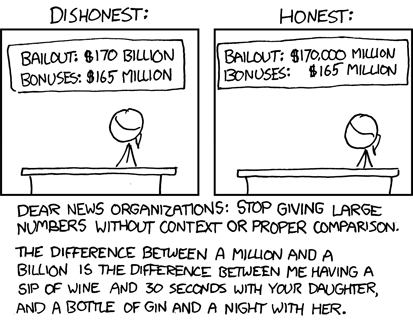
Dear News Organizations: Stop giving large numbers without context or proper comparison.
The difference between a million and a billion is the difference between me having a sip of wine and 30 seconds with your daughter, and a bottle of gin and a night with her.
- Word Workshop: Writing for Government and Business: Critical Thinking and Writing , January 28, 2010
- Update on The 111th Congress, 2010, January 29, 2010
- Congress in a Nutshell: Understanding Congress, February 10, 2010
- Congressional Dynamics and the Legislative Process, February 11, 2010
- Strategies for Working with Congress: Effective Communication and Advocacy on Capitol Hill, February 18, 2010
- The President's Budget, February 23, 2010
- The Defense Budget, February 26, 2010
- Capitol Hill Workshop, March 3-5, 2010
- Do We Need Government Intervention to Reduce the Number of Lawyers? - "[Mark] Greenbaum contends that the ABA has a “conflict of interest” that leads it to accredit too many law schools. The truth is the exact opposite. The ABA is an interest group representing lawyers. Like members of other professions, lawyers have an incentive to limit entry into their field in order restrict competition and increase their own pay. To say that the ABA has an interest in increasing the number of lawyers is much like saying that UAW workers at GM and Ford have an interest in increasing the number of imported Japanese cars. And indeed, the ABA imposes dubious accreditation requirements that make it very hard to start new law schools. At the state level, bar associations restrict entry into the profession by forcing would-be lawyers to pass bar exams that test enormous amounts of information that most lawyers don’t actually need to know to do their jobs.
. . .
Far from accrediting too many law schools, the ABA and state bar associations are running a cartel system that has the effect of driving up the cost of legal services. The poor especially often find it difficult to pay for basic legal services."- Nexus One Enterprise Version Could Have a Physical Keyboard, Bigger Battery - "On stage with Walt Mossberg, Google Engineering VP mentioned that an enterprise version of the Nexus One could have a physical keyboard and longer battery life--and there could be more Google devices, including a budget model."
- Who Burst Our Beautiful Bubble? - "Was it beauty killed the beast or was it readjustments? If you have not passed out during our review of the respective roles of adjustable rates and subprime lending in the housing debt bust, here's some detail from Edward Pinto.
Pinto, president of Smartlender, the Independent Community Bankers of America's settlement service provider, explains that default risk on an original loan increases geometrically the closer you get to no money down. A default propensity of 1 on a property bought with 80 percent financing increases to 2 at 90 percent financing, 4 at 95 percent, and 8 at 100 percent."- Twenty’s Plenty - "About now is where someone usually complains that putting up 20 mph signs is ineffective and won’t change driver behavior. But we’re not talking about mere signage here, we’re talking 'self-enforcing roads,' with a variety of engineering and design measures, and as the authors write, some evidence 'suggests that the self enforcing 20 mph zones are effective in reducing traffic speeds to an average of 17 mph, an average reduction of 9 mph.'"
- Rahm in the mayor's race would be quite a fish tale - "On my first day back at work after vacation, the political news from Washington hit me like a cold dead fish in the face:
Rahm Emanuel, mayor of Chicago?
That's enough to freeze the bowels of every voter in the land.
. . .
Naturally, the national media marveled that Obama selected a Clinton guy, Emanuel, to run things.
But Rahm is no Clinton guy. He's a Daley guy.
And if folks in Washington weren't so besotted with all that primo Hopium they've been smoking, they'd have understood this.
. . .
The Washington establishment also ignores how Rahm got elected to Congress in 2002 from Illinois' 5th District. The district's Democratic state central committeeman, DeLeo, had something to do with it. So did all those illegal City Hall patronage workers swarming the precincts, led by Donny Drama, currently in federal stir for the nasty habit of taking bribes."
YikeBike: The World’s First Super Light Electric Powered Folding Bike
- Judge Personally Ordered a Violation of the Fourth Amendment - "Here’s the Tennessee Court of the Judiciary’s public censure in the case (paragraph breaks added):"
- Undead Tech: The Modern Subway - "This installment will poke around in one colossally important everyday technology--one that buys us geographical freedom for the price of a hot dog. It's winter, in a crippling economic recession. Lets talk about the lowly subway train, which, like this beloved Internet of ours, is a series of tubes."
- Snow hampers Amtrak trains to and from Chicago - "Passengers on a Chicago-bound Amtrak train got extra time to get to know one another this week when their train came face-to-face with the first big snowstorm of 2010 to hit the upper Midwest.
The food from the dining car was long gone, and the conductor had gotten chips and snacks from the train's storage, one passenger told WGN AM-720 this morning. Many passengers hadn't expected to be on a train so long, and didn't have a change of clothes. And the hours, like the snow outside, seemed to refuse to melt away.
In the end, the No. 6 California Zephyr train arrived at Union Station 17 hours, 56 minutes late, according to an Amtrak spokesman."- Amtrak "Train From Hell" Delayed Almost 24 Hours - "It was 'the train from hell,' said one passenger.
Arriving almost 24 hours behind schedule, Amtrak's California Zephyr arrived in Chicago with a trainload of passengers who described themselves as 'tired, hungry and stinky.'
The train, which left Sacramento five days ago, was delayed by severe weather and numerous mishaps on route and pulled into Union Station more than 19 hours late."- Wheat Ridge High School Class of 1970 - "The reonion committee is working away planning the 40th reunion the weekend of August 13-15, 2010. Wheat Ridge, Colorado WRHS1970.com"
- On behalf of the two spaces between sentences I would like to say I think they are beautiful.And that it must be lonely to be one space.And I know this is wrong.
The Real World DC (Health Care Remix)
The true story... of 535 politicians...picked to live in two houses...work together and their lives taped...to find out what happens...when Congress stops being polite...and starts secret, detailed negotiations on a sweeping, transformative health care reform bill...
- Will Verizon’s LTE Pricing Look Like a Utility Bill - "Verizon’s pricing for its next-generation Long Term Evolution Network will likely involve a base subscriber fee plus usage charges for the bandwidth consumed on devices that need a cellular connection, Verizon CTO Dick Lynch told the Washington Post. So the question now is whether the pricing model will resemble that of cable services, with a high base rate and then smaller charges for premium channels, or that of a utility bill, which see users pay a tiny charge each month and then a set rate for each kilowatt consumed. Or will it be closer to that of existing cellular pricing plans, complete with high base rates and punitive overage fees?"
- Standing rib roast will have them shouting, 'Dhondra!' - "Do I look like Tiny Tim to you?
So if you're hosting a dinner for Christmas or New Year's or any other holiday -- and you want to offer your guests something that truly says "special occasion" -- I'll tell you what to cook.
It never had a beak. Never had feathers or ate seeds. But I guarantee it will knock the itchy woolen socks from Martha Stewart's feet."
January 11, 2010 08:37 AM Link Comments (0)
Assorted Links 1/9/10
Sylvia Browne: One Cool Cucumber
- Word Workshop: Writing for Government and Business: Critical Thinking and Writing , January 28, 2010
- Update on The 111th Congress, 2010, January 29, 2010
- Congress in a Nutshell: Understanding Congress, February 10, 2010
- Congressional Dynamics and the Legislative Process, February 11, 2010
- Strategies for Working with Congress: Effective Communication and Advocacy on Capitol Hill, February 18, 2010
- The President's Budget, February 23, 2010
- The Defense Budget, February 26, 2010
- Capitol Hill Workshop, March 3-5, 2010
- Obama as Greek Tragedy--Part One - "The blueprint of a Sophoclean or even Euripidean tragedy is pretty straightforward. A confident, cocky tragic hero for about the first 600 lines of the play exhibits unconstrained exuberance as he takes on the world.
. . .
The early Oedipus basks in his great wisdom and reason that had solved the riddle of the murderous Sphinx and saved the city. Creon in the Antigone assumes he is the personification of law, order, and stability, a savior regent after the prior mess.
Even in Euripides’ Bacchae, young King Pentheus boasts about his kingly powers and youthful determination to corral the Bacchants--as he sets himself up for a gruesome fall. Early Hippolytus is a sanctimonious puritan, a sort of insufferable prude (who of course will be falsely accused of fornication). Jason in the Medea prances around as if his dumped wife will agree that it was a wise idea for him to have married a younger, wealthier, and Greek princess. With all these personalities, the first person pronoun 'ego' is commonly employed. They know at first no self-doubt. They have no clue that what brought them to such heights are the same characteristics, at the right occasion, and with a tad more hubris, that will ensure their fall.
During these displays of hubris, the flawed characters are warned by various seers, by close associates, and by the sometimes fawning/sometimes anxious chorus that something is not quite right. They are supposed to check their excesses in time. They are advised to seek the golden mean, calm down, and avoid nemesis. But how can they really, when it is all such fun, this being full of oneself that heretofore has brought them so easily so far?"- Further Limitations on Civil Liberties… - "Many of us said during the days of the Bush administration that restrictions on civil liberties motivated by the conflict with Al Qaeda would be maintained during any subsequent administration, whether Democratic or Republican, as long as the terrorist threat remained. This prediction has been amply confirmed. The most recent example is the implementation of an explicit profiling program for airline passengers. The ACLU aside, there has not been much criticism of this initiative. (Maybe because some of the most prominent critics of the Bush administration’s counter terror policies are now members of the Obama administration.)"
- The Meaning of al Qaeda's Double Agent: The jihadists are showing impressive counterintelligence ability that the CIA seems to have underestimated. - "But the president is likely to compensate for systemic weakness in American intelligence in substantial, effective ways. Mr. Obama has been much more aggressive than President George W. Bush was in the use of drone attacks and risky paramilitary operations. One can easily envision him expanding such attacks in Pakistan, Yemen and elsewhere. Visa issuances, airport security, and perhaps even FBI surveillance of American Muslim militants are likely to become much tougher under Mr. Obama than under Mr. Bush. President Obama will, no doubt, continue to say empirically bizarre things about Guantanamo's imprisonment system creating jihadists, but his administration will now likely find another location to jail militants indefinitely. Too many of President Bush's released detainees have returned to terrorism."
- California’s Economic Decline - "This article, prompted by Northrop Grumman’s moving its headquarters out of California to the Washington, D.C. area, says that California is on its way toward becoming a third-world economy. Once the center of the aerospace industry, Southern California now has no major aerospace firms headquartered there. Once a financial center, California has also lost Bank of America, Security Pacific Bank, Countrywide, and First Interstate, and is now home to no major financial institutions. Once a major center of automobile manufacturing, California recently lost its last auto plant. Meanwhile, there is no inflow of economic activity to offset this exodus.
The corporate exodus brings with it shrinking tax bases, reductions in philanthropy, and of course fewer economic opportunities for Californians."- Child support, through age 23? - "A bill introduced into the Virginia legislature would put payers of child support on the hook for older kids and indeed young adults so long as they are attending college."
- Reis: U.S. Office Vacancy Rate Hits 15 Year High at 17 Percent - "The vacancy rate isn't a record, but there was a record decline in effective rents. Add that to the records announced earlier this week..."
- Faux Disclosure At The Times - "Jonathon Gruber, a prominent and well-respected health care economist, is so well respected that he was hired by Health and Human Services to crunch numbers for the same health plans he is routinely lauding in the press. Is that a conflict of interest? Well, let's think of it as a an overlap of interest - he was hired because he was already symparico to the Administration and has remained so throughout. The money may bot have changed his views or analysis bit it certainly ought to have been disclosed.
And now that this has become public we know the NY Times will leap to correct its own reporting! No peeking - do you think the Times will (a) stonewall this; (b) run a cryptic correction correcting nothing; (c) regale us with another Public Editor apologia; or (d) note the many times they have quoted Gruber and assure us that They Will Do Beter Next Time (if the Administration is Republican)."- 100 things we didn't know last year - "23. The average number of friends is 150.
. . .
41. Many mosques in Mecca point the wrong way for prayers.
. . .
84. Banana skins can take two years to biodegrade.
. . .
99. Travelling in a 'road train' can cut fuel consumption by 20%."
Obama Has Declared Open Season on Golden Geese. Good Idea or Not?
- Cell Phones Protect Against Alzheimer's Disease? - "After years of reports aimed at looking for a causal relationship between cell phone use and brain cancer a new report finds that in mice genetically engineered to get Alzheimer's exposure to electromagnetic waves is protective."
- Stupidity Bowl - "You could go pick some dude out of any LA barbershop or Pilates studio to coach Texas and they wouldn't send McCoy plunging into the line in a million years."
- Final edition - "Twilight of the American newspaper tells the story of San Francisco and its newspapers. And in that tale, a glimpse that we might be losing our sense of place along with the newspaper."
- Wheat Ridge High School Class of 1970 - "The reonion committee is working away planning the 40th reunion the weekend of August 13-15, 2010. Wheat Ridge, Colorado WRHS1970.com"
- Palm Pre Plus and Pixi Plus Exclusive to Verizon - "I attended the Palm press event at the CES today and as expected Palm is set to roll out the refreshed versions of the Pre and the Pixi. It wasn’t that much a surprise that Verizon will be getting the Palm phones, but Palm has granted Big Red the two new models under exclusive contract. I’ll bet the folks at Sprint aren’t too happy after this announcement.
. . .
The Pixi Plus remains largely the same, with the welcome addition of Wi-Fi bringing it more in line with the Pre Plus. Both new models will be available through Verizon on January 25th. Consumers who pick up one of the new Palm phones better pick up the monthly tethering option from Verizon, as Palm is including the new “Mobile Hotspot” feature on them. This option will let the phones tether to other devices to share the 3G connection, and like the MiFi with up to 5 devices at once."- Six bullet points on why people go to graduate school in the humanities - "These reasons are ugly, but a lot of it rings true. Note the behavioral economics implicit in the explanations:
. . .
With the prospect of an unappealing, entry-level job on the horizon, life in college becomes increasingly idealized. They think graduate school will continue that romantic experience and enable them to stay in college forever as teacher-scholars."- The costs and benefits of grad school - "I’m a great believer in the benefits of an undergraduate education when it’s done right (which is rarely). But grad school is a different matter entirely: the opportunity costs are much higher, the amount of debt involved rises substantially, and the range of jobs you can do at the end of it in many ways goes down rather than up.
Thomas Benton has a great column about grad school in the humanities: no one should do it, he says, unless they’re independently wealthy or otherwise being paid for somehow.
But what about more vocational graduate degrees, like law school? Anybody thinking about it should read not only Elie Mystal’s post at Above the Law but also the long comment stream attached, filled with people like Elie who graduated from law school with six-figure debts and found themselves either stuck in Biglaw jobs they hated, or else just simply overwhelmed by impossible finances."
What’s behind the Cafferty tirade on CNN?
- The $220,000 Nano - "The world’s supposedly cheapest car ($2,500 apiece) will cost $220,000 when Mumbai-based D.C. Design is through with it. They will keep the car’s snub-nosed shape, everything else has to go.
The standard two-cylinder 624cc, 33-horsepower engine will be replaced by a 1600cc engine. To make room for the motor, the back seats will be removed. The car will get new brakes, new suspension, and bigger 20-inch wheels to allow for the top speed of 200 kilometers per hour (124 mph)."- Nexus One vs iPhone 3GS vs Droid vs Pre: The Definitive Comparison - "If you're looking for the definitive comparison table between the Google Nexus One, Apple iPhone 3GS, Motorola Droid, and Palm Pre, here you have it. From storage capacity to price to plans. Guess who wins (you'll probably be wrong)." Read the comments
- And a Partridge in a Pear Tree - "As I've mentioned before, I have a bone to pick with the Wise Men. Let's visit them for a moment.
. . .
The Wise Men also have no names in the New Testament. Of course, they do now. I chalk this up to actors. I imagine that the three actors balked at being called 'Wise Man 1' and 'Wise Man 2', and that some smart director appeased them by giving them each a name. Then the actors took it from there. 'Hmmmm, if my name is Caspar, maybe I'm a black man from Egypt!' They probably fought over who got to bring the myrrh. It's so important and symbolic.
. . .
What we do know about them, however is very important. We know that they were wealthy, educated men who 'bowed down' to this child. That's the really important part, that the first people to worship were the lowliest of the low, but that the wealthy and educated were also on board to see the Light."- Digital Art Frame turns your photos into oil masterpieces - "Casio has launched a Digital Art Frame that transforms your super snaps into virtual oil paintings, pastels or water colours."
- A Few Thoughts on the Nexus One - "Gmail is so good on the phone that I can, for the first time, imagine being totally without my laptop."
January 9, 2010 02:47 PM Link Comments (0)
Assorted Links 1/4/10
Gene Kelly tap dancing on roller skates
- Word Workshop: Writing for Government and Business: Critical Thinking and Writing , January 28, 2010
- Update on The 111th Congress, 2010, January 29, 2010
- Congress in a Nutshell: Understanding Congress, February 10, 2010
- Congressional Dynamics and the Legislative Process, February 11, 2010
- Strategies for Working with Congress: Effective Communication and Advocacy on Capitol Hill, February 18, 2010
- The President's Budget, February 23, 2010
- The Defense Budget, February 26, 2010
- Capitol Hill Workshop, March 3-5, 2010
- Al Qaeda’s Yemen Connection, America and the Global Islamic Jihad - "The attack on the Amsterdam-Detroit flight also shows that al Qaeda remains obsessed with striking the American airline industry, a target it has gone after repeatedly since 1999. If AQAP has now been told by the al Qaeda core leadership to take on the job, we can probably assume that other al Qaeda franchises in North Africa, Iraq, Southeast Asia and elsewhere have also been pressed to attack."
- Me and the Christmas Underwear Bomber - "I've started to call the bizarre new TSA rules "magical thinking": if we somehow protect against the specific tactic of the previous terrorist, we make ourselves safe from the next terrorist."
- Mayo Clinic in Arizona to Stop Treating Some Medicare Patients - "The Mayo Clinic, praised by President Barack Obama as a national model for efficient health care, will stop accepting Medicare patients as of [January 1, 2010] at one of its primary-care clinics in Arizona, saying the U.S. government pays too little."
- Why the Health-Care Bills Are Unconstitutional - "President Obama's health-care bill is now moving toward final passage. The policy issues may be coming to an end, but the legal issues are certain to continue because key provisions of this dangerous legislation are unconstitutional. Legally speaking, this legislation creates a target-rich environment. We will focus on three of its more glaring constitutional defects.
. . .
America's founders intended the federal government to have limited powers and that the states have an independent sovereign place in our system of government. The Obama/Reid/Pelosi legislation to take control of the American health-care system is the most sweeping and intrusive federal program ever devised. If the federal government can do this, then it can do anything, and the limits on government power that our liberty requires will be more myth than reality."- Cisco Realizes It's A Waste Of Time To Focus On Patent Quantity - "johnjac points us to an article where folks at Cisco suggests that it might just be tech companies realizing that patenting everything is a waste of time and money. In fact, the story states that Cisco recently changed its patent strategy from trying to patent everything to trying to focus on things that it believes is really innovative, rather than everything it can possibly get a patent on."
- One Blogger Complies with TSA Agent, One Doesn't. Guess Who's Smarter. - "There's lots of web chatter about the two travel bloggers who got home visits from Transportation Security Administration agents. Following last week's attempted underwear bombing, the bloggers had posted a leaked TSA memo with instructions to airlines. The most familiar and ridiculed requirement blocks passengers' access to bathrooms, blankets, video entertainment, and carry-on bags during the last hour of flight.
So in an attempt to plug their own administrative leak, the new law enforcement agency did what law enforcement agencies do: they sent agents to investigate. While it's terrifying to imagine TSA agents harassing us at our homes beyond the confines of airport security, this should surprise no one."
Wafa Sultan Debating Islamic Cleric
- Techno-utopian fail - "If there were an award for the most embarrassing e-mail of the year, the June 15 missive to the executives of Twitter from Jared Cohen, the 28-year social-media guru at the US State Department, would surely trump any competition. What could be more emblematic of the wild techno-utopianism that has hijacked American foreign policy than this Washington insider pleading with Twitter -- once known as the best place to share what you had for breakfast -- to delay their planned maintenance downtime so that Iran’s Revolution could proceed undisturbed?
It seemed like a neoconservative dream come true: hordes of brave green-clad young Iranians breaking through the firewalls of the deranged ayatollahs, all with the help of an American start-up, run by thirtysomething Californians on generous handouts from venture capitalists. Who needs diplomacy when we’ve got Twitter? That it was mostly foreigners tweet-touting the revolution, that popular Iranian sites such as Balatarin played a much more important role locally, that the Iranian authorities were trolling Twitter to gather intelligence about the protesters -- all of that was lost on western commentators who took the events in Iran to be the ultimate proof that the digital revolution was upon us ('This is it. The big one,' the web guru Clay Shirky proclaimed in an interview with TED.com). It wasn’t long before Gordon Brown suggested that 'another Rwanda' would be impossible in the age of Twitter." ht The Browser- Hammer Time: Cheap, Cheap and Cheap - "In fact, for many years I’ve been sampling three types of ‘cheap cars’ that pay off surprisingly well. They are…
1) The very high mileage, late model vehicle.
2) The very low mileage, older vehicle.
3) The unknown mileage (True Miles Unknown) / or ‘Branded Title’ vehicle."- 25kg of cocaine hits Spanish supermarket shelves - "Drug smugglers in Spain are at least 25 kilos of cocaine short after boxes of bananas in which they'd hidden the Bolivian marching powder ended up on supermarket shelves.
The alarm was raised on Saturday morning when several one kilo packets were found in a box of 'enormous green tropical bananas' in a Madrid branch of supermarket chain Lidl."- Wheat Ridge High School Class of 1970 - "The reonion committee is working away planning the 40th reunion the weekend of August 13-15, 2010. Wheat Ridge, Colorado WRHS1970.com"
- NSFW: Hey! Look behind you! It’s the tablet of the future! - "The job of a futurologist is not to predict the future based on practicalities, but rather to write fantasy fiction about what they hope the future will hold. A futurologist would never advise Steve Jobs to temper his vision, or to fret about what moms will carry with them in their bags. A futurologist would simply assume that Apple will be able to invent with some kind of magical screen capable of displaying high definition movies one minute and print-sharp ebooks the next. Or perhaps a new type of device that makes the very idea of books redundant.
As a cynical non-futurologist -- a pessimologist if you like -- I sit somewhere between MG and Joe Wilcox. I passionately hope that the Apple Tablet will become the only portable media device I need to carry, but at the same time -- because of the Kindle -- I just can’t imagine a possible universe in which it will succeed."- The world doesn't need an Apple tablet, or any other - "That brings me back to my assertion that iPhone is functional enough, more portable and better connected than could be any 7-inch or 10-inch tablet. Would you buy an iPhone and iPod touch? I expect that for most people the answer will be 'No.' There is too much overlap in features and functionality and few additional benefits. If Apple's rumored tablet runs iPhone OS (or something close to it) and offers App Store applications, what will really distinguish it from iPhone -- other than better hardware, larger sizer and perhaps flashier UI? Are these features real benefits that would justify buying an iPhone (or other smartphone) and a tablet? You know my answer. Please offer yours in comments."
- iSlate? I spy more control from Cupertino - "The iSlate will take the iPhone concept into a decent-sized package, but more importantly for Apple it takes the security and control model into the realm of laptop computing. From there it's a small jump to the desktop and Cupertino control over everything you do on your computer.
Microsoft once suggested that Windows applications should be digitally signed, by Redmond, and that this would remove Trojans, viruses and all manner of nastiness, but the company was swiftly shouted down by customers who feared ceding control to the beast."- Apple Predictions for 2010: iPhone on Multiple Carriers, iSlate, Beatles - "Apple experienced a strong 2009 despite the recession but may make substantial changes to its product lines and strategy in 2010 in order to counter direct competition from Google, Microsoft and other players. Those strategies could include opening the iPhone to multiple carriers, introducing an iPod Touch with a camera, expanding its retail footprint, releasing the long-rumored tablet PC, imposing increased regulation on the App Store, and even introducing the Beatles catalog to iTunes."
- Ziotek Battery Checker - "the Ziotek ZT1153195 Digital Battery Checker looks like a handy device. It’s a single-AAA powered tester that can check a variety of 1.5V batteries: D, C, AA, AAA, N, and button cells."
January 4, 2010 10:27 AM Link Comments (0)
Assorted Links 1/1/10
Some Holiday Music
- Word Workshop: Writing for Government and Business: Critical Thinking and Writing , January 28, 2010
- Update on The 111th Congress, 2010, January 29, 2010
- Congress in a Nutshell: Understanding Congress, February 10, 2010
- Congressional Dynamics and the Legislative Process, February 11, 2010
- Strategies for Working with Congress: Effective Communication and Advocacy on Capitol Hill, February 18, 2010
- The President's Budget, February 23, 2010
- The Defense Budget, February 26, 2010
- Capitol Hill Workshop, March 3-5, 2010
- NY Times: Recession Cases Flooding Courts - "And this is apparently happening all across the country."
- Top Ten Pro-Liberty Books of the Decade - "As 2009 draws to a close we (gladly) wave goodbye to a decade of government decadence where respect for the principles of liberty, free exchange, and limited government was scarce. For those who hold Adam Smith’s maxim of “peace, easy taxes, and a tolerable administration of justice” dear to their hearts, the 2000s could not have ended soon enough.
To the chagrin of the statists, their crafty work in the Aughts gave writers more than enough material to produce fresh intellectual firepower that will help promote the free society for decades to come. Diogo Costa, editor of Ordem Livre (Atlas’s Portuguese platform) asked 22 classical liberal thinkers which were the most important books published this past decade that advance the cause of liberty. Each participant ranked their top 5 and the results are in.
#10 The Elusive Quest for Growth: Economists’ Adventures and Misadventures in the Tropics (2001) by William Easterly
#7 From Mutual Aid to the Welfare State (2000) by David T. Beito
#6 In Defense of Global Capitalism (2003) by Johan Norberg
#3 The Myth of the Rational Voter: Why Democracies Choose Bad Policies (2008) by Bryan Caplan
#2 Radicals for Capitalism: A Freewheeling History of the Modern American Libertarian Movement by (2008) by Brian Doherty
#1 Mystery of Capital: Why Capitalism Triumphs in the West and Fails Everywhere Else (2001) by Hernando de Soto"
- The Filibuster, Now More Than Ever? - "I’m of several minds on this issue. On the one hand, Cost is right that the major consequence of increased filibustering to date has been legislation tailored to the concerns of centrist Senators, rather than no legislation at all. The Bush tax cuts, No Child Left Behind, and Medicare Part D all passed with Senate supermajorities, and the Bush-era legislative pushes that failed -- Social Security reform and immigration reform chief among them -- did so because lots of Senators decided they weren’t interested in voting for them, not because the bills got 58 votes but couldn’t get 60. In the Obama era, meanwhile, the Senate has already voted to pass the most expensive stimulus package in history, a sweeping reorganization of the American health care system, and a host of more modest legislative initiatives. In this environment, there’s something a little strange about the stridency of liberal complaints about the filibuster, given what they’ve accomplished -- and are on the cusp of accomplishing -- even with it as an impediment."
- H1B spat unites activists, xenophobes against common enemy - "To venture into the world of online anti-H1B activism is to enter a world of legitimate grievance mixed with outright xenophobia and racism. On the one hand, these sites do great work in bringing to light the ongoing abuses of the H1B program by American tech companies, but on the other hand, it takes a pretty twisted individual to openly gloat that the mass-fatality-causing collapse of an New Delhi bridge is evidence that Indian engineers are inferior to American engineers. Nonetheless, in the midst of all the rancor--rancor that's made worse by high unemployment--south Asian IT contractors and their American opponents have joined forces against an alleged IT sweatshop's attempt to silence its anonymous online critics. The unlikely allies are also united in opposing a New Jersey court's ruling that the critics' sites be taken offline and their identities disclosed."
- Is the Financial Crisis Really a Crisis of Capitalism? - "
And, as Sorkin relates, it is hard to escape the conclusion that the rhetoric regarding our supposedly free markets without government intervention just masks the reality -- that there is a revolving door between Wall Street and Washington, and powerful people bend the rules to help each other out. In an illustration of Wall Street clubbiness, Sorkin documents a meeting in Moscow between Hank Paulson, secretary of the treasury (and former head of Goldman Sachs), and the board of Goldman Sachs. As the storm clouds gathered at the end of June 2008, Paulson spent an evening talking substance with the board -- while agreeing not to record this "social" meeting in his official calendar. We do not know the content of the conversation, but the appearance of this kind of exclusive interaction shows how little our top officials care about public perceptions of favoritism. In saner times, this would constitute a major scandal.
Johnson has historically offered more government regulation as a solution to this problem, mostly in the form of breaking up banks. Allowing banks to fail and permitting markets to self-regulate is to me a better solution. But given the explicit relationships discussed in all three of these books, of which Sorkin's is the only one I've read, I wouldn't count on much changing either way to fix the problems. Unfortunately, and contrary to the work of the founders of this country, we've moved much too far in the direction of a centralized and powerful federal government for it to serve general interests rather than special interests."
- Terrorism and Security Systems - "underwear bomber" - "Terrorists are weak actors, unable to muster conventional forces that threaten a state directly. So they try to use the power of the states they attack to achieve their aims. Provocation is an example--getting a state to overreact and undercut its own legitimacy. Polarization is another: Most often in domestic contexts, terror attacks can drive wedges among different ethnic, religious, or cultural groups, destabilizing the state and society.
Mobilization is the strategy of leverage most likely at play here--seeking to recruit and rally the masses to a cause. There’s no argument that this alienated loner is an articulate strategist, of course, but his attack could signal the importance of terrorism to a worldwide audience, making terrorism more attractive to opponents of U.S. power.
. . .
Next, I hope to see communications that subtly and appropriately portray the underwear bomb plotter as the loser that he is. I have declined to use his name, because this wretch should go namelessly to oblivion. And I am pleased to see that U.S. authorities have released an image of his underwear, half-suspecting that this was done to help make his legacy the indignity of being beaten by Americans and having his underwear displayed to the world."
- Paterson vows to fight school-aid suit - "Declaring 'you can't spend money that don't have,' Gov. Paterson this morning announced plans to fight a lawsuit seeking to restore nearly $600 million in education aid he withheld earlier this month.
'We're operating really under a fundamental precept that's really beyond the law,' Paterson said in a Manhattan news conference. 'You can't spend money that you don't have. So, I look forward to our day in court.'
Attorney General Andrew Cuomo, who serves as the governor's lawyer in such cases, will file court papers this afternoon in Albany to answer claims by a coalition of education groups that the aid freeze was illegal and unconstitutional."
- Tu Quoque - "The times have changed as much as the men that seek to change them. The toxic combination of 'it’s Bush’s fault' and 'I’m just doing what Bush did' may not last President Obama much longer."
- California Pushes for Federal Help - "Facing a $21 billion shortfall through June 2011, California leaders want billions of dollars in budget relief from Washington that could head off deep cuts expected to state programs.
Gov. Arnold Schwarzenegger will ask the White House to waive rules that require the state to spend its own money on certain programs to receive federal funds, according to California officials briefed on the Republican's coming budget proposal."
- A Rodney Dangerfield America? - "Pew's numbers touched the heart of the past decade's sense of sadness. Asked to identify the decade's singular event, 53% said the attacks of September 11, 2001. Nothing else was close.
It is debated often whether 9/11's sense of urgency about the threat of Islamic terror has faded. Apparently not for the American people. We'll catch a break if the past week wakes up Washington.
If at its end the decade was looking for a silver lining, this one got the shaft--another gray September. In September 2008, the U.S. financial system for all intents and purposes blew up. Years of imprudently low interest rates and Congress's political protection of bargain-basement mortgages decked the world in moral hazard. Cheap money was (is) crack for bankers. When the subprime mortgage mania blew, it took down much of Wall Street and a decade's worth of 401(k) gains.
Let's toss in the decade's last straw just for the fun of it: The politicians running California, New York, New Jersey and arguably Congress were shown to be fiscally deranged. If America is in decline, its political class is leading it over the cliff.
. . .
America isn't dead. It's just dead in the water.
. . .
We are in the anti-1980s. But I don't care how flat the earth is; with competitors like China, India and the others, the belief that our big fat national government can somehow subsidize, much less identify, the U.S.'s next creative edge is straight from the dusty book of the original flat-earth society."
- New York State Has First Deficit in General Fund - "The deficit, analysts said, was a barometer not only of the New York’s fiscal peril, but of the political stalemate in Albany that has left the state spending more money than it can afford for months."
Squat
- The economics of dog food - "How does the environmental impact of a dog compare to that of an SUV? Via Robert Nagle in the MR comments section, here is one article defending the dog. It makes many good points but right now I am especially interested in this passage:"
- How to Start Freelancing (Without Quitting Your Job) - "A common misconception about successful independent workers is that one day, in dramatic fashion, they quit their dayjob, hung a shingle, and lived happily ever after. The truth is, most freelancers start off moonlighting, volunteering, interning, and doing client work at night and on weekends in addition to a nine-to-five gig. If you fantasize about living the freelancer life, you can do the same--even in a recession, starting now. Let's turn some of your free time into a new career without giving up the steady paycheck."
- Las Vegas High-Rising - "One feature of CityCenter is that a group of starchitects was hired to do design duties, presumably in the high hope that the result would be a triumphal jewel in the crown of American artistic civilization. Unfortunately, I found CenterCity (or what I could see of it from outside construction barriers) to be a resounding modernist/postmodern banality, hardly in keeping with the wild, showy Las Vegas spirit."
- Wheat Ridge High School Class of 1970 - "The reonion committee is working away planning the 40th reunion the weekend of August 13-15, 2010. Wheat Ridge, Colorado WRHS1970.com"
- Movie Studios Pissed Off At Netflix, Don't Want To Allow More Streaming Movies - "We already knew that the big movie studios were annoyed with Netflix and trying to get Netflix to delay movie rentals until at least a month after the DVD comes out. Now we have an explanation why. As JJ was the first (of a few) to send in, the studios apparently are quite annoyed that, in order to jumpstart its movie streaming offering, Netflix routed around the movie studios, and signed a deal with Starz that allowed it to stream the same movies without a direct deal with the studios."
- Google: Never Mind the Nexus One, How About a Cheaper Cell Plan? - "The Nexus One is business as usual, if the reports are true. Where's Google the Disruptive Force we've come to expect? The Nexus One comes across as a fairly conventional consumer product--not unlike the Apple iPhone, Motorola Droid, and other high-end handsets. It's a me-too smart phone, not one that's going to turn the cell industry on its ear.
. . .
Now, I'm not expecting an earth-shaking announcement of, say, free cell service when Google launches the Nexus One. But an innovation that brings together Google's growing stable of telephony components would be welcome."
White House Reveals Obama Is Bipolar, Has Entered Depressive Phase
- The unlikely origin of fish and chips - "Like Morecambe and Wise or Wallace and Gromit, fish and chips are a classic double act - and yet they started life as solo performers. And their roots are not as British as you might think.
The story of the humble chip goes back to the 17th Century to either Belgium or France, depending who you believe.
Oddly enough, the chip may have been invented as a substitute for fish, rather than an accompaniment. When the rivers froze over and nothing could be caught, resourceful housewives began cutting potatoes into fishy shapes and frying them as an alternative.
Around the same time, fried fish was introduced into Britain by Jewish refugees from Portugal and Spain."- Small Cars Are King at the New Delhi Auto Show - "Small car competition is heating up at the tenth annual Delhi Auto Expo, as three major automakers are premiering new subcompacts.
Toyota and Honda are both planning to debut new small cars specifically for India and other emerging automotive markets, while Maruti Suzuki is going to unveil a homegrown sub-$8500 minivan. Called the Eeco, it comes with a 1.2L engine and seating for seven -- and is proof of automakers’ hopes for the Indian market."- New Year's Resolutions for Washington - "As for me, I resolve to speak well of Mr. Obama more frequently, curry favor with liberals by being more critical of my fellow conservatives, and be guided by the words of Mark Twain, who said that the start of a New Year 'is the accepted time to make your regular annual good resolutions. Next week you can begin paving hell with them as usual.'"
January 1, 2010 11:57 AM Link Comments (0)
Assorted Links 12/27/09
Silent Monks Singing Halleluia
- Word Workshop: Writing for Government and Business: Critical Thinking and Writing , January 28, 2010
- Update on The 111th Congress, 2010, January 29, 2010
- Congress in a Nutshell: Understanding Congress, February 10, 2010
- Congressional Dynamics and the Legislative Process, February 11, 2010
- Strategies for Working with Congress: Effective Communication and Advocacy on Capitol Hill, February 18, 2010
- The President's Budget, February 23, 2010
- The Defense Budget, February 26, 2010
- Capitol Hill Workshop, March 3-5, 2010
- Snowstorm Makes Flying A White Hell - "Airlines canceled more than 3,000 flights over the weekend, and Amtrak and commuter trains gave up all hope of running on anything resembling a schedule. Some airports saw their traffic cut by as much as two-thirds, leaving tens of thousands of people stranded. Travel had resumed this morning and the FAA said there were no major delays, but it will be awhile before things are back to normal.
'Full recovery may take well into Tuesday,' Air Transport Association spokesman David Castelveter told USA Today. 'We haven’t seen anything like this since 1996. The sad news here is that’s happening on the weekend before Christmas, when so many people are traveling.'"- Lest We Forget: Moral Hazard and the Subprime Crisis - "There are two preliminary moral hazard problems. First, obviously the sales force does not have the incentive to screen out 'bad loans' given the incentive contract offered. Second, as mortgages can be bundled and traded, the managers do not have the incentive to give the sales force the incentive to screen our bad loans. They want to maximize raw volume rather than quality-adjusted sales.
This leaves 'the market' as the potential monitor. A large group of owners of securities faces a free-rider problem in monitoring so no-one monitors. The price of the bundled security reflects the mix of good and bad loans in the market. An individual issuer of mortgages has the incentive to screen out bad loans if this is reflected in the price of the security they sell. But if no-one is monitoring, no-one will notice the extra benefits from screening, the price will not improve and there is no incentive to invest in making just good loans.
Finally when everything does tank, if banks sell mortgages and the banks are too big to fail, they get bailed out by taxpayers. One final bit of moral hazard to make sure there is no incentive to monitor the monitor to monitor the mortgage sale."- Boom Time on K Street - "Lay out a picnic, you get ants. Hand out more wealth through government, you get lobbyists. As Craig Holman of the Ralph Nader-founded Public Citizen says: 'the amount spent on lobbying . . . is related entirely to how much the federal government intervenes in the private economy.'
More on the lobbying bonanza in President Obama’s Washington here. Back in 2001 David Laband and George McClintock tried to estimate the total costs to society of efforts to effect forced transfers of wealth in their book The Transfer Society."- Bah Humbug - "Hopefully 2010 will be the end of the road for the crooks and deadbeats!"
- BAIC Got Saab Technology On The Cheap - "GM netted a paltry $200m for the Saab technology it sold to China’s BAIC. So said BAIC to Reuters today, while desperately trying to keep a straight face. The money bought BAIC the rights to three vehicle platforms, two engine technologies and two transmission systems. A pittance, given the fact that developing a new car typically costs from $1b on upwards these days.
Granted, the IP for the 9-5 and 9-3, and the tooling to make them are not the newest, but you can trust BAIC to make the most of it. Interestingly, BAIC got what they desperately needed"- A Small but Telling Example of Government Waste - "Some commenters claim that auctioning off the gifts would offend foreign governments by making it seem that their gifts weren’t valued. Of course, storing them in some warehouse never to be seen again doesn’t exactly indicate that the US government places any real value on the gifts either. Still, it’s possible that the gifts should only be auctioned off some years after they are given, by which time foreign officials are less likely to keep track of them. Alternatively, the gifts can be donated to charities that can then use the proceeds to help the poor; it would be difficult for foreign opinion to take offense at that."
- Christmas Bonuses for Fannie and Freddie - "The Obama administration tried to sneak this one under the radar by making it official on Christmas Eve. The Washington Post did a good job catching the story:"
- Explain the Difference - "Is there any difference between Hugo Chavez and Barack Obama in terms of how they approach the auto industry? 'Make the kind of cars I thing you should, or the government will take you over.'"
- Blank-Check Bailout for Fannie and Freddie Means Taxpayers Get a Lump of Coal from Obama - "Even though politicians already have flushed $400 billion down the rathole, the Obama Administration has announced that it will now give unlimited amounts of our money to prop up Fannie Mae and Freddie Mac, the two government-created mortgage companies. While President Obama should be castigated for this decision, let’s not forget that this latest boondoggle is only possible because President Bush did not do the right thing and liquidate Fannie and Freddie when they collapsed last year. And, to add insult to injury, Obama’s pay czar played Santa Claus and announced that that a dozen top 'executives' could divvy up $42 million of bonuses financed by you and me. Not a bad deal for a group of people that more properly should be classified as government bureaucrats."
- Does New Jersey like being ranked last? - "Each measure accomplishes the exact reverse of stimulating jobs, economic recovery, or fiscal solvency. With measures like these one wonders if legislators think being ranked the worst place to do business in the country is a good thing."
- How to Ensure Your LinkedIn Profile Is Effective - "Is your LinkedIn profile as effective as it could be? While you can see your “profile completeness” score on your profile page, it doesn’t measure profile effectiveness -- how good your profile is at attracting contacts, generating leads and showing off your skills. Use this checklist to ensure your profile is thorough, effective and updated."
- Al Qaeda Failed. What About Us? Ten Questions. - "Early reports about the failed Christmas bombing of NW 253 raise questions that need answers. Because, frankly, if the reports are true, al Qaeda never should have gotten this close to a successful attack."
- Beating The Low Signature Enemy - "When the Israeli Defense Forces (IDF) battled Hezbollah to basically a draw in southern Lebanon in summer 2006, one thing that really stymied the IDF was what Israeli Brig. Gen. Itai Brun called Hezbollah’s 'strategy of disappearance': Hezbollah fighters set up command posts and arms stores in civilian buildings; launched rockets from near mosques and schools; used 'low signature' weapons, such as mortars, anti-tank missiles and shoulder launched surface-to-air missiles; and spent years building extensive below ground fortifications including a maze of tunnels and bunkers.
The IDF, which had prepped for high-intensity battle against Syrian tank armies, was unprepared for an asymmetric, low-signature enemy that refused to stand in the open and smile for the electronic eyes on overhead drones and aircraft and thermal sights on Merkava main battle tanks. The IDF took fairly heavy casualties trying to root out dug-in Hezbollah combat cells and never did stop the rain of rockets fired from southern Lebanon into Israeli towns.
The challenge is how to compel the low-signature enemy to emit a detectable signal, to raise his signature level. According to a draft paper passed along to DOD Buzz, the Israelis, and certain parts of the U.S. military, are exploring a concept called “distributed maneuver,” a potentially promising approach that could force the “hybrid” enemy to breach the detection threshold so that he can be targeted and dispatched. The paper, a joint Israeli-U.S. effort, was authored by strategist Frank Hoffman, who now works in the Office of the Naval Secretary."- What Would Always-On-The-Record Government Look Like? - "Recently, I wrote a post about Government 2.0 predictions for 2010-12, and one of them was that government would 'always be on-the-record.'
By that I meant that the combination of (1) the proliferation of tech-savvy citizens with mobile camera/video devices, (2) the prevalence of wi-fi or other Web connections, (3) the massive number of people using social networks like MySpace, Facebook, and Twitter, and (4) the great interest that people have right now in a number of controversial issues like our current wars, health care, and climate change that people could and probably would start documenting everything that government officials do and say, where they go, who they meet with, for how long, what their staffers eat for lunch and with whom, and so on."- More Engineers in Jihad - "Gambetta and Hertog find that 'the share of radical Islamic engineers is no less than nine times greater than the share we could expect if the proneness of engineers to radicalize was the same as that of the male adult population.'"
- Doubling Your Money while Earning 0.01 Percent - "'What the average citizen doesn’t explicitly understand is that a significant part of the government’s plan to repair the financial system and the economy is to pay savers nothing and allow damaged financial institutions to earn a nice, guaranteed spread,' said [Bill Gross of PIMCO]"
- Beginners' Guide to Liberty - "Adam Smith Institute publishes a very nice edited "volume" on the we"
- Security Theater: A New Show Opens In Detroit - "what sort of magical thinking is behind the rumored TSA rule about keeping passengers seated during the last hour of flight? Do we really think the terrorist won't think of blowing up their improvised explosive devices during the first hour of flight?"
- Open Thread: TSA To Keep Us Safe From Nigerian Terrorists, Bankers' Sons, 419 Scammers - "Is there an inverse relationship between the retardation of the terrorist and the federal overreaction? The 9/11 attackers (who whatever you want to say about them were clearly competent and effective) inspired many new restrictions, but it took the stupid nincompoop Richard Reid to make us lose our shoes. What will we be required to doff thanks to the apparently dirt-dumb Umar Farouk Abdulmutallab?"
- The Unorganized Militia Once Again is Needed - "According to press reports, a passenger helped subdue the terrorist who was attempting to bring down Northwest #253. This again highlights the importance of the unorganized militia in asymetric warfare."
The Healthcare Jokers: Holiday Celebration
- Which are the "safest" cuisines? - "The most dangerous cuisine to try, in the United States at least, is Chinese. Your best working assumption is that the restaurant simply isn't any good. Even in a Chinatown, such as in New York or DC, most of the restaurants aren't very good. Inverting the two principles mentioned above puts you on a path toward figuring out why. Still, even in Paris or most of Europe for that matter, most of the Chinese restaurants aren't very good.
I find also that (in the U.S.) Mexican restaurants are risky, Vietnamese establishments are relatively safe, and Thai places were traditionally safe but they are becoming riskier. I've never been to a bad Nepalese restaurant."- 4-year-old survives being hit by train - "Perhaps the most urgent question raised by this Atlanta Journal-Constitution story is not: how did Elijah Anderson manage to emerge from such a collision sufficiently unscathed to resume life as a normal kid, aside from a scar? Nor is it: why is his mother, represented by attorney Fred Lerner, planning to sue railroad CSX despite an investigative report exonerating the railroad and the general principle that right of ways are not for trespassing? No, the real question is: whose idea was it to take that camera shot of him on the tracks?"
- What Is Seen, What Is Unseen. - "Emory's Mark Bauerlein contemplates higher education's supposed boy problem. ... Suppose beer 'n circus isn't an aberration, it's the mission?"
- Wheat Ridge High School Class of 1970 - "The reonion committee is working away planning the 40th reunion the weekend of August 13-15, 2010. Wheat Ridge, Colorado WRHS1970.com"
- The Book of Genesis Illustrated - "As literature, the biblical book of Genesis has it all: sex, violence, angels, war, murder, heroes, incest, world-wide disasters, spooky mystery, and a timeless story. All it needed was illustrations by the comic genius R. Crumb and you'd have a underground manga hit. And that's what this book is."
- WePay’s Group Payments Get Some Big-Name Backers, Including Max Levchin - "WePay is a startup that looks to streamline group payments.
So what exactly does WePay do that PayPal can’t? The difference stems from the way payment accounts are set up. With PayPal, your account is tied to your name, without any way to separate the payments associated with your soccer team from those of your fraternity or your own personal transactions. On WePay, you can create a unique, FDIC insured account for each of these. The account is still associated with your name, but you can keep each group account totally separate."- Your Comments on the Quadruplets Admitted to Yale - "trying to out-think the admissions office of a highly selective college is a fool’s errand. There is no set formula for admission. And, I would argue, there is no fair (or fairer) way to assemble a freshman class. There are simply too many obviously qualified applicants, and too many metrics for what constitutes merit."
- Last-Minute Bargain! - "I purchased one of those new Magellen GPS’s with Scottish turn by turn from Ampersand. 'Ye think ye can drive? Great turn, Columbus, but it was wrong!! Why not pull off now for a wee dram?'. Best electronic device I’ve ever bought. 'Ach, ya great bollocks….WRONG turn AGAIN!!!'"
- NSFW: The Physical Impossibility of The Future in the Mind of Someone Trapped In Chicago - "Chicago is, after all, the only place in the world capable of making Washington DC look like a step up."
- 24 Days Of Local Sunlight -- Day 23 - "Today I want to give a shout out Bacon’s Rebellion.
The blog is dedicated to covering Virginia; especially infastructure, transportation and taxes. Bacon’s Rebellion has a few contributors but the person I have highlighted the most is James Bacon."- Yegor T. Gaidar: R.I.P. - "So many people on this blog are free market advocates. At times, they get into the nit-picky about what they sometimes see as a creeping turn to socialism and big government.
Think of Gaidar and see the approach turned on its head. Consider that you are a member of the Communist Party of what was then a super power. You even edit an academic tome titled 'Kommunist.' Yet during the excitement of Mikhail S. Gorbachev's 'perestroika,' you get free market religion and, in increments, you turn into a capitalist that Milton Friedman would envy.
At the same time, you are thrust into a decision making position of a country undergoing a huge, lightning-fast transition from police and military industrial state to what Russians call 'dicki capitalism,' or 'wild' capitalism. You have to keep things in check, fight off mossbacks in the government, avoid civil war (with nuclear weapons no less) and somehow build an enduring structure of a free market economy."
Boeing 787 Dreamliner makes first flight
- The Innovative 787 Carries Boeing, And Aviation, Ahead - "Boeing’s 787 Dreamliner looks like any other airliner, so it might be hard for anyone but an airplane geek to get so excited about its inaugural flight. But the energy-efficient airliner is a bold step forward for Boeing, and for aviation.
As much as the 787 Dreamliner looks like the jet that carried you on that cramped, uncomfortable flight last month, almost everything about it is new. From the extensive use of composite materials and advanced aerodynamics to its fuel-efficient Rolls Royce engines and all-electric systems, Boeing is betting the 787 will be the plane to usher in a cleaner, greener future for the airline business.
Boeing claims the 787 is 20 percent more fuel-efficient than comparably sized jets."- Animated Christmas Tree Cable Cars Are Yet Another Thing For Your Guests To Trip Over - "So while these animated cable cars are a clever twist on the traditional train under the tree decoration, I don’t think they’d survive for very long in a household with either kids, pets or festive revelers. $49 from Walmart, if they ever get it back in stock."
- 20 Powerful Beliefs That Will Push You Toward Success - "Success, first of all, is not a set of achievements or a combination of external factors; it is a mindset. Success is an attitude that comes from a framework of powerful beliefs and empowering thoughts. There have been many books written about this, probably some of which you have read. In the ones I have read, there always seemed to be a certain partiality-- an incomplete picture -- perhaps biased towards financial success or some other area but not another.
In the following list of beliefs and empowering thoughts, I would like to present a rounder view of success. One that I hope will give you a wider angle towards the meaning of success ranging from the material to the spiritual."- Verizon Wireless Denies It's Charging People Phantom $1.99 Fee, Despite Tons Of Complaints - "For a little while now, Broadband Reports has been doing a good job highlighting how Verizon Wireless has been charging a phantom $1.99 fee for "accessing the internet" even when users claim they did no such thing. Despite a growing amount of press coverage, Verizon Wireless had been silent on the issue. However, once David Pogue at the NY Times reported on it, finally the FCC got involved and asked Verizon Wireless to explain. The company apparently delayed for a while and then sent a reply (pdf). While much of the press coverage focused on a separate question (about why Verizon Wireless had doubled its early termination fees), what may be more interesting is the company's non-response to the phantom $1.99. It basically said it doesn't do what lots and lots of people are saying it does." Yes, Verizon does this, and it is a hassle to get the charge removed.
- Books of note - "4. Scott Berkun, Confessions of a Public Speaker. If you get only one good tip from this book, it's worth it."
- Sun and moon 'set off deep tremors on San Andreas fault' - "Scientists have discovered that the faint gravitational tug of the sun and moon can set off tremors deep underground in one of the world's most dangerous earthquake zones."
- A Letter to the Middle-Aged Guy in the BMW Z4 - "Now when I see that blue shape ahead, stopped at a traffic light or waiting to pull in front of me at the grocery store exit, I know I'm in for a long drive home. I'm stuck behind the one little blue pill that can't get it up. "
- Speed Dial Combination Lock - "Rather than spinning a dial with numbers, Master Lock’s Speed Dial combination lock uses up/down/left/right movements. In addition to the new code entry system they use an anti-shim technology and a hardened steel shackle to prevent circumventing the combination. The result is a lock that they claim is faster to open, easier to use, and more secure then a standard combination lock."
- Former Musician Now Lawyer Comes To Terms With What's Happening To His Music Online - "He begins to reason through the arguments, recognizing that he and his (one surviving) bandmate haven't actually put their own music online for sale, and they probably would have put some of it up for free anyway, so maybe having some free music out there isn't that bad. But more importantly, he realizes that this means there's actually both interest and demand in his old band (he even discovers that old copies of the band's single are selling for £35), and he might as well do something about it, rather than worry about what others are doing"
- 10 obsolete technologies to kill in 2010 - "2. ‘Cigar lighter receptacle’ plugs in cars.
The idea of building cigar/cigarette lighters into car dashboards originated in the 1920s. The technology was perfected in the 1950s. Decades later, the automobile industry is still building these weird sockets into cars, but now usually without the actual lighter.
As electrical outlets, dashboard lighter ports are dangerous, unreliable, underpowered, inconvenient, unsightly and expensive. They require that you purchase a special plug and/or adapters, which add clutter to your car.
All cars should have standard household electrical outlets, with the converter built in. Or USB ports that can charge gadgets. Or both."- Christmas Game Theory - "The lovely wife says the jewelry I bought her for Christmas has to be returned because 'it's just too expensive!'
Do not try this at home. Without extensive knowledge of game theory and your spouse this strategy can be very dangerous to your finances"- To track small LDL, track blood sugar - "To gain better control over small LDL, follow blood sugars (blood glucose).
When you think about it, all the foods that trigger increases in blood sugar also trigger small LDL. Carbohydrates, in general, are the most potent triggers of small LDL. The most offensive among the carbohydrates: foods made with wheat. After wheat, there's foods made with cornstarch, sucrose (table sugar), and the broad categories of "other" carbohydrates, such as oats, barley, quinoa, sorghum, bulghur, etc."
December 27, 2009 11:47 AM Link Comments (0)
Assorted Links 12/18/09
So Sweet I can't stand it....
Regulation Vacation Celebration - "I have cholera!"
- Word Workshop: Writing for Government and Business: Critical Thinking and Writing , January 28, 2010
- Update on The 111th Congress, 2010, January 29, 2010
- Congress in a Nutshell: Understanding Congress, February 10, 2010
- Congressional Dynamics and the Legislative Process, February 11, 2010
- Strategies for Working with Congress: Effective Communication and Advocacy on Capitol Hill, February 18, 2010
- The President's Budget, February 23, 2010
- The Defense Budget, February 26, 2010
- Capitol Hill Workshop, March 3-5, 2010
- The Minnesota Case---An Institutional Diagnosis - "Why, then, would a high-ranking administrator in a high-profile university reveal to the public such a transparent whitewash of the whole enterprise? More than that, why would a committee of professors at 'the premier public research institution in the state' (Quam's words) produce such a hot-headed, resentment-ridden, identity-politics report that would wither under the slightest public scrutiny?
I think it has to do with the institutional conditions in which this report was produced, conditions that are largely opaque to people who have never served on an academic committee or attended a close academic meeting.
The 'Race, Class, Culture, Gender' report is an in-your-face, up-front determination about U.S. history and society. Beneath its relentless framework of 'privilege' and 'oppression' lies a firm adversarial posture. 'Lots of Americans out there don't recognize these things,' the authors declare, 'but here you will.'
But alongside the contentious, adversarial attitude is a remarkable circumstance: there are no adversaries and contenders in the room. Nobody on this committee stood up and said, 'I don't think we should emphasize racial identity so much in our review.' The committee didn't ask a believer in the old-fashioned American idea that you can become anything in the United States if you work hard and live wisely to come into the room and state the case. Everybody agreed on the priority of cultural, racial, sexual, and gender variables to all others (moral, psychological, etc.).
We don't know what went on behind closed doors, of course, but the report doesn't contain a whisper of skepticism or caution. It proceeds with all the confidence of collective wisdom. This is the fatal ingredient of all-too-many academic enterprises. They emerge out of a habitat of the like-minded, a gathering of 100% right-thinking personnel. That outsiders would recoil from their assertions probably didn't occur to the report's authors. Or rather, they expected conservatives, reactionaries, and various unenlightened ones to take umbrage, but they believed that the patent goodness of their motives and aims would prevail.
It can't happen, not in an open society. The fact that the dean of the program has to defend the initiative with thin mendacities signals the corruption at its heart. One hopes, as KC says, that the legislature in Minnesota will take heed of how state employees are meeting their duties."- I live in a van down by Duke University - "The idea of 'thrift,' once an American ideal, now seems almost quaint to many college students, particularly those at elite schools. The typical student today is not so frugal. Few know where the money they're spending is coming from and even fewer know how deep they're in debt. They're detached from the source of their money. That's because there is no source. They're getting paid by their future selves.
My 'radical living' experiment convinced me that the things plunging students further into debt -- the iPhones, designer clothes, and even 'needs' like heat and air conditioning, for instance -- were by no means 'necessary.' And I found it easier to 'do without' than I ever thought it would be. Easier by far than the jobs I'd been forced to take in order to pay off my loans.
Most undergrads imagine they'll effortlessly pay off their loans when they start getting paid the big bucks; they're living in a state of denial, disregarding the implications of a tough job market and how many extra years of work their spending sprees have sentenced them to. But 'facts do not cease to exist because they are ignored,' as Aldous Huxley famously said.
I have sympathy for my fellow students. I did many of the same things when I was an undergrad. Plus, escaping student debt -- no matter how frugal they try to be -- is nearly impossible. Even if they do resort to purchasing a large creepy van, most will still have to go tens of thousands of dollars into debt to pay for tuition.
While I found a way to afford graduate school, I by no means had the same financial responsibilities as the average student. I was so poor when I applied that my department took pity on me and significantly reduced the cost of my tuition. I even found a well-paying part-time job working for a government-sponsored program, tutoring inner-city kids."- A bad day to be in Copenhagen - "Consummate statesmen Robert Mugabe and Hugo Chavez addressed the climate change conference.
YIKES!!
. . .
Now that things have devolved to a circus, why not go all the way and have Ahmadinejad say a few words?
What's that? He's on the schedule for tomorrow?"- Time's Man of the Year: In Ben We Trust - "It was thoughtful of Time to give this award to Ben on the day before his confirmation hearings."
- New version of an old e-mail scam prompts Oklahoma Bar to schedule free webcast - "The latest version of the e-mail/forged bank check scam targeting lawyers involves scammers posing as potential clients seeking to collect back child support or alimony. Some of these say they have already worked out an agreement, but want the lawyer to process the check for a healthy share of the proceeds. Of course, any time someone wants to pay you five figures to serve as a check-cashing service, your internal "too good to be true" alarm should go off.
Many lawyers are not aware of how long it takes the banking system to recognize and notify depositors of the forged checks. The scammer just hopes they can convince the lawyer-victim to wire out the money before getting the news that the check is worthless (or maybe now much worst than worthless.)"
5 Fabulous New Features Google Unveiled Today
- Pirates Amok. Yo Ho Ho And A Sultanate Of Rum - "Of all the scourges of history we never thought we'd see again, who would've guessed pirates would be making a comeback? I'm not talking about the stereotyped, Disneyfied, Caribbean ones who get their swag from SAG -- nope, the Somali pirates are the real deal and business, as they say, is booming.
. . .
It also seems these so-called pirates really aren't that piratical at all... they sure don't conform to Stephen Colbert's description: eyepatch-wearing, rum-guzzling, shipmate-buggering peg-leggers with parrot poop layered thick on their shoulders. No plank-walking, no tying scurvy dogs to the yardarm... neither scurvy nor yardarms, if truth be told. No sinister yet romantic Black Pearl brigantines flying the Jolly Roger. Not even the occasional "ARRRR!" growled in anger. What gives? We were brought up to despise pirates and these dudes aren't following the script. No wonder the combined navies of a half-dozen nations have got their spinnakers in a collective knot over how to handle them... and they've been doing a splendid job so far, haven't they?
Methinks there be -- sorry, couldn't help it -- I think there may be an opportunity here to exploit the pirate mystique for mutual benefit. They've already got colorful characters: head of the Suleiman pirate clan Mohamed Abdi Hassan's nickname is "Big Mouth", for instance. Hey Hollywood, how about this: Pay one of the pirate gangs a few doubloons to embed a reporter and a cameraman as they go about their merry ship-seizing ways. It'll be the ultimate reality show! Call it Surviv-ARRR!, or Pirates of the Somali-ish Main, or even Biggest Loser Shipping Magnates."- Picks for the Best Gadgets of the Past Decade - "Here are my picks for the best gadgets of the last decade:"
- China fact of the day - "A Chinese policeman who died after drinking too much at a banquet he was made to attend has been deemed a martyr who died in the line of duty, in an apparent attempt to meet his family's demands for compensation, a state-run newspaper said."
- Wheat Ridge High School Class of 1970 - "The reonion committee is working away planning the 40th reunion the weekend of August 13-15, 2010. Wheat Ridge, Colorado WRHS1970.com"
- Vice President Biden wants you to know . . . - ". . . that he's really, really smart. A laugh-out-loud takedown of Mr. Biden's tacit claim. It should be noted, though, that his is a reasonably common condition. Many of our elected officials think they are really, really smart.
A big problem for our country is that they are often wrong."- The Answer Factory: Demand Media and the Fast, Disposable, and Profitable as Hell Media Model - "Online content is not worth very much. This may be a truism, but Rosenblatt has the hard, mathematical proof. It’s right there in black and white, in the Demand Media database -- the lifetime value of every story, algorithmically derived, and very, very small. Most media companies are trying hard to increase those numbers, to boost the value of their online content until it matches the amount of money it costs to produce. But Rosenblatt thinks they have it exactly backward. Instead of trying to raise the market value of online content to match the cost of producing it -- perhaps an impossible proposition -- the secret is to cut costs until they match the market value." ht Radar
Between the Folds
- Is Facebook a Brand that You Can Trust? - "Isn't it about time that we started holding our online brands to the same standards that we hold our offline ones?
Case in point, consider Facebook. In Facebook's relatively short life, there has been the Beacon Debacle (a 'social' advertising model that only Big Brother could love), the Scamville Furor (lead gen scams around social gaming) and now, the Privacy Putsch.
By Privacy Putsch, I am referring to Facebook's new 'Privacy' Settings, which unilaterally invoked upon all Facebook users a radically different set of privacy setting defaults than had been in place during the company's build-up to its current 350 million strong user base.
To put a bow around this one, the EFF (Electronic Frontier Foundation), not exactly a bastion of radicalism, concluded after comparing Facebook's new privacy settings with the privacy settings that they replaced:
"Our conclusion? These new 'privacy' changes are clearly intended to push Facebook users to publicly share even more information than before."
Ruminate on what that means for a moment. You are a parent, and you regularly upload photos of your kids to Facebook, blithely assuming that they are free from the roaming eyes of some sexual predator. While previously, these photos were only viewable to the Friends and Networks that you explicitly connected with, now, without consulting you, Facebook has made your son or daughter's pictures readily accessible to friend or felon."- Merge Duplicate Gmail Contacts With a Single Button Press - "One of the main reasons I’ve dealt with Gmail’s Contacts, even without it having advanced features is the cross-platform support. Since Gmail is a web service, I can access my contacts from any browser on any device. And because those contacts can be synchronized on nearly every major smartphone platform through Google Sync, those contacts never have to be manually entered on a handheld. Plus, any contact updates made on any of the devices are automatically sent back to the cloud and other devices. It’s simple, and it works."
December 18, 2009 09:07 AM Link Comments (0)
New Facebook Privacy Settings - How to Adjust (December 2009)
Facebook recently changed its default privacy settings, with little advance notice to the majority of its users.
Isn't it about time that we started holding our online brands to the same standards that we hold our offline ones?Case in point, consider Facebook. In Facebook's relatively short life, there has been the Beacon Debacle (a 'social' advertising model that only Big Brother could love), the Scamville Furor (lead gen scams around social gaming) and now, the Privacy Putsch.
By Privacy Putsch, I am referring to Facebook's new 'Privacy' Settings, which unilaterally invoked upon all Facebook users a radically different set of privacy setting defaults than had been in place during the company's build-up to its current 350 million strong user base.
To put a bow around this one, the EFF (Electronic Frontier Foundation), not exactly a bastion of radicalism, concluded after comparing Facebook's new privacy settings with the privacy settings that they replaced:
"Our conclusion? These new 'privacy' changes are clearly intended to push Facebook users to publicly share even more information than before. Even worse, the changes will actually reduce the amount of control that users have over some of their personal data."
"Is Facebook a Brand that You Can Trust?," by Mark Sigal, Radar, December 2009
Here are a few articles and videos that address how to adjust your Facebook privacy settings.
- 10 New Privacy Settings Every Facebook User Should Know
- How to fix Facebook's new privacy settings
- Fix Your Troubling (and Possibly Public) Facebook Privacy Settings
Facebook privacy settings: What you need to know
Clayton Morris walks you through Facebook's new privacy settings
How to : Facebook privacy settings explained step by step
December 16, 2009 08:37 AM Link Comments (0)
Assorted Links 12/15/09
WARNING - THIS IS A GRAPHIC VIDEO
VIDEO: Australian Transport Accident Commission celebrates 20 years of disturbing commercials
Slow down. Don't drink and drive. Stay at least 2 seconds behind the vehicle in front of you. Do not stop on the side of a busy road, get off before getting out of your car.
William Shatner and Sarah Palin
"Good to finally see those two together." Conan O'Brien
- Word Workshop: Writing for Government and Business: Critical Thinking and Writing , January 28, 2010
- Update on The 111th Congress, 2010, January 29, 2010
- Congress in a Nutshell: Understanding Congress, February 10, 2010
- Congressional Dynamics and the Legislative Process, February 11, 2010
- Strategies for Working with Congress: Effective Communication and Advocacy on Capitol Hill, February 18, 2010
- The President's Budget, February 23, 2010
- The Defense Budget, February 26, 2010
- Capitol Hill Workshop, March 3-5, 2010
- Government Losses from the Bailout - "And who didn't see this coming?"
- Study Sheds Light on Students Leaving College Early - "In the popular image of college, there’s dorm life, full-time classes, football games, parties, maybe a part-time job -- and then, four years later, a degree.
But for most students, it doesn’t work out that way. About 2.8 million students enroll in some form of higher education each year. But finishing what they start is a different matter: Only one in five of the students who enroll in two-year institutions graduate within three years. And even at four-year colleges, only two in five complete their degrees within six years. "- The New Bubble in the Barbarous Relic that Is Gold - "An analysis of the facts suggests that a good part of this rise in gold prices is driven by a bubble."
- The Enemy Within - "No, it’s not the latest crewe of knuckleheads crossing the seas to wage war on their countrymen. They are a blip lost in the noise band of extremism, and at least they were romantic and foolish enough to eschew domestic terror to fight in the field. If they hadn’t gotten swept up by the Pakistani authorities before they could wage jihad, they would very probably have been treated more or less respectfully by the graves registration detail before being shipped home in caskets."
- Are Democrats Sunk? - "I was talking to a libertarian friend yesterday who is a professor in the midwest, and we were marvelling at just how delusional many Obama voters seem to have been about what he was going to accomplish. Don't get me wrong--I certainly don't approve of everything Obama has done. But the guy got elected to be president of the United States, not Prime Minister of Sweden. Anyone who seriously entertained the notion that the procedural obstacles to enacting legislation in the United States would suddenly fall away--along with the essentially center-right politics of the American voter--is probably not mature enough to be driving."
- Bill 'Reforms' Constitution - "The Democrats' health-care overhaul asserts for Congress a power that the framers of the Constitution never envisioned: the power to force Americans to purchase unwanted goods or services.
With all the hype, one might think the "public option" is the linchpin of the Democratic health plan. Yet Congress has created entitlements in the past, and enrollment in a public option would not be mandatory (at least not initially).
The legislation's centerpiece is really the "individual mandate" - an unprecedented legal requirement that Americans purchase health insurance under penalty of law. The mandate is nearly universal, and without it, as President Obama admitted to a joint session of Congress, the legislation would fall apart.
. . .
The individual mandate would extend the dominion of the federal government to virtually all manner of human conduct - including the non-conduct of not buying health insurance - by establishing a federal police power that is authorized nowhere in the Constitution. Democrats will have legislated a new quasi-crime, and perhaps the sole offense in our history that can be committed only by people of a certain income, since those below the poverty line would be exempt from the mandate.
Congress' attempt to punish a non-act that harms no one is an intolerable affront to the Constitution, liberty, and personal autonomy. That shameful fact cannot be altered by calling it health-care reform"- Beyond Pleasantville - "Permissiveness is not the same thing as liberty. Permissiveness suggests a master loosening a leash, not an individual charting his own course."
- "Don't send a man to the grocery store!" - Jeanne Robertson
- Ask The Best And Brightest: Can Minivans Make A Comeback? - "And few automotive examples prove the inconstancy of market trends like the minivan. On paper they just plain make sense, creating a huge amount of flexible interior room out of high-volume sedan platforms, making them relatively cheap, capable and efficient. But if consumer decisions were made based on such rational considerations, turtlenecks would be long overdue for a huge comeback. In short, the 'image thing' killed minivans, with more than a little help from the marketing efforts of the very companies that profited off their (relatively) brief time in the sun. "
- Yes, Obama is Getting Serious About Banks. He is Now Calling Them Bad Names! - "Today, the Wall Street Journal is promoting the curious fiction that a few harsh words from Obama to the banksters has any significance aside from its hopeful PR value.
Recall that Timothy Geithner once ventured early on to actually use 'currency manipulator' and “China” in the same sentence. China threw its usual temper tantrum and the US backed down pronto. Here, Obama’s popularity ratings are falling, so the president has stepped up the rhetoric.
But who does he think he is fooling? The UK is imposing a 50% bonus supertax to encourage banks to retain earnings rather than pay them out. Financial services is a larger percentage of GDP in the UK than the US, so it is even more important for them not to mess up banking than it is for us, and they clearly believe that curbing banker pay is a positive and necessary move, and in lieu of having a worked out policy, a stopgap measure is a good place to start. Do we see anything approaching the same resolve here? Of course not, 'resolve' is an empty word as far as Obama is concerned."
Christmas Music: I Saw Three Ships, Sting
- Wireless Brain-to-Computer Connection Synthesizes Speech - "A system that turns brain waves into FM radio signals and decodes them as sound is the first totally wireless brain-computer interface.
For now, 26-year-old Erik Ramsey, left almost entirely paralyzed by a horrific car accident 10 years ago, can only express vowel sounds with the system. That’s less than can be accomplished with wired brain-computer interfaces. But it’s still a promising step.
. . .
In the last decade, brain-computer interfaces, or BCIs, have made the jump from speculation to preliminary medical reality. Since Wired reported on quadriplegic BCI pioneer Matthew Nagle four years ago ('He’s playing Pong with his thoughts alone'), the interfaces have been used to steer wheelchairs, send text messages and even to Tweet. They’re so advanced that some researchers now worry about BCI ethics -- what happens when healthy people get them? And they’re concerned about the threat posed by hackers." ht MedGadget- Top 10 Homemade Versions of Things We Love - "9. Pizza Ovens. There's an entire realm of new restaurants opening on the premise that pizza baked in wood-fired ovens tastes great, and is worth the extra time and money over your favorite napkin-soaking corner joint. We're of the mind that you shouldn't have to drop a C-note to feed a family with great pizza. We started our obsession with a temporary bricks-in-oven setup, then moved on to a small but efficient backyard model. We hit our apex with stomachs growling by glimpsing at a backyard, concrete-seated pompeii oven, and then brought it all back home with an oven you can build in one afternoon."
- Open source hardware 2009 - The definitive guide to open source hardware projects in 2009 - "Welcome to definitive guide to open source hardware projects in 2009. First up - What is open source hardware? These are projects in which the creators have decided to completely publish all the source, schematics, firmware, software, bill of materials, parts list, drawings and "board" files to recreate the hardware - they also allow any use, including commercial. Similar to open source software like Linux, but this hardware centric.
Each year we do a guide to all open source hardware and this year there are over 125 unique projects/kits in 19 categories, up from about 60 in 2008, more than doubling the projects out there! - it's incredible! Many are familiar with Arduino (shipping over 100,000 units, estimated) but there are many other projects just as exciting and filled with amazing communities - we think we've captured nearly all of them in this list. Some of these projects and kits are available from MAKE others from the makers themselves or other hardware manufacturers - but since it's open source hardware you can make any of these yourself, start a business, everything is available, that's the point."- Wheat Ridge High School Class of 1970 - "The reonion committee is working away planning the 40th reunion the weekend of August 13-15, 2010. Wheat Ridge, Colorado WRHS1970.com"
- Manolo the Columnist - "Dear Manolo,
My dear husband fancies himself an outdoorsman, and although he did plenty of hiking and hunting when he was younger, these days he mostly confines his outdoor activities to raking the leaves and long walks in the park. What can you recommend as a Christmas gift that will flatter his self-image without seeming ridiculously woodsy?
Claire"- Don’t Fence Me In - "Empires are normally associated with great cities, monumental buildings and vast tramping armies. Less well known, but perhaps as important is the phenomenon of the nomadic empire: the largest of all. By many measures the Mongol Empire utterly dwarfed Rome.
. . .
The fundamental requirement of nomadic governance was to manage problems asynchronously. To do that, the nomads created a kind of federal structure that every American would instantly recognize. Susan Alock, in her book Empires: perspectives from archaeology and history, argues that the need to manage tribal collisions, disputes over livestock and manage relationships with the settled empires, the nomads created a three tier system. At the top of the pyramid was an imperial leadership, which arbitrated tribal disputes and handled common strategy and foreign affairs; one level down were the governorships, which performed the same tribal management and strategic function at regional levels. Lastly, there were the tribes themselves: maintained with the traditional leadership and customs intact. Intuitively recognizing the principle of subsidiarity the nomads had assigned to central authority only those functions which could not be performed locally. In some ways the nomadic empires operated under the aegis of a “distributed program” in which autonomous nodes interact with each other to pursue a common goal."- Lucas wanted David Lynch to direct Return of the Jedi - "So, he took me upstairs and he showed me these things called Wookiees. And now this headache is getting stronger."
- Why Southern Universities Are Not World Class - "I like the South, and American universities in the south have improved relative to national norms a lot over the decades. So the heading on this blog is a bit unfair, a gross generalization. But it is true that the very best top flight institutions of higher learning are underrepresented in the South, although I think Virginia, along with California, has the best quality public universities in the United States.
. . .
Meanwhile, at my university, which had a reasonably decent football team (9 and 4), the grown ups (trustees, alums, etc.) are all excited that we made some third rate bowl in that garden spot of America, Detroit, playing the second best school in West Virginia. We will receive a few hundred thousand dollars in revenue, and spend far more than that in bribing students and others to attend the game so attendance is not embarrassingly low. We spend roughly $15 million a year subsidizing intercollegiate athletics, probably more than we spend on some of our academic colleges. This is not unique."- NYT suggests AT&T is taking the heat for iPhone’s shortcomings - from the comments: "EVERY ATT customer I know in Chicago, DC, NYC and SF (and I know a lot, using a variety of Blackberries, iPhones and dumbphones) has HORRID reception (voice and data). I dropped over 10 calls a call some days (client calls, to boot… that was fun…)."
Senator Hatch & Stuart Taylor on the Constitutionality of an Individual Health Insurance Mandate
"If you're not prepared to be wrong, you will never come up with anything original."
"Have you ever thought of Shakespeare being 7? He was 7 at some point. He was in somebody's English class wasn't he? How annoying would that be."
-- Ken Robinson, TED, February 2006
- Samak Sundaravej, celebrity chef and prime minister of Thailand, died on November 24th, aged 74 - "He was forced from power last September, by a court judgment, on the constitutional technicality that he had continued to host his cookery programme. Mr Samak hit back, of course, especially pointing out that he had been paid a mere 80,000 baht ($2,400) for doing four shows. His protests were dismissed. Much of his career had been built on hell-raising, wounding remarks. But he was deposed for saying 'Add coconut milk,' and 'Simmer for at least three hours.'"
- MSI Wind U123 now shipping with Windows 7 - "MSI has released its first netbook with Windows 7, and it’s the Wind U123. In other words, it’s the exact same netbook that MSI has been pushing for the last few months, except it now comes with Windows 7 Starter Edition instead of Windows XP."
- 'Nexus One' Is Google's Android Phone For Consumers - "The device will be available directly from Google online, and buyers will have to provide their own cellular service. It will be sold unlocked, so that users can choose the network on which to use it. Whether those will be CDMA-based (Sprint, Verizon) or GSM-based (AT&T, T-Mobile) is unclear, though it is more likely that the device will be GSM-based to give it a wider base of possible users."
December 15, 2009 10:17 AM Link Comments (0)
Assorted Links 12/12/09
A scene from Mr. Hulot's Holiday
Fun Biz Markie commercial for TuneUp
- Research Tools and Techniques: Refining Your Online and Offline Searches, with WiFi Classroom, December 15, 2009
- Word Workshop: Writing for Government and Business: Critical Thinking and Writing , January 28, 2010
- Update on The 111th Congress, 2010, January 29, 2010
- Congress in a Nutshell: Understanding Congress, February 10, 2010
- Congressional Dynamics and the Legislative Process, February 11, 2010
- Strategies for Working with Congress: Effective Communication and Advocacy on Capitol Hill, February 18, 2010
- The President's Budget, February 23, 2010
- The Defense Budget, February 26, 2010
- Capitol Hill Workshop, March 3-5, 2010
- Online Education and the Market for Superstar Teachers - "I have argued that universities will move to a superstar market for teachers in which the very best teachers use on-line instruction and TAs to teach thousands of students at many different universities. The full online model is not here yet but I see an increasing amount of evidence for the superstar model of teaching. At GMU some of our best teachers are being recruited by other universities with very attractive offers and some of our most highly placed students have earned their positions through excellence in teaching rather than through the more traditional route of research."
- The implausible Quantity Theory - "Suppose the gold industry was a government monopoly, and also suppose the demand for gold was unit elastic. Now suppose the government monopoly suddenly doubled the supply of gold. What would happen to the relative price of gold in terms of other goods? It would fall in half, wouldn’t it? And that is true regardless of whether or not gold has any role as money. We would get a sort of “gold inflation.” Stuff would cost more in gold terms. But not in dollar terms.
Now suppose that at some point gold was no longer used for anything other than (full-bodied) gold coins. No more gold teeth and no more gold jewelry. Now what happens if the government doubles the amount of gold, say from $100 per capita, to $200? Again the value of gold would fall in half in terms of all other goods. But this time prices wouldn’t just rise in terms of gold, prices would double in nominal terms, as gold is now money. And this is true no matter how small a fraction of our wealth is held in the form of gold. "- Thoughts, from Victor Niederhoffer - "Who is the naive party in the Uncle Remus story and the market story that believes all these stories, and pays 100 cents on the dollar to forestall these terrible outcomes? "
- Big Out-of-Control Government Has Had Better Days at the Supreme Court - "Two curious notes from the argument: 1. Petitioners’ counsel Michael Carvin referenced Cato’s brief in discussing PCAOB’s overreach internationally -- seeking to regulate even foreign accounting standards -- without oversight from the State Department or the SEC, let alone the president; 2. PCAOB brought its own lawyer to argue alongside the solicitor general, begging the question: if PCAOB is subservient to the SEC and/or the president, why does it need its own counsel to represent its own views?"
- Zombie Buildings - "Although Corfman is discussing commercial office buildings, the same idea applies to residential real estate and loan modifications. Homeowners with significant negative equity own zombie houses - the 'owners' are really renters and will defer maintenance as long as possible."
- Nothing Down Flamed the California Real Estate Bonfire: 40 Percent of First Time Buyers in 2006 and 2007 went with Zero Down in California. 4 out of 10 Purchases in California now Backed by Almost Nothing Down FHA Insured Loans. - "The no money down idea was shifted from the seedy late night infomercial crowd and became common place. We are hearing many ideas being thrown around on Wall Street and D.C. but no one will dare touch the notion that we should increase the down payment option.
I believe a big part of the housing bubble fuel was the ability for people to purchase homes with little to no money. In California, this was the accelerant that created the biggest housing bubble we have ever witnessed.
. . .
What is even more perplexing is the number of repeat buyers that went with zero down in California. In other words, people were selling their homes into the bubble and buying other bubble homes with no money. It was a Ponzi scheme that would make Bernard Madoff proud. Nothing down was a large culprit of the housing bubble. Don’t be fooled by those in the industry talking about how nothing down was somehow standard in the industry. It wasn’t. Not even close. It started in 2001 with the Federal Reserve dropping rates to historical lows:
. . .
Nothing down is such a horrible idea. First, it takes away the actual punch of a home price. If you even needed 10 percent down, buying a $500,000 home would require $50,000 saved up. That would take time and show some financial discipline. The way things stand today, you would only need $17,500 to get leverage up to $500,000. Didn’t we learn with Lehman Brothers that maximum leverage can be devastating?
. . .
The nothing down addiction is a reason FHA has now become the first time buyer choice in California."- Whacky, or Wacky? - "'It goes to show you how whacky the median price is for an indicator,' [Real estate agent Jim Klinge] said. The median, which is the point at which half the sales prices were higher and half were lower, can be skewed when buying activity shifts to varying sectors of the market."
- Federal Salaries Explode - "That’s the subject of a USA Today analysis, which reveals an outrageous increase in salaries at the top levels of the federal workforce. I’ve been complaining about excessive federal pay for some time based on one set of data, and now Dennis Cauchon provides strong support for my thesis using a different set of data.
Cauchon finds that since the economy fell into recession, the number of federal workers earning more than $150,000 has more than doubled. The federal government has become extremely bloated and top heavy, even as families and businesses across the nation have had to tighten their belts. With 383,000 workers earning six-figure salaries, the government has become an elite island of overcompensated administrators immune from the competitive job realities of average families.
There are a remarkable 22,000 federal civilians earning salaries of over $170,000, illustrating that Big Government works for the benefit of well-off insiders, not average Americans. And Cauchon only looks at salaries and wages. Average annual federal benefits are more than $41,000, which pushes total federal compensation even further ahead of the private sector average."- High public sector salaries and fake pointsettias in New Jersey - "What is truly depressing is the difficulty of reining in public sector salaries. According to the Asbury Park Press the median public sector salary for New Jersey’s 398,000 state and local employees (excluding police officers) is $49,164. That’s less than the median salary for New York City’s (251,000 public employees) of $48,076. New York City has a population of 8.3 million, slightly less than the entire population of New Jersey. The highest paid public servant in New Jersey earns over $290,000 as head of the Passaic Valley Sewerage Commission.
If municipalities really want to save money, take a cue from holiday cutbacks and reduce the public sector’s footprint on the local economy. It’s likely many currently public jobs can be provided by the private sector or non-profits. Lower property taxes will more than make up for missing tinsel."- Because taxpayers and creditors haven’t given enough - "'The House approved legislation on Thursday that would grant Chrysler and General Motors dealerships the right to challenge the companies’ decisions to close them in third-party arbitration.' The measure apparently has the support not only of Democratic leaders but of House Minority Leader John Boehner (R-Ohio)."
- Inflationary Fears Creep Back into the Market - "Despite gold's recent plunge, yesterday's auction tells you that the bond market remains extremely worried about inflation.
. . .
It's pretty simple folks:
The bond market is scared to death of inflation. I mean who wants to hold a 30 year bond at 4.5% when inflation could rise 10% a year as we power up the printing presses?
You must also assume that the bond market presumably expects the US to continue to spend themselves into oblivion. In my opinion, it becomes increasingly obvious that we cannot eliminate all of our debt without printing out of it.
Thursday's auction was very ominous: If we cannot sell our debt, the jig is up. In my eyes, this was a warning shot across the bow from the bond market."- Politicians Investigating Leaks Sites... Not Leaks - "It was rumored recently that some politicians were going to investigate Wikileaks for some leaked documents that were posted there. The details weren't clear, and I was hoping something was lost in the translation, and they meant that the politicians would be investigating the leaks not the site Wikileaks for posting it. No such luck apparently. Three Congressional Reps have apparently asked Homeland Security what can be done about sites that post leaked documents, including not just Wikileaks, but Cryptome as well."
- Stuff Journalists Like: #92 fedoras - "Like journalists themselves, nowadays fedoras are slowly fading from the newsroom, instead turning up on effeminate pop stars. However, journalists still wear fedoras, you just have to know which empty desk covered in dusty boxes to look behind.
There will sit an old curmudgeon cursing at the computer while punching the keyboard with two fingers, fedora slightly askew and whiskey seeping from the pores. This journalist may not know a blog from a RSS feed, but he makes that fedora look damn good."- The Ten Best Days of the Year to Buy a Car - "The car pricing people at TrueCar ran the stats and discovered December is the best month of the year for buying a car. Six of the ten best days fall in the last month on the calendar, with December 24th being the best of all. Walk into a showroom on the day before Christmas, says TrueCar, you can expect to get a 7.25 percent discount on the cost of the car.
The best day for scoring a deal is Black Friday, the day after Thanksgiving. But the December discounts run anywhere from 6.90 percent to 7.25 percent."- Season's Greetings from William & Mary - "Annual Yule Log Ceremony: Festivities will include music by the Gentlemen of the College and the William and Mary Choir and seasonal readings from different faith and cultural traditions. There is a rumor that Saint Nick will join us for the annual reading of Dr. Seuss’ "How the Grinch Stole Christmas." As in years past, everyone will receive a holly sprig to toss on the Yule log. Refreshments will be served. Those attending will be asked to contribute $1 to a campus charity drive."
- The Tiger Crash - "Much like a Fed-induced credit bubble, the mainstream press has inflated a Tiger bubble. Built mostly on a foundation of tabloid-level reporting, the higher-paid 'journalists' and pundits on the food chain perform two basic functions: (1) repeat the tabloid reports, and (2) continually insist this is a major story and that everyone must pay attention.
It's easy to condemn the ethics of, say, ESPN for relying on tabloid reports, but there's clearly consumer demand for tabloid gossip about well-known celebrities. The economic question here is, Why should ESPN pay expensive writers like Rick Reilly ($2 million per year) and Bill Simmons ($1 million per year) to pontificate about a subject where the cheap tabloid reporters are at least three steps ahead of the actual story? Where's the value in paying a premium for writers who do little original reporting and contribute primarily to self-sustaining hype?
Reilly, Simmons, and their top-columnist brethren are the $3 gourmet cupcakes of modern media. Sure, they might have fancy resumes and ingredients, but they're still just cupcakes. In the long run, more consumers will get the same sugar rush from 50-cent cupcakes from the grocery store."
Cool Video: Suzuki Motorcycle Assembles Itself
- 1970 History and Events - "US males who turned 18 in 1970 were subject to the draft lottery.
The President of the United States was Richard Nixon."- Wheat Ridge High School Class of 1970 - "The reonion committee is working away planning the 40th reunion the weekend of August 13-15, 2010. Wheat Ridge, Colorado WRHS1970.com"
- Small LDL: Perfect index of carbohydrate intake - "Measuring the number of small LDL particles is the best index of carbohydrate intake I know of, better than even blood sugar and triglycerides.
In other words, increase carbohydrate intake and small LDL particles increase. Decrease carbohydrates and small LDL particles decrease.
Why?
Carbohydrates increase small LDL via a multistep process:"- The new html edition of Tyler Cowen's Ethnic Dining Guide - "Currently my two favorite places are Sichuan Pavilion and Abay Market (you now can and indeed have to order vegetables in advance), with Thai X-ing a perennial. Komi is the 'finest' dining and Bourbon Steak is the place most likely to be better than you think."
- Foodzie Lands The Man Who Invented Google Gadgets As Its VP Engineering - "Foodzie helps speciality food vendors get exposure by giving them a central online marketplace to sell their goods. Foodzie takes a cut of each sale, but the vendors are still left with more than they’d get if they sold their goods through traditional speciality food sites."
- Shopping styles of men and women all down to evolution, claim scientists - "The two approaches to how we used to obtain food mirrors how we shop in modern times, the study believes.
He said women would spend hours trying to find the right outfit, present or object, because they had in the past spent ages trying to find the best quality and health giving foods.
Men on the other hand, decided in advance what animal they wanted to kill and then went looking for it. Once it was found - and killed - they returned home. " ht ALD- 99 10 Red Balloons - "Earlier this week DARPA, the Defense Advanced Research Projects Agency, moored ten, 8 ft red, weather balloons in undisclosed locations across the United States.
The DARPA Network Challenge offered a prize of $40,000 to the person or group who first identified all the locations.
The MIT Group which won the challenge used a clever pyramid incentive scheme."
Replace battery in Nike+ sensor for under $5
Or just take it back to an Apple store for replacement....
- I WISH IT COULD BE THAT EASY - "The Huskies might be the Chicago area football team with the largest following, trailed by Notre Dame, Wisconsin, and Northwestern (in that order) but turnout at those Soldier Field games doesn't persuade me there's any advantage in holding games there. That student journalists and DeKalb residents are questioning the university's continued participation in the positional arms race called college football suggests to me that, pace Ms Shaw, the use of tax funds to crowd out private universities by way of big time football isn't a sensible public policy."
- 2009 TechnoLawyer Holiday Gift Guide: GPS PND, Earphones, and iPod/iPhone Speaker System - "The Ultimate Ears 700 do not sound as good as the triple.fi 10 vi, but they sound very good and they're also a fraction of the size. In fact, they're the smallest dual driver earphones in the world (last time I checked). As a result, they virtually disappear in your ear canal. You can lay sideways on a pillow while wearing them.
My advice? Buy the Ultimate Ears 700 for music lovers, especially those who don't want to sacrifice quality while exercising, travel frequently, enjoy listening to music while laying down, or don't want to look like a nerd."- Composer reinvents the piano - "For a non-pianist, the idea of a microtonally fluid piano might seem either no big deal or baffling. But this weekend a composer will reveal the result of a 10-year mission -- nothing less than the reinvention of one of the most important instruments in western music.
Geoff Smith believes he has come up with the first multicultural acoustic piano -- what he has trademarked as a fluid piano -- which allows players to alter the tuning of notes either before or during a performance. Instead of a pianist having a fixed sound, 88 notes from 88 keys, Smith's piano has sliders allowing them access to the different scales that you get in, for example, Indian and Iranian music. For good measure, Smith has included a horizontal harp."- Wedding Police - "News flash: Catholics are allowed to go to other churches and denominations and sit in attendance at whatever is going on there short of genuine evil and Satanic rituals. Once they avoid anything involving Ouija Boards, Catholics can trot on over and celebrate the weddings of their Separated Brethren, be they Baptist, Episcopalian, Presbyterian or Mennonites.
. . .
You've missed your window of opportunity for scolding. All that is left is to try love."
December 12, 2009 11:27 AM Link Comments (0)
Assorted Links 12/8/09
Larry's High Silk Hat
Funiculi, funiculà sung by Beniamino Gigli
- Advanced Legislative Strategies, December 9-11, 2009
- Research Tools and Techniques: Refining Your Online and Offline Searches, with WiFi Classroom, December 15, 2009
- Never a Recession in Washington - "For those of you worried about starving bureaucrats, politicians, and consultants clogging the streets of Washington, D.C., don’t be. Everything is fine here! In fact, there’s more money than ever to spend."
- Simpson’s Paradox, from Phil McDonnell - "There is a very timely article in the Wall Street Journal that discusses Simpson's Paradox (a form of aggregation fallacy) and other statistical myths. A brief snippet:"
- Vengeance - "Vengeance must be the most stupid of all the motives. It is self-destructive, devoid of insight, alarmingly lacking in compassion.
. . .
The maudlin lack of pretense, the absence of any attempt to cover up the emotions, the failure to employ self-reflection -- all this was fascinating in a depressing way."- Charitable Giving - "Like many of you, I am sure, I was impressed when I heard Goldman was going to donate $500 million to a myriad of small businesses, which are widely perceived to be the primary engines of job creation in our economy. Oh goody, I thought: half a billion bucks mainlined into the veins of those businesses best able to kick start the economy back into rude health. What a coup.
. . .
Oh great, Lloyd, that's just what every small businessman needs: an education. After all, everybody knows what the owner of a chain of dry cleaners or a machine tool factory really needs is "scholarships," greater "educational capacity," and mentoring by some half-assed social worker out of an abandoned storefront. Why stop there, though? Why not endow a hundred spots at Harvard Business School in perpetuity so Hmong immigrants can learn to apply CAPM and discounted cash flow analysis to their corner delicatessens?
Either that, or you could pull your head out of your ass and actually lend some money to these guys instead. Heck, set up a small business lender with half a billion in capital, lever it up ten to one, and loan five billion dollars out to struggling small businesses. You might actually spur some real economic growth, rather than employing an army of aspiring bureaucrats to fill out scholarship applications in triplicate. Plus, you might finally earn some respect from a country which suspects you and your peers are constitutionally incapable of taking a crap without consulting the Harvard Business Review or the McKinsey Handbook of Corporate Obfuscation for instructions." (footnotes omitted)- Resolve to Fire Better - "In yesterday's resolution I encouraged you to understand what makes your bad clients bad, and avoid taking any more like them. But what do you do with the terrible clients that are already on your books? Fire them!
Sounds easy, but the reason so many lawyers continue to serve clients they shouldn't is that it is uncomfortable/awkward/difficult/etc. to let those bad clients go -- especially early in the relationship when we know the client is a difficult one, but promise ourselves they'll improve. Sound familiar?"- LETTER TO THE EDITOR. - "I take pen in hand to protest the bill currently before the city council, no. 4241984 if I recall correctly, which would ban the use of electric carving knives while operating a motor vehicle. No doubt the members of city council all come from the leisure classes, but many of us work for a living.
. . .
The half-hour I spend commuting is the only time I have alone to carve the roast for my family. Is my family to starve because a few ill-educated drivers are not responsible enough to handle a carving knife while navigating the Boulevard of the Allies? Surely the answer lies in proper education for those who require it, rather than in depriving responsible carving-knife users of their constitutional rights."- Baucus Scandal - "Some commenters think I’m being too harsh on Baucus, given that Senatorial appointments are full of conflicts of interest, personal favors, favoritism to friends, relatives, political allies, donors, friends and relatives of donors, etc. Perhaps. But I suspect that if I knew more of what went on behind closed doors in the Senate, my reaction would not be that this absolves Baucus, but that more Senators should resign, not that Baucus should be off the hook."
- Some very good (security) reasons to stay out of Facebook applications - "The problem with many of them is that they offer direct access to your personal information to the people and companies creating the apps. Facebook counts on people to give away their valuable personal information -- and they're getting what they've been hoping for. And what's unfortunate is that all of this is being figured out as the company makes decisions on the fly -- like killing off regional networks and changing the way that people have to establish their personal privacy settings."
- [hack] No, I Don’t Want to Join Your Mafia - "On the list of worst ideas of the past 100 years, Facebook applications falls between filling the Hindenburg with hydrogen and Pauly Shore’s acting career. While some apps enhance the user experience, most are just fall into dumb and/or annoying categories.
. . .
Apart from the annoyance factor, Facebook applications present a security risk. Unless you specifically tell it not to, Facebook will share all of the information you put on your profile with outside affiliate websites and applications. It’s all to better target marketing efforts, but it’s an invasion of privacy. So here are a few ways to reclaim your Facebook sanity and security.
First, disable Beacon and Facebook Connect. Beacon allows third party websites to send stories about your actions to Facebook. And Connect sends your profile information from Facebook to outside applications. Without sounding too paranoid, both are essentially information-harvesting tools. By going to Settings > Privacy Settings > Applications > Settings > Select 'Don’t allow friends to view my memberships on other websites through Facebook Connect' and 'Don’t allow Beacon websites to post stories to my profile.' This minimizes the security risk associated with applications."- Requiem for the Dollar - "As it is today, dollars are piled higher and higher in the vaults of America's Asian creditors. There's no adjustment mechanism, only recriminations and the first suggestion that, from the creditors' point of view, enough is enough.
. . .
Anyway, starting in the early 1970s, American monetary policy came to resemble a game of tennis without the net. Relieved of the irksome inhibition of gold convertibility, the Fed could stop worrying about the French. To be sure, it still had Congress to answer to, and the financial markets, as well. But no more could foreigners come calling for the collateral behind the dollar, because there was none. The nets came down on Wall Street, too. As the idea took hold that the Fed could meet any serious crisis by carpeting the nation with dollar bills, bankers and brokers took more risks. New forms of business organization encouraged more borrowing. New inflationary vistas opened.
. . .
In no phase of American monetary history was every banker so courageous and farsighted as Isaias W. Hellman, a progenitor of an institution called Farmers & Merchants Bank and of another called Wells Fargo. Operating in southern California in the late 1880s, Hellman arrived at the conclusion that the Los Angeles real-estate market was a bubble. So deciding--the prices of L.A. business lots had climbed to $5,000 from $500 in one short year--he stopped lending. The bubble burst, and his bank prospered. Safety and soundness was Hellman's motto. He and his depositors risked their money side-by-side. The taxpayers didn't subsidize that transaction, not being a party to it.
In this crisis, of course, with latter-day Hellmans all too scarce in the banking population, the taxpayers have born an unconscionable part of the risk. Wells Fargo itself passed the hat for $25 billion. Hellmans are scarce because the federal government has taken away their franchise. There's no business value in financial safety when the government bails out the unsafe. And by bailing out a scandalously large number of unsafe institutions, the government necessarily puts the dollar at risk. In money, too, the knee bone is connected to the thigh bone. Debased banks mean a debased currency (perhaps causation works in the other direction, too).
Many contended for the hubris prize in the years leading up to the sorrows of 2008, but the Fed beat all comers. Under Mr. Bernanke, as under his predecessor, Alan Greenspan, our central bank preached the doctrine of stability. The Fed would iron out the business cycle, promote full employment, pour oil on the waters of any and every major financial crisis and assure stable prices. In particular, under the intellectual leadership of Mr. Bernanke, the Fed would tolerate no sagging of the price level. It would insist on a decent minimum of inflation. It staked out this position in the face of the economic opening of China and India and the spread of digital technology. To the common-sense observation that these hundreds of millions of willing new hands, and gadgets, might bring down prices at Wal-Mart, the Fed turned a deaf ear. It would save us from 'deflation' by generating a sweet taste of inflation (not too much, just enough). And it would perform these feats of macroeconomic management by pushing a single interest rate up or down.
It was implausible enough in the telling and has turned out no better in the doing. Nor is there any mystery why. The Fed's M.O. is price control. It fixes the basic money market interest rate, known as the federal funds rate. To arrive at the proper rate, the monetary mandarins conduct their research, prepare their forecast--and take a wild guess, just like the rest of us. Since December 2008, the Fed has imposed a funds rate of 0% to 0.25%. Since March of 2009, it has bought just over $1 trillion of mortgage-backed securities and $300 billion of Treasurys. It has acquired these assets in the customary central-bank manner, i.e., by conjuring into existence the money to pay for them. Yet--a measure of the nation's lingering problems--the broadly defined money supply isn't growing but dwindling.
. . .
On the matter of comparative monetary policies, the most expressive market is the one that the Fed isn't overtly manipulating. Though Treasury yields might as well be frozen, the gold price is soaring (it lost altitude on Friday). Why has it taken flight? Not on account of an inflation problem. Gold is appreciating in terms of all paper currencies--or, alternatively, paper currencies are depreciating in terms of gold--because the world is losing faith in the tenets of modern central banking. Correctly, the dollar's vast non-American constituency understands that it counts for nothing in the councils of the Fed and the Treasury. If 0% interest rates suit the U.S. economy, 0% will be the rate imposed. Then, too, gold is hard to find and costly to produce. You can materialize dollars with the tap of a computer key.
Let me interrupt myself to say that I am not now making a bullish investment case for gold (I happen to be bullish, but it's only an opinion). The trouble with 0% interest rates is that they instigate speculation in almost every asset that moves (and when such an immense market as that in Treasury securities isn't allowed to move, the suppressed volatility finds different outlets). By practicing price, or interest-rate, control, the Bank of Bernanke fosters a kind of alternative financial reality. Let the buyer beware--of just about everything.
. . .
Collateralize the dollar--make it exchangeable into something of genuine value. Get the Fed out of the price-fixing business. Replace Ben Bernanke with a latter-day Thomson Hankey. Find--cultivate--battalions of latter-day Hellmans and set them to running free-market banks. There's one more thing: Return to the statute books Section 19 of the 1792 Coinage Act, but substitute life behind bars for the death penalty. It's the 21st century, you know."- *What Works in Development?* - "Usually essay collections are of low value but this is the single best introduction (I know of) to where development economics is at today. Contributors include Dani Rodrik, Simon Johnson, Michael Kremer, Lant Pritchett, Ricardo Haussmann, and Abhijit Banerjee, among others. Even better, there are two published (short) comments on each essay, a practice which should be universal in every collection, if only to establish context."
- Anchovy Fishing! - "Note the classic, 'the visionary failed because others lacked idealism' story. Meanwhile the visionary is off on an anchovy-fishing expedition."
- A True Tale of Canadian Health Care--Why some patients need to go to the U.S. for surgery - "Proponents of Canadian-style health care should meet Cheryl Baxter, a Canadian citizen who waited years for hip-replacement surgery, only to be told that her operation would not happen any time soon. Instead of waiting, Baxter did what an increasing number of Canadians are doing: She flew to a clinic in the United States, paid out of pocket, and had a life-altering surgery in a matter of weeks rather than years."
The Big Discombobulation
- Why This World: A Biography of Clarice Lispector, by Benjamin Moser. - "I loved this book. She's an interesting writer with a fascinating biography, plus the book doubles as a history of Brazil and a history of Judaism in 20th century South America. This is one of the sleeper books of the year. "
- The First Step Towards Getting Out of Debt - "If you’re not willing to completely stop using debt and to spend less than you earn every single month, no debt repayment plan of any kind will help you."
- The Value of Ayn Rand to the Freedom Movement - "I have a favorite Nathaniel Branden quote I like to drag out every time I'm in the middle of the Ayn Rand war zone, which can be found on page 542 of my book. Branden was noting that Rand's detractors rarely deign "publicly to name the essential ideas of Atlas Shrugged and to attempt to refute them. No one has been willing to declare: 'Ayn Rand holds that man must choose his values and actions exclusively by reason, that man has the right to exist for his own sake, that no one has the right to seek values from others by physical force--and I consider such ideas wrong, evil and socially dangerous." "
- What to do about an ungrateful adult child? - "If he's an adult, you're not obligated to do anything for him, he needs to do things on his own now.
. . .
You don't owe your adult child your life."- Ungrateful (Adult) Kids - "Does an adult child blame you for how their life may have turned out? Were you divorced? Too kind? Tried to be a friend vs. a strict parent? Does their attitude continually push you away? If you are a victim of an adult-child's animosity then let's talk about it to problem-solve the issue."
- Realizing Freedom: Libertarian Theory, History, and Practice - Video "Featuring the author, Tom G. Palmer, General Director, Atlas Global Initiative for Free Trade, Peace, and Prosperity, and Senior Fellow, Cato Institute; with comments by Tyler Cowen, Professor of Economics, George Mason University, and General Director, Mercatus Center."
- Palmer and Cowen on Libertarianism - "On Tuesday I hosted a Book Forum for Tom Palmer’s new book, Realizing Freedom: Libertarian Theory, History, and Practice. You can see the video here. I thought Tyler Cowen’s comments were very astute, so I reproduce an abridged version here:"
- Our Present Anxieties - "But what is different from past Presidents is the serial, incessant whine of 'poor me', 'Bush did it', 'we have to hit the reset the button' with the Russians, the Arabs, the Iranians, the Europeans, etc. I thought all this would have the usual shelf-life of 6 months. But here it is nearly a year and we are getting more, not less of it. We are back to the lamentations of Jimmy Carter, who, 30 years after his disastrous leadership in 1979-80 on the Iranian hostage crisis, is still talking about how others would have done worse, and how he had saved thousands of lives.
. . .
Obama’s legacy is to reduce the word 'trillion'--which used to be a mind-boggling concept--to the equivalent of 'billion', as in a 'trillion here, a trillion there.'
There are solutions, of course. Don’t laugh: the ridiculous can become the real when the money runs out. We can furlough federal employees 1 -5 days a month. We can inflate our way out by expanding the money supply. (I started farming with 12% inflation, and 19% interest rates and 10% unemployment, and watched the price of raisins go from $1,350 a ton to $480 in a single year: ergo, anything, I learned, is possible. [There is really no 'they' who will step in and save us.])
E.g., we can default on Social Security and Medicare--as in saying 'those who make over $150,000 will not be eligible for Medicare' or have 50% of their Social Security withheld as tax. Don’t laugh, worse may be in store.
. . .
How odd that amid all the reset slurs, no one has mentioned just one thing that went well from 2001-9--not one?
What is so hard about winning wars you begin, paying debts as you go, and keeping taxes and government small? (Is the antithesis really that appealing: quit conflicts you begin, borrow every year, raise all sorts of new taxes for new questionable government expenditures?) One is a Roman republican, the other a late imperial, ethos."- Wheat Ridge High School Class of 1970 - "The reonion committee is working away planning the 40th reunion the weekend of August 13-15, 2010. Wheat Ridge, Colorado WRHS1970.com"
- Who Wins Today's Godwin Award? - " Is it ... Senate Majority Leader Harry Reid, talking on Capitol Hill today about health care obstructionistas?
You think you've heard these same excuses before, you're right. When this country belatedly recognized the wrongs of slavery, there were those who dug in their heels and said, slow down, it's too early. Let's wait. Things aren't bad enough.
Nope! It's old-timey media futurist Douglas Rushkoff, recipient of the Neil Postman award for Career Achievement in Intellectual Activity (no, really!) talking about--shudder--free journalistic content online:"
Safe Routes to School
Are You Thankful?
- Of Course Defense Analysts Are Biased - "Funds and access aren’t the only things that encourage defense analysts to support hawkish foreign policy decisions. I would add social pressure and jobs. The hawkish consensus in DC is reinforced by social convention. Put a guy from Berkeley in Washington, and I bet his social milieu alone would drive his stated views right. Political ambition is even more important. High-level foreign policy jobs in both parties go to those within the establishment consensus. Smart, ambitious people know that. It affects their stated views early.
What irritates me about this situation is not that analysts aren’t truly independent, it is that so many insist that they are. No politics here, they say, just us technocrats. Why not just admit it? Think tanks are political, especially when they take government money. That limits what you can say."
- Don Draper's Guide to Being a Better Lawyer - "One of the hottest shows the past few years has been Mad Men, a show about a 1960s Madison Avenue advertising agency. Despite the show being on the air for a few years, I only recently got around to watching. I crammed three seasons into my nightly tv viewing. Not surprisingly, I have developed a strange craving to smoke Lucky Strikes, drink whiskey at breakfast and call every woman I see 'doll face'. I find it difficult to resist the overwhelmingly urge to slick back my hair with pomeade. Though I do not recommend cheating on your spouse, getting drunk during a three martini lunch, sexually harassing everyone you see or smoking yourself into oblivion, I think the show can offer some tips you can apply to your own law practice."
- 21st Century Innovation: Disaster Ready Baby Carriage - "Earlier this year Samsonite invited designers to develop products that would make it easier for people to travel with their babies. One submission came from Iranian designer Pouyan Mokhtarani who suggested a pod that can be used for casual travel or even during disaster scenarios."
December 8, 2009 08:27 AM Link Comments (0)
Assorted Links 12/5/09

The Bohr-Einstein Debates, With Puppets from Chad Orzel.
- Advanced Federal Budget Process, December 7-8, 2009
- Advanced Legislative Strategies, December 9-11, 2009
- Research Tools and Techniques: Refining Your Online and Offline Searches, with WiFi Classroom, December 15, 2009
- Who says there's a credit crunch? - "Somali pirates are raising money through a local equity offering:"
- Panel Discussion - "[Alan Nevin] mentioned that “we don’t learn” from our mistakes, and that California is a cyclical state. Traditionally there have been around 10,000 houses per year built in SD County, but this year there will only be about 2,000, and almost all of them north of the I-8 freeway.
. . .
The most powerful data of the evening was [Bruce Norris's] chart that showed that there were projections of 549,383 foreclosures to happen in California by now, but only 238,054 have happened. The shortage of 306,329 is what is haunting the market -- when will the shadow inventory hit the open market?"- A Real Fiscal Conservative - "In Washington, the term "fiscal conservative" often gets applied very loosely to people who complain about debt and deficits a lot but never, ever put any real deficit reduction proposals on the table--Evan Bayh, I'm thinking of you. Such people always say we need yet another commission to study the issue, the time isn't right, we need to wait until after the next election or better weather or whatever. So I'm pleased to call attention to a real fiscal conservative--economist Jeff Frankel of Harvard, who has put together a 10-point plan of serious, honest-to-God deficit reduction proposals. Half involve higher revenues and half reduced spending; they include entitlements as well as discretionary programs."
- Guarding Obama: Photos of the president-elect's Secret Service detail. - "Obviously, over of the course of the campaign, I got to know many of the agents quite well. In fact, it sometimes felt like traveling with the 40 or so older brothers and sisters I had never wanted: They were nosy and overprotective and fun to be around. Best of all, they almost never wanted to talk politics, a quality so rare on the campaign trail that it immediately elevates those who possess it to most-favored-interlocutor status. The only thing worse than hearing the same speech over and over is hearing people talk about it endlessly at bars afterward."
- Fed Chairmen Never Learn - "No matter if people agree or disagree with Bernanke, to maintain independence the Fed Chairman should not be commenting on the deficit and entitlements.
. . .
A very poor performance today from the Fed Chairman."- Gasbaggery at the White House - "Indeed, in the age of Obama, the summit has replaced the vaunted bipartisan commission as the ultimate empty gesture. Where a president once kicked a nettlesome political problem down the road by assembling a panel of bipartisan worthies to produce a report on entitlement reform, say, or how we made the mistake of thinking Saddam had WMDs, Obama now holds a confab to jawbone the problem to death."
- Terrorists Within our Borders - "My ears perked up at this line last night in the president’s speech about Afghanistan. It’s one sentence that has potentially huge implications:
This is no idle danger; no hypothetical threat. In the last few months alone, we have apprehended extremists within our borders who were sent here from the border region of Afghanistan and Pakistan to commit new acts of terror.
Has anyone heard about these apprehensions? Who are the perpetrators and what were they planning? This is explosive news. Am I just missing something?"- Sprint Provides U.S. Law Enforcement with Cell Phone Customer Location Data - "The odds of us ever learning the truth are probably very low."
- Yes, We Can Write Our Opinions Without Contacting The Company We're Writing About First - "This happens all too frequently. I recently wrote a short post about something that was apparently happening with YouTube and soon after received an angry email from a PR person at the company first scolding me for not contacting Google PR first and then demanding that I insert some PR babble paragraph that said nothing that addressed the key questions raised in the post in 'response.' This made no sense to me. If I got something factually wrong, I have no problem having someone point out what was in error, but demanding that I first contact them and then include a meaningless statement is ridiculous. If the PR folks have something to say, they're free to take it up in our comments."
- The Future of Western War - "My point here is that all of the usual checks on the tradition of Western warfare are magnified in our time. And I will end with this disturbing thought: We who created the Western way of war are very reluctant to resort to it due to post-modern cynicism, while those who didn't create it are very eager to apply it due to pre-modern zealotry. And that's a very lethal combination."
- Former RNC Finance Chair pleads guilty to $1 million bribery - "Elliott Broidy, the former Finance Chairman of the Republican National Committee, plead guilty yesterday to offering $1 million bribes to officials with New York state's pension funds. In return, Broidy got a $250 million investement in the Wall Street firm he worked for:
. . .
However, Pro-Publica -- which has been doggedly covering the story -- notes that nothing has been done to prevent future corruption:"- Will Medicare cost reductions stick? - "My view is this: the aggregate data show that Medicare expenditures, as a percentage of gdp, have expanded at a healthy clip for every medium-run period you can find since 1973. I don't doubt that the future -- like the past -- may well show some shorter periods which look better than others but cost control has never worked in the past on anything but a temporary basis. Citing a bunch of short periods of time doesn't convince me; they didn't stick!"
The Continuing Drama of the Document-Swiping Deputy
What the hell?
- Blackmail
- "You can trust me to pay you for the information but now the problem is that I can’t trust you. You will show me only half of what you found and blackmail me to keep that a secret. Once you have your money you will show me the other half and blackmail me again. Forseeing this I won’t pay you the first time."- Light’s Out--Norwegian Cruise Descends Into Chaos! - "What an excellent case study it would have been to be aboard the Norwegian Cruise Line’s Norwegian Dawn, which lost power last weekend---leaving the ship's 2,400 passengers on board without running water or air conditioning for two days.
. . .
If we’re to believe the anecdotal evidence from agitated cruisers, I’d have to rate the level of civilization to which the Norwegian Dawn backslid over the course of five hours to be somewhere in neighborhood of the pre-Enlightenment era."- Google Now Personalizes Everyone’s Search Results - "The short story is this. By watching what you click on in search results, Google can learn that you favor particular sites. For example, if you often search and click on links from Amazon that appear in Google’s results, over time, Google learns that you really like Amazon. In reaction, it gives Amazon a ranking boost. That means you start seeing more Amazon listings, perhaps for searches where Amazon wasn’t showing up before." hat tip Midas Oracle.org
- Chicago Cannibalization: Mayor Daley's Budget Eats 75% of a 75 Year rainy Day fund in One Year - "That is the sad state of affairs in Chicago. Unfortunately, Chicago is likely to respond the way it always does - raise taxes to make up for the lost revenue that stems from the city raising taxes.
Some will suggest this argues against privatization, but the reality is that it argues against a no-bid process rammed through by one person. It also argues against using very long-term funding for short-term needs."- "The 10 weirdest physics facts, from relativity to quantum physics" - "People who think science is dull are wrong. Here are 10 reasons why."
- Lenticular UFO clouds and other spectacular cloud formations - "Lenticular clouds are often shaped like flying saucers, leading to people reporting UFO sightings"
What is Sarah Palin?
- Follow The Bunny: Even in its heyday, Hef's magazine was a yokel's idea of sophistication. - "There has always been something faintly ridiculous about Hugh Hefner—lounging in those silky pajamas with his interchangeable twin sets of blond honeys and that erect pipe jutting from his jaw, like Popeye.
. . .
In fact, even in its heyday, Playboy was a yokel's idea of sophistication. There was, for example, the Bunny Watchers' Society, a bunch of guys in special black blazers with the Playboy logo who would sip free drinks at a Playmate Bar each afternoon while ogling cottontail cocktail waitresses and guessing their measurements.
Beneath the swagger ran a deeply unattractive misogyny. Mr. Hefner constantly proclaimed his adoration of women, but the magazine went berserk over the 'womanization' of American society, especially the dire threat of women competing with men at work. From the archives, Prof. Fraterrigo unearths a memo from editor A.C. Spectorsky, Mr. Hefner's éminence grise, to the author Philip Wylie ordering up a hatchet job on career women--'these chromium-plated, castrating, driven, vicious, unhappy, destructive, asexual or anti-sexual devouring, insatiable' menaces. Later, Mr. Hefner tried to ally himself with the feminists."- Facebook profile captures your true personality not some virtual ideal, claims psychologist - "In fact, our findings suggest that online social networking profiles convey rather accurate images of the profile owners, either because people aren't trying to look good or because they are trying and failing to pull it off."
- Google Gets Into The DNS Business. Here’s What That Means - "Google just announced Google Public DNS, a new service that lets consumers use Google as their DNS service provider. The benefits to users are a theoretically faster and more stable browsing experience, and some additional security against malware type sites. The benefit to Google – tons more data, and some potential revenue.
Here are the basic instructions on how to use it (and Google has even provided phone support)."- Markets in everything: Stepford Wife edition - "Mrs. Angus and I had been debating whether Tiger's wife would leave him or stand by her man. Turns out she is planning to lease herself to him:
. . .
YIKES!"- Deposition Videos You Have To See To Believe - "You may have seen some of them before, but probably not all six unless you hang out on YouTube a lot."
December 5, 2009 10:57 AM Link Comments (0)
Assorted Links 12/2/09
I must be going!
- Congressional Dynamics and the Legislative Process, December 3, 2009
- How to Find, Track, and Monitor Congressional Documents: Going Beyond Thomas, with WiFi Classroom, December 4, 2009
- Advanced Federal Budget Process, December 7-8, 2009
- Advanced Legislative Strategies, December 9-11, 2009
- Research Tools and Techniques: Refining Your Online and Offline Searches, with WiFi Classroom, December 15, 2009
- The limits of good vs. evil thinking - "Good vs. evil thinking causes us to lower our value of a person's opinion, or dismiss it altogether, if we find out that person has behaved badly. We no longer wish to affiliate with those people and furthermore we feel epistemically justified in dismissing them"
- 7 stories Obama doesn't want told - "[1] He thinks he’s playing with Monopoly money . . . [5] He sees America as another pleasant country on the U.N. roll call, somewhere between Albania and Zimbabwe ... [8] He’s in love with the man in the mirror"
- Budget Deficit Blowback - "One of the striking things about about the deficit crisis that seems to loom over the United States is the probability that it will force a massive change in American expectations. In Newsweek this week Niall Ferguson beats the deficit drum. His fear is that US will have to give up its position as superpower:"
- FHA to Ask Congress for Changes - "These proposals are similar to what Kenneth Harney outlined in the San Francisco Chronicle ten days ago: FHA looking for ways to pump up its reserves. Harney suggested the FHA was looking at four possibilities:"
- What's the Matter with California - "education consumes real economic resources, hence has a real cost no matter what its price… European experiments with zero-price education have not gone so well…Giving it away at the college level seems to signal for many students that it’s an entitlement, and delivered to them, rather than an opportunity to invest their own effort productively…"
- Fed: We Will Pop Future Bubbles - "Ben Bernanke, it seems, is changing his spots. He is now trying to prove that he is not Alan Greenspan. The technique? Spotting and popping asset bubbles before they do too much damage."
- Summers’ Corporate Tax Confusion - "Politico notes that Summers suggested 'that U.S. corporate tax rates are relatively low, despite complaints from U.S. corporations.' And they quote him: 'If you look at taxes paid by corporations as a fraction of profits, they’re actually very low' because the U.S. tax code is replete with 'evasion and avoidance.'
The Obama team’s solution to the supposed problem is to pile more complex IRS rules and regulations on U.S. corporations and to increase taxes on their foreign earnings.
There are lots of problems here. One is the implication that the U.S. corporate tax is uniquely subject to evasion and avoidance. It isn’t. Corporate income taxes around the globe are subject to large avoidance and evasion pressures because of globalization and technological advance.
That is one of the main reasons why virtually every other industrial nation has dramatically cut its corporate tax rate over the last decade or so. But the United States has not followed suit, and that’s why U.S. corporations are having to put large efforts into avoidance."- The future of Africa? - "This article caused me to revaluate my vision for the future of Africa. The Coase theorem is finally kicking in. I see corrupt politicians deciding it is more profitable, and also more secure, to 'sell off' their countries than to oppress them in the traditional manner. I see a new kind of tax farming, based on the extraction and exploitation of resources and raw materials, with African labor along for the ride. It will mean higher living standards and better infrastructure, but probably not along a path that will look very appealing to most Western observers."
- Cash for Cranks - "I, Grayson Lilburne know how to rescue the economy! I call it 'Cash for Cranks'. The government will give free money to dot-com investors, former presidents, and central bankers for coming up with half-baked schemes for rescuing the economy. These schemes will actually worsen the economy, thereby increasing the demand for more half-baked schemes to rescue it, which will in turn create more employment for more cranks. The schemes of these new cranks will worsen the economy yet further, which will increase crank-demand yet further, and so on. This virtuous cycle will continue to spiral until everyone is an economic crank, which means 100% employment!"
- President Obama's Trust Deficit - "Tonight as I listened to President Obama's Speech On Afghanistan and why we need to commit more troops, I found myself asking 'Where's the trust? Where's the credibility?'
. . .
Apparently Afghanistan is vital to our interests for the next 18 months, after which 'who cares?'
Does that make any sense? The only way it can possibly make any sense is if he has no intention of leaving after 18 months unless the war is won. Given there is no mission statement, no measure of victory, and nothing but nebulous goals, there is absolutely no reason to believe the war will be won in 18 months."- Going the Way of AIG with Dollar Holders as Patsies - "Those who argue for a stronger dollar because of deflation due to domestic credit destruction overlook the reality of the yawning imablance of US debt to external creditors, and the need to deal with it without writing it off like a home mortage.
Yes, the US has lots of buildings, and minerals in the ground, and forests and proprietary software, and overpriced financial assets, and tranches of dodgy mortgages to sell. We are discussing AAA liquid assets here, without significant counterparty risk. Those peddling US debt instruments to Asia these days are getting a very cold reception.
What Porter Stansberry says is valid, with the important exception that the US still owns the world's reserve currency. Otherwise it would be well on its way to a hyperinflationary climax."
And I've never been to Boston in the fall!
- Need Help Selecting a Payment Processor? Look No Further Than Payments-R-Us - "More and more startups are finally focusing on real business models, ones that are based on actually selling a product or service. For money, you know.
The irony is that many get pretty far down the development path before realizing that adding billing infrastructure to their offering may not be as simple as integrating with PayPal’s API.
Choosing the right processor, and many times, processors, from a confusing multi-layered vendor ecosystem can be tricky. Poor decision-making when it comes to issues such as terms of pricing, business fit, or processing capability, can each be a deep gash in any startup’s jugular."- That Was Fast: New Detroit Newspaper Lasted An Entire Week Before Shutting Down - "it looked like just an attempt to jump in with a product not particularly different than the ones that had already stumbled in the same market -- but without the brand recognition or built up loyalty. So, it should come as little surprise that the new paper appears to have folded after just a single week of operation, though the publishers insist it's just a temporary 'bump' due to (merely) a lack of advertising, distribution or timely printing operations."
- Are Trustee Sales For You? - "here are the reasons you should consider buying at the trustee sales"
- Christian conscience - "Our rejection of sin, though resolute, must never become the rejection of sinners. For every sinner, regardless of the sin, is loved by God, who seeks not our destruction but rather the conversion of our hearts."
- What is your favorite Christmas Carol? - "I know we’re in Advent, (my latest Advent reflection is here) and -for me, anyway- nothing captures the sense of longing and urgent anticipation of this season than O Come, O Come, Emmanuel. I also like O Come, Divine Messiah very much. Some of you may remember I vocally murdered it on one of my Advent Podcasts from last year."
- The Psychology of Being Scammed - "The paper describes a dozen different con scenarios -- entertaining in itself -- and then lists and explains six general psychological principles that con artists use:"
- North Korea Revalues Currency by 100-to-1 - "Something tells me this isn't going to work:"
- More Minnesota Madness - "My article yesterday on this site, 'Decoding Teacher Training,' discussed the efforts of the University of Minnesota's Education Department to purge prospective public school teachers deemed politically incorrect on 'diversity' matters."
- Better breathing, less fighting - "Yoga is helping low-income students cope with stress and control anger, say San Jose principals."
Lady Gaga + typeface = awesome
- Google Phone a certainty? - "While others are filing this under “certainty” we are still going to have to classify this one as a “class 1 rumor.” Gizmodo is reporting that it has a trusted source, of sound mind and body, proclaiming that Google’s Android operating system will be running on Google developed/branded hardware in the imminent future."
- Something for Everyone: 1924 - "Washington, D.C., circa 1924. "Ford Motor Co. -- Fred Haas, Rhode Island Avenue N.E." National Photo Company Collection glass negative."
- Entertainment Giants Looking At The Future... And See Cable? from the future-hazy,-please-try-again dept - "We've discussed in the past why we think that the cable companies' "TV Everywhere" strategy is destined to fail. If you don't recall, it's the way the cable companies are looking to respond to the rise of competition in the form of Hulu, Netflix, Redbox, Boxee and others -- not by offering something more compelling, but by putting up a giant wall around content and forcing you to keep your cable subscription (which fewer and fewer people seem to want) if you want to access TV shows online."
- Web-Based Productivity Suite Zoho Launches Full Integration With Google Docs - "Zoho is undoubtedly the lesser known name and an underdog in the productivity suite race with Google and Microsoft. But the startup has a compelling strategy: Zoho continuously launches integrations with its competitors and also iterates on it product to offer new and innovative products."
- A Checklist for Computer Passwords - "Nobody likes to think about the prospect of dying, but sudden illnesses and accidents can take lives unexpectedly, including one's own. And while the only password you may have needed to know 25 years ago was the PIN for your ATM card, today our lives are ruled far more than we probably realize by our usernames and passwords. In case of some dreaded personal disaster, it's worth completing a list of personal account information and storing it someplace secure so that family members can get to it in an emergency."
- What’s Wrong With This Picture: You Know, Besides All The Obvious Stuff Edition - "What happens on Facebook is not private, kids. A picture may be worth a thousand words, but the right screencap can be worth a a few million."
December 2, 2009 09:17 AM Link Comments (0)
Assorted Links 11/29/09
The World - Dubai
We interrupt your regularly scheduled Thanksgiving - "Dubai World won't repay its debt on time and the government of Dubai won't pick up the bag, raising doubts about its credibility. Who would bail out Dubai itself?"
SNL Parody of Obama & Jintao Press Conference in Beijing
"You are not allowed to pay us back in clunkers."
- Understanding Congressional Budgeting and Appropriations, December 1, 2009
- Congress in a Nutshell: Understanding Congress, December 2, 2009
- Congressional Dynamics and the Legislative Process, December 3, 2009
- How to Find, Track, and Monitor Congressional Documents: Going Beyond Thomas, with WiFi Classroom, December 4, 2009
- Advanced Federal Budget Process, December 7-8, 2009
- Advanced Legislative Strategies, December 9-11, 2009
- Research Tools and Techniques: Refining Your Online and Offline Searches, with WiFi Classroom, December 15, 2009
- The Inclination to Love Liberty - "There are those inclined to liberty -- freedom of the individual to live his life or her life in any peaceful way. And there are those who are inclined to mastery -- permitting others to live their lives only as another sees fit."
- What would Galileo say about climate change? - "We can debate the Galileo case some other time. For the sake of the present argument, let's assume that complaint is entirely justified. How is that different from what government officials--and a shocking number of professional scientists--are doing in today's debate about climate change?"
- Taxpayer funding of higher education is a forced transfer to the relatively wealthy - "Milton Friedman used to remark that the California government, with its state funding of higher education, taxed the residents of Watts to pay for the residents of Beverly Hills. I think Friedman exaggerated substantially. Even though the California's tax system relies heavily on sales taxes, which probably makes the state tax system on net somewhat regressive, it's still the case that a given Beverly Hills family pays much more in taxes than a given family in Watts. But Friedman also focused on family income of the student, and that's misleading.
What Friedman could have said, and Armen Alchian did say in a classic 1968 article, is that state subsidies to higher education are a subsidy to the relatively rich."- We Pay Them to Lie to Us: The problem with politicians - "When you knowingly pay someone to lie to you, we call the deceiver an illusionist or a magician. When you unwittingly pay someone to do the same thing, I call him a politician."
- a Brit on American thanksgiving - "'crazier than a box of Glenn Becks' -- I love it!"
- SNL Parody of Obama & Jintao Press Conference in Beijing - ""
- We Should Not Praise Stalin, But Bury Him - "Although the debate has been raging for months, it has just come to my attention that the man responsible for the second-most number of murders ever -- after Mao, of course, with Hitler a distant third -- is to have his bust placed at the National D-Day Memorial in Bedford, Virginia.
Defenders of the Stalin bust argue that, whether we like it or not, our uneasy alliance with the Soviet Union during the war is a part of history and should be recognized. Furthermore, they say that his visage is in no way glorifying the man or his deeds.
This argument misses the point entirely. Memorials are monuments to fallen heroes, not historical dioramas. There is no statue of Stephen Douglas at the Lincoln Memorial, no bust of Wendell Willkie at the FDR Memorial, and no plaques honoring Allied dead at our WWII Memorial. Moreover -- and perhaps most importantly from a historical perspective -- Stalin had no role in D-Day; the invasion of Normandy by U.S., British, Canadian, Australian, Free French, and other Western forces."- Wells Fargo Chief Economist: "There is no clear, easy way out for housing" - "In light of a weakening Case Shiller housing index, fears rise that Home Prices May Be Nearing a New Dip.
. . .
Inquiring minds might be interested in noting Fiserv Case-Shiller Home Price Insights: U.S. Housing Prices Forecast to Decrease 11 Percent over the Next Year."- Pink-Nonpink Bank - "Here’s a letter that I sent yesterday to Fred Hochberg, President of the Export-Import Bank of the United States -- an agency charged with helping American firms export more:"
- My NYT column on Austro-Chinese business cycle theory - "China uses American spending power to enlarge its private sector, while America uses Chinese lending power to expand its public sector."
Charlie Brown Was A Blockhead
- A Defense of the Lecture
- "A lively discussion of a book by a small, engaged group is an ideal to be aspired to. At the same time, it seems to me that such discussions are pretty rare, even among professional academics (note how often people will express surprise that a conference session had good discussion). Such skills need to be cultivated, and of course you can only learn by doing. Yet there are some base-level confidence issues that need to be addressed as well, and unless we want to cultivate students who believe that their every utterance is intrinsically worthwhile due to their precious snowflake-hood, it would probably be good to get them to a point where their confidence is earned, where it’s based in actual knowledge."- Shocked, Shocked to Find That Fraud is Going on in Here - "Shock and surprise at the conduct of particular individuals within the CRU seem the order of the day. I'm not quite sure why. If, indeed, the disclosures are genuine (and it certainly appears on first blush that they are) how is it news that 'scientists' embroiled in what long ago ceased to be scientific research and now amounts to a political campaign would cut corners, sabotage critics, conceal or even destroy data and analysis, massage results and graphics and otherwise act exactly like politicians, particularly where their careers, the body of their life's work and their continuing income stream were at risk?
It isn't of course. They are politicians."- Cree: Shining on the LED Lighting Market - "The lighting market that is expected to be completely transformed years from now is currently worth $119 billion. There are many players in this industry who are fully aware that the penetration rate of a potential full scale LED lighting transformation is only 1%. Leading the way is Cree Inc. (CREE) and below is an excerpt of my interview with them."
- I Challenge Any of These Guys to Open A Business In Ventura County - "It has been fascinating to watch George McGovern change his tune about much of the regulatory state over the last 10 years as he has actually tried to run a business."
- Yikes! Already-tedious gatecrashers met POTUS at state dinner - "Ugh. There is so much wrong with this story.
First, these grasping, ridiculous, wanna-be reality TV stars breached security at the White House to crash the state dinner. They embarrassed the Secret Service, who are some of the hardest-working individuals in Washington -- and now it turns out that yeah, they got close enough to President Obama to cause some trouble if they wanted to. They met him in the receiving line!
. . .
But doing it all for the cameras as part of an audition for a Bravo reality series? Tacky, vulgar, really offensive. Honest people are probably going to lose their jobs over this. And why? So that polo-playing socialites can expose themselves on cable?"- Justice Served - "A realtor had listed this house in June, noting that it was a short-sale flip in progress. They had arranged (conspired) with the seller to submit to the existing lender a short sale package at a lower price, and then listed it on the MLS for $598,321 before the short sale was approved -- intending to pocket the difference. Instead, the bank foreclosed on them" (video)
- Video Professor Tries To Bully Washington Post, Fails - "Video Professor was a side note in our original Scamville post, just one of a bunch of scams that were making their way into social games on Facebook and MySpace. But now we’re focused on them like a laser.
Video Professor is unlike mobile scams which look to get a relatively small $10 - $20/month subscription on your mobile bill and hope you never notice. They go for the big kill: $190 - $290 charged to your credit card on time.
. . .
What you see when you first hit the site depends on how you got there – directly or via an advertising partner. The least scammy version is what you see if you go to videoprofessor.com directly. On the home page in very small font is a statement that you are going to be charged $290 if you engage in a transaction with them. But that’s the only on-screen disclosure you’ll see. Click on a product and go to the next page and you are told you get lots of stuff for free, all you have to do is pay up to a $10 shipping charge. You choose your product and you’re on to the checkout page. Nothing is stated about the $290 charge. After that you are on the final checkout page, showing a total price of $4.56. There’s no fine print, just two links on the page to pages with hugely long agreements with text hidden in the middle of it all that you are actually being sent tons of products and you’ll be charged $290 for them all if you don’t cancel in ten days.
Needless to say, people who get this stuff either don’t read fine print and are charged, or try to return it. There are hundreds of user complaints about refunds not being paid. 271 complaints to be exact, on RipoffReport alone."- Webloyalty Scam - "WLIReservations"
- Free Legal Research by Google & What It Means - "In short, I've been around the block long enough to put Google's new tool in perspective -- a welcome step worth celebrating, but far from the game changer that many are predicting. At least yet. Here are my quick thoughts:"
A Very Special Thanksgiving Message--Why we're so much more happy this year than last!
- Drobo S: Simply Overpriced? - "Do you think that the new Drobo S is overpriced? So do I."
- Helpful advice from your friends at KPC - "(2) Ladies, when your husband leaves your kid stashed in his truck while he hits the strip club and then calls you in the middle of the night to come get them at the police station, it is A-OK to only pick up the kid and leave the husband in the hoosegow!"
- My Early Black Friday Deal Arrived -- Panasonic HDC-SD10 - "So is this the best handheld camcorder out there? Of course not, but at this price, I simply couldn’t pass it up. As you can see by the photo gallery, the HDC-SD10 has roughly the same footprint as my iPhone 3GS, so it’s pretty small. And it doesn’t weigh all that much either -- the body only weighs 85 grams more than my iPhone and the battery doesn’t add much more heft. I can easily see myself throwing this in a gear bag"
- 8 Ways to Keep in Shape After You Get Married - "If you think that just because you’re married now you no longer have to care about your weight, think again! Remaining slim and trim is more than just a question of being attractive to a potential partner, it’s also a question of remaining healthy for the rest of your life."
- The Paleo approach to meal frequency - "In other words, the notion of 'grazing,' or eating small meals or snacks throughout the day, is an unnatural situation. It is directly contrary to the evolutionarily more appropriate large meal followed by periods of no eating or small occasional meals."
- Dear Hampton Inns: No Wi-Fi? No Excuse - "Dear Hampton Inns management: As you well know, a reliable Internet connection is crucial to many guests, especially your business-traveler clientele. As I well know, it is a brand standard for Hampton, which both my wife and I regard generally as the best mid-priced hotel brand in the country.
Having to spend an hour and a quarter to get online because a hotel owner hasn't put out the money to ensure that the Wi-Fi works throughout the building is not acceptable.
So Hampton Inns, please note. If you cannot guarantee me a reliable, easily accessible Wi-Fi connection, everywhere in your system, please tell your franchisee to advise me before check-in, and I will go somewhere else"- Product Review: Monroe Shock Absorbers (Sensa-Trac and Max-Air) - "Bottom line: If you’re not a Bilstein-level load hauler or a Koni-loving corner-carver, and you own a fairly conventional ride that serves as basic, daily transportation (but you like it and don’t plan on trading), you would be hard-pressed to find a product more capable of providing such immediately-tangible ride and handling improvements while simultaneously doing the right thing for your vehicle’s suspension."
Neti Pot
- Steve Jobs Tells Startup Startup To Change Names, Saying 'It's No Big Deal' - "Of course, at this point it seems worth pointing out that years long battle Jobs fought with the Beatles' Apple Corp. over the "Apple" name. Would Jobs have been okay if John, Paul, Ringo and George had simply told him "Change your company name. Not that big of a deal"? Now, yes, it is true that a company needs to enforce its trademark, lest it become generic, but in this case it certainly seems like the name was descriptive in a way that certainly didn't imply endorsement from Apple. But, of course, when you've got lawyers who can bully on your behalf, the details apparently aren't that important."
- Evernote - "Evernote is a like great digital filing cabinet or scrapbook--and it's easy to use, cheap and powerful. It acts like a good archive should, too: It organizes the information, preserves sources and presents it well.
Fabulously, Evernote reaches off the computer and into the paper world. If you upload a picture or scan a piece of paper, Evernote will process the file to extract the text and make whatever text it finds readable."
- Top 100 Tools for Learning 2009 - "Here is a presentation of the Top 100 Tools. Below you can see the full list with links to pages with more information about each of the tools."
- Hemostatic "Shaving Cream" Wins Award - "Remedium Technologies won first prize in the Most Promising Security Idea category of the Global Security Challenge 2009 for their shaving cream-like foam that can stop bleeding."
November 29, 2009 10:57 AM Link Comments (0)
Assorted Links 11/24/09
Jimmie Rodgers - Years Ago (The last recording of Jimmie Rodgers)
Also see Hobo Bill's Last Ride
- Understanding Congressional Budgeting and Appropriations, December 1, 2009
- Congress in a Nutshell: Understanding Congress, December 2, 2009
- Congressional Dynamics and the Legislative Process, December 3, 2009
- How to Find, Track, and Monitor Congressional Documents: Going Beyond Thomas, with WiFi Classroom, December 4, 2009
- Advanced Federal Budget Process, December 7-8, 2009
- Advanced Legislative Strategies, December 9-11, 2009
- Research Tools and Techniques: Refining Your Online and Offline Searches, with WiFi Classroom, December 15, 2009
- The culture that is Italy - "The new (old) labor market idea -- you can call it fifth best perhaps -- is hereditary jobs:"
- Stop Picking on Fat People: Throughout history the rotund have made the world go 'round. - "It's all well and good to say that excess weight puts a strain on the heart, leads to many premature deaths, and dramatically inflates our national health-care bill. But the very same arguments can be applied to workaholics, alcoholics or garden-variety idiots, none of whom violate any specific law by indulging in a lifestyle others deplore. And once a society starts down the slippery slope toward deciding which behaviors are acceptable and which are not, it's time to assemble kindling for the funeral pyre of democracy. First they told people to stop smoking. Then they told them to lay off the hooch. Then they told them to stop eating between meals. And then they told them to stop being neurotic. Pretty soon, no one in New York City could be seen in public anymore."
- Duke Professor Finishes Yale's Job, Prints Mohammed Images in New Book; FIRE Co-signs Statement of Principle - "Duke University Professor Gary Hull has just published Muhammad: The 'Banned' Images, which dares to publish images that Yale University and Yale University Press censored from Jytte Klausen's The Cartoons that Shook the World earlier this year. Hull calls the book 'a statement of defiance against censors, terror-mongers, and their Western appeasers.' FIRE joined with the National Coalition Against Censorship, the American Association of University Professors, and nine other signatories on a Statement of Principle stating that 'The failure to stand up for free expression emboldens those who would attack and undermine it.'"
- Sweet Trade - "Here is a fun, easy and effective experiment that instructors can use to illustrate the gains from trade."
Scott Sumner's title for this video: "The right time to shoplift."
- Best Books About Etiquette: No offense to other etiquette guides, but Laura Claridge says these are impeccable - "The great classical scholar of the Northern Renaissance, Desiderius Erasmus Roterodamus, also had some thoughts about proper behavior. Teach manners early, Erasmus believed. To that end, he produced this small book addressed to children. It admirably commanded the attention of his young audience and remained popular for three centuries. 'To lick greasy fingers or to wipe them on your coat is impolite. It is better to use the table cloth,' he counsels. Also: 'It is not seemly, after wiping your nose, to spread out your handkerchief and peer into it as if pearls and rubies might have fallen out of your head.'"
- Against Congressional Briefs - "I have occasionally criticized judges and Justices who use their official positions to try to influence the legislative process. In this post I want to criticize the mirror image: Legislators who sign on to 'congressional briefs' in the Supreme Court, such as the one David Kopel links to below, designed to influence the outcome of cases.
Amicus briefs written on behalf of sitting legislators strike me as inappropriate. Of course, legislators can influence the judicial process in many ways. They write the legislation that the courts interpret; they control the rules that govern judicial hearings; they can control much of the Court’s docket; and they even control how many Justices are on the Supreme Court. Further, legislators take an oath to uphold the Constitution, and they have an independent (albeit sporadically exercised) duty to ensure that legislation they enact passes constitutional muster."
Who are the world's top intellectuals?
- My Politicals Enemies are Idiots! - "It reminds me of when Hyman Minsky would go off on John F. Kennedy, noting that he was often presented as genius because he went to Harvard. Kennedy was a below average student at a time when Harvard had a lot of dopey legacies, and Minsky the Liberal was too independent to pretend he was some sort of genius.
I consider politicians mostly narcissistic, smarmy, and unthinking. Those accidentally glommed onto my general disposition towards Friedmanism, I'm for. Ronald Reagan was often called an idiot while in office, but was a good politician because he changed the trend through his steadfast defense of smaller government. He wasn't a Richard Feynman, but he was consistent, and a good communicator.
. . .
Most pundits, professional and amateur, consider a genius as someone who can articulate one's platform more effectively than themself. An idiot is someone who effectively articulates the other side."- Another Broken Myth: Foreclosures and Crime Rates - " Prince William County, Virginia, which has the highest rate of foreclosures in Old Dominion, nevertheless saw its violent crime rate fall by 36.8 percent between 2008 and 2009. Foreclosure-plagued Oakland, California has seen a 3 percent annual drop.
Still, the perception that foreclosures are linked to the deterioration of law-abiding areas is not necessarily susceptible to statistics. Many intelligent people say they have a sense that crime is getting worse as more residences end up unoccupied. Again, my own experience contradicts this: I live in a not-so-nice part of Los Angeles County and spend plenty of time in less-nice areas (in California nothing ever goes below nice), yet I am absolutely certain I hear less gunfire and fewer police helicopters this year than I did in 2006. "- The Cost Of Additional Porsche (Li-ion) Lightness: $132/lb. - "Never one to shy away from expensive options, Porsche has announced that beginning in January 2010, a lithium-ion starter battery will be optional in the 911 GT3, GT 3 RS, and Boxster Spyder. Porsche is the first automaker to offer a li-ion SLI (starting, lighting ignition) battery, and given its cost, €1,904 (US$2,900), it may stay that way for a while. The new pack weighs 6 kg (13 lb), which is 10 kg or 22 (lb) lighter than a conventional 60 Ah lead battery. That works out to $132 per pound saved, based on European pricing. US pricing has not yet been announced. That sounds like a bargain compared to some of Porsche’s other pricing shenanigans. Ask the fellas in the paint booth to leave off the masking tape on a certain number of exterior and interior pieces to make them body colored, and they’ll ask you a mighty $13,545 for their (non)effort. Only a company that has the cojones to do that would to try to take over VW. I digress."
- How worried should we be about the deficit? - "When water regularly overflows from your toilet, you want the toilet fixed, whether or not the water is doing harm."
November 24, 2009 09:47 AM Link Comments (0)
Assorted Links 11/19/09
Video: Rick Perry asserts Texas’s Tenth Amendment rights
- Understanding Congressional Budgeting and Appropriations, December 1, 2009
- Congress in a Nutshell: Understanding Congress, December 2, 2009
- Congressional Dynamics and the Legislative Process, December 3, 2009
- How to Find, Track, and Monitor Congressional Documents: Going Beyond Thomas, with WiFi Classroom, December 4, 2009
- Advanced Federal Budget Process, December 7-8, 2009
- Advanced Legislative Strategies, December 9-11, 2009
- Research Tools and Techniques: Refining Your Online and Offline Searches, with WiFi Classroom, December 15, 2009
- The Fire Department in Concord Mass in the Nineteenth Century - "There were no fire engines, horse-drawn or otherwise. The citizens were the fire department. Each house had its own firebuckets and in the event of a fire, everyone was meant to pitch in. That meant taking your firebucket and joining the line of people from the water tank to the fire.
Does the story so far give you a warm, fuzzy feeling? Friendly folk working together, helping each other out and living by the Kantian categorical imperative. Let me rain on your parade -- I am an economist after all. The private provision of public goods is subject to a free-rider problem: The costs of helping someone else outweigh the direct benefits to me so I don’t do it. Everyone reasons the same way so we get the good old Prisoner’s Dilemma and a collectively worse equilibrium outcome."- Where Are the Judges? - "In the end, the primary reason for the slow rate of judicial confirmations is that neither the Obama Administration nor the Senate leadership has made judicial nominees a significant priority. The White House has been slow to make nominations, and the Senate leadership has made little effort to push those nominated through. Further, for all his talk of bipartisanship President Obama has yet to reciprocate President Bush’s decision to re-nominate stalled Clinton nominees, as Bush did at the beginning and end of his presidency."
How do you convince someone to stay away?
- New GM’s Projected Cash Burn is . . . Unspecified - "Taxpayer money given to GM (not including the Department of Energy’s $10 billion, 25-year, no-to-low interest “retooling’ loan): $52 billion. Current cash pile: $42.6 billion. Cash flow (according to Automotive News source): was $3 billion. And what of future cash flow? On this key issue--the only key issue--GM’s non-standard accounting of its accounts is, by no account, clear."
- Obama’s swelling ego - "At this rate, it won’t be long before the president’s ego is so inflated that it will require a ZIP code of its own."
- Tanks on the borders of....Colombia? - "Everyone's favorite autocrat, Hugo F. Chavez, is mobilizing his military to the Colombian border to heroically repel the expected US invasion."
- Less Fearful Babies More Likely To Become Criminals - "Babies less prone to feel fear are more likely to commit crimes."
- New Google Book Settlement Tries To Appease Worries - "I still stand by my original feeling towards the settlement, which is that I'm upset anyone felt it was necessary at all. Google had a strong fair use claim that I would have liked to have seen taken all the way through the courts. And, of course, this settlement really has nothing at all to do with the main issue of the lawsuit (that fair use question) and is really a debate over a separate issue: how to take the books Google scans and trying to turn them into a 'book store' rather than more of a 'library.' And, in doing so, the important fair use question gets completely buried -- which I find unfortunate."
- Where Is an Hour Not an Hour? - "In the new fairy-land of New York City parking, where drivers, who tend to act like children to begin with, will be treated thusly and indulgently, in an act of colossal political cowardice (the car is, if nothing else, the great vehicle for political pandering -- remember the 'gas tax' holiday?). Why a five-minute 'grace period'? Why not ten minutes? Why enforce any law at all?"
My nomination for Law Enforcement Officer of the Year!
- Has Anyone Seen the Tenth Amendment? - "I hate to be old fashioned and think that constitutional constraints limiting the size and scope of government are essential to sound government, but still, has anyone seen the Tenth Amendment to the U.S. Constitution? It seems to be missing."
- Asus Eee PC 1201N -- Perfect Blend of Netbook and Notebook? - "The debate between netbook and notebook might have found some middle ground with the ASUS Eee PC 1201N. I just caught the LAPTOP Magazine hands on with this device and that’s the impression I came away with. Why is that? Mainly because the 1201N offers specs closer to a notebook, but has the price and size near to a netbook. The $499 price tag competes well with many high-end netbooks and offers"
November 19, 2009 09:57 AM Link Comments (0)
Assorted Links 11/16/09
A scene from Mr. Hulot's Holiday
- Capitol Hill Workshop, November 18-20, 2009
- Understanding Congressional Budgeting and Appropriations, December 1, 2009
- Congress in a Nutshell: Understanding Congress, December 2, 2009
- Congressional Dynamics and the Legislative Process, December 3, 2009
- How to Find, Track, and Monitor Congressional Documents: Going Beyond Thomas, with WiFi Classroom, December 4, 2009
- Advanced Federal Budget Process, December 7-8, 2009
- Advanced Legislative Strategies, December 9-11, 2009
- Research Tools and Techniques: Refining Your Online and Offline Searches, with WiFi Classroom, December 15, 2009
- Pension Benefit Guaranty Corporation Deficit Increases - "The Pension Benefit Guaranty Corporation (PBGC) is the federal agency that guarantees pensions for 44 million Americans. The PBGC deficit doubled over the last six months to $22 billion ... but this is only just the beginning as the agency's potential exposure to future losses increased sharply."
- State Finance Directors Warn of More Trouble Ahead - "Michigan and California are likely to face a fresh round of budget woes when federal stimulus funds used as a fiscal crutch dry up, finance directors for the states said Friday.
Short-term budget gaps have battered states as revenues plummeted during the recession. Aided by about $250 billion in funds from the stimulus package expected through the end of next year, states managed to close the gaps this year. But both finance directors, speaking at a Pew Center on the States event in Washington, were pessimistic about their states' futures beyond fiscal 2011.
. . .
'I looked as hard as I could at how states could declare bankruptcy,' said Michael Genest, director of the California Department of Finance who is stepping down at the end of the year. 'I literally looked at the federal constitution to see if there was a way for states to return to territory status.'
There were no bankruptcy options, and the legislature chose to cut back sharply on education and health care to fill the gap. Mr. Genest already predicts the 2011 shortfall will outpace the projected $7 billion gap. It is a smaller deficit than this year's gap, but the choices will be more difficult because so many cuts have already been made.
. . .
'Citizens don't quite understand yet the implications of some of the cuts that we've made,' Mr. Bean said. 'A lot of it has fallen on local governments. I am very concerned that we're going to have a lot of insolvencies in local governments.'"- Report: 10 states face looming budget disasters - "Drastic financial remedies are no longer limited to California, where a historic budget crisis earlier this year grew so bad that state agencies issued IOUs to pay bills.
A study released Wednesday warned that at least nine other big states are also barreling toward economic disaster, raising the likelihood of higher taxes, more government layoffs and deep cuts in services.
The report by the Pew Center on the States found that Arizona, Florida, Illinois, Michigan, Nevada, New Jersey, Oregon, Rhode Island and Wisconsin are also at grave risk, although Wisconsin officials disputed the findings. Double-digit budget gaps, rising unemployment, high foreclosure rates and built-in budget constraints are the key reasons. "- GM Admits it Lied About Federal Stimulus Package’s Job Creation - "As TTAC reported back in June, one-third of the 17,600 vehicles ordered from Chrysler, Ford and GM were/are/will be assembled outside the United States. Any article about the order’s effects on American jobs should begin with that fact, which this one has. Surprise! The federal fleet sailing to The Big Three’s rescue did no such thing for American autoworkers."
- Using Two iPods On One Computer - "First, install all of your desired iPods."
- If You Think The Problems We Create Are Bad, Just Wait Until You See Our Solutions. - "Despair, Inc. gets with the program"
- Political vs economic competition, or why a two-party system can be OK - "Political competition is better than autocracy, but its benefits are not well understood by a comparison with economic competition."
- Area Man Passionate Defender Of What He Imagines Constitution To Be - "Spurred by an administration he believes to be guilty of numerous transgressions, self-described American patriot Kyle Mortensen, 47, is a vehement defender of ideas he seems to think are enshrined in the U.S. Constitution and principles that brave men have fought and died for solely in his head.
. . .
Mortensen's passion for safeguarding the elaborate fantasy world in which his conception of the Constitution resides is greatly respected by his likeminded friends and relatives, many of whom have been known to repeat his unfounded assertions verbatim when angered. Still, some friends and family members remain critical.
'Dad's great, but listening to all that talk radio has put some weird ideas into his head,' said daughter Samantha, a freshman at Reed College in Portland, OR. 'He believes the Constitution allows the government to torture people and ban gay marriage, yet he doesn't even know that it guarantees universal health care.'"- The Latin American blame game - "If you have problems in Peru, blame Chile.
If you have problems in the United States, blame Latin American immigrants."
Replace battery in Nike+ sensor for under $5
Or just take it back to an Apple store for replacement....
- Texas Leads For 2009- - "No part of America is entirely recession-proof, but it is clearly hitting some areas harder than others. The recession came later to states like Texas, and it looks to be a more shallow recession in Texas, as well:"
- American Muslims To Fort Hood Shooter: 'Thanks A Lot, Asshole' - "Following Army psychologist Nidal Malik Hasan's shooting rampage on the Fort Hood military base last week that left 13 people dead and 30 others injured, fellow Muslims across the nation sent him a message today, . . . 'Hey, great, eight years of progress right down the shitter,' St. Cloud, MN resident Zahida Naseem said at one of dozens of impromptu rallies held nationwide."
- What should you do if you are entering the job market for the first time in this unemployment climate? - "If you don't desperately need the money, wait a bit longer. The real cost of doing a PhD or taking a year off to travel the world is not just what you have to pay for it, but also the income you forego by not working. With so few jobs to go round, investing in your future or pursuing that crazy dream of yours has never been cheaper - so go for it!
If you don't have a college degree at all, this is an absolute no-brainer. College graduates earn so much more over the course of their careers that getting a degree is wise even in a booming economy. In times when finding a job is so hard, it's an offer you can't refuse.
Now, if delaying getting a job is not an option, there's a few tricks that can help you get there:"- What kind of scum is Proinsias de Rossa? - "So, when de Rossa drools over the Goldstone report like a rabid dog, with puffery about human rights, remember this is the scum who defended Soviet oppression of the Jews."
- RECLAIMING THE CULTURE, ONE PROFESSOR AT A TIME. - "Those surreptitious checks are opportunities for a quick 'What do you think?' If the metaphor is war, the quick question to the texter is the quickest way into his or her O-O-D-A loop."
November 16, 2009 09:57 AM Link Comments (0)
Assorted Links 11/12/09
John Primer, Bluesman
John Primer, Bluesman
- Writing to Persuade: Hone Your Persuasive Writing Skills, November 13, 2009
- Capitol Hill Workshop, November 18-20, 2009
- Understanding Congressional Budgeting and Appropriations, December 1, 2009
- Congress in a Nutshell: Understanding Congress, December 2, 2009
- Congressional Dynamics and the Legislative Process, December 3, 2009
- How to Find, Track, and Monitor Congressional Documents: Going Beyond Thomas, with WiFi Classroom, December 4, 2009
- Advanced Federal Budget Process, December 7-8, 2009
- Advanced Legislative Strategies, December 9-11, 2009
- Research Tools and Techniques: Refining Your Online and Offline Searches, with WiFi Classroom, December 15, 2009
More On Vitamin D
- After Fort Hood, another example of how ‘citizen journalists’ can’t handle the truth - "I’d probably feel slightly smug, if I didn’t feel so sick.
Smug that after two weeks of me suggesting that social media might not be an unequivocally Good Thing in terms of privacy and human decency, the news has delivered the perfect example to support my view.
Unfortunately it’s hard to feel smug -- hard to feel anything but sadness and nausea -- when thirteen innocent people are dead.
I’m talking, of course, about Thursday’s Fort Hood shootings. Better informed and more sensitive commentators than I have written about the massacre itself and what it means for the US army, and in particular for the thousands of Muslim soldiers currently fighting -- and dying -- for this country. How do you even begin to process the idea of an American soldier shouting the takbir, before mowing down his comrades in arms? On American soil? At the home base of the Combat Warrior Stress Reset program? Yes, that’s definitely one for the experts to parse.
And yet, the first news and analysis out of the base didn’t come from the experts. Nor did it come from the 24-hour news media, or even from dedicated military blogs -- but rather from the Twitter account of one Tearah Moore, a soldier from Linden, Michigan who is based at Fort Hood, having recently returned from Iraq.
. . .
Two weeks ago, I wrote here about how the ‘real time web’ is turning all of us into inhuman egotists. How we’re increasingly seeing people at the scene of major accidents grabbing their cellphones to capture the dramatic events and share them with their friends, rather than calling 911. Last week I went even further with my doom-mongering, suggesting that the trend of adding people’s homes to Foursquare without permission was indicative of a generation that prioritised their own fun over the privacy of their friends.
In the actions of Tearah Moore at Fort Hood, we have the perfect example of both kinds of selfishness.
There surely can’t be a human being left in the civilised world who doesn’t know that cellphones must be switched off in hospitals, and yet not only did Moore leave hers on but she actually used it to photograph patients, and broadcast the images to the world. Just think about that for a second. Rather than offering to help the wounded, or getting the hell out of the way of those trying to do their jobs, Moore actually pointed a cell-phone at a wounded soldier, uploaded it to twitpic and added a caption saying that the victim 'got shot in the balls'.
Her behaviour had nothing to do with getting the word out; it wasn’t about preventing harm to others, but rather a simple case of -- as I said two weeks ago -- 'look at me looking at this.' (I don’t know about you, but if I spotted someone taking a picture of one of my friends or relatives in a hospital then they would probably need a hospital bed of their own. 'Tell me, Ms Moore, exactly how did the iPhone end up in your lower intestine?')"- “Dissent is the highest form of patriotism” - "ABC News reports that US Intelligence had been aware for months that Major Nidal Hasan was attempting to get in touch with al-Qaeda. It is not known what role the 'Dar al-Hijrah mosque in Great Falls, Virginia' played in subsequent events. But the circumstances are suggestive. According to the Christian Science Monitor, the mosque once had prayer leader Anwar al-Awlaki. Anwar al-Awlaki had been the spiritual adviser of two September 11 attackers. He is now in Yemen and is certainly pleased at Hasan’s actions:
. . .
Barry Rubin recently spoofed the 'jumping to conclusions' phrase by writing a satirical piece retelling historical incidents in modern politically correct style. Why he asked, should John Wilkes Booth have been suspected of Confederate sympathies simply because he expressed them? Was the fact that a bombing suspect had attended IRA meetings any reason to think that it might be a factor in attacks against the British? By emphasizing the ludicrousness of it, Rubin argued that the media was going out of its way to distort the facts and suppressing what ought to be natural avenues of public inquiry.
The phrase 'dissent is the highest form of patriotism' can lead to sloppy thinking which incorrectly assumes that it is always best to give a man exhibiting dangerous tendencies the benefit of the doubt."- The Dead Zone: The Implicit Marginal Tax Rate - "To say that antipoverty programs in the United States are perverted may be an understatement. When you take into account the loss of means-tested benefits (e.g., cash assistance, food stamps, housing subsidies, and health insurance), and the taxes that people pay on earned income, the return to working is essentially zero for those in the lower two quintiles of the income distribution."
- Life on Severance: Comfort, Then Crisis - "Mr. Joegriner is a member of what might be called the severance economy -- unemployed Americans who use severance pay and savings to maintain their lifestyles. Many lost their jobs in 2007 and 2008, and thought they'd soon find work. Now, they're getting desperate. Last week, lawmakers passed a bill extending unemployment benefits up to 20 weeks. Unemployment benefits, which typically last about 26 weeks, were expected to run out for 1.3 million people by the end of the year, according to the National Employment Law Project.
. . .
Those affected often have trouble accepting their diminished prospects. Hefty severance packages, while intended as a safety net, can lull the unemployed into a false sense of security. Some people continue spending as before."- The Empire’s last stand: Real interest rates - "I am still left with 4 reasons for dismissing the view that real interest rates provide a useful indicator of the stance of monetary policy. Furthermore, I think that any one of these four arguments would be sufficient to prove my point:"
- Freedom to Confuse: Thanks to the abortion amendment, liberals suddenly care about "choice" in our health care system. - " If liberals are so disturbed by Congress' dictating whether abortion is a legitimate health care issue or not, it only makes sense that they should be equally troubled by government management of other health care decisions.
Undoubtedly, this is zealously naive thinking on my part. Reaching such a conclusion demands a modicum of consistency. And as we've seen, health care 'reform' is an ideological crusade immune from logic.
. . .
Yet even though no one would be stripped of her right to have an abortion under this legislation, the vast majority of citizens would have to deal with a cluster of new mandates and more than 100 new government bureaucracies to enforce them.
Citizens would be ordered to buy insurance or face jail time. Americans would answer to a 'commissioner of health choices' and pay extra taxes for having the gall to buy top-of-the-line insurance plans. They no longer would have the right to choose health savings accounts or high-deductible plans or, in most cases, flexible spending accounts.
. . .
So abortion not only is essential care but also was at 'the heart' of what the president had in mind for reform. (A courageous reporter might ask the president where he stands on reproductive care today. Is it essential? If not, why should federal funding be banned?)"
Group Think and "Journalism"
- Does The White House Have Any Legal Right To Demand No Modifications To Its Photos? - "The problem is the White House has no right to say that you can't manipulate the photo, since the photo is public domain. It's really unfortunate that, once again, we're seeing how little people seem to understand (or value) the public domain."
- The Big-Spending, High-Taxing, Lousy-Services Paradigm: California taxpayers don’t get much bang for their bucks. - "One out of every five Americans is either a Californian or a Texan. California became the nation’s most populous state in 1962; Texas climbed into second place in 1994. They are broadly similar: populous Sunbelt states with large metropolitan areas, diverse economies, and borders with Mexico producing comparable demographic mixes. Both are 'majority-minority' states, where non-Hispanic whites make up just under half of the population and Latinos just over a third.
According to the most recent data available from the Census Bureau, for the fiscal year ending in 2006, Americans paid an average of $4,001 per person in state and local taxes. But Californians paid $4,517 per person, well above that national average, while Texans paid $3,235. It’s worth noting, by the way, that while state and local governments in both California and Texas get most of their revenue from taxes, the revenue is augmented by subsidies from the federal government and by fees charged for governmental services and facilities, such as trash collection, airports, public university tuition, and mass transit. California had total revenues of $11,160 per capita, more than every state but Alaska, Wyoming, and New York, while Texas placed a distant 44th on this scale, with revenues of all governmental entities totaling $7,558 per person.
. . .
The biggest contrast between the two states shows up in 'net internal migration,' the demographer’s term for the difference between the number of Americans who move into a state from another and the number who move out of it to another. Between April 1, 2000, and June 30, 2007, an average of 3,247 more Americans moved out of California than into it every week, according to the Census Bureau. Over the same period, Texas saw a net gain, in an average week, of 1,544 people. Aside from Louisiana and Mississippi, which lost population to other states because of Hurricane Katrina, California is the only Sunbelt state that had negative net internal migration after 2000. All the other states that lost population to internal migration were Rust Belt basket cases, including New York, Illinois, New Jersey, Michigan, and Ohio."- Unemployment, 2004 to Present -- The Country is Bleeding - "While the recession is 'over' the unemployment rate rose to 9.8% in September from 9.7% in August. That's 214,000 more people who are jobless in the United States. The last time unemployment was this high was back in June 1983 when it was 10.1%."
- Electoral Politics in Colleges - "As I have said, students from the left should sue colleges for nonperformance on the contract."
WikiReader from Openmoko
- Picture Show: Inside a Colombian Prison - "As the home of the infamous drug lord Pablo Escobar, the city of Medellín, Colombia, used to be one of the most violent places in the world. Today, the cells and grounds of its Bellavista prison are largely populated with people who grew up in and around the city. It’s an intimidating place, to say the least, yet as is evident in the images of Vance Jacobs’s photographic series 'Colombian Prison: A View from the Inside,' even within the confines of prison walls can the beauty of the human spirit be observed. On the invitation of the Centro Colombo Americano, an English language school for Colombians in Medellín, Jacobs ventured to the Bellavista prison with an inspired assignment: to teach documentary photography to eight inmates in one week." ht Marginal Revolution
- Medal Of Honor, Medal Of Freedom - How Soon They Forget - "This is one for the 'Are you kidding me' file, and probably merits supplemental expletives - in the course of his utterly inappropriate 'shout-out' to Joe Medicine Crow prior to addressing the nation about the Fort Hood shootings, Obama flubbed the medal won by Dr. Medicine Crow."
- Bush transparency requirements lead to union revolt - "The Denver United Food and Commercial Workers Local 7 union voted out its longstanding president, Ernie Duran. The election that led to Duran's ouster was largely about accusations of corruption:"
- How to avoid an untimely death - "Number one on the list is 'drive the biggest vehicle you can afford to drive'."
- Will Amazon’s Kindle Software Kill the Kindle Hardware? - "Yesterday, I took a look at Amazon’s Kindle for PC software on my netbook. The beta software is missing a few features just yet -- search, note-taking and highlighting passages -- but for reading Kindle content, it’s quite good. You gain the benefit of a color screen and the ability to tweak fonts and line spacing to a greater degree. All in all, the experience is enjoyable. But will it be so good that it actually kills off Amazon’s Kindle hardware products? I don’t think so."
November 12, 2009 10:17 AM Link Comments (0)
Assorted Links 11/08/09
Warren Pollock: Game Change for Zombie Banks
- Writing for Government and Business: Critical Thinking and Writing, November 12, 2009
- Writing to Persuade: Hone Your Persuasive Writing Skills, November 13, 2009
- Capitol Hill Workshop, November 18-20, 2009
- Understanding Congressional Budgeting and Appropriations, December 1, 2009
- Congress in a Nutshell: Understanding Congress, December 2, 2009
- Congressional Dynamics and the Legislative Process, December 3, 2009
- How to Find, Track, and Monitor Congressional Documents: Going Beyond Thomas, with WiFi Classroom, December 4, 2009
- Advanced Federal Budget Process, December 7-8, 2009
- Advanced Legislative Strategies, December 9-11, 2009
- Research Tools and Techniques: Refining Your Online and Offline Searches, with WiFi Classroom, December 15, 2009
- Fifty Years of Economic History in one Figure - "A few thoughts: I wish Arnold Kling were correct that inflation is around the corner. We could use some inflation to get back on track. Nominal wages are simply not flexible enough to get the job done in short order and there is much to fear from populist backlash."
- ChiliPunk'd? - "Is is just me, or did Mr. Karzai totally chilipunk Obama? He loads up his government with bad guys as part of his re-election strategy, engages in sufficient electoral fraud that the US "forces" him to recant his majority win and agree to a runoff, then his opponent in the runoff drops out, Karzai is President again anyway, and our political masters now seem A-OK with this outcome.
Do y'all think Barack even got the license plate of that bus?"- Mo’ money for schools - "The school funding crisis is 'phony,' writes James Guthrie, a professor of public policy and education at Vanderbilt, in Education Next. Chicken Little reporters highlight 'budgetary shortfalls, school district bankruptcies, teacher and administrator layoffs, hiring and salary freezes, pension system defaults, shorter school years, ever-larger classes, faculty furloughs, fewer course electives, reduced field trips, foregone or curtailed athletics, outdated textbooks, teachers having to make do with fewer supplies, cuts in school maintenance,' etc. But real spending on education keeps going up, even in recessions, while the number of students stays about the same."
- Debate on the Free Access to Law - "Well, the free access to the law movement is thriving in Oklahoma. Years ago, our Oklahoma Supreme Court decided that the law should be free and available in Oklahoma. The court's website, OSCN.net, has available to anyone all of the court opinions in a searchable format, back to statehood and even before. The online law library there includes the statutes as well as the case opinions, links to the administrative code, fee and bond schedules and many other resources. The largest counties already have their case files online and work is underway on the other counties."
- CRE Report: "Gloomy Times" - "For the other CRE sectors the outlook is very grim. From the Urban Land Institute:
Among property sectors, the survey finds declines or near low record lows in investment sentiment for almost every property type. Only rental apartments register fair prospects and all other categories sink into the fair to poor range. Hotel and retail record the most precipitous falls. Development prospects are “largely dead” and drop to new depths and practically to “abysmal” levels for office, retail and hotels. Warehouse and apartments score only marginally better at “modestly poor.”
"- Memo to press secretaries for prelates: Don't assume, Ask. - "I'd like to see us someday reach the point where arch/diocesan staffers learn to avoid speculating (at least in public) on canonical matters. These well-intentioned people rarely know anything about canon law, yet they frequently say things that muddy the waters for the rest of us, or are simply wrong. The recent comments on the Donna Quinn case made by Colleen Dolan, press secretary to Chicago's Cdl. George, are a good example."
- More on Tax Credit - "Buyers who have owned their current homes at least five years would be eligible for tax credits of up to $6,500. First-time homebuyers -- or anyone who hasn’t owned a home in the last three years -- would still get up to $8,000. To qualify, buyers in both groups have to sign a purchase agreement by April 30, 2010, and close by June 30.
“This is probably the last extension,” said Sen. Johnny Isakson, D-Ga., a former real estate executive who championed the credits.
The homebuyers tax credit is one of two tax breaks totaling more than $21 billion that the Senate included in a bill extending unemployment benefits for those without a job for more than a year. The other would let companies now losing money recoup taxes they paid on profits earned in the previous five years."- Report: 11 states emerging from recession - "Alaska, Idaho, Indiana, Iowa, Louisiana, Mississippi, Missouri, Montana, Nebraska, North Dakota, South Dakota and Washington, D.C., are in recovery, according to Moody’s Economy.com, an economic forecasting firm. It determines where a state is in the recession based on employment rates, home prices, residential construction and manufacturing production figures. Some or all of these indicators were stable or improving in these states.
The firm also reported that, as of September 2009, Nevada remains firmly gripped by the worst recession because these indicators are still dropping significantly due to the plunging tourism, gambling and construction industries. The rest of the states, while still in recession, have seen the pace of their decline slow down, or moderate."- PR Pros on Press Releases - Meh - "MarketingCharts uncovers some fresh data on how PR people feel about press releases. It's ugly."
- CELEBRITY GOSSIP. - "Members of the Italian Sausage Society of Bloomfield were flabbergasted to learn that puckish pranksters in their own staff had slipped kielbasa into their spaghetti dinner. Mrs. de Facto is said to be laid up in bed recovering from the shock.
Miss Diana Smoulder, the ravishing heartthrob of the hurdy-gurdy, has pulled out of the monthly Lemming Aid concerts after a heated dispute with the promoters. Sources say the board of directors was unhappy with her recent public statements on the sensitive vole issue."- Nominal Nonsense - "Sometimes it seems like waving MV=PY in front of a Keynesian is like waving a red flag in front of a bull. It so enrages them that they lose sight of economic logic. Keynes’s entire General Theory is basically a theory of PY, and hence necessarily a theory of MV. (In fact V doesn’t have any independent meaning; it’s just PY/M.) Sure Keynes often assumes fixed prices in the GT, but not always. And what happens when he relaxes the fixed price assumption, which variable does he see AD affecting, RGDP or NGDP? The answer is obvious. Keynes relaxes the assumption at full employment, or what he calls 'bottlenecks' in the economy. If the economy has reached capacity then any further increases in AD continue to cause increases in NGDP, but RGDP no longer rises. So the General Theory is first and foremost a theory of nominal income determination. The impact of AD on RGDP is entirely contingent on the slope of the SRAS curve. For the millionth time, the equation MV=PY has zero monetarist implications, and that’s doubly true for the concept of nominal GDP. "
- British Muslim Gangs and the “Chemical Jihad” - "A Taliban fighter killed this spring by NATO troops in southern Afghanistan was found to have a tattoo from the Aston Villa Football Club, indicating he may have grown up in Britain's West Midlands. It was the latest evidence that British Muslims of South Asian origin have joined the fight in Afghanistan.
For some time, Royal Air Force spy planes have picked up radio communication between Taliban fighters who speak with thick accents from Manchester, Birmingham, West Bromwich and Bradford, all cities with large populations of British Muslims of South Asian origin.
"But it was a shock to hear that the guys we were fighting against supported the same football clubs as us, and maybe even grew up on the same streets as us," the Telegraph newspaper quoted an unnamed British military official as saying.
Some law enforcement officials believe the British Taliban fighters may have links to criminal gangs in Britain whose members are Muslim and who have been connected to selling heroin on British streets. At least one other captured Taliban fighter was found to have British gang tattoos on his arms, according to a western law enforcement advisor to the U.S. military, and there is evidence that various British Muslim gangs have sent fighters to Afghanistan, or sell Afghan heroin on British streets. Roughly 90 percent of the heroin sold in Britain comes from Afghanistan.
The Gambinos, gangsters of Pakistani origin who take their name from the New York crime family, have been linked to selling Afghan heroin in north London and Luton. So have the South Man Syndicate (SMS) and the Muslim Boys (who are also known as the PDC, or Poverty Driven Children).
"The big bosses have Taliban and al Qaeda connections and we're often told only to deal it to non-Muslims. They call it chemical jihad and hope to ruin lives while getting massive payouts at the same time," said a street dealer quoted in this British tabloid."- Weak Dick - "The picture that emerges is not one of a persecuted minority, but a man with a severe case of narcissistic personality disorder. If you can’t win the argument of your self-proclaimed superiority on merits, gun some people down. Unarmed people, of a preference.
That’ll show ‘em."
33 Questions About American History You're Not Supposed to Ask
- Little-Known Strategies to Maximize Your Social Security Benefits - "Now for a strategy that only a fraction of a fraction of Social Security beneficiaries have ever heard of! We already told you that it's smart for many people to wait until their full retirement age to start taking Social Security benefits. But what if you didn't? What if you start your benefits and change your mind? Well, most retirement decisions are hard to reverse, but this is one time you get a 'do over.' Here how it works: The Social Security Administration allows seniors who have started taking their monthly benefit to stop their benefits and start again later."
- Major Airlines Crank Up Another Fare Hike - "Major airlines have installed the third significant fare increase in as many weeks, according to Rick Seaney, the CEO of Farecompare.com"
- Report: Pre-Retirees in Denial on Savings - "I expect many of these pre-retirees will start saving more soon, and this is part of the reason I expect the saving rate to increase to 8% or so over the next couple of years."
- ACORN hard drives to be returned after data is copied by state investigators - "David Caldwell said state investigators will copy the hard drives from ACORN's computers and return them next week. The computers contain payroll information for the national organization. Caldwell noted that some computers were not taken Friday because they would have affected the agency's immediate payroll, and forced some to go without paychecks. Caldwell said investigators worked with ACORN members and will pick up those items in the near future.
People inside and close to ACORN were angered by news last spring that Dale Rathke had taken close to $1 million from the organization, which is billed as an advocate for poor and working-class people.
But in the subpoenas, the state attorney general's office suggested that the embezzlement may have been on the order of $5 million, and that ACORN's current CEO, Bertha Lewis, acknowledged as much at an Oct. 17, 2008 board meeting, soon after she assumed the position."- Needle Free Insulin Delivery from PICOSULIN - "Amy Tenderich from DiabetesMine spoke with Thierry Navarro, co-founder of PICOSULIN, a Geneva, Switzerland company developing a patch and an insulin pump with an unusually open R&D process."
- My Thoughts on the Skype Settlement: Winners & Losers Scorecard - "The final results are in: eBay and private investors led by Silver Lake Partners have struck a deal with Skype founders and JoltID, the technology company controlled by Skype founders Niklas Zennström and Janus Friis. They are also transferring the ownership of intellectual property needed to make sure that Skype works as an Internet telephony service. More than 500 million Skype subscribers can breathe a sigh of relief."
- Frank Veneroso: Employment Losses Probably Continue at a 300,000 a Month Rate - "1. According to BLS, payrolls fell at a 188,000 a month rate over the last three months. But their own household survey says employment fell at a 589,000 a month rate.
2. Why the discrepancy?"
SoundRacer -- Make The Family Sedan Sound Like A Supercar
- LogMeIn Central Makes Good Remote Support Products Better - "LogMeIn Central provides me with a customizable view of all of the machines that are associated with my account (currently approaching 50) and easy access to many setup and configuration options. Central is an interesting product, in that it really only exists to complement and enhance the LogMeIn tools I am already using. The distinction in functionality between Free and Pro2 accounts still exists, Central just works with these services (along with VPN product Hamachi) to make them much more functional."
- Miracle or Child Abuse? - "However -- and perhaps this is just me here -- it seems far more likely that instead of an actual miracle, someone is maybe, y'know, writing the verses on the baby. The mother says the baby is cranky when the words appear, which (if she's being truthful) you might expect if someone is scraping or otherwise irritating the baby's skin to make the words appear. I'll note that the words fade with time, too, just as expected if this is a fraud."
- Kindle Case Lights up for Reading in the Dark - "After reading so many books on PDAs and phones over the past years, the lack of any lighting on my Kindle2 is a bit of drag. It’s not stopping me from reading one or two novels a week, but there are times I’d like to read without the lights on. That’s were Case-Mate’s Enlighten product comes in."
- Bloggers' Right to Free Speech and Use Anonymous Sources Questioned in New Hampshire Supreme Court - "I believe the court ruled improperly in forcing the documents to be removed from Implode-O-Meter. Moreover, I believe Aaron should be able to post all of the relevant documentation he has on The Mortgage Specialists.
While some may consider a $725,000 fine substantial. I do not believe it was substantial enough. The sad irony in this case is that The Mortgage Specialists is fighting to shut down Implode-O-Meter, when it is The Mortgage Specialists who should be shut down.
This case has profound implications on the right of online journal and blogs to state their case. This is both a freedom of speech case and a journalist right to protect sources case."- What MP3 player should I buy? - "I'm in the market for a new MP3 player -- my second-gen iPod Nano is finally dead, and I don't want to buy another iPod, or any other player with DRM built in. I figure that any company that wants to devote its engineers to figuring out how to frustrate my desires doesn't really want my business."
- The Oregon School Bill, 1922 - "The 1920’s saw the last great wave of organized anti-Catholicism. One of the most powerful expressions of this bias was the passage of the Oregon Compulsory Education Act on this day in 1922. Known as the Oregon School Bill, on a single day in June 1922 volunteers from the Klan (seen here in a 1925 Oregon rally) and the Masonic Lodges collected enough votes to put the proposition on the ballot."
- The Changing Selectivity of American Colleges - "In other words, students used to attend a local college regardless of their abilities and its characteristics. Now, their choices are driven far less by distance and far more by a college's resources and student body. It is the consequent re-sorting of students among colleges that has, at once, caused selectivity to rise in a small number of colleges while simultaneously causing it to fall in other colleges. I show that the integration of the market for college education has had profound implications on the peers whom college students experience, the resources invested in their education, the tuition they pay, and the subsidies they enjoy. An important finding is that, even though tuition has been rising rapidly at the most selective schools, the deal students get there has arguably improved greatly. The result is that the 'stakes' associated with admission to these colleges are much higher now than in the past." ht Marginal Revolution
- 80 Min Exercise Per Week Prevents Visceral Weight Gain - "80 minutes per week of either aerobic or resistance training prevents any fat weight gain around the internal organs. This is good news."
- Projects: Rebirth Of A Dresser - "This old dresser has been handed down through two generations of my family before I had it. It’s close to 50 years old and has been reworked more than once. It has no particular value save its clothes-holding properties. It has been in my bedroom for close to 30 years and it’s time for a change -- preferably to something a little less Sgt. Pepper. It was time to overhaul this piece again.
. . .
All that remains is to finish the trim pieces out and add a footer band, and then it’s on to hardware and stain. It’s not a bad start for a day’s worth of work but hopefully the effort and resulting bit of furniture will help ease my transgression against the furniture gods in my younger years."
November 8, 2009 10:47 AM Link Comments (0)
Assorted Links 11/05/09
How to sell a dollar for more than a dollar
- Writing for Government and Business: Critical Thinking and Writing, November 12, 2009
- Writing to Persuade: Hone Your Persuasive Writing Skills, November 13, 2009
- Capitol Hill Workshop, November 18-20, 2009
- Understanding Congressional Budgeting and Appropriations, December 1, 2009
- Congress in a Nutshell: Understanding Congress, December 2, 2009
- Congressional Dynamics and the Legislative Process, December 3, 2009
- How to Find, Track, and Monitor Congressional Documents: Going Beyond Thomas, with WiFi Classroom, December 4, 2009
- Advanced Federal Budget Process, December 7-8, 2009
- Advanced Legislative Strategies, December 9-11, 2009
- Research Tools and Techniques: Refining Your Online and Offline Searches, with WiFi Classroom, December 15, 2009
Prediction with game theory
- Limbaugh on Third Parties - "I too get frustrated with existing parties. As long-time readers know, I transitioned from voting Democrat during the 1970s. I wasn't happy with everything the Republicans did during the Bush 41 or 43 eras and supported McCain with reluctance. Nevertheless, as things stand now politically, I side with Limbaugh on the issue of third parties."
- What Kind of People Affiliate with Human Rights Watch’s Middle East Division? - "So there you have it. Among other Jews, Robert Bernstein, the founder, longtime president, and now critic of Human Rights Watch is not merely mistaken when he accuses HRW of anti-Israel bias, he is mistaken because he thinks Jews should be held to different, lower standards than everyone else because he thinks Jews are 'so "special."' Damn Jews just think they are better than everyone else, and should be exempt from the moral standards that the civilized Christian (Cobban is a Quaker) world adheres to. We’ve heard such sentiments before, but not generally from “human rights activists.” [And as for her bizarre reference to the 'allegedly "Jewish" state, Israel,' Noah Pollak notes that 'her writing is so sloppy that it’s impossible to discern what specific slander she has in mind.']"
- MA Gov. Patrick: Lower State Deficit with Red Light Camera Revenue - "National Motorists Association researcher John Carr said that introduction of the legislation as part of the budget process was a sign that Patrick’s primary concern is monetary."
- Mother of all Carry Trades Faces an Inevitable Bust - "Since March there has been a massive rally in all sorts of risky assets -- equities, oil, energy and commodity prices -- a narrowing of high-yield and high-grade credit spreads, and an even bigger rally in emerging market asset classes (their stocks, bonds and currencies). At the same time, the dollar has weakened sharply, while government bond yields have gently increased but stayed low and stable.
. . .
So what is behind this massive rally? Certainly it has been helped by a wave of liquidity from near-zero interest rates and quantitative easing. But a more important factor fuelling this asset bubble is the weakness of the US dollar, driven by the mother of all carry trades. The US dollar has become the major funding currency of carry trades as the Fed has kept interest rates on hold and is expected to do so for a long time. Investors who are shorting the US dollar to buy on a highly leveraged basis higher-yielding assets and other global assets are not just borrowing at zero interest rates in dollar terms; they are borrowing at very negative interest rates -- as low as negative 10 or 20 per cent annualised -- as the fall in the US dollar leads to massive capital gains on short dollar positions."- Curious Meeting at Treasury Department - "Four of us had a drink afterward and none of us felt that we learned anything (not that we expected to per se; if the ground rules are “not for attribution” in an official setting, we are certainly not going to be told anything new or juicy). But my feeling, and it seemed to be shared, was that we bloggers and the government officials kept talking past each other, in that one of us would ask a question, the reply would leave the questioner or someone in the audience unsatisfied, there might be a follow up question (either same person or someone interested), get another responsive-sounding but not really answer, and then another person would get the floor. The fact that the social convention of no individual hogging air time meant that no one could follow a particular line of inquiry very far.
My bottom line is that the people we met are very cognitively captured, assuming one can take their remarks at face value. Although they kept stressing all the things that had changed or they were planning to change, the polite pushback from pretty all the attendees was that what Treasury thought of as major progress was insufficient. It was instructive to observe that Tyler Cowen, who is on the other side of the ideological page from yours truly, had pretty much the same concerns as your humble blogger does."- The Coming Collapse of the Municipal Bond Market - "A money manager friend showed me an interesting research report by Frederick J. Sheehan titled “Dark Vision: The Coming Collapse of the Municipal Bond Market. This is a product of weedenco.com and available only to subscribers, but I will summarize it here.
Sheehan starts off by noting that a lack of panic by the ratings and government agencies does not indicate health for a financial market. He cites the fact that the Fed did not anticipate how bad the subprime collapse was likely to be and obviously the Moody’s and Standard and Poor’s ratings were ridiculous.
Sheehan notes that “spending is rising and revenue is collapsing” for all levels of government. Pension fund losses will require governments to double their contributions to pension plans (see my blog posting on public employee pensions). Spending is rising, e.g., in New York City from an average of $65,401 in compensation per public employee in 2000 to $106,743 in 2009. The number of full-time employees in NYC grew as well, despite falling school enrollment. The number of state and local government workers grew from 4 million in 1955 to 20 million in 2008 (5x growth, against less than 2X growth in U.S. population). Those workers receive an average of 43 percent more pay and benefits than a private sector worker.
. . .
Barring some sort of miraculous boom in the economy and pension fund investment returns, state and local governments are headed for insolvency and default. This means that valuing a municipal bond becomes a matter for a legal expert rather than an accountant."- The creeping power grab by the executive branch and Federal Reserve - "The power grab at the Federal Reserve is a topic I first broached back in February when the Federal Reserve was creating its alphabet soup of liquidity programs to pull us back from the brink of financial disaster. I was troubled about Fed policy then and I am still troubled today.
I am equally disturbed by what is happening in shift in the balance of power to the executive branch. The Obama Administration seems to be following in the footsteps of the Bush Administration and making its own power grab and Congress has only just begun to wake up to this and start to push back.
At the risk of making this post overly broad, I want to make a few general comments about how executive power in government operates before I take on the specifics of the cases at hand. Everyone who has studied political science is aware that dictators and oligarchies use crises to invoke fear that allows them to usurp power using the cloak of ‘national security’ as a Trojan horse to consolidate power."- The Periodic Table of Finance Bloggers - "Everyone listed on The Periodic Table of Finance Bloggers has either inspired, educated or entertained me in some way, so I figured I’d return the favor. I should note that the numbering of these blogs is no way a ranking system (if it was, I’d have to decide whether or not my site goes on the top or bottom!)"
Palindromic Video
- Top 15 Franchise Failures - "One third are pizza restaurants. Hence, this wise advice:"
- Q&A: Thinking About Opening a Restaurant? Think Twice. - "I had somebody approach me who had a very good job with a major company and an MBA from a prestigious university. I looked at him and asked, 'Is your career in danger?' He said, 'No, but I’ve always loved food. I love to cook. I love to have parties.' I told him to invite 20 friends over, throw a great dinner party, and then take a stack of $100 bills and burn them one by one. It will be fun--and cheaper than opening a restaurant."
- 14 Ways a Notebook in Your Pocket Can Save You Money - "Aside from the fact that I’m able to use the notebook to write down my ideas -- my career’s bread and butter -- a pocket notebook constantly comes in handy for many other financial reasons as well. (FYI, I usually just keep a simple small Mead reporter’s notebook in my pocket, along with a good pen that doesn’t run out of ink.) Here are fourteen ways I use that notebook to directly save money."
- Dolphin markets in everything, Gresham's Law edition - "So how would dolphin bimetallism work?"
- Anniversary Celebration - "Anti-regime activists in Tehran chose the 30th anniversary of the US embassy seizure there to take to the streets:
. . .
Hope ≠ Strategy."
"Weird Al" Yankovic - Bob
Raving grace
- "Why Are Swedish Meatballs So Much Smaller Than Their American Counterparts?" - our favorite is # 14 of the parody
- Attracting Stares And Scares On The Peugeot BB1 Grand Tour - "Halloween may be over, but fright night has just begun in five European countries that are due for visits from the ghastly Peugeot BB1 electric concept. ... As much as it haunts our nightmares, we can’t fault Peugeot for an intentionally avant garde design that’s meant to draw attention to the future of electric cars. The car is a natural conversation starter, with its scooter-like steering mechanism, side-view cameras and an outward appearance that suggests a Smart fortwo that’s seen a few minutes in the microwave."
- Book of the Week - "Did you know that Mark Twain wrote a book on Joan of Arc, and that he considered it his best book? It was published first in serial form in 1895 and as a book in 1896. The full title is Personal Recollections of Joan of Arc, by the Sieur Louis de Conte."
- Three Retirement Questions for People in Their Twenties - "Here are three questions I’d encourage any twentysomething to ask themselves."
- Jesse Livermore’s 7 Trading Lessons - "Lesson Number One: Cut your losses quickly."
November 5, 2009 10:27 AM Link Comments (0)
Local Commercials
Cullman Liquidation Center
TDM Auto Sales
Bobby Denning Furniture, Appliance, Auction, Realty & Auction, Lawn Equipment, Scooters, Community Building Rental, General Contracting, Mini Storage, and Auto Sales
The do not own the Chinese Restaurant , or, amazingly, the Coin Laundry
Markets in Everything....
November 1, 2009 07:47 PM Link Comments (0)
Arlington vs. Fairfax vs Tyson - "I have a bad feeling about this"
Arlington - The Rap
Fairfax Rap (Response to the Arlington Rap)
Tyson Rap
"Everyone's got a plan til they get punched in the mouth." Mike Tyson
I have a bad feeling about this
Here is the latest on Tysons redevelopment:
Remaking Tysons Corner into the second city of Washington will take a lot more than a new Metro line and a downtown of tightly clustered buildings designed for walking. It will take almost $15 billion in new roads and public transportation.
Rein's "OMG $15 billion" Tysons costs include transportation far from Tysons
(from the comments)
Journalists and math often don't go well together.
November 1, 2009 11:27 AM Link Comments (0)
What recall elections "are supposed to be for"
In "Monroe County Wipeout", we hope it did not escape the author that in the United States it is particularly rich for a politician to tell voters what elections, recall or otherwise, are to be used for.
Kind of ironic that a taxpayers group, arguing that the county can't afford to spend millions on the new facility, pushes for the admittedly lower yet still wasteful cost of holding two related elections within two weeks."That's not what a recall election is supposed to be used for," a politician from a neighboring jurisdiction told me. "You're supposed to recall them because they're a crook, not because you disagree with them about a policy decision."
"Monroe County Wipeout", by Alan Greenblatt, Ballot Box (Governing), October 30, 2009

A free download of our Pocket Constitution is available on Scribd.

A free download of our Thomas Paine's "Common Sense" is available on Scribd.
October 30, 2009 09:27 AM Link Comments (0)
Assorted Links 10/30/09
Ask The Best And Brightest: Are Bad Drivers Born That Way?
- Writing for Government and Business: Critical Thinking and Writing, November 12, 2009
- Writing to Persuade: Hone Your Persuasive Writing Skills, November 13, 2009
- Capitol Hill Workshop, November 18-20, 2009
- Understanding Congressional Budgeting and Appropriations, December 1, 2009
- Congress in a Nutshell: Understanding Congress, December 2, 2009
- Congressional Dynamics and the Legislative Process, December 3, 2009
- How to Find, Track, and Monitor Congressional Documents: Going Beyond Thomas, with WiFi Classroom, December 4, 2009
- Advanced Federal Budget Process, December 7-8, 2009
- Advanced Legislative Strategies, December 9-11, 2009
- Research Tools and Techniques: Refining Your Online and Offline Searches, with WiFi Classroom, December 15, 2009
- The Black Conservative Tradition - "In the latest New Republic, historian Steven Hahn has a long and very interesting review of the recent Booker T. Washington biography Up from History. As Hahn discusses, Washington famously championed economic advancement and education over political activism as the key to black equality, an approach Washington perhaps best articulated in his 'Atlanta Compromise' speech of 1895.
. . .
Actually, the great Harlem Renaissance author and journalist George Schuyler--who was known as the 'black H.L. Mencken'--published “general rightist sentiments” long before Clarence Thomas came on the scene, including Schuyler’s unambiguously titled 1966 autobiography Black and Conservative. And the celebrated novelist and folklorist Zora Neale Hurston both endorsed conservative Sen. Robert A Taft in the 1952 presidential election and repeatedly attacked FDR’s New Deal, including this 1951 assault from the pages of the Saturday Evening Post: "- Student Loans are the New Indentured Servitude - "This former student's debt is far from extraordinary. It is, in fact, tragically ordinary, as student loans have become the 21st century version of indentured servitude.
. . .
Now we are currently asking children, 17, 18 or 19 years old, to try and assess how much of a student loan debt burden they can handle vis-a-vis their future income over their entire lives. But, especially compared to their grandparents, uncertainty is so much greater now. The consumption smoothing line invokes a world where everyone with a college degree will get a stable, solid job with certainty (and your employer will, of course, pick up the health care tab)."- Why [College Admissions] Selectivity Is Important - "There is, of course, a linkage between selectivity and funding. Politicians, alumni, and donors are far more likely to want to fund institutions that can show they're admitting and producing quality students. In this respect, the guidance that more poorly-funded institutions should take from Hoxby is doubly clear: do everything possible to increase selectivity and admit better students."
- Commercial-Real-Estate Crush: The Next Crisis Not to Be Wasted? - "The threat of multiple trillion-dollar commercial-real-estate write downs is just the kind of crisis that the folks in our government and at the Federal Reserve need to help them rob the American citizenry. Just think of it: irrational exuberance funded by the Fed and soon to be backed by the full faith and credit of the US government.
If then-Treasury Secretary Henry Paulson and Federal Reserve Chairman Ben Bernanke could convince Congress to expose the taxpayers to several trillion dollars in the face of the residential-real-estate bubble and a handful of struggling (but too big to fail) companies, imagine the vast sums of currency Secretary Geithner may deem necessary to protect against this larger, looming crisis. Indeed, there is already evidence of the Federal Reserve team entering this game."- Obama's Alpha Delusion - "Obama hates being compared to socialists, so I'll refrain and compare him to a communist. In the state published hagiography, Divine Stories About the Dear Leader, Kim Jong-Il is presented as someone excellent at golf, pistol shooting, technology, and battlefield courage. He's basically better than everyone at everything. For a communist state that belief is necessary, otherwise their system is too centralized.
Obama and his experts are presumably more efficient than the market at allocating more resources to productive technologies. The idea that since the market won't provide funds, perhaps the informed expected return on battery investment is truly low, seems absurd: how could selfish oafs who run business know better than an articulate, caring, public servant? It's The Secret writ large: think it true, and it becomes so. No wonder it's a popular idea: would that it were true.
. . .
The Barak Obamas and Paul Krugmans, having excelled at Harvard or MIT, can more easily think they actually know more than everyone else, leading to the classic Fatal Conceit of planners everywhere."- Testosterone Drops In Guys Whose Candidate Loses - "I'm setting aside 2 seconds while I write this sentence to feel sympathy for guys who become so invested in a political candidate that their testosterone drops if their candidate loses. Really, you should focus on achieving for yourself, not depend on political candidates to give you a feeling of power."
- Debating the future of Medicare and Medicaid - "The point was raised that this may be a case of younger generations being used as the country’s credit card, but Howard countered that argument by warning that we can’t afford to see the cost of health care continue to rise. Without reform, future graduates might be faced with the choice of saving for a mortgage or paying for health insurance."
Yikes!
- Libertarianism and Culture - "And of course, the big one: Why do women have more autonomy now than they did 100 years ago? Cultural libertarians might suggest that it’s the result of specific actions to increase the ability of women to have access to markets, as well as a greater recognition of women to have the recognized capacity of self-governance. Our Becker-ites would say that it’s simply the result of technology (the pill) and structural labor market adjustments (a move from manufacturing, benefiting men, to service, benefiting women)."
- Homebuyer Tax Credit - "Either way, the flood of sellers should temper sales prices."
- Thick, Sticky Rhetoric - "Everything about this debate has become so staged, such poorly painted stage construction, an illusion from both sides, that it is difficult not to be insulted at every turn. Are we supposed to just cave in here like comforted children?"
- The Palm Pre costs $1,250 less than the iPhone or Droid over 2 years - "If you are looking at an unlimited voice and data plan, you will spend $1,250 less over two years. There are still substantial savings even with more limited plans. The phones, on paper, have fairly similar specifications and capabilities and in terms of Network quality, speed, coverage ranking I would say Verizon, Sprint, AT&T in that order."
- Grasping At Straws - Attacking Android - "For many of us, we can get any of the apps we want for the iPod Touch. The Apple interface is great, the thousands of apps are great, and the ones that need Internet access can be handled with WiFi, which seems to be everywhere nowadays. In fact, for those of us with a portable router, and a Verizon USB stick modem, or for those of us with a MiFi portable router, it is. So, the Droid isn't an iPhone replacement. It is a replacement for whatever cell phone or smart phone we have been carrying."
- Ad Agency Claims It Owns The Right To Product Placement; Sues Competitors - "A few months back, we wrote about how ad agency Denizen wasn't just claiming to have patented product placement (check it out: patent 6,859,936) but was suing another ad agency, WPP, for violating the patent. Perhaps Denizen's next patents will be on claiming ownership of obvious ideas and suing your competitors, because it's still at it. The latest is that it's suing media agency Mindshare for incorporating the brand Vaseline into the TV show Maneater."
Balls of Steal (Aka Proud to be human)
- RIM and Apple top U.S. Smartphone market share - "The iPhone also ranked first in future purchases plans of those polled who did not currently own a smartphone, but plan to purchase one in the next 90 days. Also 36% indicated a preference towards the iPhone, 27% towards the BlackBerry, and 8% towards Palm."
- Hospitals are a hell of a place to get sick - "I laugh about this every time it happens: A patient gets hospitalized for whatever reason and the hospital staff see the supplement list with vitamin D, fish oil at high doses, iodine, etc. and they panic. They tell the patient about bleeding, cancer, and death, issue stern warnings about how unreliable and dangerous nutritional supplements can be."
- Fat acceptance in NJ Governor Race - "Asked if a governor needs to set a good example, Christie retorts, 'I am setting an example...We have to spur our economy. Dunkin Donuts, International House of Pancakes, those people need to work too.'"
- What If Mechanics And Nutritionists Switched Jobs? - "What kind of fuel are you using?”
“Only the best. Whole grain cereals, potatoes, wheat bread, lots of fruit --”
“Wo, wo, wo. So you’re stuffing the tank full of sugar?”
“No, of course not! Whole grain cereals, potatoes-”
“Same fuel, different name. It all turns to sugar in the tank, buddy. You got any idea what all that sugar does to the rest of the system? You’re working the blood sugar regulator to death. Half of what you’re eating is probably going straight into the ol’ storage tanks. No wonder you’re eating so much.”
“But … uh … they always told me --”
“Forget what they told you. They don’t know jack. You want clean combustion in the engine, stop putting sugar in the tank. Your engine needs oil, and I don’t mean the cheap synthetic stuff, either. I’m talking about real butter, olive oil, and lots of good quality saturated fat.”- Bring Your Contacts Together and Keep Them Safe - "Gmail. LinkedIn. Facebook. Your phone’s address book. Your contacts may live in many places online, yet there’s always the possibility one of these places will disappear or crash, taking your information with it for good. Or perhaps you simply decide to close your account with the network.
You should consider importing the contacts from these networks into your main address book app. We use these services to connect with people, update our statuses and play with whatever features they contain, but we don’t always remember that these resources have contacts that belong in our primary address book."- Bachmann Grayson Overdrive: Time Miffed As American People Get Moments of Comic Relief During Bush-Obama Tragedy - "Hey Time, your readers are almost definitely poorer and less contented this year than they were last year. They're watching one of the biggest financial swindles in the history of the country unfold, and they're helpless to do anything about it. They've seen the national political leadership pass directly from incompetence to incompetence, and there are several actual wars going on. You may think your readers should be more worried about a couple of populist madcaps. But do you have to suck out even the tiny bit of joy people might get from having slightly easier and cheaper access to old-timey political theater?"
October 30, 2009 08:57 AM Link Comments (0)
Assorted Links 10/28/09
Vintage Cycle Chic from Denmark and Holland
- Writing for Government and Business: Critical Thinking and Writing, November 12, 2009
- Writing to Persuade: Hone Your Persuasive Writing Skills, November 13, 2009
- Capitol Hill Workshop, November 18-20, 2009
- Understanding Congressional Budgeting and Appropriations, December 1, 2009
- Congress in a Nutshell: Understanding Congress, December 2, 2009
- Congressional Dynamics and the Legislative Process, December 3, 2009
- How to Find, Track, and Monitor Congressional Documents: Going Beyond Thomas, with WiFi Classroom, December 4, 2009
- Advanced Federal Budget Process, December 7-8, 2009
- Advanced Legislative Strategies, December 9-11, 2009
- Research Tools and Techniques: Refining Your Online and Offline Searches, with WiFi Classroom, December 15, 2009
Global Perspectives: Steep Market Declines Coming
Here Comes the Monetary Expansion Bubble
- What Happened on Flight 188? It's Not a Mystery. Right Now, It Looks More Like a Cover-Up - "Well, the three flight attendants certainly know something. The flight continued on for over an hour beyond the airport, with the cockpit unresponsive to calls from the ground, while emergency officials considered scrambling military jets. (And remember: An airline cockpit door is locked and supposedly impenetrable. So a flight attendant can't barge in and shake somebody awake if something goes really wrong.)
Unless the whole crew had been rendered temporarily unconscious by some kind of magical knockout drops that had no effect on the passengers, flight attendants (who generally don't miss a trick) certainly had at least some of the "situational awareness" that the pilots claim they misplaced during those strange 78 minutes in the cockpit. Yet we have not heard word one, as far as I know, from the flight attendants." - Health Care Delusions, Left and Right - "How both sides are misleading the American people
No matter how we 'reform' health insurance, there will still be close calls, where it's not clear that a costly procedure will actually do any good. There will have to be someone, either in government or in the private sector, to decide which operations and treatments should be covered and which should not. And there will be patients who will die after being refused. " - The United Not-States - "Josh Patashnik, at The New Republic's 'The Plank' blog, rushes to states' defense in a high-minded way, quoting Madison and Sandra Day O'Connor. Although he's sympathetic to centralization of power in Washington, he's sensible about the states' role in our system:"
- The Art Just Won't Stop - "A little tidying up after the gala art contest from last week. Mixed in among the various bribe offers (including a case of Old Style, $33.17, Pinta pomegranate tequila, a Nobel Peace Prize, and two offers of sex - one possibly from a female) were a load of late entries which might have been strong prize contenders had their creators not been procrastinators. I offer them for your enjoyment herewith:"
- Stuff Journalists Like: #219 being duped - "The relationship between a journalist and a source is not unlike the courtship between a self conscious girl and the guy in high school who drives a Trans Am and is as old as most of the teachers. The girl is so desperate for attention and can’t believe a guy who isn’t gay is talking to her that she’ll believe anything that guy will say -- including that thing about sex in water and not getting pregnant. If it’s not clear, the journalist is the chick.
Journalists by nature are a pretty skeptical bunch. If someone tells a journalist the sky is blue, a good journalist will go outside and look up. But even the best journalists gets the wool pulled over their eyes. Be it from a scorned employee, ex-wife, a certain balloon boy family, or a sheriff investigating a certain balloon boy family, from time to time, journalists are suckers and end up being duped. " - CapMark Eats Its Balance Sheet - Declares Bankruptcy - "We are watching a train wreck in slow motion, with the Fed and Treasury putting on a smoke and mirrors show to hide the gory details of perfidy.
Recovery without jobs, solvency, real consumption, or increased manufacturing is not a recovery. This is the corpse of an economy coughing up the remnants of its vitality in response to the Fed's monetary Heimlich maneuver.
And when it is done there will be nothing left, except a pile of markers and an unpayable debt, insolvency and default.
Oh, the dollar will surely stagger for a while, and do some turns and twists to confound the speculators, but its condition is worsening." - The three-year degree - "There’s no question that well-prepared students who know what they want to study can complete a degree in three years. That’s a huge cost savings for students -- and colleges save when their facilities are in full use over the summer. But many students lack the academic skills and the direction to finish in three years -- or four, for that matter. Perhaps colleges should use off-campus, online learning for students who need real-world time to clarify their goals."
- Great moments in drug enforcement law - "Counting the weight of water in reaching for maximum penalties: 'The Minnesota Supreme Court, in a 4-3 decision, has now ruled that Bong Water (water which had been used in a water pipe) was a ‘mixture’ of ‘25 grams or more’ supporting a criminal conviction for Controlled Substance crime in the first degree.'"
- Tips for Finding Females that Matter to You - "Julie Miller is a professional genealogist and a well-known speaker and author. She has written a newspaper article that should be required reading for all beginning genealogists."
- Department of Uh-Oh, or mandates don't stay modest - "Now reread that last sentence and ask yourself how many different ways there are to do this and whether all of them will fail to pass."
How to shoot an anvil 200 feet into the air
- The Cubs Are Not Going Bankrupt - "When I wear my Cubs’ cap these days, somebody always stops me and says: 'Aren’t the Cubs going bankrupt?'"
- Nun Volunteering as Abortion Clinic Escort in Illinois - "A Dominican nun has been seen frequenting an abortion facility in Illinois recently - but not, as one might expect, to pray for an end to abortion or to counsel women seeking abortions, but to volunteer as a clinic escort. Local pro-life activists say that they recognized the escort at the ACU Health Center as Sr. Donna Quinn, a nun outspokenly in favor of legalized abortion, after seeing her photo in a Chicago Tribune article."
- E-book Echo: Welcome the Nook; Kindle on the PC, Android is King of E-book Readers - "Barnes & Noble lit a fire under Amazon with the introduction of its own e-book reader, the Nook. The Nook matches Amazon’s Kindle feature for feature, and adds a small color touchscreen. The Nook will take advantage of the e-book experience with the ability to lend e-books to friends for two weeks. Nook owners will be able to read any e-book for free while inside any B&N brick and mortar store. It is running the Android OS, which opens the possibility up for homebrew apps for the Nook."
- Adobe AIR App Breathes Cross-Platform Life into Google Voice - "Now that I have two mobile phones and no landline, Google Voice is part of my daily life. The service helps me manage my calls, regardless of which number people use to reach me. On my iPhone 3GS, I simply use the mobile Google Voice site to manage devices or listen to voicemails -- pressing play on a voicemail opens up the Apple Quicktime app so I can hear it. I use the free gDial Pro on my Palm Pre, which is nearly as good as the native Google Voice software on an Android device. It’s not perfect, but it meets my needs well enough."
- How to Get Kicked Out of Grad School Before You Even Start - "JD / MBA of the Day: Jonathan Eakman, With A Big FU to SMU"
- Why Apple Is Worth $80 - "Jim Cramer thinks AAPL (AAPL) is worth $300 and I think AAPL is worth less than $100. To borrow Jim Cramer's line, 'Where do I get this stuff?' I'll point it back at him and ask, 'Where does he get that stuff'? Perhaps all he did was multiply two numbers? I can multiply two numbers, I have a passion for the markets and I too am opinionated. Can I have a TV show too, please? Jon Stewart, would you like to multiply two numbers? You can do it too. I'll show you how. I'll come on your show and multiply them for you if you like."
- Dear Hollywood: Don't Be Idiots; Don't Delay Movie Rentals - "Sometimes you just shake your head at ideas that come out of some executives that are just so incredibly dumb, it makes you wonder how anyone ever took them seriously. There have been some hints about this latest one, though."
- Get Google Voice, Keep Your Mobile Number - "Mobile users who would like to switch their voice mail to Google voice can now do so, without losing their existing mobile number. Previously, 'Going Google' required using a Google-supplied telephone number."
Social Media for Lawyers
- Checklist for Buying a Laptop Computer - "Is the monitor large enough for your tastes? There's a big difference between the screen on a 7" netbook and a 12.1" tablet, and again from that 12.1" tablet to a 17.3" widescreen. What you gain in screen quality and size with the widescreen, you lose in portability."
- James Arthur Ray in Denver - "Tuesday evening in Denver I attended a free seminar featuring a self-help guru who is currently the focus of a triple-homicide investigation. That guru's name is James Arthur Ray. I had never heard of Mr. Ray until a couple weeks ago when reading news of deaths in a sweat lodge incident at a New Age spiritual retreat in Sedona, Arizona. That incident had resulted in 18 injuries requiring hospitalization and the deaths of two people. One of the injured lay in a coma at a hospital in Flagstaff due to multiple organ damage and would later succumb to those injuries for a total of three deaths."
- The truth about the disappearing honeybees - "although the current pollination crisis is largely mythical, we may soon have a real one on our hands."
- Look Ma, No Computer! The Pandigital Photolink One-Touch Scanner - "Flat bed desktop scanners are the most common method of scanning old family photographs and they do work well for that purpose. However, they are a bit large and awkward to carry. ... The Pandigital Photolink One-Touch Scanner is small and, best of all, does not depend on a computer."
October 28, 2009 09:07 AM Link Comments (0)
Assorted Links 10/26/09
Hans Rosling: Does your mindset correspond to my dataset?
See gapminder.org
- Writing for Government and Business: Critical Thinking and Writing, November 12, 2009
- Writing to Persuade: Hone Your Persuasive Writing Skills, November 13, 2009
- Capitol Hill Workshop, November 18-20, 2009
- Understanding Congressional Budgeting and Appropriations, December 1, 2009
- Congress in a Nutshell: Understanding Congress, December 2, 2009
- Congressional Dynamics and the Legislative Process, December 3, 2009
- How to Find, Track, and Monitor Congressional Documents: Going Beyond Thomas, with WiFi Classroom, December 4, 2009
- Advanced Federal Budget Process, December 7-8, 2009
- Advanced Legislative Strategies, December 9-11, 2009
- Research Tools and Techniques: Refining Your Online and Offline Searches, with WiFi Classroom, December 15, 2009
- Wretchard's Four Rules of Lying - "Most lying is small-scale, which might be what makes Wretchard's thoughts interesting: we seldom think about huge lies and the liars that speak them."
- Recognizing Goldman Sachs - "In recognition of Goldman Sachs' recent reporting of $3 billion in earnings for the third quarter of 2009, I give you this old tale."
- Three Tweets for the Web - "The relative decline of the book is part of a broader shift toward short and to the point. Small cultural bits--written words, music, video--have never been easier to record, store, organize, and search, and thus they are a growing part of our enjoyment and education. The classic 1960s rock album has given way to the iTunes single. On YouTube, the most popular videos are usually just a few minutes long, and even then viewers may not watch them through to the end. At the extreme, there are Web sites offering five-word movie and song reviews, six-word memoirs ('Not Quite What I Was Planning'), seven-word wine reviews, and 50-word minisagas."
- Living on $500,000 a Year - "What F. Scott Fitzgerald’s tax returns reveal about his life and times"
- From the people who brought us the swine flu vaccine shortage - Government-run health care! UPDATED - "President Obama's late-night declaration of a nationwide public health emergency last night shouldn't be allowed to obscure the most important lesson of the developing swine flu crisis - The same government that only weeks ago promised abundant supplies of swine flu vaccine by mid-October will be running your health care system under Obamacare."
- Tyranny and Obama: success or failure - "Tyrannies don’t always look exactly alike. In fact, they only resemble each other in very broad principles, such as the reduction of liberty and the spread of state power."
- Thanks for the ride - "I’d like to thank all my readers living outside of Portland for buying me a streetcar:" ht Neighborhood Effects
- Thoughts on the Whitehouse.gov switch to Drupal - "Of course, it's easy to imagine that the use of open source software will slash the government's IT budget. After all, this software is freely downloadable. I have a feeling it's quite a bit more complicated than that. First off, government has a huge number of special requirements (remember the flap over President Obama's blackberry?) Second, don't underestimate the difficulty of doing business in Washington. Procurement is done through a complex ballet understood by few open source companies."
- Open Source Intel Use Soars - "The IC has touted its new commitment over the last few years, with the Director of National Intelligence creating OpenSource.gov, a website open to federal and state government employees and cleared contractors, and the creation of open source offices in almost every intelligence agency including the National Geospatial Intelligence Agency (NGA). And the use of open source information is soaring, according to a panel here in San Antonio at the annual Geoint conference. Brian Magana, geospatial analysis branch chief at the Defense Intelligence Agency, said that his consumption of open source data for one area of analysis he was following rocketed upwards 600 percent."
- Peter Schiff Has the Best Rant You'll Hear All Week - "For your listening pleasure, fiscal hawk and U.S. Senate candidate Peter Schiff tells a harrowing tale of the death of the dollar. Your hackles will be raised, your eyes will bug out, you'll kill yourself just to get the gold out of your own fillings. I'm not sure where this speech is from, and I'd check it out, but I prefer to think this is a voicemail Schiff left on Larry Summers' answering machine:"
- Liberty in Context - "As I see it, Kerry’s claim is that many libertarians fail to adequately acknowledge the fact (and it is a fact) that people are embedded in and shaped by culture, and that, as a consequence, many libertarians fail to grasp the extent to which cultural norms and social structure can limit individual liberty or work to deny some individuals the opportunity to develop the capacities needed to meaningfully exercise their liberty rights."
- Is Levitt a Global Warming Denier? - "Freakonomics was a highly popular book that appealed to both liberals and conservatives. Therefore, it carefully avoided polarizing topics, and instead uncovered the shocking truth about sumo wrestlers and other issues that are worthy of a standard 20/20 television show. Fun stuff, not what I would call economics (see the more esteemed economist Ariel Rubinstein for support). So, this time they figured they would slay some fallacies in the Global Warming debate."
- 'More than ever before' now studying Sci/Tech in Blighty - "University admissions statistics reveal that more students than ever before in Blighty have enrolled on courses in science and engineering this year. Unfortunately this progress has been achieved at a grim cost, as far larger numbers of young people have as usual chosen to study law, business, management, psychology - and computer science."
- Weekly wrap: Frustration mounts - "In some of the states hit hardest by the recession, frustration among voters and in the media over the way state government works -- or doesn’t work -- seems to be boiling over. "
- 50 Years of Coasean Brilliance - "With respect to the FCC paper [by Ronald Coase, published in Vol. 2 of the Journal of Law and Economics in October 1959], it really is about how ownership rights work in practice to solve social dilemmas, and how when government control substitutes for exchange relations the decision process inevitably falls back on arbitrary rules which produce a misallocation of resources due to lack of knowledge, inflexibility and the influence of political pressure groups."
By a rough comparison with the number of news reports found by Google news search, Hans Rosling calculates a News/Death ratio and issue an alert for a media hype on Swine flu and a neglect of tuberculosis.
- Dining tips for Manhattan - "5. Two of my reliable stand-bys are Ess-a-Bagel and Shun Lee Palace, both in East/Midtown. They're both pretty tired in terms of concept but the quality still is excellent. I enjoy them every time I go. Shun Lee Palace would not count as dirt cheap, however."
- Property Taxes and Household Income - "People who live in New Jersey and New York already know that their property taxes are high. But they may not know just how high, that these two states have the highest property taxes in the United States, by various quantitative measures as described below."
- Brain Sex Differences In Gene Expression Start Early - "Do any ideologues still maintain that fundamental sexual differences in cognition are a product of social environment? The science doesn't seem like it leaves any room for a serious argument along those lines."
- Sorry Professor, I promise to mind my own business from now on - "But doesn’t it seem like if you post a headline that another professor is a lunatic, there a sort of implied obligation to not delete any of that professor’s responses to the comment thread? Unless they’re obscene of libelous? Just asking."
- The joys of vicarious travel - "These days, travel blogs seem almost as common as traveling. My favorite travel blogs are about big trips, in which someone challenges him- or herself with travel, and sometimes challenges the whole concept of travel. Over the past few months, I’ve discovered quite a few big-trip blogs that provide some fun armchair (or desk chair, maybe) travel."
- Tesla Totaled In Colossal Collision - "Got an email from Doug at Tesla Motors Club who says that’s definitely a Toyota Prius, not an Avensis, in the pic. (Commenters made the same observation.) The latest word is the Prius allegedly hit the Roadster, pushing it under the Touareg, and Doug notes there a piece of the Roadster jammed under the rear bumper of the Touareg."
- Comcast to enter 3G/4G cellular data market - "Comcast doesn’t make note of what cell provider(s) they’ve sold their soul to, but the coverage map is pretty impressive and it’s most likely using Sprint’s network. Combine that with a $69.99 monthly price tag for high speed cable interwebs for your home (15Mbps) plus unlimited 3G/4G cellular data (3 - 6 Mbps) while on the road, and we think Comcast may have something cooking here."
- Lawyers Discussing Business Models - "it still strikes me as odd to bring together four lawyers to have them discuss business models, when their expertise is not in business at all, but in the law."
- Tips and Tricks: Making the Most of Google Calendar - "The difference is that with Google Calendar, even the smallest tweak can change it from a simple list of appointments to a comprehensive business tool. Here are some ideas you can start with."
- Editorial: The Carless Kids - "But enough of my excuses; none of my peers ever seem in the least bit surprised to find out that I don’t own a car. After all, most of them don’t. I live in a city that is easily navigable by bicycle and public transportation, and I work from home. I’m not kidding when I quip that the future of transportation is telecommuting."
- From The “You’ve Got To Be Kidding Me” Department, Golf Cart Edition… - "I wish you could see the steam coming out of my ears right now. Apparently there is a tax credit of $4200 to $5500 for the purchase of an electric vehicle. Is it really so hard to sit for a few minutes and think 'Hm…what might we want to be careful to exclude so that we avoid paying for ridiculous items that make us look foolish?' Perhaps the politicians just all wanted their free golf carts.
Now, maybe you’re thinking 'ok, that’s a little silly, but at least the demand for golf carts is putting people to work in that industry.' This is a true statement, but the reality of the matter is that taxpayer dollars are being used to artificially divert resources to making golf carts rather than making things that are objectively more useful. I’m now picturing a highway filled with golf carts, golf carts used in place of tanks, etc…and, while visually humorous, I don’t think anyone believes that that is the best direction for society to head in."
October 26, 2009 08:37 AM Link Comments (0)
Assorted Links 10/1/09
Progress
- Speechwriting: Preparing Speeches and Oral Presentations, October 16, 2009
- Understanding The Regulatory Process: Working with Federal Regulatory Agencies, October 20, 2009
- Effective Executive Briefings, October 23, 2009
- Writing for Government and Business: Critical Thinking and Writing, November 12, 2009
- Writing to Persuade: Hone Your Persuasive Writing Skills, November 13, 2009
- The Story Behind the Story: Where to Meet the Mayor - "Before I went to Memphis for our September 2009 cover story on Shelby County, Tennessee, Mayor A C Wharton Jr., at least two people had told me where I could find him -- the Starbucks on Union Avenue in Midtown."
- Traveling the World’s Economic Bubbles - "Every possible passion seems to have a travel trend associated with it. So why not econotourism, for people who are interested in how the economy affects a local culture?"
- Trial lawyers lobby sinks $6.2M in debt - "The American Association for Justice, the most prominent group representing plaintiffs' attorneys, has seen a shake-up in its executive suite and has struggled to deal with what appears to be a mounting budget shortfall. To help it fight congressional efforts to make it harder for patients to sue doctors and lawyers, it recently sent out an extra solicitation to its members, asking them to fork over money for a lobbying campaign.
The most striking evidence of its financial woes is a swift decline in income, which resulted in a more than $6.2 million deficit in its operating budget for the fiscal year ending July 31, 2008, the most recent year for which data are available."- Nanny State Doesn’t Like Competition -- the English Version - "A previous post by David Boaz poked fun at bureaucrats in Michigan for threatening a woman for the ostensible crime of keeping an eye on her neighbors’ kids without a government permit. English bureaucrats are equally clueless, badgering two women who take turns caring for each other’s kids. The common theme, of course, is that bureaucrats lack common sense -- but the real lesson is that this is the inevitable consequence of government intervention (especially when politicians say they are 'doing it for the children')."
- Even the Professors Union Thinks David Horowitz Should be Allowed to Speak at Colleges! - "St. Louis University, a Catholic school, has stopped a David Horowitz appearance, claiming that the controversial speaker might offend Muslims:"
- Verizon: LTE rollout to be 'as close to all-at-once as possible' - "Historically, wireless rollouts have been miserably long, protracted affairs that take countless years to complete, but Verizon's talking in some really aggressive terms as it moves to LTE. The company wants to be at or near 100 percent overlay with its legacy CDMA footprint by 2013, but a ton of major markets will be covered and commercially well before then -- up to 30 in 2010."
- The Most Powerful Regulatory Agency in the History of the World - "Ladies and gentlemen, we give you the Environmental Protection Agency, which plans to regulate carbon dioxide emissions no matter what the elected, policy-making branch of government does."
- Gene Healy: The Imperial Presidency comes in green, too - "The Obama team appears to believe it has the authority to implement comprehensive climate change regulation, Congress be damned. Worse still, under current constitutional law--which has little to do with the actual Constitution--they're probably right. "
- Inflation Warning - "Most economic forecasters profess to see little inflation risk. They need to reconsider their forecasts in light of the inflation warnings from within the central bank."
- Put Down the Cold Pills, Grandma, and Come Out With Your Hands Up - "A few months ago, Sally Harpold bought a box of Zyrtec-D allergy medicine for her husband at a pharmacy in Rockville, Indiana. Less than a week later, she bought a box of Mucinex-D cold medicine for her adult daughter at a drugstore in Clinton. Isn't it sad that you already know where this story is headed?
Early on the morning of July 30, Harpold and her husband were awakened by police banging on the door of their home. The officers hauled her away in handcuffs, charging the 'grandmother of triplets' (the Terre Haute Tribune-Star's descriptor) with a Class C misdemeanor, which carries a penalty of a $500 fine and up to 60 days in jail."
Michael Moore: Jesus Scholar
- The Last Days of the Polymath - "Isaiah Berlin once divided thinkers into two types. Foxes, he wrote, know many things; whereas hedgehogs know one big thing. The foxes used to roam free across the hills. Today the hedgehogs rule."
- Alive and Living in Argentina - "Hitler was born 120 years ago 20 April, so I doubt that he's likely to magically appear anytime soon in Munich hale, hearty and rarin' to start the Fourth Reich."
- The Housing Tax Credit and the Consumer Price Index - "According to the NAR, the 'first-time' homebuyer tax credit will lead to an additional 350 thousand homes sold in 2009. As I've mentioned before, this tax credit is inefficient and poorly targeted, costing taxpayers about $43,000 for each additional home sold. And where are those 350 thousand buyers coming from? My guess is most were probably renters (a few might have been living in their parent's basements!)."
- None Dare Call it Art - "After battling a head cold all weekend (with the old family cranberry juice and vodka remedy) I was delighted to discover my inbox runneth over with submissions for the prestigious Iowahawk Endowment for the Arts $33.18 Steel Cage Art Death Match."
- Dogs Better Exercise Companions Than Humans - "A good dog is a great professional trainer."
- Strategic Defaults - "Here’s an example where the high foreclosure rate is feeding on itself, leaving many more possible defaulters behind with high mortgage balances and little hope."
- Blowback - "So no, we don’t 'vote' for Hollywood stars. But we do pay them. And now Whoopi Goldberg has gone on record making the distinction between 'rape' and 'rape rape' in the case of a 13-year old girl that was unquestionably drugged, raped and sodomized by a middle age movie director. Deborah Winger has said that, oh, that was such a long time ago. As though the failure see justice done is not the fault of the child rapist who successfully fled justice.
The list of those who would apologize for child rape goes on; Martin Scorcese, Woody Allen (!), David Lynch, Tilda Swinton and Monica Bellucci.
And now the rest of us are forced to ask ourselves, who are these people? And what on earth can have compelled us to invite them into our homes? Why are we paying for this?
And how do we get them out?"
Rotten Tomatoe's Best Reviewed Movies of All Time - # 3: The Wizard of Oz (1939)
"Pay no attention to that man behind the curtain."
- Students aren’t really feeling the Kindle love - "The Kindle DX might be a good e-book, but the consensus among students at Princeton is that it is a very poor replacement for real books. Very poor, sir."
- Pictured: The tiny kingbird that took a piggyback on a predatory hawk and lived to tell the tale - "In a bold move, the aggressive little bird launched itself at the fearsome red-tailed hawk and sank its talons into the larger bird's back."
- Can't Touch This - I'll Take The IPod Touch - "The debate keeps raging about whether you need an iPhone if you want the entertainment, productivity and other useful apps available in the App Store, along with iTunes. Regular readers know that I am an iPod Touch proponent. Who needs to pay AT&T for a substandard phone and network, when you get everything in the Touch except the phone? I do phone and email on a little Palm Centro that stays in my pocket or on my hip. For everything else, I have the Touch. iPhone proponents say, wait, we have access to all the web apps wherever we are, and you have to find a WiFi hotspot. Well, yes, unless you carry a portable router with mobile broadband access, like the Verizon USB 760, a tiny USB accessory that gives WiFi everywhere." Or the MyFi
- The French Paradox - "Compared to Americans, the French consume four times as much butter, three times as much pork and 60% more cheese. Their overall consumption of saturated animal fat is double ours. Since the experts have told us over and over that saturated fat will clog your arteries, the heart-attack rate in France must be higher than the Eiffel Tower, right?"
- Former markets in everything - "Might the Finnish portable sauna someday make a comeback?"
October 1, 2009 09:17 AM Link Comments (0)
Assorted Links 9/28/09
baby sign language
- Speechwriting: Preparing Speeches and Oral Presentations, October 16, 2009
- Understanding The Regulatory Process: Working with Federal Regulatory Agencies, October 20, 2009
- Effective Executive Briefings, October 23, 2009
- Writing for Government and Business: Critical Thinking and Writing, November 12, 2009
- Writing to Persuade: Hone Your Persuasive Writing Skills, November 13, 2009
- *Too Big to Save*, by Robert Pozen - "For the last two years I've been receiving requests -- email and otherwise -- for a readable, educating book on the financial crisis. And while various books on the crisis have had their merits, no one of them has fit that bill. Until now. Robert Pozen's Too Big to Save: How to Fix the U.S. Financial System is the single best source for figuring out what happened. "
- Barack Obama, College Administrator - "If you are confused by the first nine months of the Obama administration, take solace that there is at least a pattern. The president, you see, thinks America is a university and that he is our campus president. Keep that in mind, and almost everything else makes sense.
. . .
Academic culture also promotes this idea that highly educated professionals deigned to give up their best years for arduous academic work and chose to be above the messy rat race. Although supposedly far better educated, smarter (or rather the 'smartest'), and more morally sound than lawyers, CEOs, and doctors, academics gripe that they, unfairly, are far worse paid. And they lack the status that should accrue to those who teach the nation’s youth, correct their papers, and labor over lesson plans. Obama reminded us ad nauseam of all the lucre he passed up on Wall Street in order to return to the noble pursuit of organizing and teaching in Chicago.
In short, campus people have had the bar raised on themselves at every avenue. Suggest to an academic that university pay is not bad for ninth months’ work, often consisting of an actual six to nine hours a week in class, and you will be considered guilty of heresy if not defamation."- Steward Brand, Slumlord - "Whole Earth Catalog founder and onetime Merry Prankster Stewart Brand is one of twelve thinkers asked this month by Wired magazine to contribute to a list of 'twelve shocking ideas that could change the world.' In this brief piece, Brand praises slums as good for the environment:"
- Lobbying - "So I'll ask a different question, as a form of a modest proposal to get the money out of politics. Why should it be legal to make a political contribution to a candidate who is not running for an office that represents you as a constituent? I do not think it should be. Imagine how different this senator's incentives would be if he could only raise money from the residents of Montana as individuals and not from organized interests."
- The Condo Glut - "But this is a reminder that new high rise condos are not included in the new home inventory report from the Census Bureau, and are also not included in the existing home sales report from the NAR (unless they are listed). These uncounted units are concentrated in Miami, Las Vegas, San Diego and other large cities - but as these articles show, there are new condos almost everywhere."
- House Value = 15 x Ann. Rent - "So what is residential real estate worth today? The answer to that question is, 'About 15 times the annual rent'."
- What would FDR do? - "In my Sunday Examiner column, I quoted from Barack Obama’s speech to the United Nations General Assembly last Wednesday, in a way that indicated a certain disapproval."
- Costco Fuel Settlement - "Costco, along with other fuel retailers, has been sued over the way it measures gallons of fuel in some states. The putative class plaintiffs have settled the case--for zero dollars for the class, and ten million dollars for the attorneys."
- You Have Two Cows... - "And lo and behold, there were 340,000 entries/versions under 'you have two cow jokes,' with entire web sites dedicated to them and entries dating back to early days of the internet. As a matter of fact, a web site tells us that 'You have two cows' jokes originated as a parody of typical 'Economics 101' examples, meant to show the limitations of economic systems and to point out flaws and absurdities in those systems."
- Congressman’s 72 Hour Rule Suggestion Is Inadequate - "In response to the growing support for a discharge petition to force a vote on the Read the Bill bill, Rep. Tim Walz is circulating a 'Dear Colleague' letter asking Speaker Nancy Pelosi and Majority Leader Steny Hoyer to enforce the already existing 72 hour rule."
Is Your Alarm Too Quiet? Hook Up A Pair Of 140-Decibel Horns!
- Vanity Fair's Disappearing Demographic - "One thing that interests me about the magazine is how often it features members of the Kennedy family. ... Still, I have the oddball notion that the Kennedys are pretty passé from the newsmaking standpoint, especially since Teddy has gone on to whatever reward he merits."
- My Rich Uncle - "With consumers and businesses not only cutting back but actually reducing debt, A Rich Uncle Is Picking Up the Borrowing Slack."
- Where Does Lost Luggage Wind Up? Terminal Man Finds Out - "False teeth, a hearing aid, hundreds of cell phones and iPods, and even Uncle Bob: These are the kinds of things that regularly turn up lost in a typical airport. ... Cell phones and iPods are frequent visitors to James’ office. 'On an average month, we’ll get anywhere from eight hundred to twelve hundred items,' he said. 'A large portion of those are cell phones.'"
- New Genetic Analysis Sheds Light on Origins of Indian Castes - "The research team analyzed the DNA of 132 individuals from India and neighboring regions, dividing them into 25 distinct groups based on geography, caste and language. They calculated how genetically ‘closed’ each of these groups were. In the caste system it is rare to marry someone from another class, making caste societies very closed, or ‘endogamous.’ If this endogamy continues over many generations, it will leave a behind a genetic signature for scientists to discover. Reich and his team found such a signature, indicating a long history of endogamy in several of the groups. In fact, the research team calculated that the DNA of six of the groups can be traced back to just a few individuals who lived anywhere from 30 to more than 100 generations ago. Assuming a generation time of 25 years, that establishes the existence of the caste system in the range of 750 to more than 2,500 years ago -- long before the British colonial era."
- AT&T, Google Spat Over Google Voice Blocked Calls Is Important... But Totally Misses The Point - "However (and this is important), the actual issue here is not net neutrality. The real issue is ridiculous regulatory setups in certain rural areas, that force unnaturally high connection fees on telcos to rural telcos, creating a massive arbitrage opportunity that the Free Conference call offerings making good (and profitable) use of in offering their services. Basically, every inbound call to these telcos requires massive per minute fees from the connecting service provider to the rural telco. It's so expensive that as long as the rural telco can offer a service (such as conference calls) at a cheaper rate, they make money on every inbound call -- but it's all due to outdated regulations that 'protect' those telcos."
September 28, 2009 09:57 AM Link Comments (0)
Assorted Links 9/22/09
Parkour on a bicycle
- Capitol Hill Workshop, September 23-25, 2009
- Speechwriting: Preparing Speeches and Oral Presentations, October 16, 2009
- Understanding The Regulatory Process: Working with Federal Regulatory Agencies, October 20, 2009
- Effective Executive Briefings, October 23, 2009
- Writing for Government and Business: Critical Thinking and Writing, November 12, 2009
- Writing to Persuade: Hone Your Persuasive Writing Skills, November 13, 2009
- Socialism v. Capitalism - From an article by Svetlana Kunin: "In the USSR, economic equality was achieved by redistributing wealth, ensuring that everyone remained poor, with the exception of those doing the redistributing. Only the ruling class of communist leaders had access to special stores, medicine and accommodations that could compare to those in the West.
. . .
There is no perfect society. There are no perfect people. Critics say that greed is the driving force of capitalism. My answer is that envy is the driving force of socialism. Change to socialism is not an improvement on the imperfections of the current system."- Museum of Communism - "It would be a great tragedy if Communism disappeared from the earth without leaving behind an indelible memory of its horrors. Communism was not essentially about espionage, or power politics, or irreligion. Rather it was a grand theoretical synthesis of totalitarianism... a theory which millions of people experienced as the practice of murder and slavery."
- Why Stimulus Spending Lags - "Stimulus projects are likely to come with a thick string of transparency and accountability requirements, along with potentially severe financial penalties and, in some cases, possible prison time. These conditions may be extended not only to U.S. government contractors, but to companies undertaking federally funded projects for state and local governments."
- It All Depends on What Your Definition of Tax Is - "As Katherine Mangu-Ward noted this morning, the president's attempts to narrow his pledge so that it does not include the taxes he ends up raising (such as the federal cigarette tax, raised a few weeks after he took office, or the proposed levies on Americans who fail to buy health insurance) recently prompted a testy exchange with George Stephanopoulos in which the ABC interviewer cited the dictionary definition of tax, which Obama saw as evidence that Stephanopoulos was 'stretching a little bit.'"
- The baked bean index and other economic indicators - "A bunch of odd economic indicators that I have read about recently."
- Clunk Confirmed: - "A new paper in The Economists' Voice concludes that the costs of the 'cash for clunkers' program exceed the benefits by approximately $2000 per vehicle. "
- CPSIA chronicles, September 20 - "At the Wall Street Journal, a letter to the editor regarding my op-ed of last week generally agrees with its thrust but claims that I '[err] when assigning blame to consumer groups' among others for the enactment. I find this charge baffling, since groups like Public Citizen, PIRG and the Consumer Federation of America 1) were routinely cited in the press during the bill’s run-up to enactment as key advocates of its more extreme provisions, 2) have loudly claimed credit for enacting those provisions and the overall bill ever since, 3) have been routinely cited this year in the press as key opponents of any effort to revisit the law in Congress. Why strive to excuse them from a responsibility that they gladly shoulder?"
- Maryland governor OKs ACORN investigation - "O’Malley’s announcement came in response to a request from Attorney General Doug Gansler to conduct an investigation into criminal allegations. Baltimore employees with the Association of Community Organizers for Reform Now (ACORN) were caught on video tape telling undercover investigators posing as a pimp and prostitute how they could sidestep tax laws and obtain illegal loans."
- Obama energy secretary to Americans: Stop acting like teenagers! - "When Secretary of Energy Steven Chu thinks of the American people, he apparently sees a bunch of unruly teenagers who need to be told how to act.
Asked at a seminar on reconstructing America's electrical grid about the Obama administration's efforts to persuade people to conserve energy, Chu said 'the American public…just like your teenage kids, aren’t acting in a way that they should act. The American public has to really understand in their core how important this issue is,' according to The Wall Street Journal."
Tennis scene from Mr. Hulot's Holiday
- NFL player bankruptcy - "The 78 percent number (i.e., 78% of NFL players go bankrupt within two years of retirement) is buoyed by the fact that the average NFL career lasts just three years. So, figure a player gets drafted in 2009, signs for the minimum and lasts three years in the league: He will have earned about $1.2 million in salary."
- How (and Why) Athletes Go Broke - "Recession or no recession, many NFL, NBA and Major League Baseball players have a penchant for losing most or all of their money. It doesn't matter how much they make. And the ways they blow it are strikingly similar"
- Professional Athletes and the Prevalence of Bankruptcy - "Doing the math, and discounting $400,000 per year for three years, beginning at age 17 and entering the big leagues at age 21 (not likely), the expected value of a career in baseball is about $86. Who's likely to pursue that?
. . .
Making [it] to the pros for many athletes is like the person who lives in a trailer winning the lottery - they've never learned how to handle the wealth."- 8 lottery winners who lost their millions - "Having piles of cash only compounds problems for some people. Here are sad tales of foolishness, hit men, greedy relatives and dreams dashed."
- 10 Ways Sports Stars Go From Riches To Rags - "Too much money in real estate; investments in Ponzi schemes; and poor financial advising have been exposed with the down economy. ... More than anything else, players appear to put too much money into real estate."
- American Efforts at Weisse Bier - "Surprisingly good, in fact excellent: Sierra Nevada 'Kellerweis' Hefeweizen. Much, much better than I expected. Looks and tastes just like wiessbier, in fact. Well done. My new favorite, #1 American beer."
- Unexpected effects of a wheat-free diet - "Wheat elimination continues to yield explosive and unexpected health benefits."
- An amazing note-taking tool for lawyers (and others) - "Hey, you know what’d be cool? What if you could use a pen that was (1) a recording device, but (2) also captured your writing, and (3) when you tapped it on an area in your written notes it would play the recording of what was being said at that time. That would be cool, but also totally impossible. Except it’s not. If you go to Amazon you can get this ‘smart pen’ for $129."
- Mobile Tech Minutes -- Evernote - "Evernote is a true platform agnostic, note taker / collector supreme. It runs on just about every mobile device out there and makes grabbing information a snap. I show the basic operation of the program and demonstrate how it makes it easy to find nuggets of information."
- Your Google docs: Soon in search results? - "Web 2.0 is great for interactive discovery of information. I have been reticent, however, to advise lawyers to put mission critical or client confidential information in the websphere, no matter the protestations of vendors about security. Users are not always going to make fine distinctions between 'Publish to Web' and other web terminology if they are creating documents and sharing them online. It is risky enough to send documents attached to emails. Mis-directed emails have gotten more than one lawyer or firm in trouble."
- “A new, hard test of our wisdom” - "Back in August, Terry Teachout suggested in the Wall Street Journal that those of us grappling with new media take a few lessons from the history of TV. Television succeeded for a number of reasons, he says, including its unanimous, unquestioning acceptance by the people. ... In a remarkable essay 'A Forecast of Television' (1935), Rudolf Arnheim wrote:"
- Parked Truck Gets 45 Automated Speeding Tickets - "Netherlands -- Dutch lumber merchant Martin Robben no longer believes the camera never lies. As reported by De Telegraaf, the man was falsely accused of speeding forty-five times on August 25 while his vehicle, a commercial truck, was parked on the side of the road in Oldeberkoop village. 'Sometimes there were only three seconds between the tickets,' Robben told the Dutch paper. 'That’s impossible . . . Nobody can be flashed dozens of times in an afternoon.'"
- Vandalised Gatsos - "To my knowledge this is the largest collection of wrecked Gatsos [speed cameras in England] on the internet, and its growing rapidly. So long as these cameras are robbing motorists of their cash they will continue to be destroyed."
September 22, 2009 09:07 AM Link Comments (0)
Assorted Links 9/19/09
The Devil Wears Fake Prada
- Capitol Hill Workshop, September 23-25, 2009
- Speechwriting: Preparing Speeches and Oral Presentations, October 16, 2009
- Understanding The Regulatory Process: Working with Federal Regulatory Agencies, October 20, 2009
- Effective Executive Briefings, October 23, 2009
- Writing for Government and Business: Critical Thinking and Writing, November 12, 2009
- Writing to Persuade: Hone Your Persuasive Writing Skills, November 13, 2009
- The Potency Of The Investigative Power Of Congress - "A request from Congress for an appearance or for documents should not be taken lightly. Let's say you're a major government contractor. I think it's just common sense that you should be aware of what's happening on the Hill with regard to the breadth of congressional investigations and how they could impact you and your company. The ramifications of a congressional investigation go far beyond the actual hearing itself and can threaten the reputation of a company, its CEO, and/or a product, and can cause serious harm to an individual's future employment as well as adversely impact investor confidence in a company. Everybody should be aware that Congress is going to be very active over the next two years and should act accordingly. When Congress comes calling, you'd better take it seriously."
- Measures of State Economic Distress: Housing Foreclosures and Changes in Unemployment and Food Stamp Participation - ht 13th Floor
- Sputum markets in everything - "South African saliva ... It seems to be a competitive market:"
- Taxes and Legitimacy - "A regime that depends on taxes to function and retain power will seek to assure that it retains legitimacy, by carrying out the necessary functions of governance. 'Legitimacy' need not stem from democracy; a stable authoritarian regime, like China, can have one without the other. But it does require that the government govern, as Samuel Huntington used to put it."
- Earmark Horse Hockey - "The report for the bill has the federal government sending $500,000 to the Pendleton Round-Up Foundation for 'reconstruction and construction needs of facilities which are critical to the local economy.' That’s right: The folks in Pendleton, Oregon want you to send them a half-million bucks for their 'critical-to-the-local-economy' rodeo ring."
- Rangel the roguish raconteur - "The trouble is, he also has a reputation for sloppy book-keeping. And this matters. The Democrats' agenda this year will cost a lot of money. They will struggle to persuade Americans to pay their fair share while people like Rangel are perceived not to. So no matter how entertaining and colourful a figure Rangel is, he should not be the chairman of the committee that writes America's tax laws."
- California Regulations On TV Energy Efficiency - "A geographically huge state can't generate all the electricity it uses? Why? The problem is not the vastness of California's needs. Let me reword: California's NIMBY regulations are so vast that the state prevents sufficient electricity generating capacity from being built within the state's borders. While I'm at it: California's regulatory restrictions increase transmission line losses by requiring generation capacity to be built far from its population centers and it increases odds of power outages due to failures in long distance transmission lines."
- Nonscientists Naive about Science - "When journalists talk about science in general this is usually a pretext for saying those who disagree with their favorite idea are wrong, because they are unscientific. Who can be against science? There isn't a formal anti-science movement because it's indefensible in principle. They then caricature their opponents, taking the most inarticulate advocates from the other side, and skewering their illogic. They then sit back and take take inordinate pride in their scientific pretensions, as if their selective discussion was objective. The fact is, most 'big' scientific issues do not conform to the scientific method, where one puts out testable hypotheses, rejecting ones that are falsified."
| The Daily Show With Jon Stewart | Mon - Thurs 11p / 10c | |||
| The Audacity of Hos | ||||
| ||||
Jon Stewart slams media for missing ACORN story: 'Where the hell were you!?'
- Is Mandatory Health Insurance Unconstitutional? - "In the The Politico's Arena, we are debating Rivkin and Casey's Wall Street Journal Op-ed that Jonathan notes below. While my take on this issue differs somewhat from his, in my contribution (here), I respond to this rather catty post by Washington & Lee law professor Timothy Stoltzfus Jost. This is what I wrote:"
- Profanity on the Court and the Trading Floor, from Ken Drees - "There are few things in life with less downside than good manners. No matter the field, no matter the situation."
- It was a foul, ref! Dive guide will help officials spot the cheaters from fair players - "These include clutching their body where they have not been hit, taking an extra roll when they hit the ground and taking fully controlled strides after being tackled before falling. Most tellingly they often make the 'archer's bow' position, holding up both arms in the air, with open palms, chest thrust out and legs bent at the knee. This would not occur in a natural fall."
Learning from Milton Friedman’s Rhetoric
- Dear Zagat A hearty thanks for your 30 years of service. Now go away. - "The Zagat guide turned 30 years old this year, and in honor of the occasion, I’d like to give founders Tim and Nina Zagat a hearty thanks for all their years of service to the restaurant industry. And, if I may, I’d like to offer some friendly advice, too: You can go away now."
- Remembrance of Zagat’s Past: The SNL Sketch
- Ouch - Do You Know Who Your Clients Are? - "On the surface, this is a simple case. A lawyer in a closing asks for photo IDs of his clients at the closing table. Husband provides his. Wife says she left hers at the restaurant. The closing proceeds, and the lawyer doesn't follow up. Lo and behold, the mortgage goes into foreclosure and it turns out that the 'wife' was an impostor. Now, lawyer is defending a grievance for not verifying the identity of the parties. Ouch."
September 19, 2009 07:27 AM Link Comments (0)
Assorted Links 9/16/09
No American Should Have to Choose Between Health Insurance and Getting Drunk
- Congressional Dynamics and the Legislative Process, September 17, 2009
- Capitol Hill Workshop, September 23-25, 2009
- Statistical Analysis: Yer doin' it Wrong! - "The study on the determinants of college graduation rates is making a big splash. However, its analysis is, with all due respect, crap. Correlation is not causation, there are generally multiple explanations for a correlation and it is not correct to simply pick one and assert its truthfulness."
- Swine Flu And Vaccines - "Per the Times, the swine flu is likely to peak this season in late October, before the vaccine has been made and distributed in vast quantities. Unless I utterly misapprehend the Congressional timeline, it follows that the non-timely government response will be in the midst of the debate over national health care reform."
- As Predicted: A Psychic Failure - "the fact is that nobody, no professional nor amateur psychic gave any indication that there would be a major terrorist attack in New York City or Washington in September 2001."
- Post Cash for Clunkers Sales Suck - "Any automotive analyst worth their salt could have told you--did tell you--that Uncle Sam’s $3 billion Cash for Clunkers program was going to suck the oxygen right out of the showroom. Really, this is one for Johnny Carson."
- "Too big to take a pay cut" - "We should stop using political favors as a means of managing an economic sector. Unfortunately, though, recent experience with health care reform shows we are moving in the opposite direction and not heeding the basic lessons of the financial crisis. Finance and health care are two separate issues, of course, but in both cases we’re making the common mistake of digging in durable political protections for special interest groups.
One disturbing portent came over the summer when it was reported that the Obama administration had promised deals to doctors and to pharmaceutical companies under the condition that they publicly support health care reform. That’s another example of creating favored beneficiaries through politics.
. . .
In short, we should return both the financial and medical sectors and, indeed, our entire economy to greater market discipline. We should move away from the general attitude of 'too big to take a pay cut,' especially when the taxpayer is on the hook for the bill. If such changes sound daunting, it is a sign of how deep we have dug ourselves in. We haven’t yet learned from the banking crisis, and we’re still moving in the wrong direction pretty much across the board."- No Bickering or Thinking: Just Do It: Understanding Obama's new health care agenda - "Those who claim that President Barack Obama's speech on health care this week wasn't a glorious success are fooling themselves. A Washington takeover of health care never sounded so enticing or fun.
Just ignore the specifics, because when the president says he welcomes substantive new ideas, he means that if you have the nerve to offer any ideas--as Whole Foods' CEO, John Mackey, did in The Wall Street Journal last month--his allies will attempt to destroy your business and reputation."- Three Myths about the Crisis: Bonuses, Irrationality, and Capitalism - "With a year having passed since the start of the greatest economic crisis in our lifetimes, you’d think we would know a lot more now than we did then about what caused it. Yet by the spring of 2008, a three-part conventional wisdom about the crisis had taken hold that still governs mainstream thinking about what happened and why--even though there was never any evidence in favor of the conventional wisdom, and there is now much evidence against it.
. . .
Contrary to popular belief, then, the crisis of 2008 is best described as a crisis of regulation--not a crisis of capitalism."- Public Information and Public Choice - "If we’re going to be bound by the decisions made by regulatory agencies and courts, surely at a bare minimum we’re all entitled to know what those decisions are and how they were arrived at. But as many of the participants at the conference stressed, it’s not enough for the data to be available -- it’s important that it be free, and in a machine readable form."
- American Masculinity Redeemed - "Well, apparently, just when I thought the entire country was going to slink off into the shadows and let the gang wearing the black hats rape the schoolmarm and plunder the Farmer's & Mechanic's Bank at will, a righteous badass has stepped forth. (Stark but stirring theme music plays in the background). Today I read of his manly exploits in the NY Times:"
One Senator's Thoughts on the CPSIA
"You elected me to lead, not to read."
- Musical training may help the brainstem choose - "Those with musical training may be better at picking out an important or complicated sound in a room than those without."
- The Digital Lawyer Crosses the Border - "Many, if not most, lawyers who carry laptops have some form of a 'paperless' law practice and carry many client files on their laptops, hopefully encrypted or, at least, password protected. One of the nice things about having a laptop is using it as a desktop replacement to carry everything with you.
That laptop probably can no longer travel across the U.S.border with you. Whether top military grade encryption protects your information from the Department of Homeland security or just presents a professional challenge for them is for you to decide.
But, if you just need access to a few files and know you will have Internet access at your destination, you can always just e-mail them to yourself and leave them in your inbox. You could also use an online document repository or VPN or one of several other secure solutions for remote access to files.
Bottom line: These rules probably give every law firm a great justification to buy a Netbook or two for overseas travel. Cleaning up every confidential file from a laptop used as a primary workstation before traveling overseas would be too big a pain and cost more in lawyer time than a Netbook."- "Your Tweets They Are Belong To Us" - "I think all lawyers need to examine Twitter's NEW terms of service very carefully. As the author of this post points out, when Twitter can: "use, copy, reproduce, process, adapt, modify, publish, transmit, display and distribute such Content in any and all media or distribution methods (now known or later developed)", I have to ask: "Are you kidding me?". I am an old dirt lawyer. In real property law, if you can enter on to the land, use it in any way you wish, stomp on it, dig out the minerals, and just generally fool around on it, You Own It."
- CPSIA (the Consumer Product Safety Improvement Act) - "I’ve got an op-ed in today’s Wall Street Journal on CPSIA (the Consumer Product Safety Improvement Act) and Congress’s unwillingness to reform it despite its calamitous and unnecessary impacts on the children’s product business, especially its smaller participants. If you’re new to this site, here are some pointers for further reading about the issues raised in the piece:"
- By me @ Wired: The Superconducting Super Collider - "Finally, my story about the Superconducting Super Collider, in Texas, makes it into the world. I first pitched this story to Wired in October, 2006, on the back of an interview I conducted with Johnnie Bryan Hunt.
JB Hunt was a multimillionaire and former member of the Forbes 400, who I interviewed him for All The Money in the World, in 2005. If you live in America, I guarantee you have seen one of his white trucks, with a yellow-and-black 'JB Hunt' logo, on the road somewhere."
(see next link about parking on the wrong side of the street)
- File this under: Property rights problem, things that sound like - "Upon climbing into my car this morning, I found the following note under my windshield wiper, verbatim:
Please park on your side of the street. No one from this side (block) parks on your side! Seriously, this has become a problem, park on your own side and be courteous to us as we are to you.
Since the Steelers game was last night, I needed a nice pick-me-up this morning, and this note did the trick nicely."- Gut Bucket Blues - "Johnny St. Cyr offered to start off with a banjo solo, an idea Armstrong liked. Then Armstrong, whose voice had been silenced on the hundreds of records he had made to this point, decided to make his personality immediately known by shouting encouragement to each member of the group during their solos. That's one of the reasons I've always loved this record; it's as if Armstrong could not possibly wait another session longer without letting his personality and natural ability as an entertainer shine though. 'Oh, play that thing, Mr. St. Cyr, lord. You know you can do it. Everybody from New Orleans could do it. Hey, hey!' It's a blast. No wonder it was chosen as the first Hot Five to be released...listen for yourself:"
- Dressmaking 101 - "The one body area a woman is most worried about is her hips, thighs and butt. Right? So why would a designer ever make a dress that specifically brings more attention, weight, and bulk to that area?"
- Top 10 Tactics for Protecting Your Stuff - "5. Erase your hard drives the permanent way. ... 4. Uglify gear you don't want grabbed. ... 2. Know where to hide your money"
- Canon VB-C500VD Vandal Resistant Mini-Dome Camera - "The VB-C500VD will have an MSRP of $999 and will be available in mid-October, just in time to protect your home against toilet paper and smashed pumpkins."
- PaperFix: Staple-free stapling - "The PaperFix that I've owned for all these years is silent in use, completely ecological, and the ongoing cost is zero. I reach for it at least a few times a day and with one firm press of the top can bind about 6 to 8 pages (depending on paper thickness) together."
September 16, 2009 08:27 AM Link Comments (0)
Assorted Links 9/13/09
Seven Ridiculous Ticket Camera Blunders
- How to Find, Track, and Monitor Congressional Documents: Going Beyond Thomas, September 15, 2009
- Congress in a Nutshell: Understanding Congress, September 16, 2009
- Congressional Dynamics and the Legislative Process, September 17, 2009
- Capitol Hill Workshop, September 23-25, 2009
- A comment on the Deficit and National Debt - "The time to concerned about the structural deficit was in 2001 through 2006, and hopefully again starting in 2011 or 2012."
- Life In (and After) Our Great Recession - "The defining characteristic of the middle classes has always been their orientation toward the future. The Depression ruined schemes for such baubles and pleasures as the new car and the winter vacation. But it also at best disrupted and at worst (and often) destroyed carefully wrought plans for so-called investments in the future: the substantial house in the stable neighborhood, the savings account, and, most important, what was then and remains the cynosure of American middle- and professional-class family life--a college education, or a certain kind of college education, for the children. Even today, that investment largely determines the opportunities parents seize or forgo, the towns they move to, the rhythm of a family’s daily life. The Depression rendered any careful planning for the future, an activity that depends on predictable conditions, all but impossible, or at least crazy-making."
- Junk Bond Defaults Worst Since Great Depression. So Why Is The Market Rallying? - "The corporate debt market is still in control, but we now have a warning sign from treasuries yields about the strength of the so-called recovery. This rally is extremely long in the tooth, but the fact still remains: as long as corporate bonds hold up, huge equity selloffs are unlikely."
- Anatomy of an Economic Ignoramus - "You could spend the rest of your life correcting drones and automatons who will never have an original or unconventional thought no matter how much you prod them. Their seventh-grade teacher, who was also the track coach, taught them what they know, and they're sticking to it."
- Is It Identity Theft Or A Bank Robbery, Part II: Couple Sues Bank Over Money Taken - "Last month, we posted an amusing discussion (and comedy act) concerning whether or not 'identify theft' was really a crime, or if it was really a bank robbery where the bank was passing off the liability for its poor authentication system onto the bank customer. Apparently, just such an argument is already playing out in the courts."
- General Motors Zombie Watch 17: May the Best Automaker Win - "General Motors is a nationalized automaker. But it can’t stay that way forever. Its federal taskmasters have decreed that GM must return to public ownership before the Congressional mid-term elections in 2010. Makes sense. If GM is still on welfare at election time, GM will be an enormous political liability. A symbol of Big Government gone bad. But GM can’t possibly achieve profitability within that time frame. Even if it had the brains, it doesn’t have the time or money to build what needs building, to fix what needs fixing. The new car market sucks and GM’s product planning, reputation and branding are in tatters. So New GM’s doing the only thing they can do: putting lipstick on the product pig and sending it off to market. This 'May The Best Car Win' advertising strategy will backfire. Badly."
- Luigi Zingales on threats to the Future of American Capitalism - "The distinction between a 'pro-business' agenda and a pro-market one is a crucial point that I have often emphasized myself (see here and here). Unfortunately, it is routinely ignored or misunderstood. For the reasons Zingales points out, business interests regularly lobby in favor of government intervention whenever they think it might protect them from competition or secure government-provided privileges."
- Where college dreams go to die - "Between the overmatched and the undermatched, it’s a miracle anyone earns a degree."
- Cheaper Health Care - "Here’s how the federal government can realize those savings:
These proposals would produce both short-term and, more importantly, long-term savings. The short-term savings are based on a principle of economics that’s so stupidly simple, even the average congressman can grasp it: if you stop spending money, you end up spending less."
- Stop telling us what to eat, and admit that the earlier attempts to tell us what to eat were a mistake.
- Stop subsidizing corn and other grains.
- Europe’s First Farmers Came from Afar: New Clues Shed Light on Genetic Ancestry of Modern Europeans - "The research team, led by Barbara Bramanti of Mainz University, sequenced the mitochondrial DNA (mtDNA) of just under 50 individuals unearthed from various prehistoric burial sites across central and eastern Europe. Half the individuals came from hunter-gatherer societies, and the other half from communities based around farming. As a comparison, they also sequenced the mtDNA of nearly 500 modern Europeans from the same parts of Europe."
- The Student Loan Market - "The furor over President Obama's trillion-dollar restructuring of American health care has left his other trillion-dollar plan starved for attention. That's how much the federal balance sheet will expand over the next decade if Mr. Obama can convince Congress to approve his pending takeover of the student-loan market."
- Quick Impressions of the D.C. 9/12 Protest - "I just came back from spending four-plus hours with the Don't-Tread-On-Me crowd at our nation's capitol. Expect a full Reason.tv report later, but my snap impressions: * Big crowd. * Nineteen out of 20 signs were hand-made. * Chants on the march included 'Shut down ACORN!' and 'Boot Charlie Rangel!' and 'Don't tread on me.' * The view on Obama and his administration ranged from a 'heading in the wrong direction' vibe to a 'we're not gonna take it much longer' edge."
Free Panfilo!
- Investor Beware - "Lately, there have been a number of inquiries about investing in real estate. Even though there is some frothy-ness going around, be careful! ... If you are thinking of buying at a trustee sale, buying a fixer, or 'stealing one from the bank', watch yourself - things can go wrong, very wrong. Assume that there is no 'built-in equity' and what seems like a simple repair job usually costs double."
- Google Working On Micropayment Scheme To Help Newspapers Commit Suicide Faster - "The problem with a paywall isn't that the technology doesn't exist to make it work -- it's that consumers won't buy into it. But, if the newspapers want to try -- and Google wants to provide the rope -- good for them. Update Seems like a bad time to point out that retailers are having serious problems with Google Checkout, huh?"
- Interview with Richard "Buz" Cooper, MD, Prophet of Physician Shortage and Challenger of Policymaker Assumptions - "Wealth is a source of health care creation; poverty is a source of health care consumption.
. . .
Regional variation is a product of regional differences in wealth, overlaid with differences in poverty. It’s not generally appreciated that health care expenditures for people in the lowest 15% of income are 50% to 100% greater than for people of average income. There’s also a difference at the high end. The wealthiest 15% also consume more, but only about 20% more. So there’s greater utilization at both ends of the income spectrum, but for different reasons and with different outcomes.
More spending at the high end improves outcomes, not simply for a specific condition but across the board, because the care consists of a broader spectrum of beneficial services. More yields more. But among the low-income patients, outcomes are poor despite the added spending. In fact, the added spending is because of poor outcomes -- more readmissions, more care for disease that’s out of control.
And these differences are exaggerated in dense urban environments, like Detroit, Chicago and Philadelphia. Now, when you blend all of this into 'regional' studies, which average rich and poor, urban density and ex-urban comfort, racial and ethnic groups, you get just what you’d expect. High costs with average outcomes in urban areas (the average of excellent and poor outcomes at different ends of the income spectrum).
A good example is the Dartmouth study of academic medical centers. You find that one group of academic hospitals provide more care than another group. The Dartmouth folks say that Mayo is more 'efficient' in resources used per patient or in number of doctors devoted per unit of patient care than in LA, Philadelphia, Miami, Chicago, and New York City.
But the so-called 'inefficient' hospitals are all in dense urban centers, while 'efficient' hospitals are all in smaller cities, often college towns liked Madison, Wisconsin or Columbia, Missouri, or in places like Rochester, Minnesota, where Mayo is located. Rochester is 90% Caucasian with low poverty. But in fact, Mayo is the most resource intensive center in the upper Midwest. Among peer institutions in similar socio-demographic environments, Mayo actually uses more resources. But you can’t compare Mayo to Los Angeles, where only 30% of the population is non-Hispanic white and where you have tremendous pockets of poverty.
. . .
But it all made sense when I learned that the new editor of Health Affairs, Susan Dentzer, is a Member of the Board of Overseers of Dartmouth Medical School, the former Chair of the Board of Dartmouth College, a former Trustee of Dartmouth-Hitchcock Medical Center and winner of the alumnus of the year award from Dartmouth. She has a profound conflict of interest which she failed to reveal in her editorial -- an egregious ethical breach. So, it all made sense. And it all is rather remarkable. Fortunately, truth has a way of surviving, and the truth is that states with more health care spending and more specialists have better quality health care." ht Marginal Revolution- State of Texas Forces Couple Into Nursing Home, Takes Over Their Finances - "Awful story from Texas, where elderly couple Michael and Jean Kidd were made wards of the state of Texas, then held against their will while the state took over their finances."
- "The Crisis No. I," by Thomas Paine - "THESE are the times that try men's souls.
The summer soldier and the sunshine patriot will, in this crisis, shrink from the service of their country; but he that stands it now, deserves the love and thanks of man and woman.
Tyranny, like hell, is not easily conquered; yet we have this consolation with us, that the harder the conflict, the more glorious the triumph.
What we obtain too cheap, we esteem too lightly: it is dearness only that gives every thing its value.
Heaven knows how to put a proper price upon its goods; and it would be strange indeed if so celestial an article as freedom should not be highly rated.
Britain, with an army to enforce her tyranny, has declared that she has a right (not only to tax) but 'to bind us in all cases whatsoever,' and if being bound in that manner, is not slavery, then is there not such a thing as slavery upon earth. Even the expression is impious; for so unlimited a power can belong only to God."- Obama to Impose Tariff on Chinese Tires - "From the quiet shadows of the White House, at around 10 pm on Friday night, came word that President Obama will impose prohibitive duties of 35% on imports of Chinese tires.
Well, we at Cato and elsewhere have warned repeatedly of the dangerous consequences of this outcome (June 18, July 24, August 13, September 9, September 11). Former Cato colleague and coauthor Scott Lincicome has an excellent analysis on the ramifications right here.
The good news is that we now have clarity about where the president stands on trade. The bad news is that his stance reflects his isolationist primary election campaign rhetoric and not the post-election messages of avoiding protectionism and repairing the damage done to America’s international credibility by unilateralist Bush administration policies. Short of armed hostilities or political subversion, no state action is more provocative than banning another’s products from entering your market."- If Free Trade Is Good, Why Are We Putting a 35 Percent Tariff on Chinese Tire Imports? - "for example, a nation like Canada can grow a lot of wheat, and then use their silos full of it in trade to buy the computers it needs from nations like Japan. That way both nations have computers, they are fed, and--and this is where it gets really exciting--it's possible for both nations to consume more of both goods than would be possible if they were living in isolation with no trade whatsoever, relying only upon their own workers to make all the goods they need."
- Parking lot striping business - "Parking Lot line stripping is a business that you can get started in almost immediately. It’s easy to do and has a low start-up cost."
- China alarmed by US money printing - "The good news is that someone is alarmed by U.S. monetary policy. The bad news is that it's a top member of the Chinese Communist hierarchy."
- Cornell Student Dies of Swine Flu - "A student from Cornell University in Ithaca, N.Y., has died of complications from the H1N1 virus, according to a statement on its Web site. Warren J. Schor, 20, died Friday at Cayuga Medical Center."
Inflation, explained by Pete Smith - Vintage pro-inflation propaganda
- Is the Stone Beginning to Crack? - "We’re all working from different vantage points -- some closer than others -- but the ultimate goal is similar, if not identical: to show that the Conventional Dietary Wisdom of the last hundred years has done far more harm than good."
- Woodstock Farm Festival - "Woodstockers can now buy incredibly overpriced produce, bread and free range meat, at least during the warm weather months, at our once weekly market. 'Homegrown Blueberries - $4.00' a pint! The Karaoke Queen would bust a gut over that. Good thing she’s over in the Philippines for a couple of weeks. So, I guess that the surplus carbon produced by all those cars driving into town for the market is offset by all that carbon that is not created by folks taking a trip to Kingston to buy their groceries at Shop-Rite. It’s a wash."
- Department of Duh - "I liked the opening paragraph of the piece:
'A driver has racked up dozens of speeding tickets in photo-radar zones on Phoenix-area freeways while sporting monkey and giraffe masks, and is fighting every one by claiming the costumes make it impossible for authorities to prove he was behind the wheel.'
Monkey masks I can see. But giraffe masks? That's good enough for a markets in everything. Who, other than this guy, buys a giraffe mask? And how is this for governmental wisdom?"
September 13, 2009 09:37 AM Link Comments (0)
Business Etiquette, Dining Etiquette
What's wrong with this picture?

Caution: this is a professional actor. Do NOT attempt this at a business meal!
There are at least eight things in this picture that demonstrate bad business etiquette. The answers are below the fold.
Dining Etiquette - European vs. American Dining Style, with Kimberly Law
More Tips
- "Business Etiquette: Keys to Professional Success," with Jill Kamp Melton.
- Dining Etiquette Guide - from What’s Cooking America
- Dining etiquette Q & A - from Virgina Tech
- Lessons in the Art of the Meal - from The Wall Street Journal
- Business Etiquette -- More Than Just Eating with the Right Fork
Continue reading "Business Etiquette, Dining Etiquette"
September 10, 2009 04:27 PM Link Comments (0)
Assorted Links 9/8/09
Richard Feynman - Ode on a Flower
- Strategies for Working with Congress: Effective Communication and Advocacy on Capitol Hill, September 11, 2009
- How to Find, Track, and Monitor Congressional Documents: Going Beyond Thomas, September 15, 2009
- Congress in a Nutshell: Understanding Congress, September 16, 2009
- Congressional Dynamics and the Legislative Process, September 17, 2009
- Capitol Hill Workshop, September 23-25, 2009
- DC: Camera Ticket Overturned Over Accuracy Doubts - "Doubts over the accuracy of the speed camera equipment led to the dismissal of a Washington, DC photo radar ticket last month. The motorist, who requested anonymity, decided to fight the citation out of 'spite.' He arrived at the District’s Department of Motor Vehicles on August 17 unprepared with an argument that would beat the ticket. He fully expected to lose, but thought it was right to “cost the city more money” because he saw the photo radar program as little more than an illegitimate money grab. The motorist was surprised, however, when Adjudicator Stephen Reichert took one look at the ticket photo and noted that a second vehicle had been within the radar’s field of view. "
- Czars - "Others have pointed out that having offices called 'czars' is an odd naming choice for a democracy. But czars weren't just authoritarians. They were ultimately authoritarians who left their country far poorer than their more democratic counterparts, lost a world war, and of course paved the way for an even worse system of government. The label 'czar' thus doesn't historically connect to a model of strongman effectiveness -- it connects to a model of strongman failure."
- Conflicts - "And in Wisconsin, a current legislator (one account says his license was once suspended) blows a red light, striking a cyclist."
- An Ill Wind is Breaking For Our President - "If I gather correctly from my correspondence secretary, a few Topsider subscribers have taken umbrage to my previous encomiums to Mr. Obama as the nation's foremost voice of conservatism. Invariably, these missives will emphasize at great length the President's trillion dollar shopping sprees, diplomatic apologies and bank nationalization schemes, between explicit invitations to fornicate myself. It is apparent these slow-witted correspondents are incapable of seeing the plain truth: that these are merely brilliant tactical policy feints designed by Mr. Obama to appeal to the wide swath of sensible American moderates who, I am assured, are quite keen on unlimited credit and state ownership of the means of production. Once the proletariat is on board, I have every confidence that our intrepid young captain will deftly steer conservatism back to safe harbor. In saner times it would have been a quick fortnight's journey; instead he has been buffeted by the endless gales and squalls of self-styled 'conservatives' who have opposed him at every turn."
- Solution or Problem? - "What I'm getting at is structural: what does it mean that the supposedly left-of-center Democratic Party would be covertly working on behalf on entrenched business interests at what would appear to be the expense of the members of their own party? If you want an example from across the aisle, why would the Republicans be so eager to violate their oft-professed devotion to free markets in order to rescue the nation's largest banks, already the recipients of so many decades of corporatist non-level-playing-field government support?"
- Reclaiming The Power in the People - "Morley based his distinction between Society and State on the origins of the words. Society is derived from the Latin socius, a companion. Society and association are rooted in the voluntarism of companionship…Morley continues on to the word State, which is rooted in involuntary or forced association. He sees the absence of free choice and free contract as the basis of the word status, from which state is derived."
- Politicians Unclear on the Concept - "For anyone my age or older, with clear memories of the Soviet Union and 'Communist' China, did you ever imagine a day would come when the 'Commies' would (correctly) lecture us on the benefits of free trade and free capital flows?"
- Fat reprograms genes linked to diabetes - "A gene that helps muscle cells burn fat can be radically altered and switched off if the cells carrying it are exposed to fat. The finding suggests that the same process may occur when people eat too much fat-rich junk food, resulting in drastic changes to this 'fat burning' gene."
- Fruit and Nut: 1920 - "'Allen car, 1920.' And your little dog, too, on G Street Northwest in Washington, D.C. National Photo Company Collection glass negative." 1235 G Street NW, WDC
- Lobster Shoot Out in Maine - "This year, the lobstermen are having a very bad year (I can’t recall prices being this low, inflation adjusted, ever) which will make any bad situation worse."
Scan to Evernote: Fujitsu ScanSnap
- Obama to kids: Go to private school - "President Barack Obama will use his Sept. 8 speech to urge kids to go to private school so they can 'grow up to be like me,' writes Scott Ott (aka Scrappleface) in an Examiner column."
- 5 Things We Learned From the Gmail Outage - "1. Get used to outages. ... 4. Email is finally a utility."
- It's Official: Chinese Farmers Can Build Anything, Rarely Farm - "The rig cost Tao 30,000 yuan ($4,385) and two years to build, and includes a periscope and depth control tank. No mention of a sonar system, but knowing the Chinese farmers these days that DIY achievement has to be just a matter of time." From the comments: "Everyone knows that pot doesn't lead to other drugs, it leads to carpentry."
- About Teddy's letter to the pope - "Whether Teddy in fact repented is known to him and God alone (and, I repeat, the fact of repentance is not an issue in the decision to grant a manifest sinner an ecclesiastical funeral), but I wonder whether his letter might not, at the end of time, be seen rather like the arrogant but utterly lost driver who, after so many hours of driving the wrong way, finally pulls over and considers asking for directions."
- Massachusetts: Workers Exhausting Unemployment Benefits - "This is a story that will keep building as workers exhaust their extended unemployment benefits ..."
- The Flying Bug -- Army Style - "Here's another one for you, this time an exclusive video of the T-Hawk Class 1 UAV in flight and an interview with an Army UAV operator flying it."
- Unions in trouble on Labor Day - "The Gallup organization has been asking questions about unions since 1936, the year after the first Gallup poll was conducted. Over those 73 years the public’s response has been mostly positive. Now, with astonishing suddenness, it has turned mostly negative--in just eight months!
. . .
But it’s one thing to pass or support a bill when everyone knows it won’t become law and public opinion hasn’t given it a thought, and another thing when it’s entirely possible it will become law and people will have to live with it.
. . .
The lesson is that if you want to change the world in some major way, you need to muster support for that change from the general public. Just lining up a bunch of politicians’ endorsements may not be enough; politicians don’t always stay bought. They are entirely willing to welsh on their commitments if they think that’s necessary to save their political careers."- Van Gone - "All of this reflects what Daniel Pipes calls the 'paranoid style' in American politics, and it is by no means limited to the black community. It can occur, in Pipes’ words, wherever one finds the 'politically disaffected and the culturally suspicious'. The hard right has its black helicopters and Oklahoma office buildings. The left has their grassy knoll in Dallas, TWA Flight 800 and just about everything ever written by Noam Chomsky. In many African American communities there are pernicious conspiracy theories about the assassinations of Martin Luther King and Malcolm X to go along with AIDS genocides and CIA sponsored cocaine habits. When it comes to the paranoid style, just about everyone has the Jews."
People Lie About Alpha
- How to Learn Mandarin Chinese Language - "Most recently I ran across the Rhythmic Mandarin series in iTunes. Most of what’s there is already part of my vocabulary, but I can’t help thinking this would be an ideal solution for anyone who wants to ramp up to learning to speak Mandarin quickly because it uses a fairly unique approach to language learning, based on The Third Ear by Chris Lonsdale."
- Surprisingly Skinny Mice Could Point the Way to Obesity and Diabetes Treatments - "Scientists who are studying mice with a mutation that makes them resistant to obesity even in the face of a high-fat diet may have identified a new way to treat both obesity and diabetes."
- Product Review: Turtle Wax Ice Clay Bar and Turtle Wax Black Box - "Aside from ICE wax’s impossible to open, heavy-gauge plastic packaging scratching my overly-anxious hands, Turtle Wax far exceeded my expectations. ... And considering its $22 asking price, if the Black Box works this well on the Stinkin’ Lincoln, it will work magic on newer, less abused black paint jobs. "
- Lingerie Football Sizzles in Season Opener - "Miami Caliente and Chicago Bliss prove they are more than just scantily clad females"
- Even More Research: Technology Is Making Kids Better Writers, Not Worse - "Every few months or so, we read about some freaked out reporter/columnist/pundit/politician complaining about how the internet and texting are destroying kids' ability to write. Yet, pretty much every study on the subject has found the opposite to be true. Study after study after study after study after study have all found that kids today are better writers than in the past."
- The passionate reporter: how Castro got his job through the NY Times - "The title of my post, 'Castro got his job through the NY Times,' is a reference to a William Buckley column on the subject that was famous in its time:"
September 8, 2009 10:57 AM Link Comments (0)
Wash Your Hands!
Wash Your Hands!
Staying Healthy:
- Wash your hands frequently with soap and water for 20 seconds or use a hand sanitizer.
- Avoid touching your nose, mouth and eyes as these spots allow the virus to enter your system.
- Cover your coughs and sneezes with a tissue, or cough and sneeze into your upper sleeve.
- Avoid shaking hands and, if you must, then be sure to wash your hands afterwards.
- Avoid sharing containers i.e. cups, utensils, plates, etc.
From the William & Mary Flu page
More
- Sorority Rush, Football Teams Spur College Swine Flu
- Swine flu goes to college: Here's what you need to know
- Rapping Through The H1N1
- Google Maps Swine Flu on College Campuses
- H1N1 Flu Google Map
- FluTracker
- Swine flu (H1N1 flu) - From Mayo
September 7, 2009 10:57 PM Link Comments (0)
Assorted Links 9/6/09
Rapping Through The H1N1
- Understanding Congressional Budgeting and Appropriations, September 9, 2009
- Strategies for Working with Congress: Effective Communication and Advocacy on Capitol Hill, September 11, 2009
- How to Find, Track, and Monitor Congressional Documents: Going Beyond Thomas, September 15, 2009
- Congress in a Nutshell: Understanding Congress, September 16, 2009
- Congressional Dynamics and the Legislative Process, September 17, 2009
- Capitol Hill Workshop, September 23-25, 2009
- Obama, the Mortal - "But forget the character witnesses. Just look at Obama's behavior as president, beginning with his first address to Congress. Unbidden, unforced and unpushed by the congressional leadership, Obama gave his most deeply felt vision of America, delivering the boldest social democratic manifesto ever issued by a U.S. president. In American politics, you can't get more left than that speech and still be on the playing field.
In a center-right country, that was problem enough. Obama then compounded it by vastly misreading his mandate. He assumed it was personal. This, after winning by a mere seven points in a year of true economic catastrophe, of an extraordinarily unpopular Republican incumbent, and of a politically weak and unsteady opponent. Nonetheless, Obama imagined that, as Fouad Ajami so brilliantly observed, he had won the kind of banana-republic plebiscite that grants caudillo-like authority to remake everything in one's own image.
. . .
Obama fancies himself tribune of the people, spokesman for the grass roots, harbinger of a new kind of politics from below that would upset the established lobbyist special-interest order of Washington. Yet faced with protests from a real grass-roots movement, his party and his supporters called it a mob -- misinformed, misled, irrational, angry, unhinged, bordering on racist. All this while the administration was cutting backroom deals with every manner of special interest -- from drug companies to auto unions to doctors -- in which favors worth billions were quietly and opaquely exchanged."- Labor's missing issue: right to work - "[O]rganized labor, despite having spent something like $400 million to elect Barack Obama and congressional Democrats, is not seeking what was once its number one goal, repeal of Section 14(b) of the Taft-Hartley Act which allows states to pass right-to-work laws. Those laws bar unions and businesses from requiring that employees join a union.
. . .
Currently 22 states have right to work laws, including every Southern state except West Virginia, plus several states in the Great Plains and Mountain West. Twelve of these states passed such laws in the 1940s, six more followed in the 1950s, one in the 1960s, one in the 1970s and one in the 1980s, according to the National Right to Work Legal Defense Foundation (though it references Texas’s 1993 update of its right to work law rather than the original 1947 law). The most recent such law was passed in Oklahoma by a 54%-46% margin in a referendum in September 2001.
. . .
Since the 1960s right to work states have had greater economic growth and greater economic growth than non-right to work states. A convenient metric is the number of electoral votes of the right to work states in each presidential election starting in 1948, which shows that in the six decades since the proportion of electoral votes and population in right to work states has almost doubled. "- Critically Underfunded Unemployment Insurance Plans - "Eighteen states have critically underfunded unemployment insurance plans. This issue has yet to come to a head, but it soon will."
- How Not To Do Things: Redskins Suing Over 100 Fans - "If you want a lesson in how not to treat fans, check out the Redskins."
- Not This Pig - "Our environmentally-correct czar believes that we were behind 9/11, that whites pollute poor neighborhoods on purpose, that American agriculture is pathological, that Republicans are 'assholes' and so on. He is the ideological version of the buffoonish Robert Gibbs. What do they teach at Yale (and Harvard) law school? Is admission there synonymous with graduation?
The new Supreme Court Justice thinks that some judges are better than others based on their gender and race. The Attorney General (we are 'cowards' afraid to talk about race) wants to try agents of the CIA, not hunt down terrorists that plotted to destroy America. No wonder, in a past incarnation he helped to pardon terrorists from Puerto Rico for similarly careerist purposes."- Is College a Scam? - "Career counselor Marty Nemko calls the bachelor’s degree 'America’s most over-rated product.'"
- The Tragic Flute - "Is the flute yours because you provided the materials (which were yours) and paid the kid who made it? If so, you can give it to anyone you want, or you can keep it. It’s yours! Did you steal it from the kid who made it? Then you should give it to the kid who made it. It’s hers! You’ve got no right to redistribute her flute.
Anyway, I find this thought experiment, and the not uncommon practice of assuming away the relevance of property rights when considering questions of distributive justice, confusing. A settled scheme of property rights is the main solution to the problem of distributive justice."- A Different Sort of Health Care System - "At any rate, learning from a country doesn't mean copying it wholesale. It means adapting the things it's doing right to a different social context -- by, say, reducing our reliance on insurance and eliminating our artificial restrictions on the supply of medical providers. There's an unstated assumption that the institutions that have grown up around the American and European medical systems are a cause of our higher standard of living. But what if they're a product of that wealth: vast bureaucracies that no nation needs but only the richest can afford? India is already a destination for medical tourists seeking more affordable care. If we could combine our wealth with Bangalore-style competition, they wouldn't need to travel: Prices would come down and doctors would be much more responsive to consumer demand, this time in a country where far more people can afford to participate in the medical marketplace."
- Swine flu goes to college: Here's what you need to know - "Influenza viruses are spread primarily through tiny respiratory droplets produced by coughing and sneezing. The best way to prevent the flu’s spread is to stay home when sick, cover coughs and sneezes with a tissue--or a sleeve or elbow if necessary--and washing your hands frequently for at least 20 seconds with soap and water, though hand sanitizer sanitizers such as Germ-X, Purell, or a generic store brand product with an alcohol content of at least 60 percent will do in a pinch.
Once those respiratory droplets land on a surface, the flu virus can stay alive for hours. So frequently touched surfaces in common areas, including doorknobs, refrigerator handles, remote controls, keyboards, faucet handles, countertops, and bathroom areas, can also be a means of infection. Clean them often, especially if someone in your household is sick. Likewise, heavily trafficked areas, such as computer labs or classrooms, keyboards, desks, tables, and chairs may become infected."- Simon Newcomb - "There is at the present day too great a disposition to regard the will of the majority as that of each individual of the community." ht MarginalRevolution
FCTP
- Smule + T-Pain + Antares + iPhone = madness - "If you haven’t heard about it when it was in the making, it’s basically a brilliant concept--transform the iPhone’s microphone into a mobile recording studio and get Antares’ Auto-Tune technology infused on top."
- America's Power System Is Powerless - "Why 'smart grid' technology is still dumb."
- Housing Bailouts: Lessons Not Learned - "The housing boom and bust that occurred earlier in this decade resulted from efforts by Fannie Mae and Freddie Mac -- the government sponsored enterprises with implicit backing from taxpayers -- to extend mortgage credit to high-risk borrowers. This lending did not impose appropriate conditions on borrower income and assets, and it included loans with minimal down payments. We know how that turned out. Did U.S. policymakers learn their lessons from this debacle and stop subsidizing mortgage lending to risky borrowers? NO. Instead, the Federal Housing Authority lept into the breach."
- Tax Credit: Mercury News Advocates Taxpayers pay $60 Thousand per Additional Home Sold - "Do the math. $30 billion for an additional 500,000 sales equals $60,000 per house. Ouch. And forget the 500 thousand additional sales. The evidence suggests that interest is already waning (although there will be a flurry of activity at the end just like Cash-for-clunkers). My estimate is the program will cost taxpayers $100,000 per additional home sold."
- Lowest Cost Solar Power At Coal Plants - "Effectively this avoids lots of idle electric generator capital equipment at night."
- Books Are A Load of Crap - "Far be it from me to say no to a little Google Hate. But my initial experiences with Google Books have led me to say nothing but 'Thanks for this good if imperfect thing that never existed before in human history.' I mean, really, of all the things to worry about going into commie Labor Day Weekend. And yet, I just know I will be worrying about bad metadata all weekend..."
- College for $99 a Month - "The next generation of online education could be great for students--and catastrophic for universities.
. . .
Colleges are caught in the same kind of debt-fueled price spiral that just blew up the real estate market. They’re also in the information business in a time when technology is driving down the cost of selling information to record, destabilizing lows.
. . .
Colleges charge students exorbitant sums partly because they can, but partly because they have to. Traditional universities are complex and expensive, providing a range of services from scientific research and graduate training to mass entertainment via loosely affiliated professional sports franchises. To fund these things, universities tap numerous streams of revenue: tuition, government funding, research grants, alumni and charitable donations. But the biggest cash cow is lower-division undergraduate education. Because introductory courses are cheap to offer, they’re enormously profitable. The math is simple: Add standard tuition rates and any government subsidies, and multiply that by several hundred freshmen in a big lecture hall. Subtract the cost of paying a beleaguered adjunct lecturer or graduate student to teach the course. There’s a lot left over. That money is used to subsidize everything else.
But this arrangement, however beneficial to society as a whole, is not a particularly good deal for the freshman gutting through an excruciating fifty minutes in the back of a lecture hall. Given the choice between paying many thousands of dollars to a traditional university for the lecture and paying a few hundred to a company like StraighterLine for a service that is more convenient and responsive to their needs, a lot of students are likely to opt for the latter--and the university will have thousands of dollars less to pay for libraries, basketball teams, classical Chinese poetry experts, and everything else.
. . .
Which means the day is coming--sooner than many people think--when a great deal of money is going to abruptly melt out of the higher education system, just as it has in scores of other industries that traffic in information that is now far cheaper and more easily accessible than it has ever been before. Much of that money will end up in the pockets of students in the form of lower prices, a boon and a necessity in a time when higher education is the key to prosperity. Colleges will specialize where they have comparative advantage, rather than trying to be all things to all people. A lot of silly, too-expensive things--vainglorious building projects, money-sucking sports programs, tenured professors who contribute little in the way of teaching or research--will fade from memory, and won’t be missed."
Sold Right Away: Zoomdoggle’s Buckyballs
- Design a Fiat, Even if Your Name Isn’t Bertone - "Fiat Brazil’s Style Center is crowdsourcing the design of the FCC III concept, the third concept from the company’s designers in that country. Far from a run-of-the-mill design contest, Fiat says that Mio is the first car designed under a Creative Commons license."
- “Resetting” State Governments - "How will state governments recover from the catastrophic collapse in revenues?"
- Extreme steel 'Velcro' takes a 35-tonne load - "A square metre of the new fastener, called Metaklett, is capable of supporting 35 tonnes at temperatures up to 800 ºC, claim Josef Mair and colleagues at the Technical University of Munich, Germany. And just like everyday Velcro it can be opened up without specialised tools and used again."
- Uninterrupted Power Supplies: Boring, but necessary - "Ever since I put any of my external drives and USB hubs on a UPS, I have not received a single delayed write error!"
- University of Oregon Football - "LeGarrette Blount, a running back at the University of Oregon, punched a player of the opposing team last night after Oregon’s loss on national television. Afterward, he pushed around teammates and tried to fight Boise State fans before being forced off the field by police. Upon hearing about this chain of events we went to Youtube to see what actually happened."
- Personal Media Players: The 5 Best Alternatives to the Apple iPod - "There are many reasons to look beyond Apple--perhaps you want features iPods don’t have, play files iTunes doesn’t support, or perhaps you just hate Apple--in any case, below is a list of alternatives that are actually pretty good."
September 6, 2009 10:47 AM Link Comments (0)
Assorted Links 9/4/09
Richard Feynman on the "Inconceivable nature of nature"
- Understanding Congressional Budgeting and Appropriations, September 9, 2009
- Strategies for Working with Congress: Effective Communication and Advocacy on Capitol Hill, September 11, 2009
- How to Find, Track, and Monitor Congressional Documents: Going Beyond Thomas, September 15, 2009
- Congress in a Nutshell: Understanding Congress, September 16, 2009
- Congressional Dynamics and the Legislative Process, September 17, 2009
- Capitol Hill Workshop, September 23-25, 2009
- Houses and Autos: The Cost of a Tax Credit per Additional Units Sold - "If Edmonds.com is correct, and total sales were 1.17 million (NSA) in August, then the tax credit only generated about 320 thousand extra sales. Of course some regular car buyers might have put off a purchase to avoid the rush in August, so this isn't perfect, but instead of costing taxpayers $4,170 per car (as announced by DOT), the cost to taxpayers per additional car sold was close to $7,200.
. . .
With 1.9 million first-time buyers, the total cost of the tax credit will be $15.2 billion. Divide $15.2 billion by 350 thousand, and the program cost $43.4 thousand per additional buyer. The actual number could be much higher if there were fewer additional first-time buyers than the NAR's estimate - or if the overall cost is higher (more buyers claiming tax credit).
This is the actual cost per additional home sold. And since buyer interest will fade (like with the Clunkers program), the cost per additional house will increase sharply if the program is extended. "- Michelle Goldberg argues against heated rhetoric while mentioning that she "hated Bush so much" and talks of the "blessed day" when Dick Cheney dies - "Goldberg is attacking what she sees as right-wing rhetoric that 'contribute[s] to a climate of incitement.' What struck me was how, in the course of the debate, Goldberg casually expresses her deep hatred for Bush and Cheney. At 64:20, she mentions in passing, 'God, I hated Bush so much.' And at 39:10 Goldberg refers to the 'blessed day' when Dick Cheney dies and says, 'I certainly wouldn't be shedding many tears if Dick Cheney dropped dead.'"
- The Real Reason the Government Wants To Tax Soda - "Vigna's amazement that the trillions of 'dollars' worth of stimulant hasn't been enough to stave off deflation is quaint, as is his assumption that we would now be experiencing horrendous deflation if not for the burial of all that Monopoly money. It's true that there's an apparent disconnect between the weakness of the dollar in international currency markets and its strength at your local Safeway. That's because the international markets are geared to respond to the sudden appearance of vast oceans of U.S. government debt. But since, among other things, this debt immediately gets bought by the Federal Reserve, no new money is actually printed.
If, on the other hand, you are participating in the dollar-denominated economy -- if you are spending actual dollars and nickels and quarters and all those other trinkets that supposedly don't matter in this post-scarcity, long-now age of abundance -- you are not willing to pay more than a dollar and a half for a gallon of milk just because Ben Bernanke's friends are getting a lot of free virtual money. Even Americans aren't that stupid. "- Budget cuts test state personnel policies - "Forced to dramatically cut payrolls, some states are finding low-cost ways to boost employee morale, even as they struggle to maintain basic human resource functions such as training, recruiting, hiring and regular performance reviews."
- Cut My Pay, But Please Give Me A Job - "If you think this is inflationary, you are not thinking clearly."
- New Study on Genetics of Ethnic Groups Reveals We May Not Be So Different After All - "Often two groups’ differences -- along with circumstantial factors -- lead to tension between them and sometimes violence. The Hutus and Tutsis of Rwanda, the Sunnis and Shiites of Iraq, and the Croats and Serbs of former Yugoslavia all illustrate how cultural distinctions -- like language and religion -- can contribute to tensions and conflict around the globe.
But do these cultural and ethnic distinctions translate to biological distinctions as well? Exactly how biologically distinct are two ethnic groups living side by side? Anthropologist Evelyn Heyer and an international team of researchers set out to answer these and many other questions by studying the adjacent -- and culturally very different -- Tajik and Turkic speakers along the Silk Road of Central Asia. Their results are published in this week’s BMC Genetics."- The Fatal Conceit - "Uh oh, the philosopher-kings have already made a mistake. Bertram confuses two notions of insurance."
Guiness World Record for most T-Shirts worn at one time
- Win, Hold and Lose - "Since the U.S.-led invasion that overthrew the Taliban government in late 2001, hordes of Western military and civilian personnel have been involved in everything from setting up schools to drilling wells to building roads. Although they avoid using the term nation-building, that is clearly what is taking place. Not only is Afghanistan an extremely unpromising candidate for such a mission, given its pervasive poverty, its fractured clan-based and tribal-based social structure, and its weak national identity, U.S. and NATO officials should also be sobered by the disappointing outcomes of other nation-building ventures over the past two decades. An audit of the two most prominent missions, Bosnia and Iraq, ought to inoculate Americans against pursuing the same fool’s errand in Afghanistan."
- The Gender Politics of Mad Men - "I like to watch Mad Men for the menswear and a sense of the superiority of my postmodern egalitarian consumption partnership. But that’s not inconsistent with the idea that lots of guys who like the show don’t get the point of it and like to imagine how sweet it would be to have women take care of all the annoying details of life and smoke at work."
- AMC Renews Mad Men for 4th Season - "AMC executives announced today that they have greenlit a fourth season of the cable network's hit series Mad Men."
- Brill Gets More Delusional: Now Thinks 10 to 15% Of Online Newspaper Readers Will Pay - "Earlier this summer, we noted that it was something of a pipedream by Stephen Brill to believe that 5 to 10% of online newspaper readers would pony up for a subscription to the online site. Having spent time looking at plenty of 'free' websites that have tried to charge, the numbers are significantly lower in almost all cases. We're talking 1% tops -- unless there's a really really good reason to pay, and then you're talking 2 to 3%. In many cases, the number is even lower than 1%. At the same time, I pointed out that Brill was making the classic mistake that makes any venture capitalist laugh you out of the room: 'if we just get x% of this market, we'll be huge!' But that's top-down thinking, and markets don't work that way. You need to be bottom up and explain not why x% will buy, but why the first person will buy, and the second person will buy and so on. "
- Human-Powered Helicopters Get a Bigger Carrot - "One exception to this rule is human-powered helicopters. It’s a small field to be sure, but one the American Helicopter Society wants to see thrive. Nearly 30 years ago it offered $20,000 to the first person to successfully fly a human-powered aircraft capable of vertical take off and landing. No one’s claimed it, so the Igor I. Sikorsky Human-Powered Helicopter Competition is offering a bigger carrot. A $250,000 carrot, to be exact."
- SNPwatch: Researchers Find Link Between Red Hair and Avoiding The Dentist - "Redheads might have a better excuse than the rest of us for avoiding the dentist.
For several years now scientists have known that the same genetic variations that give redheads their fiery manes can increase the amount of general or local anesthetic a person needs in order to be properly put out or numbed up.
New research suggests that the effect of these variations is strong enough, and hasn’t been addressed by dentists well enough, that the people who carry them are more than twice as likely as those who don’t to avoid going to the dentist altogether."- What happens when there are no more world records left? - "In short, I expect entrepreneurs will always find ways around this problem. In chess the gaps between the top fifteen players have narrowed considerably, yet the public doesn't seem to have lost interest in the game."
- In a recession, is college worth it? Fear of debt changes plans - "For years, an article of faith in this country has been that college is the gateway to a better life. So deeply held is this belief that many students, such as Horn, borrow tens of thousands of dollars to attend prestigious public or private universities. But as the worst recession since World War II trudges into its 21st month, many graduates are discovering that the college payoff could be a long time coming -- if it comes at all."
721 claps per minute
- Sample Paint -- Who Needs That? - "I’ll freely admit I laughed at this recently when I saw the ad for sample 8 oz. cans of paint for just under $3 at the Depot. I should have known better; every time I scoff at something like that it winds up biting me in the rear."
- Arizona: Peoria Cameras Increased Accidents - "According to data released last week at a Peoria (Arizona) council study session, the number of traffic accidents doubled at locations where red light cameras were installed. City data also indicate that more recent changes in intersection yellow timing have reduced the number of red light violations. So far, the financial impact of the program has been substantial."
- Is AT&T losing its grip on the iPhone? - "If, as rumored, Apple is in discussions with Verizon Wireless about a CDMA iPhone next year, the Futurelawyer may find himself in a quandary. I love using the Palm Centro for phone calls and quick and dirty email, because it is narrow and fits easily in one hand. It also has a hard keyboard that I can manipulate with the thumb of the hand I am carrying the Centro in. However, I love the big screen and apps of the iPod Touch, and use it for many things."
- AT&T Windows Mobile phones to get free Wi-Fi starting September 14th - "AT&T has jumped in to reveal plans to add Windows Mobile-powered handsets to its free Wi-Fi pool. That’s right folks, starting Friday September 14th, AT&T’s WinMo smartphones will gain free access to each and every AT&T Wi-Fi hotspot."
September 4, 2009 10:27 AM Link Comments (0)
Assorted Links 9/1/09
Richard Feynman on "Social Sciences"
- Understanding Congressional Budgeting and Appropriations, September 9, 2009
- Strategies for Working with Congress: Effective Communication and Advocacy on Capitol Hill, September 11, 2009
- How to Find, Track, and Monitor Congressional Documents: Going Beyond Thomas, September 15, 2009
- Congress in a Nutshell: Understanding Congress, September 16, 2009
- Congressional Dynamics and the Legislative Process, September 17, 2009
- Capitol Hill Workshop, September 23-25, 2009
- The Inheritance of Education - "The effect for father's years of education is even larger; about a ten times larger effect on biological children than on adoptees. Similarly, parent income has a negligible effect, small and not statistically significant, on an adoptee completing college but an 8 times larger and statistically significant effect on a biological child completing college...."
- PACER Petition - "Law librarians from Georgetown and Stanford Law Schools are getting ready to deliver a petition from several hundred law libraries to the Administrative Office of the Courts, the group that administers the federal judiciary's PACER system. They have a goal of 1,000 signatures. If you have a few minutes, look over the petition and if you agree with it, I'm sure the organizers will appreciate your support. The petition asks for some pretty reasonable things from the federal judiciary: signatures on documents, copies of the dockets to federal libraries, and a better way to disseminate the data."
- Weekly wrap: Rising Medicaid bill a growing concern for states - "New Mexico may foreshadow a Medicaid crisis facing states next year as the federal economic stimulus money dwindles."
- Grasscutting, fertilizer, and healthcare - "My simple relationship with Jeff is, I believe, the healthcare model of the future. You manage your own cholesterol issues, your own basic thyroid issues, supplement and monitor your vitamin D levels, use diet to suit your needs, order blood tests when necessary, even obtain basic imaging tests like heart scans, carotid ultrasound, bone density testing. Your doctor is a resource, near by when and if you need him or her: guidance when needed, an occasional review of what you are doing, someone to consult when you fracture an ankle. What your doctor is NOT is a paternal, 'do what I say, I'm the doctor,' or a 'You need these tests whether you like it or not' holder of your health fate."
- FBI investigating laptops sent to US governors - "The U.S. Federal Bureau of Investigation is trying to figure out who is sending laptop computers to state governors across the U.S., including West Virginia Governor Joe Mahchin and Wyoming Governor Dave Freudenthal. Some state officials are worried that they may contain malicious software." ht Bruce Schneier
- Bankruptcy Filings and Mortgage Delinquencies by State - There is a sortable table to find the data for each state.
- Fixing Health Care - "I won't do Mr. Goldhill the injustice of trying to inadequately summarize his proposals - but it's the first thing I've read (and again - I don't claim to have read all that much) about this issue that makes a damned bit of sense to me."
- Cleaned by Capitalism VII - "One of the most unheralded anti-pollutants brought to you by capitalism is the metal can. By significantly retarding the multiplication of bacteria in the foods sealed within them, cans make our foods cleaner -- less polluted -- and safer."
Hillary: The Movie
"More broadly, campaign finance regulation is thought control: it takes a position on whether money should influence political outcomes. Whether or not one agrees, this is only one possible view, and freedom of speech is meant to prevent government from promoting or discouraging particular points of view."
- Va. SPCA exec's dog dies after 4 hours in hot car - "An executive for an anti-animal cruelty group says her 16-year-old blind and deaf dog died after she accidentally left him in her hot car for four hours."
- Housing, Transportation, and the Politics of Path Dependency - "I’ve been long puzzled by the widespread libertarian preference for state-subsidized roads plus building regulations oriented around cars over state-subsidized trains and buses and building regulations oriented around them."
- Aim Your Windshield Washer Jets - "Klann’s Windshield Washer Jet tool will run you about $6 before shipping. Whether it’s worth the money when you can probably do the same job with a straight pin is your decision."
- South Dakota: Supreme Court Limits Roadside Searches - "The South Dakota Supreme Court has limited the ability of police to search and interrogate innocent interstate travelers absent a reasonable and articulable suspicion of wrongdoing. The court considered the unique case of a vehicle search not made pursuant to a traffic stop, but while the owner was being detained before entering his vehicle."
- Clunkers and August Auto Sales - "There is no question auto sales will decline sharply in September, but there is a pretty amazing range of estimates for August ... a couple of excerpts:"
- Make Free VoIP Calls from Google Voice - "Since we're extremely cheap, we'll start out with the Gizmo/Google Voice 1/2 combo, since you can use it to place and receive calls without spending a dime. If you're particularly partial to Skype, we'll demonstrate how you can integrate Gizmo, Voice, and Skype for cheaper Skype calls after we demonstrate how to get everything up and running with Gizmo.
. . .
If you're already set up with a Skype name and lots of contacts and you'd prefer to keep Skype as your go-to VoIP app, you can get Google Voice and Gizmo to route calls to Skype for notably less money than Skype charges for its call-out service. Alternately, if you only need to make the occasional Skype call and don't want to bother installing software and getting a user account, Gizmo and Google are available there, too." OR, you could just cough up the $60 per year for SkypeIn and Skype Out....- Hey Poland, We Were Only Trying to Help - "For the real story of Nazi-Soviet collusion in the war against Poland, check out the 2008 documentary The Soviet Story which, as The Economist explains, reveals that 'Soviet radio transmitters guided German bombers in their attacks on Poland. A Soviet naval base near Murmansk helped the Nazi attack on Norway. The Soviet secret police helped train the Gestapo and discussed how to deal with the 'Jewish question' in occupied Poland.'"
- Nation's Unemployment Outlook Improves Drastically After Fifth Beer - "Despite ongoing economic woes and a jobless rate that has been approaching 10 percent, U.S. unemployment projections drastically improved Monday after the consumption of five beers.
. . .
Reports from those well on their way toward putting away a whole six pack suggested that unemployed Americans could look forward to increased job security and much higher salaries. In addition, many half-in-the-bag analysts said they foresee greater career satisfaction and massive quality-of-life improvements following the inevitable arrival of new employment opportunities."- Dap 3.0 -- The Official Goo Of The 21st Century - "When I heard 'Dap 3.0' my mind immediately wandered into science fiction territory and I started to wonder if they’d stuffed nanobots into the goo, but alas, we’ll have to wait on that. No, Dap 3.0’s new formula sports a quick dry compound that can be exposed to water in just three hours and won’t wash out. That’s some damn good news to those who depend on sealant on the job or who, like me, use it like a ward against household evil."
- Howard Dean on Obamacare and med-mal reform - "Perhaps the most buzzed-about story while I was on vacation (I’m back now) was the frank acknowledgment by former Democratic Party chairman (and former physician) Howard Dean when asked why liability reform was omitted from the health care redesign"
- Things that are better than a New York City hot dog - "In response to a hyperbolic statement from a friend about the goodness of New York City hot dogs, Matthew Diffee compiles an extensive list of stuff that's better. A sampling:"
September 1, 2009 09:47 AM Link Comments (0)
Assorted Links 8/30/09
Darwin, Magic and Evolution
- Understanding Congressional Budgeting and Appropriations, September 9, 2009
- Strategies for Working with Congress: Effective Communication and Advocacy on Capitol Hill, September 11, 2009
- How to Find, Track, and Monitor Congressional Documents: Going Beyond Thomas, September 15, 2009
- Congress in a Nutshell: Understanding Congress, September 16, 2009
- Congressional Dynamics and the Legislative Process, September 17, 2009
- Capitol Hill Workshop, September 23-25, 2009
- Fresh OLC Memos - "The Founders made an inherently inefficient form of government as a check against arbitrary use of the power of the state. The President doesn’t declare war, Congress does. When we allow the government to write itself a waiver to constitutional limitations that are part and parcel of its contract with the people, it’s time for the people to let the government know who the boss is in this employer-employee relationship."
- The National Endowment for the Art of Persuasion? - "Is this truly the role of the NEA? Is building a message distribution network, for matters other than increasing access to the arts and arts education, the role of the National Endowment for the Arts? Is providing the art community issues to address, especially those that are currently being vehemently debated nationally, a legitimate role for the NEA? I found it highly unlikely that this was in their original charter, so I checked.
. . .
In an attempt to recapture the excitement and enthusiasm of the campaign the organizers of this conference call have entered murky waters, a strait that the NEA cannot afford to swim. Previously shackled with the controversy over the Serrano and Mapplethorpe images of 1989 that escalated to a debate over its very existence, the NEA needs to stay far away from any questions of impropriety."- If we don't recover, it's your fault - "The NYT is already referring [to] the 'legacy' of the recession, with this an example: 'Even as evidence mounts that the Great Recession has finally released its chokehold on the American economy, experts worry that the recovery may be weak, stymied by consumers' reluctance to spend.'"
- Ezra Klein's Confusion Over "Rationing" - "Klein evidently thinks that market outcomes that he dislikes mean that government should step in and impose outcomes that he does like. All right, let's admit it; the health insurance market and the rest of health care are royally screwed up as a result of decades of government interventions and mandates. Consequently we don't actually find the usual benefits of falling prices and improving products and services that we experience in normally operating markets where robust competition and choice reign."
- Can the FTC Regulate Lawyers As Creditors? - "It seems that the FTC did not learn its lesson. Once again it is trying to impose financial privacy protection rules on lawyers and law firms. This time, however, it claims it has such authority under the Fair and Accurate Credit Transactions Act of 2003. "
- Homeland Security Still Plans To Search Laptops At Borders With No Probable Cause - "On top of this, the other thing that's not at all clear is how far the 'search' can go. With a growing number of 'cloud' based services in use, many of which act as if they're local, can the border patrol search those as well? For example, I use Jungledisk, which gives me a virtual drive that shows up in my file system as if it were a local hard drive, even though it's hosted in some data center somewhere. It looks like a local drive... but it's not actually on my laptop. Would border patrol have the right to search that, even though the contents of that drive are not actually traveling across the border? "
- The president can fire the attorney general - "The attorney general serves at the pleasure of the president, and the president can determine that a prosecution would undermine the national security--a subject on which he has a wider perspective and a greater responsibility than the attorney general--and order that it not go forward."
- Twice Branded: Western Women in Muslim Lands - "But it is no coincidence that women who must submit to Sharia law find themselves in a very bad place, wherever those women and those places happen to be. This includes France, where only last year a court in Lille upheld the right of a Muslim man to hold fast to his faith and annul his marriage when he discovered his bride was not a virgin. And it includes Germany, where in Berlin in 2005 there were eight murders of young women of Turkish origin, executed by members of their own families. And Australia, where, after a group of unveiled Muslim women were raped, the succinct Mufti Taj al-Din al-Hilali explained away the crime as an attack on 'uncovered meat.' And it includes the United Kingdom, where Scotland Yard has probed 109 suspicious deaths of women, also likely slaughtered by relatives. Islam is an easy rider: it travels everywhere and often brings with it a lot of baggage.
Bet let’s start with Islam as it affects women in their home countries. Last year, in a poll of 2,000 Egyptian men, 62 percent admitted harassing women: an activity most of those interviewed insisted was not really their fault as their advances, however intemperate and offensive to their victims, had after all been provoked by the women themselves.
. . .
In other words--and here is a telling paradox of life in much of the Islamic world--whatever devout Muslims are religiously prohibited from doing to women (and there are plenty of strictures listed in the Koran: a man must lower his gaze in the presence of a woman, for instance, and also guard her chastity) is in practice resolutely ignored, all the more so when it comes to foreigners.
Why bother to observe prohibitions on a group so manifestly inferior? Eltahawy complains bitterly that the donning of the hijab, which she as an observant Muslim used to do, actually procures no real measure of safety for the wearer. 'I was groped so many times that whenever I passed a group of men, I’d place my bag between me and them,' she writes. But not wearing the hijab or a veil in Egypt is the sure sign of a foreigner--a word that has become synonymous with 'slut.' 'I was at a conference just recently which was attended by both Egyptians and Americans,' Eltahawy recalls. 'One researcher showed us clips from an Egyptian documentary in which men were interviewed: and it was always the same reaction from the men. ‘The Western woman is always easy prey. . . . All they want is sex . . .'
. . .
It is, of course, the women who don’t get to fly home to New York--or indeed leave any airport without their husbands’ consent--who truly deserve international attention. And yet these are the very women our Western politicians, media outlets, and academicians barely acknowledge because, as I was constantly advised by European and American diplomats in both Egypt and also the Sudan when I visited, 'We have no right to pass judgment on the customs and mores of other countries.'
Here are just a few of those customs and mores: in Turkey, a nation often cited as 'moderate,' wife beating is so common that 69 percent of all female health workers polled (and almost 85 percent of all male health workers) said that violence against women was in certain instances excusable. In April, a new epidemiological study in the European Journal of Public Health revealed that one out of every five homicides in Pakistan is the result of a so-called honor killing. And in Mauritania, the age-old practice of force-feeding young girls--a life-threatening process that is intended to make them round and therefore 'marriageable'--has seen a renaissance. Girls as young as five are herded into 'fattening farms.' Those who resist are tortured."- Unbearable - "Shorter Zorn: Privileged scions of politically powerful families ought to be given a pass on negligent homicide in the here and now because some day they might make up for it."
Misc: Cerberus, Flippers and Market
- The Truth About Cash for Clunkers (Again, Still): Buyers Paid More - "Binge and purge doesn’t work for dieters. It’s not going to work for the car industry either."
- Rise and fall of an ethically challenged attorney - "Not content with making more than $1 million a year through his [Minneapolis] injury practice, [David] Moskal also stole millions from clients. Even after his disgrace, he passed himself off as an attorney while working as a client liaison at a [Denver] spine-injury center."
- Can You Run Your Business from an iPhone? - "Reliability is an issue as well for Tony Nestor, CEO of Progress Technologies, Inc., and a software developer. Enjoy the benefits of connectivity, but remain a bit cautious, he advises. Back up data elsewhere and have an alternative appliance readily available."
- Video: UAV in a Firefight of a Different Kind - "Earlier this month in Alaska, a 40-pound Insitu Scan Eagle saw duty fighting wildfires after dense haze grounded conventional aircraft."
- Hitting the Big Time: - "I've now made it to the highest-circulation publication that I've ever written for -- more than three times the circulation of the Wall Street Journal, my previous record. That is, of course, Costco Connection, with a circulation of nearly 8 million."
- Massachusetts Loses Bid to Collect Taxes on New Hampshire Sales - "Massachusetts' highest court ruled Tuesday that the state can't collect taxes from a retail chain that sells tires to Massachusetts residents in New Hampshire."
- Old Tales That Still Seduce - "Western culture owes a debt to 'The Arabian Nights'"
Les Mille et une Nuits au TNT Show
- What do kids find worth fighting over? - From the comments: "It is not a wife who socializes a husband, it is a daughter."
- Great Moments in Faculty Meetings - "As chair, I have now been presiding over faculty meetings for fully 10 years. (Not one meeting. Just when we have meetings, I mean) Sometimes, a shining beacon of comedy gold breaks through the tedium, and there are moments of transcendent joy. Today was such a day."
- People Narcissistic And Boring On Facebook? - "I get much more out of reading my favorite blogs. The long turn trend in social networking seems to be more people talking and fewer listening."
- US Dems fill inboxes with 419 scams - "Scammers pumping out emails that try to trick recipients into parting with large sums of cash are getting a helping hand from the Democratic National Committee."
- Energizer Rips Off Customers With AA Batteries Disguised As D’s - "That’s right, if you tear open one of these batteries (I don’t usually recommend opening batteries, as it’s just a bad idea) you’ll find a something that resembles a AA battery inside a plastic case. Granted, the shape is a bit different, but the capacity is exactly the same. So for $25 you are essentially getting the same thing as a $6 pair of AA’s and a pair of cheap (we’re talking a couple bucks each) AA-to-D converters. For shame Energizer, for shame!"
- Vendy Awards names best [NYC] sweet street vendor finalists - "The non-profit Street Vendor Project on Thursday announced the finalists in the dessert category for the Vendy Awards, which will determine the city’s best street eats."
- Drobo Experience Report: Going strong after 18 months - "Verdict: Recommended!"
August 30, 2009 11:17 AM Link Comments (0)
Assorted Links 8/25/09
Back to the Future
- Understanding Congressional Budgeting and Appropriations, September 9, 2009
- Strategies for Working with Congress: Effective Communication and Advocacy on Capitol Hill, September 11, 2009
- How to Find, Track, and Monitor Congressional Documents: Going Beyond Thomas, September 15, 2009
- Congress in a Nutshell: Understanding Congress, September 16, 2009
- Congressional Dynamics and the Legislative Process, September 17, 2009
- Capitol Hill Workshop, September 23-25, 2009
- Open Science And Closed Science: Aren't Papers Supposed To Be A Part Of The Conversation? - "It's no secret that we've got some serious problems with the way the old school scientific journals work -- basically locking up scientific research rather than really living up to their mandate to spread scientific knowledge. Stephen alerts us to a separate issue with traditional journal publications: how they handle the followup discussion."
Richard Feynman 'Fun to Imagine' 6: The Mirror
- Answers to Common Excuses not to Travel Full-Time - "Oftentimes when folks hear what we’re up to -- we get the response of ‘You’re living my dream!’. To which we of course reply ‘Then why aren’t you doing it too?’. We are in process of compiling our responses to the common excuses that folks give us to that question, some very valid. We aim to share examples of others overcoming the challenges, our own stories and share resources to assist. This will be a growing series,"
- Carrier Wars: T-Mobile results, wrap up - "Let’s take a quick look at everything lined up nice and pretty:
Average Download Speed
1. Sprint: 1361kbs
2. AT&T: 933kbps
3. T-Mobile: 786kbps
4. Verizon: 701kbps
Average Upload Speed1. Verizon: 322kbps
2. Sprint: 267kbps
3. AT&T: 180kbps
4. T-Mobile: 177kbps
There you have it folks-- the final act of Carrier Wars is officially a wrap. While these numbers shouldn’t be considered absolute or scientific, they certainly give an accurate representation of each carrier’s 3G network speeds as experienced by our readers."The Small Business Guide to Wikis - "Streamlined communication, collaboration, and information sharing are all vital aspects to building a successful small business. You need to build ideas as a team, record past successes and failures, and have your employees keeping each other informed on their current work so your company can avoid overlap."
‘U.S. News’ Readers: FIRE's Red Alert List Exposes the Worst Violators of Campus Rights
- *Codes of the Underworld: How Criminals Communicate* - "it is the best applied book on signaling theory to date."
- Future trucks: Cleaning up the kings of the road - "While the average fuel efficiency of the US car fleet has almost doubled in the last 40 years, today's heavy trucks guzzle the same amount of fuel - roughly 30 litres per 100 kilometres - as they did in 1969."
August 25, 2009 12:17 PM Link Comments (0)
Assorted Links 8/23/09
Quote of the Day: Overstimulation Edition
"It’s just a mess, an absolute mess. There is a billion dollars of dealerships’ money on the road."
- Understanding Congressional Budgeting and Appropriations, September 9, 2009
- Strategies for Working with Congress: Effective Communication and Advocacy on Capitol Hill, September 11, 2009
- How to Find, Track, and Monitor Congressional Documents: Going Beyond Thomas, September 15, 2009
- Congress in a Nutshell: Understanding Congress, September 16, 2009
- Congressional Dynamics and the Legislative Process, September 17, 2009
- Capitol Hill Workshop, September 23-25, 2009
- What happened to the antiwar movement? Cindy Sheehan hits 'hypocrisy' of Left, Democratic allies. - "I asked Sheehan about the fact that the press seems to have lost interest in her and her cause. 'It's strange to me that you mention it,' she said. 'I haven't stopped working. I've been protesting every time I can, and it's not covered. But the one time I did get a lot of coverage was when I protested in front of George Bush's house in Dallas in June. I don't know what to make of it. Is the press having a honeymoon with Obama? I know the Left is.'"
- Rahm’s Grand Coalition - "Having rushed through an enormously expensive stimulus package that, so far at least, has failed to stimulate anything but the appetite for even more pork, the Blue Dogs have gazed into the trillion dollar abyss on health care reform and seen it staring right back into them in the form of future electoral defeat."
- The Nuclear Option For Pensions? - "A massive reduction in pension benefits will likely cause massive protests by union members, which means more social unrest.
When I wrote that the pension crisis will define President Obama's legacy, I meant it. Those pension bombs that started exploding in 2008 have exposed the vulnerability of the nation's retirement systems.
Politicians all around the world better pay close attention to global pension tension because a financial nuclear bomb was detonated in 2008 and its full effects have yet to be felt."- It Started with Plato - "Plato's ideal republic was founded upon two primary assumptions: (1) that the community must be comprised of only two classes, those who govern and those who are governed (the latter owing implicit obedience to the former), and (2) that human qualities are mainly hereditary and therefore that rulers must beget future rulers."
- Bastiat's Nightmare - "A friend wants the government to start a 'Dollars for Dumps' program through which they will subsidize the destruction of his current house and the purchase of a new one."
- The autistic macroeconomist - "The cause of the Great Depression was too few pennies being made at the Philadelphia mint.
If you think this speculation is far-fetched, go read the piece Krugman wrote in the NYR of Books right after Milton Friedman died. Krugman argues that Friedman and Schwartz’s whole argument relies on the assumption that the Fed had the ability to prevent a fall in M2, simply by printing more base money. . . . You find an aggregate that is correlated with NGDP, and then you argue that the Fed just needs to expand the base enough to keep that aggregate growing at a steady, non-inflationary rate. It doesn’t have to be money at all; it could be postage stamps.
. . .
So let me finally get to the point. I believe that the financial crisis of 2008 was the mother of all frame jobs. The commercial bankers were framed, when it was really the central bankers that created the severe recession."- U.S. population distribution by age, 1950-2050 - best comment: "I can’t really say anything knowledgeable about looming health care costs, but I will say this: Stay off the roads in 2050--something tells me we’ll be seeing a lot more full-sized sedans and a lot less turn signals."
- My Qualm about Universal Health Insurance - "Just going by personal interest, I should be wildly in favor of universal health insurance. But as to the country at large, I worry about the rationing issue. To be clear, I'm not worried that there will be too much rationing, I'm worried that there won't be enough."
- Is ObamaCare Unconstitutional? - "Speaking of substantive due process, there may be other constitutional problems arising from national health care reform -- but not of the enumerated powers variety. While the federal government may be able to require national health insurance coverage, could it require all individuals to purchase plans that cover certain procedures? What if the guidelines for acceptable plans include contraception, abortion, and certain types of end-of-life care? Could the federal government require devout Catholics to purchase such plans for themselves?"
- Leviathan on the Move - "Something to keep in mind next time you see or hear a news report about state and local governments being strapped for cash:"
- Uncle Sam's Big Gamble on Derivatives - "In any case it's exciting to see my ideas in action, even though the Fed isn't really the government, just an old-fashioned bank run by simple folks."
- Initial Comparison of College Rankings - "The figure below plots the relationship between the USNWR rankings of Liberal Arts Colleges and the comparably modified Forbes/CCAP rankings of Liberal Arts Colleges. We can easily observe that there is a large degree of correlation between the two rankings (actual correlation value is p=.71), particularly at the top, although the two become increasingly disparate as you move farther down the rankings."
- US Blues & World Distort - "What brochures and websites can't do is allow you to interact. There is nothing that can replace the opportunity to walk, on your own two feet, across the grass of a courtyard positioned between a residence hall and an academic building at an institution you've been reading about for months. The chance to watch the class that's being held outdoors in that courtyard (cause it's a gorgeous fall day) and to hear the conversations between classmates immediately following the conclusion of the formal discussion. There's little that will replace the chance to hear from a student about what he loves and hates about the school (the second of those two things is often more telling)- and to watch his facial expressions as he talks to you. The chance to stop and glance at the bulletin boards in the student center getting a sense of what students might be doing this weekend, and what causes are most important to them. Eating a meal in a dining hall, observing a class, touring a recreation center... My list could go on, but I'm sure you get my point. Seeing what is current, engaging in real time, offering you personalities and character and heart. Synthesize it all with what you know about yourself and the type of environment you want to be a part of and you've got a much better sense of whether that school is a good fit. THAT is what a visit can do for you.
. . .
Colleges are not their rankings. They are people, traditions, buildings, spirit, culture, temperature, sounds, history, grass, bricks, mascots, energy... Don't let rankings get in the way of getting to know those things about a place"
Is It ID Theft Or Was The Bank Robbed?
"The problem isn't 'identity theft.' It's bad security and verification processes by a financial institution."
- A Litmus Test For Source of Sweetness - "At this week's American Chemical Society's 238th National Meeting, researchers from the University of Illinois at Urbana-Champaign presented a study about a sensor that can accurately detect the presence of any of the common sweeteners used in food products. The business card size sensor has color spots that activate when particular chemicals are detected, and the color pattern as a whole identifies the actual sweetener in drinks and even solid foods."
- Q and A on Flat Fee Pricing - "What are the advantages of flat fee billing?"
- Libertarian Squishiness - "Libertarians have been more willing than traditional conservatives to oppose government-sponsored discrimination against gays and lesbians. Libertarians are also less likely to allow their religious views to dictate their public-policy preferences and are also less likely to presume that traditional practices should enjoy any presumption."
- A Last-Minute Dash for Tuition - "Weeks or even days before classes start, hundreds of thousands of college students nationwide still don't know whether they'll be able to cover their tuition bills this year."
- Apple loses students to netbooks and Windows - "When US students return to their classrooms this fall, few of them will be lugging along new Apple notebooks.
. . .
'Netbooks are affordable - some costing only $170.00. In contrast, Apple laptops start at $949.00. At a time when many people are experiencing economic hardship, having a new Apple laptop isn’t a necessity.'"- Forget The Segway, The EniCycle Is One-Wheeled Fun We Could All Get Behind - " The EniCycle is an a prototype self-stabilizing unicycle from Slovenian inventor Aleksander Polutnik. Featuring a three-hour battery, gyroscope and a spring damper, Polutnik claims a 30 minute learning curve." includes video
- The rise of the $299 Wal-Mart laptop - "These computer have 2 Gigs of memory, 15 inch screens, full sized keyboards, 160 Gig hard drives, DVD-RW/CD-RW drives, wireless Internet, LAN ports, and Vista Basic. In other words, this is more computer than the average attorney or professional will ever need to get the job done."
- *The Inheritance of Rome* - "I have to count this tome as one of the best history books I have read, ever. The author is Chris Wickham and the subtitle is A History of Europe from 400 to 1000."
Circle Drawing Man
- URL shortener speed and reliability shootout - "So, by these two simple criteria, Ow.ly and Bit.ly tied for 'first place.'"
- Black Elk (1863-1950) - "Born to a medicine man who followed Crazy Horse, Black Elk witnessed the Battle of Little Bighorn in 1876 and the upheaval that followed the tribe's flight to Canada to join Sitting Bull. In 1886 he joined Buffalo Bill's Wild West Show. ... In 1904 he was converted by a priest to the Catholic faith and took the name Nicholas Black Elk."
- I'm forever blowing Zubbles! Inventor spent 15 years creating world's first colour bubbles that don't stain - "Tim Kehoe spent 15 years and an astonishing $3m (£1.8m) creating the world's first ever coloured blowing bubbles, which have now gone on sale."
- 13 Things a Burglar Won't Tell You - "1. Of course I look familiar. I was here just last week cleaning your carpets, painting your shutters, or delivering your new refrigerator."
- You Deleted Your Cookies? Think Again - "More than half of the internet’s top websites use a little known capability of Adobe’s Flash plug-in to track users and store information about them, but only four of them mention the so-called Flash Cookies in their privacy policies, UC Berkeley researchers reported Monday.
Unlike traditional browser cookies, Flash cookies are relatively unknown to web users, and they are not controlled through the cookie privacy controls in a browser. That means even if a user thinks they have cleared their computer of tracking objects, they most likely have not."- But What Keeps McDonalds From Charging $100 for a Big Mac? - "t’s amazing, given this logic, that McDonald’s doesn’t charge $100 for a Big Mac, given that there is no government competitor in that market. The reality of course is that the relationship works the other way around - Fedex and UPS keep the Post Office in check. Many of the Post Office’s most recent service offerings were copied from UPS and Fedex."
- Credit Card Issuers Reimposing Annual Fees in Response to New Card Regs - "More regulations go into effect next year, so look for more offsetting changes to your credit cards: more annual fees, higher interest rates, less-generous rewards, higher penalty fees, lower credit lines, and less access to credit."
- Iodine deficiency is REAL - "Make no mistake: Iodine deficiency is real. While most of my colleagues have dismissed iodine deficiency as a relic of the early 20th century and third world countries, you can also find it in your neighborhood."
- US Life Expectancy Up To 77.9 Years - "If you want to cut your own risks read my archives Aging Diet Cancer Studies and Aging Diet Heart Studies. A lot of the dietary factors heart disease risk reduction also slow brain aging. But you can also read Aging Diet Brain Studies for more ideas."
- Irwin Stelzer on Executive Compensation: - "The appeal is irresistible to a certain professional New Class but not exactly populist. The reason these 'populists' are stretched is from trying to make tuition payments to Sidwell Friends, National Cathedral School, or St. Alban's - all of whose annual tuitions, so far as I can gather, are slated to hit around $50,000 a year in current dollars by ten years from now. But what appeals to these technocrats is not devising a structure of incentives - it is the naked exercise of moralizing power over paychecks, one group of professionals, exercising political power in the political sphere, over another, the previously untouchable and in every way advancing, winner take all, professional class of financiers."
- Arlington Sues Virginia Over HOT Lanes - "The I-395 HOT Lane project, however, does not involve any new construction. An Australian tolling company, Transurban, will restripe and narrow the existing HOV lanes to include three lanes within the current space built with federal and state taxpayer dollars for two lanes. These lanes reverse depending on the time of day."
From the comments: "Arlington is upset that the state found a way to avoid new construction in an attempt to prevent Arlington from using its normal 'don’t build anything anywhere' tactics of using the environmental process."
August 23, 2009 11:57 AM Link Comments (0)
Whoops! Official Argentine inflation just a tad off
We have posted in the past about how Argentina has been fudging their macro data (see here and here) by systematically under-reporting inflation, which is a very convenient thing to do when you have issued inflation-indexed bonds!However, it seemed like the Kirchner governments were more or less getting away with it. Now, after a humbling electoral defeat, anti-corruption prosecutors are actually going after them for the funny numbers!
Economists say the official inflation rate of 8.5 percent in 2007 was really about 25 percent.
August 19, 2009 10:17 PM Link Comments (0)
Can you trust what you see?
What do you think when you're reading an interesting story and you come to a picture of a man with short hair and the journalist describes him as having a shaved head?
A "bump in the road"? I must be going blind? My lying eyes? His razor must be terrible? Oh, it's just a detail?
Or do you then begin wondering about the accuracy of other things the journalist writes in the story - things that you can't see in an accompanying photograph?
Scroll down to see the man with the "shaved head", Mike Austin:
"The New American Religion Behind the Growing American Rage."
August 19, 2009 08:57 PM Link Comments (0)
Assorted Links 8/19/09
While I was away
- Understanding Congressional Budgeting and Appropriations, September 9, 2009
- Strategies for Working with Congress: Effective Communication and Advocacy on Capitol Hill, September 11, 2009
- How to Find, Track, and Monitor Congressional Documents: Going Beyond Thomas, September 15, 2009
- Congress in a Nutshell: Understanding Congress, September 16, 2009
- Congressional Dynamics and the Legislative Process, September 17, 2009
- Capitol Hill Workshop, September 23-25, 2009
- Roubini Project Syndicate Op-Ed: A Phantom Economic Recovery - "So, the end of this severe global recession will be closer at the end of this year than it is now, the recovery will be anaemic rather than robust in advanced economies, and there is a rising risk of a double-dip recession. The recent market rallies in stocks, commodities and credit may have gotten ahead of the improvement in the real economy. If so, a correction cannot be too far behind."
- Drug Policy Debate Is Under Way in Latin America. What About the U.S.? - "A serious and open debate about the future of drug policy in Latin America seems to be underway. The question remains on whether Washington is paying any attention to this."
- New at Reason: Radley Balko on Bernard Baran, Wrongful Convictions, and Prosecutorial Misconduct - "What happens to prosecutors who withhold exculpatory evidence in cases that result in wrongful convictions? Not much. Senior editor Radley Balko reports on the case of Bernard Baran, a man who served 22 years in prison after he was convicted of molesting several children at a daycare center in Massachusetts. Evidence pointing to Baran's innocence was never introduced at trial, and the prosecutor who may have committed serious misconduct in winning Baran's conviction not only was never investigated or disciplined, he was soon promoted to judge, a job he has held for the last 20 years."
- We're Not Getting Older, We're Getting More Powerful - "For Congress to attempt to restructure one-sixth of the US economy prior to repealing the Law of Unintended Consequences is daunting to any reasonable person."
- Is Obamacare Constitutional? - "3. It violates Substantive Due Process, and interferes with doctor-patient medical decisions to a vastly greater extent than did the laws declared unconstitutional in Roe v. Wade."
- Our Ongoing Catharsis - "We must remember that America is a naturally rich country. We inherited a lavish infrastructure. Our Constitution is singular. We largely solved the problem of a multi-racial, multi-religious society not devolving into the Balkans, Rwanda, or Iraq. Our higher education in the sciences is superb. American individualism is a magnet that draws kindred spirits the world over. Our military is 19th-century in its patriotic outlook, and 21st century in its competence. So the fumes of America are strong and can keep us fueled for a long time.
But like it or not, at some future date, we will lose what we inherited if we keep borrowing trillions. At some point racial identity politics will result in factionalism. No country can survive with open borders. An educational system that is therapeutic rather than knowledge-based will result in that terrible combination of an arrogant and ignorant electorate that becomes a mockery on the world stage."- Rose Friedman Passes - "Rose Friedman, co-author of several books with her late husband and Nobel laureate economist Milton, passed away this morning. Rose and Milton co-wrote Free to Choose the wonderful book that formed the basis of Milton’s PBS television series, as well co-writing their joint auto-biography 'Two Lucky People.'"
Texting While Driving
Disclaimer: The video above contains graphic images and pulls no punches with the depiction of an auto accident. Gear Diary is in no way liable for any nightmares or post-traumatic stress syndrome caused after viewing this video. You’ve been warned…
- How Aware Are We of Our Own Distraction? - "One factor that promotes overconfidence in one’s ability to “safely” multitask while driving is the idea that we cannot often correctly monitor our own level of vigilance."
- Kirzner at FEE - "FEE has just posted the video of Israel Kirzner's opening lecture at the FEE Advanced Austrian Economics seminar from earlier this month. I have to say that to have at almost 80 years of age, Israel's energy and passion for ideas that he has talked about hundreds of times before is just stunning."
Economist Richard Vedder on Why College Costs So Damn Much!
- What are health care co-ops? - "I am in any case puzzled by the topic. If, say, rescission is a major problem, why do not health insurance customers seek out health insurance mutuals or co-ops, both of which offer the possibility of greater consumer control and thus less opportunism from the supplier."
- The Gypsy In My Soul - "'The Gypsy in My Soul' was written in 1937 by two graduates of the University of Pennsylvania, Moe Jaffe and Clay Boland. It was written for the 50th anniversary of UPenn's Mask and Wig show and according to sources, wasn't much of a hit at the time of its composition but over the years, it grew into something of a minor standard. Some jazzmen tackled it, such as Lester Young, Oscar Peterson and Barney Kessell, but really, it was a tune tailor made for the pop ilk such as Judy Garland, Sammy Davis Jr., Patti Page and Doris Day."
- Asus Eee PC 1101HA, 1005HA compared, contrasted - "There are three computers in the Asus Eee PC 'Seashell' lineup. The Eee PC 1005HA and 1008HA each have 10 inch displays, while the Eee PC 1101HA has a larger 11.6 inch display. It also has a higher screen resolution of 1366 x 768 pixels, and a slower Intel Atom processor that clocks in at just 1.33GHz."
August 19, 2009 09:17 AM Link Comments (0)
Assorted Links 8/17/09
Larry Reed's 3 Lessons of Freedom We Are In Danger of Forgetting
"1. Government can provide you with absolutely nothing except that which it has first taken from somebody else.
2. A government big enough to give you want you want, is big enough to take everything you have.
3. A free people are not economically equal, and an economically equal people are not free."
- Understanding Congressional Budgeting and Appropriations, September 9, 2009
- Strategies for Working with Congress: Effective Communication and Advocacy on Capitol Hill, September 11, 2009
- How to Find, Track, and Monitor Congressional Documents: Going Beyond Thomas, September 15, 2009
- Congress in a Nutshell: Understanding Congress, September 16, 2009
- Congressional Dynamics and the Legislative Process, September 17, 2009
- Capitol Hill Workshop, September 23-25, 2009
- Obama's Montana town hall not quite the 'Wild West' - "Barack Obama's town hall in the Bozeman, Montana area is not as 'bold' of a trip into the Wild West as described by Politico's Carole E. Lee this morning. Bozeman, Montana is a college town with many resident yuppies and is a home for multi-millionaires looking to buy their own piece of the West. [Montana's] Gallatin county was blue enough to support Barack Obama in the 2008 election and over 70% of voters supported Democratic Senator Max Baucus."
- Firefox extension liberates US court docs from paywall - "A new Firefox extension created by the Center for Information Technology Policy at Princeton aims to tear down the federal judiciary's PACER paywall. It uploads legal documents to a freely accessible mirror that is hosted by the Internet Archive."
- The worst health care reform ever? - "Perhaps Turkmenistan takes the prize:"
- FDIC Bank Failure Update - "The FDIC closed five more banks on Friday, and that brings the total FDIC bank failures to 77 in 2009. The following graph shows bank failures by week in 2009. The pace has really picked up recently, with the FDIC seizing almost 5 banks per week in July and August, and with 4 1/2 months to go, it seems 150 bank failures this year is likely."
- Coolest Map of Bank Failures You'll See All Day - "From The Wall Street Journal. You can really tell when WaMu went under."
- More Than 150 Publicly Traded US Banks Are In Serious Trouble - "This analysis by Bloomberg is based on some fairly modest economic assumptions. Most of the banks in question are state and regional banks that have not enjoyed the largesse of the Fed and Treasury like the free-spending, Wall Street money center banks, who are sharply curbing lending and raising rates on credit cards and other revolving debt aggressively even for customers with excellent credit and no history of non-payment.
As you might suspect, even the worst of the banks with large percentages of non-performing loans all claim to be 'well capitalized' by regulatory standards. If as indicated more of the smaller banks fail, we will be left with a few, larger, more potentially lethal financial institutions."- Boycott Obamacare. Girlcott Whole Foods! - "Dear Olivia Jane: You and many readers of Daily Kos are furious that Whole Foods CEO John Mackey expressed--in the pages of the Wall Street Journal--his opposition to greater government involvement in health care."
- How American Health Care Killed My Father - "Insurance is probably the most complex, costly, and distortional method of financing any activity; that’s why it is otherwise used to fund only rare, unexpected, and large costs. Imagine sending your weekly grocery bill to an insurance clerk for review, and having the grocer reimbursed by the insurer to whom you’ve paid your share. An expensive and wasteful absurdity, no?
Is this really a big problem for our health-care system? Well, for every two doctors in the U.S., there is now one health-insurance employee--more than 470,000 in total. In 2006, it cost almost $500 per person just to administer health insurance. Much of this enormous cost would simply disappear if we paid routine and predictable health-care expenditures the way we pay for everything else--by ourselves.
. . .
The unfortunate fact is, health-care demand has no natural limit. Our society will always keep creating new treatments to cure previously incurable problems. Some of these will save lives or add productive years to them; many will simply make us more comfortable. That’s all to the good. But the cost of this comfort, and whether it’s really worthwhile, is never calculated--by anyone. For almost all our health-care needs, the current system allows us as consumers to ask providers, 'What’s my share?' instead of 'How much does this cost?'--a question we ask before buying any other good or service. And the subtle difference between those two questions is costing us all a fortune.
. . .
For fun, let’s imagine confiscating all the profits of all the famously greedy health-insurance companies. That would pay for four days of health care for all Americans. Let’s add in the profits of the 10 biggest rapacious U.S. drug companies. Another 7 days. Indeed, confiscating all the profits of all American companies, in every industry, wouldn’t cover even five months of our health-care expenses.
. . .
The net effect of the endless layers of health-care regulation is to stifle competition in the classic economic sense. What we have instead is a noncompetitive system where services and reimbursement are negotiated above consumers’ heads by large private and government institutions. And the primary goal of any large noncompetitive institution is not cost control or product innovation or customer service: it’s maintenance of the status quo.
. . .
Keeping prices opaque is one way medical institutions seek to avoid competition and thereby keep prices up. And they get away with it in part because so few consumers pay directly for their own care--insurers, Medicare, and Medicaid are basically the whole game. But without transparency on prices--and the related data on measurable outcomes--efforts to give the consumer more control over health care have failed, and always will.
. . .
By contrast, consider LASIK surgery. I still lack the (small amount of) courage required to get LASIK. But I’ve been considering it since it was introduced commercially in the 1990s. The surgery is seldom covered by insurance, and exists in the competitive economy typical of most other industries. So people who get LASIK surgery--or for that matter most cosmetic surgeries, dental procedures, or other mostly uninsured treatments--act like consumers. If you do an Internet search today, you can find LASIK procedures quoted as low as $499 per eye--a decline of roughly 80 percent since the procedure was introduced. You’ll also find sites where doctors advertise their own higher-priced surgeries (which more typically cost about $2,000 per eye) and warn against the dangers of discount LASIK. Many ads specify the quality of equipment being used and the performance record of the doctor, in addition to price. In other words, there’s been an active, competitive market for LASIK surgery of the same sort we’re used to seeing for most goods and services.
. . .
Technology is driving up the cost of health care for the same reason every other factor of care is driving up the cost--the absence of the forces that discipline and even drive down prices in the rest of our economy. Only in the bizarre parallel universe of health care could limiting supply be seen as a sensible approach to keeping prices down.
. . .
A wasteful insurance system; distorted incentives; a bias toward treatment; moral hazard; hidden costs and a lack of transparency; curbed competition; service to the wrong customer. These are the problems at the foundation of our health-care system, resulting in a slow rot and requiring more and more money just to keep the system from collapsing.
How would the health-care reform that’s now taking shape solve these core problems? The Obama administration and Congress are still working out the details, but it looks like this generation of 'comprehensive' reform will not address the underlying issues, any more than previous efforts did. Instead it will put yet more patches on the walls of an edifice that is fundamentally unsound--and then build that edifice higher.
A central feature of the reform plan is the expansion of comprehensive health insurance to most of the 46 million Americans who now lack private or public insurance. Whether this would be achieved entirely through the extension of private commercial insurance at government-subsidized rates, or through the creation of a 'public option,' perhaps modeled on Medicare, is still being debated.
Regardless, the administration has suggested a cost to taxpayers of $1 trillion to $1.5 trillion over 10 years. That, of course, will mean another $1 trillion or more not spent on other things--environment, education, nutrition, recreation. And if the history of previous attempts to expand the health safety net are any guide, that estimate will prove low. "- Health Costs Squeezing DoD Budgets - "As the body politic passionately debates the rising costs of healthcare and what to do about it, the country’s largest employer is already feeling the pain. Even though the Obama administration is spending record amounts on defense, DOD’s budget is being squeezed by rising healthcare costs that will increasingly crowd out funding for weapons systems, according to number crunching done by the Center for Strategic and Budgetary Assessments."
- Obama Names Tyson “Townhall Healthcare Debate Czar” - "In keeping with his tradition of naming czars--individuals with extraordinary skill sets in their given field of expertise--to oversee crucial policy areas, President Obama has named former heavyweight boxing champion Mike Tyson as his new 'Townhall Healthcare Debate Czar.'"
- Giving Money to Poor People - "In theory, the $175MM given to New Yorkers ($200 per child) will alleviate malnutrition, perhaps pay for shoes, school supplies, a crock pot. In practice, videogames:"
- Cash for Clunkers Pays 10X Market Rate for Greenhouse Gas Reduction - "The Cash for Clunkers (a.k.a. C.A.R.S.) program is a car industry bailout dressed-up as a green initiative. The University of California’s put some numbers to the boondoggle. According to a study by UC Davis transportation economist Christopher Knittel, Uncle Sam’s taxpayer reach-around is paying 10 times the 'sticker price' to reduce emissions of the greenhouse gas carbon dioxide. At least."
- The Treacherous Path for Housing - 42 Percent of California Mortgages with Negative Equity: $1 Trillion in Mortgages Submerged Underwater in California. $3 Trillion in U.S. Mortgages Underwater and Risking Foreclosure. - "$1 trillion in California mortgages are underwater and swimming in the Pacific Ocean. $3 trillion in U.S. mortgages are in a negative equity position. What this means is borrowers owe more than their home is worth. A few research papers have shown that the number one factor in determining potential foreclosure is being upside down on a mortgage (job loss is up there as well). "
- Armey: No Client Asked Me to Leave - "Former Rep. Dick Armey said he resigned from DLA Piper because 'I could see that this fight was bringing innocent people in harm’s way.' In an interview with The National Law Journal Friday evening on his way to give the keynote speech at an Atlanta rally against Democratic health care plans, Armey said he had been growing increasingly concerned by commentators who linked his campaign through nonprofit FreedomWorks to his work at DLA Piper."
- Stuff Journalists Like: #46 Stephen Colbert - "Stephen Colbert There is a rift dividing journalists, one that is threatening to rip the journalism world apart. No, it’s not Craigslist or hyperlinks. Those are doing more than just mere threatening journalism. For the most part, journalists live and think as a collective unit. They all prefer sans serif fonts, the Firefox browser and 100 percent voted for Barack Obama. But lately there is an issue that journalists can’t agree on: who they like more -- Stephen Colbert or Jon Stewart. Every journalist wishes he or she could get their own Colbert bump."
- CPSIA Update: Safe Vitamins Versus Safe Books and Baubles - "Today marks the effective date for the Consumer Product Safety Improvement Act’s lower standard for lead content in children’s products, dropping from 600 parts per million (ppm) of lead to 300 ppm as of August 14. (CPSC release, earlier post, more from Overlawyered. Good AP story.)
However, as a number of Consumer Product Safety Commission votes on petitions for exemptions have shown (books, and beads and crystals) the ban really affects products that could conceivably permit 'any' absorption of lead. That makes the effective standard 0 ppm. As in zero.
That’s right. Children’s vitamins may have tiny, infitesimal amounts of lead and still be safe and legal. The Food and Drug Administration in 2008 released a report, 'Survey Data on Lead in Women’s and Children’s Vitamins.'
. . .
So the FDA regards it as acceptable for vitamins to contain extremely small amounts of lead, vitamins that children actually eat.
But products that children may occasionally touch with their hands must not have any lead in them---ANY---thanks to the Consumer Product Safety Improvement Act."- Keynes and Penn Spread Teller's Wealth Around! - "Samuel Adams once expressed opposition to the redistribution of wealth stating: 'The utopian schemes of leveling, and a community of goods are as visionary and impracticable as those which vest all property in the Crown, are arbitrary, despotic, and, in our government, unconstitutional.'"
- Who’s Un-American? - "I also agree with Thomas Jefferson, who wrote that 'When the people fear their government, there is tyranny; when the government fears the people, there is liberty.' In my lifetime, I can’t recall our politicians ever really fearing the people. This past week is about the closest to genuine trepidation by our ruling class that I’ve ever witnessed, and a recent poll suggests that independent voters have more sympathy for the protesters than the politicians."
Retro-Nose: Cuckoo’s Nest II: The Housing Denial
- Teslas Look Sexy in Drag - "Four Teslas under the Christmas tree sounds like a gearhead’s episode of Sesame Street, but it’s just what we’ve found on YouTube. Grapevine murmurings and viral video of Roadsters hitting the dragstrip are emerging online, even though it seems like only yesterday when the balls-to-the-wall EV went into production."
- KozyFill - "Automatic bird bath filler"
- COOKING FOR ONE. - "I’m Al, filling in for Herb, who they tell me is responding to external stimuli again, so good job there Herb. We’re all about cooking things guys like to eat, and today we’ve got a real treat for you."
- The case against vitamin D2 - "Why would vitamin D be prescribed when vitamin D3 is available over-the-counter?"
- Weekly wrap: Florida's population shrinks - "Florida, which has always struggled to manage its growth, has stopped growing. University of Florida demographers said Friday (Aug. 14) that the state lost about 50,000 residents between April 2008 and April 2009. It was the first decline in 63 years."
- DOJ Doesn't Believe $80,000 Per Song Unconstitutional Or Oppressive - "First, what's stunning is that the brief claims the awards are perfectly constitutional because it is not 'so severe and oppressive as to be wholly disproportioned to the offense [or] obviously unreasonable.' Really? It seems that an awful lot of people find the idea of being forced to hand over $80,000 per song without any evidence that it was ever actually shared by anyone is severe and oppressive to the point that it's disproportionate to the offense and quite obviously unreasonable. I mean, this is a woman who wanted to listen to her favorite bands, and she now has to pay nearly $2 million. How can anyone claim that's not 'severe and oppressive' in relation to the actual 'harm' done?"
- How to stop bullies - "They recommend a strategy developed in Norway that engages the whole school community in identifying and suppressing bullying."
- New York Times op-ed urging "Getting Smart on Crime" - "Today's New York Times included this op-ed by Charles Blow titled 'Getting Smart on Crime.' Though the piece cover a lot of ground that should be familiar to regular readers of this blog, these excerpts (and the chart reprinted here) seemed worth emphasizing:
Much of the rise in the prison population was because of draconian mandatory sentencing laws that are illogical -- sociologically and economically.
On the sociological side, as the criminal justice expert Joel Dvoskin of the University of Arizona explained to me, data overwhelmingly support the idea that locking up low-risk, nonviolent offenders makes them worse, not better. "- CPSIA: August 14 arrives - "On Friday several key provisions of the Consumer Product Safety Improvement Act of 2008 took effect [CPSC release]. The permissible amount of lead in products dropped from 600 parts per million to 300 ppm, ensuring that more zippers, rocks, brass bicycle parts and other harmless items will fail; the new tracking-label mandate went into effect for newly manufactured kids’ goods; and penalties went way up, from a maximum of $8,000 per violation to $100,000 per violation and $15 million overall. "
- A review of Douglas Jewell’s Roadtrip - "When he was 20 years old, Douglas Jewell made a life list. He had decided to live an unconventional life, unencumbered by the traditions of what he saw as a materialistic, consumer-oriented society. So he put pen to paper and came up with 10 ambitions, most dealing with life experiences that he wanted to have. Now 58, he has accomplished eight of these goals."
- Eight screens, one e-book: What’s the lesson here? - "Behold--the Kindle, Sony Reader, iRex and five other machines--all displaying the same book!"
Luxury REO Tour
"we’re not fooling around with subprime crackerboxes anymore"
- Print, beware! Publishers are "on the road" to pure digital - "Digital publishing and open access policies are changing the face of academic publishing, and many of the trends that develop here are likely to make their way into the larger publishing market. That's what made news that broke earlier this year so striking: a leaked memo suggested that the American Chemical Society's publishing wing was almost entirely abandoning print and would focus instead on digital publishing. Since then, however, the ACS said that it will continue printing 'condensed' versions of its journals for the time being."
- Coolest Stuff I Have Worked With In A While - "Electro-Luminescent wire."
- Print Isn't Dying, Serious Journalism Is - "It's a tired Silicon Valley drum beat: print is dying, blogs and Twitter are the future of news. Many in the business of blogging like to think that print ad revenues are declining and subscriber bases are shrinking because online media is vastly superior to those dinosaurs. This is one area where the evidence actually seems to suggest that the bloggers are justified.
However, if you're not so full of yourself that 'citizen journalism' seems like a revolution, you can understand the real reason that print is dying: newspapers' shit is all retarded. "- Plug that folds flat: Sleek new design for the laptop generation - "Over the decades, many of the appliances it powers have become slimmed-down, compact or flat. But the British three-pin plug has remained exactly the same size--very bulky. Until now, that is, as an enterprising design student has come up with a folding plug that tucks away snugly to a quarter of the size of a standard one. Its three pins can be folded flat and the sides turned-in."
- Netbook Roundup: 5 of The Best Netbooks On the Market - "We’ve done the research, and here is a look 5 of the best notebooks on the market."
- Netbooks With High-Res Displays--Are You Sure You Really Want One? - "I have used a lot of mobile devices with small screens, and I can tell you that using a small display with a high resolution screen can get tedious after a while."
- Debunking Netbook Myths and Misconceptions -- The Straight NetScoop - "I can’t recommend the NC20 more highly (other than the fingerprint magnet glossy case-- a pet peeve of mine)."
- Bridge The Spiral, Don’t Crush It - "A standard hose clamp doesn’t work very well for clamping a spiral hose such as that found in dust collection systems. It has to clamp over one of the coils which can make a less-than-airtight connection. To solve this problem you can use a bridge hose clamp which has an offset connector that crosses over the coil without crushing it."
- P2Peer Education: Bringing Elite Education to the Masses - "Like so many other industries, early attempts at delivering online education have generally consisted of making available the same content that’s found offline. While this is a good start, the key to online education is amplifying the way in which we learn when we’re at school -- from our peers."
August 17, 2009 08:17 AM Link Comments (0)
Assorted Links 8/15/09
New Aviation Films Show the Filmmaking Has Definitely Changed
- Understanding Congressional Budgeting and Appropriations, September 9, 2009
- Strategies for Working with Congress: Effective Communication and Advocacy on Capitol Hill, September 11, 2009
- How to Find, Track, and Monitor Congressional Documents: Going Beyond Thomas, September 15, 2009
- Congress in a Nutshell: Understanding Congress, September 16, 2009
- Congressional Dynamics and the Legislative Process, September 17, 2009
- Capitol Hill Workshop, September 23-25, 2009
- US Consumer Credit Shows Steepest Contraction in Over 5 Decades - "Thanks to Dave Rosenberg for the above series of 5 stunning charts that highlight the inflation/deflation debate. The key take away is those charts all show deflation. Indeed, in a credit based economy a better title for chart 3 might be 'Credit IS Inflation'."
- Deflation Hits Porn Industry, Canadian Grocery Stores, Newspapers, Firefighters, Lawyers, High Tech - "While nearly everyone is worried about inflation, deflation is hitting a wide gamut of white collar, blue collar, and no collar industries. Let's take a look.
. . .
Some voluntarily embrace frugality, others have frugality embrace them. The amazing thing to me is that people are harping about inflation with this hugely deflationary backdrop across a wide array of industries."- Good Enough For You, Not Good Enough For Me - "President Obama just revealed at the New Hampshire "town hall" that he rejected Federal government supplied insurance for himself and his family when he was in the U.S. Senate, and instead of the government regulated stuff he took advantage of his wife's private insurance supplied via her $317,000 per year political fixer/politician's wife job with the University of Chicago Hospital."
- Anti-consumerist tracts: so many to choose from! - "Neal Lawson’s All Consuming -- yet another book that bashes the consumerist society -- sums up the flimsy intellectualism and elitist disdain for the masses that courses through the veins of today’s anti-shopping lobby."
- Calling the Police as Negligence - "Yesterday, I blogged about the silent alarm case: A store was being robbed. The safe was set up to trigger a silent alarm to the police station when it was opened (supposedly contrary to company policy). The police came. There was a shootout with the criminals, in which a patron died. The patron's family sued the store for negligence, on the theory that the store shouldn't have risked patrons' lives by triggering the silent alarm. The trial court granted the store summary judgment. The appellate court reversed the grant of summary judgment, holding that it was for the jury to decide whether silently calling the police was negligent."
- First-time Home Buyer Frenzy - "Expect a surge in existing home sales (and some new home sales) over the next few months. Expect prices at the low end to rise (simple supply and demand). Expect all kinds of reports that the bottom has been reached.
Expect the frenzy to end ... "- Diet Advice For Diabetics Falling On Deaf Ears - "Type II diabetes do produce insulin. In fact, they tend to produce lots of insulin-- but it’s not enough to keep their blood sugar under control. Why not? Simple: they’ve become resistant to the stuff. When the body’s insulin receptors are constantly flooded with insulin, they become damaged and stop working … just like the cilia in your ears can become damaged by too much noise. Worse, the beta cells in the pancreas can become overworked from constantly cranking out the insulin and burn out.
. . .
There is, of course, a natural alternative: stop forcing your body to smack down your blood sugar several times per day. Then you won’t need so much insulin. Many Type II diabetics have been able to stop taking insulin and any other blood-sugar medications simply by eliminating sugar and starch. That’s how it worked for Dr. Jay Wortman, the medical expert behind the wonderful documentary My Big Fat Diet."- Science and Pseudoscience in Adult Nutrition Research and Practice - "Human nutrition research and practice is plagued by pseudoscience and unsupported opinions." ht ALD
- Misguided Worries About Inflation - "Indeed every week I have someone email me that 'We have inflation and deflation at the same time.'
No we don't. It is not possible. The reason is falling prices are a symptom of deflation not a definition of it. Falling prices frequently accompany deflation, but they are not a necessary ingredient.
. . .
In Austrian economic terms inflation is a net increase of money supply and credit and deflation is the opposite, a net decrease in money supply and credit. In those terms we either have inflation or we don't. Prices simply do not fit into the equation.
. . .
The notion of inflation and deflation at the same time is a widely held belief based on brainwashing by the Fed about what inflation is. If everyone realized inflation involved money supply, the Fed and Central Bankers would not be able to lie through their teeth about being 'inflation fighters'.
Once you realize that inflation involves money supply, you must come to the realization that the only source of inflation in the world comes from Central Bankers. Unfortunately, the media has bought the Fed's 'inflation fighting' mantra hook line and sinker by talking about inflation as if it was prices."
Domestics’ Share of Cash for Clunkers Sales Shrinks; Toyota Tops the Table
- A Short Walk Goes a Long Way - "'Those who increased their physical activity by even a small amount-- 60 to 119 minutes per week--showed similar reductions in liver enzymes compared to those who increased physical activity by about four hours,' the study says. In other words, they found no dose-response effective for an increase in exercise of more than 60 minutes per week.
'I like the fact that 60 minutes a week is enough for NASH,' my favorite Certified Diabetes Educator wrote me. 'This should help get the depressed or skeptical NASH-afflicted couch potatoes to start moving around! That’s just 10 minutes six days a week!'"- DesignYourDorm Takes The Guessing Out Of Moving In - "Just supply your school, residence hall, and room number during registration, and if you're lucky you'll get a 3D model of your room. The site doesn't have replicas of every room in every university in their database, but they allow users to add floor plans, meaning that in time it'll only get better. (If you don't want to add your floor plan, you can also just select a generic floor plan.)"
- Getting Things Done Explained for Students - "GTD is basically a 'workflow for life,' so if all you want to do is get papers in by their deadlines, it's overkill. Luckily, some of the GTD precepts work for the student workflow--so that's what I'll share here."
- Storage of your photos: Some ideas - "Well, here’s what I would recommend after thinking about this quite a bit myself (side note: I have over 60,000 digital images, most of them RAW photos, but at least several hundred digital abstract art pieces that I have created as well that total approx. 400 Gigabytes):
Get a network attached storage device (NAS Array) that accommodates 4-5 hard drives and offers RAID levels 5, 6 or 10. Backup all of your photos, videos, etc. on a regular basis to this NAS Array. Plug into this NAS Array a single external 1.5TB hard drive and backup the array to that. Keep the external hard drive either in your car or your office or at your friend’s house. Use online backup as well if you want an extra layer of protection.
Networked Attached Storage plugs directly into your network router and is/should be accessible from every computer in your house and from your network-enabled PlayStation 3 or Xbox 360 (real men use Xbox 360s :) ).
If you buy a Drobo, Thecus, Qnap or Buffalo NAS (all of which I have researched and can recommend, though I lean towards the Thecus and Qnap because of speed of data transfers and the fact that the Drobo, strictly speaking, doesn’t offer network connectivity [even with its optional 'Droboshare' add-on, it transfers data from the network through an RJ45 connection to the Drobo via a USB 2.0 connector]), and set them to RAID 5, you have pretty good protection."
Health care: the government is the problem
- The economics of the secret Chinese menu - "Especially for immigrants, restaurant life is often about ambience, social contacts, and feeling you have a space to call your own. A restaurant cannot be all things to all people and the #1 best way of judging a restaurant is to look at its customers."
August 15, 2009 10:27 AM Link Comments (0)
Assorted Links 8/10/09
If Obama has his way, his health care plan will be funded by his treasury chief who did not pay his taxes, overseen by his surgeon general who is obese, signed by a president who smokes, and financed by a country that is just about broke.
What possibly could go wrong?
- Understanding Congressional Budgeting and Appropriations, September 9, 2009
- Strategies for Working with Congress: Effective Communication and Advocacy on Capitol Hill, September 11, 2009
- How to Find, Track, and Monitor Congressional Documents: Going Beyond Thomas, September 15, 2009
- Congress in a Nutshell: Understanding Congress, September 16, 2009
- Congressional Dynamics and the Legislative Process, September 17, 2009
- Capitol Hill Workshop, September 23-25, 2009
- Birmingham, Alabama: National Guard Needed After Budget Cuts? - "The sheriff of Birmingham, Alabama warns he may need to call the National Guard to maintain order after this week’s Circuit Court ruling that Jefferson County leaders can proceed with plans to slash $4.1 million from the sheriff’s budget.
. . .
How did Jefferson County end up close to earning the title of 'biggest municipal bankruptcy in U.S. history?'
To finance a $3.2 billion sewer cleanup, six years ago, after consluting with J.P. Morgan, the county issued floating interest rate debt instead of the typical fixed interest rate debt. It was meant to save taxpayers money. But the collapse of the subprime mortgage market drove up variable rates and has left Jefferson County hemorrhaging red ink, with unexpected debt payments of $7 million a month. "- NODs Increasing, Foreclosures Decreasing - "Really these underwater 'homeowners' are more renters than owners, and many will still have negative equity when the interest rate increases again. Perhaps we should call the modification programs Single Family Public Housing."
- Shame On Executives For Flying Private Jets… - "…only those of us in Congress get to fly private jets."
- We just need a sugar daddy! - "Ironically, instead of using US taxpayer money to help finance universal health care in the US, our Government used US taxpayer money to help finance universal health care in Western Europe, by paying so much $$ for the defense of the region!"
- US Consumer Demand Off a Cliff as the Crisis Deepens - "The big story is the collapse of the US consumer, unprecedented since WW II, and possibly the Great Depression. This is apparent in the numbers despite the epic restatement of GDP having just been done by the BLS in their benchmark revisions. If the Fed and Treasury were not actively monetizing everything in sight, we would certainly be seeing a more pronounced deflation as prices fall WITH demand. And if they continue, we may very well feel a touch of the lash of that hyperinflation that John Williams is predicting."
- How the link economy benefits Reuters - "My feeling, however, is that the way that Reuters will benefit most from the link economy won’t show up in Ahearn’s P&L at all. The Reuters news product is primarily monetized through terminal sales, not through ad sales on reuters.com, and that’s how we’ll make our money from the link economy too: insofar as Reuters becomes a central hub of the link economy, it will increasingly be a must-have product for the financial-market professionals who pay $1,000 a month* for their terminals. Could those professionals, in theory, find the same content online for free? Yes. But not nearly as quickly or as conveniently as they can find it on their terminal, where it’s pushed to them with ultra-low latency and long before the story in question finally gets put up on our website. As Reuters becomes increasingly authoritative and important online, largely through all the inbound links it gets, it will become that much easier for us to sell those terminals and make lots of money doing so"
- Restating the case for human uniqueness - "despite the very small difference in the gene coding sequence between humans and chimps, some of the important genetic differences are in genes that regulate a whole host of other genes. So a small change can make an immense difference. The genetic difference between us and chimps may be much greater than the 1.6 per cent figure implies, as our uniqueness is based on a powerful network of gene regulation, [Jeremy Taylor] argues [in 'Not a Chimp: The Hunt to Find the Genes That Make Us Human']."
- Four Days in North Korea - "There is no Internet access in North Korea—the Pyongyang elite use an intranet to listen to music and watch movies. There are three TV channels, and North Koreans usually go to telephone booths when they need to make calls.
. . .
From our first moments in the country, it was obvious that some North Koreans receive special treatment. The train for Pyongyang had 15 cars, but only the three "international compartments" had fans to fight the sweltering heat. Well-dressed North Koreans took up the majority of seats in the compartment. The women wore silk blouses, nice skirts, and high heels, and the men were decked out in good T-shirts, which sometimes showed off their big bellies.
They were the only fat North Koreans that I saw on the trip. The people in the streets of Pyongyang and Kaesong were often downright skinny. In Pyongyang, I had my picture taken with two elementary-school boys in Kim Il-Sung Square, and I could clearly feel their ribs when I put my hands on their backs. "- Health Care Reform and the Golden Rule - "As for Obama’s motivation in pushing healthcare reform? Just guessing, but so far Obama’s administration has been so corporatist in handing over aid and comfort to specific industries that it makes me wonder if he views instituting something like universal healthcare to be a bone to throw at the ordinary Joe, who may have begun to resent exactly how rigged (in favor of the big-ticket investors) politics in the U.S. has proven during the current downturn. If that line of thinking starts to proliferate, something bad could happen to the big ticket brigade. "
- Everybody wants to go to heaven - "A mean conservative Newt Gingrich argues: 'we need a new federal resolve to truly defeat Alzheimer’s. As America’s largest generation ages, we have no time to lose.' On the empathic left Ezekial Emanuel (brother of the gentle soul, Emanual): 'Conversely, services provided to individuals who are irreversibly prevented from being or becoming participating citizens are not basic and should not be guaranteed. An obvious example is not guaranteeing health services to patients with dementia.'"
- You don't have to go to school - "Here is the story of a Russian woman's experience with pulling her three children out of school that I thought would provide some valuable perspective to people in the States who are confronting the same decision, so I translated it."
- Quelle Surprise! Hank Paulson and Goldman CEO Talked to Each Other a Lot! - "At this point, the New York Times story reporting that Treasury Secretary Hank Paulson and Goldman chief Lloyd Blankfein spoke frequently during the crisis is close to a 'dog bites man' news item. After Goldman was the only Wall Street player involved in the discussions of what to do about the rapidly unravelling AIG, and Goldman then turned out to be the biggest beneficiary of the dubious credit default swaps unwinding, any other cases of undue attentiveness to the needs of Paulson's former firm are likely to pale. The amusing bit is that the public is looking for more signs of behind the scenes winks and nods, when what is in the open is so blatant that there really wasn't much need to do things in a covert fashion."
The Real Clunkers in this Deal: Why "cash for clunkers" is a terrible idea
- Ten things we don't understand about humans - "4. Teenagers: Even our closest relatives, the great apes, move smoothly from their juvenile to adult life phases -- so why do humans spend an agonising decade skulking around in hoodies?"
- Mini-magnet test makes things sticky for TB - "TUBERCULOSIS can now be diagnosed in just 30 minutes, using magnetic nanoparticles which identify Mycobacterium tuberculosis in sputum, even at very low concentrations."
- What Kinds of Girls Are Upper Tier Colleges Looking For? - "Selective schools are not interested these days in girls who like English and history, like to read and are able to write clearly and well. Those skills fill the bell curve for smart girls ... Selective schools have absorbed the folk myths of bobo culture. So cool girls are math smart, genetically destined to be hackers, risk takers, and into competitive sports."
- Vive la Difference! A New Approach to College Rankings - "The most exciting dimension of this year's Forbes/CCAP rankings of colleges is a revolutionary new concept --the do it yourself ranking, available here. You first determine the region where you want to go to school, and the size of the institution. After that, you indicate which of 12 factors you think are important --and how important. Those factors include admissions selectivity, average freshman SAT scores, the student-faculty ratio, the four year graduation rate, crime rates on campus, student evaluations of their instruction (and instructors), incidence of listing in Who's Who in America, average post-graduate salary data, whether students or faculty won nationally competitive awards, average student debt loads, and net tuition costs. Then the screener gives you the top 20 schools, given your tastes and preferences."
Richard Hammond's Honda Fireblade vs... a rocket and a golf ball?
- iStubz - The Dumbest Idea I’ve Ever Wholeheartedly Endorsed - "I wouldn’t go as far as to call these iStubz replacement sync/charge cables for the iPod and iPhone genius or anything, I mean they’re just shorter versions of the ones Apple gives you, but 9 times out of 10 I only need 7cm of cord. I’ll happily suck it up that one time I need a bit more slack if the rest of the time my desk isn’t a cluttered cobweb of white cables."
- Feds at DefCon Alarmed After RFIDs Scanned - "It’s one of the most hostile hacker environments in the country -- the DefCon hacker conference held every summer in Las Vegas.
But despite the fact that attendees know they should take precautions to protect their data, federal agents at the conference got a scare on Friday when they were told they might have been caught in the sights of an RFID reader.
The reader, connected to a web camera, sniffed data from RFID-enabled ID cards and other documents carried by attendees in pockets and backpacks as they passed a table where the equipment was stationed in full view.
It was part of a security-awareness project set up by a group of security researchers and consultants to highlight privacy issues around RFID."- LG’s THX-Certified LED HDTVs are Now Available in the U.S. - "Hear that? It’s the trademark THX sound you hear before movies. Now you can watch those movies on LG’s new THX-certified LH90 series of LED-backlit HDTVs that have finally arrived on U.S. soil. The trio of 1080p HDTVs, which are the first to receive the THX certification here in the US, feature TruMotion 240Hz technology."
- GearDeal: Prepaid cell phone cards – $50 refills only $44 at Target - "Some providers such as T-Mobile even let you keep your minutes for a full year if you fill them with $100 at a time. Target has all brands of prepaid cellular refill cards on sale this week. Spend $44 and get a $50 card. Choose Virgin Mobile, Boost, T-Mobile, AT&T or Verizon Wireless. Available in store only."
August 10, 2009 07:37 AM Link Comments (0)
Assorted Links 8/8/09
Is Your iPod Unpatriotic?
- Understanding Congressional Budgeting and Appropriations, September 9, 2009
- Strategies for Working with Congress: Effective Communication and Advocacy on Capitol Hill, September 11, 2009
- How to Find, Track, and Monitor Congressional Documents: Going Beyond Thomas, September 15, 2009
- Congress in a Nutshell: Understanding Congress, September 16, 2009
- Congressional Dynamics and the Legislative Process, September 17, 2009
- Capitol Hill Workshop, September 23-25, 2009
- Foreclosures: One Giant Wave, Still Building - “To say there is a second wave implies the (current) wave has receded,” [Sam Khater, senior economist, First American CoreLogic] “I don’t see that the wave has receded.”
- E85 Boondoggle of the Day: 2100 Gallons of Water Per Gallon of E85? - "Corn-based ethanol took another blow from the scientific literature this week. University of Minnesota scientists published an article revealing that corn into E85 could require three times as much water as previously estimated."
- The Obama/Joker Poster Is Racist, Says a Washington Post Article by the Newspaper's Culture Critic - "Joker = 'urban' = 'inner city' = black. True, he's white, Heath Ledger is white, but ... But what exactly? All references to white 'urban' criminals are actually secretly to blacks? The references to William Ayers were, too?"
- Prairie-Fire Anger - "There is a growing sense of a 'we’ve been had', bait-and-switch. Millions of moderate Republicans, independents, and conservative Democrats--apparently angry at Bush for Iraq and big deficits, unimpressed by the McCain campaign, intrigued by the revolutionary idea of electing an African-American president--voted for Obama on the assumption that he was sincere about ending red state/blue state animosity. They took him at his word that he was going to end out of control federal spending. They trusted that he had real plans to get us out of the economic doldrums, and that he was not a radical tax-and-spend liberal of the old sort.
Instead, within days Obama set out plans that would triple the annual deficit, and intends to borrow at a record pace that will double the aggregate debt in just eight years.
He not only took over much of the auto- and financial industries, but also did so in a way that privileged unions, politically-correct creditors, and those insider cronies who favor administration initiatives. On matters racial, his administration is shrill and retrograde, not forward-looking. It insists on emphasizing the tired old identify politics that favor a particular sort of racial elite that claims advantage by citing past collective victimization or piggy-backs for advantage on the plight of the minority underclass.
In other words, the Obama swing voter thought he was getting a 21st-century version of pragmatic, triangulating Bill Clinton--and instead got something to the left of 1970s Jimmy Carter."- Regulation Is Almost Always Anti-Competitive - "I can see the effects of this right here where I am sitting, out near the end of Cape Cod. Zoning and business regulation here is enormously aggressive - its is virtually impossible to start a new retail establishment here, particularly on virgin land. As a result, every store and restaurant here feels like it is right out of the 1950s. You’d hardly know there has been a revolution in retail or service delivery over the past few decades, because businesses here are sheltered from new entrants."
- MoD Minister: This is the last generation of manned fighters - "In a bizarre repeat of history, a British defence minister has given it as his opinion that we are currently witnessing development of the final generation of manned combat aircraft. The comments made last week by Quentin Davies MP echo those made in a 1957 government white paper by the then Defence minister, Duncan Sandys."
- A $191 Million Question - "Raymond said it is common practice for contractors to bolster their chances of winning a deal by providing information that helps to shape statements of work. 'It happens all the time . . . They disguise it as a white paper,' he said.
. . .
'The game around this town is you put résumés of people who are well known,' Raymond said."
Stand-Up Economist: The world’s first and only stand-up economist
- You just can’t make this stuff up - "Seriously, I propose an emergency meeting of the AEA to resolve this issue once and for all. We should not wait for the January meetings in Atlanta, as by then a whole new group of EC101 students will have been mis-educated in the fall semester."
- USAF’s C-5 Galaxy Gets Modern Upgrades With…GPS! - "Believe it or not, one of the things pilots are enjoying the most in the new cockpit is the GPS navigation. The older C-5s still relied on inertial navigation which can be less than ideal on long trips. With the new glass cockpits, the pilots can finally enjoy the same convenient navigation the military first started using more than 20 years ago."
- How good is the post office really? - "For obvious reasons, an inefficient quasi-monopolist might run high costs and overinvest in public relations. Some of the world's worst post offices have pretty stamps and the guy behind the counter really does smile like grandpa."
Revolt is brewing among AARP members against AARP leadership
- Panoramic Windshields - "By 1961, wrap-around windshields were gone. Fords returned to traditional A-pillars in 1960 and General Motors followed for its 1961 line as can be seen on this Buick. The windshield glass curves both horizontally and vertically, but there is no significant wrapping. The A-pillar has returned to its traditional backwards slant. This situation prevails nearly 50 years later, strongly implying that wraparound windshields weren't such a great idea."
- 7 Reasons Not to Ditch Your iPhone - from the comments: "I will ditch my iPhone for the next gen iPod Touch (comes out in September) plus the Verizon Mifi. This allows me to retain the iPhone apps and functionality while freeing myself from AT&T (which is the main problem for me)." We agree that this combination has the potential to be a game-changer.
- Why you don't drive in fog - Three dead following collision on Interstate 81: "The wreckage of the passenger car and third tractor was recognizable only because both vehicles' tire rims and the tractor's exhaust pipe were visible. Debris littered the highway under the trailer, in which chemicals burned throughout the day." Video slide show here
- Organic food and unhealthy snobbery - "People don’t eat organic for its nutrients, but because they want to distinguish themselves from the junk-scoffing hordes.
. . .
As Professor Ottoline Leyser of York University says: ‘People think that the more natural something is, the better it is for them. That is simply not the case. In fact, it is the opposite that is true: the closer a plant is to its natural state, the more likely it is that it will poison you. Naturally, plants do not want to be eaten, so we have spent 10,000 years developing agriculture and breeding out harmful traits from crops. 'Natural agriculture' is a contradiction in terms.’"- Is The Post Office So Bad? Yes, and Try Eating More Kiwi. - "Consider, this story from today about USPS's $1.1 billion loss in the 3rd quarter. The USPS's primary business is transportation. You give them something, they give it to someone else, oftentimes within a mailbox or two of the address you ask of them. If you are sending a small, light, paper envelope, within the U.S., then you will get a rate of $0.44.
Visit the grocery store and price Kiwifruit, and depending on the time of year, the weather conditions of the growing season, and where you are located relative to major distribution points, you will get quoted a price in the ballpark of 40-50 cents."
August 8, 2009 12:37 PM Link Comments (0)
Assorted Links 8/6/09
Not going so well in PA.... Hmm, read the bill - that's novel!
"Is it representative government when your representatives don’t read the bill?"
Democrats Decline to Listen to Unhappy Constituents, Decide to Label Them Nuts Instead
- Understanding Congressional Budgeting and Appropriations, September 9, 2009
- Strategies for Working with Congress: Effective Communication and Advocacy on Capitol Hill, September 11, 2009
- How to Find, Track, and Monitor Congressional Documents: Going Beyond Thomas, September 15, 2009
- Congress in a Nutshell: Understanding Congress, September 16, 2009
- Congressional Dynamics and the Legislative Process, September 17, 2009
- Capitol Hill Workshop, September 23-25, 2009
- A tale told by an idiot - "'The Sheriff at the Gates: A Farce in Three Acts’"
Act One
(A street in Cambridgeham. Most Exalted University Professor HENRY LOUIS GATES, freshly returned from the Land of the Asian Khan, is rattling the door of his keep. Enter a WENCH.)....- What Does This Sad Story Say to You? - Uh, don't look for jobs in bars? (See Out of Options, photo 9)
- My Father The Dope Dealer - "I loved the car trips I took with my mom as a kid. In 1986, we climbed into a rented motor home and bolted south Florida for the mesas of New Mexico, seeing cousins and digging for Indian arrowheads in my aunt's yard. Later we toured New England, New York, and the Southeast, my mom taking advantage of the long hours behind the wheel to grill me about my grade-school crushes and playground fights. I thought we were just bonding and visiting family. Years later, I would learn that the trips had another aim: to hunt down cash and valuables my dad had stashed during his days as one of the biggest suppliers of high-quality marijuana in the Northeast."
- Lobbying: A Booming Business in a Politicized Economy - "Lobbying expenditures are up in the second quarter of the Obama administration, reports the Center for Responsive Politics. Well-connected Democratic lobbyists like former House majority leader Richard Gephardt and Tony Podesta, the brother of Obama transition director John Podesta, did especially well. Given the administration’s focus on nationalizing health care and energy, it’s no surprise that health care and energy companies were the biggest spenders.
. . .
As Craig Holman of the Nader-founded Public Citizen told Marketplace Radio the last time such a report was issued, 'the amount spent on lobbying . . . is related entirely to how much the federal government intervenes in the private economy.'"- Does this Congress have transparency problem? - "The same problem exists in the Senate, where the committee on Health, Education Labor and Pensions (HELP) passed its health care bill on July 15. We still don't have a copy of that text"
- OMB v. CBO in the "First Battle of the Blogs" - "Washington policy battles usually play out in person in the Oval Office and in the offices of congressional leaders. On Saturday, July 25, Washington witnessed the first 'Battle of the Blogs.'"
- Pricing Transit - "This analysis acknowledges that as the price of Boston public transportation rises, people at the margin will substitute other means of transportation, reducing the number of riders. This may seem obvious to those commuters who realize that demand slopes downward, but oftentimes those involved in setting prices for public transportation do not acknowledge that changing fares leads to a movement along the demand curve for their service."
- Office Volume Down 50% to 91%; Industrial Space at Decade Low; Retail Vacancies at 7.5% - "Retail, office, and industrial real estate are all suffering to various degrees."
- The Bottom Hasn't Arrived for Commercial Real Estate - "for the vast majority of small banks who didn't play the sub-prime mortgage game, but are hip deep in commercial construction loans, the plunging of commercial real estate values may spell the end of their existence."
- Hot Waitress Economic Index - "In New York, we have our own economic indicators, often based on the degree to which people are being thwarted by the lack of opportunity. An old standby is the Overeducated Cabbie Index. The Squeegee Man Apparition Index is another good one. There’s also the Speed at Which Contractors Return Calls Index: within 24 hours, you’re in a recession; if they call you without prompting, that’s a depression." ht Marginal Revolution
- Our Enemy, the State - "It is unfortunately none too well understood that, just as the State has no money of its own, so it has no power of its own. All the power it has is what society gives it, plus what it confiscates from time to time on one pretext or another; there is no other source from which State power can be drawn. Therefore every assumption of State power, whether by gift or seizure, leaves society with so much less power. There is never, nor can there be, any strengthening of State power without a corresponding and roughly equivalent depletion of social power."
- Andrew Sullivan: Opposition to Cash-for-Clunkers Shows GOP Not Serious About Limited Government - "What about the estimated 12 percent of Americans aged 15 years and above who don't drive, period? What about all the adults who live in the 8 percent of households that don't have a vehicle? What about half the residents of Manhattan, who took transit planners' decades-old dream to heart and 'got out of their cars'? What about those who are too poor to drive? The answer: All of these people are subsidizing whoever turns in an SUV or crappy old $800 K-Car like the one I used to drive. Not only that, but what do you think happens to the $800 car market when the guvmint is handing out $4,500 checks to have the things destroyed? I'll go ahead and state the obvious: It shrinks, making it more expensive for the truly poor people, the ones who want to make that daring leap from the bus system to an awful old bucket of rust."
- GOP Senator: White House Encroaching on First Amendment - " A Republican senator is calling for the White House to suspend a new project that asks members of the public to flag 'fishy' claims about President Obama’s health care plans, arguing that it raises privacy concerns and will serve to chill free speech.
Sen. John Cornyn, R-Texas, is sending a letter to the White House today asking the president to 'cease this program immediately' -- or to explain how Americans’ privacy will be protected if e-mails are forwarded to the White House as requested."
New at Reason.tv: Sending Our Fishy E-Mails to the White House!
- Lawyer hid millions from IRS - "Most creative of his dodges? Entering into a sham child support agreement."
- High Sensitivity C-reactive Protein - "This blood test measures a marker for inflammation, thought to be involved in plaque formation. It's often elevated when a person is overweight, out-of-shape, and on the road to diabetes. Many doctors routinely do this blood test nowadays and it can be combined with Framingham risk factors to give you what's known as a Reynolds Risk Score. Research shows it provides more accurate information about heart-disease risk than Framingham and can tell you your heart attack risk out to 40 years and your risk of other heart conditions like strokes. "
- Reynolds Risk Score - "If you are healthy and without diabetes, the Reynolds Risk Score is designed to predict your risk of having a future heart attack, stroke, or other major heart disease in the next 10 years."
- Apolipoprotein- B But not LDL Cholesterol Linked to Artery Calcium Build Up - "Dangerous LDL comes in small particles which are prone to attach to arteries. Very large fluffy LDL molecule tends not to bond to your arteries. The LDL calculation apparently gives something like the total volume of your LDL, so if, like me, you have a modest number of very large fluffy molecules the formula gives an extremely high LDL figure while someone with a lot of very small dense LDL may be told they have a low, misleadingly comforting LDL number.
This is one reason why fully one half of people who have heart attacks have "normal" cholesterol--because just measuring the amount of cholesterol is worthless. You have to know how many cholesterol particles you have to better understand risk since small dense LDL does correlate with your risk of having cholesterol clog your arteries.
So while it isn't new that your APO B value is a useful indicator of risk, the new Diabetes study is useful because it finds that APO B is the only LDL test result that provides useful information to people with Type 2 diabetes."- OpenHouse NY releases early site list for '09 free tours - "Come October, the non-profit openhousenewyork will again pull back the curtain at hundreds of seldom-seen spots around the city, allowing free public access to the Apollo Theater, the abandoned 1844 railway tunnel under Atlantic Avenue, the Thaw Conservation Center at the Morgan Library and Museum, and the 'Model Museum' showcasing the designs of architects Richard Meier and Partners."
- The Forbes/CCAP Best Buy College Rankings - "we have prepared a list of 100 Best Buy American colleges and universities, after both institutional quality and the typical cost of tuition after average discounts are considered (e.g., scholarships). While the Best College top 100 is dominated by private schools, a large majority (61 percent) on the Best Buy list are public institutions--because, on average, public institutions are less expensive to attend than private ones."
Sand Animation: "WWII as experienced in the Soviet Ukraine. A story told with sand and hands..." ALD
The artist is Ksenia Symonova
- Fiber gets nimble: small telcos weaving fiber web - "Fiber to the home is associated with Verizon, but half of the rural telcos around the country are installing it, too, a few hundred lines at a time. The strange result: Bemidji, MN gets fiber but Chicago does not."
- Google Voice offering active serviceman and women instant invites - "In an effort to help assist deployed servicemen and women in the United States Military, Google is allowing anyone with a .mil email address to sign up for a Google Voice invite and get pretty much instantaneous access."
- Where Are All the Funny People? - "Chief among the myriad problems infecting this junk heap [Funny People movie] is that the funny people in the title are simply not funny. Of course, it doesn’t help if you are allergic to Adam Sandler and an aberration called Seth Rogen in the first place. This grim duo is about as funny as two kidney stones.
. . .
If there is anyone more repulsive than Adam Sandler and Seth Rogen, it is Jason Schwartzman, who also provided a musical score that makes construction-site jackhammers sound like Debussy’s 'Prelude to the Afternoon of a Faun.' Between batteries of blood tests and treatments, we get routines guaranteed to bore a kindergarten at recess. There is even a scene in which everybody takes turns rubbing peanut butter on their face and the dog licks it off. Talk about wasting time to drag out a movie by covering up the fact that there is no movie!
. . .
There is nothing cute or cool or liberating about almost two and a half hours of X-rated excreta by criminally unfunny people feigning to be pros." ht The Browser- 3 ways to save on college textbooks - Rent, buy digital, buy used.
- The Omnivore’s Delusion: Against the Agri-intellectuals - "Critics of 'industrial farming' spend most of their time concerned with the processes by which food is raised. This is because the results of organic production are so, well, troublesome. With the subtraction of every 'unnatural' additive, molds, fungus, and bugs increase. Since it is difficult to sell a religion with so many readily quantifiable bad results, the trusty family farmer has to be thrown into the breach, saving the whole organic movement by his saintly presence, chewing on his straw, plodding along, at one with his environment, his community, his neighborhood. Except that some of the largest farms in the country are organic--and are giant organizations dependent upon lots of hired stoop labor doing the most backbreaking of tasks in order to save the sensitive conscience of my fellow passenger the merest whiff of pesticide contamination. They do not spend much time talking about that at the Whole Foods store.
. . .
Biotech crops actually cut the use of chemicals, and increase food safety. Are people who refuse to use them my moral superiors? Herbicides cut the need for tillage, which decreases soil erosion by millions of tons. The biggest environmental harm I have done as a farmer is the topsoil (and nutrients) I used to send down the Missouri River to the Gulf of Mexico before we began to practice no-till farming, made possible only by the use of herbicides. The combination of herbicides and genetically modified seed has made my farm more sustainable, not less, and actually reduces the pollution I send down the river.
. . .
Most of the critics of industrial farming maintain the contradictory positions that we should increase the use of manure as a fertilizer, and decrease our consumption of meat. Pollan would solve the problem with cover crops, planted after the corn crop is harvested, and with mandatory composting. Pollan should talk to some actual farmers before he presumes to advise a president."
August 6, 2009 08:17 AM Link Comments (0)
Assorted Links 8/4/09
Barney Frank, on the Road to Socialized Medicine
Also see: Uh oh...
- Advanced Legislative Strategies, August 5-7, 2009
- Capitol Hill Workshop, September 23-25, 2009
- Cash-Strapped Zoo: "Give Us Money or the Gorilla Gets It" - "Massachusetts lawmakers provided $6.5 million in their latest budget to help fund the Franklin Park Zoo. That figure represents about half the zoo's annual budget."
- Affirmative Actionocracy - "Countless pundits have debated whether the Henry Louis Gates Jr. brouhaha is about race or class. In truth, Barack Obama’s maladroit but heartfelt interjection of his own prejudices into the controversy stemmed from a quite precise intersection of race with class."
- The Mask Comes Off - "Congresswoman Maxine Waters on what she'd like to do with the oil industry "
- Desperate Times: Arizona Leases State House - "Arizona faces its own catastrophe. Its budget shortfall, while at $3.4 billion not as large as California’s, represents 30 percent of its $10.7 billion budget. After months of wrangling over how to meet the shortfall -- program cuts versus tax cuts -- a possible solution was reached this week, four weeks into the state’s new fiscal year: the lease of 32 government-owned properties including the State House, a prison, and a state hospital."
- Here They Come - "About 1 in 10 Californians with a home loan is now in default, and there’s growing evidence that the mortgage meltdown is spreading to commercial real estate.
. . .
The staggering number of home mortgage defaults probably will lead to large numbers of foreclosures through at least this year, housing experts say."- Tiered House Prices for Several Cities - "My feeling has been that house prices are probably close to the bottom in the lower priced bubble areas with heavy foreclosure activity (Lawler's 'de-stickification'). Inventories are very low in many of these areas, and activity has been fairly high as first time buyers and investors buy distressed properties.
However it appears there are more foreclosures coming, and the level of inventory will be the key to future price declines.
My view is that mid-to-high priced bubble areas - with far fewer distressed sales than the low-to-mid priced areas, and much higher inventory-to-sales levels, and few move-up buyers - will see continued real price declines, although the pace of price declines will probably slow."- 'Too Big to Fail' Cause of Current Community Bank Failures - "we have seen a tremendous increase in bank closures over the past 7 months. In fact, the closure rate is alarmingly high and accelerating every month. To date we have had 69 banks fail in 2009 which is 276% more banks than last year and at the current rate it will double by the end of the year. Keeping in mind that in July alone we have had 24 banks closed by the FDIC which is almost 100% of all of last years closures.... This should trouble you as it has an impact to the availability of credit in smaller communities."
- Copyright Cops Go After Town For Creating Little Mermaid Statue - "It's hard to believe that this one artist, whose been dead for fifty years, should have total control over statues of mermaids, but that's what today's copyright law gives us. Isn't it great?"
- Digital Wretches - "The decline of urban print newspapers is sparking local replacements online."
- It Won’t Be So Bad: A Q&A With the Author of $20 Per Gallon - "That said, civil engineer and Forbes reporter Chris Steiner argues that prices will rise precipitously over the next few decades."
- How they laugh in Hell - "Anyone who doesn’t think that government bureaucracy eventually destroys all it touches should read this solicitation by the U.S. Department of the Treasury for consultants to provide 'two, 3-hour Humor in the Workplace programs.' You’ve never seen, I promise you, a more humorless treatment of humor."
- F.A. Hayek and the Fatal Conceit of Barack Obama - "Members of Congress lecture car manufacturers and mortgage lenders on how to do their jobs. Politicians keep taking on more and more responsibility for the U.S. economy, as each industry appears to be getting its own 'czar.' Unfortunately, more czars will not produce better cars, or health care, or mortgages, or much of anything else.
The belief that one person or group, no matter how smart, can know how best to allocate resources is a classic example of what the Nobel Laureate economist F. A. Hayek called 'the fatal conceit.'
In Hayek's view, what enables businesspeople to make good decisions about the allocation of resources is not that they are smarter than other people. Instead, two other factors are key.
. . .
Imposing a vision of how an industry 'should' work and how it should produce and deliver its products from the top down is the height of political hubris."- More Exhaustees Coming - "The details on exhaustees -- the people have used up their total Unemployment benefits-- are pretty daunting. I mentioned this to Doug Kass last week, who referred to our prior post in one of his recent missives.
Now, the Sunday NYT looks at the same issue prospectively, to guesstimate how many more exhaustees there will be in the next few months.
Short answer: 1.5 million."- A Little Inflation Now Might Help --- Really? - "Hume told us that in designing governmental institutions we must presume all men to be knaves. Smith told us that political power was nowhere as dangerous as in the hands of a man who thought he had the presumption that he possessed the knowledge and the power to impose 'correct' policy for the good of society. Ideal policy design, in other words, must be 'robust' policy design that takes into account the fact that government can be, and will be used by some to benefit themselves at the expense of others. This is true of Congress and public spending, and it is true of the Fed and monetary policy.
. . .
An omniscient eunuch is not in charge of monetary policy."- Iran’s Stalinesque Show Trials - "Stalinism was dropped even by the Soviet Union when the murderous Joseph Stalin died, but it has never disappeared completely. North Korea, for instance, mimics the bizarre personality cult promoted by the Soviet dictator. Now Iran appears to be adopting the Stalinesque tactic of staging show trials, with 'confessions' from the obviously brutalized accused."
They all fall down: Mattress dominoes world record attempt
- Would You Pay $5 For A Truly Great Slice Of Pizza? - "Di Fara's, the pizza place 12 blocks from my ancestral home in Brooklyn, N.Y. and one of the absolute best places for pizza by the slice in New York City (hence anywhere in the universe), is now charging $5/slice...and getting it! I completely understand why."
- Charles Atlas: Muscle Man - "How the original 97-pound weakling transformed himself into Charles Atlas and brought the physical fitness movement to the masses."
- I went wheat-free and I . . . - "I believe we can conclude from this casual exercise that, as a simple strategy, wheat elimination is surprisingly effective. "
- I was Corner Man in a Poison Frog Ceremony, from Bo Keely - "The talent of Dow-kietl, the shiny green frog that exudes Sapo or frog sweat to paralyze the biting jaws of predator snakes, was hidden from the western world until Peter Gorman introduced the 'death experience' to the N.Y. American Museum of Natural History in 1986, and then to Amazon outward bounders. Last night I witnessed three people cringe under cigarette burns on their biceps, the yellow viscous Sapo dabbed on exposed mesoderms, and I sat back to watch them 'die'."
- What Can You Eat When You are Cutting Carbs? - "If you are trying to cut back on your carbohydrates to lower your blood sugar, you may be wondering what there is left to eat. Here are some ideas to get you started."
- South Beach Diet: Phase 1 Food List and Sample Menu - "'The South Beach Diet is not low-carb or low-fat. Instead, the South Beach Diet teaches you to change the balance of food you eat to emphasize health and weight-loss! You'll do away with bad carbs and bad fats, and start eating good fats and good carbs."
- Nanosheets May Replace Sutures for Scar Free Results - "Michael Berger over at Nanowerk profiles the work of Japanese scientists that created adhesive ultrathin 'nanosheets' that are able to bind tissue together. The goal was to create a material that can help avoid suturing or stapling of fragile tissue during surgery. The material, developed by a team from Waseda University and the National Defense Medical College, may also lead to plastic surgery techniques that don't leave a scar behind."
- Ethanol is a false solution with unintended consequences - "American farmers planted a record 94 million acres in corn in 2007, yielding a record 13 billion bushels. Yet we displaced just 3 percent of our total oil consumption with ethanol. It's not clear we could even make any sort of significant dent in our oil consumption. According to researchers at the Polytechnic University of New York, 'Using the entire 300 million acres of U.S. cropland for cornbased ethanol production would meet about 15 percent of the demand.' Our ethanol policies might be enriching Archer Daniels Midland and other Midwest agribusinesses. But we're deluding ourselves if we think they are keeping Hugo Chavez or oil-soaked Middle Eastern kleptocrats awake at night."
- The Department of Double Standards - "Crude, ridiculous and off-point caricature of George W. Bush as Heath Ledger’s version of the Joker: High art! Crude, ridiculous and off-point caricature of Obama as Heath Ledger’s version of the Joker: akin to lynching!"
- Roubini Says Commodity Prices May Rise in 2010 - "Roubini predicted on July 23 that the global economy will begin recovering near the end of 2009, before possibly dropping back into a recession by late 2010 or 2011 because of rising government debt, higher oil prices and a lack of job growth. "
- Rockport Boots - "Toolmongers with feet that would impress a yeti know the pain of trying to find a good pair of work boots. Wide-footed individuals the world over have leaned towards New Balance products for ages, but New Balance doesn’t make work boots, do they? Well, sort of: Rockport Works, a work shoe manufacturer, contracts with New Balance to design their foot beds and toe caps, leaving the uppers, tongue, and lace arrangement for themselves, at least according to Moe at Harry’s Army Surplus."
metacool Thought of the Day
"It would be insane to call Hamlet a loser. He is not a loser, even though he has lost."
- Top 10 Computer Hardware Fixes and Upgrades - "If your desktop or laptop parts have died or seen better days, you've got a friend. All of your Lifehacker editors--and many helpful net denizens--have upgraded or repaired faulty systems, and we've rounded some of their most helpful tutorials."
- The reality behind dual nationalities and multiple passports - "The topic of multiple nationalities and passports tends to be filled with hype and mystery, but it’s really simple. Your ethnicity, birthplace, and religion can be the basis of dual citizenship. If your spouse has dual citizenship, you may be eligible for it too."
- America’s Seven Worst Gas Guzzlers - "here are the most environmentally reprehensible rides, from the not least least efficient to the most least efficient, by vehicle category."
- 100M Portable Apps Downloads Can't Be Wrong - "There's something insanely cool about having everything you need with you on your key chain, as long as you can find a PC somewhere - which is easier than you might think. USB apps have lightened my load dramatically. I can almost always find a workstation wherever I roam"
August 4, 2009 07:17 AM Link Comments (0)
Assorted Links 8/2/09
Dave Barry, Award-Winning Humorist, Speaks Out on College Censorship in New FIRE Video
- Advanced Federal Budget Process, August 3-4, 2998
- Advanced Legislative Strategies, August 5-7, 2009
- Air Conditioning and Civilization - " I find it something of a wonder that civilizations sprouted in climate hell-holes such as India, Egypt, what is now Iraq, and Mexico-Central America. With heat slowing one to a snail's pace and sweat dripping off the nose, how did they even think of creating writing, arts, and other things we associate with civilized life? And to what heights might they have arisen had they invented air conditioning?"
- NCSL: Too Liberal? - "legislators in Utah and other red states are thinking about pulling out of NCSL [National Conference of State Legislatures] due to their conviction that the group leans left"
- Is There a 'Right' to Health Care? - "If there is a right to health care, someone has the duty to provide it. Inevitably, that "someone" is the government. Concrete benefits in pursuance of abstract rights, however, can be provided by the government only by constant coercion. People sometimes argue in favor of a universal human right to health care by saying that health care is different from all other human goods or products. It is supposedly an important precondition of life itself. This is wrong: There are several other, much more important preconditions of human existence, such as food, shelter and clothing.
. . .
The question of health care is not one of rights but of how best in practice to organize it. America is certainly not a perfect model in this regard. But neither is Britain, where a universal right to health care has been recognized longest in the Western world.
Not coincidentally, the U.K. is by far the most unpleasant country in which to be ill in the Western world. Even Greeks living in Britain return home for medical treatment if they are physically able to do so."- How did ADHD evolve and survive? - "many people with ADHD can use their 'jumpiness' to propel themselves to sample and learn extra new pieces of information. The current distribution of identified cases from the ADHD population likely suffers from selection bias, namely that it idhttp://hobnobblog.com/mt/mt.cgi?__mode=view&ping_errors=1&_type=entry&id=2263&blog_id=1&saved_changes=1entifies ADHD cases associated with greater life problems."
- Resurrecting the New Deal in Perry County, Tennessee - "Instead, for long-term economic health, former manufacturing centers need to allow the private investment to direct their labor pools toward their new comparative advantages."
- Coincidence? I think not - "And where is this powerful hospital with all the lobbying money located? Why in the metropolitan area of McAllen, Texas. McAllen, Texas? Hmmm...now where I have heard that name before?"
- Did Warren Burger Create the Health Care Mess? The 1975 antitrust decision that gave you physician-owned hospitals. - "Where there's death, my friend, there's always hope."
- Ignorant bloggers go nuts over Michelle Bachmann - "A single afternoon of C-Span should be enough to teach you that this sequence of postponing votes until the evening occurs nearly every day in the House of Representatives, especially with relatively uncontroversial measures that are expected to get two-thirds of the vote, and totally uncontroversial resolutions like this one."
Or you can sign up for our Congress in a Nutshell course. Or listen to our two tapes about C-SPAN - the House and the Senate. Sheesh.- Ain't Misbehavin': The 1940s Versions - "I still wanted to make time to get another one of these 'Ain't Misbehavin'' blogs out there. Today will focus on the 1940s, which was THE decade of 'Ain't Misbehavin'' in Armstrong's career. I have over ten versions in my collection from this decade...and I'd be a nut to share all ten. But I'd at least like to pepper in four or five"
- *Imperial*, by William Vollmann - "It is glorious in its 1100 pp. plus of text, analytical diatribes, love stories, monomaniacal rants, ecological analyses, and unevenly eloquent prose. I'm on p.206 and so far it's a first-rate book on the Mexican-American border (Imperial is a county in California), low lifes, the desperation of America's empty spaces, and this is from an author who issues books like others do blog posts."
- Immigration Raids Circumventing the Fourth Amendment - "It looks as if we can add 'llegal immigration' to the growing list of issues so critical, they deserve exceptions to the Fourth Amendment."
- Eight hours of Bach for three bucks - "Even though Bach's works preceded copyright protection, this is a good example of how our culture benefits from sensible copyright term limits: eight hours of some of the finest music ever composed for about the price of a Happy Meal"
- Street Urinal Makes Public Peeing Practical - "The Axixa is a design by Mexican Miguel Melgarejo, and could be deployed cheaply and easily on any city wall. Inside there is a traditional U-bend water trap leading to a drainage pipe. The outside could actually be any shape, but a yellow streak of piss seems appropriate enough. But would people use them? If you are desperate enough to pee in the street anyway, we doubt you’d be too embarrassed to use the Axixa instead."
- Mysteriously High Tides on East Coast Perplex Scientists - "From Maine to Florida, the Atlantic seaboard has experienced higher tides than expected this summer. At their peak in mid-June, the tides at some locations outstripped predictions by two feet. The change has come too fast to be attributed to melting ice sheets or anything quite that dramatic, and it’s a puzzle for scientists who’ve never seen anything quite like it."
- Pasara Thai - "It was one of the very best Thai meals I’ve eaten in this area -- ever -- superb in every way. The minced chicken with basil was especially good, also the drunken noodles and the chinese broccoli with small pork fritters. I can’t promise you’ll succeed in getting the same treatment, but like I said it’s worth a try."
- 32 Ways to Use Facebook for Business - "Facebook’s not just for keeping tabs on friends and filling out quizzes-- it can also be used as a highly effective business tool. It’s great for marketing your products, landing gigs and connecting with your customers."
August 2, 2009 12:47 PM Link Comments (0)
Assorted Links 7/30/09
RIP: John S. Barry
- Advanced Federal Budget Process, August 3-4, 2998
- Advanced Legislative Strategies, August 5-7, 2009
- Disney Small World ride a casualty of the obesity epidemic - "Despite my kind of flippant tone in this post, I don’t find the large numbers of obese guests (as the Disneyland staff refers to the people paying to go there) and staff amusing in the slightest. I think it is tragic. As I’ve said many times before, we have all been the unwitting subjects of a long experiment, the hypothesis of which is that since fat is bad and carbs are good, we should all eat low-fat, high-carb diets. If so, says this hypothesis, obesity will go away. Well, it hasn’t. It has gotten much, much worse. And the sad, sad thing is that this hypothesis was never validated scientifically before we were all enrolled in the experiment. When I see dozens and dozens of young people looking like the one pictured above, it makes my blood boil. Most of the people who inflicted this nonsense on us are still around and still pushing the carbs and still blaming the fat in the diet. Tar and feathers spring to mind."
- New York Times Can't Afford to Hire Housekeeper - "This comment from Paul Krugman, Nobel prize winner, hugely popular New York Times columnist, and important media star, says more about the state of the economy and newspapers than anything else I have seen to date:"
- Maker's schedule, Manager's Schedule - "There are two types of schedule, which I'll call the manager's schedule and the maker's schedule. The manager's schedule is for bosses. It's embodied in the traditional appointment book, with each day cut into one hour intervals. You can block off several hours for a single task if you need to, but by default you change what you're doing every hour.
When you use time that way, it's merely a practical problem to meet with someone. Find an open slot in your schedule, book them, and you're done.
Most powerful people are on the manager's schedule. It's the schedule of command. But there's another way of using time that's common among people who make things, like programmers and writers. They generally prefer to use time in units of half a day at least. You can't write or program well in units of an hour. That's barely enough time to get started.
When you're operating on the maker's schedule, meetings are a disaster. A single meeting can blow a whole afternoon, by breaking it into two pieces each too small to do anything hard in. Plus you have to remember to go to the meeting. That's no problem for someone on the manager's schedule. There's always something coming on the next hour; the only question is what. But when someone on the maker's schedule has a meeting, they have to think about it." ht Kottke- Court Okays Secession for New Jersey Cul-de-sac: Bay Beach Way - "Bay Beach Way’s residents are reminding government of something seemingly forgotten: citizens are taxed because they expect to get certain services in return. When those tax rates are punitive and services poor, the choices are to vote your elected officials out of office (or have them recalled, like Point Pleasant Beach), to 'vote with your feet' and move. Or, in this case, re-draw the line."
- UAW to TARP Oversight Panel: FOAD - "But even though the White House is on hand to show how easy putting your best platitude forward can be, the UAW won’t be joining the testimonial fun.
The Congressional Oversight Panel isn’t happy about the non-development. 'The UAW came before Congress and pleaded for billions of taxpayer assistance,' GOP member Rep. Jeb Hensarling tells the Detroit News. 'Their ownership stakes in Chrysler and GM look suspicious at best and like sweetheart deals at worst. It’s outrageous they would benefit from the taxpayers’ money and then refuse to testify about it.'
Outrageous, yes. But not entirely unexpected. Hensarling said it himself . . . 'Without [the UAW], the panel cannot provide meaningful oversight for $80 billion of taxpayer support rewarded to Chrysler and GM.'"- President Obama Can’t Locate Any Waste - "If you can’t find $100 million to cut, you just are not even trying."
- What Keeps Poor Kids Out of College? - "There’s ample econometric evidence showing that private schools boost high school graduation rates, college acceptance rates, and college graduation rates, especially for urban minorities, over the levels seen in public schools (and after appropriate controls for student and family background). Policies that give these students easier access to private schools should thus improve their college prospects significantly."
- WaPo: Foreclosures Frequently Best Alternative for Lenders - "When you compare the losses from foreclosure to the losses from modifications - and include self-cure risk and redefault risk - the researchers argue there are very few preventable foreclosures."
- Some Democrats Worry About Abortion Funds in Healthcare Bill - "Add abortion to the list of issues that could trip up President Obama's bid for healthcare reform this year. Conservative Democrats and antiabortion Republicans are mounting strong opposition to an element of the health reform plans that would mandate taxpayer funding for abortions, a clause that the White House won't rule out as a key element to the final package. Democrats first raised the issue with House Speaker Nancy Pelosi in a letter in which they said that mandated abortion coverage 'is unacceptable.'"
- Ghulam Nabi Azad says late-night TV will help slow India’s birth rate - "India intends to harness the passion-killing properties of late-night television to help to control a potentially catastrophic population explosion. Ghulam Nabi Azad, the Health and Family Welfare Minister, has called for the country to redouble its efforts to bring electricity to all of its huge rural population." ht Marginal Revolution
- We Are All African Now - "Some 99% of the human genome is shuffled from one birth to the next. The Genographic Project traces the 1% of the genome which is not shuffled--mitochondrial DNA (mtDNA) through the maternal line and the Y-chromosome through the paternal. These jokers in the pack allow geneticists to work back to our common ancestors. Our mtDNA appears to coalesce in a single woman, who lived on the African savannah 150,000 years ago. Our Y-chromosome survives from a single man, who lived in the Rift Valley of Kenya or Tanzania 59,000 years ago. So Adam and Eve did exist--90,000 years apart. The discrepancy is because, unlike the biblical Adam and Eve, this couple only represent the last common Ancestors we can trace genetically." ht The Browser
- Liberals revolt after Blue Dog health deal - "Just hours after House Democratic leaders announced a deal with their party's conservative Blue Dogs on a sweeping health care reform bill, their liberal wing is pushing back."
- Class sizes grow - "A Tennessee study showed long-term gains for classes of 14 to 17 students in the early grades, especially for blacks. However, small classes in higher grades don’t produce significant performance gains, says researcher Eric Hanushek."
- Janet Yellen Channels Ronald Reagan: "Deficit's Don't Matter" - "Her thinking underpins the basis for Bernanke's strategy of packing the banks with liquidity, monetizing their assets, but maintaining control of that added liquidity by having the ability to attract bank reserves into the Fed where they can be managed through the ability to pay interest on those reserves."
- "Illegal Eggs Taste Amazing" - "A recent study found that $10 wine tastes better if the drinker thinks it's $90 wine ("with the higher priced wines, more blood and oxygen is sent to a part of the brain called the medial orbitofrontal cortex, whose activity reflects pleasure"). The same phenomenon is probably at least partially responsible for raptures over illegal duck eggs and summer sausage. The price is only part of the cost, and an egg custard that might land you in the pokey is bound to be more delicious than a legit dessert make from supermarket eggs."
- Women's (or Men's) Concealed Carry Handgun Recommendations: - "In keeping with my original query, I'd like to ask commenters to specially consider what might be preferred by women, or to be more precise (1) by people who might be on the smaller side, or (2) by people who might want to carry in a purse rather than in a holster. On the other hand, if you think you have a good unisex answer, or have advice only for men and not for women, please feel free to post it -- just note whom your advice is focused on."
- Rice and Beans for 2n - "olive oil or butter
n yellow onions
other fresh vegetables; experiment
3n cloves garlic
n 12-oz cans white, kidney, or black beans
n cubes Knorr beef or vegetable bouillon
n teaspoons freshly ground black pepper
3n teaspoons ground cumin
n cups dry rice, preferably brown
Put rice in rice cooker. Add water as specified on rice package. (Default: 2 cups water per cup of rice.) Turn on rice cooker and forget about it.
Chop onions and other vegetables and fry in oil, over fairly low heat, till onions are glassy. Put in chopped garlic, pepper, cumin, and a little more fat, and stir. Keep heat low. Cook another 2 or 3 minutes, then add beans (don't drain the beans), and stir. Throw in the bouillon cube(s), cover, and cook on lowish heat for at least 10 minutes more. Stir vigilantly to avoid sticking.
If you want to save money, buy beans in giant cans from discount stores. Spices are also much cheaper when bought in bulk. If there's an Indian grocery store near you, they'll have big bags of cumin for the same price as the little jars in supermarkets."- Take Close Note - "Top Party Schools, from the new Princeton Review college guide:"
- Clean Energy Shopping List: 5 Stocks with Technology to Improve Grid Reliability - "I previously stated I like all smart grid stocks because I see so much potential for the sector, and I have a hard time picking winners. But when I have to choose, in a competitive market with many new entrants, I tend to favor established companies that already have established business lines and experience working with customers in the space."
- Thyroid: Be a perfectionist - "Iodine replacement should be part of any thyroid health effort. Iodine is not an optional trace mineral, no more than vitamin C is optional (else your teeth fall out). The only dangers to iodine replacement are to those who have been starved of iodine for many years; increase iodine and the thyroid can over-respond. I've seen this happen in 2 of the last 300 people who have supplemented iodine."
- God and Majors: Some parents of faith have long worried about the possible impact of (secular) colleges on the religious observances of their children. - "Being a humanities or a social science major has a statistically significant negative effect on religiosity -- measured by either religious attendance and how important students consider the importance of religion in their lives. The impact appears to be strongest in the social sciences." ht Marginal Revolution
- Genographic Project - "With a simple and painless cheek swab you can sample your own DNA and submit it to the lab. We run ONE test per participation kit. We will test either your mitochondrial DNA, which is passed down each generation from mother to child and reveals your direct maternal ancestry; or your Y chromosome (males only), which is passed down from father to son and reveals your direct paternal ancestry. You choose which test you would like administered."
We did this last year, running paternal for father and maternal for daughter. Perfect gift for $100.
- Using Niacin to Improve Cardiovascular Health - "Niacin’s benefits are not limited to its influence on blood markers of cardiovascular disease risk. It also reduces heart attack risk dramatically."
- Yes, Things are Still Better than They Used to Be - "If one thinks about all the bad economic policies and the general growth of the state that has taken place since the early 70s, the fact that life is still so much better in so many ways should lead one to think, to borrow from Pete, that the Smithian forces of the division of labor and the power of Schumpeterian innovation will indeed continue to conquer the stupidity of the state. No doubt the fight will be a tougher one in the years to come, thanks to the events of the last year, but both history and theory suggest that the combined efforts of humanity coordinated by even restricted markets will still win out over the stumbling and bumbling of the political class."
- Patents On Common Beans Rejected 10 Years Too Late - "This one's a bit old, but Boing Boing just pointed us to the incredible story of a guy named Larry Proctor who was able to get the USPTO to patent some yellow beans he picked up in Mexico. Yes. Really. You can read the patent (5,894,079) here. Thankfully, it was (finally) invalidated last year, but was around for about nine years -- during which time the patent holder basically was able to put a tax on imports of such beans to the US from Mexico"
- A New Page: Can the Kindle really improve on the book? - "The Kindle DX ($489) doesn’t save newspapers; it diminishes and undercuts them--it kills their joy. It turns them into earnest but dispensable blogs."
- Financial Times: Apple’s tablet due out in September - "As for the possibility of a cellular radio, FT is reporting that it’s slim to none which really makes us wonder what’s up with all of those Verizon/Apple tablet rumors. Separate device? Complete BS? With September just over a month away, information should start flowing pretty soon if the FT rumor has any credence."
- Huascaran Restaurant, 3606 Mount Vernon Avenue, Alexandria, VA, 703-684-0494, right across from the Birchmere - "Its distinguishing feature is that they serve cuy – guinea pig – on a regular basis. Technically it is listed as a special, so call ahead, but usually they seem to have it. The sauce is delicious, especially on the potatoes. The key to eating the cuy is to chew on the fatty skin and the sauce and not obsess over getting all the meat."
- Stay Tuned for Bluetooth on Your TV - "Bluetooth on the TV gives consumers the ability to use their cell phones as a remote control, connect wireless headsets to the TV, and stream music from an iPod or other MP3 player to their television or speakers attached to their TV, all without a wire."
- Military pain-ray to be directed at troublesome geese instead of protestors - "Now, if you’re in the northwest like me, you know that Canadian geese, while great-looking birds and majestic creatures, are a huge pain in the ass. They bite kids, they crap all over the place, and they never stop honking. So while I normally don’t advocate shooting pain rays at animals, it’s better than just gassing them, which is the current practice."
- Google Voice apps yanked from iTunes App Store - "The GV Mobile application had been available since April 24, 2009 which seems to lend credibility to some theories that AT&T’s unhappiness with a program that made using their service cheaper could have been behind this sudden approval change."
- Fix Your Terrible, Insecure Passwords in Five Minutes - "Start with an original but memorable phrase. For this exercise, let's use these two sentences: I like to eat bagels at the airport and My first Cadillac was a real lemon so I bought a Toyota. The phrase can have something to do with your life or it can be a random collection of words--just make sure it's something you can remember. That's the key: Because a mnemonic is easy to remember, you don't have to write it down anywhere."
- There is no WiFi allergy: newspapers misreport PR as science - "Newspapers fall for the PR campaign behind a new album, and credulously repeat a DJ's claims that he suffers health problems from WiFi exposure, a condition that doesn't appear to actually exist."
- This Summer’s 5 Hottest Cell Phones
- Print Isn't Dying, Serious Journalism Is - "Print media isn't hurting because it's an outdated business model, print media is hurting because it's boring. Blogs and Twitter are succeeding because their shit is clearly not retarded. And you know what? I love it. Intellectualism is dying, and the news is now anything we want it to be."
- Ten Great Government Web Sites - "Government Printing Office’s Federal Digital System offers public access to documents from all three branches of government through a single portal. 'It is a Web site of sweeping scope,' Jackson writes."
July 30, 2009 07:27 AM Link Comments (0)
Assorted Links 7/27/09
ht Gongol
- Drafting Effective Federal Legislation and Amendments, July 29, 2009
- Preparing and Delivering Congressional Testimony, July 30, 2009
- Advanced Federal Budget Process, August 3-4, 2998
- Advanced Legislative Strategies, August 5-7, 2009
- United By Hate: The uses of anti-Semitism in Chávez’s Venezuela - "Instead of political parties, representative institutions, and, above all, ideologies, Chavismo manifests as a physical relationship between the people and Chávez, with, as Chávez himself describes, love as the potent glue connecting them.Thus during the recent campaign for the referendum to abolish presidential term limits, the widespread slogan, 'Amor con amor se paga' ('love must with love be repaid'), which captures the notion that Chávez’s love for the people comes with a corresponding obligation.
. . .
As hard as Chávez tries to reduce all opposition to an internal oligarchy backed by imperialism, his 'enemies' proliferate: workers’ unions, the student movement, the church, civil society organizations.
. . .
Chavista anti-Semitism is a symptom of the weakness of the regime itself. From its inception, Chávez’s government has been unable either to bend the inherited state apparatus fully to its will, or to abolish it and replace it with its own revolutionary design. The “Bolivarian Revolution” has thus developed within the constraints of certain democratic practices, where the entitlements of consumers, labor unions, government bureaucracies, community organizations, and property owners must be taken into account, if not necessarily respected.
In classic Leninist theory, old regime structures and emerging revolutionary institutions were to coexist for a brief transitional period. In Chávez’s Venezuela, on the contrary, the duality has become endemic, compromising state accountability. Paramilitary groups, drug mafias, high crime rates, death squads, and corruption thrive.
This dual structure is the context that frames and explains Chávez’s politics of distraction--his verbal antics and his reliance on unpredictable and spectacular policy innovations. The direct connection that Chávez has tried to forge with (some of) the people further undermines structures of administrative mediation. Opposition and dissatisfaction are therefore constant threats to the presidency itself. In such a scenario, a rhetoric that reduces all political friction to a single cause, to a single common enemy, is useful indeed. However, if history is any guide, ideologies of this sort have an elective affinity with dictatorship rather than democracy. When a regime relies on populism, military uniforms, homophobia, and anti-Semitism, it is time to worry."- Why Did No One Inform Us Of The Imminent Death Of The American Newspaper Industry? - "It appears that in America the very business of published news is in the midst of widespread atrophy, and now carries forward as does a sickly and aging man, coughing up blood and gasping for breath and bearing the pronounced stench of inevitable failure.
Why did no one inform us of this? Great shame must now consume those who kept silent about the 87 percent decline in newspaper readership nationwide. Great shame must now consume those who did not open their lips before our dealings were done, and allowed the industrious and cherished Yu Wan Mei Group to sink itself like a granite stone. "- California Budget Resolution puts Band-Aid on Failing Dike - "For starters, the much ballyhooed budged is not even balanced. Borrowing money from local governments is fiscally unsound and possibly illegal.
. . .
Sadly, but not unexpectedly, the end result of months of political wrangling is a California budget bill that fails to address or even consider numerous structural defects. This is akin to putting a Band-Aid on a failing dike, hoping the problems go away on their own accord, something that will never happen."- Phony Checks At Top of Scam List - "Nearly 45% of people reporting being scammed were ripped off using a phony check scheme -- by far the largest type of fraud reported in the first six months of this year, according to the National Consumers League. The average dollar loss in that type of scam: $3,178."
- Real Homes of Genius: Rancho Park and the zero down $775,000 2 Bedroom Home - Deconstructing the Westside of Los Angeles. The 310. Foreclosures moving up to Prime Markets. Notice of Defaults Second Highest Quarter on Record. - "There is something surreal in the air in California. With the warm summer weather and gorgeous sunsets it is hard to come to terms that the state has a $26 billion budget deficit that will be solved with massive cuts and borrowing. The state is issuing IOUs which should be a warning sign to most that the state isn’t flush with excess revenues. Yet for some reason, there is this belief that we will once be back to the bubble heyday. I was talking with a person trying to sell their home. They had pulled the home off the market and told me, 'I’m going to wait for one or two years when the market bounces back.' Bounce back to what? The manic easy credit induced bubble days? Those days are long gone. In fact, in this particular area the homes are littered with Alt-A and option ARM loans. How can you tell? You see massive additions to the home and remodeling projects that have costs upwards of $100,000 courtesy of a HELOC. This is not Beverly Hills but your mid-tier market.
Today we’ll look at another Westside area in Rancho Park.
. . .
In each of these areas we are seeing the early signs of a foundation cracking at the edges like poorly applied makeup. Yet many in these areas believe in the housing bubble like some kind of underground cult. They know something you don’t. In their world, math doesn’t apply and supply and demand are words left to boring analysis. Who needs analysis when you have the almighty power of the granite counter-top? Who cares if the state has an 11.6 percent unemployment rate, the highest in modern BLS record keeping history? That is a minor footnote. Who cares that nearly 50 percent of option ARM loans sit in California anxiously waiting like ticking time bombs to level equity in mid to upper priced areas?
. . .
Today’s home is an example of someone who sold at the peak (and conversely someone who bought at the peak). Now who can really tell if they timed it perfectly or if the cosmos merely smiled upon the seller. This above 2 bedroom and 2 bath home sold for $775,000 in 2005, near the peak of the bubble. The last sale on this home was in 1978 for $90,000. Does anyone doubt the diluting power of the Federal Reserve and U.S. Treasury? The home as you can see does not look like a home that is worth three-quarters of a million dollars. It is 1,134 square feet. Yet these are the homes that are still sitting on the market.
. . .
The above is a quick analysis. We didn’t contribute any funds to a 401k or anything of that sort. No healthcare is in there either. So even with that, the PITI will eat up 64 percent of the net income of this household that pulls in $120,000 a year. Do you see why home prices still have a long way to go down?"- The Devil's In the Details - "Here is what you will discover if, unlike Congress, you actually read the Obamacare bill:
. . .
Pg 22 of the HC Bill mandates the Government will audit books of all employers that self insure. Can you imagine what that will do to small businesses?
. . .
Pg 126 Lines 22-25 Employers MUST pay for HC for part time employees AND their families.
. . .
Pg 167 Lines 18-23 ANY individual who doesn’t have acceptable HC according to Government will be taxed 2.5% of income.
. . .
Pg 195 HC Bill -officers & employees of HC Admin (the GOVERNMENT) will have access to ALL Americans’ finances and personal records."- How Reuters Should Be Responding To The AP's Suicide - "First of all, someone should sit [AP's CEO Tom] Curley down and explain to him fair use -- a concept of which he appears to be ignorant. This whole exercise seems to be an attempt to pretend that you can take away fair use rights via metadata. You can't. But, more importantly (from a business perspective) this shows a near total cluelessness on how Google works. Yes, Google built a multi-billion dollar business out of "keywords" but they did so not by forcing people to pay, but by adding value to people who did pay. That's the opposite of what Curley's trying to do. If you can't understand the difference between positive value and negative value, you should not be the CEO of a major organization. "
- Are Crackdowns on Tattooed Officers Really Worth It? - "One unnamed Dallas officer disagrees with the upcoming policy. 'What are you going to do with that guy who is 300 pounds, and you put him in long sleeves in the heat of summer, and he drops out on you?' the officer said."
- Four Questions About the Toyota Prius - "I have nothing against the Toyota Prius. It’s the car’s mystique that irks me. You know what I’m talking about: the whole 'Toyota Pious' thing. As someone who’s read rational reports from Prius-owning TTAC commentators, as a pistonhead who understands that there’s more to driving a Ferrari than beauty and performance, I swear I’m OK with the hybrid’s PC mantle. But the Prius’s high MPG numbers and green street cred tend to stifle the debate on some important points."
- Amazon, Zappos and Buying What You Can’t Compete Against - "Amazon bought Zappos. At first I was a bit surprised. Like an aging celebrity going to the 'big theater in the sky' it is unexpected when you first hear about it - but upon reflection not surprising at all. It smacks of inevitability.
. . .
I believe culture is exactly what Jeff Bezos and Amazon were buying (after all it likely wasn’t fulfillment centers, logistics, inventory or even customers). Culture is the one asset Amazon couldn’t compete against."- “Filial responsibility” laws and nursing home bills - "A number of states have what are sometimes known as filial responsibility laws which obligate adult children to pay for their parents’ medical and nursing-home care."
- The Sony PRS-505 reader: My initial review - "I still think my ideal device would be a Sony Reader sized iPod Touch. That would do the job for me in all but a few rare circumstances. But for now, I am happy to be a two-device girl and reserve the Sony for my more leisurely, reverent reading at home or when I have the time to really curl up for awhile. On days I travel lightly, I’m happy to keep reading on my iPod Touch too."
100 Best Movie Lines in 200 Seconds
- Living without money - "Daniel Suelo, who lives in a cave near Moab, Utah, has gone without using money since 2000."
- Need a Connection? Sorry, This Is MyFi - "Readers, I need your thoughts on an etiquette issue associated with technology. Yesterday morning I was at the San Francisco airport finishing up a story while waiting for a flight. Inspired by my colleague James over at jkOnTheRun, I had my laptop and my Verizon MiFi out on the table.
. . .
A fellow traveler spied the device, knew what it was (only in San Francisco), and asked if he could piggyback on my connection to do some work. I politely said no, then packed up my stuff to change locations so he would think I had to leave and not that I was a complete jerk (James over at jkOTR would also say no). But was I?" No.
- Burdened children - "Consumer Reports weighed backpacks at three New York City schools, reports the New York Times’ Well blog. Elementary students carried only about five pounds, but the weight soared in sixth grade."
- Twitter's popularity makes it a bigger security target than ever - "What will be especially interesting to watch is how long it takes for something else to eclipse Twitter as the premier 'microblogging' service -- because Twitter won't stay on top forever. The concept of microblogging -- ultra-short updates of the user's preference, posted on the Internet -- is far too simple to be dominated exclusively by one service."
- You know, this is… excuse me… a DAMN fine cup of coffee! - "Then I found it. In a thrift store of all places. The Bialetti Stove Top Expresso maker for $25. My goal was to find a convenient, relatively inexpensive coffee maker that, here goes, makes a strong and tasty cup of coffee. Now, the Bialetti line is for espresso making -- but, I find that it doesn’t pressurize to make true espresso. Oh, the debate can go on for hours…but here’s the thing: it doesn’t matter, because it makes a damn good cup of coffee
. . .
Now, the only 'issue' I ran into was how can I make this awesome coffee when away from home or at work?"
- Living Your Best Life: It’s the One You Feed - "One evening, an old Cherokee told his grandson about a battle that goes on inside people. He said, 'My son, the battle is between two ‘wolves’ inside us all. One is Evil - It is anger, envy, jealousy, greed, and arrogance. The other is Good - It is peace, love, hope, humility, compassion, and faith.' The grandson thought about this for a while and then asked his grandfather, 'Which wolf wins?' To which the old Cherokee simply replied, 'The one you feed.'"
July 27, 2009 08:37 AM Link Comments (0)
Assorted Links 7/24/09
Look Around Before Buying
- Drafting Effective Federal Legislation and Amendments, July 29, 2009
- Preparing and Delivering Congressional Testimony, July 30, 2009
- Advanced Federal Budget Process, August 3-4, 2009
- Advanced Legislative Strategies, August 5-7, 2009
- Moody's Commercial Real Estate Scorecard Accelerates To Downside - "Does anyone even remember the potty theories that the mortgage crisis would be limited to subprime and how commercial real estate was going to be the savior when residential real estate sank?
. . .
Flash forward to today. As long as businesses are not expanding there is no driver for jobs. And here's a hint: Businesses are not expanding to any significant degree because overcapacity is rampant."- Mortgage Fraud in Florida - "The Herald Tribune has a graphic on hot spots for flipping fraud in Florida, and some supporting documents."
- Master’s pay bump is waste of money - "Paying teachers more for a master’s degree wastes money, conclude researchers Marguerite Roza and Raegen Miller in Separation of Degrees by the Center on Reinventing Public Education and the Center for American Progress."
- They Don’t Call It TARP For Nothing - "You can’t see under it. While we might be a bit concerned about Recovery.gov’s reporting practice for a bunch of ham, the problems with the TARP bailout program are so much worse."
- WashingtonWatch Needs Help Crowdsourcing Earmarks - "Earmarks -- the pork barrel spending our elected officials dump into various bills to fund friendly projects for constituents -- got plenty of attention during last year's Presidential campaign, but since the campaign is over, it seems that many have forgotten about them. The House and Senate did recently update rules, requiring members to reveal earmark requests, but they've done so in different ways and different formats, and there's no central repository. WashingtonWatch is trying to change that."
- Is the U.S. Senate Obsolete? - "Blessed by the Supreme Court and other judicial rulings, state governments have become administrative appendages of the federal government.
In one area after another in the twentieth century -- matters of transportation, public health, land use control, education, wildlife management, etc. -- the federal government assumed powers that had traditionally been reserved to the states. States might still have an administrative role, but they are now working under a very tight federal leash.
It is not the states but the U.S. Senate that is obsolete. When the United States was founded, the ratio of the largest state in population to the smallest (Virginia to Delaware) was 13 to 1. Now it is 71 to 1 (California to Wyoming). The U.S. Congress makes most of its decisions by forging compromises that bring together large enough coalitions of winners to pass a bill. Senators from Wyoming and other sparsely populated states sell their disproportionately large voting rights for disproportionately large federal moneys (relative to population). That is a main reason farm subsidies have been impossible to curb: states like North Dakota and South Dakota trade Senate votes for this abundant source of federal money."- Do superstition and eclipses matter for the stock market? - "eclipses are bad days for buying stocks."
- How Will States Handle DIY Funerals? - "But this doesn't mean you can just bury Aunt Myrtle out by the tool shed. ... Even in the states that don't require a funeral director to be involved, you'll probably have to get a permit in order to bury someone in your back yard."
- Why C-SPAN Isn't Showing the Health Care Talks - "President Obama is starting to reach that moment of truth, where the things that sounded good on the campaign trail don’t actually work out in reality. He seemed to promise that he wouldn’t use signing statements the way George W. Bush did -- to ignore provisions of bills he had signed into law -- but he hasn’t actually been able to avoid all signing statements, as House Democrats have noticed.
And at Wednesday night’s press conference, Obama got called out for not televising the health care negotiations on C-SPAN, another campaign promise that probably sounded better to the communications strategists than to people who actually know how Congress works.
. . .
Well, yes, members of Congress could always open those meetings to C-SPAN. They could have done that before Obama took office. They don’t, though, and it appears that Obama won’t push them to do so. No one on Capitol Hill really expected him to, because when actual, sensitive discussions go on to cut deals on legislation, no one in Congress really wants to do that in front of the TV cameras.
Still, what Obama talked about on the campaign trail -- many times, not just once -- was televising 'the negotiations, not just a forum at the White House."- The Productivity Challenge: Is Health Care as Bad as Education? - "So far at least, the evidence doesn’t seem to support the notion that the health care sector has suffered a productivity collapse quite like education. It still looks as though schooling, and only schooling, has gotten both worse and substantially more expensive since 1970."
- Obama’s Path Not Taken - "In 1968 a divided country elected Nixon 'to bring us together' in the mistaken notion that he was a Reaganesque conservative rather than a vindictive partisan. So too forty years later, mutatis mutandis, the country wanted to go a notch left, and ended up instead with a European socialist nursed in the politics of Chicago--and like Nixon, unless he changes, doomed to implode."
- Rep. Issa's report claims criminal enterprises within ACORN - "The report’s authors believe ACORN is purposely organized like a criminal enterprise. They describe ACORN as a 'shell game,' noting that it has operations in 120 cities, 43 states and the District of Columbia.
There is 'systemic fraud' in ACORN made possible by its organizational structure, the report said:
'Both structurally and operationally, ACORN hides behind a paper wall of nonprofit corporate protections to conceal a criminal conspiracy on the part of its directors, to launder federal money in order to pursue a partisan political agenda and to manipulate the American electorate.'"- Overcriminalization - "when an innocent person sits down in a quiet room to assess his options following a federal arrest and indictment, you soon learn that you’ll be broken financially if you choose to fight and go to trial. The pressure to plead guilty -- even if you are innocent -- is enormous. If we had a small and sensible criminal code where the rules were clear and objective, the costs of defending yourself from bogus (or trumped up) charges would be sharply reduced."
- Blunt's Soviet spying 'a mistake' - "The memoirs of former spy Anthony Blunt reveal how he regarded passing British secrets to Communist Russia as the 'biggest mistake of my life'.
. . .
'What I did not realise at the time is that I was so naive politically that I was not justified in committing myself to any political action of this kind,' says Blunt.
'The atmosphere in Cambridge was so intense, the enthusiasm for any anti-fascist activity was so great, that I made the biggest mistake of my life.'"- Apple Hedging Cellular Bets with a Tablet Through Verizon? - "I can’t think of a better way to kick AT&T’s network upgrades into the next gear--Apple merely suggesting the idea of partnering with Verizon on another data-hungry money maker just might do it."
- The Neuroscience of McGriddles - "The 'standard' McGriddle consists of bacon, a brick of bright yellow egg and neon orange American cheese served between two small pancakes that have been injected with maple syrup (or some sort of maple simulacrum) so that they taste extremely sweet and yet aren't sticky to hold. The top of the griddle pancake is embossed with the McDonald's logo. Needless to say, the McGriddle is eerily delicious. If the human tongue has a secret password, then this sweet, salty and fatty breakfast sandwich is the code.
. . .
This is a troubling idea, since it reveals the very deep biological roots underlying the obesity epidemic. Let's imagine, for instance, that some genius invented a reduced calorie bacon product that tasted exactly like bacon, except it had 50 percent fewer calories. It would obviously be a great day for civilization. But this research suggests that such a pseudo-bacon product, even though it tasted identical to real bacon, would actually give us much less pleasure. Why? Because it made us less fat. Because energy is inherently delicious. Because we are programmed to enjoy calories." ht The Browser- Fast food mafia - "Fast food spokespersons as mob bosses."
- Stuff Journalists Like - #53 The Onion - "While journalists may respect, and even admire other news sources, when it comes to The Onion every journalist deep down inside aspires to reach a pinnacle in their career where they can cover such earth-shattering stories as Bush being elected the President of Iraq, Obama’s plans to run for McCain’s senate seat in 2010 or about how the nation is ready to be lied to about the economy again."
- The Anatomy Of The Twitter Attack - "It’s clear that Twitter was completely unaware of how deeply they were affected as a company - when Williams said that most of the information wasn’t company related he believed it. It wasn’t until later that he realized just how much and what kind of information was taken. It included things like financial projections and executive meeting notes that contained highly confidential information."
July 24, 2009 08:07 AM Link Comments (0)
Assorted Links 7/22/09
Homeopathic Medicine
- Drafting Effective Federal Legislation and Amendments, July 29, 2009
- Preparing and Delivering Congressional Testimony, July 30, 2009
- Advanced Federal Budget Process, August 3-4, 2998
- Advanced Legislative Strategies, August 5-7, 2009
- Law Schools’ Ward Churchill Moment - "Sonia Sotomayor’s shameless repudiation in the Senate of her past statements on gender, race, and judging is not just hypocritical, it is a lost opportunity."
- UK National Portrait Gallery threatens Wikipedia over scans of its public domain art - "[Britain's National Portrait Gallery argues] that they can service the public -- whose taxes sustain them -- by extracting additional rents from photos instead of seeing to it that they are widely distributed. This is an increasingly common argument by public institutions, for example, the BBC jealously guards its additional DVD income and shies away from any kind of public archive that might undermine it, saying that the five percent of its budget derived from commercial operations is so important that the material funded with the other 95 percent of its income -- which comes directly from the public -- should be locked up."
- Bailouts Could Hit $24 Trillion? - "We used to complain that George W. Bush had increased spending by ONE TRILLION DOLLARS in seven years. Who could have even imagined new government commitments of $24 trillion in mere months? These promises could make the implosion of Fannie Mae and Freddie Mac look like a lemonade stand closing."
- States' budget pain eclipses last recession - "State tax revenues plunged nearly 12 percent in the first three months of 2009, the worst in the 46 years for which quarterly data are available, the Nelson A. Rockefeller Institute of Government said in its latest state revenue report. The drop exceeds those of recent recessions, the report said."
- New Yorkers, Give A Hoot! - "As the Metropolitan Transit Authority raises fares and reduces spending, it will undoubtedly be tempted to economize further by cutting the subway cleaning budget. The agency must avoid doing so at all costs. Nothing signals a city out of control more decisively than a filthy public-transit system. If trash starts piling up again on subway platforms and in subway cars, New Yorkers will know that the time to despair has arrived.
But it need never come to that point. Subway litter is a problem that New Yorkers can solve for themselves simply by changing their ways. There is no possible excuse for leaving a half-drunk cup of coffee on a subway floor, dropping a candy wrapper on a platform or abandoning a newspaper on your seat as you exit a train. The execrable habit of dropping trash in public areas does not belong in a world-class, civilized city."- Nat’l Arbitration Forum to cease consumer work - "The Minnesota Attorney General’s office announced Sunday it reached a settlement with National Arbitration Forum, under which the St. Louis Park-based company will stop consumer credit arbitrations by July 24.
The company was sued July 14 by Attorney General Lori Swanson, who charged the company with masking its extensive ties to the collection industry.
National Arbitration Forum had represented itself to consumers facing debt disputes with creditors as an independent body that operated like an impartial court system. In fact, Swanson alleged, the company worked alongside creditors and against the interests of consumers."- Media groups seek end to "off the record" events in Washington
- Daniel Levy's Defense of Human Rights Watch - "And note that this was a speech to an American audience. God knows what she said in Saudi Arabia. And God knows what she thinks privately, as opposed to what she reveals publicly. Somehow Levy hasn't persuaded me that this speech shows that Whitson doesn't single out Israel for criticism in the U.S., much less when she's on a fundraising trip to Saudi Arabia."
Optical Illusions and The Sensory Order
Location of 3D Image Processing in Brain Identified
- Power Your Car With Pee - "A scientist at Ohio University has developed a catalyst capable of extracting hydrogen from urine. That’s right. Urine. Now you can fill one tank while draining another."
- The 10 Most Dangerous Foods to Eat While Driving - "It should be said this is by no means scientific; it’s a rundown of things actuaries don’t think you ought to have in your hand (or mouth) when driving. That said, the list is more frightening than the repair bill we got when our Jag needed a transmission rebuild.
1. Coffee. It’s hot. It can spill. That’s bad. That said, we’re guilty of this. So are you. Admit it."- Is pomegranate juice healthy? - "In your quest to increase the flavonoids in your diet, do you overexpose yourself to fructose? Remember: Fructose increases LDL cholesterol, apoprotein B, small LDL, triglycerides, and substantially increases deposition of visceral fat (fructose belly?). How about a slice of whole grain bread with that glass of pomegranate juice? The Heart Association says it's all low-fat!"
- Dissolve the (White) People - "The most dominant and common tribal, race-obsessed, and vengeful racism in America today is found among black and Hispanic activists who make no bones about their anti-white agenda."

July 22, 2009 07:17 AM Link Comments (0)
Assorted Links 7/20/09
Penn Jillette on Health Care Reform
- Drafting Effective Federal Legislation and Amendments, July 29, 2009
- Preparing and Delivering Congressional Testimony, July 30, 2009
- Advanced Federal Budget Process, August 3-4, 2998
- Advanced Legislative Strategies, August 5-7, 2009
- A County's Contracts Go Missing - "Jefferson County, Alabama, is likely the nation's most financially troubled large local government. Alabama's most populous county (home to Birmingham) could go bankrupt because it can't pay the debt from its sewer system. Jefferson County also could go bankrupt for a completely unrelated reason: A judge threw out a tax that provided more than a quarter of its general fund. To get where it is today, Jefferson County has suffered from a lot of bad luck. But, you'd also struggle to find a worse-managed county."
- My favorite things Alabama
- Mish Should Ditch His Deflation Fears - "We who are advocates of sound, free-market money need to get our story straight. Are we predicting hyperinflation or massive deflation? Personally, I am much more worried about the former problem. Using a recent article by Mish, I hope to show that no one has made a convincing case for falling prices."
- Liberty and Safety - "For a professor of law at one of the country's best law schools who was once the go-to guy in the Justice Department whenever the Bush White House needed legal cover for its truly lawless ventures outside the Constitution, John Yoo has revealed a breathtaking ignorance of American values, history, and jurisprudence."
- Downtown Condo Tour - "If the builder offers these condos priced in the low-$300s per sf, and throws an all-out party for realtors, it’ll be a good sign that they get it about how tough the market is, and might have a chance to move some units. If they want $400/sf or higher, and are offering cheeze and crackers, it’ll be a long road home."
- Dr. Krugman and Mr. Keynes - "Franklin Roosevelt (one of Mr. Keynes’s favorite presidents) tried a high wage policy 5 times. Each time the policy was adopted during periods of near zero interest rates and very rapid economic growth. And as I showed in this post, each time the policy brought promising recoveries from the Great Depression to a screeching halt. I don’t know about you, but I’m not willing to abandon good old supply and demand for a bizarre theory featuring upward slopping AD curves that was tried 5 times, and failed spectacularly each time."
- Jim Cramer Generates 134.79% Return - "Jim Cramer is now an internet hack shill. His encyclopedic knowledge of company details is impressive, and he did run a successful hedge fund for a decade, though as a hedge fund his performance claims are unaudited and implausible (24% annual returns with 1 down quarter over 10 years). Yet for some strange reason, like many famous investors, he quickly realizes it is more profitable to sell advice than invest on it. If he had anything like the edge he claims (5% out performance?), it simply makes no sense to sell this advice as opposed to invest on it, especially when you have capital to start.
So now the same company (CNBC) he used for his pump-and-dumps in the 1990s he uses to broadcast his highly popular show 'Mad Money', illustrating that the best salesman create willing dupes impervious to experience."- Guess who? - "His birth was marked by a double rainbow and a new star, he hit 11 holes-in-one in his first game of golf, finishing 38 under par, and throughout his life he has performed heroic feats impossible for mere mortals. When he shouts, 'huge storms happen'."
- Why (Some) Docs Support the House Bill (So Far) - "The American College of Surgeons boasts that its executive committee voted unanimously to support the House Democrats’ bill because it would increase Medicare’s price controls so that over the next 10 years, Medicare would pay physicians $284 billion more than under current law. Reminds me of something New Democrat David Kendall wrote in 1994:
Not surprisingly, some specialists welcome price controls -- which would lock in their high income -- and fear competition, which might depress it. For example, the American College of Surgeons has endorsed the single-payer approach, which would control prices at the current level and preserve surgeons’ relative value among physicians.
Of course, to pay off the docs, the Democrats will have to rob even more people than they otherwise would."- Candidate Obama, President Obama: - "Candidate Obama, June 2008, in front of AIPAC: 'And Jerusalem will remain the capital of Israel, and it must remain undivided.' President Obama, July 2009: 'The United States views East Jerusalem as no different than an illegal West Bank outpost with regard to its demand for a freeze on settlement construction.'"
- What's Next, Mr. President -- Cardigans? - "Barely six months into his presidency, Barack Obama seems to be driving south into that political speed trap known as Carter Country: a sad-sack landscape in which every major initiative meets not just with failure but with scorn from political allies and foes alike.
. . .
The key to understanding Obama's predicament is to realize that while he ran convincingly as a repudiation of Bush, he is in fact doubling down on his predecessor's big-government policies and perpetual crisis-mongering. From the indefinite detention of alleged terrorists to gays in the military to bailing out industries large and small, Obama has been little more than the keeper of the Bush flame. Indeed, it took the two of them to create the disaster that is the 2009 budget, racking up a deficit that has already crossed the historic $1 trillion mark with almost three months left in the fiscal year.
. . .
In the same way that Bush claimed to be cutting government even while increasing real spending by more than 70 percent, Obama seems to believe that saying one thing, while doing another, somehow makes it so. His first budget was titled 'A New Era of Fiscal Responsibility,' even as his own projections showed a decade's worth of historically high deficits. He vowed no new taxes on 95 percent of Americans, then jacked up cigarette taxes and indicated a willingness to consider new health-care taxes as part of his reform package. He said he didn't want to take over General Motors on the day that he took over General Motors.
Such is the extent of Obama's magical realism that he can promise to post all bills on the Internet five days before signing them, serially break that promise and then, when announcing that he wouldn't even try anymore, have a spokesman present the move as yet another example of 'providing the American people more transparency in government.'
. . .
Bush learned the hard way that running government as a perpetual crisis machine leads to bad policy and public fatigue. Obama's insistence on taking advantage of a crisis to push through every item on the progressive checklist right now is threatening to complete that cycle within his first year.
. . .
That the administration is now spending millions of dollars to revamp its useless stimulus-tracking site Recovery.gov is one more indication that, post-Bush, the White House still thinks of citizens as marks to be rolled."
- Fed Independence: Too Important to Verify - "One reason to want an audit of the Fed is to establish whether or not it has actually been acting with sufficient independence. The question is already in the air. To attempt to impede an inquiry into the question by stressing the high value of independence is obviously to beg the question. Those who prize independence, if they really do, ought to be all the more keen on an inquiry. The importance of Congress asserting the authority to inquire is that, otherwise, the Fed can use the ideal of independence as cover for what may be in fact extremely political decisions."
- America’s Best Schools - "DoDEA schools have an extremely impressive record. You can find public school districts that outperform DoDEA on the National Assessment of Educational Progress but they’re invariably districts with very favorable demographics." ht Marginal Revolution
- Let's Try a Small Thought Experiment - "The stock market is up again and I’m outraged!! ... I can’t wait [for] Matt Taibbi take these frauds down!"
- Why is Amazon insisting that its retail sellers break the law? - "It is simply unbelievable that an allegedly sophisticated technology company like Amazon can not find a way to allow its retailers to comply with the law."
- Is a Saint the ‘patron saint’ of something because it is assumed from aspects of their life that they hold a special interest in it? - "Should you become a saint (and you will be a saint once you find yourself in Heaven) you can be the patron saint of people who have to deal with lawyers on a daily basis. You will be sympathetic to their plight with deep understanding."
- Is Your Job Costing You A Fortune? Ten Great Ways to Save Money At Work - "Here are ten ways to cut back on your job-related spending. I’ve listed these in roughly the order that they apply to your working day:"
- The Return of the Puppet Masters - "No word yet on whether [being infected with Toxoplasma gondii] increases the probability of being eaten by cats although I suppose it would have to."
- The Power of Opaque Selling - "Priceline, Hotwire and vacation packages from offline and online travel agencies can offer prices that are dramatically lower than published rates without cannibalizing revenue because they are opaque selling channels. Opaque selling makes some part of a purchase non-transparent to the consumer (such as which hotel, what time the flight will leave, what products you are buying) so that the probability of revenue cannibalization is dramatically reduced."
- Dear Dr. Boli: Can you discuss the differences between a hobo, tramp, and vagabond? A rather shabby, unshaven, and, shall we say, fragrant, gentleman has been sleeping in the backseat of my vehicle for the last fortnight. I should think that one should ascertain the proper nomenclature before notifying the authorities. Thank you in advance for your knowledge. --Sincerely, Dixon Herbstreit, Paw Paw, Mich.
- Recharge Your Car's Air Conditioner - "If you have a car that isn't showroom fresh anymore, there's also a good chance it's lost a little of its air conditioning mojo. Get things icy cool again with this simple fix."
- Ultrasound Used for Taxonomy of "Clicking" Languages - "Africa is home to a few languages that utilize clicking sounds, and linguists have had a problem finding a way to classify and identify them. Amanda Miller from Cornell University decided to try an innovative approach that uses a portable ultrasound to actually record the movement of the tongue."
- Rediscovering the long walk - "Since I’ve been anchored to my home for a few months now, I had to find another way to express my need for travel. Here’s the solution I found: take several long walks within the week. By doing this, homebound vagabonds don’t have to feel trapped or confined when they are between trips. You just step outside your front door and keep walking - no plans necessary."
- Autoblog Explains 90-Day Buick LaCrosse Inventory Over-Supply Promise
July 20, 2009 06:57 AM Link Comments (0)
Assorted Links 7/17/09
Is Barbara Boxer the Orville Faubus of the Climate Committee?
- Drafting Effective Federal Legislation and Amendments, July 29, 2009
- Preparing and Delivering Congressional Testimony, July 30, 2009
- Advanced Federal Budget Process, August 3-4, 2998
- Advanced Legislative Strategies, August 5-7, 2009
- Manhattan Office Vacancy Rate Increases, Effective Rents off 44% - "Sharply lower rents, reduced leverage and much higher cap rates - Brian calls this the 'neutron bomb for RE equity'; destroys CRE investors, but leaves the buildings still standing. "
- Senator Feinstein and the Commerce Clause - "Either Senator Feinstein misspoke, or she needs better staff. In the last decade, the Supreme Court has only struck down a single federal statute for exceeding the scope of the federal commerce clause power. In United States v. Morrison (2000), the Court invalidated portions of the Violence Against Women Act. Given her reference to 'protecting schools,' I assume she meant to include the Court's 1995 decision in United States v. Lopez, but that only increases the number of cases to two in which the Court found Congress exceeded the scope of its Commerce Clause power."
- Sotomayor Displays a Lack of Deep Thinking - "Sonia Sotomayor is not a Cass Sunstein or Larry Tribe or Elana Kagan or (fellow circuit judge) Diane Wood. She is not a scholar or an ideologue. Her liberality is reflexive and warmed-over, a product of the post-modern educational environment that formed her in the 1970s--complete with ethnic activism--but not an intellectual edifice. This does not mean she isn’t a danger to liberty and the rule of law, or that her votes and opinions won’t harm the Constitution. But it does indicate that, for all her bluster about being a 'wise Latina,' she is little more than a left-leaning empty robe."
- Sotomayor Again Misstates Fundamental Rights Doctrine - "This is both a grossly incorrect (and empty) understanding of the doctrine governing the protection of fundamental rights and an inaccurate statement of the precedents concerning the incorporation of the right to keep and bear arms into the Due Process Clause of the Constitution."
- Feds Set to Pay Billions to Axed GM and Chrysler Dealers - "As our previous story on New GM’s dealer oath indicated, New Chrysler and Government Motors are fighting a desperate battle to head-off H.R. 2743. The bill--which has cleared committee and continues to gather steam amongst the axed dealers’ political allies-- would require the former bankrupts to take back thousands of terminated franchisees."
- Federal sentence on former [PA State] senator prompts outcry - "The 55-month federal sentence imposed Tuesday on former Sen. Vincent Fumo, one of the most powerful and corrupt politicians of the past two decades, was a 'slap on the hand' and a 'travesty of justice,' according to observers from a wide range of backgrounds."
- The War Against the Producers - "This recovery cannot work, other than a brief spurt that results from trillions in printed money, because we are rewarding unproductive areas of the economy (federal money for more wind farms, federal hurdles for pumping more known natural gas or nuclear power construction; more of the community-organizing model, less of the productive small business model) and punishing the engines of the economy.
. . .
Remember the logic: the poor Californian voter who works at Starbucks or Target is angry that the grandee social worker is unnecessary and grossly overpaid at $90,000 a year, with lush retirement and benefits, and so is told that if he does not raise taxes to over 10% income and 9% sales, then firemen, police, and water workers will quit/be laid off/furlow and so he will starve, be murdered, and have no sewage.
That is the model here in California and that is the model we are soon to see in Washington: the government worker and those who receive his largess, are kings; those who pay for them, and who work in private enterprise for far less, are, well, less than fools.
Whereas thousands are fleeing the natural paradise of California for the arid deserts of no-tax Nevada, there is no Nevada to the United States -- the last hope of an otherwise depressing planet."- Ancient global warming shows the limits of our knowledge: A new analysis of a past period of climate change suggests that there might be feedbacks in the climate system that we aren't aware of yet.
- After the storm comes a hard climb - "Recovery will be slow and painful, with substantial danger of relapses."
- Autism as Academic Paradigm - "t's a little tricky to talk or write about the autistics who may work in your institution. If you work at a college or university, there is a good chance you are interacting with people on the autism spectrum on a very regular basis. Maybe the reaction of the reader is to draw up a mental list of people in the workplace and start applying various stereotypes to them. Maybe you'll be on the lookout at the next dean's meeting for people who exhibit 'autistic traits' and then gossip about those perceptions to your friends.
That's human nature, but I'm suggesting an alternative tack. Embrace individualism. Question your stereotypes. Maybe even look in the mirror. When you're done, it's likely that you'll see far more talent, in far more unorthodox varieties, than you expected."- $2 million and 7 years to fire a teacher - "Seven years after Los Angeles school officials fired a special education teacher for sexual harassment, a judge has approved the firing of Matthew Kim, reports the LA Times."
- Seven hours of [Richard] Feynman lectures online
- calibre ebook management
- Why I purchased the Sony PRS-505 Reader - "Here’s to the hope to the publishing industry figures things out faster than RIAA’s member companies. In the meantime, I will be mostly pretending that the both the Sony and Amazon eBook stores with their proprietary DRM’ed books don’t exist…"
- Hands on with Sony's new PRS-700 digital reader
- Stanza
- Save on Back-to-School Spending: College Edition - Do You Really Need That? A Mom & Son's Advice - "In the not-so-far future, in the unloading area of college dormitories all across America, cars and SUVs will be disgorging skyscrapers of stuff: bed-in-a-bags, floor lamps, microwaves and cube refrigerators, computer laptops in leather carrying cases and more than a few flat screen TV sets. But what do you really need? And how can you make college spending dollars stretch? Our mother and son blogging team have some advice."
July 17, 2009 07:17 AM Link Comments (0)
Movies From and For Depression / Recession
From Ch. 13, Other Resources, in "Recession, Depression, Insolvency, Bankruptcy, and Federal Bailouts," ISBN 10: 1587331594 ISBN 13: 978-1-58733-159-6 (forthcoming 2009 from TheCapitol.Net)
July 16, 2009 06:37 PM Link Comments (0)
Assorted Links 7/15/09
Bob Barr on Drug Reform
- Drafting Effective Federal Legislation and Amendments, July 29, 2009
- Preparing and Delivering Congressional Testimony, July 30, 2009
- Advanced Federal Budget Process, August 3-4, 2998
- Advanced Legislative Strategies, August 5-7, 2009
- No diploma, no job, 3 kids - "The economy makes it worse for unskilled young men trying to support a family. But Bobby’s bad decisions -- goofing off in school, quitting at 16, trusting a girl with two kids to stay on the pill -- have dug him in a deep hole. He’s not ready to be a family man."
- The Path to Corporate Welfare is Paved with Essential Legislation - "When corporations see that politicians plan to get their pound of flesh, they maneuver to give half a pound in exchange for a deal where their competitors give two."
- Ask the Best and Brightest: New GM, Same Old Quality Issues?
- So Much for Academic Freedom: - "What a bizarre and disturbing comment to come from the AAUP president, whose professional obligation is to be a spokesperson for academic freedom! He's suggesting that if a professor disagrees with the 'international consensus' on a particular narrow issue within a much broader field, that professor should be deemed incompetent to teach in that field."
- Bureaucrat U - "College tuition increased by 6.6% a year over the past decade, a rate that is approximately 2.4 times that of inflation. One big cause: the bloating of university bureaucracies. Between 1997 and 2007 the administrative and support staffs at colleges expanded by 4.7% a year, double the rate of enrollment growth. The burgeoning army of college bureaucrats defends this extraordinary growth as necessary to provide consumer-oriented students with an expanded breadth of noninstructional services. Yet this obfuscates the underlying mission of colleges to produce and disseminate knowledge. It is time for higher education to go on a diet."
- Housing Update - How Far To The Bottom? - "The Case-Shiller charts suggest that the worst may finally be over. However, so far all we can say is that things are getting worse at a decreasing pace. This is not the same as getting better. Indeed it may take 2 years or more to cross the zero-line in the second Case-Shiller chart. That would be consistent with a bottom in 2011.
Thus I see no reason to switch from my long-held estimate of a 2011-2012 timeframe for a bottom. Furthermore, even once housing does bottom, do not expect a V shaped recovery. Housing prices are likely to remain weak especially in real (inflation adjusted) terms for another decade."- WHAT! The CIA Was Trying to Kill bin Laden? - "A.) Tell me how firing hellfires from Predators is more ethical or legal than sending a team to kill or capture a single person.
B.) Doesn't this sort of smack of Sandi Berger-esque national security policy? We know from the 9-11 commission report that Berger got cold feet when he had bin Laden in his sights for a proxy raid in Afghanistan because he was afraid of collateral damage and blowback. Now some of the same national security policy minds are back in the driver's seat so we cancel a program to kill bad guys using CIA assets. Great idea folks."- Binding arbitration could result in "nationalization of small businesses," Overstock.com president says - "But if a law like card check were to pass, Overstock.com would probably begin to outsource as much work as possible."
- Wind farms will be a monument to an age when our leaders collectively went off their heads - "Let us be clear: Britain is facing an unprecedented crisis. Before long, we will lose 40 per cent of our generating capacity.
And unless we come up quickly with an alternative, the lights WILL go out. Not before time, the Confederation of British Industry yesterday waded in, warning the Government it must abandon its crazy fixation with wind turbines as a way of plugging this forthcoming shortfall and instead urgently focus on far more efficient ways to meet the threat of a permanent, nationwide black-out.
. . .
The Government has now shovelled so much money in hidden subsidies into the pockets of the turbine companies that the 'wind bonanza', promoted on a host of fraudulent claims, has become one of the greatest scams of our age."- 5 Auto Atrocities To Throw Down a Black Hole - "We drew up a list of cars that should be wiped from the pages of automotive history. Feel free to set us straight or make any additions-- just know that whatever goes in will never come out."
We agree with the multiple stunned comments that the AMC Pacer didn't make the top 5.- Which words make you wince?
- Bricks in iPod boxes: the retail employee perspective: The tech world is full of mysteries. We try to answer one of the least pressing: why do rocks, bricks, and even meat end up in product boxes on a semiregular basis?
- Vacationers, watch out with Wi-Fi - "The latest trend for the in hacker is what has become known as 'vacation hacking.' It works by the hacker setting up fake Wi-Fi hot spots where they can lure in unsuspecting travelers. Some favorite locations are airports and hotels. Vacationers think everything is safe, especially if it is set up to somehow include the name of the place they are currently in while trying to connect. Little do they realize that instead, they are logging on to phony networks, and handing over all the information on their laptops.
. . .
Some advice from Symantec comes in five simple steps. While it may seem like common sense to some, it still bears repeating." [more]- EcoBlast Rechargable Air Horn Is Like A Super Soaker For Sound - "ike the Super Soaker, the EcoBlast uses a plastic tank that can be refilled, with air in this case, from a bike pump or air compressor using a standard valve."
- Gnome Sweet Gnome - "They're garden gnomes, and love 'em or hate 'em they're a fixture of the suburban landscape. The question is, WHY??"
- Best home improvement projects under $1,000
- Use The "Egyptian Method" to Sleep Well on a Hot Night - "Wet a sheet or bath towel that is large enough to cover you with cool or cold water, and wring it or run it through the spin cycle on a washing machine until the sheet is quite damp but not dripping wet. Place the dry towel or sheet on your bed underneath your body and use the wet sheet as your blanket. The damp blanket will keep you cool." Sleep like an Egyptian....
- Sort Email by Multiple Columns in Outlook - "All you need to do is hold down the Shift key while clicking on the column header for one column, and continue to hold the key down while you click on another column."
July 15, 2009 07:47 AM Link Comments (0)
Assorted Links 7/13/09
Goldman Sachs Loses Grip on Its Doomsday Machine: Jonathan Weil
- Drafting Effective Federal Legislation and Amendments, July 29, 2009
- Preparing and Delivering Congressional Testimony, July 30, 2009
- Advanced Federal Budget Process, August 3-4, 2998
- Advanced Legislative Strategies, August 5-7, 2009
- Cyber Can Kill SAMs - "[That's right. All those arguments about the F-22 being absolutely necessary because of its unrivalled effectiveness may be a lot less important than the plane's supporters thought. On top of that, one industry expert at the Paris Air Show said that the F-35 has a requirement that it be able to take out triple digit SAMs while the F-22 never did. That's not to say the F-22 isn't capable of it. It just means the plane wasn't designed to do it.]"
- The Empire Strikes Back - Kohn Warns Congress on Meddling in Fed's Affairs - "Our hero, Ron 'Skywalker' Paul, has managed to gather sufficient support to overthrow the Evil Empire widely known as the Fed.
In a brazen attempt to beat back our hero, the Empire has taken its case directly to Congress, seeking more power to rape and pillage the populace under cloak of secrecy.
The Washington Post picks up the story in Sith Lord Kohn warns Congress on meddling in the Empire's affairs."- Detroit Public School System Ponders Bankruptcy - "the pension time bomb has finally gone off"
- California IOUs to be shunned by big banks after today - "People holding California state IOUs -- including taxpayers, vendors and local governments -- will soon have a tougher time redeeming them, as most major banks are standing firm on a vow not to cash the vouchers after today [July 10, 2009]."
- California Division of Forestry Not Paying Bills, Vendors Demand Cash or Credit Cards Upfront - "Regardless of how California balances its budget, if it does not include pension reform, the state will be back at crisis level within a couple years, if not sooner."
- How California’s Schools Brought the State to its Financial Knees - "California is in budgetary hell because of a massive collapse in the productivity of its public schools. If the public schools had just maintained the productivity level they enjoyed in 1974-75, taxpayers would now be saving $36 billion annually. That’s $10 billion more than the deficit the state is currently facing."
- The University of Phoenix's Roots - "So, the man [John Sperling] whose fabulously successful [University of Phoenix] is anathema to academics was an academic himself, one whose favorite memories are of his life as a graduate student at Berkeley, where he and his friends hung out in cafes and argued about 'theory, fact, and fiction.' But academia spurned Sperling once he decided that average people should have a chance at an education, too. He had to enter the marketplace in order to achieve that."
- Weekly wrap: Bullet point dramatizes crisis - "How bad is the state budget crisis? So bad that Mississippi is limiting state troopers to one box of ammunition per year. ... In California, epicenter of the budget mess, the strain on state resources is likely to mean sharply higher state college fees and fewer spaces for students. ... Tiny Vermont is the exception to budget woes buffeting most of the states--so far."
- The City’s Finances, Part 1: Life in Taxopolis: After the financial meltdown, Mayor Bloomberg’s “luxury product” has become unaffordable. - "Rather than using its surpluses to return to the tax-cutting of the late 1990s, however, the city let its swelling budget soak them up, creating a much larger budget baseline. During Bloomberg’s first six years in office, from 2002 through fiscal year 2007, the city’s budget increased by nearly a quarter after inflation. New York now spends about twice as much per capita as the average of the nation’s ten largest cities.
Fueling the growth were huge increases in education outlays, now a hefty $20,000 per pupil--more than in many tony suburban districts. Employee costs have also risen rapidly and unnecessarily. The average annual compensation for a city worker, including salary and benefits, is an eye-popping $106,000. Since 2000, the city’s per-worker pension costs have increased more than sevenfold, from about $2,500 annually to north of $20,000. Rich contract deals negotiated between the unions and city hall, as well as porcine benefits packages bestowed by state legislators in Albany, have pushed these costs way beyond what similar workers earn in the private sector and way beyond what is necessary to attract qualified workers to city government.
Now the bill is coming due, and the crippled finance industry won’t be paying it.
The bottom line is that since New York no longer has a fabulously wealthy business community as its customer base, it cannot remain a luxury product. It will need to appeal to less well-heeled businesses--if not quite the equivalent of Wal-Mart shoppers, then perhaps something like the moderate-income customers who patronize that New York landmark, Macy’s."- Even Less Sunlight Before Signing - "Since the White House announced its new sunlight policy, nine additional pieces of legislation have been signed into law by the President and yet, as of yesterday, not one had been posted on the White House web site."
- Scott Moore: Bailout Art
- Where Have All the Gas Pumpers Gone? - "Does anyone really think a kid with a paper route should earn a wage high enough to support a family?
The only way to increase wages is to increase worker productivity. If wages could be raised simply by government mandate, we could set the minimum wage at $100 per hour and solve all problems. It should be clear that, at that level, most of the population would lose their jobs, and the remaining labor would be so expensive that prices for goods and services would skyrocket. That’s the exact burden the minimum wage places on our poor and low-skilled workers, and ultimately every American consumer.
Since our leaders cannot even grasp this simple economic concept, how can we expect them to deal with the more complicated problems that currently confront us?"- Brown Manure, Not Green Shoots - "With the current rate of job losses, it is very clear that the unemployment rate could reach 10% by later this summer--around August or September--and will be closer to 10.5%, if not 11%, by year-end. I expect the unemployment rate is going to peak at around 11% at some point in 2010, well above historical standards for even severe recessions.
. . .
Also, concerns about unsustainable budget deficits are high and are going to remain high, with growth anemic and unemployment rising. These deficits are already pushing long-term interest rates higher as investors worry about medium- to long-term stability. If these budget deficits are going to continue to be monetized, eventually, toward the end of next year, you are going to have a sharp increase in expected inflation--after three years of deflationary pressures--that's going to push interest rates even higher."- Westside Los Angeles: The Ultimate Prime and Stagnant Real Estate Market. Comparing March and May 2009 Data. Gear up for the Foreclosure Storm. $17.5 Million Foreclosures happen when you let WaMu and BofA Play Together. Digging into the Housing Shade of Palms. - "I find it hard to believe that there is still a sizable contingent of anti-math folks that believe this entire global credit mess was created by subprime borrowers. They think that poor people in the inner city somehow led to $13.87 trillion in household wealth being wiped off the balance sheet. Try telling these people that some $1 trillion in subprime loans does not equal $13.87 trillion in wealth destruction. The reality is much of this is a distraction from their puppet masters on Wall Street and the true crony-banking machine. Now moving back to the Westside you can rest assured the likes of WaMu, Countrywide, and IndyMac made plenty of maximum leverage loans that will end horribly in the next 6 to 18 months. ... As you can see from the tiny number of sales in the Westside that there are still people buying in the Westside who still believe in the pagan god of real estate. Yet many will be stunned when the Alt-A and option ARM wave strikes. I have never seen such a massive pent up wave of problem real estate and this current pattern is very similar to what occurred in 2007 with the subprime bust."
- Beware William Tell's Second Arrow - "Last year, Washington tried to impose a $780 million fine on the Swiss for their refusal to enforce U.S. tax laws within their own country.
Next week, the Regime intends to press its claims in court -- that is, in its own courts -- in the hope of forcing the Swiss to turn over confidential information on some 52,000 Americans who have private accounts protected by Swiss law.
To their eternal credit, and the benefit of those who cherish freedom everywhere, the Swiss are responding to Washington's imperial bullying with the equivalent of William Tell's laughter, augmented by an upraised middle digit.
Earlier this year, the Swiss People's Party (SVP) began a campaign urging their fellow citizens and elected leaders to resist Washington's imperial blackmail. After the Swiss government capitulated in late February to Washington's demand to pay a $780 million fine and disgorge the names of Americans who had opened private banking accounts, the SVP -- the nation's largest political party, which combines traditionalist populism with enticing hints of libertarianism -- angrily demanded the repatriation of Swiss gold stored in the Swiss National Bank in the U.S.
The party also demanded a ban on the sale of U.S. commercial and government bonds in Switzerland (a sound proposal, if only because the sale of fraudulent financial instruments is a crime), an end to the Swiss government's role as a diplomatic intermediary between Washington and various national governments disinclined to act as U.S. colonies, and a refusal by Geneva to help Washington free itself from the tar-baby it created at Gitmo by taking in detainees freed from the detention facility.
Not everything about the SVP is entirely commendable, but in mounting this pressure campaign it was acting squarely in the noble tradition of William Tell and Henri Guisan."- "Asia's Rise Is Unstoppable." - "Given Asia's relatively low per capita income, its growth rate will indeed outpace the West's for the foreseeable future. But the region faces enormous demographic hurdles in the decades ahead. More than 20 percent of Asians will be elderly by 2050. Aging is a principal cause of Japan's stagnation. China's elderly population will soar in the middle of the next decade. Its savings rate will fall while healthcare and pension costs explode. India is a lone exception to these trends-any one of which could help stall the region's growth."
- Priming the Pump for $20/Gal. Gas: Interview with Chris Steiner - "I think the future of renewable energies is obviously very bright, and very much linked to the price of gas. Obviously everyone was feeling really good about these when gas was $4.50 across the country. Interest as far as venture capitalists has ebbed, but it'll pick up again. I think we all realize that the price of gas won't stay at $3 forever."
- A Sponsorship Scandal at The Post - "The Washington Post's ill-fated plan to sell sponsorships of off-the-record 'salons' was an ethical lapse of monumental proportions. ... Today, Atlantic Media Company, owner of the Atlantic and the National Journal, hosts sponsored, off-the-record gatherings similar to what The Post was proposing."
- Pope Obama? Hardly. - "Once an expression of and aid to unity in the face of a dominant protestant culture, Catholicism is now the dominant denomination and cultural mobility has eliminated much of the cultural significance. Arguments about what defines Catholics beyond the ecclesiastical are increasingly hard to make." We enjoyed this comment: It's interesting to me how many American Catholics, like Gov. Townsend, seem to believe they speak for other Catholics. If you don't like what the Catholic Church teaches, then you're not a Catholic - you're a Protestant.
- The Tyranny of Mark Levin’s “Liberty” - "What the Old Right criticized as liberal, Wilsonian globalism is now considered mainstream conservatism, as defined by the most popular pundits who speak for the Right. Non-interventionists, and foreign-policy realists, who oppose utopian efforts to impose democracy militarily are often denounced as 'liberals.'"
- The Student Loan Crisis - "Middle and high income students have access to highly subsidized loans, which has increased their ability to pay ever-increasing tuition fees. In turn, this has incentivized colleges to spend exorbitant amounts of money to improve their 'prestige' in order to attract these students and the revenues that follow."
- Why The New Webcasting Rates Are A Death Sentence For Webcasters
- Goodbye, fructose - "Add to this the data that show that fructose increases uric acid (that causes gout and may act as a coronary risk factor), induces leptin resistance, causes metabolic syndrome (pre-diabetes), and increases appetite, and it is clear that fructose is yet another common food additive that, along with wheat, is likely a big part of the reason Americans are fat and diabetic."
- If A Diet Is Bad For The Teeth It Is Also Bad For The Body - "The correlations between dental diseases and systemic disease, he adds, provide indirect support for those researchers who have suggested that Alzheimer's disease and pancreatic cancer are due to an abnormal blood glucose metabolism.
The hypotheses on dental diseases as a marker for the diseases of civilization were postulated back in the mid-20th century by two physicians: Thomas Cleave and John Yudkin. Tragically, their work, although supported by epidemiological evidence, became largely forgotten, Hujoel notes. This is unfortunate, he adds, because dental diseases really may be the most noticeable and rapid warning sign to an individual that something is going awry with his or her diet."- 30+ Useful Websites You Probably Didn't Know About
- Skadden's Robert Bennett to Investigate Marion Barry Contracts
July 13, 2009 06:57 AM Link Comments (0)
Assorted Links 7/10/09
Guaranteed to Cure Nostalgia for the Early 80s
- Drafting Effective Federal Legislation and Amendments, July 29, 2009
- Preparing and Delivering Congressional Testimony, July 30, 2009
- Advanced Federal Budget Process, August 3-4, 2998
- Advanced Legislative Strategies, August 5-7, 2009
- Activists on both the left and the right spotlight a broken federal government - "Millions of Americans perceive that the federal government is broken and might not be fixable. They view centralized power as heavy-handed, intrusive—and yet useless when it’s called upon for help, as in the aftermath of Hurricane Katrina. ... Their solution is radical local activism to restore power to citizens at the state level. They aim to make state laws that counteract federal ones. They hope to preserve local or regional cultures against homogenization. They’re all aiming for their idea of freedom--although often their concepts of freedom are diverse, to say the least. Watch them: They may be the vanguard of a much larger movement of frustrated citizens who feel helpless to achieve their aims at the federal level but who aren’t willing to accept the status quo."
- Rocket Lawyer Bankruptcy Center - "The Rocket Lawyer Bankruptcy Center has the resources you need to get through the Bankruptcy process." ht Robert Ambrogi's LawSites
- The statin-free life - "--Eliminate wheat, cornstarch, and sugars to reduce small LDL
--Add iodine
--Supplement 6000 units of an oil-based vitamin D preparation
--Take fish oil to provide at least 1800 mg EPA + DHA per day
--Take Armour Thyroid 1 grain per day"- Urban Farming - "The mind-blowing productivity growth in agriculture over the 20th century stands as one of the great achievements of human history. It involved immense strides in pest and weed control, farm machinery, bioengineering, and economies of scale. All this has made it possible to feed a rapidly increasing population with decreasing amounts of land and labor."
- The Case for Power-to-Weight Graduated Drivers’ Licenses - "When you can buy a 400 horsepower motor the size of a sewing machine and put it in a street Honda Civic it’s time to evaluate the guy behind the wheel. When Ford dealers hand the keys to a 500 hp Mustang to a twenty-something enthusiasts with a basic down payment, it’s time to ask if he should have a license proving the basic ability to handle the horses."
- What is it that Adam and Doug are always telling me? - "If someone in a 30+ years, only gets 30 or less hits, they haven't done much to advance our science; just as if someone teaches for 30+ years and doesn't have a bevy of students who have become economists due to exposure to that persons teaching, then that person isn't much of a teacher."
- DC Police Chief Says It's 'Cowardly' To Monitor Speed Traps With Your iPhone - "Apparently, real men prefer ignorance about where the police are hiding to give them tickets for driving a couple miles per hour over the speed limit."
- Love in Truth: My third thoughts about the encyclical [Caritas in Veritate] - "The major thing I noticed [in reading Caritas in Veritate] was not just that the Pope pokes at pretty much all the dominant ideologies of our day (which he does). It’s that the encyclical’s really very non-prescriptive. Again and again, there are criticisms of existing stuff along with praises of what’s good about them, and then there are suggestions about what kind of spiritual framework and practical principles need to be applied to situations. ... Just as in this pope’s first encyclical, Caritas Deus Est, political and other concrete implementations are firmly decreed to be the business of the lay faithful. ... The second thing I noticed was that pretty much everyone either read this document in shards, paying attention only to what they most agreed or disagreed with (the 'blah blah blah GINGER' principle); or even worse, they only read what other people said about it, and got so disgusted that they announced they didn’t have to read anything more."
How to Send Back Restaurant Food
- Phone App Puts New York Subway System In Your Pocket
- iPhone for Life - "And although I’m on my third iPhone model, I’m not concerned with what my next phone will be, because I’ll own an iPhone for life."
- The Best iPhone App for Weight Loss - "Currently, the one that is by far most popular is called the Lose It! app."
- Smith and Wesson Hardhat
July 10, 2009 06:27 AM Link Comments (0)
Assorted Links 7/8/09
USO Girl Training- TSO v. Uncle J
- Drafting Effective Federal Legislation and Amendments, July 29, 2009
- Preparing and Delivering Congressional Testimony, July 30, 2009
- Advanced Federal Budget Process, August 3-4, 2998
- Advanced Legislative Strategies, August 5-7, 2009
- A Sunni-Israeli Alliance? - "According to the Times of London, Saudi Arabia has quietly given Israel permission to use its airspace on the way to Iranian nuclear weapons facilities. "
- The right side of history ... and of the energy lobbyists, too - "The Waxman-Markey climate-change bill that passed the House two weeks back had the strong backing of some major players in the energy industry. Duke Energy, AES, and General Electric are the leading proponents of a cap-and-trade scheme for greenhouse gas emissions, but power company Entergy has also long been a player in the greenhouse-gas allowance lobbying game.
In 2008, Entergy petitioned the Supreme Court to declare CO2--the stuff you and I (and even Entergy's attorneys) exhale--a pollutant. The company is a leading nuclear power provider, and it also has already invested in carbon credits. A cap-and-trade scheme means profits for Entergy."- Loan Mod Frauds - "The scamsters are thriving ..."
- The Politicians and the Founders - "Maybe each week there should be three national radio broadcasts: one from the incumbent president, one from the other big-government party, and one reflecting the views of the Founders."
- Obama WH; we don’t need no stinking Senate! - "[E]verything Obama does is hasty, rushed and performed under a big, flashing red sign that screams, 'emergency; no time to discuss, no time to read, no time for bothersome procedure…just do what I want, and trust me, we’ll be fine…three minutes to critical mass…'"
- Sweeten it, but don’t read it - "After passing the cap and trade bill in rush, we are beginning to see what was included in the last hours prior to the vote. According to the Washington Times, the final 300 page amendment to the 1,200 page bill appears to have been filled with sweeteners for wavering congressmen. ... Of course, one of the biggest problems is that we were given under 24 hours to read these 300 pages of obscure language. So, we are brought reporting after the bill is passed teasing out the actual contents, which appear to include vote-attracting sweeteners. No one could have realistically known what was in the bill, and inserted for whom, before the vote took place."
- Big Banks Don't Want California's IOUs - "A group of the biggest U.S. banks said they would stop accepting California's IOUs on Friday, adding pressure on the state to close its $26.3 billion annual budget gap.
. . .
State officials said they were disappointed by the banks' decision. Garin Casaleggio, a spokesman for [California State Controller John] Chiang, said: 'We don't want anybody to suffer who can't redeem them when they need cash.'" Uh, then California ought to pay with ... cash, not IOUs. Sheesh.- How Many Jobs Does a Playground Make? - "[Norfolk, VA] wanted to spend $50,000 in stimulus funds on a playground, but the feds said that really wouldn't do much for job creation. ... [So the City Council] moved the same amount of money out of the drainage project and into swings and slides. 'In other words, you take money out of your left pocket and put it in your right pocket,' Vice Mayor Curtis Milteer Sr. said."
- Kmiec Chosen for Ambassador to Malta
- Endangered at the mall - "In the baby boom era, when I grew up, it was normal for young children to play together outside without any supervision. We had no malls, but we’d walk to the park or explore the ravines when we were six, seven or eight years old."
- Data Dump Day at TTAC: They Think It’s All Over - "one wonders who’s going to get the goodies as Chrysler continues to tank, and GM follows suit."
- Ruins of the Second Gilded Age - Photo essay of "the physical evidence of the real estate bust in the United States."
- Buyer's Remorse Hits Vegas Project - "You have 1,500 condo buyers right now who wish they'd never put this thing into contract and most of them have some kind of relationship with MGM Mirage," said one buyer who put a $600,000 deposit on a $3 million unit, and would like to get his deposit back. "It's tricky for MGM Mirage. You make your best customers angry."
- This Recession Isn't Over: Now for the Hard Part - "... the hardest part of the cycle is likely ahead of us."
- CNBC Interview with Bryan Marsal, CEO of Lehman Brothers Holdings - "This applies to all kinds of debt - extend and pretend - that sounds like most of the residential loan modifications! But eventually many of those same loans will reach the 'send' phase." (As in, "Send in the keys.")
- Markets in everything: convert the atheist, on Turkish TV
- State of the Airline Industry Chart Compares Airline Service Fees
- The Big To-Do Over To Do's - "My needs are relatively simple: I want to follow the general principles outlined by David Allen in GTD and have all my lists be: a) searchable, b) cross-platform, c) mobile and d) private. ... I haven't been able to find one that sticks. But now I think I have finally landed on an outstanding combo: Taskpaper, pictured above. This is a Mac app but it also has an nearly identical Windows cousin called ToDoPaper. Both are super. A web service powered by Google Appspot is coming soon to Taskpaper.com as is an iPhone app."
- Desperate-to-leave LinkedIn users rename accounts "delete delete delete" (see the comments)
- Prepare Yourself For iPod Video - "If Apple added cameras to its line of iPods, there would be another 3+million of them hitting the market per month, and the low end of the digital video camera market could be crushed."
- Creatine: Not just for muscle heads - "A study of creatine supplementation in men, average age 70 years, demonstrated that, when creatine was combined with strength training, it increased muscle mass 250% better than placebo (7.26 lb muscle vs 2.86 lb muscle), along with improved leg strength and endurance. The same group also demonstrated 3.2% increased bone density (measured using dual energy X-ray absorptiometry) after 12 weeks in participants taking creatine with strength training, while the control (no strength training, no creatine) group decreased by 1.0%."
- The Luckiest Boy at Morse Pool - "What made him lucky in my mind was the mom he got, who showed such exquisite patience in the face of monumental challenges. This mom also made me see up close, for the first time, how the parents of the severely disabled face extreme isolation from other parents."
Bambi Alert! - Tips to avoid/survive deer accidents
- Getting in Shape Can Help Your [Law] Practice - "Since starting our Wii program, I have noticed a positive change in our staff. Everyone seems to have a little more spring in their step. I myself have a little more energy coming into work. I am not as tired at the end of the day and find myself getting to the office earlier. And I feel like I'm getting more work done."
- The blue and the green - "Via my evil twin Richard Wiseman comes one of the best color optical illusions I have ever seen." ht Kottke
- Using Simple Technology isn't Easy - "As I tried to explain to them that the technology they utilized, though pretty basic, wasn't easier to use for someone unfamiliar with it, I struggled to find a good example. Today, I finally found one in the unlikeliest of places: an article by a teenager who gave up his iPod for a week and replaced it with his father's 25-year-old Sony Walkman."
- CH Hanson 24″ Precision Ball Level - "Someone should have thought of this years ago. The aviation-style ball, which replaces a bubble vial, is both accurate and simple to read. Because the level is ball-style it can measure in two directions at once, just like the one in a plane. Plus, it measures angles in degrees or pitches."
- After Half-Century On the Hill, Beloved Trover Shop Comes To the Last Chapter - "According to Andy Shuman, business at the store took a turn for the worse two years ago when a fire at a neighboring bar, the Capitol Lounge, caused a half-million dollars in damage to the Trover card shop, which was just three doors from the bookstore. The losses were so extensive they closed the card shop and combined its merchandise with the bookstore. Now, with the economy in a slump and online booksellers chipping away at the customer base, Shuman says the store's time is up."
- Disposable urinal: Travel John - "I’ve used these for several years, and they’re great when the need to urinate calls but no facilities are accessible. I've found them useful while flying in small planes that don’t have a toilet, and also when I didn’t want to leave my tent in the middle of a rainy night to relieve myself. ... Keep some in your glove compartment. You won’t be sorry."
- Shock the Jocks - "A better than decent case can be made that the NCAA is a more invidious anti-competitive cartel than, say, the Standard Oil Trust of John D. Rockefeller, the Tobacco Trust of James B. Duke, the alleged (although in my judgment fictitious) Microsoft monopoly, etc. The NCAA monitors a system of exploiting thousands of workers (e.g., athletes); it has promoted a decline in emphasis on academics; its rules and regulations leads to graft, corruption and a decline in respect for higher education, etc., etc. I don't even like the NCAA telling teams that their mascots or nicknames are inappropriate. In short, the NCAA, by and large, sucks."
- Answers to Common Excuses not to Travel Full-Time
- Screen on the Green [DC] Sked Released
- Young children 'should be taught evolution so they don't mistake Fred Flintstone for scientific fact'
July 8, 2009 06:47 AM Link Comments (0)
Assorted Links 7/6/09
This week I found this amazing video of a marriage proposal that you must see to believe. I suspect the groom-to-be works in the Disney World park.....
- Drafting Effective Federal Legislation and Amendments, July 29, 2009
- Preparing and Delivering Congressional Testimony, July 30, 2009
- Advanced Federal Budget Process, August 3-4, 2998
- Advanced Legislative Strategies, August 5-7, 2009
- Not Much News Yet: Media sources are hoping to get the jump on the foreclosure tsunami. - "Sales of foreclosed houses soared last year as investors and first-time home buyers swarmed over what were considered bargain houses. This year it’s been unusually quiet, says Jerry Abbott, a broker and co-owner of Grupe Real Estate in Stockton [CA]. That doesn’t make sense, he said, because he sees many houses in foreclosure in the city.
But just recently, said the 37-year real estate veteran, there’s been a surge of requests for so-called broker price opinions, or appraisals that lenders often ask brokers to provide just before they put a foreclosed property on the market."- LA Times: 'Another wave of foreclosures' - "Hoocoodanode? And just wait for the Option ARM recast wave ... "
- Homeownership's Downsides - "My hunch is it's time for new hybrid forms of housing tenure which mix the benefits of ownership with the flexibility of renting."
- 3 Benefits of Living in a Small Space - "A very common question we’re asked is if we ever wish we had selected a larger living space. Our quick answer is, no - our space is perfect and well considered for our needs. At only 80 square feet of living space ...."
- Billy Mays, Free Market Hero - "Smug journalists just cannot accept capitalism. Mays sold 'as seen on TV' products like OxiClean detergent and Mighty Putty; products that he believed in and backed with a money-back guarantee. And people apparently loved the products, since Mays sold an estimated billion dollars worth of goods."
- Hezbollah on Steroids - "Smart weapons, once the near monopoly of the U.S. military, are now proliferating to non-state actors. That was the real shock of Israel’s 2006 Lebanon war when Hezbollah roughly handled the Israeli military. That 'proliferation of precision' will greatly accelerate in coming years as munitions become more precise, with increased range, easier to use and more widely available to irregular warriors, according to CSBA."
- That's My Kid Too - "The real science is obvious and overwhelming. Vaccines don't cause Autism. Mercury in vaccines didn't cause Autism. Jenny McCarthy's son was vaccinated after mercury was removed from the MMR (measles, mumps, rubella) vaccine. Autism rates haven't dropped as a result of mercury being removed from vaccines. Autism rates are the same in vaccinated and non-vaccinated kids. There are big studies around the world showing this to be true. They are the best science we have and science is our only hope in solving this. Chip Denman said it best, (Forgive my paraphrasing) 'Science is not a smorgasbord. You don't pick and choose what you want to believe. You sit down and take what you're served.' Autism rates won't be changed by Jim Carrey or Jenny McCarthy but there will be dead and injured people as a result of their anti-vaccine campaign. ... Oddly enough, there IS a conspiracy. The vaccine scare is a known and well documented scam started by people wanting to make money off the growing Autism panic."
- 15 of the Most Spectacular Uses for LEDs
- China Looks to Undermine U.S. Power, With ‘Assassin’s Mace’ - "Could China wipe out an American military advantage with a simple black box? Joshua Cooper Ramo’s thought-provoking book The Age of the Unthinkable challenges all kinds of conventional thinking about everything from venture capital to military strategy. One section caught my eye in particular, about how the Chinese might neutralize American air superiority, using a type of weapon known an 'Assassin’s Mace.'"
- Our Chrysalis Stage - "Our America–nationalizing the auto industry, socializing the health care system, allowing state, local, and federal income and payroll tax to confiscate 65-70% of the wealthy’s income, gravitating to a state-run, Ministry of Information media in which ideology governs access, news dissemination and appraisal, and even the banalities of press conference questioning–is now to be not that different from previously demonized states.
We are no longer 'exceptional' (Obama’s words, not mine), and merely a postnational state with no particular global interests other than “world peace” and “global fairness”. In other words, there is now no real reason why an Iran or Venezuela should have any reason to be angry with the United States. Our President sympathizes with much of their past hurts and sensitivities; he has voiced similar criticism of the past global role of the United States; and America will now find its new role as one with those it used to isolate and bully. (The Europeans used to despise sanctimonious, moralistic and non-interventionist Jimmy Carter; but they can’t really get mad at Obama. He’s no Georgia peanut farmer, with drawl, Bible, and Billy, but a metrosexual, Europeanized one of them who will drive them absolutely crazy as he sermonizes and pontificates.)
. . .
I think after Afghanistan, NATO will be analogous to the International Criminal Court--A Hague-like institution that will let the Euros deal with the Russians or the Islamists on their own, while issuing all sorts of moral “grave concern” and 'extremely troubled' communiqués.
. . .
The problem with all this is that Obama’s sleek Boeing jet, his neat helicopters, his Chicago mansion, his children’s upscale prep schools, the flying in of chefs or flying in for a night in New York, are all predicated on a bountiful, profit-minded capitalist system of production, in which entrepreneurs take enormous risks in search of sizable personal profits, and are left alone to profit within government’s wide parameters of fair play. A state-of-the-art military protects the global capitalist order, ensuring both free sea lanes and communications, but also plays the theoretically ultimate enforcer of fair play on things as diverse as copy-write laws to patent protection. Tamper with all that? I don’t know at what point the proverbial goose and golden egg rule applies, but it is somewhere-as we see in the messes elsewhere in most of the world.
Obama has surrounded himself with legions of ‘fixers.’ Bright men and women who have Ivy League law degrees, business school credentials, PhDs in the social sciences, and academic pedigrees in science, humanities, and engineering. Quite impressive, these Platonic Guardians of the soon to be perfect state. But most of their careers in finance, government, business, and academia have been well paid jobs critiquing, administering, regulating, nuancing, writing about, and hectoring those who create things–builders, developers, industrialists, farmers, truckers, transportation execs, retailers, lenders and investors."- Thanks! - "In an exceptionally magnanimous gesture, North Korea today fired a series of rockets into the sea in celebration of 233 years of freedom and democracy. This extraordinary display of fireworks in recognition of America’s Independence Day would have ordinarily been unthinkable for an envious regime that maintains its tenuous claim to legitimacy only through vicious suppression of a brutalized populace, but such was the regime’s unmasked appreciation of a superior system that they did so willingly, even eagerly! ... So right back at you, Huge-Headed Impotent Dictator Guy: You’re a Real American hero!"
- Palin: it’s the education, stupid - "Back in September I wrote that some of the Palin-hatred we’ve seen represents a class war. ... Liberals like to think of themselves as friends of the downtrodden masses, the uneducated and the working classes. But they prefer this to be a form of noblesse oblige--they are the enlightened ones reaching down in their great magnanimity to help the unfortunates, who will then be ever-grateful for the largesse. ... Sarah Palin shatters those rules. Her true bottom-up (as opposed to fake top-down) populist appeal, her whiteness, and her rejection of the veneer of academic elitism that she could take on if only she changed her speech patterns, have driven them wild from the start. It’s only been compounded by the fact that she is a member of a certain group usually seen as oppressed: women. ... Later on I got my own big degrees, several of them, from a few highfalutin schools to boot. But I encountered a surprisingly wide variety there in terms of brainpower. There was book learning and then there was smart, and the one didn’t always have that much to do with the other, although sometimes it did. I also found myself thinking that the highly educated could be dangerous in their hubris if their schooling wasn’t accompanied by a deep thoughtfulness, because it could instead be accompanied by arrogance and the idea that because they had that elite education they knew far more than they really did."
- “An assembly-line fraud factory” - "A jury convicted three California lawyers and two interpreters who prosecutors said had organized massive fraud in the filing of asylum claims, generating false documents and coaching hundreds of clients to make false claims of persecution in India, Romania, and other countries so as to obtain the right to remain in this country."
- Evernote- the Best Productivity App on the Planet - "One of the big strengths of Evernote is that it is cloud based which means my notes live up in the cloud. This is important as it means they are available no matter what device I am using in a given moment, they are just there. More importantly for me it also means that I can capture bits of information for future reference no matter what I am doing or what I am using at the time. The many ways to get information grabbed and saved is simply game-changing for my work."
- The Perfect Mobile Phone Is (Nearly) Here - "The iPhone may have begun the smartphone's transition into a full-fledged computer, but lots needs to change before we get there. Here's my wish list."
July 6, 2009 06:47 AM Link Comments (0)
Assorted Links 7/3/09
It’s Just Cool: Tractor Square Dance
- Drafting Effective Federal Legislation and Amendments, July 29, 2009
- Preparing and Delivering Congressional Testimony, July 30, 2009
- Advanced Federal Budget Process, August 3-4, 2998
- Advanced Legislative Strategies, August 5-7, 2009
- How To Choose the Best Rewards Credit Card - "But for general all-purpose points earning, I still favor the Starwood American Express card for the flexibility of its points and the large number of points transfer partners the Starwood Preferred Guest program has."
- A Bank Run Teaches the 'Plain People' About the Risks of Modernity: Some Amish Lived It Up Until Hard Times Hit; Dinners Out and LED-Appointed Carriages - "In Amish country, a bank run is about as familiar as a Hummer or a flat-screen TV."
- Watching Government Opacity Melt Away, “Right before our Eyes!”
- Deadbeat: Not Just A Circumstance, A State of Mind - "But one pattern emerges when you add up all the redefaults per quarter and compare them to the total number of loan modifications: When you take deadbeats and give them a free opportunity to get out of contractual obligations they willingly signed before God and country, a fairly reliable majority of them -- and often a fillibuster-proof 60+ percent -- end up deadbeating again.
. . .
So if these borrowers really are honest citizens who just need help getting back on their feet, the percentage of redefaulting loans should be going down, not up. That's not the case, because they are not honest citizens. They're deadbeats, and it's time to stop pretending they can be anything else."- Got 60? Who Cares? - "Al Franken's victory brings Democrats' number in the Senate to 60, and has everyone thinking about how they can now defeat potential Republican filibusters against cap-and-trade and health reform. But why go through all the trouble of getting 60 when you can do just as much with 50?
The process of budget reconciliation is extremely complicated. The part that most Washington-watchers understand is that bills passed under it cannot be filibustered in the Senate -- they require only a simple majority. The purpose of reconciliation, supposedly, is to adjust federal spending and revenue levels. But this is nearly always a pretext.
The original idea behind reconciliation in the 1970s was to use it as a tool for balancing the budget. As the process has evolved and been corrupted, budget reconciliation has instead become a tool for making substantive policy changes under the guise of revenue and spending changes, so as to avoid having to get 60 votes in the Senate."- A Conversation with Robert D. Kaplan - "We discussed Colombo’s brutal counterinsurgency campaign there against the Tamil Tigers, what China has been up to while no one was looking, Russia’s revived imperial project in its 'near abroad,' the geopolitcal ramifications of a more liberal Iran, Israel’s difficulty in fighting effective counterinsurgency warfare, and our new man-hunting General Stanley McChrystal in Afghanistan."
- The Krugman Blues
- Personal Bankruptcy Filings increase 40% in June (YoY) - "The American Bankruptcy Institute is predicting over 1.4 million new bankruptcies by year end - I'll definitely take the over!"
- New Evidence on the Foreclosure Crisis: Zero money down, not subprime loans, led to the mortgage meltdown. - "What is really behind the mushrooming rate of mortgage foreclosures since 2007? The evidence from a huge national database containing millions of individual loans strongly suggests that the single most important factor is whether the homeowner has negative equity in a house -- that is, the balance of the mortgage is greater than the value of the house. This means that most government policies being discussed to remedy woes in the housing market are misdirected.
Many policy makers and ordinary people blame the rise of foreclosures squarely on subprime mortgage lenders who presumably misled borrowers into taking out complex loans at low initial interest rates. Those hapless individuals were then supposedly unable to make the higher monthly payments when their mortgage rates reset upwards.
But the focus on subprimes ignores the widely available industry facts (reported by the Mortgage Bankers Association) that 51% of all foreclosed homes had prime loans, not subprime, and that the foreclosure rate for prime loans grew by 488% compared to a growth rate of 200% for subprime foreclosures."- Diesels grab 81% of Volkswagen Jetta Sportwagen sales in June - "Among the 8,431 Jetta sedans sold in June, 40 percent were also diesel powered."
- Was the Declaration of Independence an Example of Secession, Revolution, or Both? - [T]he Declaration of Independence was both a revolution and a secession."
- How to get Comcast Deals for your Cable Bill - "A couple of the price drops are only for a few months, so I’ll be closer to 50% in about 6 months, but I may call in again and see if there are any other specials. Bottom line here is Comcast will offer you deals on service, but only if you take the time to call and ask."
July 3, 2009 06:47 PM Link Comments (0)
"Washington Post cancels lobbyist event amid uproar"
Washington Post publisher Katharine Weymouth said today she was canceling plans for an exclusive "salon" at her home where for as much as $250,000, the Post offered lobbyists and association executives off-the-record access to "those powerful few" -- Obama administration officials, members of Congress, and even the paper’s own reporters and editors.The astonishing offer was detailed in a flier circulated Wednesday to a health care lobbyist, who provided it to a reporter because the lobbyist said he felt it was a conflict for the paper to charge for access to, as the flier says, its “health care reporting and editorial staff."
"Washington Post cancels lobbyist event amid uproar," by Mike Allen and Michael Calderone, Politico, July 3, 2009
"Astonishing" doesn't begin to do justice to describing this. Bet the WaPo supports "transparency", too. Also sounds like Katharine Weymouth and other WaPo execs need to register as lobbyists....
July 3, 2009 10:37 AM Link Comments (0)
Assorted Links 7/1/09
Support for Federal Reserve Audit Increasing
- Drafting Effective Federal Legislation and Amendments, July 29, 2009
- Preparing and Delivering Congressional Testimony, July 30, 2009
- Advanced Federal Budget Process, August 3-4, 2998
- Advanced Legislative Strategies, August 5-7, 2009
- Alt-A and Option ARM Economic Disaster Update: California Solution? Workout 3,430 Alt-A loans in March. Good Job. All we have is an additional 643,000 Alt-A Loans in the State. At this Rate it will take us 15 years to Modify or Alter all Alt-A Loans. - "The Alt-A and Option ARM tsunami still looms large casting a dark shadow over the state of California housing. This is on top of the reality that we are now talking about issuing IOUs for only the second time since the Great Depression. I’m not sure if this is what many had in mind when Bernanke started talking about his imaginary friend Mr. Green Shoot. There is definitely no green shoots in California.
. . .
As you can see, the Alt-A and option ARM tsunami is still heading this way. Many of these programs being devised are betting (not explicitly) that another housing rebound is just minutes away. This is utter nonsense. Say you bought a $500,000 home that is now worth $250,000. Does a 40-year mortgage and a lower interest rate sound appealing to you? You are simply a renter. By definition you won’t be building up any equity given that one of the options in the CFPA is negative amortization. And do you really think that home will go up again? If you wanted to sell you would find yourself in the same position as today. Either a generous short-sale is approved or you walk away. And for those that think real estate can’t stay down for a long time I offer you Japan:"- House Bias: The economic consequences of subsidizing homeownership (4-page pdf) - "Ask most people in America today whether buying a home is better than renting one, and you’ll likely get a response that equates renting with stuffing money down a garbage disposal. The idea of homeownership today is not one that simply evokes the comfort or pride of living in a place of one’s own. Instead, it’s become part of a common investment philosophy.
But if you ask Edmund Phelps, the Nobel Prize-winning economist from Columbia University, he’ll proudly declare that he doesn’t own a home. And to him, that’s not a bad thing. 'It used to be that the business of America was business,' said Phelps in August 2008 to Bloomberg News. 'Now the business of America is homeownership.' In fact, many economists will tell you that the American love affair with homeownership has some consequences that you won’t normally hear discussed." ht Marginal Revolution- June Economic Summary in Graphs - "Here is a collection of real estate and economic graphs for data released in June ... New Home sales have fallen off a cliff."
- Boom Time: Personal Bankruptcies in SoCal
- ‘The Police Became a Mob’ - "The attack was so violent that it couldn’t be ignored. Several officers were prosecuted, but the blue wall of silence kicked in and several officers committed perjury to shield their criminal acts. Judge Easterbrook writes, 'The distance between civilization and barbarity, and the time needed to pass from one state to the other, is depressingly short.'"
- Congress Votes to Change the Weather - "As you undoubtedly know by now, Congress voted on Friday to change the weather--or more accurately, the climate. The idea that a government of one country could appreciably change the world's climate over the next 40 years is the ultimate hubris. Legislators may think they are God, but they're not."
- Want A Job? Learn SharePoint, Says Gary Blatt - from the comments: "typical government inept bureaucratic money-wasting decision, to pay for microsoft software that doesn't work, everyone hates, and they can't find anyone who wants to program in it or use it. and this parasite has managed to infiltrate the host _totally_... government 2.0 is broken; suggest immediate upgrade to 2.2. -bowerbird"
- Stretching The Truth - "I said it in the film, I’ve said it in interviews, and I’ll say it again here: the obesity epidemic has been exaggerated to suit the goals of the weight-loss industry. If you check the story, you’ll notice it explains that Skinny Chef lost weight on the Cambridge Diet -- one of those stupid, semi-starvation, liquid diets.
If this woman truly did consider herself overweight and chose to slim down by eliminating the sugar and starch from her diet, I’d be all for it, because she’d be getting healthier in the process. But too many people focus exclusively on weight. They become so desperate to shrink themselves, they go on semi-starvation diets that end up wrecking their metabolisms -- or worse, they let a surgeon cut apart their stomachs and bypass a crucial section of the digestive system."- Arizona Group Forces Red Light Ticket Refund
- From the Speaker of the California Assembly
- Thoughts on a Schizophrenic Society - "Our greatest icons-Jefferson, JFK, FDR-at times conducted private affairs in a manner that this society would have sensationalized, a society that in fact is far more tawdry and without the decorum of the past. ... popular culture idolizes certain postmodern traits and then turns Victorian when their tab comes due. ... In the old days-sin being ageless and inherent in human nature-FDR simply kept his private life private, and most in the media complied. In a better age, the fact that he died near someone not his spouse was incidental and went unreported. Most in theory might object to the President’s adultery, but in fact did not care to know-inasmuch as they did not know the full details of the Roosevelt marriage and did not demand to find out. We live in a Dr. Jekyl/Mr. Hyde world-stifling prudery without the resulting prim and proper behavior; free love without the accompanying absence of shame and social stricture."
- In which regards are autistics more rational?
- Study concludes Wikipedians are a bunch of grumpy introverts - "A study making the rounds suggests that Wikipedians may feel at home online, in part because they're grumpy introverts. But the results need to be interpreted very cautiously, as they were based on only 69 contributors from a single nation, a tiny drop in the Wikipedian ocean."
- Toyota iQ Gets A Scion Badge And Aston Martin Grille - "The iQ has over the past year been touted with a bunch of paltry engines, ranging from a fire-breathing 1.0-liter inline three-cylinder to a smoking hot 1.4-liter diesel four-banger. Now, you could fit something as big as a 1.6 liter engine in there, according to Chief engineer Hiroki Nakajima, but we’re not ones to, um, encourage such things. The iQ will also feature a mileage-enhancing stop-start system, and should get around a highly impressive 56 mpg. And bringing it in as a Scion makes sense for the American market."
- Homegrown Evolution: Urban self-sufficiency
July 1, 2009 06:47 AM Link Comments (0)
Assorted Links 6/28/09
Three Worthwhile Health Care Videos
- Drafting Effective Federal Legislation and Amendments, July 29, 2009
- Preparing and Delivering Congressional Testimony, July 30, 2009
- Advanced Federal Budget Process, August 3-4, 2998
- Advanced Legislative Strategies, August 5-7, 2009
- How California Became Ungovernable - "The fiscal effect of Proposition 13 itself is only part of the damage the initiative did to California. Even worse have been the methods Capitol politicians devised to try to lessen the measure’s financial impact." What's missing is any mention of the growth of special interests, including public employee unions.
- The Albany-Trenton-Sacramento Disease - "President Obama has bet the economy on his program to grow the government and finance it with a more progressive tax system. It's hard to miss the irony that he's pitching this change in Washington even as the same governance model is imploding in three of the largest American states where it has been dominant for years -- California, New Jersey and New York.
A decade ago all three states were among America's most prosperous. California was the unrivaled technology center of the globe. New York was its financial capital. New Jersey is the third wealthiest state in the nation after Connecticut and Massachusetts. All three are now suffering from devastating budget deficits as the bills for years of tax-and-spend governance come due."- Degrees of employment - "A majority of college graduates 25 and under are working in jobs that don’t require a college degree--if they’re working at all--concludes a survey by the Center for Labor Market Studies at Northeastern University. ... Going to community college to learn vocational skills is a good bet for young people who lack academic interests. The 20-year-old with the medical technology certificate is going to trump the 22-year-old with the degree in journalism or political science--and a pile of loans to pay off."
- Barack Obama vs. International Law - "By characterizing its demand that Israel prohibit Jews from building homes in Israel's capital city and its heartland as a legal requirement, the Obama administration portrays Israel as an international outlaw. After all, if building homes for Jews is a crime, and Israel is not prohibiting Jews from building homes, then Israel is at best guilty of enabling a crime to take place, and at worst, it is a criminal state.
...
The problem with the Obama administration's characterization of a ban on Jewish building in Jerusalem, Judea and Samaria as an Israeli legal obligation is that Israel has never taken upon itself a legal obligation to prohibit such building activities. Israel has never signed an agreement that has characterized any Jewish communities as 'illegal.'
...
Multiple news reports in recent days have indicated that the Obama administration is working to facilitate the establishment of a Palestinian government that will include Hamas. US efforts to legitimize the incorporation of a terrorist group in a Palestinian government are a severe violation of US and international law. This is the case since it would clearly involve aiding a designated terrorist organization and helping to provide it with a safe haven.
...
Obama, the former law professor, never tires of invoking international law. And yet, when one considers his policies toward Israel on the one hand, and his policies toward illegal terrorist organizations on the other, it is clear that Obama's respect for international law is mere rhetoric."- Michael Jackson - "One isolated case doesn’t prove anything, of course. But obviously his vegetarian diet didn’t make him immune to cardiac arrest, if that’s what killed him. And if he was abusing alcohol, a diet consisting of vegetarian foods that metabolize easily into blood sugar may have made him crave the stuff, as I talked about during my interview with Nora Gedgaudas.
...
Meanwhile, cancer is virtually non-existent among hunter-gatherers. There’s a reason cancer, heart disease and Type II diabetes are called 'The Diseases of Civilization.' They barely show up in populations that still live on a primal diet.
...
So the moral of the story is: don’t smoke, don’t do drugs, and don’t eat junk food. But a steak isn’t junk food. Biscuits are junk food."- Grumpy Old Man: How did I become such a curmudgeon? - "What happens to middle-aged men to make them so irritable? It is almost as if there’s a hormone, a bit like testosterone, that is released into the bloodstream once we reach a certain age.
. . .
It must be something to do with becoming a stakeholder in society: Once men become fathers, we have a vested interest in preserving public order. Overnight, we go from being apathetic Bohemians to the Elite Republican Guard of the bourgeoisie. I used to be a party animal, but in the last five years I have become a trustee of a blindness charity, the patron of a residential community for adults with learning disabilities and the head of fund-raising on the PTA of my daughter’s primary school. It’s official: I’m a pillar of the community.
. . .
But the flipside is that I’m also about a hundred times more grumpy. Now that I’ve been press-ganged into joining the officer class, I won’t tolerate any bad behaviour in the lower ranks. I have all the Messianic zeal of a born-again non-smoker -- and don’t even talk to me about smoking in front of my children. I’m Mr Angry. If I was allowed to issue tickets to people parking illegally on my street, I would.
. . .
Quick, give me some beta-blockers. I feel a heart-attack coming on." ht 2Blowhards- Natural History Magazine's Picks From the Past
- The End of Transparency (Before It Ever Began) - "If legislation of this sort, which establishes the first-ever regulatory controls on the most ubiquitous byproduct of modern industrial society, imposes new efficiency requirements on all-manner of appliances and consumer products, could trigger the imposition of tariffs on foreign products (likely in violation of U.S. trade commitments), furthers the federal government's environmentally destructive love affair with corn-based ethanol, contains numerous provisions drafted or urged by various special interest groups, and (at least in one version) contained provisions designed to create a national housing code, can be adopted by a House of Congress within hours of being written (let alone becoming public), then any claim of transparency in government is a farce.
UPDATE: FWIW, the Waxman-Markey climate bill passed 219-212. Any guess how many of those 219 (or, for that matter, the 212) really know everything that is in the bill?
SECOND UPDATE: As it turns out, there was not even a copy of the final bill language available in any form when the bill passed. Rather, as David Freddoso reports, the House Clerk had a copy of the 1090-page bill that emerged by committee and a copy of the 300-page set of amendments agreed upon at 3am Friday morning, and many provisions in the latter consist of the likes of 'Page 15, beginning line 8, strike paragraph (11) . . .' In other words, it is highly doubtful that more than a handful of member of Congress knew the contents of the legislation they voted on."- The know-nothing party - "To become a citizen, immigrants must answer six of 10 basic civics questions, such as: Who wrote the Declaration of Independence? What do we call the first 10 amendments to the Constitution? Who was the first president of the United States? When the Goldwater Institute asked Arizona public high school students 10 random questions from the citizenship list, only 3.5 percent got six or more questions right, writes Matthew Ladner in a preview on Jay Greene’s blog. Half the students got only one question right."
- Last Journey: A Father and Son in Wartime, a review by Anthony Swofford - "The elder Mr. Griffin and his son had been engaged in a decades-long debate that they called "The Great Conversation." The senior Griffin guided his son's reading when the boy was younger and then was led by the son as he grew older and hungrier for knowledge. The men decided that when Skip returned from Iraq after his second tour they would write a book together, based on their intellectual engagement. One father wants to take his son to a bar; another wants to write a book with his son. This fact alone is rather remarkable." ht ALD
- Youth Not Liking Catcher in the Rye - "The classic (1951) book of teenage angst, Catcher in the Rye, is about a young man, Holden Caulfield, who finds the world filled with phonies. Adults are shallow, hypocritical, insignificant. He seems to have Tourrette's syndrome, as every other word is 'goddam'. The New York Times reports current teens find the protagonist whiny, as opposed to 'deep'. Perhaps reality television and more complex TV shows are paying off."
June 28, 2009 12:37 PM Link Comments (0)
Assorted Links 6/25/09
The No-Rights List
- How to Research and Compile Legislative Histories, June 26, 2009 - with WiFi Classroom
- Drafting Effective Federal Legislation and Amendments, July 29, 2009
- Preparing and Delivering Congressional Testimony, July 30, 2009
- Advanced Federal Budget Process, August 3-4, 2998
- Advanced Legislative Strategies, August 5-7, 2009
- States Fight Medicaid Expansion - "Some governors are pushing to scale back or kill proposals to expand Medicaid to provide health-care coverage to the uninsured, raising a new challenge to President Barack Obama's effort to overhaul the system. Medicaid, the health-care program for the poor, is funded through a combination of federal and state tax money. Proposals in the House and Senate would expand the program to cover at least a third of the nation's 46 million uninsured, but states are worried they would get stuck with a big part of the tab."
- AmeriCorps feared bad press if IG investigation continued - "Walpin's objections were the subject of a now-controversial May 20 meeting in which Walpin, to use his term, 'lectured' the board on what he believed was its mistake in approving the Johnson settlement. On the morning of the meeting, the Sacramento Bee reported that a man named Rick Maya, who worked with Kevin Johnson in the St. HOPE project, claimed that Johnson's emails had been deleted during the time of Walpin's investigation. The Maya news suggested that there might have been obstruction of justice in the St. HOPE affair, and Walpin used it to drive home his point that the board should have let his investigation stand. ... Later in the meeting, members questioned Walpin about his intentions. It was at that point that they say Walpin became confused and disoriented. But whatever Walpin's demeanor, it appears that board members, of both parties, were worried about the possibility of embarrassing new revelations involving a sensational case they thought had been closed. After the meeting, the board began an accelerated effort to remove Walpin, compiling an informal list of grievances against him -- he could be difficult, he telecommuted, he was somehow disabled -- that the White House would ultimately cite as cause for his firing. But there is no doubt that, whatever the other reasons, the board feared that a revival of a scandal they thought was in the past would be embarrassing to the newly-prominent AmeriCorps."
- BigLaw: How to Work With Very Difficult Clients
- Housing Bust and Mobility
- Deflating our way to Prosperity: Five Major Sectors of our Economy Pointing to Demand Destruction Price Deflation. Education, Wages, Housing, Stocks, and Automobiles. - "As we highlighted early in the article, only two areas are now seeing inflation. Those are medical care and education. Education I hate to say is also experiencing a bubble with easy financing. How many people do you know who went or sent their kids to a private non-elite college paying $40,000 a year in tuition to pursue a career that wouldn’t pay more than $30,000 a year? Clearly, many of these people would have never been able to afford the tuition cost if it wasn’t for easy access to student loans."
- How Difficult Is It To Post A Bill On The White House Website For Five Days?
- Insightful books on politics, written by politicians
- Daredevil: Riding motorbikes without a helmet, flying planes while half asleep--not to mention discussing books he’d never read and using words he didn’t understand--William F. Buckley courted adventure in all that he did. Here, the conservative godfather’s onetime protégé and longtime nemesis [Garry Wills] fondly recalls their friendship--and argues that Buckley was not the snob many thought him to be.
- PBGC Assumes Pensions at Lehman Brothers Holdings Inc
- Beating the Heart Association diet is child's play - "Elimination of wheat and sugars yields dramatic effects on basic lipids, especially reductions in triglycerides of up to several hundred milligrams, increased HDL, reduced LDL."
- How Much Dough Did Clear Burn Through? - "Clear was, as I said yesterday, a very expensive failure. With two or three people staffing its access lanes at 18 airports, and with one or two others staffing the enrollment kiosks in terminals, the weekly nut had to have been quite impressive.
And that doesn't count the money spent on the GE-produced electronic shoe-scanner kiosks that the TSA adamantly refused to approve for security use, or the equipment to produce biometric ID cards at each Clear location. Or the development of other technology, which was well underway.
Clear was the brand name of the version of the ill-fated 'registered traveler' program that Steven Brill's Verified Identity Pass Inc. tried mightily, and futilely, to install as a component of airport security. The TSA, as I said yesterday, wanted no part of private-enterprise incursion on its security turf, and successfully bled Clear to death."
- The U.N.'s 10-Year Plan to Eradicate Drugs: How'd That Go? - "In 1998 Pino Arlacchi, executive director of the U.N. Drug Control Program, declared: 'Global coca leaf and opium poppy acreage totals an area less than half the size of Puerto Rico. There is no reason it cannot be eliminated in little more than a decade.' How's that going? Today Antonio Maria Costa, Arlacchi's successor at what is now the U.N. Office on Drugs and Crime (UNODC), issued a 314-page report that takes stock of what was accomplished during the U.N. Decade Against Drug Abuse. Among other things, estimated global production of opium more than doubled, from 4,346 metric tons in 1998 to 8,890 in 2007. During the same period estimated cocaine production rose from 825 to 994 metric tons. But don't be discouraged, Costa says; a century after the dawn of international drug control efforts, we're about to turn the corner."
- Effects of a low-carbohydrate diet on glycemic control in outpatients with severe type 2 diabetes
- Not Every Child Is Secretly a Genius - "Multiple intelligences put every child on an equal footing, granting the hope of identical value in an ostensible meritocracy. The theory fits well with a number of the assumptions that have dominated educational philosophy for years. The movements that took flower in the mid-20th century have argued for the essential sameness of all healthy human beings and for a policy of social justice that treats all people the same. Above all, many educators have adhered to the social construction of reality -- the idea that redefining the way we treat children will redefine their abilities and future successes. (Perhaps that's what leads some parents to put their faith in 'Baby Einstein' videos: the hope that a little nurturing television will send their kids to Harvard.) It would be difficult to overestimate the influence of Gardner's work, both in repudiating that elitist, unfair concept of 'g' and in guiding thought in psychology as it applies to education.
...
Finally, as Waterhouse noted in her exchange with Gardner, the theory of multiple intelligences has little value for clinical testing of intelligence or the prediction of future performance. 'G' alone is highly predictive of both academic and work success. The other intelligences, or whatever they are, add very little.Part of the confusion that has allowed the theory to survive long past the stage of empirical disrepute is the irascible debate regarding what intelligence is in the first place. Intelligence is among the most stable of psychological constructs. It is as possible to define it both operationally and conceptually as it is for almost any other psychological variable, although that might not be saying much. At worst, intelligence is like pornography: I may not be able to define it to the satisfaction of all, but I sure know it when I see it (or, in the case of intelligence, when I come across its absence). At the optimistic extreme, a reasonable definition of intelligence is not hard to come by. Intelligence: an innate cognitive ability that powers learning. Perfect? No. But that's basically it.
Aren't there plenty of Ph.D.'s who can't fix their cars? Sure, but the majority of them could learn if they were so inclined. An individual with low 'g' is going to struggle at both book learning and auto repair (although perhaps car mechanics would prove more manageable than literary theory or quantum physics). In other words, individuals high in "g" are going to be able to learn a wider range of activities with greater ease than individuals low in 'g'.
...
Many people like to think that any child, with the proper nurturance, can blossom into some kind of academic oak tree, tall and proud. It's just not so.Multiple intelligences provides a kind of cover to preserve that fable."
- A&P Mechanic's Cable Key Ring
- Amazing footage of lunar probe's final moments before it crashes into Moon
- Bing and Google Agree: Slow Pages Lose Users
- Richard Marx, One Of The Artists Jammie Thomas Supposedly Shared, Blasts Verdict, Apologizes
- Amanda Palmer Connects With Fans, Gives 'Em A Reason To Buy... And Makes $19k In 10 Hours
June 25, 2009 09:47 AM Link Comments (0)
Assorted Links 6/23/09
What they are chanting in Iran
- Tracking and Monitoring Legislation: How to Find and Use Congressional Documents, June 25, 2009 - with WiFi Classroom
- How to Research and Compile Legislative Histories, June 26, 2009 - with WiFi Classroom
- Drafting Effective Federal Legislation and Amendments, July 29, 2009
- Preparing and Delivering Congressional Testimony, July 30, 2009
- Advanced Federal Budget Process, August 3-4, 2998
- Advanced Legislative Strategies, August 5-7, 2009
- Book touring in Beijing - "It was when the elderly Chinese lady clambered up on to the stage as I was doing a reading and began a curious, undulating dance to music playing out of her cellphone, that I first started to think: book touring in China is very different from elsewhere and, in many ways, totally weird. It all began with the sale of my most recent book to a Chinese publisher. I had written about the eccentric Cambridge biochemist Joseph Needham, whose adulterous love affair with a Chinese student in 1937 led to him writing what turned out be the longest English book on China ever written--25 volumes and more than 4m words. In Britain, Needham is almost entirely forgotten beyond the confines of academia. But in China he is widely known and universally revered."
- The Left watches as industry hijacks yet another "progressive reform" - "It was hard-core anti-smoking groups hoping to drive cigarette companies out of business that started the push for federal regulation of tobacco. Now Philip Morris ended up writing the bill in a way that may drive smaller companies out of business, but preserves and likely the tobacco giant's dominance. It was Upton Sinclair's The Jungle that started a rallying cry for federal regulation of meat, but it was the meatpackers who wrote the legislation, again crushing competitors, bilking taxpayers, and helping the Bigs get Bigger through regulatory barriers to entry. ... When you give government more power, you give the big lobbyists more influence."
- Chinese Coal Rides A Maglev. Why Don’t We?
- What will drive future growth?
- Oregon Decides to Tax Jobs, Not Suds
- House Prices and the Unemployment Rate, Washington D.C.
- Confessions of a TARP Wife - "I know people are angry--angry at those they view as responsible for the subprime crisis and the subsequent economic meltdown. I don’t blame them. I’m angry too. But my fury extends to any number of culprits: to Alan Greenspan, who encouraged the loose-money policies that undermined the pricing of risk; to Barney Frank, who cudgeled Fannie Mae into supporting loans to unfit homebuyers; to the rating agencies that were ethically compromised; to the subprime-mortgage brokers who chased fees and ignored any accountability; to the investors who didn’t do their homework and absurdly leveraged up their balance sheets. I’m an equal-opportunity blamer. And yes, I blame those who were in charge of the big banks--including my husband--for not seeing the default tsunami coming. But almost no one did. Everyone knows this, yet financial CEOs have replaced the Mob as the most despised group in the country. The good news is that Americans have short attention spans. Before long, some other group will come along to absorb all the frustration and anger."
- The Best Places to Start Over
- It is about Iran, not about America! - "What has changed is Iran. Back in 2000 Iran was run by a so-called reformist who was running into opposition from the same forces that have recently showed just how dishonest Iran's system is. Today Iranians are on the streets in protest against that act of massive electoral fraud and the regime's violent response. It is about them. It is not about us"
- Say Farewell To Kodachrome Film
- The Benefits of a Classical Education
- Two students, two schools - "Kyle is taking community college classes this summer. Henry hopes to return to LA to hang out with friends."
- Toyoda: “Toyota’s Screw-Ups Look Like GM’s”
- CRE: Chicago Eyesore - "Every CRE bust leaves what Crain's Chicago Business calls the Waterview: 'a 26-story concrete monument symbolizing the excesses of the real estate boom'"
- Belkin Announces Gigabit Powerline HD Starter Kit - "Even if you lose a good part of that bandwidth, most network cards still only operate at 100 Mb/s. If this device holds up to its claims (and can provide a more reliable connection than wireless), it might be worth the $150 price tag."
- Arthur Conan Doyle, Good Kindle Books at a Glance #15
- Buying two Kindles
- Kindle 2 for Singaporeans!
- Medtronic's Aggressive Move into Diabetes Market
- Glucose Buddy Helps to Watch Glucose Levels Over Time - free app for your iPod or iPhone
June 23, 2009 08:27 AM Link Comments (0)
Assorted Links 6/21/09
St. Louis Blues - 1958 - A Jazz Dream?
Watch Walpin for yourself: does this man seem confused?
- Tracking and Monitoring Legislation: How to Find and Use Congressional Documents, June 25, 2009 - with WiFi Classroom
- How to Research and Compile Legislative Histories, June 26, 2009 - with WiFi Classroom
- Drafting Effective Federal Legislation and Amendments, July 29, 2009
- Preparing and Delivering Congressional Testimony, July 30, 2009
- Advanced Federal Budget Process, August 3-4, 2998
- Advanced Legislative Strategies, August 5-7, 2009
- Khamenei on the Ropes? - "Iran is not a theocracy. It is a military dictatorship headed by Khamenei and advised by a coterie of generals from the Islamic Revolutionary Guard Corps and the Army, as well as hard-liners in the secret police. Ahmadinejad is little more than the spokesman for this group"
- Keep the $3.65 - I Don't Need it Anymore - "I truly cannot believe what it took to get a $3.65 refund from the Metro system in D.C., also known as WMATA, the Washington Metropolitan Area Transit Authority. It required a chat with station agent, filling out a paper form and mailing it, two phone calls and two emails. I purposely put myself through this to test the system. When my farecard didn't work last month (I usually use a more technologically advanced 'SmarTrip' card that I just flash at the barrier and the gates open, but I'd left it at home) I showed it to the station manager. He gave me the option of sending the dead card in for a refund of the amount left. Yes, $3.65 is a trivial amount but this can be a bigger issue for people who load a card up with, say, $100."
- A Swat At PETA - "I realize the PETA folks like to blur the distinctions between various life-forms, but flies aren’t animals. They’re insects. They don’t plan for their futures, they don’t fall in love, and they don’t miss their cousin Boo-Boo if he has an unfortunate encounter with a presidential hand. A fly is probably about as intelligent as a medium-sized potato - and therefore only slightly more intelligent than a medium-sized PETA volunteer. ... p.s. - some months ago I wrote a little poem in a comment on Mike Eade’s blog:
PETA, PETA, Pumpkin eater,
Had a wife but served no meat her.
Fed her corn and pasta shells,
And only killed her beta cells."
- The Newsweekly’s Last Stand - "The Economist prides itself on cleverly distilling the world into a reasonably compact survey. Another word for this is blogging, or at least what blogging might be after it matures--meaning, after it transcends its current status as a free-fire zone and settles into a more comprehensive system of gathering and presenting information. As a result, although its self-marketing subtly sells a kind of sleek, mid-last-century Concorde-flying sangfroid, The Economist has reached its current level of influence and importance because it is, in every sense of the word, a true global digest for an age when the amount of undigested, undigestible information online continues to metastasize. And that’s a very good place to be in 2009."
- Coldwell Banker CEO: "Move-up buyers absent"
- More Layoffs at Cessna in Business-Aircraft Malaise - "Cessna Aircraft is cutting another 1,300 jobs, following the 6,900 job cuts it announced last month, citing lower demand for new aircraft. Last year, Cessna employed over 15,000 people."
- Down with capitalism! (sort of) - "Yet again we find evidence that the current global economic crisis hasn't resulted in political swings against markets."
- More New Regulation! - "The problem with Washington oversight is they haven't a clue what is important, only what is popular. The pitchfork and torches crowd is against 'rich guys in suits' and derivatives, and want to appear pro-active. ... Warning labels? Has anyone seen a mortgage in the past 5 years? There are tens of pages, and you have to initial it in 17 places, so many none are read by your average borrower. So now we will have to initial in 34 places. If the warning light is always flashing, people ignore it. But to prioritize implies understanding the relative magnitudes of risk, and that is outside their scope. This doesn't change anything. ...The positive feedback loop of nonprofits getting Federal grants, giving money to poor people to buy homes they could not afford, supported by homebuilders and lenders who would then donate to legislators, could not be more corrupt."
- House Prices and the Unemployment Rate - "this graph suggests that house prices will not bottom (in real terms) until the unemployment rate peaks (or later, especially since the current bubble dwarfs those previous housing bubbles). And it is unlikely that the unemployment rate will peak for some time ..."
- Obama Lawyers Talk Gitmo and Judge-Picking at ACS Convention - "The final question of the night-- 'What does the Obama presidency mean to you?'-- came from an audience member. It even gave [Jones Day partner Noel Francisco, the sole conservative on the panel], who represents oil and tobacco companies now grappling with tougher regulations, an opportunity to see the bright side of a Democratic administration. His answer: 'Enormous amounts of business.'"
- No, Obama can't govern like FDR in 1933 - "But this is not 1932, and Obama is not FDR. FDR came into office with 20+% unemployment and a banking crisis that was wiping out peoples' life savings every day. FDR also came into office with a trivial national debt, and a Federal government that consumed less than 4% of GDP. He had a lot of run room. Maybe more importantly, he came into office without the kinds of institutional arrangements that made it politically difficult to pass his policies. ... No president will ever again face a Congress as ready to follow a president and as unprepared to set a different course as the Congress Franklin Roosevelt called into special session in March 1933."
- Is the revolution over? - "I'd just like to repeat a simple question I asked at the beginning of the Obama administration: which would you rather have, the fiscal stimulus or $775 billion in public health programs?"
- Foreclosure Reality Check: 1.6 Million Foreclosure Filings with 5 Months of Data. California Notice of Defaults and Foreclosures Skyrocketing. - "Foreclosures are jumping not because of home prices falling but because home prices went too high! Can you imagine during the tech bubble bursting someone explaining that the bubble burst not because of over valuation but because Pets.com was falling and we need to put a bottom on prices? How about giving tax breaks for those buying AOL stock? The same thing is occurring with housing. In fact, the easiest way to fix this problem is to give every American $20,000 more as 'wages' and you’ll see prices of everything go up. Not a smart idea but neither is giving trillions to Wall Street and banks who designed the eco-system of this bubble. We are giving those 'wages' to Wall Street and that is why they are now back up. Have you taken a look at Goldman Sachs recently? ... How people can be calling a bottom while foreclosures reach historic levels is beyond me."
- P.J. O’Rourke on the American Car
- Book Review: 'The Birth of Plenty' Is a True Economic History of the World - "The Birth of Plenty is meant to be an economic history of the world. A tall order, for sure. But it delivers. Bernstein’s basic premise is that healthy institutions promote prosperity. In particular, countries must possess the following basic institutional ingredients in order to prosper:
1. Property Rights
2. The Scientific Method
3. Capital Markets
4. Effective Means of Transportation and Communication
After describing the historical development of each of these institutions, Bernstein then goes on to describe which countries were able to develop such institutions, which countries were not, and to what effect. "
- "Public debt could represent 80% of GDP before today's third-graders graduate from high school."
- Dr. Frank Luntz: Evil Genius Preventing the Cure for Cancer - "Back when I was merely middle-aged and the Golden State was considering a mandated-insurance statewide health care reform proposal, I had fun trying to get Gov. Arnold Schwarzenegger to use the word 'coercion' in describing how he was going to get hundreds of thousands of Californians who didn't want to buy insurance to buy insurance. His response -- that he was seeking to change the 'mentality of people' in order to make Californians more closely resemble the Austrians he once bragged about fleeing -- was instructive. Schwarzenegger's health care overhaul failed specifically because its breezy assumptions couldn't survive the light of day. And that was in the land of the nuts and the fruits. Imagine how much bogus language remains to be unpacked as the realities of multi-trillion-dollar state-run programs and death's inescapable victory reveal themselves through the summer."
- Cooperating Against the Censors - "One of the consequences of governments attempting to crack down on dissent is increasing cooperation among groups in different countries pushing for greater liberty and human rights. For instance, some of the most important aid for Iranian protestors is coming from Chinese dissidents."
- Signaling and Solidarity - "So folks on Twitter have been turning their avatars (little profile photos) green to show solidarity with the protesters in Iran. There are websites to help you do this. But why do this? How does it help? I want the Iranian people to live in freedom, just as I want all people to live in freedom. But the point of the gesture eludes me, unless the point of the gesture is to be seen making the gesture by others who will credit you for it. Like so many political gestures, it is vanity dressed up as elevated moral consciousness."
- Hard to Understand - "A low-time GA pilot buys a hot new ride, gets trained and certified by the company to fly it exclusively in visual meteorological conditions, inadvertently enters IFR and crashes, killing himself and a passenger – pretty much the oldest story in the books."
- Another watershed moment in American indebtedness - "The people lending us the money know that we will eventually have to further weaken the value of the dollar to pay off the loans or we would start defaulting. The price we pay to lenders has risen 2 percent since January -- billions more in interest. So the interest rates will keep rising as lenders try to stay ahead of the inflation they know will eventually follow, just as it does in other desperately indebted nations."
- How do recessions affect friendships?
- Reports: State income levels plunge - "States racing to cobble together new budgets for their July 1 deadline could find themselves sinking back into red ink sooner than they think, as Americans’ income and the taxes they pay on it shrink, new data show."
- In tough times, consumers tend to trade down on college choices too - "Just as grocery shoppers trade down to private-label products in hard times, consumers of college services are making a similar value-for-the-dollar transition. ... 'The primary way a bubble bursts in higher education is a reallocation of students,' said Andrew Gillen, research director at the Center for College Affordability and Productivity. 'The schools dependent on charging students $30,000 a year are really going to be in trouble.'"
- Google Voice to Offer Phone and Messaging Services
- Using Gmail Aliases for Better Organization
- 21 of The Coolest VoIP and Skype Gadgets
- Update on ‘Barrel Monster’
- Beware of These Speeding Ticket Myths - "If you're going to fight a ticket, don't believe everything you read. I've listed some common myths...."
- Consumer Reports Rates Digital Cameras
- MySpace: That Great Club Everyone Used To Go To
- Kindle DX vs. Kindle 2 - "If you like to read on the go and portability is important to you – go with Kindle 2. If you need to work with PDF files or graphically intensive content that K2 can’t display properly because of lack of support or small screen size – go with Kindle DX."
- Kindle’s DRM Rears Its Ugly Head… And It IS Ugly - There is a limit on how many times you can download a Kindle book. "This entire episode makes me question whether or not I will purchase any additional books from Amazon. I never wanted to get on the 'DRM-Complaint Bandwagon'."
- Gnome Sweet Gnome - "You see them in gardens, peeking out from shrubbery; they even star in TV commercials for an online travel agency, for some odd reason. They're garden gnomes, and love 'em or hate 'em they're a fixture of the suburban landscape. The question is, WHY??"
- Why Laptop Battery Claims Are So Useless, And Why That Won't Soon Change
June 21, 2009 08:47 AM Link Comments (0)
Assorted Links 6/19/09
James Randi and Steve Novella
- Tracking and Monitoring Legislation: How to Find and Use Congressional Documents, June 25, 2009 - with WiFi Classroom
- How to Research and Compile Legislative Histories, June 26, 2009 - with WiFi Classroom
- Drafting Effective Federal Legislation and Amendments, July 29, 2009
- Preparing and Delivering Congressional Testimony, July 30, 2009
- Advanced Federal Budget Process, August 3-4, 2998
- Advanced Legislative Strategies, August 5-7, 2009
- No master of that domain - In California, "a domain name is not something a judgment creditor can have 'turned over' as an asset of the debtor"
- The Neocon Right Swoons for Iran - "I can’t get too pumped about what’s going on in Iran. Perhaps on balance Mousavi would be better for the United States and the Iranian people. It’s hard to say. But lots of angry people in the streets does not mean he’s a great guy with a great plan to support a more liberal and decent regime in Iran. Muqtadr al Sadr used to get the crowds out too. Indeed, so did Khomenei. It’s just as likely, considering the people and history involved, Mousavi would spend much of his energy oppressing his erstwhile oppressors if elected. This is the way politics runs in the Third World."
- Unrest In Iran -- Why Obama Is Proceeding With Caution - "While the election of Ahmadinejad or his rival and more pragmatic fellow insider, Mir Hossein Mousavi, may ultimately have no effect on Iran’s pursuit of nuclear weapons or its support for terrorism, the outcome is likely to dramatically affect how Iranians live and conduct their internal affairs."
- Trying to Cover the Unenthusiastic Uninsured - "[A]ny government plan would have to confront and overcome a troubling characteristic of the uninsured that rarely gets discussed in reform debates: Many of them, perhaps nearly half of the 47 million Americans without coverage, earn enough to afford insurance, or qualify for existing government health programs, but still remain without coverage. Why do they lack coverage, then? One reason is that some of them have simply decided to spend their money elsewhere. ... Designing a health care effort that offers newfangled options for all of these folks won’t mean much unless we actually get them to participate. And to do that we need some honest assessment of why people in this huge group aren’t insured already. You won’t get much of that in a lot of the coverage of America’s health care woes. ... Some 45 percent of uninsured adults without children who earn more than three times the poverty level are in their 20s and 30s, and 93 percent of this group report their health as good or excellent."
- How to Strategically Cut Your Healthcare Bill - "Rather than paying for an all-inclusive healthcare plan, CNN Money says that now might be a good time to ditch the vision and dental options. The article suggests running a quick calculation to determine if this method would benefit your situation."
- The Illinois Admissions Scandal - "Illinois, the state where Senate seats are sometimes sold, has now scandalized higher education with the revelation that hundreds of applicants to the University of Illinois were placed on a special 'clout' list, many receiving favorable treatment. According to a series of investigative reports by The Chicago Tribune, state legislators, university trustees, and former Gov. Rod Blagojevich successfully pressured University of Illinois officials to admit less qualified applicants, including a relative of influence peddler Antoin (Tony) Rezko."
- The Second Coming of Corn Flakes - "Remember not too long ago, when I was talking about the history of the Protestant churches and how it all started with Henry the VIII and Martin Luther and went downhill from there? I was admonished by some for being 'too simplistic', a criticism I fully embrace. My excuse? It's only a blog. Each denomination could take up several volumes. As time goes on, new denominations spring up like weeds in a vacant lot and their seeds blow in the wind and plant even more denominations."
- The Politics of the REAL ID Revival Bill - "But while all the stars aligned for repeal (or continued rigor mortis), one cloud came across the sky: State lobbying groups, the National Governors Association and the National Conference of State Legislatures found in REAL ID an opportunity to gain influence. (Or perhaps it was just the lobbyists within those groups.) If REAL ID were to move forward, and if they could make a plausible case that the federal government would fund it, the state lobbies would cement their role as supplicants in Congress for their 'clients,' the governors and legislatures. They would have a permanent job begging Congress for money and managing federal control of state driver licensing policy. ... With its huge tax revenues - and willingness to borrow on the credit of future generations - the federal government may put up the tens of billions of dollars it takes to fund the national ID system. The states will get to grow their driver licensing bureaucracies, even though they lose power to decide what their driver licensing bureaus do. NGA and NCSL - the real winners - lock in their lobbying business. This is not the kind of bargain our politicans and government are supposed to produce, though. The distinct roles that the Constitution sets out for the states and federal government are supposed to create conflict among them, not collaboration. When governments get together, the result is not good for liberty. And the national ID system found in the 'PASS ID Act' is not good for liberty."
- Zotero - "Zotero is a free program for citations management and bibliography generation designed to be competitive with Endnote and similar products. ... If you are looking at a paper on JSTOR, for example, you can "one-click import" the citation. One-click import is also available from Amazon, Cite-Seer, ABI-Inform, the Library of Congress, many university library catalogs, Medline, Google books and many others."
- The Simple Fitness Rules
aguyinnewyork-20
June 19, 2009 06:47 AM Link Comments (0)
Assorted Links 6/17/09
John Williams and Julian Bream: C.Debussy-Clair de Lune
- Tracking and Monitoring Legislation: How to Find and Use Congressional Documents, June 25, 2009 - with WiFi Classroom
- How to Research and Compile Legislative Histories, June 26, 2009 - with WiFi Classroom
- Drafting Effective Federal Legislation and Amendments, July 29, 2009
- Preparing and Delivering Congressional Testimony, July 30, 2009
- Advanced Federal Budget Process, August 3-4, 2998
- Advanced Legislative Strategies, August 5-7, 2009
- The Singularity is Near - I "doubt that Marx is the best guide to this new world. try Charlie Stross instead"
- Capital One Chargeoffs Rise To 9.4%; American Express Chargeoffs 10%; Card Issuance Drops 50%
- Iran's Disputed Election - in photos
- HDMI cables don’t have to be a ripoff - "And in this little scenario we see exactly what’s wrong with the American consumer. Why wait a few days when you can blow four times as much money for the same exact product in order to get it instantly? Why wait to get something you can’t afford at the moment when you can put it on a high interest credit card? Why wait to get a nice house via a reasonable down payment when you can take out a subprime mortgage that you won’t be able to afford in five years? You want to know what’s wrong with the American economy? Just look at Best Buy’s cable aisle."
- Twitter, Data Center Delay Upgrades Rather Than Cut Off Iranian Communications - "Twitter has emerged as an amazingly powerful communications tool as to what's happening in Iran ... it's fascinating to see that Twitter and its data center partner, NTT, have actually chosen to delay some critical updates, knowing that cutting off communications from Iran just as so many people are relying on it would be a disaster. "
- Reflections on the Iranian Enigma - "Is it all that moral, or all that wise, or all that much in US realpolitik interests to apologize to a thug? Does it show solidarity with the Iranian people to court a nut? What is so smart in making Iran the center of our attention rather than the Maliki democratic government in Iraq? Hamas rather than democratic Israel?"
- Why Obama Should Stay Silent on Iran - "If Iran’s government has overreached, the right response is schadenfreude. It couldn’t have happened to a nicer group of guys."
- Obama on the Iranian Election - "But you don't want to get to a point where foreign leaders think that the best way to immunize yourself from American criticism is to become America's sworn enemy, and the worst way is to be great friends."
- Dr. Krugman: This Patient Needs More Bloodletting
- The health care lobbyist in the White House--and the State House - "Why is a lobbyist for for-profit hospitals, nursing homes, and other health-care companies going to the White House tomorrow to participate in a health-care forum chaired by HHS Secretary Kathleen Sebelius? Because that lobbyist is also an elected member of the Maryland House of Delegates."
- Now For The Real Interbuildability - "Years ago, I was in a new Volkswagen factory. Different cars of different brands were rolling down the same assembly line, most of the work done by robots. A huge stamping machine made fifty fenders, dropped the tool into a storage bin, grabbed another tool and made eighty doors. I said to the guy who showed me the factory: 'Soon, you can ship the tooling to another factory via e-mail.'"
- Bariatric Surgery: Bad To The Bone - "But of course, you don’t have to become vitamin deficient to lose weight. You can lose weight by cutting out sugar and starch, which don’t contain any nutrients we need – or to be more accurate, they don’t contain any nutrients."
- Asus Eee PC 1000HE review - cnet
- Spain Cracks Down on Radar Detectors, Laser Jammers and . . . Sat Nav
June 17, 2009 08:17 AM Link Comments (0)
Assorted Links 6/15/09
Katrina Pierson Invites Janeane Garafolo to Dallas Tea Party
- Tracking and Monitoring Legislation: How to Find and Use Congressional Documents, June 25, 2009 - with WiFi Classroom
- How to Research and Compile Legislative Histories, June 26, 2009 - with WiFi Classroom
- Drafting Effective Federal Legislation and Amendments, July 29, 2009
- Preparing and Delivering Congressional Testimony, July 30, 2009
- Advanced Federal Budget Process, August 3-4, 2998
- Advanced Legislative Strategies, August 5-7, 2009
- Money And Politics: Why spending millions on personal campaigns might help you lose - "Having to ask people for money forces a candidate to take their feedback, thus learning about their concerns directly rather than filtered through pollsters and consultants."
- Editorial: General Motors Zombie Watch 5: Cross-Eyed and Painless - "If President Obama wanted to save GM, he should have let it fail. There’s only one way to change deeply-ingrained habits: pain. GM’s management will not change its slavish devotion to the fundamentally inefficient status quo unless it’s more painful for them to keep doing what they’re doing than to do something else. By making bankruptcy painless for GM’s upper echelons, by adding complexity rather than removing it, politicians have effectively sealed its fate."
- Eugene Debs v. Oliver Wendell Holmes Jr. - "Holmes and his progressive fans advocated granting the state vast new authority to manage all walks of American life while at the same time weakening traditional checks on government power. ... Mencken accurately denounced Holmes as 'no more than an advocate of the rights of law-makers':"
- A Socratic Dialogue: Fearing the Collapse of U.S. Treasury Bond Prices
- Fitch Expects Home Prices to Fall through 2nd Half of 2010 - "Fitch expects 'home prices will fall an additional 12.5% nationally and 36% in California' from Q1 2009."
- Study: Home Equity Borrowers in Danger - "There will be many foreclosures of homes bought before the bubble (or in the early stages of the bubble), because the homeowners extracted too much equity from the home. This is not surprising, but probably means more foreclosures than policymakers expect. "
- The Debt Conundrum, Part I - " Only stooges would expect the same borrow and spend policies that ruined our economic system in the 1st place to fix the problem. The housing and debt crisis needs the attention of reality based, blunt, straight shooting doers. Not a 3 Stooges solution."
- "If They Can Find Time for Feminist Theory, They Can Find Time for Edmund Burke" - "The politicization of everyday life by the socio-economic-professional-New Class I hang out with - the tendency, for example, to twitter one's fleeting political thoughts twenty times a day, or to Make Political Statements with status updates on Facebook a couple of times a day - strikes me as somewhere between bizarre and pathological. Or, worse, trivial - merely the identification of professional sports. I understand it if it's sports; I don't understand it at all if it's politics."
- Weekly wrap: California faces July 1 deadline - "If lawmakers fail to act before the July 1 start of a new budget year, Schwarzenegger says he will not go along with a short-term loan to keep the state afloat. "
- "Brutal" budget cuts loom in Colorado: State lawmaker: Lagging tax receipts paint a picture far grittier than area economy suggests - "Just when it seemed Colorado's economy was improving, tax collections are backsliding and there are new worries the state budget will be $150 million to $300 million deeper in the hole than expected, a top lawmaker warned"
- To Discourage Water Bottles, a Little "Tap" Dancing - "U.S. cities could take a cue from Venice -- 'rebranding' tap water is a great idea! Now, if only they could figure out a way to charge for it, citizens would flock to it in droves."
- Property Rights Take a Hit - “'Crony capitalism' is a term often applied to foreign nations where government interference circumvents market forces. The practice is widely associated with tin-pot dictators and second-rate economies. In such a system, support for the ruling regime is the best and only path to economic success. Who you know supersedes what you know, and favoritism trumps the rule of law. Unfortunately, this week’s events demonstrate that the phrase now more aptly describes our own country."
- Moscow’s Commuting Dogs - "In Moscow, it seems there is an outbreak of commuting dogs. According to England’s Sun (the U.K.’s most eminently respected trashy tabloid): 'STRAY dogs are commuting to and from a city centre on underground trains in search of food scraps. The clever canines board the Tube each morning.'"
- "Drugs Have Won" - "The NYT's Nicholas Kristof joins the ranks of those urging an end to the drug war. The War on drugs, Kristof notes, has had three consequences: 1) 'we have vastly increased the proportion of our population in prisons'; 2) 'we have empowered criminals at home and terrorists abroad'; and 3) 'we have squandered resources.'"
- They also serve who only sit in class - "Maryland mandated student service in 1992. It’s taught cynicism, Greene concludes."
- Oops dept. - "The lead plaintiff in Alli v. Decker, an ACLU-led class action lawsuit aimed at preventing the deportation of various aliens who commit crimes, turns out to be a conman who played a role in a huge Nigerian-led identity theft scam."
- Why is there a dire shortage of hippies in the country and what should the government do to address it?
- Archbishop Chaput gives 'Stoning of Soraya' two thumbs up
- 8 Ways Reading Makes You Better at Life
- Fried Food Is Tasteless: Let’s Thank The Guy From CSPI
- Jogging does NOT cause heart disease - "Having seen coronary plaque detected with heart scans in many runners, virtually all of whom demonstrated increased Lp(a), I believe that Lp(a) is causal."
- Good Science: Dr. Leibel Explains Metabolic Slowdown with Weight Loss - "most people eating carb controlled diets or using strategies that keep their blood sugars normal do report that they are able to maintain their 15-20% weight loss long term"
- Why ants survive in a microwave
- Cherettes -- Postered, Painted and Pasteled - the "guy who really invented the modern poster was Jules Chéret (1836-1932)."
- Dream discoveries
aguyinnewyork-20
June 15, 2009 08:47 AM Link Comments (0)
Assorted Links 6/13/09
As Time Goes By
- Tracking and Monitoring Legislation: How to Find and Use Congressional Documents, June 25, 2009 - with WiFi Classroom
- How to Research and Compile Legislative Histories, June 26, 2009 - with WiFi Classroom
- Drafting Effective Federal Legislation and Amendments, July 29, 2009
- Preparing and Delivering Congressional Testimony, July 30, 2009
- Advanced Federal Budget Process, August 3-4, 2998
- Advanced Legislative Strategies, August 5-7, 2009
- As Time Goes By - "Let's get it out of the way once and for all: that's not Louis Armstrong in Casablanca, folks. If you've heard the famous version of the tune from said movie, that's not Louis Armstrong. Louis Armstrong recorded many, many standards in the studio and though "As Time Goes By" would have been an apt choice, it was never to be. Louis Armstrong never recorded tune. There. I'm glad that's out of the way. Of course, I didn't say that Louis Armstrong never performed the tune..."
- A Manifesto for Scholarly Publishing - "books remain the most effective technology for organizing and presenting sustained arguments at a relatively general level of discourse and in familiar rhetorical forms -- narrative, thematic, philosophical, and polemical -- thereby helping to enrich and unify otherwise disparate intellectual conversations. ... In effect, books remain valuable precisely because they are distinct from the other, more transitory, forms of scholarly communication."
- Taleb Watch - "I think folks are beginning to catch on to what I and others have been saying for a long time--Nassim Taleb is fantastically overrated."
- Jihadists ‘Smell Blood’ in Pakistan - "Influential former Obama administration advisor on South Asia, Bruce Riedel, told a Washington audience yesterday of the very real possibility that Islamic jihadists could seize control in Pakistan."
- Online museum devoted to telling horrors of communism goes active Tuesday
- Mortgage Market Remains Solidly Frozen - "'Mortgage rates jumped again to 5.75% and refis are frozen solid. The trade-up market is dead but some new houses are still moving .... for now. '"
- Mandatory composting in San Francisco
- Unemployment Claims: Record 6.8 Million Continued Claims
- Stiglitz: America's double-standard on economic crises infuriates the poor world - "In the eyes of many throughout the developing world, the revolving door, which allows American financial leaders to move seamlessly from Wall Street to Washington and back to Wall Street, gave them even more credibility; these men seemed to combine the power of money and the power of politics. American financial leaders were correct in believing that what was good for America or the world was good for financial markets, but they were incorrect in thinking the converse, that what was good for Wall Street was good for America and the world."
- Do Lower Rates Help Recasts? - "not only are there many homeowners sitting on neg-ams about to recast, but many specuvestors used them to purchase flips that are now unable to sell"
- Barney Frank Runs Away from Tough Questioning - "Congressman Frank is a bully pure and simple and today he was put in his place."
- Households with Mortgages: Approximately 20 Percent Equity
- An Uneven Playing Field - "Similarly, a frustrated executive from AC Milan blames Kaka’s departure on the Italian tax system: 'I repeat, this is all a matter of different types of taxation. If we were a Spanish club, we would have saved €40 million.' Policymakers and soccer fans alike should take note."
- foodie nonsense - "So the Scotts are having their burn barrels fabricated out of scrap metal by a local welder for ideological reasons, as opposed to the frickin’ common sense reason that ALL custom welding is done by local tradesmen?"
- You don't (want to) know yourself
- "We got the Duke!" - "Today marks the passing of another famous convert who only entered the Church a few days before his death in 1979. John Wayne was raised a Presbyterian but he married three Catholic wives, and his children were all raised Catholic."
- Lancets, bloody lancets - "How about the humble lancet? Here's a device that someone with type 1 diabetes could use between 1,200 and 4,000 times a year."
- HP Mini 110 XP Edition - $299.99
- Hummingbirds outpace fighter pilots - "Hummingbirds are the fastest animals on Earth, relative to their body size. They can cover more body lengths per second than any other vertebrate and for their size can even outpace fighter jets and the space shuttle -- while withstanding g-forces that would make a fighter pilot black out."
- How to Discover Your Kid's Real Values
- And a Dog Named Gyp: 1922
June 13, 2009 08:47 AM Link Comments (0)
Assorted Links 6/11/09
How to Slice and Dice an Onion Like a Pro
See also "How to Chop a Red Onion"
- Tracking and Monitoring Legislation: How to Find and Use Congressional Documents, June 25, 2009 - with WiFi Classroom
- How to Research and Compile Legislative Histories, June 26, 2009 - with WiFi Classroom
- Drafting Effective Federal Legislation and Amendments, July 29, 2009
- Preparing and Delivering Congressional Testimony, July 30, 2009
- Advanced Federal Budget Process, August 3-4, 2998
- Advanced Legislative Strategies, August 5-7, 2009
- State-run health insurance plans - "1. Three dozen state governments currently run such plans and they do not in general drive private insurance companies out of business. In California, the largest such plan, two-thirds of all eligible people choose the privately-run health insurance plans."
- Facebook Used to Nail Bail Violator in DUI Case
- Thomson Reuters Lawsuit Against Competing Software Product Dismissed - "wouldn't it be nice if the company focused on competing by innovating on tools and features, rather than trying to sue competitors out of existence?"
- Arizona Judge Throws Out Political Arrest Based on Photo Ticket - "Judge Keegan took the case as an opportunity to reinforce his previous judgment that the Arizona law governing freeway speed cameras is unconstitutional."
- Judicial "Activism" Isn't the Issue - "Jeff Rowes of the Institute for Justice has an important op-ed in today's Wall Street Journal: Judicial 'Activism' Isn't the Issue: Liberals and conservatives both show too much deference to Congress."
- Race: Sotomayor And Obama Versus Voters
- Apparently If You Work For The AP, You're Not Allowed To Criticize Newspaper Management
- Remembering Tiananmen, 20 years later - photos
- Was the TARP a Ruse? - "What was that explanation? In Bailout Nation, we discuss the possibility that The TARP was all a giant ruse, a Hank Paulson engineered scam to cover up the simple fact that CitiGroup (C) was teetering on the brink of implosion. A loan just to Citi alone would have been problematic, went this line of brilliant reasoning, so instead, we gave money to all the big banks."
- 600,000 jobs “saved or created”
- Price, Demand, and Money Supply as They Relate to Inflation and Deflation - "Is money supply growing faster than real per capita GDP? Yes, decidedly so. And unless this trend changes significantly we will face a whopping monetary inflation."
- I am afraid I no longer believe . . . "That we have an inquisitive American media as we once knew it. There has emerged something as bad as state-sanctioned coercion--which we could at least identify, and thus struggle against."
- Beyond graduation - "Only seven in 10 students finishes high school in four years. Is college a realistic goal for all students?"
- Lawrence H. White joins GMU faculty
- Ask the Best and Brightest: International House Of Penske Lineup?
- Cash for Clunkers
- Earmark My Words - "What do top earmarkers talk about in Congress? Does our money go where their mouths are?"
- My talk on economics for university administrators - "4. The higher education bubble has burst. The expiration of stimulus funds in 2011 will be a crushing event for many public sector universities."
- John Viega Talks About Beautiful Security - "The average home user, as long as they are not doing anything dangerous that leaves them prone to social engineering or out in a very hostile environment like potentially a conference, they're usually okay. So on your home network, you're behind a NATing firewall usually. So there's really little threat from the outside world, except what the user browses to. And then there are tools like Site Advisor that can help make the browsing experience a lot more safe as well. ... When you're on any open wireless network, you should assume that the security problems on your computer might be accessible to other people."
- Use Microsoft Outlook with Google Apps for email, contacts, and calendar
- 30 Rock = The Muppet Show rebooted
- Education: Another Money-Saver - "more education about diabetes is associated with fewer hospitalizations down the road. ... the hospitalization rate for people who had had at least one educational visit was 34% lower than for those people who had had none. And the cost savings were considerable: Having had any type of educational visit was associated with $11,571 less in hospital costs per person. All types of education were effective, but nutritionist visits were associated with the greatest reduction in hospitalizations and costs."
- PDF Transformer 3.0: Read Our Exclusive Report - "The new version of PDF Transformer doesn't just convert PDF files into an editable Word or Excel file, but it retains all the formatting as well thanks to ABBYY's Adaptive Document Recognition Technology, which it initially developed for its OCR software. This technology preserves footnotes, tables, fonts, headers, footers, page numbers, and more."
- Health-Monitoring Football Helmets Take All the Fun Out of Death Sports
- Tall Tales About Exercise - "So after carefully thinking through all the evidence, I came to the obvious conclusion: playing basketball makes you tall. And the longer you play, the taller you become. Nothing else can explain why the players become taller as they move from high school, to college, to the pros."
- Tech Upgrades: GPS Quest
- How 18th Century Technology Could Down an Airliner - "While the mystery of what caused Air France Flight 447 to vanish into the Atlantic Ocean is far from solved, preliminary reports suggest equipment first developed in the 18th century may have contributed to the crash of one of the most sophisticated airliners ever built."
- One-Third of U.S. Doesn’t Have Broadband
- The meaning of the $99 iPhone 3G to Pre and RIM - "The point I’m trying to make is that Apple really nailed it with the price on the iPhone 3G 8GB model [$99]. Now not only do they have models competing in the more expensive smart phone market but the average consumer market as well."
- Sirius XM Passing Music Royalty Rates On To Subscribers, Raising Lots Of Questions
June 11, 2009 08:07 AM Link Comments (0)
Assorted Links 6/8/09
Trailer for Mr. Hulot's Holiday
- Capitol Hill Workshop, June 10-12, 2009
- Tracking and Monitoring Legislation: How to Find and Use Congressional Documents, June 25, 2009 - with WiFi Classroom
- How to Research and Compile Legislative Histories, June 26, 2009 - with WiFi Classroom
- Drafting Effective Federal Legislation and Amendments, July 29, 2009
- Preparing and Delivering Congressional Testimony, July 30, 2009
- 40,000 Fewer Students: Good or Bad? - "Those not going to college now, on average, have lower cognitive skills, less motivation, less already accumulated human capital, than those who do. Pushing those currently not attending college into universities is setting up millions of Americans to fail --either out of school (probably with big debts), or successfully graduated with the prospects of taking relatively menial jobs."
- Why U.S. health care policy is especially egalitarian - "I am amazed (but not surprised) by how frequently people think of egalitarianism in terms of social markers of status rather than actual forward-looking endowments. It is common for more egalitarian policies to be less efficient."
- The problem of nationalization: Barney Frank pressures GM to keep warehouse open - "It's common sense that putting the government in charge of a company opens that company up to all sorts of politics."
- Work Till You Drop? - "We are ignoring the pensions timebomb at our own peril. Unfortunately, for far too many people this means that they will have to work till they drop - if they still have a job."
- Militant Unions Raise Muni Risk - "This intersection of finance and politics has resulted in a steady increase in local debt and, more disturbing, an increase in offerings that circumvent state and local legislative debt limits. States and cities have created a bevy of public authorities and other bodies that they use to issue debt that’s officially off-the-books but still leaves taxpayers on the hook. Several years ago an audit in New York State found that public authorities there had issued some $43 billion in so-called ‘backdoor debt,’ that is, debt not approved by voters--one reason why the state will spend nearly $5 billion this year just to service its debt."
- Reports: Bleak state budgets through 2011 - "Even if the national recession ends this year as many predict, state budgets will likely be in the red for the next two years, with budget gaps topping $230 billion as tax collections of sales, personal and corporate income lag, two new reports show. ... Some of the revenue drops are eye-popping."
- NY's Pension Peril - It's Worse Than They Say - "But the situation isn't as bad as it sounds. It's actually worse -- when you realize that New York, like most other government employers across the country, systematically understates the true value of its long-term pension promises."
- Geithner faces sluggish market, rents out NY home. Treasury secretary grapples with sluggish market -- for his own suburban NY home
- A diploma isn’t enough - "Students who lack the motivation or academic skills to earn a college degree should be encouraged to aim for a vocational certificate at a community college. The effort will pay off."
- The Reckoning - "A sojourn at an elite university, you see, can sometimes become a very dangerous thing indeed."
- "Study, Study, Study" - A Bad Career Move - "I asked him why he considered it important to tinker with admissions instead of just letting the chips fall where they may. In an unguarded moment, he told me that unless the university took steps to 'guide' admissions decisions, UC would be dominated by Asians. When I asked, 'What would be wrong with that?' I got an answer that speaks volumes about the underlying philosophy at many universities with regard to Asian enrollment. The UC administrator told me that Asians are 'too dull - they study, study, study.' He then said, 'If you ever say I said this, I will have to deny it.' ... There is one truth that is universally applicable in the era of 'diversity,' especially in American universities: an absolute unwillingness to accept the verdict of colorblind policies."
- What should university presidents and provosts know about economics that they don't?
- The Tyranny of Shelter - "[The Poorhouse] makes a compelling case that the modern homeless shelter is more draconian than the 19th century almshouses he studied."
- Presidential Signing Statements -- The More Things Change - "I'm sure it's only a matter of time until the ABA denounces as 'contrary to the rule of law and our constitutional system of separation of powers' President Obama's use of signing statements to voice constitutional concerns about legislation he signs into law."
- Chrysler to Emerge from C11 on Monday - "Provided, that is, the Supreme Court of the United States (SCOTUS) turns down Indiana’s request to overrule the sale of assets from Old, Crap Chrysler to New, Italian-controlled Chrysler. This after the U.S. Appeals Court told the gearbox-factory-jilted state’s lawyers to piss off. Or, more specifically, 'You can’t wait for a better deal to come in from Studebaker.'"
- How Patents Are Harming Small Companies Too - "While there have been plenty of high profile fights between patent holders vs. big companies, that's only a small part of the issue. And, in fact, it's often smaller, more innovative companies that are the most harmed by patents."
- No PDFs! - "This week, Speaker Pelosi asked House administrators to post House members’ expenses on the Web, for the first time. ... Congress needs to be urged to provide these reports in a format that is structured, searchable, downloadable and mashable. This will enable the reuse of information to improve public scrutiny. Assurances should be given to the public that these records will be permanently archived and the House should be encouraged to make these reports happen in as close to real-time disclosure as feasible."
- Sotomayor and the ADA/bar-exam case
- Selflessly Giving…to Themselves - "A couple of days ago, I was driving through the streets of D.C. and ended up behind what appeared to be a new, black Jaguar. Now, trailing a Jag wasn’t all that extraordinary--D.C. is home to a lot of fancy cars. What was extraordinary was the wholly inconsistent declaration printed on the frame of the status symbol’s license plate: 'Proud to be a social worker.' ... public-service-as-a-synonym-for-sacrifice is largely a political myth, a narrative repeated by public employees to win your sympathy while they grab for your wallet."
- Can't Get Your Act Together? Embrace Your Inner Eccentric - "A tweak here, an adjustment there, and we will seem charming, zany, madcap, instead of just disorganized and haphazard. After all, what's the difference between eccentric and flaky? A certain touch of whimsy, perhaps? A sense of purpose? A willingness to embrace the peculiar?"
- The Learjet repo man - "Nick Popovich is a repo man, but not the kind that spirits away Hyundais from suburban driveways. Popovich is a super repo man, one of a handful of specialists who get the call when a bank wants back its Gulfstream II jet from, say, a small army of neo-Nazi freaks. For the past three decades, Popovich has been one of a secret tribe of big game hunters who specialize in stealing jets from the jungle hideouts of corrupt landowners in Colombia, Mexico and Brazil and swiping go-fast boats from Wall Street titans in Miami and East Hampton"
- Book with Low-Fare Carriers to Maximize Leg Room "consider booking with a low-fare carrier to get the most leg room possible."
- More biking = safer biking
June 8, 2009 06:57 AM Link Comments (0)
Which Colleges Actually Graduate Their Students (and Which Don't)
They reached the conclusions that the more selective an institution, the higher the graduation rate, and that there exists wide discrepancy in completion rates among schools that admit similar types of students (lowest at the most selective colleges).
. . .
[S]tudents ought to know their chances of receiving a degree at a particular school -- Diplomas and Dropouts makes this possible.
Making Graduation Rates Publicly Available
Diplomas and Dropouts: Which Colleges Actually Graduate Their Students (and Which Don't). The full report is an 80 page pdf.
June 5, 2009 08:47 PM Link Comments (0)
Assorted Links 6/5/09
A Vision of Students Today
I'm a fan of anthropologist Dr. Michael Wesch
| The Daily Show With Jon Stewart | M - Th 11p / 10c | |||
| BiG Mess | ||||
| ||||
Daily Show: The BiG Mess
- Capitol Hill Workshop, June 10-12, 2009
- Tracking and Monitoring Legislation: How to Find and Use Congressional Documents, June 25, 2009 - with WiFi Classroom
- How to Research and Compile Legislative Histories, June 26, 2009 - with WiFi Classroom
- New Terror Attack Continues Troubling Pattern
- GM Keeping In-House Lobbyists
- Educational bankruptcy
- What kind of iodine do you take?
- The Party of Nixon - "The message, I take it, is that the damn hippy kids can appoint bisexual robot Latinas to the Supreme Court and tell GM to make cars that run on fairy kisses as long as they know the Serious People will continue to control the power that matters. All signs point to Obama going along, which, as Nixon knew, is what you can expect from self-impressed Ivy League assholes."
- Reports: Bleak state budgets through 2011 - "Even if the national recession ends this year as many predict, state budgets will likely be in the red for the next two years, with budget gaps topping $230 billion as tax collections of sales, personal and corporate income lag...."
- If Only His Bootstraps Were Made of Red Tape
- Public defender offices are in crisis nationwide
- The Next Bubble - "It has been the habit of the United States, in its capacity as a nation of investors and consumers with a highly developed sense of entitlement when it comes to returns and little or no tolerance for corrections of any kind, to sate the appetite of the cult of buoyancy by inflating various bubbles."
- Fiscal Disorder: The broken budget process and the dire need for reform
- Sunlight maps Visclosky's 'pay-to-play' earmarks
- Benefit Spending Hits $2Trillion, Highest Percent Since 1929; One Dollar Out of Every Six From Vouchers
- Black Wave: a book worth $1 million - "Have you been considering saving up some money, selling your house, and retiring to a 55-foot catamaran for a round-the-world trip? If so, reading Black Wave by John and Jean Silverwood should save you approximately $1 million. "
- Is the U.S. "One of the Largest Muslim Countries in the World"?
- College rankings: Did Clemson play fair in quest to be the best?
- Protect Your Income Before It’s Too Late
- GooGone: Vanishing goo - "GooGone is a liquid that helps remove adhesive residues. I've been using it for years to clean off the adhesive residue left from stickers, labels, tape, etc."
- Plantronics Voyager PRO Bluetooth Headset Sounds Like a Winner
- Weber Grilling Goodness
- How to Lose Weight by Eating More
- The Art of the Schmooze - "Marketing is Not Advertising: Ben Franklin once said that the Constitution only guarantees you the right to the pursuit of happiness, you have to catch it yourself. In other words, don't wait for opportunities to happen, make them happen. Whatever type of law you practice, networking should be a part of your business development plan. I'm not talking about Facebook or Twitter social networking here. "
- Undelete Plus 3.0 can get that file back | Crave - CNE
- Google expects 18-20 Android handsets this year
- Here’s what’s wrong with the Palm Pre
- Pre Is Not Competing with the iPhone
June 5, 2009 07:17 AM Link Comments (0)
Assorted Links 6/3/09
Rappin' Jesus, Ronald Reagan and Atlas Shrugged
- Congress in a Nutshell: Understanding Congress, June 4, 2009
- Congressional Dynamics and the Legislative Process, June 5, 2009
- Capitol Hill Workshop, June 10-12, 2009
- Tracking and Monitoring Legislation: How to Find and Use Congressional Documents, June 25, 2009 - with WiFi Classroom
- How to Research and Compile Legislative Histories, June 26, 2009 - with WiFi Classroom
- The great carbon credit con: Why are we paying the Third World to poison its environment? - "In the fields around this giant chemicals factory in Gujarat, the barren soil smells of paint stripper and the water from the well makes you gag. So why has it been given tens of millions of pounds of taxpayer-funded UN ‘green reward points’, which are traded hungrily on the financial markets at huge profit?"
- The National Security Risks of Gov 2.0 and the Social Web - "How do you mitigate the risks while enjoying the benefits of Gov 2.0 and the social web? You do it by thinking like your opponent; or like the Trickster. Read your post twice before you hit send; once as you and once as your adversary who is looking to exploit you. If you work for the DOD or a government contractor, start by re-reading your employer's OPSEC guidelines and edit your profile and your posts accordingly. If your office hasn’t created any OPSEC guidelines for social media yet, please let me know. My company GreyLogic is creating training for precisely that purpose. In the meantime, here are five things that you can do right now to reduce your risk profile:"
- Jim the Realtor: Check out this Backyard!
- Metro Dig at Tysons Stirs Underground Intrigue: High Anxiety Over Top-Security Cable
- Patron Saint of Turpentine
- Hot or Not? Consumer Reports
- The Economy is in Good Hands - "It's funny, but just the other day I was telling my wife that I hope the automobile industry's future [and, more broadly, the economy's] is in the hands of early 30-something political operatives working on law degrees from Yale who have no formal background in business, economics, engineering, or marketing."
- Tax What You Love - "Governor, why don't you tax golf carts?"
- The Last Empire: China's Pollution Problem Goes Global: Can the world survive China's headlong rush to emulate the American way of life? - "China has become not just the world's manufacturer but also its despoiler, on a scale as monumental as its economic expansion. Chinese ecosystems were already dreadfully compromised before the Communist Party took power in 1949, but Mao managed to accelerate their destruction. With one stroke he launched the "backyard furnace" campaign, in which some 90 million peasants became grassroots steel smelters; to fuel the furnaces, villagers cut down a 10th of China's trees in a few months. The steel ultimately proved unusable. With another stroke, Mao perpetrated the "Kill the Four Pests" campaign, inducing the mass slaughter of millions of sparrows and a subsequent explosion in the locust population. The destruction of forests led to erosion and the spread of deserts, and the locust resurgence prompted a collapse of the nation's grain crop. The result was history's greatest famine, in which 30 to 50 million Chinese died. Yet the Mao era's ecological devastation pales next to that of China's current industrialization."
- Former Chinese Central Bank Advisor Questions Geithner's Math, Calls Federal Reserve Assets "Rubbish" - "Referring to the Federal Reserve 'as the world’s biggest junk investor,' and to Chairman Ben S. Bernanke as 'helicopter Ben,' Yu said the Fed has dropped 'tons of money from the sky since the subprime crisis.'”
- GM’s Nationalization and China’s Capitalists
- What plagiarism looks like
- Google throws down the gauntlet, announces plans to sell e-Books (NYT)
- Selective Outrage - "This has all the proper elements: Violence against women with a religious nexus. I wonder what the difference could be?"
- Vanishing Muslims and the Shift to Africa
- The Death of George Tiller - "For an extended critique of the idea that moral blame for Tiller's death extends beyond the person who pulled the trigger, see Brendan O'Neill's excellent column from yesterday, a powerful assault on the notion that "public debate should be watered down to the level of polite tea-party disagreements, lest any borderline cranks be agitated or inflamed by it.""
- When You Can Hold Every Song Ever Recorded In Your Pocket... Does $1/Song Still Make Sense?
- Booksfree Is Like Netflix for Audiobooks
- Why aren't more theatrical plays on DVD?
- Jazz Me Blues
- Tips On Running Your Food Business
- Jet Cyclist Hits 73 MPH and Lives to Tell the Tale
- Signos Portable Ultrasound Billed As World’s Smallest
- Making your own charcoal
- How to make charcoal at home, by Dan Gill
- Barbecue 101: A guide to Wicked Good Barbecue. Part II: The Fuel
June 3, 2009 06:47 AM Link Comments (0)
Assorted Links 6/1/09
Beniamino Gigli - O sole mio
How The Lock Industry Put Its Head In The Sand, Rather Than Deal With Vulnerabilities To Locks
The Ultimate Lock Picker Hacks Pentagon, Beats Corporate Security for Fun and Profit
- Congress in a Nutshell: Understanding Congress, June 4, 2009
- Congressional Dynamics and the Legislative Process, June 5, 2009
- Capitol Hill Workshop, June 10-12, 2009
- Tracking and Monitoring Legislation: How to Find and Use Congressional Documents, June 25, 2009 - with WiFi Classroom
- How to Research and Compile Legislative Histories, June 26, 2009 - with WiFi Classroom
- Be careful what you wish for - "Suppose you have a crystal ball, and are given one peak at the future, say May 2011. But you are only allowed to look at one variable--and it’s not the Dow, it’s the fed funds rate. Now suppose I tell you the following, it will be one of these two numbers:
...
Long time readers of this blog will note that I continually harp on the idea that what matters isn’t the current setting of monetary policy, but rather the expected future path of policy. "- Property Rights Cases are Not "Pro-Business" vs. "Anti-Business" Cases
- Bailout Watch 541: Treasury Gives New Chrysler $6.6 Billion; Bailout Tally Tops $100 Billion
- A wise Latina woman with the richness of her experiences - "I like to tell people that I grew up in a working class neighborhood in Detroit and that my father made his living with his hands. Both statements are true, but not the whole truth. When I was 11, we moved to Bloomfield Township (a high income suburb) and my father is a surgeon."
- The ultimate travel guide isn’t a Blackberry, iPhone or even a guidebook; it’s the people you meet
- Spontaneous combustion, vampires, and goitrogens - "What do the following have in common: - Lima beans - Flaxseed - Broccoli - Cabbage - Kale - Soy - Millet - Sorghum?"
- Here Comes World Government
- Marines vs Taliban
- CRE: See-Through Buildings on the Beltway
- May 29, 2009 Right-Wing Comment of the Day
- Beniamino Gigli
- Alt-A Foreclosures in Sonoma - "Since a majority of the sellers in low priced areas are lenders (DataQuick reported 57.1 percent of sales in Sonoma in March were foreclosure resales), there will be few buyers for these Alt-A foreclosures. "
- Stuff Journalists Like: #48 desk dining
- Zune HD Official: Multi-Touch, OLED and… Radio?
- Dangerous home experiments: Theo Gray's Mad Science
- On rebooting Star Trek
- Mining for Concise Tech Tutorials on wikiHow
- A Triglyceride-Neuropathy Connection? - "A routine blood test for triglycerides, used as a screening tool to determine whether a person is at risk of developing cardiovascular disease, may also be a useful predictor of nerve damage, according to a recent study in the journal Diabetes."
- Excellent List of Online Historical U.S. & English Electronic Sources
- Autobiography of BS: How I Violated the One China Principle
- Could netbooks with ePaper screens spell the death of single purpose eBook readers?
June 1, 2009 08:07 AM Link Comments (0)
Assorted Links 5/29/09
The Labelizers - Bonus Clip (Carrie Nation returns!)
also see "Calorie-Count Menu Laws - A Load Of Bologna"
"Bach Bach Revolution"
- Congress in a Nutshell: Understanding Congress, June 4, 2009
- Congressional Dynamics and the Legislative Process, June 5, 2009
- Capitol Hill Workshop, June 10-12, 2009
- Tracking and Monitoring Legislation: How to Find and Use Congressional Documents, June 25, 2009 - with WiFi Classroom
- How to Research and Compile Legislative Histories, June 26, 2009 - with WiFi Classroom
- Crisis spurs spike in 'suburban survivalists'
- Early retirement claims increase dramatically: Instead of working longer as the economy worsens, more Americans are calling it quits before age 66. The ramifications could be profound for the retirees, families, government and social institutions.
- Waxman-Markey cost-benefit calculations
- Evasive tactics on global warming won't help Obama
- New at Reason: Shikha Dalmia on Why the GOP Should Embrace Liberty
- 10 Ways To Make Yourself (And Everyone Around You) Miserable
- Apple Drops Another Arbitrary Rejection On An E-Book App, Because Somebody Might Read The Kama Sutra With It
- The North Korean nuclear test: What the seismic data says - ht The Browser
- Product Review: SmartCover
- The Impact of Judicial Power on Gay Marriage Revisited
- Fascinating fights over how to pass the prison buck in California
- Housing: More problems ahead for the low end?
- Editorial: General Motors Death Watch 254: All That You Dream - "Government Motors doesn’t have the vehicles it needs to survive.
...
The idea that the United States government will reform GM’s way of being and reverse the curse is completely preposterous. It’s like asking a cocaine dealer to sponsor a crack addict."- After FEC Eviscerates Bundling Disclosure Law, Only One Bundler Discloses
- Mute Testimony
- How Much Will Universal Coverage Cost?
- The Cost Conundrum: What a Texas town can teach us about health care. - "The place [Doctors Hospital at Renaissance, in Edinburg, Texas, one of the towns in the McAllen metropolitan area,] had virtually all the technology that you’d find at Harvard and Stanford and the Mayo Clinic, and, as I walked through that hospital on a dusty road in South Texas, this struck me as a remarkable thing. Rich towns get the new school buildings, fire trucks, and roads, not to mention the better teachers and police officers and civil engineers. Poor towns don’t. But that rule doesn’t hold for health care.
...
McAllen costs Medicare seven thousand dollars more per person each year than does the average city in America. But not, so far as one can tell, because it’s delivering better health care.
...
Compared with patients in El Paso and nationwide, patients in McAllen got more of pretty much everything--more diagnostic testing, more hospital treatment, more surgery, more home care.
...
The primary cause of McAllen’s extreme costs was, very simply, the across-the-board overuse of medicine. This is a disturbing and perhaps surprising diagnosis. Americans like to believe that, with most things, more is better. But research suggests that where medicine is concerned it may actually be worse.
...
Woody Powell is a Stanford sociologist who studies the economic culture of cities. Recently, he and his research team studied why certain regions--Boston, San Francisco, San Diego--became leaders in biotechnology while others with a similar concentration of scientific and corporate talent--Los Angeles, Philadelphia, New York--did not. The answer they found was what Powell describes as the anchor-tenant theory of economic development. Just as an anchor store will define the character of a mall, anchor tenants in biotechnology, whether it’s a company like Genentech, in South San Francisco, or a university like M.I.T., in Cambridge, define the character of an economic community. They set the norms. The anchor tenants that set norms encouraging the free flow of ideas and collaboration, even with competitors, produced enduringly successful communities, while those that mainly sought to dominate did not."- Need A Witty “App For That” Phrase? There’s An App For That.
- A brief history of presidential spin on female court nominees from O'Connor to Sotomayor
- Bailout Watch 538: Feds to “Buy” Delphi for GM for Undisclosed Billions
- Collateral Damage
- And Yet Another 'Anonymous' Dataset Proves To Be Not Anonymous
- The Curse (Blessing) Of Anonymous Speech
- 25 And Over - "If you have reached the age of 25, I have a bit of bad news for you, to wit: it is time, if you have not already done so, for you to emerge from your cocoon of post-adolescent dithering and self-absorption and join the rest of us in the world. ... Grow up. ... You must, however, stop viewing carelessness, tardiness, helplessness, or any other quality better suited to a child as either charming or somehow beyond your control. A certain grace period for the development of basic consideration and self-sufficiency is assumed, but once you have turned 25, the grace period is over, and starring in a film in your head in which you walk the earth alone is no longer considered a valid lifestyle choice, but rather grounds for exclusion from social occasions." - ht Kottke
- Amazon Takes Personal Kindle Notes, Ratings Online
- Why advertise the public schools? - "Who funds the Fund for Public Schools? We do not know, for the organization has made the most of a loophole that exempts it from disclosing such information."
- The Power of Red (red kale, red grapes and bing cherry green smoothie)
- The Dearth of Move Up Buyers
- Digital Location Independent Lifestyle Designing NuNomads
- Magazines Giving Readers A Real Reason To Buy
- Wireless Data Costs - Kindle Economics #1
- More Privacy Laws Don't Mean More Privacy
May 29, 2009 07:37 AM Link Comments (0)
Assorted Links 5/27/09 - Special homemade musical instruments edition
Big Can & Cigar Box - Robert S. Hilton & Brother Yusef
Variety of instruments from jamilgiudice
Rubber Glove bagpipe
Introduction of handmade vegetable musical instruments
How to Make a Filled Tambourine With Rice & Beans
The Squarepent - Homemade Tuba (Serpent)
Bubble Organ by Aaron Wendel
- Congress in a Nutshell: Understanding Congress, June 4, 2009
- Congressional Dynamics and the Legislative Process, June 5, 2009
- Capitol Hill Workshop, June 10-12, 2009
- Tracking and Monitoring Legislation: How to Find and Use Congressional Documents, June 25, 2009 - with WiFi Classroom
- How to Research and Compile Legislative Histories, June 26, 2009 - with WiFi Classroom
- Homemade Instruments
- Homemade Musical Instruments
- How To Build Your Own Musical Instrument
- Homemade Instruments
- Make Your Own Lute, Maracas, Boom-Bah and Rain Stick
- Inventing Homemade Instruments with Math and Measurement
- How to Make Musical Instruments for Kids
- Woodworking : Building Musical Instruments
- How to Make Musical Instruments
- How Musical Instruments Make Music: Studying Music and Physics Can Bring Art and Science Together
May 27, 2009 06:47 AM Link Comments (0)
Assorted Links 5/26/09
A Public Service Message From Reason.tv: If You Want Health Care Coverage, Go Out and Get Some!
Video: Slow Motion Lightning Filmed From An Aircraft
- Congress in a Nutshell: Understanding Congress, June 4, 2009
- Congressional Dynamics and the Legislative Process, June 5, 2009
- Capitol Hill Workshop, June 10-12, 2009
- Tracking and Monitoring Legislation: How to Find and Use Congressional Documents, June 25, 2009 - with WiFi Classroom
- How to Research and Compile Legislative Histories, June 26, 2009 - with WiFi Classroom
- How to Pack Smart for a Trip
- Foreign Aid Establishment Runs Scared
- Netanyahu's peace plan - "Iran has made clear that it wants Israel destroyed. The mullahs don't care how big Israel is. Their missiles are pointing at Tel Aviv, not Beit El. As for the international community, the Russians and Chinese have not been assisting Iran's nuclear and missile programs for the past 15 years because there is no Palestinian state. They have been assisting Iran because they think a strong Iran weakens the US. And they are right. ... In portraying Jews who live in mobile homes on barren hilltops in Judea and Samaria - rather than Iranian mullahs who test ballistic missile while enriching uranium and inciting genocide - as the greatest obstacle to peace, the Obama administration not only seeks to deflect attention away from its refusal to prevent Iran from acquiring nuclear weapons. It is also setting Israel up as the fall guy who it will blame after Iran emerges as a nuclear power."
- Hitler's European Holocaust Helpers - "The Germans are responsible for the industrial-scale mass murder of 6 million Jews. But the collusion of other European countries in the Holocaust has received surprisingly little attention until recently. The trial of John Demjanjuk is set to throw a spotlight on Hitler's foreign helpers." - ht ALD
- Reduce Hot Water Use for Energy Savings
- The Phoenix Housing Boom
- The $9,000 Man - "I want to reduce my carbon footprint and save the planet from environmental disaster, so I am trying to date locally. Maintaining a five-to-ten mile date radius will save on the consumption of fossil fuels and eliminate hazardous mood-killing road rage that stems from driving long distances on Los Angeles freeways"
- Do People with Type 2 Always Deteriorate?
- Even MORE Bad Science: Triglycerides Predict Neuropathy - "what this study actually found is not more proof of the dangers of eating a high fat diet. What we have is instead more proof that diabetic complications are a associated with the excess consumption of carbohydrates. Which makes total sense since when people with diabetes eat excess carbohydrates they not only get high triglycerides, they get high blood sugars. "
- Disconnected
- After FEC Eviscerates Bundling Disclosure Law, Only One Bundler Discloses
- Detroit to close 29 schools in the fall
- The California Scare Campaign - "Use of the word 'experts' is one of the great tells in journalism. It usually means something close to "those people I cherry-picked to agree with my thesis." It is an artificial and scientific-sounding reputation-enhancer, one used in stark contrasts to the way that critics of said thesis will be portrayed in the same article."
- The Labelizers - Bonus Clip - "The Physicians Committee for Responsible Medicine is 1) a vegan activist group, not a bunch of concerned doctors, and 2) comprised of annoying, self-appointed nutrition-nannies who think it’s their job to tell the rest of us how to eat. (Dr. Mike Eades wrote about them recently on his blog.)"
- The Revolt of the Masses
- Lifehacker - EeeRotate Orients Your Laptop Screen for Easy Reading - Screen
- Judge Apparently Thinks He Can Tell Newspaper Which Photos It Can Use
- Identity Politics And Sotomayor: The judge's thinking is representative of the Democratic Party's powerful identity-politics wing.
- Panasonic Launches New Vandal-Proof Network Dome Camera - WV-NW484S
- Autobiography Of BS Pt. 2: The World’s Most Elaborate Duck Trap
- Top 10 digital nomad writers (including Yours Truly!)
- Missing Liberaltarians
- "Marijuana legalized two days after its advocates put on neckties" - ht Gongol
- Heidegger and the Art of Motorcycle Maintenance: Get out of your cubicle, and get those cuticles dirty! - "But what distinguishes Crawford from his predecessors is how far blue-collar work, both in numbers and prestige, has fallen since even the '70s. Shop Class surveys an economic landscape where everyone must go to college or else be viewed as suspect, stupid, and/or unemployable. The massification of higher education has also created a new vocational pitfall: I've got a degree; therefore, I should be doing smart, clean, fun, and well-paid work. Except for clean, these adjectives can be scarce in cubicle alley."
- San Francisco Quickie Tour
- Lost Vegas
- Motorists' Group: 'Watch Your Wallet' in These 10 States - "Jim Baxter, President of the National Motorists Association, said 'It is not exactly a well kept secret that many traffic laws, enforcement practices, and traffic courts are more about generating revenue and political posturing, than they are about traffic safety. During holidays, like the upcoming Memorial Day weekend, we're bombarded with messages about intensified enforcement, 'click it or ticket,' and horrendous fines when in fact most vacation-related traffic accidents are caused by inattention, distraction and fatigue. However, these are accident causes that don't generate much in the way of government revenue, so instead our highways are overrun with unmarked police cars and ticket cameras.'"
- Find Speed Traps
- Microsoft arms half-wit developers with PHP handgun: PHP is legal. But it shouldn't be
- Staedtler Antibacterial Ballpoint Pen, Two-Pack
- Peace with China, and Other Suprises: A dispatch from Beijing - from the comments: "I have lived in China for over 2 years now (yes, quite possibly the least compatible place with my libertarian beliefs, I know) and will say with 100% certainty that everything the Chinese government says is propaganda-based and intended to make the people feel good about themselves."
May 26, 2009 06:37 AM Link Comments (0)
Assorted Links 5/22/09
Trailer for The Invisible Hook
- Congress in a Nutshell: Understanding Congress, June 4, 2009
- Congressional Dynamics and the Legislative Process, June 5, 2009
- Capitol Hill Workshop, June 10-12, 2009
- Tracking and Monitoring Legislation: How to Find and Use Congressional Documents, June 25, 2009 - with WiFi Classroom
- How to Research and Compile Legislative Histories, June 26, 2009 - with WiFi Classroom
- TearMender - Glue for clothing
- Streaming vs. Ownership
- Meanwhile In Japan: Hot Hybrids
- Frank Lloyd Wright Lego Sets
- Hammer Time: A Whorific Ending - "One hundred billion dollars. Small change? Not even for Bill Gates. For $100 billion you could give 400,000 students an Ivy League education. If we’re talking about a quality state education, we’re looking at closer to two million graduates. That’s absolutely massive. Amazing . . . and think of our long-term GDP growth? Now consider our current spending on Detroit Inc. For all that money. All that purchasing power that should never be “printed” in the first place. We’re supporting a failed business model and prolonging our recession for years to come."
- Remembering the Attitude of the Times: Fannie Mae, 1993
- Obsessive Housing Disorder: Nearly a century of Washington’s efforts to promote homeownership has produced one calamity after another. Time to stop.
- As the Walkman returns after 30 years, why we'd all be happier if we'd never heard of the GADGET THAT HELPED BREAK BRITAIN - ht The Browser
- The Freemium Model And A Desktop App Get The Thumbs Up With Pandora One
- JBL On Stage 400P Speaker Dock for iPhone/iPod Deals & Sales
- At the playground (ya know?) - don't grab other people's children unless they are in imminent danger....
- Super Catamaran Speeds Through Pirate Waters
- Doing Penance - "We are in a sort of medieval mode in which the suspect wine-bibbing, fornicating priest cleverly launches a general inquisition against the use of alcohol and sex to escape scrutiny." ... "The more DC officials like limousines, the more likely they like the poor." ... "But the problem is not that we all can change our minds as events change, or that acts sometimes are at odds with words. Rather the rub is the vehemence in which views are expressed-and for some, the propensity to slur and slander others, and the readiness even to call for criminal penalties. Once that extremism, fueled by self-righteousness, begins, we rightly suspect the virulence comes not just from the issue in question, but rather from some deep psychological desire for penance, to expiate one’s own past sins by finding their new counterparts in others."
- Your "Out of Office" Voice Mail Message
- The Hidden Cost of Owning a BlackBerry
- Girls Against Girls - Figuring It Out with Bonnie Burton
- Eco-kid, shut up
- Simple Ways to Boost Your Energy Levels
- Pandora One- Better than the Free Version
- The Varieties of Conservative Collectivism - "For too many conservatives, 'individual rights' is code for their right to remain unburdened by whatever exercise of state power they happen to dislike."
- Late Thoughts - "[I]t was quite refreshing to have a head of state not hypnotized by Obama's boundless rhetoric. It seems as if he may have met his match with Netanyahu, a man who's country is surrounded by enemies, and a man who doesn't have the time nor desire to bow down and accept a leash put on him by his naive US counterpart."
- Nurture Beats Nature in At-Risk Teens
- New Teaching Company Sale
- Pension Benefit Guaranty Corporation Deficit Increases
- Insulin Resistance
- Try the “Tastes Good” Diet - "Did you know that how your body uses food depends partly on how much you like the food? Eating food that tastes good and that has a pleasing appearance can help your body react to the food in healthier ways. So cooking and eating attractive, tasty food will reward you with both pleasure and health."
May 22, 2009 07:37 AM Link Comments (0)
Assorted Links 5/20/09
Bonus Footage - Frankenstein Fats - "how the misguided fears over saturated fats gave us the Frankenstein fats we consume today."
Traffic Safety Film of the Week
- Congress in a Nutshell: Understanding Congress, June 4, 2009
- Congressional Dynamics and the Legislative Process, June 5, 2009
- Capitol Hill Workshop, June 10-12, 2009
- Tracking and Monitoring Legislation: How to Find and Use Congressional Documents, June 25, 2009 - with WiFi Classroom
- How to Research and Compile Legislative Histories, June 26, 2009 - with WiFi Classroom
- Experiment Reveals Which Puppy Will Please The Most Chicks
- Honda Insight 1.3 IMA SE Hybrid - "weird-beards buy locally produced meat and vegetables for eco-reasons. So why not apply the same logic to cars?"
- Wolfram|Alpha Fails the Cool Test
- Articles of Confederation Revived, from Stephen Jovanovich
- Closing Gitmo
- Am I on the ring road? Stunt driver defies gravity on the world's biggest loop-the-loop
- Craigslist Caving Shows The Perils Of Self-Policing... Or The Perils Of Granstanding Politicians?
- The Coming Explosion of Federal Spending - "While President Obama promises a new era of responsibility, what he’s delivering is a continuation of President Bush’s fiscal recklessness--this time on steroids. Unfortunately, we already know the consequences: slower growth, more unemployment, a lower standard of living, and higher levels of poverty."
- Happiness and Income Inequality
- Chicago Fed on Why GM’s Dead
- Look Ma, no bailout
- Volt Birth Watch 141: Toyota Laughs at the Volt, Indirectly
- The Strange Death of American Capitalism
- Bugs Break Wind for Energy Storage
- How to Lose a Client in 10 Days
- Dumbest Generation - "Young people mature in large part by being acclimated to grown-up society. But if they are more and more able to opt out of grown-up conversations and activities by shuttling off to communicate with their equally ignorant and immature friends, when does maturation -- in any sense but the purely biological -- occur?"
- Hubble's final servicing mission
- Tiny, DIY Satellites Get NASA Boost
- Embassy CyberSpy (GhostNet)
- Pirate Terrorists in Chesapeake Bay
- The new Gabriel García Márquez biography
- Another Loss.. Earl "Presto" Johnson, a generous, dedicated, magician of rare talent.
- A New Yorker’s Guide for Tourists: 20 Ways to Make Your Stay in New York City More Enjoyable
- Tersano Lotus Sanitizing System - Cleaning with water and ozone
- Google Street View Cameras: Now on Tricycles
- The Abercrombie and Fitch of the Legal Publishing World: Profile of West Publishing Company
- Credit Card Changes: Make the Prudent Pay
- Where There's a Will, There's Still no Ebay; or Why I Love the Market, Part Whatever
- Hoops Hotties: 1912
May 20, 2009 06:57 AM Link Comments (0)
Assorted Links 5/18/09
Budget Visualizations: "Two YouTube videos help put proposed budget cuts and our growing debt into perspective."
One of them from Political Math
- Public Affairs and the Internet: Advanced Techniques and Strategies, May 19, 2009
- Congress in a Nutshell: Understanding Congress, June 4, 2009
- Congressional Dynamics and the Legislative Process, June 5, 2009
- Capitol Hill Workshop, June 10-12, 2009
- Tracking and Monitoring Legislation: How to Find and Use Congressional Documents, June 25, 2009 - with WiFi Classroom
- How to Research and Compile Legislative Histories, June 26, 2009 - with WiFi Classroom
- It's an Emergency! Now What?
- One-Stop Shopping for Propane Conversions
- How Is Chrysler Closing Dealerships? Not Nicely, And Maybe Not Well, Either
- Debunking The Notion Of Too Big To Fail
- A plainly stupid defense of Social Security
- Universal Pre-K Scam
- Credit Card Defaults At Record Highs But Worst Is Yet To Come
- Glick in the Philadelphia Inquirer - Washington has abandoned its obligations
- Montreal cop cuffs, busts and fines student $450 for not holding escalator rail in subway
- Cocalero - "The film is an attempt to pay homage to Evo Morales and his supporters but it actually shows a far bleaker and more Caplanian picture of life on the ground. It's one of the best movies on poverty, albeit unintentionally in whole or in part."
- Thank God it's Friday!
- Talk about an activity fee! - "The mayor of Providence [RI] wants to tax Brown students directly."
- San Francisco Housing: Problems at the High End
- Constitutional Rubbish - "Historical analysis has always shown that the Founders, if anything, intended for Congress to be preeminent, and not the President and the executive branch. For example, only Congress has the constitutional power to remove the President and other high officers of the executive branch as well as the judiciary, but the latter cannot remove any member of Congress. And Congress has control of raising and spending government funds as well as the power to overrule any presidential attempt to veto legislation."
- What’s Wrong With Empathy?
- "They told me that if I voted for McCain we'd get an airheaded chatterbox for Vice President. And they were right!"
- Someone's Gonna Get Fired: LeMons Cars Invited To Hillsborough Concours d'Elegance
- Store Fruits and Vegetables Properly to Minimize Waste
- Extech Mini Microscope Debuts
- Iconography Dominates in the Age of the Attention Crash
- Health and Fitness Linkage
- Goiter and the Golden Medical Discovery - iodine
- Medical Applications for Android Phones
May 18, 2009 09:07 AM Link Comments (0)
Assorted Links 5/16/09
Nat Hentoff on Thought Crimes
- Public Affairs and the Internet: Advanced Techniques and Strategies, May 19, 2009
- Congress in a Nutshell: Understanding Congress, June 4, 2009
- Congressional Dynamics and the Legislative Process, June 5, 2009
- Capitol Hill Workshop, June 10-12, 2009
- Tracking and Monitoring Legislation: How to Find and Use Congressional Documents, June 25, 2009 - with WiFi Classroom
- How to Research and Compile Legislative Histories, June 26, 2009 - with WiFi Classroom
- The Complexity of Happiness - "In an interview in the March 2008 newsletter to the Grant Study subjects, Vaillant was asked, 'What have you learned from the Grant Study men?' Vaillant’s response: 'That the only thing that really matters in life are your relationships to other people.'” and "Vaillant's confession reminded me of a poignant lesson from his work--that seeing a defense is easier than changing it. Only with patience and tenderness might a person surrender his barbed armor for a softer shield. Perhaps in this, I thought, lies the key to the good life--not rules to follow, nor problems to avoid, but an engaged humility, an earnest acceptance of life's pains and promises."
- It’s the Carbs, Not the Calories - "In other words, we eat too much because we’re too damned hungry. And we’ll stay hungry as long as we continue living on foods that spike our blood sugar several times per day."
- US court ruling may bankrupt the PLO
- End the Drug War. Just Do It.
- Amazon as book publisher
- Open Source Ebook Reader, Libraries and Ebooks, Life Lessons, and Government Licenses
- Campgrounds In Maine Can't Compete Against Free... So Want It Outlawed
- The Diamond Market Is a Scam
- The Three Things You Really Need to Know About RAM
- Triptrop NYC - "subway travel time heatmaps"
- Cracks in the Facade: Fissures in the Obama Totem
- Obscure Americanism - "Chris Matthews answered some questions from a CNS News correspondent at the white house correspondent's dinner over the weekend. The gentleman asked Matthews if he still gets a thrill up his leg from Obama, to which came the response...."
- Political Ignorance and the "Cap and Trade" Proposal
- Should we put a carbon tax on China?
- Between the Lines: GM Does Not Welcome Its New Governmental Overlords - "Again and again, GM betrays the belief that its only problem is liquidity. If an organization is so blind to its own structural problems, how could partial government ownership make the situation any worse?"
- World’s Smallest Car Fits In a Mini
- Next-Gen Prius Already a Hot Seller
- Why outraged Chelsea fans should ref off: Chelsea fans might be angry, and pundits critical, but for everyone else referee Tom Henning Ovrebo is a hero.
- Are Cellphone Carriers Like Gas Stations?
- CPSIA chronicles, May 15 (2009)
- Matt Homann's E-book: Thinking About Law Practice in 140 Characters or Less - "Firing bad clients doesn’t put them out of their misery, but it puts them out of yours."
- Ten Rules for Conference Vendors
May 16, 2009 12:37 PM Link Comments (0)
Assorted Links 5/14/09
YouLaw: "Aw Shucks" Lawyer Achieves What You Cannot
- Working with Congress and Congressional Staff: Communicating Effectively with Capitol Hill, May 15, 2009
- Public Affairs and the Internet: Advanced Techniques and Strategies, May 19, 2009
- Congress in a Nutshell: Understanding Congress, June 4, 2009
- Congressional Dynamics and the Legislative Process, June 5, 2009
- Capitol Hill Workshop, June 10-12, 2009
- Tracking and Monitoring Legislation: How to Find and Use Congressional Documents, June 25, 2009 - with WiFi Classroom
- How to Research and Compile Legislative Histories, June 26, 2009 - with WiFi Classroom
- Medical care without third party payment: the autism example
- Suffering Succotash: Happy Mother's Day! - "It should be Mother's Week. That way, everyone would actually appreciate all that mom does every day instead of pretend they do, on a Sunday no less. Brunch and flowers really doesn't quite cut it, in my estimation. A family should take over all, and I do mean all, of mother's duties for one whole week, while mother writes poetry and makes collages, takes hot baths and long walks, comes and goes as she pleases and only gets kisses from clean faces and hands."
- Vaclav Havel on the UN Human Rights Council
- Spending Transparency: Vital to the State of our Union
- Chrysler and the Rule of Law: The Founders put the contracts clause in the Constitution for a reason.
- This Is Not Another Great Depression - "Since the start of the recession in late 2007, the monthly unemployment rate has risen from 4.9 percent to 7.6 percent in January 2009. Before thinking about the Great Depression, realize that unemployment rates have exceeded 7 percent in 139 months since World War II. This includes 32 months between 1974 and 1977, 76 months between 1980 and 1986, and 21 more between 1991 and 1993. The Great Depression was far more disastrous. One year after the stock market crash of 1929, the unemployment rate had risen from 2 percent to 10.8 percent. The next year it was 16.8 percent. Then unemployment rates rose above 20 percent for four straight years!"
- Chevy has 381 Day Supply of Vehicles
- Undercutting cap-and-trade?
- ROTC and the Future of Liberal Education - ht ALD
- Iodine is not salt
- Digital Interfaces and Analog Eyeballs
- Country Wisdom & Know-How
- The Luxury City vs. the Middle Class - ht ALD
- Can't Sell? Try Renting
- Mortgage Equity Withdrawal (MEW), Consumption and Personal Saving Rate
- Sigh Proposition 13, Again - "Is it fair to charge tax based on the stupidest person’s in the neighborhood’s price?"
- Econ Neglects Licensing
- It’s time to move beyond the nature/nurture divide: In advising parents to ignore hectoring experts, Judith Rich Harris’s book still packs a punch 10 years on. But its use of evolutionary theory and social psychology to explain how people are ‘shaped’ leaves much to be desired.
- The inevitability of health care rationing
- Slain Lawyer's YouTube Video Plunges Guatemala into Crisis, Protests Form on Facebook
- Any Cop is RoboCop With an Electric Police Trike
- Skytone Alpha 680 netbook Google Android spotted in the wild
- McBummer
- Do You Still Have a Land Line?
- PhoneTag - Still The Best
- What Items Do You Stock Up On?
- Cheerios as “drug”
- Cheerios: Prescription required?
- The decline of chewing
- Former FBI Agent: Torture Sucks. Don’t Do It.
- Amnesiatics: That Was Then, This is Now… - "Big Brother comes not with jack boots and May Day parades, but with a kindly therapeutic smile--inviting all of us to accept hope and change and forget what we were."
- Home Burial: Death of the American way of death
May 14, 2009 07:57 AM Link Comments (0)
Assorted Links 5/12/09
What is the Right Amount of Swine Flu Coverage?
- Understanding Congressional Budgeting and Appropriations, May 13, 2009 - with WiFi Classroom
- Working with Congress and Congressional Staff: Communicating Effectively with Capitol Hill, May 15, 2009
- Public Affairs and the Internet: Advanced Techniques and Strategies, May 19, 2009
- Congress in a Nutshell: Understanding Congress, June 4, 2009
- Congressional Dynamics and the Legislative Process, June 5, 2009
- Capitol Hill Workshop, June 10-12, 2009
- Tracking and Monitoring Legislation: How to Find and Use Congressional Documents, June 25, 2009 - with WiFi Classroom
- How to Research and Compile Legislative Histories, June 26, 2009 - with WiFi Classroom
- Congress opts out - "To put it more concretely, this Congress shies away from accepting responsibility for the various bailouts, yet we think it will somehow solve far tougher problems? I, for one, am worried."
- NYT subway track totterer awarded $5.95 million
- Why The Easleys Did It - "Political corruption knows no party. It is a creature of power, especially the power created by longtime incumbency, insularity, and lack of competition."
- Elsevier has an entire division to publishing fake advertorial "peer-reviewed" journals
- The Novel on the F Train: An Interview with Peter V. Brett
- Freedom Index, from Charles Pennington
- Obama's green light to attack Iran
- Obama and Netanyahu to clash on Golan too?
- Joseph Bottum on Obama and Notre Dame
- Vanishing Credit Lines for Consumers and Small Businesses
- Time to Go on the Record
- Wisconsin Appeals Court Upholds Warrantless GPS Spying
- On the Street.....Winter Scarf, Summer Style, Sydney
- More 100-Calorie Nonsense
- Transitioning to a Paleo Diet
- Should lobbyists be required to disclose anything?
- Traveling by the one bag rule
- Osprey to Deploy With New Firepower
- Is Cannibalism Ever Funny?
- Media Discovers Woman Even Dumber Than John McCain
- "You can't reduce coronary plaque."
- Understanding Vitamin D Cholecalciferol
- Color E-Paper From Philips That Could Replace Monitors, the Real Thing
- Why Jeff Bezos Is Obsessed With Waste
- E-textbooks vs. Kindle DX: What will college kids pick?
- CourseSmart
- PermaFLOW Self Cleaning Drain System - see also Safe-T-Trap
- A third of internet users too scared of fraud to hand over credit card details for online shopping
- Who's Watching the Fed?
- The new new money
- Should You Go To College? Seeking a four-year degree right out of high school isn't the right path for everyone.
May 12, 2009 07:47 AM Link Comments (0)
Assorted Links 5/10/09
Waves in slow motion
- Understanding Congressional Budgeting and Appropriations, May 13, 2009 - with WiFi Classroom
- Working with Congress and Congressional Staff: Communicating Effectively with Capitol Hill, May 15, 2009
- Public Affairs and the Internet: Advanced Techniques and Strategies, May 19, 2009
- Congress in a Nutshell: Understanding Congress, June 4, 2009
- Congressional Dynamics and the Legislative Process, June 5, 2009
- Capitol Hill Workshop, June 10-12, 2009
- Tracking and Monitoring Legislation: How to Find and Use Congressional Documents, June 25, 2009 - with WiFi Classroom
- How to Research and Compile Legislative Histories, June 26, 2009 - with WiFi Classroom
- Federal Homeownership Subsidies Have Left A Trail Of Catastrophes
- Boring Within or Simply Boring? - ht Kottke
- The Party of Untrammeled Freedom and Maximum Individual Choice?!
- Supreme Court Justices Want a Workhorse to Replace Souter
- Drive As I Say
- Vanguard Money Market for grad school savings?
- note to self: unions, government, always have first lien
- 4 Essential Utilities for Windows Netbooks - ht jkOnTheRun
- The Spinal Trap Strikes Back
- White House Formalizes Supreme Court Short List
- Cold Turkey -
- The coming Obama-Netanyahu schism
- “Everyone’s Lamenting The Death Of The Quote-Unquote Big Three. Well That Happened A Long Time Ago.”
- Secure Your Door With The Addalock
- Illinois State Trooper Takes Seized Charger SRT8 Home
- Obama and the 9/11 and Cole families
- Cincinnati Must Pay Through the Nose--and not just for crapola football and baseball teams! - public employee pension fund
- 10 reasons not to fear high inflation
- Thought of the Day
- Verizon Launches MiFi Hotspot Without Subscription
- Oregon Man Used an Electric Dog Collar to Shock His Kids "Because He Thought It Was Funny"
- Name That Party - Special CYA With The CIA Edition
- Corporate Blogs: It's The PageRank, Stupid
- Free Does Not Mean No Business Model
- California Continues To Implode
- Campground Review: McKinney Falls State Park (near Austin, TX)
- HE REALLY HATES ORANGES - "'This next disturbing video,' writes Israellycool’s Aussie Dave, 'is for those of you who do not believe anti Semitism exists in a place like Perth, Western Australia.' An extraordinary amount of it seems to be contained within one particular idiot:"
- Public opinion favors Israel over Iran
- Silver Lining in America's Purported Decline
- "Why Al Gore is too chicken to debate me"
- New York Times webteam nukes the careers of many journalists
- A sneak peek at some upcoming BlackBerry accessories from WES
- Gruber Assist Adds A Stealthy Electric Motor To Your Bike
May 10, 2009 02:07 PM Link Comments (0)
Assorted Links 5/8/09
The Gypsy - Revisited
- Understanding Congressional Budgeting and Appropriations, May 13, 2009 - with WiFi Classroom
- Working with Congress and Congressional Staff: Communicating Effectively with Capitol Hill, May 15, 2009
- Public Affairs and the Internet: Advanced Techniques and Strategies, May 19, 2009
- Get Solvent Fast!!! When the economy hands infomercial hucksters lemons, they make limeaid
- Illegal Immigration Realities - "there is something nonetheless odd about hyper-liberalism in the abstract, and 1950s segregation in the concrete."
- New Yorker Summit: Geoffrey Canada - "2. They start working with kids from birth and stay with them until they graduate from college. If they don't let them get behind, later superhero-type interventions (which don't often work) are not needed."
- Obama's Brave Burger Run; Even Takes Biden Along (And You Know How Risky That Can Be)
- On the Street......Walking Shorts, Sydney
- Friedman Resigns as NY Fed Chairman, Had Been Buying Goldman Stock in 2008-9
- Your Stimulus Dollars at Work: Stimulatin' Seldom-Used Airports Named for Influential Congressmen!
- Your tax dollars at work and more: The UN 'Human Rights Council'
- Pentagon’s Black Budget Grows to More Than $50 Billion (Updated)
- How to keep your job: Forget boasting and flattery. If you want to avoid getting laid off, right now it's all about the money.
- Use Time Wisely to Change Your Life
- DC Rally to Support School Choice For ALL, Not A Few
- Chavez and the Power of the State
- Tips for the workplace
- Fact Checking? Newspapers Duped By Wikipedia Edit Again
- China: New Visa Regulations for U.S. Citizens, Earthquake Tourism in Sichuan
- Shirtless Biden Washes Trans Am In White House Driveway
- Cause distress, go to jail
- AT&T to drop the monthly charge for an iPhone?
- Bayco’s Night Stick Beats Back The Night
- This Car Is Not the Future
- Bike and Helmet Cam How To - also for motorcyclists...
- Kindle DX, now with 9.7″ screen
- Kindle DX, Textbook Reader
- First impressions on the Amazon Kindle DX
May 8, 2009 07:47 AM Link Comments (0)
Assorted Links 5/6/09
Reason TV on Obama & DC School Vouchers
- Crisis Communications Training, May 7, 2009
- Understanding Congressional Budgeting and Appropriations, May 13, 2009 - with WiFi Classroom
- Working with Congress and Congressional Staff: Communicating Effectively with Capitol Hill, May 15, 2009
- Public Affairs and the Internet: Advanced Techniques and Strategies, May 19, 2009
- How much should we worry about pandemics?
- Flu Pandemic Could Cripple U.S. Rail System
- Stuff Journalists Like: #25 pandemics
- Who's Your Daddy? Pay attention, young adventurers--school's in session. - "Old guys tend to have better connections, more influence, and--how to put this?--more money. Their credit cards work. Their cars don't fall apart five miles after they turn off pavement. They have better gear, and they take better care of it." - ht The Browser
- Chevrolet Dealer Charges $5000 Camaro Premium, $1000 for “Nitrogen Tires for Life”
- Regarding The Jonas Brothers - "The Jonas Brothers are a flagship weapon in the culture wars. They feign conservative social values while romping around the bizarre hyper-sexual Disney meta-verse where young kids dress like Madonna and Mick Jagger and live the rock n' roll lifestyle, promising to America's young, malleable minds a life of glamor and cool that can never be obtained, while diverting these child automatons from healthy creative engagement, imaginative play, and intelligent thought."
- Outsiders Voting in Ohio - Update
- Politicians! Allow us to introduce our new line of Enhanced Campaign Devices
- Democrats put Specter at bottom of seniority list; Republicans are amused
- Good and Bad Marijuana News
- Homeowners Underwater
- Fast Food, Fat Food
May 6, 2009 08:17 AM Link Comments (0)
Assorted Links 5/4/09
Countless Wonders
- Media Relations for Public Affairs Professionals, May 5, 2009
- Advanced Media Relations, May 6, 2009
- Crisis Communications Training, May 7, 2009
- Understanding Congressional Budgeting and Appropriations, May 13, 2009
- Working with Congress and Congressional Staff: Communicating Effectively with Capitol Hill, May 15, 2009
- Public Affairs and the Internet: Advanced Techniques and Strategies, May 19, 2009
- Markets in everything: terrifying yet stupid pieces of furniture
- "A Bureaucratic Nightmare"
- Killing Us With Crony Capitalism
- When the Engineer Gardens
- Marion Barry, Defender of Marriage - "You wonder what the politicians who are not moral are like."
- Nader: Obama Ignores Me and Other Progressives
- After swine flu gaffe, Biden sent to his safe zone
- Media Having Trouble Finding Right Angle On Obama's Double-Homicide
- Is 10% of portfolio too much for the [Vanguard] Energy Fund
- No child left alone
- Bailout Watch 518: How Much is This Boondoggle Going to Cost Me?
- Shiller on Depression Scares
- Krugman: Falling Wage Syndrome
- The thinkers who predicted early on many aspects of this financial crisis
- Dead Grass Alternative
- I’m not the only doomsayer
- The Boston Globe vs. The New York Times--vs. the internet: "The old saying about premarital sex--why buy the cow when you can get the milk for free?--appears to apply to the newspaper world as well."
- Swine flu and hotel liability
- Stainless Steel Microneedles for Flu Vaccine Delivery
- I'm becoming semi-nomadic
- John Allison and Rand - "We don’t think that it’s good business in the long term to do bad things to your clients, even if you make a profit doing it."
- Costs Are Not Benefits
- How To Prevent Speech From Being Suppressed - "Apparently it's fine for Congress to debate the DREAM Act but not campus speakers."
- BOOKS: Freedom to offend
- Generous Lust
- Delicious Squeezable Bacon
- More on the new Geoffrey Miller book, *Spent*
- Business Resolutions For The New Year
- COPS: The Suburban Edition?!
- Systemic Fraud at Public Pension Funds?
- Video of UAE torture prince assaulting 25 others -- who's censoring this news in the UAE?
- The Ladder Lock: Your Little Ladder-Holding Buddy
- Bluetooth Headset Makers in Class-Action Lawsuit -- Give Me a Break
- Carmageddon Continues
- The high cost of firing (or not firing) teachers
- What Would An Activist Do?
- Ocean Godzilla v. Space Godzilla v. Mogera
- It Don't Mean A Thing (If It Ain't Got That Swing)
- Human landscapes from above
May 4, 2009 08:07 AM Link Comments (0)
Assorted Links 5/1/09
New Homes Demolished in Victorville, CA
- Media Relations for Public Affairs Professionals, May 5, 2009
- Advanced Media Relations, May 6, 2009
- Crisis Communications Training, May 7, 2009
- Understanding Congressional Budgeting and Appropriations, May 13, 2009
- Working with Congress and Congressional Staff: Communicating Effectively with Capitol Hill, May 15, 2009
- Public Affairs and the Internet: Advanced Techniques and Strategies, May 19, 2009
- Our Nightly Bread - "Might it be better if more restaurants charged for bread and butter?" Yes.
- TrueCar is a Truth Serum for Car Dealers
- Specter proposed ban on switching parties in 2001
- Specter’s party switch is all about winning
- Today's Vaccines Won't Stop Swine Flu > Six Steps to Protect Your Family from Avian Flu - also good advice for swine flu
- Preparation for Swine or Avian Flu: A Natural Therapy for self-protection and treating influenza
- Senior Chrysler Creditors Revolt - "The fact is, in this process and in its earnest effort to ensure the survival of Chrysler and the well being of the company’s employees, the government has risked overturning the rule of law and practices that have governed our world-leading bankruptcy code for decades."
- Does the U.S. need an auto industry? - "Our automobile industry could be much more “American” if we really cared to make it so. But we don’t. Our behavior as investors and consumers is usually more rational than the claims we offer up in politics and in public discourse."
- Ratings Agencies Abject Failure
- Who Will Replace Justice Souter?
- Go Easy on the Advil, Motrin, Ibuprofen etc. - "Another study has added to the evidence we already have that suggests that nonsteroidal antinflamatories, the "non-aspirin pain killers" you buy over the counter at the pharmacy are bad for you."
- Amazon starts charging by the megabyte for delivering personal documents to your Kindle - adds support for DOCX and RTF file formats
- ‘No-fail’ grading gets an ‘H’
- Pirate Bay Verdict May Actually Lead To Pirate Party Official Joining European Parliament
- Broadband without Internet ain't worth squat
- White tea -- the solution to the obesity epidemic?
May 1, 2009 09:27 AM Link Comments (0)
Assorted Links 4/29/09
World’s Most Popular Motorcycle Returns to America
- Media Relations for Public Affairs Professionals, May 5, 2009
- Advanced Media Relations, May 6, 2009
- Crisis Communications Training, May 7, 2009
- Understanding Congressional Budgeting and Appropriations, May 13, 2009
- Working with Congress and Congressional Staff: Communicating Effectively with Capitol Hill, May 15, 2009
- Public Affairs and the Internet: Advanced Techniques and Strategies, May 19, 2009
- The riskiness of trying to eliminate all risk - pension edition
- The 10 craziest things about Boylemania: Yes she’s a good singer, but there’s no excuse for turning Susan Boyle into a theological, moral and political symbol.
- Globalization and Tax Reform
- Simple, Colorful Invention Could Save Lives
- U.S. Homeownership by Age Group
- Practical Tips for Combatting Swine Flu In Your Home
- Swine flu: All is well, remain calm!
- Google Maps Mashup Tracks Swine Flu
- Against torture prosecution
- Congressional Rep. Webcasts Hearing With Supreme Court Justices To Show How Easy It Is
- Pass the death sentence on mandatory sentencing: ‘Americans are a fundamentally decent people’, politicians proclaim, leaving you to wonder why over two million of us are in prison.
- Prestige Matters More For Smarts
- Two Academies
- Prayer is not about God coming over to you
- Mary Ann Glendon Turns Down Honor At Notre Dame Commencement
- "checkers is more helpful to kids as a game to prepare for life than chess."
- Unfair and Deceptive Data Trade Practices
- Five Cars Only Gearheads Would Love
- GM Employee Stock Fund Dumps All Company Shares
- Where’d You Learn to Drive?
- OhGizmo! Review - Oral-B Triumph Electric Toothbrush With Wireless SmartGuide
- Optimum Online announces Ultra service, 101Mbps/15Mbps for $99
- Alpine Innovations Spudz: Keychain-ready microfiber
- $3 million for not-very-matic pizza
- LaCie DataShare recycles your bits, will never say goodbye or hurt you
- Apple prototyping "iPhone lite" and MacBook Mini / media pad for Verizon?
April 29, 2009 07:57 AM Link Comments (0)
Assorted Links 4/27/09
“Everything is amazing; nobody is happy.” Louis C.K.
Thus spake Hegel
- Media Relations for Public Affairs Professionals, May 5, 2009
- Advanced Media Relations, May 6, 2009
- Crisis Communications Training, May 7, 2009
- Understanding Congressional Budgeting and Appropriations, May 13, 2009
- Working with Congress and Congressional Staff: Communicating Effectively with Capitol Hill, May 15, 2009
- Public Affairs and the Internet: Advanced Techniques and Strategies, May 19, 2009
- NetVideoHunter Downloads Videos From Popular Video Sharing Sites
- More Delusion on the High-End
- What a difference being responsible makes.
- Brad Smith for the Defense (of Deadlocks) [at the FEC]
- The capital well is running dry and some economies will wither: "The world is running out of capital. We cannot take it for granted that the global bond markets will prove deep enough to fund the $6 trillion or so needed for the Obama fiscal package, US-European bank bail-outs, and ballooning deficits almost everywhere. "
- 4 Things to Consider Before You Try to Join the Amish
- We've only chlorinated our water for a hundred years
- A Tree (and Fruits and Veggies) Grow in Detroit
- On Pelosi's Duplicity and Apparent Sandbagging of Elizabeth Warren
- Marines Equipment Woes Increasing Problem
- The UN’s Epic Fail in Geneva
- Is America now an exceptionally bad country?
- Editorial: Nostalgia Ain’t What It Used to Be. Or Is It?
- Confessions of a Contrarian
- After mass security lapse, RBS Worldpay gets IRS contract - "RBS Worldpay - the electronic payment processor that admitted it exposed sensitive financial records for millions of customers - has been awarded a contract by the Internal Revenue Service to process tax return payments next year."
- From Jingle Of Coins To Jingle Of Jail Keys - "Imagine $170,000. Now imagine that much in quarters and nickels and dimes. That's how much money Alexandria [VA] police say William J. Fell stole, canister by canister, from his job as a parking meter repairman over about a year"
- The Mansion: A Subprime Parable
- Fake Facts on Twitter
- Individuals and History, by Riz Din
- Promoting Webinars With Twitter - "I hate Twitter.... I find Twitter to be the present-day equivalent of a fictional anecdote from “The Hitchhiker’s Guide to the Galaxy” by Douglas Adams. The only way the Belcerebon race could deal with the curse of telepathy that was imposed upon them was to talk endlessly about utter trivia. And thus it is with Facebook walls and personal tweets."
- Dell Vostro A90: The cheapest Macbook Mini? - "The Dell Inspiron Mini 9 is one of the easiest netbooks to install OS X on."
- Swine Flu Pandemic Would Cost Trillions
- Sticking it to the streets of New York--and elsewhere
- Take Aerial Photos with a DIY Kite Camera Timer
- Not *Every* Children's Book Needs A Film Adaptation
- Easy web-based alarm: OnlineClock
- A Basic Checklist for Computer Security
- Come to our Contemporary Worship - We promise to keep the God stuff down to, like, five minutes tops.
- Scientists create super strong spider silk... using metal
April 27, 2009 07:27 AM Link Comments (0)
Assorted Links 4/25/09
Martin Luther King Sings (auto tune)
- Media Relations for Public Affairs Professionals, May 5, 2009
- Advanced Media Relations, May 6, 2009
- Crisis Communications Training, May 7, 2009
- Understanding Congressional Budgeting and Appropriations, May 13, 2009
- Working with Congress and Congressional Staff: Communicating Effectively with Capitol Hill, May 15, 2009
- Public Affairs and the Internet: Advanced Techniques and Strategies, May 19, 2009
- Survival, Attention, and Doing Nothing, by James Sogi
- Waste, Fraud, and Stimulus
- Human Sacrifice At The Altar Of The Cult Of Buoyancy
- Here's why Jon Stewart is a hack
- You're a bastard
- Back to the future: Obama’s foreign policy
- "Can someone please tell us how U. S. Secretary of Homeland Security Janet Napolitano got her job?"
- Diabetic Men Who Stay Fit Live Longer
- Connectedness: "a remarkable extent of the world is now covered in roads."
- GMAC Credit Card Biz Breaks with BOA
- Jim Webb Is Open to Legalizing Pot
- Putting MADD in Charge of America's Highways: President Obama's troubling nominee to head the National Highway Traffic Safety Administration
- The Worst Stock of the Decade
- Amazon Kindle 2 costs about $185.49 to build, $359 to own
- Why I want a big screen ereader
- Candle Forks
- How to Keep Foods Fresh Longer
- Jailhouse Tech Sniffs Out 'Cell' Phones
April 25, 2009 08:07 AM Link Comments (0)
Assorted Links 4/23/09
How to Make a Baby
- Media Relations for Public Affairs Professionals, May 5, 2009
- Advanced Media Relations, May 6, 2009
- Crisis Communications Training, May 7, 2009
- Understanding Congressional Budgeting and Appropriations, May 13, 2009
- Working with Congress and Congressional Staff: Communicating Effectively with Capitol Hill, May 15, 2009
- Public Affairs and the Internet: Advanced Techniques and Strategies, May 19, 2009
- "We haven't even seen the bottom for RI [house prices] yet!"
- Housing Bust and Geographical Mobility
- Know How to Spot an ATM Skimmer
- Is it a good sign to see cops eating at a restaurant?
- GM Is Becoming a Royal Debacle
- GM to Close Factories for Nine Weeks This Summer
- Five Factors Driving the Coming 'Transparency Squeeze'
- Tarred by TARP
- "The main reason we are annoyed by our fellow passengers' physical intrusions is that the airlines don't give us enough room for normal occupation of a physical space for long periods of time."
- Obama and the Pundits: Wrong on the handshake, wrong about Chavez
- The New World Order - A Group Photo
- The Anti-Capitalist Documentary That Can Make You Love Ayn Rand
- Sea ice in Antarctic is increasing as a result of the ozone hole, reveals new research
- Elizabeth Warren Grills Geithner
- Nonlethal Weapons and the Right To Defend Life
- Teacher of Year nominee laid off: "they have to go on seniority.”
- My Students. My Cellphone. My Ordeal.
- The Great Brazilian Sat-Hack Crackdown
- Low-Tech Impersonation
- Part-Time and Full-Time [Law] Students
- Gag name - Wikipedia
- Delta Airzound Bike Horn
- The Bride Was Beautiful
- Could Handwriting Recognition Be Andoid’s Secret Weapon?
- Author Offers Free Copy Of His Book To Anyone Who Writes An Amazon Review
- Parents, Don’t Listen To This Bologna
- A Child’s Garden of Alleged Bad Touching
- Blazing Saddles: 1922
- Stuff Journalists Like: #5 the good old days
April 23, 2009 08:17 AM Link Comments (0)
Assorted Links 4/22/09
C'est Ne Pas Une Pipe
- Media Relations for Public Affairs Professionals, May 5, 2009
- Advanced Media Relations, May 6, 2009
- Crisis Communications Training, May 7, 2009
- Understanding Congressional Budgeting and Appropriations, May 13, 2009
- Working with Congress and Congressional Staff: Communicating Effectively with Capitol Hill, May 15, 2009
- Public Affairs and the Internet: Advanced Techniques and Strategies, May 19, 2009
- Are the Right Convicts Being Let Out of Jail Early?
- Have I got a deal for you
- Scientists Augment Scorpion Venom with Nanoparticles; Promise Super Brain Cancer Killer
- The Bail-Out as Class Warfare
- Citi Guys Slams Sysco
- When They Say "Smart Grid," Think "General Electric"
- Clean Up Your Classic Car With Propane
- The Wonders of Socialized Dentistry
- David Simon: Newspapers could emulate HBO and charge for content
- ABC Reports Psychics Contributing to Bad Economy
- Miss Bennett makes a move
- Can We Replace DHS Secretary Napolitano with Fox News Legal Expert Napolitano?
- Wag the Dog: What if the system to provide heart care has already gotten as big as it should be?
- Foreclosures: Movin' on up!
- California, Please Send A Message! California citizens have a chance to tell the spendthrifts to go to hell.
- NEA Asks President to Nationalize Industries
- Louis Armstrong Live At The 1958 Monterey Jazz Festival - Revisited
- Pedal powered electricity generator
- Markets in everything - Fake TV
- Chinese Gov't Computer Problems May Force Chinese Citizens To Change Names
April 22, 2009 07:27 AM Link Comments (0)
"Who Needs A Manual To Write Real Good"
"Who Needs A Manual To Write Real Good" is a tongue-in-cheek commentary that recently aired on NPR’s All Things Considered. Author Marc Acito hails the 50th anniversary of William Strunk and E.B. White’s Elements of Style, the highly acclaimed grammar manual.
Acito playfully turns the book’s rules of grammar on their head. We especially liked his version of “shall” versus “will”. His commentary will make you chuckle.
If his commentary leaves you doubting your writing ability, TheCapitol.Net offers an intensive one-day course that can help you improve your writing capability. Writing Refresher: Critical Thinking and Writing helps you understand the three dimensions of professional writing: organization, format, and style. It shows you how to apply critical thinking to the writing process, develop an effective writing style, and return to plain English.
April 21, 2009 01:17 PM Link Comments (0)
Assorted Links 4/20/09
AA-12 Combat Shotgun Can Fire 5 12-Gauge Shells Per Second
Atchisson Assault Shotgun - Wikipedia
- Congressional Dynamics and the Legislative Process, April 22, 2009
- Media Relations for Public Affairs Professionals, May 5, 2009
- Advanced Media Relations, May 6, 2009
- Crisis Communications Training, May 7, 2009
- Understanding Congressional Budgeting and Appropriations, May 13, 2009
- Working with Congress and Congressional Staff: Communicating Effectively with Capitol Hill, May 15, 2009
- Public Affairs and the Internet: Advanced Techniques and Strategies, May 19, 2009
- Reference materials
- Charter [schools] can’t meet demand
- Does Declining Popular Identification with State Governments Undermine the Case for Federalism?
- Why don't they boo more at the opera?
- Potato bins
- How To Make Potato Vodka
- Poteen Folklore
- Going Postal: The Imminent Death of the U.S. Postal Service?
- Yahoo Removing Your Stock Board Comments Is Not A Violation Of Your First Amendment Rights
- Washington’s Government-Centric View of the World
- Mystery Saturn Investors Enable Dealer Denial
- Why Won't Local Governments Just Increase The Length Of Yellow Lights?
April 20, 2009 08:37 AM Link Comments (0)
Assorted Links 4/16/09
They laughed when she stood up to… sing
- Congressional Dynamics and the Legislative Process, April 22, 2009
- Media Relations for Public Affairs Professionals, May 5, 2009
- Advanced Media Relations, May 6, 2009
- Crisis Communications Training, May 7, 2009
- Understanding Congressional Budgeting and Appropriations, May 13, 2009
- Working with Congress and Congressional Staff: Communicating Effectively with Capitol Hill, May 15, 2009
- Public Affairs and the Internet: Advanced Techniques and Strategies, May 19, 2009
- OpenSecrets.org releases 200 million government data records
- Conflict at the FEC
- Mortgage Fraud on TV
- Six Banks to Receive up to $9.9 Billion for Mortgage Modifications
- "It appears that both the Great Depression and the current crisis had their origins in excessive consumer debt -- especially mortgage debt -- that was transmitted into the financial sector during a sharp downturn."
- The Ungoverned Space Moves to Sea; Clinton Outlines Response - "The solution must ultimately lie ashore. 'We can’t continue to have the Navy floating around without some political direction,' [Martin] Murphy says, adding more ships offshore is not going to solve the Somalia as pirate safe-haven problem, the area is fast becoming another sanctuary for not only criminal gangs but Islamic extremism, similar to the tribal areas along the Afghan-Pakistan border."
- McKinsey: adopt the cloud, lose money. Virtualize your datacenter instead.
- Questions that are rarely asked: Is euchre making a comeback?
- Great liars of the law
- The Tax-Defying DC Detective
- If You Work For The IRS, You Better Pay Your Taxes. If You Run The IRS, Not So Much.
- Livio Radio: Pandora Streaming Without the Computer
- A Buyer's Guide to Wi-Fi Internet Radio Receivers
- Pandora Internet Radio
- The death of a block
- CycleKarting: Extreme Vintage Go-Karting
April 16, 2009 06:37 AM Link Comments (0)
Assorted Links 4/13/09
Using a Square Wheel
W.T. Wallington's Forgotten Technology Official Website
Wally Wallington - Wikipedia
The Construction of the Pyramids
- Congressional Dynamics and the Legislative Process, April 22, 2009
- Media Relations for Public Affairs Professionals, May 5, 2009
- Advanced Media Relations, May 6, 2009
- Crisis Communications Training, May 7, 2009
- Understanding Congressional Budgeting and Appropriations, May 13, 2009
- Working with Congress and Congressional Staff: Communicating Effectively with Capitol Hill, May 15, 2009
- Public Affairs and the Internet: Advanced Techniques and Strategies, May 19, 2009
- Kindle Formatting: The Complete Guide
- It all depends on what the meaning of “bow” means
- Video Camera Strapped To An Eagle
- All the News That’s Fit to Tint - ht Cafe Hayek
- CBO: TARP Bailout to Cost Taxpayers Even More Than Expected
- Stalled CRE [Commercial Real Estate] Projects in D.C.
- Fed Paper on Reducing Foreclosures - "This analysis suggests mortgage modifications - without principal reduction - will have limited success. The authors suggest that loan or grants to homeowners with lost income might be more effective than mortgage modifications."
- America's Love Affair With Malls Ends; Toxic Drywall; Halted Projects; and Vacant Dealerships
- The Cost of Global Warming: A Story in Pictures
- Seek Superstar Slavery
- "Teacher’s aide in Queens, N.Y., sues 11 year old, saying he was dashing for ice cream and ran into her (this happened when he was eight)"
- Is your interior designer really putting your life at risk?
- The Folly of Sin Taxation
- The Tax Capital of the World: States are raising taxes despite the 'stimulus'; New York is No. 1.
- The New Atheists’ Easter message? ‘Grow up or die’. Religulous, Bill Maher’s religion-baiting documentary, confirms what modern atheists hate most about religion: its humancentricity.
- It’s time to stop this ‘miracle cure’ madness: In his speech to the Royal Society of Medicine, Dr Michael Fitzpatrick said the ‘war on autism’ is dehumanising people with the condition.
- The monster inside my son: For years I thought of his autism as beautiful and mysterious. But when he turned unspeakably violent, I had to question everything I knew.
- Autism - Wikipedia
- YouTube Is Doomed (GOOG) - ht Marginal Revolution
- The World as It Is and "simple-headed vanity"
- Surviving in a post-American world
- Just How Easy it [is] to Disrupt Infrastructure?
- $200 Oil Is Coming While We Waste a Perfectly Good Crisis
- Concerned resident aims to form armed militia to patrol Stockton, CA
- No Tofu in Colorado (Or the F-Word, Either) - ILVTOFU
- Time Traveling The Multiverse
- Castro, Race and the Black Congressional Caucus: An Inconvenient Truth
April 13, 2009 07:17 AM Link Comments (0)
Assorted Links 4/9/09
Stop Spending Our Future!
- Congressional Dynamics and the Legislative Process, April 22, 2009
- Media Relations for Public Affairs Professionals, May 5, 2009
- Advanced Media Relations, May 6, 2009
- Crisis Communications Training, May 7, 2009
- Understanding Congressional Budgeting and Appropriations, May 13, 2009
- Working with Congress and Congressional Staff: Communicating Effectively with Capitol Hill, May 15, 2009
- Public Affairs and the Internet: Advanced Techniques and Strategies, May 19, 2009
- John Hope Franklin's Moral and Intellectual Poise - ht ALD
- Does a Move To Greater Internationalism Jeopardize American Free Speech Values?>
- Apartment: Vacancy Rate Increases, Rents Fall
- Which are the most neurotic states?
- The More Obama ‘Challenges,’ the More Education Will Look the Same
- Repo markets in everything, Passover edition
- In Defense of Free Speech: The 2009 Jefferson Muzzle Awards
- Portfolio Allocation in Times of Volatility and Uncertainty - Nouriel Roubini
- Parking In Rome. a/k/a You Think YOU Have Parking Problems
- Sadr City After the Fall
- Worst Is Yet to Come for Banks - Mike Mayo
- Who Won the First Naval Battle of Yulin?
- Strong words and actions as Stevens conviction set aside
- Chubby Belly a Predictor of Heart Failure
- Ultra Surge Protector
- The War on Drugs: Methamphetamine
- China’s SAIC To Buy Buick For Bupkis
- SWAT Regulation
- Reinventing College
- The Bloom Could Not Survive
- The Dark Side of Dubai
- What I Wish I Knew When I Was 20: Tina Seelig's Great New Book
- Close Look at the Accelerating Rate of Unemployment
- It's Not a Flying Car -- It's a Driveable Airplane
- Vacancies, vacancies, vacancies ... and falling rents
April 9, 2009 06:37 AM Link Comments (0)
Assorted Links 4/7/09
A Tiny Lightbulb from Luxim Has Great Medical Future
- Congressional Dynamics and the Legislative Process, April 22, 2009
- Media Relations for Public Affairs Professionals, May 5, 2009
- Advanced Media Relations, May 6, 2009
- Crisis Communications Training, May 7, 2009
- Understanding Congressional Budgeting and Appropriations, May 13, 2009
- Working with Congress and Congressional Staff: Communicating Effectively with Capitol Hill, May 15, 2009
- Public Affairs and the Internet: Advanced Techniques and Strategies, May 19, 2009
- Compare LED Lights
- WeLoveLEDs
- Turn Storage Containers into Self Watering Tomato Planters
- Shorting Reason
- The Future of Our Cities: Open, Crowdsourced, and Participatory
- Stealing Commodities
- From Bubble to Depression?
- Repair Manifesto
- Confessions Of A Recovering Leaf Blower Addict
- Comments on Criticism of Cato [Global Warming] Ad
- Franken-Coleman gravy train rides on
- Just A Friendly Reminder… - back up your data
- Designer Threatened With Copyright Infringement Claims... On His Own Work
- Why "Voting With Your Feet" in a Federal System Benefits the Poor More than the Rich
- Announcing the 2011 Obama Sedan - also see "The Pelosi GTxi SS/RT, Take 2"
- Larry Summers, Tim Geithner and Wall Street's ownership of government
Last night, former Reagan-era S&L regulator and current University of Missouri Professor Bill Black was on Bill Moyers' Journal and detailed the magnitude of what he called the on-going massive fraud, the role Tim Geithner played in it before being promoted to Treasury Secretary (where he continues to abet it), and -- most amazingly of all -- the crusade led by Alan Greenspan, former Goldman CEO Robert Rubin (Geithner's mentor) and Larry Summers in the late 1990s to block the efforts of top regulators (especially Brooksley Born, head of the Commodities Futures Trading Commission) to regulate the exact financial derivatives market that became the principal cause of the global financial crisis. To get a sense for how deep and massive is the on-going fraud and the key role played in it by key Obama officials, I highly recommend watching that Black interview (it can be seen here and the transcript is here).
. . .
Just think about how this works. People like Rubin, Summers and Gensler shuffle back and forth from the public to the private sector and back again, repeatedly switching places with their GOP counterparts in this endless public/private sector looting. When in government, they ensure that the laws and regulations are written to redound directly to the benefit of a handful of Wall St. firms, literally abolishing all safeguards and allowing them to pillage and steal. Then, when out of government, they return to those very firms and collect millions upon millions of dollars, profits made possible by the laws and regulations they implemented when in government. Then, when their party returns to power, they return back to government, where they continue to use their influence to ensure that the oligarchical circle that rewards them so massively is protected and advanced. This corruption is so tawdry and transparent -- and it has fueled and continues to fuel a fraud so enormous and destructive as to be unprecedented in both size and audacity -- that it is mystifying that it is not provoking more mass public rage.- Traffic: Deal With It. Hanoi Style
- Retiring Public-Sector Retirement Plans
- Top 10 Home Office Hacks
- Tekkeon MP3450 Power Station Review
- Brunton Solaris 26 Solar Panel Review
- Chlorine in Our Drinking Water - A Cause For Concern
April 7, 2009 08:47 AM Link Comments (0)
Assorted Links 4/6/09
Back to Work
- Congressional Dynamics and the Legislative Process, April 22, 2009
- Media Relations for Public Affairs Professionals, May 5, 2009
- Advanced Media Relations, May 6, 2009
- Crisis Communications Training, May 7, 2009
- Understanding Congressional Budgeting and Appropriations, May 13, 2009
- Working with Congress and Congressional Staff: Communicating Effectively with Capitol Hill, May 15, 2009
- Public Affairs and the Internet: Advanced Techniques and Strategies, May 19, 2009
- Sodastream Home Soda Maker - see spring specials at company website
- StashSafe 100 Hip Pack
- Inflation vs. Deflation
- Blast small LDL to oblivion - eliminate wheat from your diet
- Buy local, get a goiter
- PDF for Lawyers
- Paperless office? Ha! How about a paperless life? Is it possible to make everything digital? Is it desirable?
- [House] Pricing Rule-of-Thumb
- U.S. property bust threatens condo "death spiral"
- The DAP Legacy: FHA Delinquencies Rise Sharply in 2008
- Harvey Mansfield on economists
- Too Crazy to Fail
- Why creditors should suffer, too
- "trusting a politician’s conscience seems a bit like trusting a prostitute’s sense of propriety."
- Does a Stimulus Lobbyist Work for You?
- They don’t get the joke
- Daimler Finds Use for 200 U.S. Smart Cars
- WiFi is a Must for Smartphones
- Video - Building Innovation Teams - What is Your Learning Type?
- Learning-styles-online.com
- Savory: Native Kindle epub and PDF Converter
- UCSF draws the line at $75 bottles of wine
April 6, 2009 08:07 AM Link Comments (0)
Assorted Links 4/4/09
Hayek Warns of "Omnipotent Elected Assembly"
- Congressional Dynamics and the Legislative Process, April 22, 2009
- Media Relations for Public Affairs Professionals, May 5, 2009
- Advanced Media Relations, May 6, 2009
- Crisis Communications Training, May 7, 2009
- Understanding Congressional Budgeting and Appropriations, May 13, 2009
- Working with Congress and Congressional Staff: Communicating Effectively with Capitol Hill, May 15, 2009
- Public Affairs and the Internet: Advanced Techniques and Strategies, May 19, 2009
- The Road to Serfdom - wikipedia
- “Game Changer”
- 57 Days to GM Bankruptcy: Stock Set for Delisting
- Obama, his task force, and the auto industry: does anyone else find this especially chilling?
- Wrong Tomorrow
- What crisis? "Keep calm and carry on"
- Woman’s DNA showed up at 39 crime scenes
- NPR on CPSIA: “Public Concern, Not Science, Prompts Plastics Ban”
- Faith In Breasts
- The monster inside my son: For years I thought of his autism as beautiful and mysterious. But when he turned unspeakably violent, I had to question everything I knew.
- "As research reveals more about inheritance, it has become abundantly clear that humans are not blank slates. Neither, however, are our personalities and behaviour forged by genes alone."
- Cities Where Cars Are More Trouble Than Worth
- Pay Cuts For Thee, But Not For Me (if Me is a Federal Worker)
- Who Are The Top Hayekian Public Intellectuals in America? - ht Marginal Revolution
- There Will Be (Hyper)Inflation
- Just Add Diesel: How Unintended Consequences Rob Taxpayers Blind
April 4, 2009 11:37 AM Link Comments (0)
Who's going to pay for the deficit?
Who's going to pay for the federal deficit?
April 3, 2009 08:47 AM Link Comments (0)
Assorted Links 4/2/09
Sweet Science
King Corn, the movie
- Congressional Dynamics and the Legislative Process, April 22, 2009
- Media Relations for Public Affairs Professionals, May 5, 2009
- Advanced Media Relations, May 6, 2009
- Crisis Communications Training, May 7, 2009
- Understanding Congressional Budgeting and Appropriations, May 13, 2009
- Working with Congress and Congressional Staff: Communicating Effectively with Capitol Hill, May 15, 2009
- Public Affairs and the Internet: Advanced Techniques and Strategies, May 19, 2009
- "Just the kind of debate folks in DC love, one that sounds really important but leaves the government-created problem almost totally untouched."
- Report: Obama believes automaker BK appears inevitable
- Welcome to a Fascist….er, Managed Democracy?
- Ho-hum
- People Tend To Follow The Advice Of Experts Over Their Own Common Sense
- Congress Will Support Energy Policy As Long As It's Ineffective
- Virginia Gov. Kaine blocks funding for embryonic stem cell research
- Taxpayer Financing of Campaigns Returns
- Ford U.S. March sales fall 40.9%
- No You Can't Sign Up For A Comcast Account And Resell It Throughout Your Building
- The Spaghetti Book Club - "I would recommend this book about Cinderella to my mom because she likes to do chores."
- Which new mothers are most likely to abandon their old jobs?
- Data Glutton, Data Pauper
- Gorilla Power!
- The muddling-through option in China is not to be misunderestimated
- Gaza Crossings
- Top 10 Trends for Your Home This Year
- How to Become a "Death of Newspapers" Blogger
- Jane Brody’s Cholesterol Headache
- Tom Naughton and "Fat Head": A Revisit
- Thefts at the Museum of Bad Art
- Blair, Gates OK Multi-Billion Secret Sats
April 2, 2009 08:17 AM Link Comments (0)
Assorted Links 4/1/09
Amusing, but Tragically Accurate, Video on Ag Subsidies from the U.K.’s Taxpayers Alliance
- Congressional Dynamics and the Legislative Process, April 22, 2009
- Media Relations for Public Affairs Professionals, May 5, 2009
- Advanced Media Relations, May 6, 2009
- Crisis Communications Training, May 7, 2009
- Understanding Congressional Budgeting and Appropriations, May 13, 2009
- Working with Congress and Congressional Staff: Communicating Effectively with Capitol Hill, May 15, 2009
- Public Affairs and the Internet: Advanced Techniques and Strategies, May 19, 2009
- The AP Daily without the AP
- Chinese cyberspy ring discovered
- Obama Taps Ralph Nader to Run GM, Nader Joins UAW
- GM of the Future: Much Smaller and Actually Profitable
- The many fascinating legal and social issues swirling around "sexting"
- "We have to wait for the fire brigade because of health and safety"
- Traveling With Tea
- The Nutrition Lesson Hidden in a Bowl of Miso Soup
- Says he didn’t mug her (but does want her money)
- Skype May Be The Biggest Winner From The Web 2.0 Era
- Stuff Journalists Like: #43 anonymous sources
- Frogs and Hawks, from Victor Niederhoffer
- Some Interesting Details - Carla Baron
- IIG Special Investigation: Carla Baron, Psychic Detective (?)
- Verizon to Sell 3G Hotspot From Novatel
- Verizon MiFi 2200 Personal Hotspot Leak
- Self-directed health: At-home lab testing
- Privacy and the Fourth Amendment
April 1, 2009 08:17 AM Link Comments (0)
Assorted Links 3/31/09
CPSIA chronicles, March 30, 2009
- Writing Refresher: Critical Thinking and Writing, April 1, 2009
- Writing Congressional Correspondence, April 1-2, 2009
- Congressional Dynamics and the Legislative Process, April 22, 2009
- Media Relations for Public Affairs Professionals, May 5, 2009
- Advanced Media Relations, May 6, 2009
- Asus Eee PC 1000HE review
- Netbook with Optical Drive Arriving from Asus
- The Ugly--Part Two
- Is The Bible Top Shelf ?
- Are You a Crazy-Ass Racist?
- Arab League to Israel: 'It's now or never'
- Hyperbaric Oxygen for Autism? Not so fast
- UC ‘diversity’ means more whites, fewer Asians
- Larry vs Harry Meets Colville
- Fetus-Hating Screws Up Your Brain
- Lawyers, Dominatrix Whip Up Mortgage Scam
- Managing the Fed's new balance sheet
- Credit Crunch: Is it Real?
- How Bailouts Are Messing with Capitalism
- How GM Became Uncle Sam’s Bitch
- The People's Pottage
- House Prices: Round Trip to 1990
- How I Got Started on a Fitness Plan and Lost 70 Pounds
- Ocean's Five
- Glad There's Someone In The World With True RC Airplane Skillz
- Hotelicopter Hoax Flies Over Bloggers' Heads
- "Bias at the Bar"
- The Good--Part III
March 31, 2009 07:47 AM Link Comments (0)
Assorted Links 3/30/09
To Pay for our Debts
- Writing Refresher: Critical Thinking and Writing, April 1, 2009
- Writing Congressional Correspondence, April 1-2, 2009
- Congressional Dynamics and the Legislative Process, April 22, 2009
- Media Relations for Public Affairs Professionals, May 5, 2009
- Advanced Media Relations, May 6, 2009
- "Oil comes not only from the ground, but ultimately from the mind. It takes human ingenuity, innovation, foresight to see that this gunk can be transformed into a productive resource to serve human needs."
- Markets in everything, gypsy threat point edition
- Hope Was Never a Strategy
- "But when Freddie Mac's executives concluded a few weeks ago that they had to disclose that the government's management of the McLean company was undermining its profitability and would cost it tens of billions of dollars, the firm's regulator urged it not to do so, according to several sources familiar with the matter."
- Bailout Watch 463: Detroit: “Just Shut Up and Give Us the Money”
- Let’s Talk About Tax Cheating: A Freakonomics Quorum
- California Association of Realtors (CAR) March 2009 Analysis
- High Woo-Woo at Work - House selling edition
- Faulty House Wiring Activates ICD (implanted cardiac defibrillator)
- Costco
March 30, 2009 07:27 AM Link Comments (0)
"Common Sense" by Thomas Paine - Sparked the Revolution
"Published in 1776, Common Sense challenged the authority of the British government and the royal monarchy. The plain language that Paine used spoke to the common people of America and was the first work to openly ask for independence from Great Britain."
"Common Sense," by Thomas Paine
March 28, 2009 12:37 PM Link Comments (0)
Assorted Links 3/27/09
"Say what you will about Britain’s financial health, the daily rough and tumble of their parliamentary system prepares a pol to think on his feet."
- Writing Refresher: Critical Thinking and Writing, April 1, 2009
- Writing Congressional Correspondence, April 1-2, 2009
- Congressional Dynamics and the Legislative Process, April 22, 2009
- Media Relations for Public Affairs Professionals, May 5, 2009
- Advanced Media Relations, May 6, 2009
- Toyota Planning Yaris-Based Hybrid
- This Just In . . .
- Sun packs 150 billion web pages into meat locker: Getting your arms around the internet
- Rebecca Kysar on Earmark Rules and Statutory Interpretation
- The Biology of Creativity - Right Hemispheric Thinking, Problem Solving by Insight, and Diffuse Attention
- "Has the Gaming of the Public-Private Partnership Begun?"
- Shell Game - "If you don't know who the sucker in the room is, you're the sucker."
- Roubini Says Stocks Will Drop as Banks Go ‘Belly Up’
- If REITs Predict the Market, from Phil McDonnell
- The Death of Equities: Part of a Never-Ending Series
- Bad Chinese Drywall
- "Why is the pot and cocaine business heavily armed and violent, but the beer and tequila business is not?"
- "Why has Obama suddenly turned into the Paris Hilton of teachable moments?"
- Resignation
- "I wonder if Kindle advocates are underestimating how important it is for people to show those around them not just that they like to read, but also what they like to read?"
- Mahogany Hall Stomp - Part 2
- A memo to prospective students -- If you have the choice, I think that you should attend W&M over UVA.
March 27, 2009 07:47 AM Link Comments (0)
Assorted Links 3/26/09
Watch This Video, Order This Set And Go To This Concert!
- Writing Refresher: Critical Thinking and Writing, April 1, 2009
- Writing Congressional Correspondence, April 1-2, 2009
- Congressional Dynamics and the Legislative Process, April 22, 2009
- Media Relations for Public Affairs Professionals, May 5, 2009
- Advanced Media Relations, May 6, 2009
- The perfect time to backpack: now
- Ratcheting Spring Clamps
- The future of immigration
- Which Came First, the Lobbyist or the Company?
- The Gods of Retail: Ten companies with faith in their business models.
- Report: Asus takes most reliable computer title from Apple
- The Petraeus Model Won’t Work for Israel
- "It is rich that Congress, which ran up an $11 trillion deficit, bankrupted the country and then raised its own pay, tells others how to run their financial affairs."
- The Maryland Tradition in American Catholicism
- Test Ride: Even in New York, the Aptera Stops Traffic
- Man Beats Speeding Ticket After Pointing Out It Was For 50 mph Faster Than His Car Could Go
- VA Breathlyzers Under Fire
- Shanty Towns
- America's Abandoned Cities
- Here’s A “Toxic Asset” for You…
- As Long As People Keep Buying, Scams (and Spam) Will Keep On Coming
- Cholesterol effects of carbohydrates
- How to become Jason Bourne
- How people think
- Seeing Red - "The Archives of Internal Medicine reported that a new study confirmed previous studies that showed a correlation between consuming a large amount of red meat and a shorter life."
- The Real Systemic Risk
- Mums - on bicycles
March 26, 2009 07:07 AM Link Comments (0)
Assorted Links 3/25/09
The Presidency and The Politics of Emergency
- Writing Refresher: Critical Thinking and Writing, April 1, 2009
- Writing Congressional Correspondence, April 1-2, 2009
- Congressional Dynamics and the Legislative Process, April 22, 2009
- Media Relations for Public Affairs Professionals, May 5, 2009
- Advanced Media Relations, May 6, 2009
- Do It Yourself Volunteering
- My Husband's Insatiable Mistress, Built Like a Brick House
- Investing Without Political Risk
- "The Treasury today unveiled a fourth pillar in the battle to re-inflate the bubble to provide us with the asset prices to which we have grown accustomed."
- America’s Problem: Too Little Government Lending!
- The Braying Yahoo Crew
- Report: China Suggests New Reserve Currency
- "What do you call a bunch of liar loans packaged into toxic assets and placed on the balance sheet of the Federal Reserve as collateral for rescue loans?" fuffle
- Oligarchization
- On the Intelligence of Politics and Politicians
- How To Deny Employees Free Choice
- Congress Forced To Watch Training Video About Bipartisan Cooperation
- Worm breeds botnet from home routers, modems: More than 100,000 hosts invaded
- No License? Chinese Police: “We’ll Teach Ya”
- Review and Contest: Ipevo Wi-Fi Phone for Skype S0-20
- Skype Takes Aim At Business PBXes
- Rawvolutionarily Different: Healing Diabeties and More with Green Smoothies and Raw Foods
- Two Current TV Reporters Still Being Detained In North Korea
- "Disparities Seen in Federal Securities Fraud Sentences"
- Seasteading: Homesteading the High Seas for Liberty
- Election Fraud in Kentucky
- Cities Upset That Increasing Yellow Light Time Length Reduces 'Revenue'
- How to Avoid Overreacting and Acting like a Juvenile
- Park and hide: Sales double of Thunderbirds-style pop-up garage that sinks into your drive
March 25, 2009 07:47 AM Link Comments (0)
Assorted Links 3/24/09
African Albinos Become Prey to Witchcraft
- Writing Refresher: Critical Thinking and Writing, April 1, 2009
- Writing Congressional Correspondence, April 1-2, 2009
- Congressional Dynamics and the Legislative Process, April 22, 2009
- Media Relations for Public Affairs Professionals, May 5, 2009
- Advanced Media Relations, May 6, 2009
- Congress's `Hypocrisy' on Corporate Trips Ban Angers U.S. Hotel Industry
- Reasons for Optimism, from Gregory Rehmke
- Populist Outrage Over AIG Bonuses Scaring Private Investors Away From Buying Toxic Assets
- Understanding Lehman & AIG
- Gaming the Geithner plan?
- Gold Against Stocks
- Headlines showing how a down economy is a downer for prisoners, too
- "The practical implications of [Obama’s budget] is bankruptcy for the United States."
- The AIG Bonus Tax and the Spending Clause
- Buying REOs to Rent
- When Satellites Collide! How to Avoid.
- Bandwidth Demands Crowd Military Needs
- Does This Guy Even Begin To “Get It”?
- Online Monoculture and the End of the Niche - ht Marginal Revolution
- TT: Fifteen keepers: "Time was when the American musical looked and sounded very different from the Disney-style shows that now dominate Broadway."
- Lives “Hidden” & Suppressed
- Sweet Home Alabama: 1935
- My Sony Reader, one week in
- Zoom H4n review
- Airbike Provides A Pedal-Powered Boost For Hang Gliders
- Was General Sherman Catholic?
- A Big List of Sites That Teach You How To Do Stuff
March 24, 2009 07:37 AM Link Comments (0)
Assorted Links 3/23/09
The Credit Card Song by Old Man Pie
- Writing Refresher: Critical Thinking and Writing, April 1, 2009
- Writing Congressional Correspondence, April 1-2, 2009
- Congressional Dynamics and the Legislative Process, April 22, 2009
- Media Relations for Public Affairs Professionals, May 5, 2009
- Advanced Media Relations, May 6, 2009
- The specialty-honey business is inherently inhumane; only so-called “wildflower honey” is reliably cruelty-free.
- Our House of Representatives
- A Paycheck Away From Ruin
- Fiber Optics Activate Neurons, Axons to Answer Parkinson's Questions
- Against breast feeding
- Apply New Lobby Rules Across the Board
- How to travel to Europe after college
- Minnesota: Slap on Wrist for Cop Who Rammed Minivan Full of Kids
- More on AIG Bonus Tax as Bill of Attainder
- Why Do Newspapers Keep Publishing Bogus Piracy Numbers From Lobbyists As Fact?
- Newspapers and Thinking the Unthinkable
- Fascinating To See How Journalists React To Clay Shirky's Thoughts On Journalism
- Stuff Journalists Like: #121 furloughs Banks Leaving Money on the Table "All Day Long"
- Who is susceptible to Obamalove, and why?
- "the Russians make very good ejection seats."
- Experimenting with Classes
- Contrail - Biking Community Tool
- The Roar of the Crowd: Sports fans' primal behavior - ht ALD
- Science's 10 Most Beautiful Physics Experiments
March 23, 2009 07:27 AM Link Comments (0)
Assorted Links 3/20/09
What a Wonderful World - Louis Armstrong
- Writing Refresher: Critical Thinking and Writing, April 1, 2009
- Writing Congressional Correspondence, April 1-2, 2009
- Congressional Dynamics and the Legislative Process, April 22, 2009
- Media Relations for Public Affairs Professionals, May 5, 2009
- Advanced Media Relations, May 6, 2009
- Credit Card Cancer
- Obama, Democrats Disrespect Mexico and Brazil--Where Are the Bush Critics?
- Selective Taxation Is Tyranny
- Didn’t know it was unsafe to dance on bar, cont’d
- Cheating Goes Global as Essay Mills Multiply: From Virginia to Manila: on the trail of papers for cash
- Louis Armstrong's Greatest Broadcast?
- I Am an Air Traffic Controller, from Christopher Tucker
- A Close Call
- U.S. Dollar Has Third Biggest One-Day Decline Ever
- 2007 Data: Record Number of Babies Born in U.S.
- AIG: Political Three Card Monte
- CIA Awkwardly Debriefs Obama On Creation Of Crack Cocaine
- Sign of the Times? UAW Votes Itself Out of a Job
- Large Corporation Gives Massive Bonuses! Shocking stories of massive amounts of bonus money hit the news wires today.
- Obama Stimulates the Economy...If You're in the Gun Business
- Dubai: New Rules to Reign In Behavior
- The Happiness of the People: The 2009 Irving Kristol Lecture - ht ALD
- How far will mortgage rates fall?
- After Being Educated About Negative Effects, Students Stop Using Laptops In Class
- Why teachers can’t get no respect
- Hose Bib Lock
- Ghost Repeller Now Available
- Sony Reader gets 500,000 public domain e-books thanks to Google
March 20, 2009 07:37 AM Link Comments (0)
Assorted Links 3/19/09
Jet Blue Pokes Fun at CEOs
- Writing Refresher: Critical Thinking and Writing, April 1, 2009
- Writing Congressional Correspondence, April 1-2, 2009
- Congressional Dynamics and the Legislative Process, April 22, 2009
- Media Relations for Public Affairs Professionals, May 5, 2009
- Advanced Media Relations, May 6, 2009
- When is Warren Buffett going to fix Moody’s?
- The Onion: U.S. Economy Gunned Down In Gas Station Robbery
- The rule of men
- In Defense of Distrust in Government
- Government and Moral Hazards
- TT: The house that Satchmo built
- Overview of the smartphone market - will Android succeed?
- Telcos Resisting Broadband Stimulus Because They're Worried It Might Force Them To Compete
- Will Barack Obama Be a One-Term President?
- Golden State-icide
- Ode to Trader Joe’s: Update
- Five-Milers: 1914
- New ethics rules for judges
- Only in England
- Teaching financial savvy
- "He insists their real news is fake, they insist his fake news is real"
- Hefty 'battle strength' electro-laser breaks 100kW barrier
- Mexican Drug Smugglers Try Flying the Unfriendly Skies
- Wednesday Podcast: ‘The Science of Medical Marijuana’
March 19, 2009 06:07 AM Link Comments (0)
Assorted Links 3/18/09
For parents with teenagers ... how to handle road rage ... Teenager Driving Contract
Teaching Teens To Drive
- Writing Refresher: Critical Thinking and Writing, April 1, 2009
- Writing Congressional Correspondence, April 1-2, 2009
- Congressional Dynamics and the Legislative Process, April 22, 2009
- Media Relations for Public Affairs Professionals, May 5, 2009
- Advanced Media Relations, May 6, 2009
- I'm glad St. Patrick's Day happens during Lent.
- Housing Starts: Is this the Bottom?
- The Obushma Spending Record
- The Subway Business Administration
- More nastygrams over anonymous blog comments
- In New Terror Video, AIG Demands Huge Ransom from U.S.: Shadowy Group Seeks Bonuses, Golf Retreats
- A.I.G. bonuses
- Common sense and the economistic worldview
- Judge Rules [City of] Vallejo [Calif.] Can Void Union Contracts
- The “Depression” for Us Idiots
- "The level of violent crime in Guatemala remains high."
- What a hedgehog looks like without any spines
- Bucket Boss Bag
- Anti-Palestinian Fliers Lead to Calls for Police Investigation; Police Say The Fliers Are Free Speech
March 18, 2009 07:17 AM Link Comments (0)
Assorted Links 3/17/09
Shortcomings of [James] Madison's Federalist 10
- Writing Refresher: Critical Thinking and Writing, April 1, 2009
- Writing Congressional Correspondence, April 1-2, 2009
- Congressional Dynamics and the Legislative Process, April 22, 2009
- Media Relations for Public Affairs Professionals, May 5, 2009
- Advanced Media Relations, May 6, 2009
- “Crumbled lives and shredded families”
- This Small Town Ain't No Mayberry
- Take Off Pounds Sensibly - TOPS
- Clay Shirky's "Newspapers and Thinking the Unthinkable"
- Out Of The Ashes Of Newspapers...
- The future news ecosystem
- Daily News Habit Doubles Among U.S. Mobile Users
- "It's very hard to take risks at Google."
- Ben Bernanke Is Still Stuck in the 1930s
- On the Street....Patagonia, Milano
- Advanced Fashion Quiz
- Trade Policy Stinks (and Not in a Good Way)
- Finger pointing
- Time Machine Radio: Enter the past
- Do influential people develop more conventional opinions?
- Just Say No to College
- Threats to a Free Society, Small and Large
March 17, 2009 07:47 AM Link Comments (0)
Assorted Links 3/16/09
John Williams and Julian Bream - Spanish Dance No.1
- Writing Refresher: Critical Thinking and Writing, April 1, 2009
- Writing Congressional Correspondence, April 1-2, 2009
- Congressional Dynamics and the Legislative Process, April 22, 2009
- Media Relations for Public Affairs Professionals, May 5, 2009
- Advanced Media Relations, May 6, 2009
- Roubini: "Reflections on the latest sucker’s rally"
- The Roubini Portfolio
- Real Regulators: Madoff’s Accomplices
- Mark-to-Market: The Bogeyman of the 1930s Is Back
- Recovery Transparency Stories and Recommendations
- AIG, moral hazard, and “depression economics.”
- End of the Honeymoon
- Ghost Towns Dot Finland as Forestry Collapse Threatens Growth
- Electronics vs. The Old Way, RE: Madeoff, from Douglas Dimick
- The success of drug decriminalization in Portugal
- Studio portraits of Mumbai's itinerant nomads
- Traffic Stripes Get A Brighter Future
- Avoid sterol-added "heart healthy" products.
- College admissions is a lottery
- Resignation letter on cake
- You Are What You Don't Eat
March 16, 2009 07:47 AM Link Comments (0)
Assorted Links 3/14/09
Traditional Franciscans - I Didn’t Even Know They Existed!
- Writing Refresher: Critical Thinking and Writing, April 1, 2009
- Writing Congressional Correspondence, April 1-2, 2009
- Congressional Dynamics and the Legislative Process, April 22, 2009
- Media Relations for Public Affairs Professionals, May 5, 2009
- Advanced Media Relations, May 6, 2009
- Stuff Journalists Like: #85 abbrvtns
- Glenn Loury's Sermon
- Read the Bill: Spending Bills Rushed
- Summary Post: Household Wealth, Retail Sales, and more
- Dog sledding (pictures)
- Falling in love all over again! (Green Smoothie Goodness Rediscovered with Oranges, Spinach, Celery, and a Banana)
- Decisive arguments for and against multilateralism
- Like Busting Potheads at a Phish Concert
- [University] Endowments Are Still Massive--So Spend
- Zoom H4n audio take 2 - second time not so charming
- Downhill Tilt
- Auntie Beeb’s Anti-Car Crusade Continues
- A Week Without Groceries, Part II
March 14, 2009 02:57 PM Link Comments (0)
Assorted Links 3/13/09
Ten Credit Score Myths Dispelled in 60 Seconds
- Writing Refresher: Critical Thinking and Writing, April 1, 2009
- Writing Congressional Correspondence, April 1-2, 2009
- Congressional Dynamics and the Legislative Process, April 22, 2009
- Media Relations for Public Affairs Professionals, May 5, 2009
- Advanced Media Relations, May 6, 2009
- Texas Has Foreclosure Lessons, Especially for Nevada, Arizona, Florida, California
- What happened to Iceland?
- Rival Thoughts: I'm reading about Abe Lincoln
- And now for a change of pace: Giselle through the ages
- Fresh Oil Supply Data and Potential Market Impact
- According to Goldman Sachs, we’ll soon need bigger wallets.
- Embryonic stem cell study promises cure for global warming
- S&P: Delinquencies Surge for HELOCs and Jumbo Prime Loans
- GrandCentral Reborn as Google Voice, a Suite of VoIP Services
- GrandCentral To (Finally) Launch As Google Voice. It’s Very, Very Good.
- No Wonder the GOP Has No Credibility on Spending
- So Long Risk Premium
- The Future of Macroeconomics
- TARP Recipients Discover One of Many Conditions
- The Obama Rosetta Stone
- SWATS That Sniper!
- Don't Sweat Inflation: Deflation "In the Cards" for 2009 and Beyond, Shilling Says
- Smoking Cessation by Warranted Efficacious Method
- What your doctor doesn't know about heart disease
- Vanity Fair and the Cowardly, Fatuous Mr. Langewiesche (Part I)
- Introducing the Eee PC-in-a-Keyboard
- End Drug War and Save $77 Billion
- Hawaiians Irked Over 'SNL' Skit
- Luckily for you, the various governments of the United States seem to have acquired the reputation of being run by the kind of people PT Barnum would have loved.
- School shooters are crazy
March 13, 2009 07:57 AM Link Comments (0)
Assorted Links 3/12/09
History of the Internet
- Speechwriting: Preparing Speeches and Oral Presentations, March 13, 2009
- Writing Refresher: Critical Thinking and Writing, April 1, 2009
- Writing Congressional Correspondence, April 1-2, 2009
- Congressional Dynamics and the Legislative Process, April 22, 2009
- Media Relations for Public Affairs Professionals, May 5, 2009
- Advanced Media Relations, May 6, 2009
- Government in Action: 1917
- Study Identifies Virus Linked to Both Type 1 and Type 2 Diabetes
- Bernanke's Fix Missing Key Ingredient: Moderating Excesses and Asset Inflation
- Scamming Looks Like A Growth Industry In These Economic Times
- On the Street......Les Tuileries, Paris
- GMail’s down and out again
- After Bush, the Deficit Deluge! And the Portugese Water Dog!
- The Effect of the Internet on the Number of Withdrawn Nominees
- Oh, the Debts We Will See!
- The economics of car towing
- Screeching rails close London Tube station: 'Health and safety gone mad', thunders commuter
- More Credit Tightening
- Homeless Scare Numbers
- From Scandals to Stimulus: Visualizing Finance
- Highest-Ever NOD (notices of default) Count in San Diego County
- State Unemployment Rates
- Spend More Time Fishing, Less Time Scaling
- EveryBlock: Filtered, hyperlocal 411
- The Ara-Eaters: Tree Octopuses Of Polynesia
- A Nation of Jailers
- Homelessness Among Families
- Greenspan’s Denial
- The Joys of Global Gridlock
- Tinkerbell Returns!
- Paper or Plastic?
- Legalizing Drugs: The Least Bad Answer
- When Making Fuel From Wood, Be Sure You Have Wood
March 12, 2009 07:07 AM Link Comments (0)
Economic Stimulus? Bring back Boss Tweed
Don't misunderstand. Stealing is wrong. Graft is bad.Still, watching today's politicians in Washington tripping over themselves trying to figure out ways to stimulate the economy, I get nostalgic for the master. Bring back Boss Tweed.
William Magear Tweed, Boss of New York's Tammany Hall machine in the 1860s and 70s, controlled mayors, governors, newspapers, and companies. He kept his power by stealing elections. He used his power to steal from the city and county -- for an astounding estimated $100 million (billions of dollars in modern money) during his relatively brief time at the pinnacle.
But Tweed also used his power to build. Talk about infrastructure? Tweed and his Tammany crowd did more to modernize New York and bring immigrants and the working poor into the social (read more here)
March 11, 2009 12:47 PM Link Comments (0)
Assorted Links 3/11/09
What Are Carbon Offsets? Karma Neutral Explains
- Speechwriting: Preparing Speeches and Oral Presentations, March 13, 2009
- Writing Refresher: Critical Thinking and Writing, April 1, 2009
- Writing Congressional Correspondence, April 1-2, 2009
- Congressional Dynamics and the Legislative Process, April 22, 2009
- Media Relations for Public Affairs Professionals, May 5, 2009
- Advanced Media Relations, May 6, 2009
- The Rhythm
- Attn: Pam Cooking Spray Ad Agency
- What Happens When You String 24 Samsung 256GB SSD Drives Together?
- Harvard’s masters of the apocalypse: If his fellow Harvard MBAs are all so clever, how come so many are now in disgrace? - ht ALD
- "I will never, ever join Facebook"
- The Future of the Book Business According to Thomson Reuters Chief Scientist
- Used Vehicle Wholesale Prices Rebound
- Own a Frank Lloyd Wright home
- The Idiot’s Guide to Destroying the Economy: a 12-Step Program
- Survival, from Jim Sogi
- What is a depression?
- How the Crash Will Reshape America
- 10 Simple Ways To Overcome Depression and Sadness
- How easy is it to fill those Treasury jobs?
- Military discipline helps dropouts
- University Club [of Washington, DC] ‘Public Service’ Discount for Justices Causing a Stir
- AZ Pols Pocket $36,265,795 in Photo Radar Campaign Contributions
- Two Big Air Scoops
- Falling Dividends: Are Utilities Next?
- Causes and gifts
- The truth about transit ridership numbers
- NCAA Renames March Madness ‘March Bipolar Disorder’ - Under Pressure from National Institute of Mental Health
- Get out of jail, postage due
- Fatal Distraction: Forgetting a child in the back seat of a hot, parked car is a horrifying, inexcusable mistake. But is it a crime?
March 11, 2009 07:37 AM Link Comments (0)
Assorted Links 3/10/09
The Crisis of Credit Visualized, by Jonathan Jarvis
What Goes Up Comes Down
- Speechwriting: Preparing Speeches and Oral Presentations, March 13, 2009
- Writing Refresher: Critical Thinking and Writing, April 1, 2009
- Writing Congressional Correspondence, April 1-2, 2009
- Congressional Dynamics and the Legislative Process, April 22, 2009
- Media Relations for Public Affairs Professionals, May 5, 2009
- Advanced Media Relations, May 6, 2009
- Rooting For Failure
- Spoof Magazine Covers and More at WriteOnIt
- Famous Last Words Revisited
- Read the Bill: Define Publicly Available
- Fiscal and monetary policy during World War II
- China Tests Obama; US Ship Threatened
- Roubini on CNBC: Could be 36 Month Recession
- The Amazon Kindle is the Great White Hope for Monetizing Print Media
- Judge Defines Douchebaggery. Really.
- Frozen Cycle Chic in Canada and Alaska
- Mexican cartels infiltrate Houston: Recent arrests in a mistaken killing point to the perilous presence of gangs
- Bridge demolitions set to opera
- Teachers misbehaving in ‘class’
- BlackBerry Curve 8900- best one yet?
- Wargaming the Worst
- Loving Cranks to Death
- CPSIA: throwing away 500 stuffed animals
- Childs Restaurant: 1917 - 1423 Pennsylvania Avenue NW, Washington, DC, the Willard Hotel
- Rumors Abound re: Layoffs at Washingtonian Mag
- Can Ooma replace my Vonage office line (saving $65 per month)?
- Denmark: Copenhagen’s Norrebo District Too Dangerous for Safety Group
- American Library Association Chooses Poorly
- Kingdom Of Drift
March 10, 2009 07:27 AM Link Comments (0)
Assorted Links 3/9/09
Video of the Week: Karen Knowler’s Green Smoothie
More on green smoothies here
- Speechwriting: Preparing Speeches and Oral Presentations, March 13, 2009
- Writing Refresher: Critical Thinking and Writing, April 1, 2009
- Writing Congressional Correspondence, April 1-2, 2009
- Congressional Dynamics and the Legislative Process, April 22, 2009
- Media Relations for Public Affairs Professionals, May 5, 2009
- Advanced Media Relations, May 6, 2009
- What is driving the eBooks boom?
- For Argument's Sake
- The Next Hit: Quick Defaults. More FHA-Backed Mortgages Go Bad Without a Single Payment
- Business Cycle: Temporal Order
- How Obama plays the pundits
- Touching Hearts and Minds
- 15 Simple Changes That Will Quickly Improve Your Health
- Without a real challenge that tests the limits of our creativity as individuals or as a species-civilization, we wither.
- Snipe hourly deals for adventure gear at huge discounts
- 15,000 At Fullerton, CA Tea Party Protest
- A Great Depression
- OLED Windshields May Provide the Evolution of the Middle Finger
- In Europe, VoIP Grows & Grows
- On the [stability] ball
- The secret of long life? It's all down to how fast you react
- Excellent public speaking advice
- You Eat Petroleum Every Day
March 9, 2009 07:27 AM Link Comments (0)
Assorted Links 3/8/09
Department of Banking Metaphors
- Speechwriting: Preparing Speeches and Oral Presentations, March 13, 2009
- Writing Refresher: Critical Thinking and Writing, April 1, 2009
- Writing Congressional Correspondence, April 1-2, 2009
- Congressional Dynamics and the Legislative Process, April 22, 2009
- Media Relations for Public Affairs Professionals, May 5, 2009
- Advanced Media Relations, May 6, 2009
- Leader Boehner Directs Ranking Members to Use Web
- Can millet make you diabetic?
- “worse than economists’ expectations . . .”
- Obama: Another $750 Billion Needed for Banks
- Vengeance is His
- Ode to Green Smoothies
- Eskimo ice cream
- Kitchen Cabinets the Color of Blue Jeans
- Cataloging Digital History: A New Role For Libraries?
- Too Many Kiddie Cooks Spoil the Broth: Why the child foodie movement has got to go.
- Friday Musings
- Obama and sharing the misery: planner or fool?
- 2009 Depression Will Be Nothing Like 1929
- Debt Rule of Thumb
- This Is Why Universal Coverage Is a Religion -- and Not about Compassion or Saving Lives
- As ye judge those who fund thee, ye shall be judged
- Verizon Customers - Just Say No
March 8, 2009 09:07 AM Link Comments (0)
Assorted Links 3/7/09
Drug Prohibition’s Role in Mexico’s Violence
- Speechwriting: Preparing Speeches and Oral Presentations, March 13, 2009
- Writing Refresher: Critical Thinking and Writing, April 1, 2009
- Writing Congressional Correspondence, April 1-2, 2009
- Congressional Dynamics and the Legislative Process, April 22, 2009
- Media Relations for Public Affairs Professionals, May 5, 2009
- Advanced Media Relations, May 6, 2009
- Are big law firms built on implicit leverage?
- A Ditch, Not a Summit
- Senate Bill Seeks $500 Billion for FDIC
- What exactly is one TRILLION dollars?
- The Unpredictability of This Crisis
- Iran is great theater
- Cheney's "Favorite Channel" Doing Just Fine in Obama Admin
- Compulsory Unionism and Public Debt
- Obama's Left Turn: Centrists fear that the president's budget reveals his liberal leanings.
- Web maven gives convicted botmaster keys to new kingdom: Mahalo.com embraces Acidstorm
- Further Down the [Chavez ] Revolutionary Road
- Pelican Makes Toolboxes Now
- Who Makes The Best Multi-Bit Screwdriver?
- Dems need do-over in spending fight
- Spring Shoes
- Linux loses more netbook market share
- Grad school and joint programs in a down economy
- Ed Secretary: DC Schools Have ‘More Money than God,’ But They’re Still Lousy
- Potomac Yard: 1925 - Potomac Yard Transfer of Density (Update-1)
- Jon Stewart Vs. CNBC
- Order Book Sagging, Gulfstream Cutting Heavy Metal -- and 1,200 Jobs
- Dancing With The Treasury Stars - "My simple test for advocates of nationalization - name the Swedish banks that were nationalized. And good luck; most people will have a better chance naming the members of ABBA."
- Good order, good reading skills
- Clearwire is still launching WiMAX, slowly
- JOURNAL: Markets Tracking Nicely to D2 Scenario
- TRIBES!
- Most Chinese Economists Favor Gold Over US Treasuries for Their National Reserves
- The Social Life of Small Urban Spaces
- Evidence of Google Android powered netbooks grows
March 7, 2009 08:47 AM Link Comments (0)
Assorted Links 3/6/09
James Randi exposes Uri Geller and Peter Popoff
It's Tough Being Psychic
- Confessions of a White African-American: Racism and Affirmative Action on Two Continents, March 7, 2009
- Speechwriting: Preparing Speeches and Oral Presentations, March 13, 2009
- What is exactly is one TRILLION dollars? - ht Neptunus Lex
- Saul Alinsky, Barack Obama and George Orwell
- Was the 2,000 Crash Bush’s Fault? ‘09 Obama’s?
- Plight of the Emos
- Robots (photos)
- Ed Secretary Crosses Congressional Democrats on DC Vouchers
- The True Measure of Inflation
- Healthcare Costs
- Warren Buffett's 'Fundamental Weakness'
- Don’t hate Barbie because she’s beautiful
- Cube Steak's Resurgence With Sinking Economy
- The Top 95 Lemons Of The Gator-O-Rama 24 Hours Of LeMons
- Literature for Lawyers, in Good Times and Bad
- Oh, oh, good news ahead
- Freeman ties to China, Saudi Arabia to be examined
- "Court worried about big penalty for phone buyer"
- Child Killing Biohazard Bag-Stuffer Arrested
- Squeeze Every Last Dollar Out of Your Income Tax Return
- Editorial: The Truth About Speeding Tickets and the Recession
- Every phone in your home is a Skype phone
- What to do when your BlackBerry trackball stops working
- Merging Local Governments Usually Doesn't Make Economic Sense
- Wyeth v. Levine
- Lying With Style
- Gossip Girl
- Hey How about Saving the Banks with Printed Money ?
- SuperMagnetMan
- Poor, Deluded Myrmidons
- Casio Atomic G-Shock
March 6, 2009 07:17 AM Link Comments (0)
Assorted Links 3/5/09
Oldie but goodie: Women in crosswalk hits car with her bag causing the airbag to deploy in driver's face.
- Speechwriting: Preparing Speeches and Oral Presentations, March 13, 2009
- Confessions of a White African-American: Racism and Affirmative Action on Two Continents, March 7, 2009
- Pensions: Another Trillion Dollar Bailout?
- How much is a trillion?
- A ‘Stimulus’ Bill that Makes Us Worse Off
- "We elect public servants, not messiahs."
- Government Announcements Lead to Falling Stocks
- Two Free Website Building Platforms Compared - WordPress VS. Google Sites
- Two Ways To Keep Your Bum Warm
- Stuff Journalists Like: #119 Twitter
- Georgia: Longer Yellows Force City to End Red Light Camera Program
- Green light for super-fast broadband that could change our lives
- [Aaron and Christine Boring] Eloquently Appeal The Street View Ruling, Declaring: Google, Don't Tread On Me
- Insurgents Offer Tough Air Critique
- A Republic of Front Porches
- The end of lawyers?
- On the Street....At Marni, Milano
- In My Neverending Quest for Good New York Style Pizza
- Febreze Odor Removal Appliance = awesome
- Roku & Amazon: Cloud vs Hard Drive
- Camtasia Settings for YouTube Best Results
- T.C. Williams High School Titans Debate Team Dominates VHSL Patriot District, Continues Success
- Ayn Rand and the Tea Party Protests
- India Failing to Control Open Defecation Blunts Nation’s Growth
- Yet another sentence to ponder
- Life after dead (trees & newspapers)
- Book review: The Lost City of Z: A Tale of Deadly Obsession in the Amazon
- Hitler finds out about new Watchmen ending (yet another DOWNFALL remix - SPOILER ALERT)
- Mononucleosis
- LA Times: Housing Development Sites Become "Wasteland"
March 5, 2009 07:07 AM Link Comments (0)
T.C. Williams High School Titans Debate Team Dominates VHSL Patriot District, Continues Success
ALEXANDRIA, Va.--March 4, 2009--On February 28, 2009, the T.C. Williams High School Titans Debate Team competed in the Virginia High School League (VHSL) Patriot District Tournament. The debate tournament, hosted by Stone Bridge High School in Ashburn, Virginia is the first of three VHSL tournaments this season.
The Patriot District is comprised of schools in Northern Virginia including West Potomac, Thomas Jefferson, Hayfield, Lee, Lake Braddock, Annandale, South County, and West Springfield. All but Lake Braddock, Annandale, and Lee competed in the Patriot District Debate Tournament.
Titan debaters Yasmin Faruki and Saif Chames-Eddine qualified for VHSL Regionals when both won their elimination round. Elimination rounds featured the top eight debaters at the tournament and were judged by three-judge panels. Ms. Faruki won her round with a 3-0 decision and Mr. Chames-Eddine won on a 2-1 decision.
This tournament marks an important turn in T.C. Williams Debate Team history. The team has worked harder, attended more tournaments, and realized more success than ever before.
This year the team competed at invitational tournaments at George Mason University and Pennsbury High School in Fairless Hills, PA. At the George Mason University Tournament in January Titan debaters Yi Ping Caitlin Roberts qualified to octofinals and Yasmin Faruki qualified to quarterfinals—the best run at an invitational tournament in recent memory.
The Titans debate team also competes in the Northern Virginia Forensic League, a part of the Virginia Forensic League, which is in turn a part of the National Forensic League. At the four NoVaFL tournaments, T.C. qualified debaters (Yi Ping Caitlin Roberts, Yasmin Faruki, Sam Wascowicz, Saif Chames-Eddine, Kyle Stevenson, and Tiroune Oates) to the Tor Johnson Distinct Championship.
The debate team is lead by Head Coach Nick J. Sciullo, a VHSL State Champion in Debate, former college debater at the University of Richmond, former head policy debate coach at Midlothian High School in Midlothian, Virginia, and assistant debate coach at West Virginia University. Dr. Mary Downs, a speech pathologist with the Alexandria City Public School system, also coaches and helps the team.
For more information please visit http://tcdebatesociety.org.
The T.C. Williams Debate Society is a non-profit organization located in Alexandria, Virginia. The T.C. Williams Debate Society provides monetary and planning support to the City of Alexandria, Virginia’s T.C. Williams High School Debate Team. T.C. Williams High School is the home of the Titans.
The T.C. Williams Debate Society believes in the educational, civic, and societal benefits of competitive debate. The Society believes that interscholastic debate can develop advocacy skills, confidence, creativity, and research skills, which are applicable across a wide variety of academic, work, and personal situations.
Source: http://www.businesswire.com/news/home/20090304005999/en
TheCapitol.Net is a supporter of the T.C. Williams Debate Society.
March 4, 2009 03:17 PM Link Comments (0)
Assorted Links 3/4/09
Wafa Sultan - Terrorism and Islam
Gaza: We've been had
- Speechwriting: Preparing Speeches and Oral Presentations, March 13, 2009
- Confessions of a White African-American: Racism and Affirmative Action on Two Continents, March 7, 2009
- Wings of the Bullet: A Story of Young Americans at War
- [US Supreme] Court to rule on copyright settlement
- Down With Weak Yogurt!
- House "Deal of the Week"
- Holder’s “Assault Weapons” Folly
- Limbaugh: Nothing Wrong With Conservatism That Shouting Louder Won't Fix
- New York City to Install Bus Lane Ticket Cameras
- Should you go to graduate school in a recession?
- Putting the "Government" in Government Sponsored Entities
- American Express, Chase Cut Card Limits As Chargeoffs Soar
March 4, 2009 07:37 AM Link Comments (0)
Assorted Links 3/3/09
Slumdog Millionaire Final Dance Scene "Corrected" at last to "Peanut Butter Jelly Time" - "the 'Stairway to Heaven' of 'Peanut Butter Jelly Time.'"
- Speechwriting: Preparing Speeches and Oral Presentations, March 13, 2009
- Confessions of a White African-American: Racism and Affirmative Action on Two Continents, March 7, 2009
- CIA Following Bin Laden on Twitter: Hopes to Locate Madmen Via Tweets
- Sending your video camera around the sushi conveyor
- The Sizzling Sound of Music
- The Best Talk On Creativity I Ever Saw - Director's Commentary: Elizabeth Gilbert on the creative process
- Nuance
- Pelosi's list: Who's on her bad side?
- Status Affiliation Puzzles
- Obama and the Slumdog Millionaires
- The Next Bailout: Pension Funds Imploding
- Disincentives to Work -- Remember Those?
- Irrational Exuberance? We Are Now Below It . . .
- From Scandals to Stimulus: Visualizing Finance
- Wonderful Stem Cell News
- Businessman Tells [Alexandria, VA] City Bureaucrats To Go Fuck Themselves; Offers To Sell Them the Means To Do So
- Recessional
- Monumental: 1919
- Vehicle Sales in January
- What Dying Business Has Survived By Raising Prices On An Inferior Product?
- WobZip Extracts Compressed Archives Online
- Good teachers trump class size
- How Free Is Your State?
- You Walk Away LLC sued in class action lawsuit
- Libel Ruling Protects Anonymous Comments
- Uproar Over Netflix's New Instant Viewer
- Swtizerland Should Stiff-Arm the IRS
- PayPal Charges $81,400,836,908 For $26 Tank Of Gas
March 3, 2009 07:37 AM Link Comments (0)
Assorted Links 3/2/09
2008 Piaggio MP3 500 Review
- Speechwriting: Preparing Speeches and Oral Presentations, March 13, 2009
- Confessions of a White African-American: Racism and Affirmative Action on Two Continents, March 7, 2009
- How Broke Would You Have to Be to Revert Back to Dial-Up?
- Talking Shop With a ‘Vulture’ Investor
- Obamaland
- Memo to America's Irresponsible Tea Party Whiners: STFU
- Motorcycle Airbag Makes Science Fiction Real
- Piaggio MP3
- Buffett's Letter to Shareholders
- Consumer Reports Annual Auto Report: Winners And Losers but see True Delta Car Reliability Comparisons and CR’s results misinterpreted to Chrysler’s detriment
- Automatic Garage Door Opener with German Engineering
- February Economic Summary in Graphs
- FREAK-Quently Asked Questions: Tyler Cowen
- Deep Web
- Weekend Video: Ron Paul's Position Statement Video from 25 February 2009
- How Radio Wrecks the Right
- Defeating Caller ID Blocking
- Beating caught on police video: Tape shows [King County, WA, sheriff] officer kicking, striking teenager
- To Hell with Niceness - ht ALD
- Finding the lost city: Does the Amazon jungle conceal a vanished empire? - ht ALD
- Class war: welcome to dinner at the égalité cafe
- Layoffs (short comedy)
- Ark Royal
- The Pentagon is a Money Toilet - ht 2 Blowhards. " If you knew a family that had more guns than all its neighbors put together, but was living on credit cards and cadging loans from people who hated them, what advice would you give them?"
- Just whose side is he [Chas W Freeman, Obama’s pick for the chairmanship of America’s National Intelligence Council] on?
- Free-market personality disorder
- CPSIA: How to keep current?
- Paul Harvey (RIP)
- Down the Dark Alley
- 8 Harsh Truths that Will Improve Your Life
- The National Academy of Sciences Slams Bite Mark Analysis
- New Chairman of the National Council of Intelligence
- The secret of why our hair goes grey ...and the shampoo that could reverse its effects
- The Armenian route to a cheap but prestigious diploma
- Sita Sings the Blues (wikipedia article)
- Diplomatic Pooch: 1915
- Springtime is Around the Corner
March 2, 2009 07:57 AM Link Comments (0)
Assorted Links 3/1/09 - special "Green Smoothie" edition
How to make a Green Smoothie
- Green Smoothie Challenge
- 70 Green Smoothie Recipes
- Green Smoothie Girl
- Victoria Boutenko - Raw Family
- January Recipe - Green Smoothie with Victoria Boutenko (video)
- Green Smoothies - Yahoo Glue
- Green Smoothies - squidoo
- Vita-Mix Green Smoothie
- How to Peel an Orange in One Peel
- 12 Great Tasting Green Smoothie Recipes!
- Green Smoothie Recipe - Top 5
- Surprisingly Delicious [Gluten-Free] Green Smoothie Recipe
- Banana Strawberry Collard Green Smoothie Recipe
- Green Smoothie Recipe - Dr. Joel Fuhrman
- Emerald Ecstasy (Green Smoothie)
- 1-2 Cups of Green Grapes
- 1/4 of a large Pineapple or 1/3 of a small Pineapple
- One large, ripe Banana (one and a half if small)
- Half of an Apple (o.k. to include stem, seeds, skin, and core)
- 1/4 of a slice of Lemon (o.k. to leave lemon rind on)
- A BIG double hand-full of spinach (probably 4 cups)
- 2-3 cups of ice (should reach the top of the container)
- Tropical Green Smoothie
- The Green Smoothie Blog
- Green Grow the Rushes O
- Edible and Medicinal Uses of Native Plants Found at Mound City - NPS
- Leaf vegetable - wikipedia
- How to Find Wild Edible Plants
- Edible Wild Plants - Science Tracer from Library of Congress
- Greens, Edible - from Librarians Internet Index
- North Bay Trading Company
- Barry Farm Foods
March 1, 2009 07:37 AM Link Comments (0)
Assorted Links 2/28/09
Loewe Commercial. Made me smile. (Loewe US, Loewe UK)
- Speechwriting: Preparing Speeches and Oral Presentations, March 13, 2009
- Confessions of a White African-American: Racism and Affirmative Action on Two Continents, March 7, 2009
- "Shaming and scaring johns into becoming average joes"
- Department of Irony - Congress has passed House Resolution 180
- BT reprograms biz customers as hotspots: Bandwidth so good they're charging for it twice
- Would a Fraud Bounty Have Exposed Madoff Years Ago?
- Why school projects should be banned [rant]
- CIAwful: On the Lack of Intelligence in Central Intelligence
- New Mandatory Savings Plan?
- Obama Tax Increases Mirroring Japanese Failures
- Obama Asks $533 Billion for DoD
- Ads in Google News Turn it into a PR Playground
- The countercyclical asset, northern Virginia edition
- Torn Up Lungs and Motorcycle Mauraders!
- Jade, Diana and the myth of public hysteria
- Don't trust National Journal rankings
- Party Like It's ... 1996
- 12th Precinct [DC]: 1923
- A Taliban Surge in Afghanistan?
- A Great Depression for rich people
February 28, 2009 07:17 AM Link Comments (0)
Assorted Links 2/27/09
Reason.tv: The John Stossel Interview
- Speechwriting: Preparing Speeches and Oral Presentations, March 13, 2009
- Confessions of a White African-American: Racism and Affirmative Action on Two Continents, March 7, 2009
- The Doughnut King of Texas
- Toyota iQ Logs Five Star NCAP Score
- Can low budget travel turn into exploitation?
- No Taxation Without Representation? OK, I’ll Take the No Taxation
- Obama Dog Pick Stalled By Immigration, Tax Questions
- Sickness May Be the Cure for the U.S. Economy
- The Rust Coast
- Edit MS Word default template to save time and get better branding
- Who you gonna believe: me, or your own eyes?
- Spite House: 1924 (Alexandria, VA) (more here and here and here)
- MA-1 Bomber Jacket
- Fourth quarter profit at WaPo plunged 77 percent.
- Juice your cell phone signal with this $99 wireless cellular phone signal booster
- Hammer Time: Kiametrics - cars traded in with more than 150k miles
- Solving a 17th-Century Crime
- When Will Journalists Stop Treating Google As The Enemy?
- What’s Wrong With This Picture: We’re Here To Collect The Bailout Edition
- Try to predict shifts in relative prices!
- ExpanDrive: FTP that doesn’t suck
- New York Times Misses Point: In Related Story, Sun Rises in East
- Perverse Thoughts about this Perverse Recession
- Brazil: Gangs Take over Two Rio Hotels, Rob Guests
- Reading, ‘riting, ‘rithmetic and recess
February 27, 2009 06:17 AM Link Comments (0)
Assorted Links 2/26/09
KCET: The Trashout Squad
- The Defense Budget, February 27, 2009
- Speechwriting: Preparing Speeches and Oral Presentations, March 13, 2009
- Confessions of a White African-American: Racism and Affirmative Action on Two Continents, March 7, 2009
- Nation Instinctively Forms Breadline
- Make Sure Your Facebook Profile Doesn't Lose You A Job
- The Deficit That Obama Didn't Quite Inherit But Will Almost Certainly Vastly Expand
- Why Obama's Economic Plan Will Fail
- Social security and fiscal policy
- Why did monetary policy fail?
- Do conservative magazines take liberty seriously?
- Fight Foreclosure: Make ‘Em Produce The Note! - Produce The Note “How-To”
- Too Close to the Problem?
- Waiting for Inflation? It May Take a While
- Plastic Bag Bans: All Talk and No Action?
- When You've Lost ESPN, it Might Be Time for a Re-think
- German, Japanese Exports Plunge
- Steerable plumbing tube sled
- The Pewsitter Petition on Canon 915
- Less water for pasta cooking
- Obama Thinks America Invented The Automobile
- CreteSheet
- Japan's boffins: Global warming isn't man-made
- Michael Coren's Oscar speech
- Gavin Plays Seacrest After Obama Address
- An Alternative Future for the US Mil...
- 10 Reasons to Buy a Kindle 2… and 10 Reasons Not To
- Authors Guild Continues To Falsely Claim That Reading Aloud On A Kindle Violates Audio Rights
- Supreme Court to Hear Potentially Important Property Rights Case: On Monday, the Supreme Court granted writ of certiorari in Alvarez v. Smith, a potentially important case that underscores the dangerously weak state of protection for constitutional property rights....
February 26, 2009 06:57 AM Link Comments (0)
Assorted Links 2/25/09
Brother, Can You Spare A Dime?
- Working with Congress and Congressional Staff: Communicating Effectively with Capitol Hill, February 26, 2009
- The Defense Budget, February 27, 2009
- Speechwriting: Preparing Speeches and Oral Presentations, March 13, 2009
- Confessions of a White African-American: Racism and Affirmative Action on Two Continents, March 7, 2009
- Seventy-Two Hours Is All We Ask
- It's The Law: AT&T Has To Give You A Phonebook
- Accomplish More Each Day: Four Steps to Easy Delegation
- Bloggers photo guide
- Defining "Creationism" Down
- Humorous ways of saying it is not as bad as you think
- Old King Coal: 1925
- ETech Preview: On The Front Lines of the Next Pandemic
- Hamra Street
- Conquer Dunes and Visit the ER on a Sand-X
- Tearful Atlanta Cops Express Remorse for Shooting 92-Year-Old Kathryn Johnston, Leaving Her To Bleed to Death in Her Own Home While They Planted Drugs in Her Basement, Then Threatening an Informant So He Would Lie To Cover It All Up
- A National Talk-Show Host with Nuclear Weapons
- House Prices: Selected Cities
- Sauce for the Goose
- Grace Tape2USB Cassette Converter
- CPSIA chronicles, February 24
- Reason.tv Salutes Joe Biden, Real Man of Genius
- Markets in everything, financial crisis get rid of your customers edition
- Editorial: A Case for Advanced Driver Training
- First grade: Nice is not enough
February 25, 2009 07:07 AM Link Comments (0)
Assorted Links 2/24/09
Samsung: Chicks dig it. Puppies, hedgehogs, and hamsters as well
- Working with Congress and Congressional Staff: Communicating Effectively with Capitol Hill, February 26, 2009
- The Defense Budget, February 27, 2009
- Speechwriting: Preparing Speeches and Oral Presentations, March 13, 2009
- Confessions of a White African-American: Racism and Affirmative Action on Two Continents, March 7, 2009
- More on the Possible Nationalization of Some Banks
- DEAR CITIBANK: I WOULD LIKE REQUEST TO YOU HELP IN SECURING 27 MILLION DOLLARS US
- Something Smells in Swabia
- 13 Things You Must Balance in Your Life!
- Husband's Day in Iceland
- Can one be truly serious about the dangers of terrorism if they continue to support the prohibitionist policies that fund the terrorists?
- Is Anyone in Washington Listening?
- The War on Drugs Is a Failure: We should focus instead on reducing harm to users and on tackling organized crime.
- "The last thing the Supreme Court needs: Another judge"
- Mini USB to Micro USB adapter solves BlackBerry charger incompatibility issues - $1.94
- While New York Bleeds, Washington Thrives: At the same time Wall Street is losing jobs and prestige, the nation's capital is gaining steam as it ramps up to fight the recession
- A poor photographer blames his tools
- Microsoft to laid off employees: We’re gonna need that cash back
- Self-inflating tire technology captures innovation award
- More Evidence on the Power of Gratitude
- Make Chicken Stock Like a Pro
- Prosperity for the Looter Class
February 24, 2009 06:57 AM Link Comments (0)
Racist Cartoons
This week's now-notorious New York Post "monkey" cartoon -- the one showing two policemen standing over a dead monkey they've just shot and saying "They'll have to find someone else to write the next stimulus bill" -- has raised storms of protest. Whether the artist intended the monkey as Obama or not, the implication is hard to miss.
The controvercy raises a deeper fact. Political cartoons in America have a long history of treading into racism, zenophobia, and bigotry. And some of the worst have come from our most celebrated, main stream journals.
Thomas Nast, for instance, is celebrated as the (continue)
Post by Ken Ackerman, author of the Federal Regulatory Process Poster and numerous books.
February 23, 2009 02:11 PM Link Comments (0)
Assorted Links 2/23/09
It's hard to believe they're both of the same species
- The President's Budget, February 24, 2009
- Obama's budget plans
- Obama: Deficit is big, my plan is bigger
- How a "Stimulus" Bill Became a Law: With apologies to ABC, legendary vocalist Jack Sheldon, and my childhood
- Working with Congress and Congressional Staff: Communicating Effectively with Capitol Hill, February 26, 2009
- The Defense Budget, February 27, 2009
- Speechwriting: Preparing Speeches and Oral Presentations, March 13, 2009
- Confessions of a White African-American: Racism and Affirmative Action on Two Continents, March 7, 2009
- Sherlock Holmes - Free Old Time Radio Shows
- This Week On BotJunkie
- Requiem for the Redhead
- Get Thee to a Cannery
- Foreclosures Are a Regional, Not a National Problem--Half Are in Four States
- Scientific questions and other questions
- Emma Sky, British 'tree-hugger' in Iraq who learnt to love US military
- The Wrap Up: The Week in Food (DC)
- It Took 23 Years, But I Finally Got to Give My View of the National Press on National Television
- The rich are affected: Luxury car sales declining
- Luxury Manhattan Real Estate Could Fall Another 50% - Barron's
- Falling Rents
- Did Washington Post Series on Chandra Levy Lead to Suspect's Arrest?
- Winter Vinter Hiver
- Are Higher Taxes the Solution to Bloated Government?
- Alcohol And Eighteen
February 23, 2009 07:07 AM Link Comments (0)
Assorted Links 2/22/09
Daily Show: Fixing the Economy with John Hodgman
- The President's Budget, February 24, 2009
- Working with Congress and Congressional Staff: Communicating Effectively with Capitol Hill, February 26, 2009
- The Defense Budget, February 27, 2009
- Speechwriting: Preparing Speeches and Oral Presentations, March 13, 2009
- Confessions of a White African-American: Racism and Affirmative Action on Two Continents, March 7, 2009
- Our Battered American
- How to Swim: 1913
- Battling the Threat of Famine with One Hand Tied -- Thanks Again Greenpeace and FOE
- Slumdogs and Millionaires
- Democrats: We Should Get Obama Jobs, Not Republicans and Reporters
- Major Banks Will Be Nationalized Eventually: Wall Street's Dirty Little Secret
- Banks vs. bank holding companies
- Irving: Where’s the outcry from the acts?
- US Existing House Price / Median Family Income
- Sign of the Times
- Fight the Power, and [all] that
- Fish Tank Friday: biOrb SpyOrb
- Cable Companies Negotiating To Control What TV Shows You Can Watch Online
- How Reporters Contribute To Misconceptions About Patent Lawsuits
- The franchise and the career unemployed
- U.S.: No habeas rights at Bagram
- EPA Proposes Odd-Even Carbon Dioxide Emission Rationing
- Unique vitamin D observations
- Wikipedia's Future: Catering to the Web's Next Billion Users
- Nuclear Grade Duct Tape: You Wouldn't Want To Be Gagged With This Stuff
- Maybe Google Should Pay a Dividend
- Shake-up at Congress.org
- Obama's second act of open hostility against Israel
- Watch Those Home Owner's Insurance Policies
- How To Go to Harvard for Free: The joys of Academic Earth's online video lectures.
February 22, 2009 08:57 AM Link Comments (0)
Assorted Links 2/21/09
Laura Nyro - It's Gonna Take A Miracle (1971)
- The President's Budget, February 24, 2009
- Working with Congress and Congressional Staff: Communicating Effectively with Capitol Hill, February 27, 2009
- The Defense Budget, February 27, 2009
- Speechwriting: Preparing Speeches and Oral Presentations, March 13, 2009
- Confessions of a White African-American: Racism and Affirmative Action on Two Continents, March 7, 2009
- Not All Schools Are Created Equal
- Lent is just one week away!
- Cave house for sale in Festus, MO
- Unintentionally Funny Quote of the Week
- The TARP Visualized
- Saab Declares Bankruptcy
- *Spin* magazine moves from a five star system to ten
- Money in Crisis: Revisiting the Legal Tender Cases
- Twitter Drives Traffic, Sales: A Case Study
- The Staggering Greatness of Homemade Yogurt
- Forecast: Office Vacancy Rate to increase to 16.7% in 2009
- Velkomme to Sweden
- Michael Phelps, Meet Muhammad Ali. Just Say No
- Don't Take Your Vitamins
- What are the advantages of an Android netbook?
- Keeping the smart kids down
- Don't Keep Personal Data on Work Computers
- Fasnet!
February 21, 2009 08:37 AM Link Comments (0)
Assorted Links 2/20/09
Roubini: Housing, Stimulus and Nationalization
- The President's Budget, February 24, 2009
- The Defense Budget, February 27, 2009
- Confessions of a White African-American: Racism and Affirmative Action on Two Continents, March 7, 2009
- Canon Announces Ten PowerShot Cameras, A Compact Photo Printer and Two Tilt-Shift Lenses
- Stuff Journalists Like: #61 cursing
- Xoopit
- The truth about the founding father of big government in America: Being Honest about Abe
- Widespread withholding of data by academic researchers undermines policymaking process
- Nine Bailout Surprises from GM and Chrysler
- What to think of Obama's housing plan
- Mass Problems Solved with Mass Choice
- Rick Santelli: "Chicago Tea Party in July"
- Head Lice Going Around Senate
- Paki Journalist Covering Taliban "Peace March" Shot Dead
- Oil Rigs Become Luxury Hotels
- Secret Society of the Onyx Persimmon
- Does this mean we can't start referring to America as a banana republic?
- A Matter of (Public) Opinion, in Judicial Campaign Finance
- More Views on 'Dangerous' Libel Case - Noonan v. Staples, 539 F.3d 1 (1st Cir. 2008) - Noonan v. Staples: “The most dangerous libel decision in decades”
- 'Suicide By Cop' Phenomenon Occurring In Over A Third Of North American Shootings Involving Police
- The Year in Pictures, Navy-style
- See Monkey, Go Berserk
- Using Two Different Sample Rates in Audacity
- How to combine audio clips using Audacity
- Changing Audio Sample Rate in Audacity
- Audacity Tutorial
February 20, 2009 08:47 AM Link Comments (0)
Assorted Links 2/19/09
Roiling Mass of Snakes To Receive $160 Billion in Government Stimulus
- The President's Budget, February 24, 2009
- The Defense Budget, February 27, 2009
- Confessions of a White African-American: Racism and Affirmative Action on Two Continents, March 7, 2009
- Overcapacity Everywhere
- Growing stocks of unsold cars around the world - see comments here: Worldwide Auto Inventory Glut in Pictures
- Shouldn't Government Transparency Be Included In The Legislative Process... Not Just The Aftermath?
- A Brand New Plan to Pump Up to Reinflate the Housing Bubble That Helped Get This Whole Economic Mess Started
- Comments on Housing Plan
- The economic collapse of Japan and the Phoenix Suns
- Shape-Shifting EV Is the Ultimate iPhone Killer App
- States considering laying off the death penalty during tough economic times
- Corrupt Judges Sent Kid Who Made Spoof MySpace Pages To Detention... For Profit
- How to Write Great Cover Letters for Your Resume
- Pirates Held as “Test” Case
- The Nationalization Train Has Left The Station
- Follow the “Stimulus” Dollars
- "It should not take seven years and a team of lawyers to open a small business."
- "Hate Speech"
- High Definition to Crash the Voice Party
- Dr. Michael Eades on the Paleolithic diet
- Breakfast in America
February 19, 2009 06:07 AM Link Comments (0)
Assorted Links 2/18/09
When Bernie Met Milton Or, In Case You Were Wondering If Bernie Sanders Is Still a Socialist
- The President's Budget, February 24, 2009
- The Defense Budget, February 27, 2009
- Confessions of a White African-American: Racism and Affirmative Action on Two Continents, March 7, 2009
- Daschle, Obama aides join K Street
- The Venezuelan referendum, and the perils of democratic tyranny
- Depression, Recession, Downturn--Whatever
- Should Libertarians Go Red or Blue?
- Cynical About Cynicism
- CPSIA and vintage books, cont’d: slicing the past
- A 'fraud' bigger than Madoff: Senior US soldiers investigated over missing Iraq reconstruction billions
- Who controls the stock market, or, physicists do it differently
- Free Market Bank Nationalization
- Now that the So-Called Stimulus Is Enacted, the Time Has Come to Look at Policies that Actually Improve Economic Performance
- LED Flashlight On A Budget
- "The Coming Law Firm Hiring Crisis"
- 1956 Brütsch Mopetta (more here)
- Insight Foot Care Scale Allows Diabetics To Check The Health Of Their Feet
February 18, 2009 08:07 AM Link Comments (0)
Assorted Links 2/17/09
Don't Miss: Supercool Video Explains New F1 Rules
- The President's Budget, February 24, 2009
- The Defense Budget, February 27, 2009
- The Looming Horror of Global Cooling
- House "Deal of the Week" - "Over almost 30 years (1979 to Dec 2008) the price increased 13%."
- Another $3T of U.S. Debt: Don't Count on Foreigners to Pay for Our Bailouts
- Cash4Gold Apparently Threatening Bloggers With Defamation
- Hidden Stimulus Provision Yanks Lawmaker Pay
- Failings in Structured Finance Agency Conflicts
- "even homes that original [sic] sold for over one million dollars are sometimes destroyed by the owners"
- Abraham Lincoln: 1865
- Sifting the Wheat from the Tares: 20 Signs of Trouble in a New Religious Group
- Zuckman to Obama Administration
- From Car Czar to Car Politburo
- China's Lantern Festival, and an unfortunate ending
- Six Reasons You Should Consider Reading Poetry
- Reality Intrudes on the Drug War
- The Truth About Using a HELOC to Buy A Car
- MWC: Intel Takes on the Mobile Internet Device
- What if all the smart people are in one party?
- Area Man Doesn't Believe in Miracles
- Another Isolated Incident?
- Are books dangerous?
- Jim Crow Was a Product of Government
- The local ad opportunity (and the danger of losing it)
February 17, 2009 07:47 AM Link Comments (0)
Assorted Links 2/16/09
"Theme and Variations, Op. 9" - Andres Segovia
- The President's Budget, February 24, 2009
- The Defense Budget, February 27, 2009
- Obama Seeks New Commerce Secretary on Craigslist
- President Honors Pledge to Post Bills Before Signing
- Obama's Rhetoric Is the Real 'Catastrophe'
- “Only you can prevent your own servitude.”
- Do I need a visa?
- Pictured: The supergun that kills from a mile - and the camouflaged crackshots using it against the Taliban
- Freedom Go to Hell
- US military laptops, other gear filtering out to black market
- Diabetic man wins Americans With Disabilities Act ruling
- eReader versions coming for Blackberry, Android, Linux, E-Ink
- Five Things: The "Mirage" of Wealth
- "shoes are more than mere protective coverings for the feets"
- Asia’s Export Economies In Free Fall; Protectionism On The Rise
- Lawmakers urge halt to NSPS pending review
- Satellite Crash on Google Maps
- Snowmodo: Don't You Wish You Were Snowboarding?
- The 4-Step Thought Process For Any Major Life Decisions
- Why eBay Should Consider Breaking Itself Up
- Social Collapse Best Practices
- Queensboro Bridge: 1909
- Lots of interesting crime and punishment reading in the Sunday papers
- Specialty Bottles
February 16, 2009 08:17 AM Link Comments (0)
Stunning - Torvill and Dean skating Bolero
A Valentine trip down memory lane
February 15, 2009 11:27 AM Link Comments (0)
Assorted Links 2/15/09
Where the Hell is Matt? (2008)
- The President's Budget, February 24, 2009
- The Defense Budget, February 27, 2009
- Nationalize the Banks! We're all Swedes Now
- State Sovereignty Movement Quietly Growing
- Most Fun Walking Incentive Ever!
- Those criticizing Michael Phelps must be stoned
- Not Going to Say I Couldn’t Do It
- An Especially Elegant Evpsych Experiment
- U.K.: Europe court says prisoners have right to use artificial insemination
- Red-faced rag top: Volkswagen unveils New Beetle "Blush"
- Stimuluswatch.org; The Falling Cost and Accelerated Speed of Group Action
- Historic and Transformational
- Announcing the Reason Personal Stimulus Generator! You May Qualify For Up To $350 Billion!
- Second Thoughts on Judd Gregg
- Public still sky-high on Obama 'brand'
- An “unprecedented” stimulus bill
- Taking Out the Trash
- Right Makes Might
- "The Singing Revolution" Documentary Is Well Worth Your Time
- Free book on Free Range kids
- I'm Addicted To Bad Behavior & I'm Sorry. But Get Over It.
- Competition For the App Store Is Mounting La Crosse Battery Charger
- Streamlight Nano
- Why don't stents prevent heart attack?
- Outsourcing the Costs of the War on Drugs
- Love Makes You Fat
- Funny how the world media missed that, isn't it?
- University Officials Struggle to Explain Israeli Divestment Moves
- German Car Sales Are Having A Wrecking Ball
- State Department Prepares for Onslaught of Applications for Credit Card-Sized Passports
- On the Street......Grey & Blue, Milano
- Twitter force-fed $35m in venture capital: Web2.0rhea king mocks Meltdown
February 15, 2009 08:47 AM Link Comments (0)
Assorted Links 2/14/09
- The President's Budget, February 24, 2009
- The Defense Budget, February 27, 2009
- Regulatory Glamour--and Its Casualties
- CPSIA chronicles, February 12
- More YouTube videos on CSPIA
- Is love a countercyclical asset?
- The Stimulus Bill Reaches 1,434 Pages
- Police drive Detroit pol’s son to private school
- Om Malik ditches iPhone due to AT&T
- Tel Aviv Doctors Find Way to Stitch Wounds Using Lasers
- Verizon introducing Friends & Family - free calling to and from 5 numbers anywhere
- Seeking Verizon BlackBerry Curve? Amazon has them and cheaper than Verizon too!
- Judd Gregg Commerce Nomination Focused Attention on White House Census Strong-Arming
- Attorney Layoffs: "Unprecedented Bloodbath"
- Advice From Lawyer Lincoln
- Most Revolting Corruption Story in a Long Time
- Why Does The Government Hate Satellite Service Providers?
- Landlords to the rescue?
- Banks Plan To Dump $50 Billion In Troubled Mortgages On Taxpayers
- PDair leather case for iPod Touch 2
- Pelosi & the Pope: Do Not Be Afraid
February 14, 2009 09:57 AM Link Comments (0)
Assorted Links 2/13/09
Muslim Cleric: Valentine’s Day More Dangerous than AIDS, Ebola, and Cholera
- The President's Budget, February 24, 2009
- The Defense Budget, February 27, 2009
- Saudi Columnist: How to Keep Your Son from Becoming a Terrorist
- No Cut-astrophe
- Stuff Journalists Like: #11.5% statistics
- Munger on Reform, Pain, Leveraged Speculation
- Army Building Electronic Warfare Soldiers
- Army Starts Electronic Warfare Troops
- Rowing Wisdom, from Tristram
- Why Americans Should Care More About the $2-$5T Bailout vs. the $789B Stimulus
- Wikipedia's Circular Logic Pops Up Again
- Bailout for Bailout Nation
- Unfit for a college education
- Buy a House, Get a Visa
- Be aware, be very aware
- Women Over 55 Take Facebook by Storm
- Attention, Geeks: You Are Not Lawyers
February 13, 2009 06:57 AM Link Comments (0)
Assorted Links 2/12/09
Twelve Girls Band - Freedom
- The President's Budget, February 24, 2009
- The Defense Budget, February 27, 2009
- Feds Gear Up to Off Baby Boomers When They Get Too Old to Change the Beatles CD
- Bob Lutz: So Long, And Thanks For All The, Uh, Cash
- Why Losers Litigate: It's Profitable!
- Harley Boy: 1922
- Obama on Nationalization
- As government gets bigger, there are fewer reporters in D.C. to cover it
- Geithner Warns His Talking Could Cause Depression
- Dare Ye Inquire Concerning Such a Wretch?
- The Kindle and the End of the End of History
- There is no good reason for this
- One large firm requires attorneys to use Loislaw rather than Westlaw/Lexis to save costs
February 12, 2009 07:47 AM Link Comments (0)
Assorted Links 2/11/09
Riccardo Patrese drives wife crazy in Civic Type-R (after watching above, see subtitled version here) - and don't watch her, watch him
- The President's Budget, February 24, 2009
- The Defense Budget, February 27, 2009
- The Depression Scenario is Here
- FBI Cuts Off CAIR Over Hamas Questions
- Another eReader hits the scene
- Editorial: General Motors Death Watch 230: How Bob Lutz Destroyed GM
- Predatory Policing in Texas
- Geithner Bank Bailout Plan: Fiasco
- Watch That Stimulus
- Two polls. Two graphs. Two views. Be afraid. Be very afraid.
- Concert Crisis
- Fannie & Freddie: Mo Money
- Obama the Malaise-Master
- 6 Tips that will Increase Your Productivity in the Office
- US Launching Cyber Review
- Instead of stimulus, do nothing -- seriously
- Google Sync Keeps Contacts and Calendars in Sync on Your Mobile Phone
- Stopping Trucks the Superhero Way
- A Dispatch from the Border with Gaza
- Countless billions are spent each year on health care, and yet the mortality rate remains at exactly 100 per cent. Can any better proof be offered of the incompetence of our current government?
- How Much is Afghanistan Really Worth to Us?
- Education vs. unemployment
- Car Dealers Positioning Themselves for D2.8 C11 Payout
- Insanity Prevails
- The Trough of No Value
- Fed Expands TALF to $1 Trillion
- JPMorgan Cuts Unused Credit as Banks Free Up Capital
February 11, 2009 07:07 AM Link Comments (0)
Assorted Links 2/10/09
Pallywood 1948
- Capitol Hill Workshop: Politics, Policy, and Process, February 11-13, 2009
- The President's Budget, February 24, 2009
- The Defense Budget, February 27, 2009
- Mansori: Tax Credit Will Not Boost House Prices
- 100 Years of Failed Drug Prohibition
- British diplomat arrested after expletive-laced tirade against Jews
- CPSIA: fifty stars and an asterisk and CPSIA roulette
- Potential fraudsters trying to sell luxury electric cars on eBay
- Bully Victim
- Against Propaganda
- Roubini: Anglo-Saxon model has failed
- Hoping someone in a town hall might ask Prez Obama about government spending for the drug war in prison nation
- "Christianity and Wealth"
- Lessons From a Life Well Lived, from Jeff Watson
- WWGD? - The PowerPoint
- That Person Asking For $3000 On Facebook Might Not Actually Be Your Friend
- Mindful travel should be more than mere transactions
- Umbrella With Hydrochromatic Inks Changes Color When Wet
- Obama, Congress Should Define Success
- The party of big government versus the party of big government
- Nikwax Aqueous Wax
- Asus Eee PC 1000HE reviewed
- The reshaping of the stimulus: public choice thoughts
February 10, 2009 06:07 AM Link Comments (0)
Assorted Links 2/9/09
Ready or not, here I come!
- The New Congress 2009: Understanding The 111th Congress, February 10, 2009
- Capitol Hill Workshop: Politics, Policy, and Process, February 11-13, 2009
- The President's Budget, February 24, 2009
- The Defense Budget, February 27, 2009
- The Competing Stimulus Bills
- My fear of junk mail (and what I did about it)
- Another myth exposed: Most Israelis oppose a 'Palestinian' state
- Even iPhone Apps Won't Help Drivers Beat New Speed Cameras
- Vanity Fair
- Law Brings Out the Very Worst in People.
- Social Security & You
- Oh no she didn’t
- Unsportsmanlike Conduct
- Stage theaters breathe life into neighborhoods
- How to travel in the U.S.
- Slugging
- Parents cut back on kids’ parties
- Thoughts from the road- HP Mini 2140 rocks!
- Architects of Control
- Asus EEE PC Configurations
February 9, 2009 08:07 AM Link Comments (0)
Assorted Links 2/8/09
Save the tree octopus!
- UNRWA suspends aid to Gaza after Hamas steals it again
- “Why the Innocent Are Punished More Harshly Than the Guilty”
- Bill Gates vs. Bill Gates
- Will Technology Really Displace Business Travel This Time?
- Don’t fall for bogus stimulus payment email scams
- The Dark Side of Psychology, from Nigel Davies
- Zodi Camp Shower Gives You 10 Minutes Of Hot Water
- AIG Implodes: The Two Cows Version
- For Obama and Democrats It's Stimulus Versus Saving the Environment
- One more kick in the kidneys for papers: The end of legal ads
- Late Payments on Credit Cards Reach Record Levels
- Trillion Dollar ReFi
- Does Bipartisanship = Bigger Government?
- Obama Copies GM Worker Buyout with GOP Senators
- Did Saddam Hussein Bug Dan Rather Before the Iraq War?
- The $10 Microscope: A lensless device is in the works that will be far cheaper and more efficient than traditional microscopes.
- How Far Should Your Sympathies Go?
- Happy Birthday Kamani Hubbard!
February 8, 2009 09:27 AM Link Comments (0)
Assorted Links 2/7/09
A penny saved is a penny earned.
- The New Congress 2009: Understanding The 111th Congress, February 10, 2009
- Capitol Hill Workshop: Politics, Policy, and Process, February 11-13, 2009
- The President's Budget, February 24, 2009
- The Defense Budget, February 27, 2009
- Obama losing stimulus message war
- The Fierce Urgency of Pork
- Abbot and Costello - Old Time Radio
- With plan in hot water, Obama fired up
- Data mining gone wild: Bellwether electoral districts
- The Only Good Crowding-Out Argument
- New York City Datapoint of the Day
- More to worry about … the US downturn looks to be getting worse when it should be getting better
- Willem Buiter: The US and UK as Banana Republics
- "Skips" in Dubai
- Samuel Huntington died a pariah among America's intellectual elite. It's because he was normal
- Why the British elite is so scared of babies
- Headwind
- Libraries Up in Heavy Trading
- Sports and the Law: Can Schools 'Cheer' Their Way into Title IX Compliance?
- "Fat Head" Now Available
- Updike's urban [NYC] bushwhack
- Treating life itself as a mental illness
February 7, 2009 10:57 AM Link Comments (0)
Assorted Links 2/6/09
What Would John Thain Do?
- The New Congress 2009: Understanding The 111th Congress, February 10, 2009
- Capitol Hill Workshop: Politics, Policy, and Process, February 11-13, 2009
- The President's Budget, February 24, 2009
- The Defense Budget, February 27, 2009
- Trouble With Double Negatives
- Volcker Chafes at Obama Panel Delay, Strains With Summers Rise
- Tax Cheats or Tax Idiots?
- 2/4: Daschle Goes Down
- Don’t Call It “Stimulus” - call it "deficit spending"
- "Abject Failure:" Madoff Whistleblower Slams SEC - "The SEC is overlawyered...."
- One Trillion is No Small Number
- We’ve Heard This All Before
- Obama's Perks: Private Jet, Chef Tax-Free - The President Gets $400,000 a Year Plus Plenty of Freebies
- Congress to Vote to Ban Retreats (John Feehery)
- BRE Properties: Beginning of "Two Year Declining Rent Curve"
- Google's AOL stake walks the plank: A $726m loss? We'll take it
- “Buy American” Amendment To Trigger Trade War -- Or Not
- Unpolitical Science
- Fake parking tickets lead unwary to malware
- Stuff Journalists Like: #57 vending machines
- Dear Newspapers: Focus On Enabling Your Community; Not Whining About Who Owes You Money
- Hybrid Enemies - A Primer
- Are You Too Smart?
- Visual Voicemail for BlackBerry
- Mobile Restaurant Ordering (Finally) Hits The[iPhone] App Store
- On the Street....Front Row Fashion, Stockholm
- Kanye West and his entourage - Pufnstuf or Joe the Camel or 419 scam?
- Easy (and Sexy) Ways to Lose 50 Pounds a Year
- The EconDirectory: Traffic Rankings for Business and Economics Websites
February 6, 2009 06:17 AM Link Comments (0)
Assorted Links 2/5/09 - Special "living in your car" edition
VanDwellers - The basics of living in a car
- The New Congress 2009: Understanding The 111th Congress, February 10, 2009
- Capitol Hill Workshop: Politics, Policy, and Process, February 11-13, 2009
- The President's Budget, February 24, 2009
- The Defense Budget, February 27, 2009
- Living Out Of Your Car Is A Dying Art
- How to Live in Your Car
- Extreme Frugality: Living Out of Your Car
- Do you think living in your car and taking showers at truck stops can save you money?
- VanDwellers · "Live in your Van 2" (note spike in messages starting in December 2007)
- Living out of your car
- Tips for living in your car during a job hunt
- VanDwellers.org
- Cheap RV Living
- The Urban Vandweller
- twokniveskatie
- The UPS Store - locations
- How to Adapt to Living in your car - Survive Hunger Pains
- RV lifestyle
- Workamper News
- Workamping It Ain't All Good
- Bad Workamping Jobs: 10 Warning Signs From Negative Workamper Experiences
- Workamping: Letting Your RV Work for You
- Good Sam Club
- Escapees RV Club
- Walmart
- The $800 Billion Question: What Do Cities Want?
February 5, 2009 06:37 AM Link Comments (0)
Assorted Links 2/4/09
JetLev Water Powered Jetpack
- The New Congress 2009: Understanding The 111th Congress, February 10, 2009
- Capitol Hill Workshop: Politics, Policy, and Process, February 11-13, 2009
- The President's Budget, February 24, 2009
- The Defense Budget, February 27, 2009
- GM, Chrysler Suing Taxpayers with Taxpayer Money
- Marketing Authentically with Personal Brands as Corporate All-Stars
- Runaway Trains Gather Momentum
- Pablo Neruda’s Shoes
- A Minority Report from the West Bank and Gaza
- This link kills spam
- Mike's Doomsday [NYC] Budget? If Only
- Nate Persily on the Roberts Court and Election Law
- Your day in Brandeis, piling-on edition
- Thoughts on the Therapeutic Style
- Driving Mr. Daschle
- Nice Price Or Crack Pipe: The $23,500 Renault Alpine A310?
- “Blood River: A Journey to Africa’s Broken Heart,” by Tim Butcher
- Darth Vader Gets Pregnant, Has a Girl and a Cake
- Travel Day Kauai Here We Come Again
- Roll Call Snags WBJ Editor Mike Mills as New Editorial Director
- The Key Thing Sure Beats A Boring Key Hook
- Debating Democratic Tax Cheats
- The Residential Rental Market Update
- Teaching unmeasurable skills
- Skype 4.0 for Windows: Not Bad on Smaller Screens
- The business of dumpster diving
February 4, 2009 07:47 AM Link Comments (0)
Assorted Links 2/3/09
Reel Geezers- The Curious Case of Benjamin Button
- The New Congress 2009: Understanding The 111th Congress, February 10, 2009
- Capitol Hill Workshop: Politics, Policy, and Process, February 11-13, 2009
- The President's Budget, February 24, 2009
- The Defense Budget, February 27, 2009
- Economists across the Political Spectrum. Not.
- As Gazans Look for Way Into Egypt, Cairo Looks for Way Out of Crisis
- Funeral Potatoes: A Good Wife Always Knows Her Place
- 55 Reasons I Love the DC Area
- The Twilight of Expertise (medical doctors)
- Hummer Drivers Get More Tickets. A Lot More.
- Twitter, Communication, and My Intermittent Inner Luddite
- Free custom handwritten fonts
- Joe Biden: Taking the Measure of A Great, Great Man
- China headline of the day
- AP: Lynch Hints Gregg Successor Will Be A GOPer
- Starbucks Ditches Its New Gulfstream G550
- The Stimulus Lobbying Frenzy
February 3, 2009 07:47 AM Link Comments (0)
Assorted Links 2/2/09
New Media Douchebags in Plain English (from Cinnamon Pants)
First and foremost, we believe that politics--a rotten, zero-sum game in which the winners rub the losers' face in dog shit like a schoolyard bully--should not be the primary focus of human activity. It should be squeezed into the smallest box possible so that individuals and the communities they form can get on with far more interesting and exciting and liberatory stuff.
Second, you need to keep a close eye on the adult version of the student council presidents and the bright boys who know the one best way to do anything and will force you to live their way or the highway.
"INTERVIEW: Nick Gillespie," by Russ Smith, SpliceToday, January 30, 2009
- The New Congress 2009: Understanding The 111th Congress, February 10, 2009
- Capitol Hill Workshop: Politics, Policy, and Process, February 11-13, 2009
- The President's Budget, February 24, 2009
- The Defense Budget, February 27, 2009
- 23 of The Hottest Gadgets and Technologies from 2008
- H.R. 1, The American Recovery and Reinvestment Act of 2009 - Cost per person: $1,382.01 (yes, that's your share)
- On Capitol Hill, Twitter is Catching On
- Reinventing the Corporate War Room
- When Smoke Detectors Talk, People Listen
- Gaza cameraman burned - literally
- Transcript of Peres speech at World Economic Forum in Davos
- NYC: Rents "Falling Fast"
- Only the Little People Pay Taxes
- Twitteree Recommendations Wanted
- Office Space in 30 seconds, re-enacted by bunnies.
- "Twilight" in 30 seconds by Bunnies
- Valley Buzz: Dell's MePhone, Tesla's Financial Woes, Zuckerberg's Tie and Google's Evil Act Caught on Tape
- Jimmy Wales Quietly Launches Wikianswers
- Yes, Artists Build On The Works Of Others... So Why Is It Sometimes Infringement?
- Google Chocolate Factory leaks (more) GDrive talk: Oompa Loompa 'monitors' your clicks
- Effective Ways To Backup Important Data
- Unemployment Forecast
- Kerry Dougherty Makes Fat Jokes
- E-books, DRM and those vanishing malls
- Game Day: 1925
- Davos09: Open Bank
- Obama honeymoon watch V
. . . . . . . . .
February 2, 2009 08:57 AM Link Comments (0)
Assorted Links 2/1/09
How to prevent body odor with an Urawaza secret - and smell like a lemon
- The New Congress 2009: Understanding The 111th Congress, February 10, 2009
- Capitol Hill Workshop: Politics, Policy, and Process, February 11-13, 2009
- The President's Budget, February 24, 2009
- The Defense Budget, February 27, 2009
- It's a Recession... Congress Gives Lawmakers $93,000 More to Spend (Video)
- January [2009] Economic Summary in Graphs
- Limiting Free Speech in Holland
- What is the best food produced en masse?
- Health care groups paid Daschle $220k
- Canadian blogger a "racist" for using Obama's middle name?
- Old Fashioned Plane Pr0n
- The Pajamas Media blogging enterprise has collapsed.
- Why the Size of Government Matters
- Stimulus, Illustrated
- Mr. President, We Disagree….
- Question of the Day: If You Were A Traffic Cop for One Day…
- Blue’s New Eyeball
- The Short Case on Strayer Education
- Playing my Widower Card
- The Land of the Quick Fix
- As property crimes increase, more neighbors are on patrol
- The Canadian Cat Meat Marketing Board
- Bush Hatred and Obama Euphoria Are Two Sides of the Same Coin
- Is the Google Cookie Tracking Everyone's Surfing Habits?
- The True 21st Century Begins
February 1, 2009 09:17 AM Link Comments (0)
Assorted Links 1/31/09
"Why are you just deciding to do this now?" - from Macho Sauce Productions (YouTube Channel)
- The New Congress 2009: Understanding The 111th Congress, February 10, 2009
- Capitol Hill Workshop: Politics, Policy, and Process, February 11-13, 2009
- The President's Budget, February 24, 2009
- The Defense Budget, February 27, 2009
- A Week With Gregory Cochran: Day Four
- Is bank nationalization cheaper?
- Confidence tricks
- FDR Spent Too Little; Obama Has to Spend More
- Ecobee's eco-saving, WiFi-enabled Smart Thermostat now available for order
- Hardball politics stays in the Oval
- The Business Jet Industry: Don't They Get It?
- Davos Love Fest
- Valley Buzz: Google's Good News and Bad News, a New Obama Techy, Glam Media's Glamorous Growth, and Michael Dell Gets an Earful at Davos
- Sayonara Blackwater
- I just flew back to the East Coast from one of the most exciting reviewing trips in my six-year-long career as The Wall Street Journal's drama critic.
- Charter Launches 60 Mbps Service
- A News Corp. Bull Throws in the Towel; WSJ Layoffs Coming?
- Q4 GDP Forecasts: Consensus 5.4% Decline
- Global Crisis Destroys 40% of World Wealth; Bailout to Hit $4 Trillion
- The New Bipartisanship: Vote With the Majority, or Die
- Visualizing the Growth of Target (Stores)
January 31, 2009 09:57 AM Link Comments (0)
Assorted Links 1/30/09
Chabad House Frozen In Time.
- The New Congress 2009: Understanding The 111th Congress, February 10, 2009
- Capitol Hill Workshop: Politics, Policy, and Process, February 11-13, 2009
- The President's Budget, February 24, 2009
- The Defense Budget, February 27, 2009
- Toyota Shows Its Hypermiling iQ
- Boo!
- My Dinner with Andre in 30 seconds, re-enacted by bunnies.
- Irrational Intelligence; Get Smarter
- Che: The Ronald McDonald of Revolution
- I Just Don't Get It
- showTIME Connects Your iPhone To Any TV
- Continued Unemployment Claims at Record High
- CQ goes on the market
- Of Babies and Bathwater: Congressional Quarterly is the Healthy Bait for Rescuing the Ailing St. Pete Times
- CQ [Congressional Quarterly] is Up for Sale | Press Release
- Geithner Discusses Nationalization In $2 Trillion Bailout Proposal
- Politics (and FEC Enforcement) Make Strange Bedfellows: The Soros Book Matter
- Hi, I'm Beth, and I'm Dating an I-Banker
- At first they came for the Irish oatmeal, and no one spoke up..
- US-EU trade war looms as Barack Obama bill urges 'Buy American'
- Al-Marri is (Probably) a Terrorist -- We Should Have Tried Him
- Amazon expands as etail shrinks: Post-Meltdown sales up 18 per cent
- Reason.tv at Sundance: Shouting Fire!--First Amendment Attorney Martin Garbus on Free Speech Under Obama
- The yellow line
- How we reduced chargebacks by 30% (as a percentage of sales)
- The $300 Million Button
January 30, 2009 07:07 AM Link Comments (0)
Assorted Links 1/29/09
How to Repaint a Jumbo Jet in 3 Minutes
- The New Congress 2009: Understanding The 111th Congress, February 10, 2009
- Capitol Hill Workshop: Politics, Policy, and Process, February 11-13, 2009
- The President's Budget, February 24, 2009
- The Defense Budget, February 27, 2009
- How Stimulus Spending Puts the "Con" Back in Congress
- Released Gitmo detainees threaten Jews, West, Arab countries
- Madoff and his sons: walking the perp walk alone?
- Still Not Getting It
- Amazon Kindle 2 may be coming on February 9th
- House Panel Approves Cram Downs
- The case for doing nothing
- Online Publications Still Think They Can Get Away With Charging For Access
- An 18-Wheeler That Feels Like Home
- College Newspapers Finally Hit by Economic Downturn
- Stuff Journalists Like: Trends
- Let's try snow days (weeks) for legislators
- The [College] Bookstore Conundrum
- Creativity without content
- CIA station chief a serial rapist?
- The Scariest Blog Post Ever
January 29, 2009 08:17 AM Link Comments (0)
Assorted Links 1/28/09
Agricultural Subsidies: Corporate Welfare for Farmers
- The New Congress 2009: Understanding The 111th Congress, February 10, 2009
- Capitol Hill Workshop: Politics, Policy, and Process, February 11-13, 2009
- The President's Budget, February 24, 2009
- The Defense Budget, February 27, 2009
- Into the Wild
- Shark Fin Ice Tray
- The Scourge of Redshirting. Kindergarteners... Not Athletes
- AT&T Announces First Femtocell For 3G Users
- eBay comes around, begins to realize Skype needs to go
- Eleanor Roosevelt vs. Randy Komisar on Failure
- Bi-Curious: Now we'll get to see what Obama means when he calls for "bipartisanship."
- Guantanamo’s manipulators leading the new Jihad
- Politics from the point of view of the Kennedy Clan?
- More On Criticism Of Israel
- You're Gonna Miss Me - a documentary about the musician Roky Erickson
- Dives into river on dare, jury awards $76 million
- 31 Laws of Fun
- Why local-news aggregation is useful information, not information overload
- How to Stay Sane as the Job Market Plots Against You
- Markets in everything?
- If I Were A Buddhist I Would Blow Something Up (Maybe Myself)
- Not so much mad as just really pissed off
- Deleted in Boise
- [Nation States as] Protection Rackets
- My Year in Twitter
January 28, 2009 08:27 AM Link Comments (0)
Best Twitter sentence I've read the past 7 days
How to explain to someone that the attraction you feel towards them is strictly gravitational?
January 27, 2009 08:57 PM Link Comments (0)
Assorted Links 1/27/09
Spoof of Wall St. bailout’s plea: ‘I want some TARP’
- The New Congress 2009: Understanding The 111th Congress, February 10, 2009
- Capitol Hill Workshop: Politics, Policy, and Process, February 11-13, 2009
- The President's Budget, February 24, 2009
- The Defense Budget, February 27, 2009
- Nationalization
- CHINESE ASTROLOGY: Presented in Honor of the Lunar New Year by Nergal-Sharezer the Rabmag.
- Family Plot - Rabbi Ben Zona of Congregation Lochamei Aravim receives an email from Yasser Arafat's widow
- Who Creates the Value of Labor?
- State, War, Navy: 1917
- Obama’s Constitution
- Supporting Abortion Rights is Worse than Holocaust Denial
- The Ryan Frederick Trial, Days Four and Five
January 27, 2009 07:17 AM Link Comments (0)
Assorted Links 1/26/09
Billions of Taxpayer Dollars Flushed Down John Thain's 35K Commode
- The New Congress 2009: Understanding The 111th Congress, January 27, 2009
- Capitol Hill Workshop: Politics, Policy, and Process, February 11-13, 2009
- The President's Budget, February 24, 2009
- The Defense Budget, February 27, 2009
- Virtual or and Real
- Is Big Inflation Coming?
- Obama to Take On China?
- There are no words to describe the following. (NSFW)
- Option GlobeSurfer III 3G Wi-Fi Hotspot Has a Screen and USB Port
- ABCs & 123s on TV
- Why People Don't Want More Kids, and What It Means
- Verizon gets official with Network Extender: $249, no monthly fees
- Microsoft Zune: Down 54%
January 26, 2009 07:17 AM Link Comments (0)
Assorted Links 1/25/09
Football Undercover - playing in DC on January 28, 2009 as part of Film Neu
- Old whitehouse.gov down the memory hole
- The Difference Between Clinton and Obama? Their Law Schools
- Tribal Biases and the Inauguration
- Iniquity of the fathers?
- NYC Jailhouse Blues
- Ratings, Stocks, and Credibility
- Roubini: The U.K. is NOT Iceland
- Overpaid bankers and income distribution
- What instead? 2
- GM And Toyota. A Tale Of Two Losers
- Excommunications Lifted; Media Ignorance Descends
- Scariest. Headline. Evar.
- Obamaphiles: it’s only love, and that is all
- Putting a Price on Infection
- World's Fastest Car Goes Electric
- Woman "Murdered For Facebook Status" -- Or Because Her Estranged Husband Was Nuts
- Verizon's New Weapon in the War Against Churn
- From the Recent Literature
- Slacker for BlackBerry reviewed
- Use Paypal’s free disposable credit card number to manage recurring charges
- Now…What Creates the Incentives for Such Violence? The Drugs, or the Drug Laws?
- Reason Writers Around Town: Shikha Dalmia and Henry Payne in the WSJ on How Detroit Is Betting Its Future on Washington
- Econdomonomics
- Hands-On: Striker Magnetic LED Light
- Good government agenda sails into headwinds
- Not Welcome
- Monster.com suffers database breach deja vu: Millions (more) at risk
- Al Gore And Abby Cohen Discuss The Economy
January 25, 2009 08:37 AM Link Comments (0)
Assorted Links 1/24/09
"Israeli missiles using special 'baby seeking technology...'"
- Pat Metheny on Kenny G
- After Gaza: what’s behind 21st-century anti-Semitism?
- Do Contribution Limits Reduce Corruption?
- Bank Failures and Commercial Real Estate
- Time For Some Top-Down Executive Head-Smacking, Mr. President, Regarding Medical Marijuana Raids
- Frog Tape: Diaper Technology Comes To Painting
- ProCom Unvented Propane Heater
- AZ Moves to Ban Speed Cameras From Highways
- Camouflage moldy sandwich bag deters lunchroom thieves
- Friendfeed is the Next Great Blogging Platform, Here's Why...
- From Email: Fairness, Life, Secrecy, Caroline
January 24, 2009 10:47 AM Link Comments (0)
Assorted Links 1/23/09
Changefest '09
- The New World Order
- German Economic Intervention Has No Limits
- The Most Unpleasant Post I'll Ever Write... and It Is About World Peace
- Inflatable Gladiator Combat Set Is A Better Way To Resolve Office Conflicts
- The Guantanamo Bubble Pops
- Health Care Reform Follies
- Out of an abundance of caution....
- Obama And The Black Elite
- School Marmalade
- Class action law firm announces “investigation”
- Once a Bum, ...
- Dissent
- “We cannot allow our brand to be abused”
- The mystery of the Obama Hope photo
- No Posh DC Digs for Ted Strickland
- The 2009 Dakar Rally in photos
- Cuba: 50 Years Later
- Legislature Should Get Real (Time Energy Pricing)
- Infant calls cops to dad's dope plantation
- Early Windows Mobile 6.5 Leak Hints at New Interface, Zune Integration
- How Not to Fix the New York Times
- How To Get In Wikipedia: Get An Article Written About How You Aren't In Wikipedia
- Squirrel stew
- Copenhagen Wildlife
- Sirius XM price increases coming in March
January 23, 2009 06:47 AM Link Comments (0)
Assorted Links 1/22/09
And Now, For The Portion Of The Show Where We Put A Reasonably-Priced Person In Our Star Car
Porsche GT3
- The New Congress 2009: Understanding The 111th Congress, January 27, 2009
- Capitol Hill Workshop: Politics, Policy, and Process, February 11-13, 2009
- The President's Budget, February 24, 2009
- The Defense Budget, February 27, 2009
- Blue Duck Tavern
- US aerospace giants stall Elon Musk's NASA deal: Can Falcon 9 overcome heavyweights' Washington pull?
- Seven reasons for healthy skepticism
- Inauguration or Coronation?
- National Association of Home Builders: Prices to Fall 29% in 2009
- $300 Memjet Prints Full Color Page In One Second
- The country's new robots.txt file
- Squirrel's dark legacy: How black variety are the descendants of one rogue American rodent
- On the Street....Red & Green, Milano
- Don't touch when you are shopping, or the new endowment effect
- McCain: Obama's newest advisor?
- Automotive Press Imitates Real Estate Drivel
- Stimulus and strings for schools
- Inaugural Hopes, Promises, and Red Ink
- Obama to Sign Cardholders' Bill of Rights
- Why do libertarians love Walmart?
- Want a Lower Broadband Bill? Maybe You Should Move
January 22, 2009 08:07 AM Link Comments (0)
Assorted Links 1/21/09
Dana, living near Sderot, Israel, explains how it feels to live with a fifteen-second warning of death-by-rocket for eight years. Dana recorded this in July 2008. After Hamas kept shooting rockets and mortars at Israeli civilian targets, Dana asked Zionist Organization of America (ZOA) to post her testimony on YouTube
- The New Congress 2009: Understanding The 111th Congress, January 27, 2009
- Capitol Hill Workshop: Politics, Policy, and Process, February 11-13, 2009
- The President's Budget, February 24, 2009
- The Defense Budget, February 27, 2009
- Obama Inaugurated, Ex-Klansman Collapses
- Bush Mocked As He Arrives on Inauguration Dais
- I Pledge to Ridicule Celebrities Who Refuse to Recognize We Are At War With People Who Want to Kill Them, Too
- U.S. Stocks Slide in Dow Average’s Worst Inauguration Day Drop
- Happy Days are Here Again
- Inaugural as federal “emergency”
- Obama Inauguration Speech Ruined By Incessant Jackhammering
- Chinese Unemployment Jumps, May Hit 30 Year High
- Are TIPS or the Market Irresistibly Cheap?
- Kansas City barbecue bleg
- Rand McNally’s fabMAPs
- The day the newspaper died.
- Recession attack on charter schools
- Why You Don't Need Fancy Fitness Gadgets and Gym Memberships
- Incompetent Staff Feels Underappreciated
- Top 100 Tools for Learning 2008
January 21, 2009 07:07 AM Link Comments (0)
Assorted Links 1/20/09
Using your age to close a big deal: Priceless
- The New Congress 2009: Understanding The 111th Congress, January 27, 2009
- Capitol Hill Workshop: Politics, Policy, and Process, February 11-13, 2009
- The President's Budget, February 24, 2009
- The Defense Budget, February 27, 2009
- WMATA Rider Tools
- touching lives
- Teddy Bear Coat Looks Warm, Creepy
- No Regrets: Why I'm not sorry that George W. Bush beat Al Gore and John Kerry.
- Doom & Gloom in '09
- King and Nonviolence
- Civility Makes Strange Bedfellows
- Scenes from Dupont Circle, Take One
- Hamas and Hezbollah supporters return to Calgary's Jewish neighbourhood
- Not a Bad Idea
- It's okay to fly the flag again!
- House Prices Fall to Zero
- $5,000 Paper House is the World's Swankiest Hobo Pad
- VZW Network Extender femtocell to launch 25 January
- Rollin' in Hash
- Bloodbath in the Clouds Continues as RSS Email Service Shutters
- Hot or Not? Vocational Schools
- Bank Bailed Out, Let's Buy an Airport!
- Fiat and Chrysler
January 20, 2009 10:37 AM Link Comments (0)
Assorted Links 1/19/09
Congress Debates Adding Elaborate Dance To Obama's Inauguration Ceremony
- The New Congress 2009: Understanding The 111th Congress, January 27, 2009
- Capitol Hill Workshop: Politics, Policy, and Process, February 11-13, 2009
- The President's Budget, February 24, 2009
- The Defense Budget, February 27, 2009
- WMATA Rider Tools
- Forgetting Our Roots
- Calling all documentary filmmakers
- Excerpts from Great Powers, part 2
- Jailtime - The Only Answer!
- The Real Reason Obama Talked to the WaPo
- Obama naysayers speak out
- Flexible Displays Come Closer to the Consumer Market
- At confirmation, two views of Holder emerge
- Top Ten Reasons I Should Leave California
- Top 10 Ways to Save Money in a Recession
- What the Swedes did and did not do
- Still in love with Lang...
- TV is a poor college counselor
- 'Largest ever' hoard of iron age gold coins unearthed by a treasure hunter using a metal detector
- Ohio Governor Asks For Across The Board Union Pay Cuts
- Cyclists May Have More Osteoporosis
January 19, 2009 07:07 AM Link Comments (0)
Assorted Links 1/18/09
"Snopes Before You Send" - Please, please, please, check Snopes BEFORE you forward warning emails to everyone you know....
- The New Congress 2009: Understanding The 111th Congress, January 27, 2009
- Capitol Hill Workshop: Politics, Policy, and Process, February 11-13, 2009
- The President's Budget, February 24, 2009
- The Defense Budget, February 27, 2009
- WMATA Rider Tools
- Hysteria over Blair House
- The Commemorative Barack Obama Sunbeam
- Snopes: Obama Acceptance Speech Real Virus
- Scam O Rama: The Lads from Lagos - Advance Fee Fraud, 419 Scams
- Bird and Fortune: Silly Money (video)
- We're All Subprime Now! *
- Itty bitty banks
- Treasury/Fed: All Goldman Sachs, All the Time
- Economic Potpourri January 17, 2009
- Obama's Dangerous Detainees
- Little Trees Air Freshener Company Ads Warn People Not To Mess With Its Trademark
- The Super Awesome Right Wing News Twitter Guide For Newbies
- Being a nun is a balancing act.
- Patent Trolls Are a Symptom of Deeper Problems
- Bailout Watch 348: Jet-Gate Becomes Jet Hate
- Belkin Rep Pays For Positive Reviews of Belkin Products on Amazon
- McCaffrey on Mexico
January 18, 2009 08:57 AM Link Comments (0)
Assorted Links 1/17/09
Robots at War: The New Battlefield
- The American Character (see also this review)
- Fitch Foresees "Hard Landing" for China
- Worst News of the Day
- People of the Screen
- Another Yelp lawsuit
- An Education Fantasy Come True
- Countrywide: “Don’t believe everything you see on TV”
- U-Fizz Adds Carbonation To Any Drink
- Connecticut Government Bails Out Newspapers
- The Economy is Not a Machine
- Instant Coffee is Far Out, Causes Hallucinations...
- Prof. Kmiec accuses 'right wing' Catholic bloggers of character assassination
- What To Do With Terrorist Aliens?
- Surgeon General-To-Be Votes No on Pot, Will Wear Epaulets
- Where is Bernie's Trade Book? Who Were His Partners?
- China: Lunar New Year to See World’s Largest Human Migration
January 17, 2009 09:27 AM Link Comments (0)
Assorted Links 1/16/09
Child Abuse in Gaza
- A Country in a Hostile Region
- Fed's Yellen: "Worldwide Recession"
- Universities as Starbucks
- FujiFilm Teams Up With The Smithsonian's National Zoo To Offer A Photo Challenge And Sweepstakes
- With Google Killing Products, Is Reader Next?
- Recommended Readings From Michael Barone
- Movies Are Your Best Entertainment Value
- Senator Cuomo looms as Dame Caroline fades
- RealtyTrac: Foreclosure Filings Increase 81% in 2008
- Stuff Journalists Like: #181 Firefox
- My “I Told You So” Post
- Do You Remember Where You Were...
- Archaeology of a hippie commune
- The Train in Spain Replaces the Plane
- Boost Mobile to offer $50 unlimited iDEN plan starting January 22nd
- Bumpits: Big Happie Hair
- No. 15.--The Emperor Penguin.
- A Tale of Two LDL's
January 16, 2009 07:27 AM Link Comments (0)
Assorted Links 1/15/09
Exquisite Craftsman Type Home
- Question of the Day: Best Car Ever?
- The Oldest Hatred
- From Gaza to Guantanamo
- Greenpeace Buys Land To Block New Heathrow Runway
- Cold? Throw a politician on the fire.
- He Tried Using the Fourth, But It Was Full of Holes
- Poll finds low trust in feds
- Zune 120 Review at JAMM
- What Happens When College Cafeterias Go Trayless?
- Google Adds Time Stamps, Inches Closer to Real-Time Web Search
- Why I resumed Netflix
- How to turn your MP3 player into an e-reader or easy-to-use jukebox: Rockbox’s free open source firmware
- The Power Law of Scientific Dismissiveness
January 15, 2009 11:27 AM Link Comments (0)
Assorted Links 1/14/09
Arab journalist: 'Israelis value human life more than we do'
- Pretty Talk and Ugly Realities
- "When you have an integrated global economy…there are not many places to hide because markets [and economies] become correlated"
- Bernanke Hints Banks, Economy In Much Worse Shape Than Previously Admitted
- What is a "Threat"?
- Anonymous Political Campaign Spending
- Who's the Partisan Hack?
- Industrial Education?
- Educator Droning
- Your Google search is killing Earth
- [Drunk] Aliens Send a Message to UK: Wind Power Sucks
- Catching the Last Train Home
- Montgomery County Changes Sanctuary Tune
- The EU getting smarter on Russia's energy supply
- Marijuana Monopoly Maintained
- Senator Corker Comes To Detroit, Cavorts With Ze Germans
- Joy Ride: 1920
- The Sashimi Tabernacle Choir, aka the Fish Volvo, aka The Most Annoying Thing Ever
- Markets in everything, Japan edition
- Dogs and Demons
- Ugly Betty, Tina Fey, and the cultural mechanics of comedy last night
- Why Text Remains King of the Web
- Windows 7 on the MacBook- runs pretty darn well
- Mouse Computer LB-F1500 netbook has a Super Multi Drive
- A New Twist On Wire Connectors
- Wavecam: A way to watch sports from a different perspective
January 14, 2009 06:27 AM Link Comments (0)
Assorted Links 1/13/09
Toronto 2009: "Jewish child, you are gonna fuckin' die!"
- Surprise!... Hamas Supporters Use Children as Human Shields At Protests, Too (Video)
- Zandi: The "Lost Economic Decade"
- Economics the 60 Minutes Way
- Remember Obama's Pledge Not to Let Earmarks Get Into His Massive Stimulus Package?
- Comparing Recessions
- The Best of Times, the Worst of Times
- 6 Terrible Ways to Handle Getting Fired
- Obama to reverse Bush executive orders
- Advanced Nonsense: The Politics of Alternative Energy
- "The time is ripe for rethinking the First Amendment as a positive call for non-market support of a meaningful journalism"
- Stuff Journalists Like: # 10 drinking
- TT: Forty years with Nero Wolfe
- Computer keyboard you can pop in the dishwasher could eradicate superbugs in hospitals
- Manolo the Columnist
- Deaf persons on juries
- Next-Gen Prius Boasts More Power, Better Fuel Economy
- Safety Benefits of Yellow Timing Increase Documented in Denver
January 13, 2009 07:47 AM Link Comments (0)
Assorted Links 1/12/09
2007 UAV Outback Challenge
- Amazing solar-powered fridge invented by British student in a potting shed helps poverty-stricken Africans
- Border Bullies
- Federalized Air Power
- When Flattops Encountered Jets
- [CES 2009] E-Cig Makes Smoking Good For You
- The Madoff Whistleblower
- Government will create how many jobs?
- Demolition as Stimulus
- Citigroup Starts to Break Apart
- A Warning from Hamas
- Tell it to Bar-Kochba
- State Counterterror Chief Says UBL/Zawahiri 'in a Hole.'
- US Told Israel “No” When They Asked To Bomb Iran
- CAIR's Silence on Hamas
- Mexico's Bazaar of Violence
- ABG First Drive: 2010 Honda Insight, 63.4 mpg!
- Beijing Shopping (the Beijing Zoo)
- Cat Wanders Into a Live Weather Broadcast
- C.E.S. Interview: Reed Hastings of Netflix on TV’s Future
- Book Review: The Deniers
- The end of the Christmas Season
- Quality Counts Lacks Quality
- Italian priest creates iBreviary
- You Gotta Problem
January 12, 2009 08:07 AM Link Comments (0)
Assorted Links 1/11/09
The Realtor
- Live Audience Polling
- How to Profit From Your Country's Financial Ruin
- Bungling the Bank Bailout
- Henry And The Cape Buffalo
- Schwarzenegger's Failure
- Hey, Obama, What Happened to "Buying American?"
- Homeownership should not be subsidized
- The antithesis of anti-imperialism
- Whose war is it anyway?
- Oakland BART Officer Who Shot Pinned, Unarmed Man Resigns
- Twitter Squatters Take Over Where Domain Squatters Left Off: Resolution Policy Needed?
- After Credentials
- Clint Eastwood, admitting he voted Republican, said "but Republicans are supposed to be libertarians, aren't they?"
- Gum Disease Worsens Diabetes: Another Crazy Bernstein Idea Validated
- FDA Cracks Down on Crushed Beetles in Food
January 11, 2009 09:47 AM Link Comments (0)
Assorted Links 1/10/09
Geosystems Situational Awareness Mast (aka Zippermast)
The Little Bot that Could
- Serious Stories
- The War Against the Jews
- Economists v. Historians on the New Deal and the Great Depression
- Obama’s choice: FDR or Reagan?
- Baltimore mayor indicted on theft, perjury charges
- Office Vacancy Rates Rising
- Dems stew in botched Burris imbroglio
- The Residential Rental Market
- 'Lord of the Universe' disciple exits Wikipedia: Scientologists entrench
- The Cost Of Not Being Online
- In Defense of Carbs
- Pressure Irons
- Facebook's valuation (in Whoppers)
January 10, 2009 07:07 AM Link Comments (0)
Assorted Links 1/9/09
Branford Marsalis on students today
- Good jobs, bad jobs
- Murder in Oakland
- LAPD Pressured Coroner to Change Findings in Police Shooting
- Why Commodity Bull Eric Bolling Is Short Gold
- Commercial Delinquencies Double over last 90 days
- Roubini: Two Year Recession
- E85 Boondoggle Of The Day: Ethanol Dominates Renewable Energy Subsidies
- The Smart Grid and the Fiscal Stimulus
- Thinking about (and with Some Sympathy for) the Federal Election Commission
- Girl Talk
- How The NCAA Funds Research Into Itself
- It’s Just Cool: Dump Truck Drags
- Skype Lite Heading to Android, iPhone Not Far Off
- Does an iPhone Make You Less Productive?
- Speech recognition for Mac users
- How Singapore Sells Co-Payment
- Private jets and their image problem
- [Google Maps] Street View Finds Kidnapped Child
- Toll Trap: Why a Fee for E-ZPass is NOT a Good Idea
- No sleeping allowed in DC public libraries
- STILL for well-stocked national digital libraries--and local p-libraries, too
- Murder, Marriage, and Hamster Wheels
- Why you can't trust your gut in this market
January 9, 2009 07:07 AM Link Comments (0)
Assorted Links 1/8/09
Laura Nyro - - Save the Country
- Cancer and Statistical Illusion
- Fact for the Day: Toothlessness
- Talking Joe: Biden makes news
- The Problem of Media Economics: Value Equations Have Radically Changed
- Reid Is Backing Down As Fast As He Can
- College Football Star Highlights the Poverty of a Public Education Monopoly
- Three Reasons the Internet is Eroding Apple's Mojo
- More Post-Holiday Detox Diet Suggestions
- Mall Vacancies Reach 10-Year High
- Forever babies
- [CES 2009] Meade ETX-LS Telescope With LightSwitch Technology Is Actually Affordable
- Obama's wheels: Secret Service to unveil new presidential limo
- Man Demands Return of Kidney, Redefines "Messy Divorce"
- Cappuccino costs Chicago schools $67,000
January 8, 2009 07:47 AM Link Comments (0)
Assorted Links 1/7/09
Karl Haas (1913-2005), host of "Adventures in Good Music"
- Havoc
- Cut the Waste - Tres Chic!
- The Stimulus: Price and Process (A.B. Stoddard)
- Prisoners against the Stimulus
- Fed Fears Long Recession
- Factory Orders Tumble, Retail Sales Fall, Foreclosure Sales Triple
- Department of No
- CES 2009 Preview: Whole-home 1080p60 HD via Wi-Fi
- Bailout Watch 321: UAW Boss: “GM, Chrysler May Not Need More Bailout Bucks”
- On the Street....Pink & Grey, Paris
- Nearly Instant Messaging - "Call Us When the Net Goes Down"
- Clay Shirky on traditional media: "2009 is going to be a bloodbath."
- Madoff mess raises interesting white-collar bail issues
- Switching to MyFax (from eFax)
- Burris, Rejected by Senate, 'Weighs Options'
- Murkowski Would Crush Palin
- Help Me Explain Twitter to Eggheads
- A farewell to Quaker
- PBS in Action
- Nothing new in black & white
- Tips for discovering the best local eateries around the world
- What's It Like To Race A Motorcycle-Engined Geo Metro?
- Best Buy punts resurrected Jesus Phones
- Is the iPhone’s small screen actually better for e-reading? And how about Stanza-ePub for newspaper reading?
- Lowering the Bar “Best of 2008″ (legal humor)
- Is Kids' Openness About Risky Activities Good Or Bad?
January 7, 2009 07:17 AM Link Comments (0)
Assorted Links 1/6/09
No one talks about Jewish refugees in the Middle East. Because Israel resettled them. Also see "Zbig on the Palestinian-Israeli Conflict"
- Orwell, blinding tribalism, selective Terrorism, and Israel/Gaza
- Ignoring the Oracles: You Are With the Free Markets, or Against Them
- Mitch McConnell Suddenly Determines That When It Comes to Bailouts and Stimulus Packages, More Time Is Better Than Less
- Why being President-elect is a difficult job
- Nuclear Proliferation, One More Thing to Read About and Worry About
- No Permanent Majorities in America
- How the system works
- The Last Lecture, from Victor Niederhoffer
- Japanese Delivery Bikes Feature Bowl Balancing Contraptions
- Comcast's Internet Slowdown System Fully Armed and Operational (and Avoidable)
- Does Matt Labash Have The Best Job In Journalism?
- Credit Crisis Indicators: Improvement
- Where is the geographic center of Johnny Cash's moral and musical universe?
- The Incredible Shrinking Air-Traffic System
- What’s the Best Netbook for the Price Right Now?
- Dancing With The Router
- The long tail
- The Mitsubishi LaserVue Makes HDTV Better With Lasers
January 6, 2009 07:37 AM Link Comments (0)
Assorted Links 1/5/09
Darwin Award Dimwits 2 - Attack of the Dimwit
- 2008 Darwin Awards
- Israel Eyes a "Real and Serious Lesson"
- Burris puts Senate Dems in tough spot
- The Illinois Senate Appointment and the Reach of Powell v. McCormack
- Beware the Necco Smoothie
- eBay Find of the Day: 1982 Ford Escort Exp EV
- Global Corporate Profits to Drop in ’09; More Bankruptcies Loom
- The Austrian and Chicago Schools
- A bad idea whose time has come--to go away!
- 44 States Face Huge Budget Shortfalls
- Chicago Fed Says Take Interest Rates "Below Zero" and Monetize Debt (to Devalue Dollar)
- New Home Sales and Unemployment
- Private Jet Indicator, from James Sogi (More fuel-efficient planes expected to hold value)
- Taxi strategies to beat the scams
- How a Customized F-150 Portends Immigration Trends
- What is gluttony and why is it a sin?
- Having a holy tongue
- "Court action sought on Massey-Benjamin; Brief asks justices be barred from voting on cases involving large campaign contributors"
- Consumer Reports takes a look at cell phone based GPS
- “Is Google’s culture grab unstoppable?” - editorial in The Register
- 12 Changes For 2009
- Choping
- Learn about Different Screw Types
- Copenhagen Aerodynamics
- Harry Reid is a racist
- Loose change
- Orville Wright Did Not Have A Pilot's License
- Nick Gillespie on Why Joseph Priestley, "The Father of Modern Chemistry," Was A Gas
January 5, 2009 08:17 AM Link Comments (0)
Assorted Links 1/4/09
Wingsuit Flying from Ali on Vimeo.
- The Best and Worst of Gmail Labs
- Transparent Duct Tape Is Like Something Out Of Star Trek IV
- Museum of Communism
- The AIG Story: A Brief Introduction
- Senate Has No Right Not to Seat Roland Burris, Despite Blagojevich
- Cory Booker - Wikipedia
- London's Mayor Issues a Challenge to Gordon Brown
- VoIP: Dead or Alive?
- Gangs rule over the most crime-free America in decades
- For the Supreme Court, Tradition Is on Tap at Inaugural
- Optimate 4 Battery Charger is loaded with features and lights, but is more better?
January 4, 2009 08:57 AM Link Comments (0)
Assorted Links 1/3/09
The Pelosi GTxi SS/RT, Take 2, from Congressional Motors
- Republicans to flee DC for inauguration
- How "Something For Nothing" Ideas Become Policy
- The Madoff scandal widens
- The art market bubble
- What Do TV Anchors Do During Commercials?
- The value of a Nobel prize
- Boardwalk Boondoggle Express
- Losing Sleep Isn't a Useful Signal of Worth
- down for everyone or just me?
- Even Lawmakers Warned on Security for Obama's Inauguration
- Joint Committee on the Inaugural Ceremony
- What's the Difference Between a Recession and a Depression?
- A Look at the “New” GMAC From the Sharp End
January 3, 2009 08:37 AM Link Comments (0)
Assorted Links 1/2/09
Dianne Lennon (of the Lennon sisters) and Steve Smith, on the Lawrence Welk Show. "Very excellent"
Ah, those were the days. Cf. "Wun'erful, Wun'erful" by Stan Freberg (mp3 sample)
- Find Decaf Impostors With These Handy Strips
- No Bailouts to "Save" Industries
- Oh, Yeah: Bailouts for Newspapers!
- Science, Perverted
- Four Bad Bears: End of Year Update
- Life With The Duchess
- Accidents Double at Houston Red Light Camera Locations
- Bosphorous
- Weightbot Tracks Your Weight with Pretty Graphs, Friendly Interface
- A 16-year old enjoys Per Se
- More ‘gappers’ postpone college
- Land of Lincoln
- Netanyahu On Gaza and Hamas; Dershowitz on Moral Idiocy
- Middle Class Consumers?
- The Good News from a Bad Year
- We Drive Traffic To Your Web Site
- The current state of diabetes treatment
January 2, 2009 08:07 AM Link Comments (0)
Assorted Links 1/1/09
Reel Geezers- 2008 DVD movies
- “By 2060 the total population of humans on earth will be less than it is today.”
- Asus launches the Eee PC 900SD, now with less storage
- Chess is now a young man's game
- Office Rents off as much as 25% in New York
- What are the Chances of a Depression in 2009?
- Guy Tries To Pay $1.50 In Missed Sales Tax, Gets Threatened With Fines, Criminal Charges
- DIY biohackers in the news
- Go out on a limb and give us your boldest political prediction for 2009
- Another eBook reader- BeBook: phones work better
- 30GB Zunes all over the world fail en masse
- Shocker! Up to $2,500 a year said to be saved by a family of four borrowing 10 public library items a month
- On the Street....The Right Fit DB, NYC
- Angels, demons, teachers and auto workers
- The Post Prepares For Inauguration
- 73.4 Percent of All Wikipedia Edits Are Made By Roughly 1,400 People
- RAM Mount Plastic Universal Side Clamping Cradle Small (RAM-HOL-UN1 - 1.5-2.6) | Medium (RAM-HOL-UN2 - 2.2-3.75) | Large (RAM-HOL-UN3U - 2.3 - 3.3) | Large (RAMHOLUN2)
- Need A Ride Home? Zingo’s There For You
- Oh to Be Young Again
- The Best Free Web Apps for 2008
- Top 100 Products of 2008
- About "Twitter Means Business"
- 6 New Web Technologies of 2008 You Need to Use Now
January 1, 2009 12:37 AM Link Comments (0)
Assorted Links 12/31/08
The More You Know: Caroline Kennedy
- Dancing on a Precipice: The Tenuous Balance in Global Finance
- It's time once more to blame the Jews
- Putting Congress to the Test
- Cool Tool Saves Money: Home Spin Dryer / Water Extractor
- Holiday Excess is Nearly Over and Diet Season is Coming
- Slegoon Is The Ultimate Sled
- Now You Don’t See It, Now You Do.
- Open source future
- An Interstate Road Map for Bikes
- Taubes, Contra-Taubes, More
- Stuff white people like (book review)
- If Only the Singer of "Psychotic Reaction" Had Listened to Charles Murray 40 Years Ago
- Inauguration rentals still on the market
- Website: How to backpack the world on a budget
- What Remedies are Available for Sex Discrimination in Schools? (3-page pdf)
- Large Form iPod Touch To Launch in Fall ‘09
- “Uncertainty Management”
- Manolo in Uruguay
December 31, 2008 08:37 AM Link Comments (0)
Assorted Links 12/30/08
Pre-Game Coin Toss Makes Jacksonville Jaguars Realize Randomness Of Life
- Sell Unwanted Gift Cards for Cash
- Attention + Influence do not equal Authority
- Peace on Earth
- Isn't "Happy holidays" a form of suicide bombing too?
- Liberal legal group comes to the fore
- Krugman: 50 Hoovers
- The Madoff Tax Advantage
- One ray of light, one bolt of gloom
- A new way to beg for Obama jobs
- "Oprah Winfrey. Her gullibility knows no bounds."
- Another break for e-books: Big spike in iPod Touch sales
- Amazon says 2008 holiday season was 'best ever'
- LG to announce wristwatch phone at CES
- Water and M: 1927 (Google map)
- Kindle Download Guide
- Iraq as Regional Power/ The Weakness of Dictatorships
- 9 Year End Tax Tips that may pay for your Holiday Shopping!
December 30, 2008 07:27 AM Link Comments (0)
Assorted Links 12/29/08
12 Girls Band
- Tracking Santa: the backstory
- Obama bristles as the bubble closes in on him
- Smoker’s Mittens - keep you comfortable while on extended smoke breaks
- The Problem with Online Newspapers Is that You Can Block the Ads
- NY Times on Possible CRE Bailout
- Celebrate the New Year In a More Appropriate Style
- Unhealthiest States In America 2008
- California Crisis May Crunch $3.8 Billion of Jobs in Slowdown
- Meth an Accepted Aid in Loan Processing at WaMu
- Ponzi Nation
- Ask The Best and Brightest: Where Are the Cars?
- Hammer Time: Survivalist Edition
- We Have Our Work Cut Out for Us….
- Tech-Savvy Prius Owner Uses Hybrid To Power House During Snow Storm
- Opera in New York: RIP?
- Disarming Presence: U.S. Envoy Negotiates Fine Line With North Korea
- Keychain cash stash: Cash Can
December 29, 2008 07:37 AM Link Comments (0)
Assorted Links 12/27/08
The Queen's Christmas Speech 2008
- Hammer Time: The Sweet Spot
- College Marketer Exposed in Facebook Scam
- Fooled by Ponzi (and Madoff): How Bernard Madoff Made Off with My Money
- Quest for the perfect middle school
- Maryland concocts a way to let failing high school seniors graduate
- 21 Excellent Web Apps For College Students
- Cocaine Turns Honeybees Into Liars
- NY SEN: Paterson Won't Be Rushed
- Zagg Invisible Shield - 30% off through 12/31
- Want To Refinance? Good Luck
- How to Press the Reset Button On Your Life
- Remember The Milk: Online to do list and task management
- Pininfarina hopes for big things from B0 electric car
- The art of traveling for free
- The Ultimate Guide to Free Travel
- Best Holiday Sleeper Gift: Slinky
- Flying J Illustrates Hard Plight of Refiners
December 27, 2008 10:47 AM Link Comments (0)
Assorted Links 12/26/08
Rotary Snow Plow Union Pacific 900082 Blizzard 2006 Action
- Help Santa Choose a New Sleigh
- Dealmonger: Pipe-Heating Cable $18
- This link kills spam
- States Sharply Raising Taxes to Meet Budget Shortfalls
- The "Diversity Recession"?
- It’s all about Cushing (Oklahoma)
- Sagebrush Bailout
- Why Obama Really Might Decriminalize Marijuana
- The Longshot Bias
- OGCC Day 24 - Classic Star Trek Nutcrackers
- "You'd have to be a moron not to ask for a discount"
- Obama’s Not-So-Centrist Cabinet
- An object lesson -- in progress -- of how bad decisions end up getting made
- Train of Thought - Chic Christmas Transport
- All of Hoover’s Men
- Purple squirrel in England
- Manhattan Office Vacancy Rate Rises to 10.9%
- Tips for Taking Better Pictures This Holiday Season
- Reviewing Fauxtography: A blog-driven challenge to mass media power without the promises of networked publicity
- Fed Destined To Become World's Largest Auto Dealership
- How Not to Get Into College: Submit a Robotic Application
- Wasted college dollars
December 25, 2008 04:57 AM Link Comments (0)
Assorted Links 12/24/08
Former SEC Commissioner Paul Atkins on how the regulatory agency's inattention contributed to the financial crisis
- Tools & Fools 2008
- Gold fact of the day
- Housing Bust Impacting Labor Mobility
- The Birth of a Baby-Boomer Campaign
- It’s tough to choose an e-book reader
- Waking Up from the 'Nightmare on Tech Street'
- Obama's Transportation Secretary Lacks Vision
- Rep. Frank: Obama 'Overestimates' Ability to Unify
- Hey, Caroline -- You’re Not Entitled (Dick Morris)
- Inauguration Day Crowd Estimate Reduced by Half
- Frozen Wages
- Read it and weep
- God Is a Problem, Sources Say
- Bicycle Seats Explained
- The Doldrums
- Hope For Us All
- Is Martindale Dropping Its AV Ratings?
- Sixteen Reasons to Tweet on Twitter
- Good lord: World of Warcraft has 11.5 million subscribers
- Reilly, Grim, Cullen Leave Politico
- This is How You Explain Malware To Your Grandparents
December 24, 2008 07:37 AM Link Comments (0)
Assorted Links 12/23/08
- The squid, the whale and the bear
- Fiscal Insanity Virus Rapidly Spreading The Globe (Part 1)
- Fiscal Insanity Virus Rapidly Spreading The Globe (Part 2)
- Don't panic
- Are men or women more tolerant of inappropriate gifts?
- Obama Won the Shopoholic Election, Too
- Mens Rea and the Psychology of Pain
- Windows XP will live on until May 30, 2009
- Kennedy education record at issue
- Credit Where It Isn’t Due
- Her and him don’t know English grammar
- S. 2191, The America's Climate Security Act of 2007: Cost per person: $5,754.82
- Just how big a party?
- White House: Hoocoodanode?
December 23, 2008 07:17 AM Link Comments (0)
Assorted Links 12/22/08
Roger Stone talks about Obama, McCain, and much more | Roger Stone, Political Animal | Wikipedia
- Why music?
- Successful Dynasties
- On Caroline Kennedy: If She’s to Be Anything Like Clinton, Schumer, or Her Uncle RFK, She Better Look North
- Does the U.S. dollar’s December slide mean the USD has passed its peak? Most likely not.
- All roads lead out of Afghanistan
- My favorite world music recordings of 2008
- [A]n exchange of wisdom matched in history only by the Lincoln-Douglas Debates
- Iowa Husbands: Knock Before Opening the Bathroom Door
- Divorce rates drop as couples realize it's cheaper to stay together
- Honda Promises An Electric Motorcycle By 2010
- Last Week's Best Late-Night Jokes
- Christmas Rules
- Iowa town de-ices roads with garlic salt
- Promoters overstated the environmental benefit of wind farms
- More Class Hatred in the Washington Post
- FREAK Shots: When Money Goes Down the Toilet
- Virtual Fireplace, Now In Blu-ray HD!
- Sticky Savior: U.S. Army Readies a New Blast-Protection Adhesive for Deployment
- Time After Time: Review of Rhythms of Life: The Biological Clocks that Control the Daily Lives of Every Living Thing
- E-Books Are on the Rise, But Slowly
- Locking Business Travelers out of Power Outlets
- Led Sylvania wireless motion sensor anywhere lights are awesome
- Antlers for your outlets
December 22, 2008 09:27 AM Link Comments (0)
Assorted Links 12/21/08
See The Fifth Amendment - Why you don't talk to the police without an attorney
- Disinheritance Hell
- We can't admit we don't know if we don't know we don't know
- The Devil at 37,000 Feet
- Robert Reich Stands Tall for the Separation of Powers
- NY Times: Ideologues Aided Mortgage Crisis
- California Implodes In Multiple Ways
- Retail Space to be Vacated
- Does Santa have MFN status?
- Make Your Own Glass Whiteboard for Under $70
- BlackBerry Media Sync updated to support album art, Vista 64-bit
- Weather Channel Accused of Pro-Weather Bias
- An infant was found in the crib of a nativity scene in southern Germany
- Travel in the year ahead
- NYC's Hammered Luxury Hotels: What? Us? Discount?
- RV Sales Go Up in Smoke, But There Are Alternatives
- MasterCard card. Card card. Card.
- On Lobbying
- Roku v1.5 firmware update brings HD Netflix streaming
December 21, 2008 09:57 AM Link Comments (0)
Assorted Links 12/20/08
See The Fifth Amendment - Why you don't talk to the police without an attorney
- The Panic of 1873
- When A Newspaper Stops Publishing In Print, What Happens To The Print Advertising Dollars?
- Yoda Christmas Statue Looks Like A Grinch
- “Be Nice to the Countries That Lend You Money”
- Get Ready to Scrimp and Save, Says Economist Shilling
- SJC reprimands judge for threat
- Father punishes son with public humiliation
- More of the flavors dogs crave!
- With economy in shambles, Congress gets a raise
- Life at Macy's from Life at Google
- John Holdren to be Obama's Science Advisor
- Bailout Watch 298: Why Give Cerberus Federal Money?
- All Those Harmed by a Federal Financial Crime Are "Victims" Protected by the Crime Victims' Rights Act
December 20, 2008 09:17 AM Link Comments (0)
Assorted Links 12/18/08
What riding the Metro (subway) in DC will be like during the Inauguration - except the platforms will be much more crowded....
- Too Young For This: They're Having Babies. Are We Helping?
- HUD: Mortgage Modification Program "a failure"
- They're watching you
- Is There Something Smaller than a Baby Step?
- Try life without Google, France
- 'Shovel-Ready' on Campus
- Meet Lois Whitman, The Poster Child For Everything Wrong With PR
- Four Bad Bears Update
- Study: Auto Bankruptcy Fears Are Overblown - whocoodanode
- Butter Is The Secret to Better Holiday Cookies
- Short Skirts and Coloured Bags
- Stocking the Melting Pot
- The Obama congress, district by district
- Bloombergers cooking for Caroline
- Holder's AG Questionnaire
- GeoData Explorations: Open Street Map's Growth
- Top Ten Astronomy Pictures of 2008
- HOWTO build a Linux-based supercomputer out of Playstation 3s
- Carbon Fiber Table Measures 2mm Thin
- Markets in everything: Boxing Day edition
- OPEC's Surprise Announcement Gets Big Yawn
- The Voysey Inheritance: A Play, in Five Acts, by Granville Barker
December 18, 2008 07:37 AM Link Comments (0)
Assorted Links 12/17/08
- Hysteria in Four Acts
- Blagojevich’s Real Outrage
- What is the best kind of fiscal policy shock?
- Who Will Bail Out Uncle Sam?
- The world remains safe for Harvard grads
- Pelosi lays down the law with Rahm
- Obama on Governor Blagojevich/Rahm Emanuel
- Beware Valerie Jarrett
- New York to Close Budget Gap With $7.2 Billion Cuts
- Time to Buy!
- The big con and the coming blowback
- Attractive Girls Union Refuses To Enter Into Talks With Mike Greenman
- Burying Loved Ones With Cellphones Becoming Commonplace
- It’s Just Cool: 3D Wood Puzzles
- Image Guided Spine Navigation Systems Improve Spine Surgeon's Screw Placement
- Universities As The New Corporations?
- Sun Induces Strange 'Breathing' of Earth's Atmosphere
- Aunts And Stepdads Line Up For This Year's Hottest Gift: The Electric Tea Kettle
- Bacon Rice Krispy Treats
- Open Source iTunes Competitor Songbird Officially Released
- Father of Oregon bank bombing suspect arrested | more
Early Parkour - A clip from the film Gizmo (full 80 minute film here)
December 17, 2008 06:47 AM Link Comments (0)
Assorted Links 12/16/08
- Foam Fruitcake Can Be Passed Down For Generations
- New York's Alright (If You Like Saxophones)
- What should the new Administration know about drugs?
- Gift Guides 2008
- Baptizing my iPod
- When Jesus met Buddha
- The Impact of Falling Oil Prices on Energy Investment
- Oil Betrays Chavez
- Chipmunks Roasting on an Open Fire....
- Fred Thompson explains bailouts
- Dongfeng To GM: You Are Beyond Salvage
- What to Buy After the Bailout
- Sirius XM offers Lifetime Subscription Discount
- Fad alert: 21st century skills
The Dyson Toilet
December 16, 2008 08:37 AM Link Comments (0)
Assorted Links 12/15/08
- Don't Forget to Eat Meat While You Read!
- "How many cows do you have?"
- Findings slow to come in Woodburn bank blast probe
- Dismal science? Not by a hoot
- Chinese Electrical Output Fell 9.6% in November (Plus Possible False Positive on Shipping Front)
- Escapee Tells of Horrors in North Korean Prison Camp
- GSEs to Let Renters Stay after Foreclosure
- Robert J. Samuelson on The Great Inflation and Its Aftermath--how Reagan and Volcker tamed economic policy and why Obama should be listening
- Oh so wrong
- 12/12: A Tough Night For Detroit
- Speed Cameras in UK, Italy Burned and Shot
- Long-Term Personal Data Storage?
- OGCC Day 14 - Yoda Christmas Lights
- Throwing Stones: From Inside or Outside?
- Beuy Combs
- Why we need to go digital this holiday
- Higher costs for higher education
- Washing machine repair in the 21st Century: upgrade the OS
Bjorn Lomborg Says Cool It!
December 15, 2008 07:07 AM Link Comments (0)
Assorted Links 12/13/08
Snowball the dancing cockatoo - Another One Bites The Dust
- $1 Trillion Stimulus Plan?
- How to run a Ponzi scheme
- Things Are Tough All Over, But Really 'Horrific' in New York
- Sen. Coburn Releases ‘Worst Waste of the Year’ Report (full report available here as a 46 page pdf)
- In the age of euthanasia, politics has become less about pursuing the Good Life than ensuring a Good Death.
- What the railroading of a teacher by technically inept police and prosecutors reveals about the criminal justice system
- Hubble Space Telescope Advent Calendar 2008
- The Brickley Engine
- Web, not bias, offing [news]papers
- MSM Smells Coffee, Insists: “Sell It To The Indians.”
- Decline, fall and then some
December 13, 2008 08:47 AM Link Comments (0)
Assorted Links 12/12/08
1905 subway ride
- The Madoff Complaint
- Is February 10th National Bankruptcy Day?
- How Will You Spend Your Carbon Credits?
- FCC Commissioner Blames WoW For College Drop-Outs
- Apple gets into the book-banning business
- The Shoes We'll All Be Wearing in a Few Years
- Bailout Watch 282: UAW Balks; $14b Bailout Bill D.O.A.
- Rich brains vs. poor brains in childhood
- Myles Brand’s Code of Silence
December 12, 2008 09:07 AM Link Comments (0)
Assorted Links 12/11/08
Import Cars Mob Russian Border
- Upgrade yourself
- A Remarkable Question
- Deflation Descends Upon The U.S.
- U.S. Says It Will Bail Out Christmas
- F or H?
- Financial charts converted to computer-generated 3D wooden sculptures
- House approves autos package; Senate lacks votes
- Initial Unemployment Claims Increases Sharply to 573 Thousand
- Bush Offers Compassionate Version of Auto Bailout Bill
- $20 oil predicted
- Generic-Pill Spending Dips in ‘Fierce’ U.S. Price War
- Why asset bubbles are a part of the human condition that regulation can’t cure
- Ramesh on Bollywood 1
- Princeton Settles With Heirs of Contributor
- Gmail Labs Gets SMS in Chat Again--For Real This Time
- Who will mourn local newspapers?
- College Debate Ain't What It Used To Be
- But if You Go Carrying Pictures of Chairman Mao
December 11, 2008 09:57 AM Link Comments (0)
Abraham Lincoln's 1864 Victory Speech on display at Christie's
Abraham Lincoln's 1864 Victory Speech. The Original Manuscript. (his hand writing on paper!) On view at Christie's, Rockefeller Centre. To be auctioned February 12, 2009.
"...now that the election is over, may not all...reunite...to save our common country?" "we cannot have free government without elections..."
More
- Abraham Lincoln (1809 - 1865)
- The Writings of Abraham Lincoln V01 Page 01
- "The Life of Abraham Lincoln," by Henry Ketcham, Chapter XXXVI. Second Election
- Abraham Lincoln - Wikipedia
Christie's, 20 Rockefeller Plaza, 212-636-2000
December 11, 2008 08:57 AM Link Comments (0)
Assorted Links 12/10/08
- What's a Senate seat worth?
- The stubbornly seductive perils of justice porn
- Towards responsible use of cognitive-enhancing drugs by the healthy
- Illinois Governor Rod Blagojevich taken into federal custody
- Cartoon: Automakers just need a little push
- Taking risks with bailout for U.S. automakers
- Let Ford Save Ford
- Game theory and auto subsidies
December 10, 2008 07:17 AM Link Comments (0)
Assorted Links 12/9/08
- Obama’s best and brightest
- Liberals voice concerns about Obama
- Obama's Election Was a Fluke!
- The Newspaper Industry and the Arrival of the Glaciers
- Scandinavian Culture: It's a Scream!
- Cell phone money transfers going international
- Long-Standing Conflict Ends As Israel Returns Lawn Mower To Palestine
- Comparing recessions
- privnote: Send notes that will self-destruct after being read
- Recession: When the money goes, so does the toxic wife
- Credit Suisse Forecast: 8.1 million foreclosures by 2012
- Dugan: High Re-Default Rates
- Ouch! Borrowers Keep Defaulting After Mortgage Modification
- This Is Not A Drill: Ford In Concrete Talks To Sell Volvo To China
- Illinois Threat to Bank of America Is Dangerous, Critics Say
- Pleading Poverty: Colleges Want Parents to Foot the Bill for Their Largess
December 9, 2008 07:17 AM Link Comments (0)
Assorted Links
- Paul Volcker is back, and he warns of tough times ahead
- How Not to Dispute a Speeding Ticket
- General Theory, [by John Maynard Keynes] chapters one and two (see this first}
- So, you want to save the economy?
- Anonymous Banker: Why Creditworthy Businesses Can’t Get Loans
R/C Video Friday: Ripsaw Gets A Gun
December 8, 2008 09:07 AM Link Comments (0)
Assorted Links
"Drift Away" with Dobie Gray
- Remembering Pearl Harbor 2008
- 2009 Recession Will Be Severe: 'There Is a Global Deflationary Risk,' Roubini Says
- Dr. Doom Foresees Much More Pain: So Why Is Roubini's 401(k) All in Stocks?
- You can’t teach niceness
- Detroit Rarely Misses a Chance to Miss a Chance
- Crosstown Auto Supply: 1927
- Three's a Crowd
- Only Yesterday
- Ruth Marcus: Larry Summers Was Right About Men and Women in Math and Science
- A Young Mad Scientist's First Alphabet Blocks
- Obama's fiscal stimulus: some details
- Mr. Dingell's Bullying Pulpit
- What Would Keynes Do?
- AskMarkets Launches Prediction Market For Crunchbase. Who’s Going To The DeadPool?
- Inside a frozen pizza factory
December 7, 2008 09:37 AM Link Comments (0)
Assorted Links
Gotcha!
December 6, 2008 11:57 AM Link Comments (0)
Assorted links
- Americanus Prudens: In Search of an Endangered Species
- The Sensuous Child: Dr. Benjamin Spock and the Sexual Revolution
- What Caused the '60s?
- Documents and Disorder
- Burning Down His House
- Damian Green - UK MP - Wikipedia
December 5, 2008 01:47 PM Link Comments (0)
Assorted Links
December 4, 2008 08:37 AM Link Comments (0)
Assorted links
December 3, 2008 11:47 AM Link Comments (0)
"75th Anniversary of Alcohol Prohibition’s End Inspires Modern Effort"
On Tuesday, December 2, a group of law enforcers who fought on the front lines of the “war on drugs” and witnessed its failures will commemorate the 75th anniversary of alcohol prohibition’s repeal by calling for drug legalization. The cops, judges and prosecutors will release a report detailing how many billions of dollars can be used to boost the ailing economy when drug prohibition is ended.
“America’s leaders had the good sense to realize that we couldn’t afford to keep enforcing the ineffective prohibition of alcohol during the Great Depression,” said Terry Nelson, a 30-year veteran federal agent and member of Law Enforcement Against Prohibition (LEAP). “Now, cops fighting on the front lines of today’s ‘war on drugs’ are working to make our streets safer and help solve our economic crisis by teaching lawmakers a lesson from history about the failure of prohibition. We can do it again.”
"Cops Say Legalizing Drugs Can Boost Economy by Billions," Press Release from LEAP, November 26, 2008
Prohibition didn't work in the 1920s and 1930s, and it isn't working today.
December 1, 2008 09:27 PM Link Comments (0)
Where's Sock Puppet's Bailout?
More
- Pets.com
- Sockpuppet - from Wikipedia
- Sock puppet - from Wikipedia
Hat tip Hit & Run.
November 26, 2008 12:57 PM Link Comments (0)
Tyler Cowen: The Free Market and Morality
Tyler Cowen: The Free Market and Morality
Tyler Cowen
November 25, 2008 08:47 AM Link Comments (0)
Can you pass a basic civics quiz?
Take the ISI Civics Quiz, and see if you can score higher than most elected officials.
Some of the results:
- Officeholders typically have less civic knowledge than the general public. On average, they score 44%, five percentage points lower than non-officeholders.
- Seventy-one percent of Americans fail the test, with an overall average score of 49%.
- Fewer than half of all Americans can name all three branches of government, a minimal requirement for understanding America’s constitutional system.
- Only 24% of college graduates know the First Amendment prohibits establishing an official religion for the United States.
- Only 54% of college graduates can correctly identify a basic description of the free enterprise system, in which all Americans participate.
More
- US officials flunk test of Amercian history, economics, civics - Yahoo News
- Proud to be an American? Take the quiz - USA Today
- The Myth of the Rational Elected Official - Marginal Revolution
btw - TCN's Publisher got 100%
You answered 33 out of 33 correctly — 100.00 %
Average score for this quiz during November: 77.6%
November 23, 2008 10:27 AM Link Comments (0)
Overparenting
As children explore their environment by themselves--making decisions, taking chances, coping with any attendant anxiety or frustration--their neurological equipment becomes increasingly sophisticated, [Hara Estroff] Marano says. “Dendrites sprout. Synapses form.” If, on the other hand, children are protected from such trial-and-error learning, their nervous systems “literally shrink.”
Such atrophy, Marano claims, may be undetectable in the early years, when overattentive parents are doing for the child what he should be doing on his own, but once he goes off to college the damage becomes obvious. Marano sees an epidemic of psychological breakdown on college campuses: “The middle of the night may find a SWAT team of counselors calming down a dorm wing after having crisis-managed an acute manic episode or yet another incident of self-mutilation.” Overparented students who avoid or survive college meltdowns are still impaired, Marano argues. Having been taught that the world is full of dangers, they are risk-averse and pessimistic. (“It may be that robbing children of a positive sense of the future is the worst form of violence that parents can do to them,” she writes.) Schooled in obedience to authority, they will be poor custodians of democracy. Finally--and, again, she stresses this--their robotic behavior will threaten “American leadership in the global marketplace.” That was the factor that frightened parents into hovering. And by their hovering they prevented their children from developing the very traits--courage, nimbleness, outside-the-box thinking--that are required by the new economic order.
. . .
As for children’s safety, [Carl] Honoré makes what will no doubt be the controversial recommendation that we stop fretting about it. He quotes Samuel Butler on the subject: “Young people have a marvelous faculty of either dying or adapting themselves to circumstances.” Allergy rates in children are rising throughout the industrialized world. Honoré blames this on oversanitized environments: “Just look at what happened in Germany. Before unification, allergy rates were much higher in the western part, even though the Communist-run eastern half had much worse pollution and more children living on farms. After the countries reunited, East Germany was cleaned up and urbanized--and allergy rates soared.”
. . .
As for the steamy devotion shown by later generations of parents, what it has produced are snotty little brats filled with “anger at such abstract enemies as The System,” and intellectual lightweights, certain (because their parents told them so) that their every thought is of great consequence. [Joseph] Epstein says that, when he was teaching, he was often tempted to write on his students’ papers: “D-. Too much love in the home.” As his essay suggests, critics of overparenting have political concerns as well as moral ones. The politics go both ways, however. The conservatives are afraid that we’re turning our children into pampered ninnies (that is, Democrats); the liberals that we’re producing selfish, authoritarian robots (Republicans).
. . .
As for the current outbreak of worry over the young, [Steven] Mintz reminds us that America has seen such panics before--for example, in the nineteen-fifties, with the outcry over hot rods, teen sex, and rock and roll. The fifties even had its own campaign against overparenting, or overmothering--Momism, as it was called. This was thought to turn boys into homosexuals. For the past three decades, Mintz writes, discussions of child-rearing in the United States have been dominated by a “discourse of crisis,” and yet America’s youth are now, on average, “bigger, richer, better educated, and healthier than at any other time in history.” There have been some losses. Middle-class white boys from the suburbs have fallen behind their predecessors, but middle-class girls and minority children are far better off. Mintz thinks that we worry too much, or about the wrong things. Despite general prosperity--at least until recently--the percentage of poor children in America is greater today than it was thirty years ago. One in six children lives below the poverty line. If you want an emergency, Mintz says, there’s one.
"The Child Trap: The rise of overparenting." By Joan Acocella, The New Yorker, November 17, 2008
November 22, 2008 07:57 AM Link Comments (0)
The "celebritariat"
Will the day come when the celebritariat endangers its own existence by becoming a self-perpetuating elite, closed off to new members? There are signs that this is beginning to happen, with the children of famous people inheriting their celebrity status, just as aristocrats inherited their parents estates. It sounds odd to say it, but for those like my father who dream of turning Britain into a socialist paradise, the greatest cause for hope may be the existence of Peaches Geldof.
"Lulled by the celebritariat," by Toby Young, Prospect, December 2008
Also see "Sick fascination with celebrities indicts Americans," by Leonard Pitts Jr., Columbia Tribune, January 19, 2008
November 20, 2008 06:57 AM Link Comments (0)
Assorted Links
- Should The Government Stop Dumping Money Into A Giant Hole? - Calculated Risk
- Thomas Kinkade's 16 Guidelines for Making Stuff Suck - Vanity Fair
- Love in the Time of Darwinism - City Journal
- The Coming Slavery - ThinkMarkets
- Is tax protesting a cult? - Daniel Evans
November 18, 2008 07:07 AM Link Comments (0)
Peter Schiff was right....
Peter Schiff, president of Euro Pacific Capital, among others, has been predicting the current economic crisis since 2006.
Just as prices in a free market are set by supply and demand, financial and real estate markets are governed by the opposing tension between greed and fear. Everyone wants to make money, but everyone is also afraid of losing what he has. Although few would ascribe their desire for prosperity to greed, it is simply a rose by another name. Greed is the elemental motivation for the economic risk-taking and hard work that are essential to a vibrant economy.
But over the past generation, government has removed the necessary counterbalance of fear from the equation. Policies enacted by the Federal Reserve, the Federal Housing Administration, Fannie Mae and Freddie Mac (which were always government entities in disguise), and others created advantages for home-buying and selling and removed disincentives for lending and borrowing. The result was a credit and real estate bubble that could only grow -- until it could grow no more.
"Don't Blame Capitalism," by Peter Schiff, The Washington Post, October 16, 2008
November 16, 2008 05:07 PM Link Comments (0)
Will You Get Your Mail-In Rebate?
We have it from good sources currently that CPG owes consumers somewhere in the neighborhood of $9M to $12M worth of rebates. The problem here is that CPG currently only has about $3M in cash to cover that $9M-$12M in rebates owed to the consumer. Where that money has gone to is anyone’s guess and we will leave speculation up the law enforcement authorities and the courts.
Currently CPG is contacting its customers telling them that they will need to yet again deposit money into CPG accounts in order for CPG to have the cash to cover rebate checks to consumers. This is money that companies have already paid CPG previously. CPG is telling its customers that if they do not pony up AGAIN, consumer rebate check payments are in jeopardy. In our example above, CPG is not sure where the $100,000 is that Company X paid them, but we are sure that they want another $100,000 or CPG will start bouncing consumers' MIR checks.
"Your Mail in Rebate May Be In Jeopardy," by Mike Bennett, [H]Enthusiast, November 13, 2008
Just a day after it handed out pink slips to 17 employees, CPG Marketing Inc. and Continental Promotion Group Inc. of Tampa have filed for Chapter 11 bankruptcy protection Friday.
"Continental Promotion seeks bankruptcy protection after layoff," by Michael Hinman, Tampa Bay Business Journal, November 14, 2008
Caution is necessary here on any rebate through this holiday season as outcome of this mess is uncertain at this time.
Check your status (CPG link)
http://www.rebatestatus.com/search.aspx
List of companies that show up on above search link below.
SlickDeals > Deal Talk > Wiki Community Board
November 15, 2008 07:57 AM Link Comments (0)
"The End of Wall Street's Boom"
To this day, the willingness of a Wall Street investment bank to pay me hundreds of thousands of dollars to dispense investment advice to grownups remains a mystery to me. I was 24 years old, with no experience of, or particular interest in, guessing which stocks and bonds would rise and which would fall. The essential function of Wall Street is to allocate capital--to decide who should get it and who should not. Believe me when I tell you that I hadn’t the first clue.
. . .
Whitney was an obscure analyst of financial firms for Oppenheimer Securities who, on October 31, 2007, ceased to be obscure. On that day, she predicted that Citigroup had so mismanaged its affairs that it would need to slash its dividend or go bust. It’s never entirely clear on any given day what causes what in the stock market, but it was pretty obvious that on October 31, Meredith Whitney caused the market in financial stocks to crash. By the end of the trading day, a woman whom basically no one had ever heard of had shaved $369 billion off the value of financial firms in the market. Four days later, Citigroup’s C.E.O., Chuck Prince, resigned. In January, Citigroup slashed its dividend.
From that moment, Whitney became E.F. Hutton: When she spoke, people listened. Her message was clear. If you want to know what these Wall Street firms are really worth, take a hard look at the crappy assets they bought with huge sums of borrowed money, and imagine what they’d fetch in a fire sale. The vast assemblages of highly paid people inside the firms were essentially worth nothing. For better than a year now, Whitney has responded to the claims by bankers and brokers that they had put their problems behind them with this write-down or that capital raise with a claim of her own: You’re wrong. You’re still not facing up to how badly you have mismanaged your business.
"The End of Wall Street's Boom," by Michael Lewis, Portfolio, November 11, 2008
November 15, 2008 12:07 AM Link Comments (0)
Real Estate Downfall
“We had some very good years but a lot of people over-capitalised,” he says. “They bought $300,000 new boats, $300,000 new houses, and new trucks, never putting anything away for a rainy day. But here it is, pouring rain.”
"Maine lobstermen suffer as prices fall," by Rebecca Knight, FT.com, November 10, 2008
More
- "A California town drowns as home values sink," by David Streitfeld, International Herald Tribune, November 11, 2008
- "Bonus Jackpot Can Be Yours in Five Easy Steps," by Michael Lewis, Bloomberg News, November 10, 2008
- Calculated Risk
- Nouriel Roubini's Global EconoMonitor
- Case-Shiller index - from Wikipedia
November 11, 2008 07:07 AM Link Comments (0)
"The Uses of Adversity"
One of the reasons that the Parsi in India, the East Asians in Africa, the Chinese in Southeast Asia, and the Lebanese in the Caribbean, among others, have been so successful, sociologists argue, is that they are decoupled from the communities in which they operate. If you are a Malaysian in Malaysia, or a Kenyan in Kenya, or an African-American in Watts, and you want to run a grocery store, you start with a handicap: you have friends and relatives who want jobs, or discounts. You can’t deny credit or collect a debt from your neighbor, because he’s your neighbor, and your social and business lives are tied up together.
"The Uses of Adversity: Can underprivileged outsiders have an advantage?" By Malcolm Gladwell, The New Yorker, November 10, 2008
November 8, 2008 08:37 AM Link Comments (0)
A single red deer is worth fifty thousand oysters
It's a history of Europe which blends economic geography and economic archaeology. The underlying question is how Europe became so innovative and the answer has much to do with trade and migration.
. . .
The photography and the color plates of the art are lovely. You can learn how to view the Roman Empire as an "interlude" and as a break from the major story and how to understand 800-1000 A.D. as a period of rebalancing. And you get passages like this:...the actual return in calorific value for the effort expended in collecting [shellfish] is comparatively small. A single red deer would be worth fifty thousand oysters! That said, the value of shellfish is that they are always available and can be substituted when other food sources run short.
If you enjoy early economic history, this is a must, noting that it does not have the titillating feel of a popular science book.
"Europe Between the Oceans," by Tyler Cowen, Marginal Revolution, November 6, 2008, reviewing "Europe Between the Oceans: 9000 BC-AD 1000," by Barry Cunliffe.
November 6, 2008 07:37 AM Link Comments (0)
Hugo Chavez
On September 18, we released a report in Caracas that shows how President Hugo Chávez has undermined human rights guarantees in Venezuela. That night, we returned to our hotel and found around twenty Venezuelan security agents, some armed and in military uniform, awaiting us outside our rooms. They were accompanied by a man who announced--with no apparent sense of irony--that he was a government "human rights" official and that we were being expelled from the country.
. . .
In the more than twenty years that Human Rights Watch has worked in Latin America, no government has ever expelled our representatives for our work, not even the right-wing dictatorships guilty of far more egregious abuses than those committed by Chávez. Presumably they knew better. After all, Chávez's decision to expel us merely served to confirm the central message of our report and ensure that it received extensive coverage around the globe.
Why did Chávez do it? One Brazilian on the plane on which we were forced to leave Venezuela offered a view that is increasingly widespread throughout Latin America: "Chávez is crazy." But the human rights defenders we work with in Venezuela have drawn a far more sobering conclusion. Chávez, in their view, was sending a deliberate message to his fellow countrymen: he will not allow human rights guarantees to get in his way, no matter what the rest of the world may think.
If their interpretation is right, it does not bode well for the future of Venezuelan democracy.
"Hugo Chavez Versus Human Rights," by Jose Miguel Vivanco, Daniel Wilkinson, The New York Review of Books, November 6, 2008
Of course, the falling price of oil won't help Chavez, either.
October 29, 2008 07:17 AM Link Comments (0)
When you smile the whole world smiles with you
In June 2008 in the Journal of the American Academy of Dermatology, a team of cosmetic surgeons suggested this experiment is making all of us happier. People with Botox may be less vulnerable to the angry emotions of other people because they themselves can’t make angry or unhappy faces as easily. And because people with Botox can’t spread bad feelings to others via their expressions, people without Botox may be happier too. The surgeons grant that this is just speculation for now. Nevertheless, they declare that “we are left with the tantalizing possibility that cosmetic procedures may have beneficial effects that are more than skin deep.”
"Why Darwin Would Have Loved Botox: All those wrinkle-causing winces, smirks, and sneers may have been the product of evolution." By Carl Zimmer, Discover, October 15, 2008
Also see "Warm Hands Warm Your Heart," by Steven Reinberg, The Washington Post, October 23, 2008
October 26, 2008 01:17 PM Link Comments (0)
The Term Paper "Business"
The term paper biz is managed by brokers who take financial risks by accepting credit card payments and psychological risks by actually talking to the clients. Most of the customers just aren't very bright. One of my brokers would even mark assignments with the code words DUMB CLIENT. That meant to use simple English; nothing's worse than a client calling back to ask a broker -- most of whom had no particular academic training -- what certain words in the paper meant. One time a client actually asked to talk to me personally and lamented that he just didn't "know a lot about Plah-toe." Distance learning meant that he'd never heard anyone say the name.
In broad strokes, there are three types of term paper clients. DUMB CLIENTS predominate. They should not be in college. They must buy model papers simply because they do not understand what a term paper is, much less anything going on in their assignments.
. . .
The second type of client is the one-timer. A chemistry major trapped in a poetry class thanks to the vagaries of schedule and distribution requirements, or worse, the poet trapped in a chemistry class.
. . .
The third group is perhaps the most tragic: They are well-educated professionals who simply lack English-language skills.
. . .
There's another reason I never felt too badly about the job, though I am pleased to be done with papers. The students aren't only cheating themselves. They are being cheated by the schools that take tuition and give nothing in exchange.
"The Term Paper Artist: The lucrative industry behind higher ed's failings." By Nick Mamatas, The Smart Set, October 10, 2008
And we wonder why a college degree doesn't mean what it used to....
More
- "America's Most Overrated Product" - Hobnob Blog, October 23, 2008
- "Are Too Many People Going to College?" - Hobnob Blog, September 14, 2008
- "Does it matter where you go to college?" - Hobnob Blog, October 2, 2007
- "Kids and High School" - Hobnob Blog, January 24, 2006
- "What You'll Wish You'd Known," by Paul Graham, January 2005
October 24, 2008 10:37 AM Link Comments (0)
America's Most Overrated Product
[E]ven those high-school students who are fully qualified to attend college are increasingly unlikely to derive enough benefit to justify the often six-figure cost and four to six years (or more) it takes to graduate. Research suggests that more than 40 percent of freshmen at four-year institutions do not graduate in six years. Colleges trumpet the statistic that, over their lifetimes, college graduates earn more than nongraduates, but that's terribly misleading. You could lock the collegebound in a closet for four years, and they'd still go on to earn more than the pool of non-collegebound -- they're brighter, more motivated, and have better family connections.
Also, the past advantage of college graduates in the job market is eroding. Ever more students attend college at the same time as ever more employers are automating and sending offshore ever more professional jobs, and hiring part-time workers. Many college graduates are forced to take some very nonprofessional positions, such as driving a truck or tending bar.
"America's Most Overrated Product: the Bachelor's Degree," by Marty Nemko, The Chronicle of Higher Education, May 2, 2008
More
- "Are Too Many People Going to College?" - Hobnob Blog, September 14, 2008
- "Does it matter where you go to college?" - Hobnob Blog, October 2, 2007
- "Kids and High School" - Hobnob Blog, January 24, 2006
- "What You'll Wish You'd Known," by Paul Graham, January 2005
October 23, 2008 09:17 AM Link Comments (0)
Thin-skinned
Study the topic of "taking offense" and you realize people are like tuning forks, ready to vibrate with indignation.
"Well, Excuuuuuse Meee! Why humans are so quick to take offense, and what that means for the presidential campaign." By Emily Yoffe, Slate, October 17, 2008
October 22, 2008 09:47 AM Link Comments (0)
Unregulated Capitalism? Where?
Communism’s failure involved Stalin’s terror-famine in Ukraine, the Gulag, the deportation of the Kulaks, the Katyn Forest massacre, Mao’s Cultural Revolution, Che Guevara’s executions in Havana, the flight of the boat people from Vietnam, Pol Pot’s mass slaughter -- a total death toll of 94 million people, according to the Black Book of Communism. Prominent American leftists -- from Lillian Hellman and Dalton Trumbo and lots of other writers to Alger Hiss of the State Department and FDR speechwriter Michael Straight, who became the publisher of The New Republic -- were members of the party that did these things. And that party had total control in the countries that it ruled. There were no opposition parties, no filibusters, no election-related maneuverings that prevented the party in power from getting what it wanted.
. . .
And what is the "failure," as [Harold] Meyerson puts it [in the Washington Post], of this semi-deregulated capitalism? Does it involve mass starvation? Does it involve terror-famines? Does it involve millions of deaths? No, so far it involves a sharp decline in the stock market from record levels. Taking 1980 as the starting point for Meyerson’s nightmare vision of "unregulated capitalism," here’s what has happened to the S&P 500. It’s had some dips, but it still reflects vast wealth creation, and vast increases in the assets of our IRAs and 401(k)s.
"Gods That Fail," by David Boaz, Cato @ Liberty, October 15, 2008
More
- Museum of Communism - by Bryan Caplan
- "What Unregulated Capitalism?" By Conn Carroll, The Foundry, Heritage Foundation, October 15, 2008
October 19, 2008 07:07 AM Link Comments (0)
Prediction Markets and Manipulation
As many people suspected someone was manipulating Intrade to boost John McCain's stock price
. . .
This is big news but not for the reasons that most people think. Although some manipulation is clearly possible in the short run, the manipulation was already suspected due to differences between Intrade and other prediction markets. As a result,According to Intrade bulletin boards and market histories, smaller investors swept in to take advantage of what they saw as price discrepancies caused by the market shifts -- quickly returning the Obama and McCain futures prices to their previous value.
This resulted in losses for the investor and profits for the small investors who followed the patterns to take maximum advantage.
This supports Robin Hanson's and Ryan Oprea's finding that manipulation can improve (!) prediction markets - the reason is that manipulation offers informed investors a free lunch.
"Manipulation of Prediction Markets," by Alex Tabarrok, Marginal Revolution, October 18, 2008
After the election, for analysis of what the election means in Congress, see our Capitol Hill Workshop: 2008 Election.
More
- "Trader Drove Up Price of McCain ‘Stock’ in Online Market," by Josh Rogin, CQPolitics, October 17, 2008
- intrade
- IEM - Iowa Electronic Markets - from the University of Iowa
- "Speculation and Energy Prices: Legislative Responses," by Mark Jickling and Lynn Cunningham, CRS Report for Congress RL34555, July 8, 2008 (28-page pdf
 )
)
- "Subprime Mortgages: Primer on Current Lending and Foreclosure Issues," by Edward Vincent Murphy, CRS Report for Congress RL33930, March 19, 2007 (12-page pdf )
October 18, 2008 12:37 PM Link Comments (0)
"wild greed and market failure"
Many believe that wild greed and market failure led us into this sorry mess. According to that narrative, investors in search of higher yields bought novel securities that bundled loans made to high-risk borrowers. Banks issued these loans because they could sell them to hungry investors. It was a giant Ponzi scheme that only worked as long as housing prices were on the rise. But housing prices were the result of a speculative mania. Once the bubble burst, too many borrowers had negative equity, and the system collapsed.
Part of this story is true. The fall in housing prices did lead to a sudden increase in defaults that reduced the value of mortgage-backed securities. What's missing is the role politicians and policy makers played in creating artificially high housing prices, and artificially reducing the danger of extremely risky assets.
"How Government Stoked the Mania: Housing prices would never have risen so high without multiple Washington mistakes." By Russell Roberts, The Wall Street Journal, October 3, 2008
The consensus among economists is now clear, the best strategy for dealing with the financial crisis is to recapitalize the banks that need recapitalization.
"The Economic Consensus v. Politics," by Alex Tabarrok, Marginal Revolution, October 3, 2008
October 3, 2008 07:57 AM Link Comments (0)
"top executives and regulators do not understand the technical characteristics of today's financial instruments"
[W]hen trouble hits, everyone looks out for themselves, and your goal is to be the first person to jump ship. If Merton is right, a lot of people are going to be hurting, relative to their plans, over the coming years, and a lot of them may turn to government for help. The financial sector will have gotten the jump on everyone else, and there won't be much money left in the Treasury when individuals start to realize they are suffering. The banks mark their mortgage assets to market right away. Individuals don't revalue their houses and revise their retirement planning. (Granted, this means that when house prices were rising they didn't become as optimistic as they would had they mentally marked to market.) In a few years, as people retire, they won't have nearly as much home equity to borrow against as people had a few years ago, and we don't know how that might play out.
The other point that Merton [Robert C. Merton of Harvard] made was that top executives and regulators do not understand the technical characteristics of today's financial instruments. Once again, this is vindication for a view that I have been pushing. I worry that there is a disconnect between the geeks and the suits in valuing these mortgage securities. The geeks think that their low values are realistic. The suits think that the securities are undervalued. [Treasury Secretary Henry] Paulson is a suit. I'm a geek.
"Mankiw, Rogoff, and Merton," by Arnold Kling, EconLog, September 27, 2008 (emphasis added)
Also see
"Is a Potential Bailout Making Things Worse?" by Alex Tabarrok, Marginal Revolution, September 27, 2008
"Smaller Banks Thrive Out of the Fray of Crisis: People Shift Money From Wall St. to Main St." By Binyamin Appelbaum, The Washington Post, September 26, 2008
September 27, 2008 06:47 PM Link Comments (0)
"Movie Wisdom"
The great thing about Paris is that you can always see the Eiffel Tower from your room, whether you're an artist in a tiny garret or a millionaire in a first-class hotel. Just look out the window and there it is. We who have spent much of our lives at the movies know this to be a fact, having seen it demonstrated on many occasions.
. . .
Fans of traditional western movies, for example, know that the gunmen on the American frontier settled their disputes fair and square, meeting in one-on-one main-street pistol duels, ideally at noon.
. . .
Over the last 25 years or so the movies have also taught me that there's no such thing as a good man who is also rich.
. . .
[Y]ou can be sure that the nicest, sweetest, most helpful character who appears in the early scenes will likely die before the end (providing he or she is not a star).
. . .
If we are watching a movie about people in Biblical times, we can expect that they will sometimes wear ragged clothes but their teeth will always be perfect.
. . .
[I]t's in the matter of romance and courtship that Movie Wisdom provides the most helpful guide to life. It teaches us that if a man and a woman intensely dislike each other when they meet, they will soon fall in love and marry. It warns us that if a girl has sex just once, she'll for sure get pregnant, particularly if she's only 16. When a baby is about to be born, the important thing is to boil a lot of water. Who could do without this information?
"Always settle scores at noon: And other lessons learned at the movies," By Robert Fulford, National Post, September 9, 2008
September 25, 2008 06:47 AM Link Comments (0)
"I've always said a congressman should ride across country."
[John] Madden, lolling in the front seat with his feet on the windshield, nods at the colors.
"People pay money to see scenes like this," he says. "You only get to see America driving through places like Nebraska for eight hours.
"This is seeing our country. I've always said a congressman should ride across country. Not drive, because you can't see when you drive, you have to ride. You have to be a witness to America."
"John Madden: America's biggest commuter," by Paul Bannister, Bankrate.com, December 9, 2003
September 22, 2008 05:17 PM Link Comments (0)
David Kalb beats Lebron James in a game of H-O-R-S-E
David Kalb, a warehouse worker from La Habra, California, won a contest to compete against Lebron James in a game of H-O-R-S-E. Using some bizarre trick shots and benefiting from some lucky misses by Lebron, Kalb managed to win. Via Muttpop.
H-O-R-S-E - from Wikipedia
September 19, 2008 07:17 AM Link Comments (0)
"You were always free to go."
Advocates of liberty and limited government should not concede the concept of “law and order” to those who engage in “excessive use of police powers.” Those who actually believe in law and order would hold police and prosecutors, as well as criminal suspects, to the rule of law; and that seems to be what the Virginia Supreme Court did.I was reminded of this when I came across this video of a law-and-order type encountering Customs and Border Patrol agents as he attempted to drive on State Route 86 in Arizona.
“'Law and Order' -- YouTube Version," by Jim Harper, Cato @ Liberty, September 12, 2008
More
- "Va. Court Rejects 2 Drug Searches: Justices Conclude Police Acted on Vague Suspicions," by Tom Jackman, The Washington Post, April 19, 2008
- "Protecting the U.S. Perimeter: 'Border Searches' Under the Fourth Amendment," by Yule Kim, CRS Report for Congress RL31826, January 15, 2008 (23-page pdf )
- "The Foreign Intelligence Surveillance Act: An Overview of the Statutory Framework and U.S. Foreign Intelligence Surveillance Court and U.S. Foreign Intelligence Surveillance Court of Review Decisions," by Elizabeth B. Bazan, CRS Report for Congress RL30465, February 15, 2007 (106-page pdf )
- "The Foreign Intelligence Surveillance Act: A Sketch of Selected Issues," by Elizabeth B. Bazan, CRS Report for Congress RL34566, July 7, 2008 (17-page pdf )
- "Intelligence Issues for Congress," by Richard A. Best, Jr., CRS Issue Brief for Congress IB10012, May 26, 2006 (19-page pdf )
September 16, 2008 10:37 PM Link Comments (0)
"Are Too Many People Going to College?"
More people should be getting the basics of a liberal education. But for most students, the places to provide those basics are elementary and middle school.
. . .
We should look at the kind of work that goes into acquiring a liberal education at the college level in the same way that we look at the grueling apprenticeship that goes into becoming a master chef: something that understandably attracts only a few people. Most students at today’s colleges choose not to take the courses that go into a liberal education because the capabilities they want to develop lie elsewhere. These students are not lazy, any more than students who don’t want to spend hours learning how to chop carrots into a perfect eighth-inch dice are lazy. A liberal education just doesn’t make sense for them.
. . .
When high-school graduates think that obtaining a B.A. will help them get a higher- paying job, they are only narrowly correct. Economists have established beyond doubt that people with B.A.s earn more on average than people without them. But why does the B.A. produce that result? For whom does the B.A. produce that result? For some jobs, the economic premium for a degree is produced by the actual education that has gone into getting the degree. Lawyers, physicians, and engineers can earn their high incomes only by deploying knowledge and skills that take years to acquire, and degrees in law, medicine, and engineering still signify competence in those knowledges and skills. But for many other jobs, the economic premium for the B.A. is created by a brutal fact of life about the American job market: Employers do not even interview applicants who do not hold a B.A. Even more brutal, the advantage conferred by the B.A. often has nothing to do with the content of the education. Employers do not value what the student learned, just that the student has a degree.
. . .
But while it is true that the average person with a B.A. makes more than the average person without a B.A., getting a B.A. is still going to be the wrong economic decision for many high-school graduates. Wages within occupations form a distribution. Young people with okay-but-not-great academic ability who are thinking about whether to go after a B.A. need to consider the competition they will face after they graduate. Let me put these calculations in terms of a specific example, a young man who has just graduated from high school and is trying to decide whether to become an electrician or go to college and major in business, hoping to become a white-collar manager. He is at the 70th percentile in linguistic ability and logical mathematical ability—someone who shouldn’t go to college by my standards, but who can, in today’s world, easily find a college that will give him a degree. He is exactly average in interpersonal and intrapersonal ability. He is at the 95th percentile in the small-motor skills and spatial abilities that are helpful in being a good electrician.
He begins by looking up the average income of electricians and managers on the Bureau of Labor Statistics website, and finds that the mean annual income for electricians in 2005 was$45,630, only about half of the $88,450 mean for management occupations. It looks as if getting a B.A. will buy him a huge wage premium. Should he try to get the B.A. on economic grounds?
To make his decision correctly, our young man must start by throwing out the averages. He has the ability to become an excellent electrician and can reasonably expect to be near the top of the electricians’ income distribution. He does not have it in him to be an excellent manager, because he is only average in interpersonal and intrapersonal ability and only modestly above average in academic ability, all of which are important for becoming a good manager, while his competitors for those slots will include many who are high in all of those abilities. Realistically, he should be looking at the incomes toward the bottom of the distribution of managers. With that in mind, he goes back to the Bureau of Labor Statistics website and discovers that an electrician at the 90th percentile of electricians’ incomes made $70,480 in 2005, almost twice the income of a manager at the 10th percentile of managers’ incomes ($37,800). Even if our young man successfully completes college and gets a B.A. (which is far from certain), he is likely to make less money than if he becomes an electrician.
"Are Too Many People Going to College?" By Charles Murray, The American Magazine, September 8, 2008
September 14, 2008 09:07 AM Link Comments (0)
"How to 'Peel' Hard-Boiled Eggs Without Peeling"
From Tim Ferris - how to easily peel a hard boiled egg.
September 10, 2008 04:47 PM Link Comments (0)
Bibliotherapy
Bibliotherapy is an old concept in library science. In the US it is documented as dating back to the 1930's. The basic concept behind bibliotherapy is that reading is a healing experience. It was applied to both general practice medical care, especially after WWII, because the soldiers had a lot of time on their hands while recuperating. Also, the soldiers felt that reading was healing and helpful. In psychiatric institutions bibliotherapeutic groups flourished during this time. The books kept the patients busy, and they seemed to be good for their general sense of well being for a variety of reasons.
Bibliotherapy - from Wikipedia
Hat tip Marginal Revolution
August 22, 2008 08:27 AM Link Comments (0)
The tragic story of Zimbabwe
The tragic irony of Zimbabwe is that what is today a hellish country should by all evidence be a paradise. Its high, malaria-free interior is a magical place: sweeping vistas of long tawny grasses slope up to the mountain ranges of the eastern highlands; in the north the land falls sharply down to the Zambezi River, which tumbles magnificently over the Victoria Falls. Zimbabwe is blessed with rich, loamy soil. Beneath it lie generous seams of gold, chromium, coal, iron, and diamonds. At independence in 1980, Mugabe inherited a sophisticated, well-maintained infrastructure. The black middle class grew fast, and Zimbabwe enjoyed the highest standard of living in black-ruled Africa.
But that was yesterday. The most recent World Values Survey shows that Zimbabweans are today the world’s unhappiest people. Their economy has almost halved in size in the past 10 years. The unemployment rate is more than 80 percent. About half of all Zimbabweans are reliant on food aid. Some 20 percent of the population is afflicted with H.I.V./aids. Zimbabwe today has the world’s shortest life span--the average Zimbabwean is dead by age 36 (down from age 62 in 1990). As a result the country now has the highest percentage of orphans on the planet.
"Day of the Crocodile. Zimbabwe’s longtime ruler, Robert Mugabe, made a brutal sham of recent elections, after banning Western journalists. The author, a native, reports from the inside on Mugabe’s campaign of terror--and the extraordinary courage of those who’ve confronted 'The Fear.'” By Peter Godwin, Vanity Fair, September 2008
More
- "Zimbabwe," by Lauren Ploch, CRS Report for Congress RL32723, March 25, 2008 (46-page pdf )
- "Zimbabwe: Current Issues," by Jeffrey Townsend and Raymond Copson, CRS Report for Congress RL32723, March 11, 2005 (24-page pdf )
- "The Food Crisis in Southern Africa: Background and Issues," by Charles Hanrahan, CRS Report for Congress RS21301, December 6, 2002 (6-page pdf )
- "Zimbabwe Update," by Raymond Copson, CRS Report for Congress RS21595, August 15, 2003
- "Zimbabwe: Election Chronology," by Raymond Copson, CRS Report for Congress RS21161, March 26, 2002
August 17, 2008 02:17 PM Link Comments (0)
China's "Little Emperors"
Chinese parents bemoan their only child's desire for instant gratification, excessive consumption, and a life free of hardship, but such complaints are just proof that the policy worked: The children are like little Americans. "These kids have the same dreams as all middle-class kids: to go to college, to get white-collar jobs, to own their own home, to have Nikes and name brands," says Fong. "They expect things that are normal in developed countries, but by China's standards, are unheard of."
"Plight of the Little Emperors: Coddled from infancy and raised to be academic machines, China's only children expect the world. Now they're buckling under the pressure of their parents' deferred dreams." By Taylor Clark, Psychology Today, July/August 2008
August 14, 2008 05:27 PM Link Comments (0)
"America, ...." Bernie Mac dead at 50. RIP
Mac struggled early in his career, driving a Wonder Bread delivery truck to pay the bills."Chicago comedian Bernie Mac dead at age 50" Chicago Tribune
"Popular comedian, actor, Chicago native: Bernie Mac 1957-2008" Chicago Sun-Times
"Actor, comedian and exasperated dad Mac dies at 50" MyWay
"Bernie Mac, 'Original King of Comedy'" Seattle Times
"Comedian Bernie Mac dies at 50" The Independent
"Comedian Bernie Mac, 50, dies of pneumonia complications" The Dallas Morning News
"Bernie Mac, 1957-2008" Hartford Courant
Bernie Mac - Wikipedia
August 10, 2008 10:27 AM Link Comments (0)
When french fries are outlawed, only outlaws will have french fries....
The war on fat has just crossed a major red line. The Los Angeles City Council has passed an ordinance prohibiting construction of new fast-food restaurants in a 32-square-mile area inhabited by 500,000 low-income people.
"Food Apartheid: Banning fast food in poor neighborhoods." By William Saletan, Slate, July 31, 2008
I don't think the state has any more right to tell me what what to put in my mouth than it has to tell me what can come out of my mouth.
--Milton Friedman
"I Do Not Believe the State Has Any Right to Tell Me What to Put In My Head," Cafe Hayek, July 31, 2008
I'll give up my french fries when they pry them from my cold pudgy fingers....
Next up: police checkpoints for fast food. Watch out Five Guys!
August 1, 2008 08:17 AM Link Comments (0)
Communism and 2 cows...
COMMUNISM: You have two cows. The government takes both cows. The government sells the milk in government stores. You can't afford the milk. You wither away.
You have two cows. The government.... - from TheCapitol.Net
It is not an accident that communism, wherever it has strongly established itself, has always restricted international travel, stirred up spy-mania, and jammed foreign radio stations. Where the USSR led, the People’s Republic of China and Cuba followed. And their example was picked up by North Vietnam, Cambodia, and Ethiopia. Communist leaderships in power repeatedly clamped down on the free flow of information in their countries and used propaganda to indoctrinate whole populations. Official media claimed that poverty and oppression were the universal features of life under capitalism; that capitalism was entering a period of terminal decline; and that the future, the brightest of futures, lay with communism.
"Hoover Archives: What I Found in Mr. Hoover's Papers," by Robert Service, Hoover Digest, 2006 No. 2
The Museum of Communism is an online, "virtual" museum that provides historical, economic, and philosophical analysis of the political movement known as Communism; it may be found on the World Wide Web at http://www.gmu.edu/departments/economics/bcaplan. An overwhelming consensus of historians from a wide range of political viewpoints concludes that the human rights violations of Communist regimes have been enormous - often greater, in fact, than those of the infamous Nazi Germany. Yet public awareness of the major crimes of Communist regimes remains minimal. The purpose of the Museum of Communism is to disseminate this information, combining high scholarly standards with an entertaining format.
Museum of Communism - by Bryan Caplan
July 31, 2008 08:17 AM Link Comments (0)
Nitrogen in tires
Costco uses nitrogen to inflate tires it installs. A green valve stem cap is used to indicate that the tire is filled with nitrogen. Costco will fill your tires for free if you are a member.
- "Nitrogen Tire Scam part 3," by cfeagans, Hot Cup of Joe, July 16, 2008
- "Nitrogen in tires - Q&A," Consumer Reports, October 11, 2007
- "Tires - Nitrogen air loss study," Consumer Reports, October 4, 2007
- "Is it better to fill your tires with nitrogen instead of air?" by Cecil, The Straight Dope, February 16, 2007
- "Fill your tires with nitrogen," by Wayne Cunningham, Alpha, May 1, 2006
- "Nitrogen-Filled Tires & Better Gas Mileage?" Blueprint for Financial Prosperity, October 20, 2005
- "Hot or Cold! Inflate your tires with NITROGEN for FREE at Costco! Membership required!" Fat Wallet.com, August 17, 2004
July 30, 2008 08:27 AM Link Comments (0)
The Fifth Amendment - Why you don't talk to the police without an attorney
In a brilliant pair of videos, Prof. James Duane of the Regent University School of Law and Officer George Bruch of the Virginia Beach Police Department present a forceful case for never, ever, ever speaking to the police without your lawyer present. Ever. Never, never, never.
"Law prof and cop agree: never ever ever ever ever ever ever talk to the cops about a crime, even if you're innocent," by Cory Doctorow, BoingBoing, July 28, 2008
Fifth Amendment to the United States Constitution - from Wikipedia
Prof. James Duane, Regent University School of Law
Officer George Bruch, Virginia Beach Police Department
July 29, 2008 09:27 PM Link Comments (0)
When theory is transformed into ideology
When a theory is transformed into an ideology, it begins to destroy the self and self-knowledge.... No one can tell it anything new. It is annoyed by any detail which does not fit its worldview.... Begun as a way to restore one’s sense of reality, now it attempts to discipline real people, to remake natural beings after its own image.
“The Way of all Ideology,” by Susan Griffin, 1982 (from "The End of the Black American Narrative," by Charles Johnson, The American Scholar, Summer 2008)
July 29, 2008 07:57 AM Link Comments (0)
Lobbying for Dictators
[L]obbying for dictators sounds like a caricature of the lobbying profession as a whole--people with no morals shilling for the world's least savory people. But it isn't that simple. In fact, there may be a darker psychological explanation for why Americans would lobby for such awful governments.
"Devils' Advocates: Despots and the lobbyists who love them." By James Kirchick, The New Republic, August 13, 2008
July 28, 2008 12:07 AM Link Comments (0)
"Society is the same in all large places."
"Society is the same in all large places. I divide it thus:
1. People of cultivation, who live in large houses.
2. People of cultivation, who live in small houses.
3. People without cultivation, who live in large houses.
4. People without cultivation, who live in small houses.
5. Scrubs."
-- Oliver Wendell Holmes (Sr.) (writing while a medical student at Harvard)
More
- Oliver Wendell Holmes, Sr. - from Wikipedia
- Works by Oliver Wendell Holmes at Project Gutenburg
- Oliver Wendell Holmes, Jr. - from Wikipedia
July 26, 2008 08:37 PM Link Comments (0)
Insight
Thirteen smoke jumpers died in the Mann Gulch fire [August 5, 1949]. White crosses below the ridge still mark the spots where the men died. But after several terrifying minutes [Wag] Dodge emerged from the ashes.
. . .
[Mark Jung-Beeman] recommends that, if we're stuck on a difficult problem, it's better to set the alarm clock a few minutes early so that we have time to lie in bed and ruminate.
. . .
One of the surprising lessons of this research is that trying to force an insight can actually prevent the insight.
. . .
Concentration, it seems, comes with the hidden cost of diminished creativity. "There's a good reason Google puts Ping-Pong tables in their headquarters," [John] Kounios said. "If you want to encourage insights, then you've got to also encourage people to relax."
"The Eureka Hunt: Why do good ideas come to us when they do?" by Jonah Lehrer, The New Yorker, July 28, 2008
Hat tip: Tyler Cowen at Marginal Revolution
Compare and discuss "terrifying" and "relax".
See "The Big Lebowski."
More
- Mann Gulch fire of 1949 - from Wikipedia
- "Mann Gulch Fire: A Race That Couldn't Be Won," by Richard Rothermel,General Technical Report INT-299, US Forest Service, May 1993 (14-page pdf )
- Mark Jung Beeman, Northwestern University
- John Kounios, Drexel University
- Earl K. Miller, MIT
- Jonathan D. Cohen, Princeton
July 24, 2008 04:47 PM Link Comments (0)
"Sources Warn Miley Cyrus Will Be Depleted by 2013"
The Onion: Sources Warn Miley Cyrus Will Be Depleted by 2013
July 2, 2008 06:37 AM Link Comments (0)
"Global Warming as Mass Neurosis"
Last week marked the 20th anniversary of the mass hysteria phenomenon known as global warming. Much of the science has since been discredited. Now it's time for political scientists, theologians and psychiatrists to weigh in.
. . .
The Arctic ice cap may be thinning, but the extent of Antarctic sea ice has been expanding for years. At least as of February, last winter was the Northern Hemisphere's coldest in decades. In May, German climate modelers reported in the journal Nature that global warming is due for a decade-long vacation. But be not not-afraid, added the modelers: The inexorable march to apocalypse resumes in 2020.
. . .
A light carbon footprint has become the 21st-century equivalent of sexual abstinence.
"Global Warming as Mass Neurosis," by Bret Stephens, The Wall Street Journal, July 1, 2008
More
- EPA's Climate Change Site
- "Don't fight, adapt. We should give up futile attempts to combat climate change." Open Letter to the Secretary-General of the United Nations, December 12, 2007
- Global Warming: Frequently Asked Questions - from NOAA
- GlobalWarming.org - from the Competitive Enterprise Institute
- Global warming - from Wikipedia
July 1, 2008 07:47 AM Link Comments (0)
The Manolo he recommends the shoes for Congressional pages
Dear Manolo,I am a Congressional page and I’m in need of comfortable, yet stylish, black shoes. Our uniform is a navy blazer with grey slacks or a skirt (with which we have to wear nude or black hose). I’m open to almost anything that looks cute.
Caitlin
Manolo says, ayyyyy! One minute you are sitting in your sophomore social studies class, reading about the founding geniuses, John Adams and George Washington, and the next, thanks to the help of your Uncle Don the politically active scrap metal baron, you are in the Senate cloakroom fighting off the inappropriate fumblings of the senior senator from the Great State of Inebriation.
Read the whole thing: "Manolo the Columnist," Manolo’s Shoe Blog, May 2, 2008
More About Congressional Pages
- "Guide for Congressional Pages"
- T-shirt: Congressional Totem Pole (as Drawn by a Former House Page)
- What's the deal with . . . Congressional Pages?
- Senate Pages
- The U.S. House of Representatives Page Program
- "Pages of the United States Congress: Selection, Duties, and Program Administration," by Mildred Amer, CRS Report for Congress 98-758, May 21, 2008 (3-page pdf )
- "Pages of the United States Congress: History, Background Information, and Proposals for Change," by Mildred Amer, CRS Report for Congress RL33685, February 6, 2007 (13-page pdf )
- United States House of Representatives Page Program - from Wikipedia
- United States Senate Page Program - from Wikipedia
June 30, 2008 07:57 PM Link Comments (0)
Amazon down since Monday? 3-day Amazon outage?
Is it just us or has Amazon.com been down since Monday morning, June 9, 2008 (it's now 2 pm ET, Wednesday, June 11, 2008)?
Since Monday, during the day, we have been able to reach Amazon less than 1 hour each day. We've tried 2 different locations using 2 different access providers, and can't reach Amazon from either.
Is this Amazon outage occurring anywhere else other than in the DC area? Anyone else having these problems?
June 11, 2008 02:07 PM Link Comments (0)
Diplomas Count 2008 - Dropping Out of High School
As the nation struggles to close its graduation gap, Diplomas Count 2008 examines states' efforts to forge stronger connections between precollegiate and postsecondary education.
. . .
Nationwide, about 71 percent of 9th graders make it to graduation four years later, according to data from 2005, the latest available. And that figure drops to 58 percent for Hispanics, 55 percent for African-Americans, and 51 percent for Native Americans.
Those rates improved slightly from 2004 to 2005 for all groups, but large gaps remain across states. While more than eight in 10 students graduate on time in Iowa, New Jersey, Pennsylvania, Vermont, and Wisconsin, for example, the proportion drops to fewer than six in 10 in the District of Columbia, Georgia, Louisiana, Nevada, New Mexico, and South Carolina.
Analyses conducted for Diplomas Count by the EPE Research Center also continue to show wide disparities between state-reported graduation rates and the center’s estimates. Such disparities are one reason that the U.S. Department of Education proposed new rules this spring that would require all states to calculate graduation rates based on a uniform method that tracks cohorts of students as they progress through high school.
"Executive Summary," Diplomas Count 2008, by Education Week and the Editorial Projects in Education Research Center
More
- Diplomas Count 2008
- Table of Contents
- Interactive Map of U.S. Congressional Districts
- Graduation Briefs
- Mapping Tool - A geographical Web interface where users can create interactive maps and download special reports for any school district in the country that includes comparisons to state and national statistics.
- High School Dropout Rates - from Child Trends DataBank
- "They made it!," by Joanne Jacobs, June 7, 2008
- Mapping Educational Progress 2008 - from the U.S. Dept. of Education
- Famous High School Dropouts: Part 1 | Part 2
- High School Dropouts In Their Own Words - Susan Lulic Enholm
- "High School Graduation Rates in the United States," by Jay P. Greene, Manhattan Institute, April 2002
- "High School Graduation, Completion, and Dropouts: Federal Policy, Programs, and Issues," by Jeffrey J. Kuenzi, CRS Report for Congress RL33963, July 24, 2007 (26-page pdf ) (also available from Open CRS)
- "Vulnerable Youth: Federal Mentoring Programs and Issues," by Adrienne L. Fernandes, CRS Report for Congress RL34306, January 4, 2008 (38-page pdf )
- "What You'll Wish You'd Known," by Paul Graham, January 2005 (I wrote this talk for a high school. I never actually gave it, because the school authorities vetoed the plan to invite me.)
June 8, 2008 10:07 AM Link Comments (0)
"China’s Cyber-Militia"
Computer hackers in China, including those working on behalf of the Chinese government and military, have penetrated deeply into the information systems of U.S. companies and government agencies, stolen proprietary information from American executives in advance of their business meetings in China, and, in a few cases, gained access to electric power plants in the United States, possibly triggering two recent and widespread blackouts in Florida and the Northeast, according to U.S. government officials and computer-security experts.
"China’s Cyber-Militia: Chinese hackers pose a clear and present danger to U.S. government and private-sector computer networks and may be responsible for two major U.S. power blackouts." By Shane Harris, National Journal, May 31, 2008
Hat tip, Slashdot
More
- "Chinese hackers: No site is safe," by John Vause, CNN, March 11, 2008
- "Hackers exploit China earthquake to punt Trojan," by John Leyden, The Register, May 22, 2008
- "Cyber officials: Chinese hackers attack 'anything and everything'," by Josh Rogin, FCW, February 13, 2007
- "Botnets, Cybercrime, and Cyberterrorism: Vulnerabilities and Policy Issues for Congress," by Clay Wilson, CRS Report for Congress RL32114, November 15, 2007 (43-page pdf )
- "Information Operations, Electronic Warfare, and Cyberwar: Capabilities and Related Policy Issues," by Clay Wilson, CRS Report for Congress RL31787, March 20, 2007 (17-page pdf )
- "Critical Infrastructure: Control Systems and the Terrorist Threat," by Dana Shea, CRS Report for Congress RL31534, January 20, 2004 (22-page pdf )
- "Banking and Financial Infrastructure Continuity," by N. Eric Weiss, CRS Report for Congress RL31873,
January 31, 2008 (24-page pdf )
- "High Altitude Electromagnetic Pulse (HEMP) and High Power Microwave (HPM) Devices: Threat Assessments," by Clay Wilson, CRS Report for Congress RL32544, March 26, 2008 (24-page pdf )
June 1, 2008 06:37 PM Link Comments (0)
Nutella ... and guilt....
See this image from Mr. Toledano.
Mmmmmmmm, Nutella
- Nutella - from Wikipedia
- Super Simple Nutella Ice Cream, Chocolate & Zucchini, February 13, 2008
- What Nutella (and I) Can Teach You About Blog Marketing
May 26, 2008 08:27 PM Link Comments (0)
And you thought your divorce was acidic....
A biochemist was sentenced to life in prison without the possibility of parole Friday for killing her estranged husband by knocking him out and stuffing him into a vat of acid, possibly while he was still alive.
Larissa Schuster was convicted in December of murdering Timothy Schuster with the special circumstance that the murder was committed for financial gain. At the time of his death in July 2003, the Schusters were in the middle of a divorce after nearly 20 years of marriage.
"Chemist gets life for husband's acid vat murder," CNN, May 16, 2008
May 18, 2008 07:37 PM Link Comments (0)
Football, er, soccer, and promotion
For the promotion-phobics, the Premiership is a gilded fake while the Championship represents authentic football. ‘In my years as a supporter I have seen seven relegations and six promotions’, recounts Watford fan Graham Smith. ‘That is what being a football fan is all about. It is about supporting your team through thick and thin. It is about suffering the bad times and enjoying the good times. That’s why I like being a fan of a team that basically belong in the Football League rather than the Premier League. It is real football.’
"Every team wants to be promoted, right? Wrong," by Duleep Allirajah, Spiked!, May 9, 2008 [emphasis added]
More
- GolTV
- Fox Soccer Channel
- Major League Soccer (MLS)
- DC United
- Washington Freedom
- United Soccer Leagues (USL)
- Women’s United Soccer Association (WUSA)
- Women’s Professional Soccer (WPS)
- US Youth Soccer
May 9, 2008 10:17 AM Link Comments (0)
Wal-Mart expands "discounted prescription drug program to offer 90-day supplies for $10"
I've spent a fair amount of time shilling for Wal-Mart's prescription drug plan on this blog, so don't think for a second that I would miss today's news that the Corporate Monster from Bentonville is greatly expanding the program to include a whole slate of new drugs, including, according to AP, "several women's medications."Wal-Mart Stores Inc., the world's largest retailer, announced Monday it would expand its discounted prescription drug program to offer 90-day supplies for $10 and add several women's medications at a discount. It also said it would lower the price of more than 1,000 over-the-counter drugs.
"The Wal-Mart Prescription Drug Benefit," by Michael C. Moynihan, Hit & Run, May 5, 2008
More
- Wal-Mart Pharmacy
- $4 Prescriptions Program
- List of $4 drugs available - by medical condition (5-page pdf )
May 5, 2008 03:57 PM Link Comments (0)
"Want to Remember Everything You'll Ever Learn?"
In the late 1800s, a German scientist named Hermann Ebbinghaus made up lists of nonsense syllables and measured how long it took to forget and then relearn them. (Here is an example of the type of list he used: bes dek fel gup huf jeik mek meun pon daus dor gim ke4k be4p bCn hes.) In experiments of breathtaking rigor and tedium, Ebbinghaus practiced and recited from memory 2.5 nonsense syllables a second, then rested for a bit and started again. Maintaining a pace of rote mental athleticism that all students of foreign verb conjugation will regard with awe, Ebbinghaus trained this way for more than a year. Then, to show that the results he was getting weren't an accident, he repeated the entire set of experiments three years later. Finally, in 1885, he published a monograph called Memory: A Contribution to Experimental Psychology. The book became the founding classic of a new discipline.
Ebbinghaus discovered many lawlike regularities of mental life. He was the first to draw a learning curve. Among his original observations was an account of a strange phenomenon that would drive his successors half batty for the next century: the spacing effect.
Ebbinghaus showed that it's possible to dramatically improve learning by correctly spacing practice sessions. On one level, this finding is trivial; all students have been warned not to cram. But the efficiencies created by precise spacing are so large, and the improvement in performance so predictable, that from nearly the moment Ebbinghaus described the spacing effect, psychologists have been urging educators to use it to accelerate human progress. After all, there is a tremendous amount of material we might want to know. Time is short.
"Want to Remember Everything You'll Ever Learn? Surrender to This Algorithm," by Gary Wolf, Wired, April 21, 2008
More
- SuperMemo - Super Memory: Forget about forgetting
- "SuperMemo Helps You Remember Everything Before You Forget," lifehacker, April 22, 2008
- Introduction to "Memory" Hermann Ebbinghaus (1885/1913), by Robert H. Wozniak
- SuperMemo Library
- SuperMemo and learning English
May 4, 2008 10:27 AM Link Comments (0)
"I Have a Dream..."
… that one day, corporate executives will tire of being bullied by demagogic politicians. I was reminded of that dream by a press release issued yesterday by Sen. Pete Domenici, ranking member of the Senate Energy and Natural Resources Committee and long-time Republican major-domo on energy policy.
"I Have a Dream..." by Jerry Taylor, Cato-at-Liberty, May 1, 2008
See the article for Jerry Taylor's suggested reply to this congressional request.
However, if you are a company executive who won't send such a letter, and you need help preparing to testify before Congress, sign up for our 1-day course Preparing and Delivering Congressional Testimony, next scheduled for July 30, 2008
May 2, 2008 10:27 AM Link Comments (0)
"How Roses Handle Water"
A team of chemists from Tsinghua University in Beijing, China figured out why tiny water droplets seem to get stuck to petals of red roses. Not unexpectantly, the mechanism, known as the Cassie impregnating wetting state, is a result of nanostructures ("hierarchical micropapillae" and "nanofolds") on the surface of petals.
"How Roses Handle Water," medGadget, April 29, 2008
Reminds us of the invention of Velcro by George de Mestral.
April 29, 2008 03:17 PM Link Comments (0)
"Hillary is Dunkin Donuts, Barack is Starbucks"
Hillary is minivans and American sedans, Barack is Range Rovers and Hondas. Hillary is cross-trainers with jeans, Barack is Abercrombie and Fitch and Banana Republic. Hillary is Dunkin Donuts, Barack is Starbucks. And their supporters are equally vocal, in different ways.
"Primary concern: Nasty fight between Obama, Clinton could blow it for Democrats," by Lisa van Dusen, Edmonton Sun, April 22, 2008
John McCain is Costco.
"McCain Knows Where to Vote Shop: Costco," Washington Whispers, April 18, 2008
April 23, 2008 10:17 AM Link Comments (0)
Contemporary China-bashing
Since the military suppression of the anti-China protests in the Tibetan capital Lhasa last month, the focus on China’s treatment of its Tibetan population has intensified. But while it has been the West doing the focusing, the Beijing Olympics has provided the lens. Everything related to the games, as French president Nicolas Sarkozy’s recent threat to boycott the Olympics opening ceremony shows, has now become an opportunity for moral grandstanding, an opportunity to portray China as everything we in the West are not. The 31-mile journey of the Olympic torch, from Wembley in north-west London to Greenwich in the south-east, was to prove no exception.
Yesterday morning at the British Museum stage of the route -- one of the protest points for the campaign organisation Free Tibet -- the air was already thick with indignation.
"Grown-up politics goes up in flames: Yesterday’s public grappling with the Olympic torch shone a light on the self-satisfied, cartoonish nature of contemporary China-bashing." By Tim Black and Brendan O’Neill, spiked, April 7, 2008
The attacks on China’s boys-in-blue looks like history repeated as farce. In much of the coverage of the torch relay, commentators have talked about the ‘supine’ British government and the ‘cowardly’ Bush administration which are failing to stand up against the brutes from the East, while cheering the French protesters and the Australian government for taking the Chinese on. As in the past, the driving force behind this outbreak of China-bashing is a perception that the West is in political and social decline, and the East might take its opportunity to snuff out ‘our’ civilisation once and for all. That 15 men in tracksuits could give rise to such an hysterical, out-of-control, fin-de-siècle, prejudicial debate reveals so very much more about contemporary Western fear and irrationalism than it does about Chinese wickedness.
"The invasion of the robotic thugs: The attacks on the ‘horrible, ominous, retarded’ Chinese men guarding the Olympic flame are historical prejudice repeated as farce." By Brendan O’Neill, spiked, April 9, 2009
San Francisco Mayor Gavin Newsom is apologizing to those who were disappointed when the Olympic torch relay route was changed Wednesday. However, the mayor isn't apologizing for his decision.
Faced with thousands of anti-China protesters, San Francisco authorities pulled a last-minute switch during the torch relay yesterday. The late change rerouted the torch away from thousands who had crowded the city's waterfront to witness the flame's symbolic journey to the Beijing Games.
"San Francisco Officials Defend Torch Decision," KCBS, April 10, 2008
April 11, 2008 01:27 PM Link Comments (0)
"Ribbon Culture"
In many respects, Ribbon Culture is an analysis of several apparently contradictory aspects of contemporary culture. The ribbon is, explains Moore, ‘both a kitsch fashion accessory, as well as an emblem that expresses empathy; it is a symbol that represents awareness, yet requires no knowledge of a cause; it appears to signal concern for others, but in fact prioritises self-expression’.
. . .
It is the commercialisation of causes, which both empties them of all content and transmits messages that are negative and misleading, that Moore sees as problematic. In seeking to understand why the individuals she interviewed wear the ribbons or wristbands that they do, Moore’s account stands out through her refusal to pander to the rhetoric of ribbon culture, which emphasises ‘awareness’, ‘caring’ and engagement with a cause. In reality, these positive rhetorical sentiments mask an anxious, self-obsessed, depoliticised culture.
"The relentless rise of the ribbons," by Jennie Bristow, a review of "Ribbon Culture" by Sarah Moore, spiked, March 2008
April 4, 2008 04:47 AM Link Comments (0)
Night owl or morning person? Can't sleep?
Night owls are more creative, more flexible and more caffeinated, while morning people are healthier, more conscientious and more emotionally stable, studies have found. So, with the help of several experts, our columnist -- and longtime night owl -- has been working to reset her biological clock.
"Learning to Live Like an Early Bird," by Melinda Beck, The Wall Street Journal, March 4, 2008
More
- Sleep deprivation - Wikipedia
- National Sleep Foundation
- "Sleep Habits: More Important Than You Think: Chronic Sleep Deprivation May Harm Health," by Michael J. Breus, WebMD
- "How to Become an Early Riser," by Steve Pavlina, May 23, 2005
- "How to Become an Early Riser," from eConsultant
- "How I Became an Early Riser," from zenhabits, January 31, 2007
March 5, 2008 01:57 PM Link Comments (0)
Chinese Restaurants in America

Chef's Ma Paul Tofu (Wu Liang Ye Restaurant, NYC)
What most Americans know as Chinese food would be more properly termed American Chinese food, a category that includes chop suey and lemon chicken, dishes born in the U.S. Given, as Lee points out, that there are about 40,000 Chinese restaurants in the U.S., "more than the number of McDonald's, Burger Kings, and KFCs combined," Chinese food might be our national cuisine. "Our benchmark for Americanness is apple pie," she writes. "But ask yourself. How often do you eat apple pie? How often do you eat Chinese food?"
Chinese restaurants are ubiquitous, usually taking the form of urban carryout shops and suburban buffets. But how did these restaurants flourish across the American landscape? For the most part they are independently run, so how is it they seem to share similar characteristics, such as gigantic menus filled with egg rolls, garish red sweet and sour sauce, and General Tso's chicken?
Each chapter answers these questions and more, examining soy sauce, the distinctive shape of takeout boxes favored by Chinese restaurants, and fortune cookies, which Lee discovers are Japanese in origin.
"West eats East: A fact-filled look at Chinese food, which just might be America's national cuisine," by Bich Minh Nguyen, ChicagoTribune.com, March 1, 2008
More
- Author's blog: The Fortune Cookie Chronicles
- Chinese Restaurants on Tyler Cowen's Ethnic Dining Guide
- Chinese Restaurants on A Guy in New York
- "Review: 'The Fortune Cookie Chronicles'," by Heller McAlpin, Special to Newsday, March 2, 2008
- "Solving a Riddle Wrapped in a Mystery Inside a Cookie," by Jennifer 8. Lee, The New York Times, January 16, 2008
March 3, 2008 08:47 AM Link Comments (0)
Campus rape
The campus rape industry’s central tenet is that one-quarter of all college girls will be raped or be the targets of attempted rape by the end of their college years (completed rapes outnumbering attempted rapes by a ratio of about three to two). The girls’ assailants are not terrifying strangers grabbing them in dark alleys but the guys sitting next to them in class or at the cafeteria.
. . .
If the one-in-four statistic is correct--it is sometimes modified to “one-in-five to one-in-four”--campus rape represents a crime wave of unprecedented proportions. No crime, much less one as serious as rape, has a victimization rate remotely approaching 20 or 25 percent, even over many years. The 2006 violent crime rate in Detroit, one of the most violent cities in America, was 2,400 murders, rapes, robberies, and aggravated assaults per 100,000 inhabitants--a rate of 2.4 percent. The one-in-four statistic would mean that every year, millions of young women graduate who have suffered the most terrifying assault, short of murder, that a woman can experience. Such a crime wave would require nothing less than a state of emergency--Take Back the Night rallies and 24-hour hotlines would hardly be adequate to counter this tsunami of sexual violence. Admissions policies letting in tens of thousands of vicious criminals would require a complete revision, perhaps banning boys entirely. The nation’s nearly 10 million female undergrads would need to take the most stringent safety precautions. Certainly, they would have to alter their sexual behavior radically to avoid falling prey to the rape epidemic.
. . .
University of Virginia students, for example, have at least three different procedural channels open to them following carnal knowledge: they may demand a formal adjudication before the Sexual Assault Board; they can request a “Structured Meeting” with the Office of the Dean of Students by filing a formal complaint; or they can seek voluntary mediation. The Structured Meetings are presided over by the chair of the Sexual Assault Board, with assistance from another board member or senior staff of the Office of the Dean of Students. The Structured Meeting, according to the university, is an “opportunity for the complainant to confront the accused and communicate their feelings and perceptions regarding the incident, the impact of the incident and their wishes and expectations regarding protection in the future.” Mediation, on the other hand, “allows both you and the accused to discuss your respective understandings of the assault with the guidance of a trained professional,” says the school’s sexual-assault center.
Rarely have primal lust and carousing been more weirdly paired with their opposites. Out in the real world, people who regret a sexual coupling must work it out on their own; no counterpart exists outside academia for this superstructure of hearings, mediations, and negotiated settlements. If you’ve actually been raped, you go to criminal court--but the overwhelming majority of campus “rape” cases that take up administration time and resources would get thrown out of court in a twinkling, which is why they’re almost never prosecuted. Indeed, if the campus rape industry really believes that these hookup encounters are rape, it is unconscionable to leave them to flimsy academic procedures. “Universities are equipped to handle plagiarism, not rape,” observes University of Pennsylvania history professor Alan Charles Kors. “Sexual-assault charges, if true, are so serious as to belong only in the criminal system.”
"The Campus Rape Myth: The reality: bogus statistics, feminist victimology, and university-approved sex toys," by Heather MacDonald, City Journal, Winter 2008
See also "How Crime in the United States Is Measured," by Nathan James and Logan Rishard Council, CRS Report for Congress, RL34309, January 3, 2008 (68-page pdf )
March 2, 2008 08:27 AM Link Comments (0)
The Most Spoiled Girl In The World?
Hmmmmm....
February 22, 2008 06:37 AM Link Comments (0)
May your worst enemy....
Moral: May your worst enemy have a lawsuit in which he knows he is right.
"The Perfect Case," by Jacob Stein, The Washington Lawyer, February 2008

Legal Spectator & More, by Jacob Stein
January 28, 2008 03:37 PM Link Comments (0)
Detroit Public Schools Book Depository
Sweet Juniper’s photos show the ruins of the Detroit Public Schools Book Depository.
"Abandoned hope," Joanne Jacobs, January 21, 2008
"It will rise from the ashes," Sweet Juniper! November 26, 2007
"Rotting textbook warehouse in Detroit," boingboing, January 19, 2007
flickr photos: sweet juniper, flickr search
January 23, 2008 09:07 AM Link Comments (0)
"Humanity, thou art sick"
"In my mother’s generation, shy people were seen as introverted and perhaps a bit awkward, but never mentally ill."
So writes the Chicago-based research professor, Christopher Lane, in his fascinating new book Shyness: How Normal Behaviour Became a Sickness. ‘Adults admired their bashfulness, associated it with bookishness, reserve, and a yen for solitude. But shyness isn’t just shyness any more. It is a disease. It has a variety of over-wrought names, including “social anxiety” and “avoidant personality disorder”, afflictions said to trouble millions’, Lane continues.
Lane has taken shyness as a test case to show how society is being overdiagnosed and overmedicated. He has charted - in intricate detail - the route by which the psychiatric profession came to give credence to the labelling of everyday emotions as ‘disorders’, a situation that has resulted in more and more people being deemed to be mentally ill.
"Humanity, thou art sick: Shyness is now ‘social phobia’, and dissent is ‘Oppositional Defiant Disorder’. How did everyday emotions come to be seen as illnesses?" a review by Helene Guldberg of "Shyness: How Normal Behaviour Became a Sickness," by Christopher Lane, in spiked, December 2007
January 19, 2008 08:57 AM Link Comments (0)
The shopping mall
[Victor] Gruen got an extraordinary number of things right first time [with his first shopping mall, Southdale in Minnesota]. He built a sloping road around the perimeter of the mall, so that half of the shoppers entered on the ground floor and half on the first floor--something that became a standard feature of malls. Southdale's balconies were low, so that shoppers could see the shops on the floor above or below them. The car park had animal signs to help shoppers remember the way back to their vehicles. It was as though Orville and Wilbur Wright had not just discovered powered flight but had built a plane with tray tables and a duty-free service.
"Birth, death and shopping: The rise and fall of the shopping mall," The Economist, December 19, 2007
January 6, 2008 09:37 AM Link Comments (0)
"People are generally happier with decisions when they can't undo them"
In 2002, Jane Ebert and I discovered that people are generally happier with decisions when they can't undo them. When subjects in our experiments were able to undo their decisions they tended to consider both the positive and negative features of the decisions they had made, but when they couldn't undo their decisions they tended to concentrate on the good features and ignore the bad. As such, they were more satisfied when they made irrevocable than revocable decisions. Ironically, subjects did not realize this would happen and strongly preferred to have the opportunity to change their minds.
Now up until this point I had always believed that love causes marriage. But these experiments suggested to me that marriage could also cause love. If you take data seriously you act on it, so when these results came in I went home and proposed to the woman I was living with. She said yes, and it turned out that the data were right: I love my wife more than I loved my girlfriend.
"The Benefit of Being Able to Change My Mind," by Daniel Gilbert, Edge World Question Center, 2008
January 3, 2008 09:27 AM Link Comments (0)
Who Pays Federal Taxes?

Source: Marginal Revolution, December 18, 2007; "Historical Effective Federal Tax Rates: 1979 to 2005," CBO, December 2007 (8-page pdf
)CRS Reports
- "Real Earnings and the Distribution of Earnings, 1995-2005," RL33835, January 24, 2007
- "Income Inequality and the U.S. Tax System," RL34155, September 04, 2007
- "Major Tax Issues in the 110th Congress," RL33768, January 10, 2007
- "The Tax Reduction and Reform Act of 2007: An Overview," RL34249, November 13, 2007
- "Corporate Tax Reform: Issues for Congress," RL34229, October 31, 2007
- "Tax Gap and Tax Enforcement," RL33882, February 16, 2007
- "Modifying the Alternative Minimum Tax (AMT): Revenue Costs and Potential Revenue Offsets," RL33899, March 06, 2007
- "Estate and Gift Tax Revenues: Past and Projected," RL34142, August 24, 2007
- "Tax Benefits for Health Insurance and Expenses: Overview of Current Law and Legislation," RL33505, July 20, 2007
- "Estate Taxes and Family Businesses: Economic Issues," RL33070, January 26, 2007
- "Federal Income Taxation of Indian Tribes and Members," RL34220, October 26, 2007
December 19, 2007 08:37 AM Link Comments (0)
When your Karate instructor gets beat up by an interior decorator....
I'm not in the least bit shocked that the CIA would try to destroy the tapes of an interrogation. It's a spy agency for God's sake, not an accounting firm. The whole foundation of the CIA is based on secrecy and covert operations, not transparency and accountability. Yet I too have to confess to being shocked by this revelation. Why? Well, apparently our top spy agency is too inept to handle even a simple cover up operation. This is a very despairing revelation.
It's sort of like finding out that your Karate instructor was beaten up by an interior decorator.
"What is the CIA doing?" Ernie the Attorney, December 7, 2007
December 16, 2007 11:47 AM Link Comments (0)
Real or artificial tree?
"New Yorkers should really never be included in any survey of what normal Americans do."
"re: Did You Know?" by Kathryn Jean Lopez, The Corner, December 7, 2007

The Christmas Tree and Neapolitan Baroque Crèche at the Metropolitan Museum of Art in NYC, November 20, 2007 - January 6, 2008.
December 7, 2007 08:27 AM Link Comments (0)
China
It is Hong Kong’s good fortune to possess, in addition to its corporatist elite, a vibrant civil society, the rule of law, and a free press; China has no such safety valves for the discontent of its people, no resilience in its politics. The echo chamber of today’s Chinese regime--with its slogans and show trials, its claims of expertise and openness, its pretense of oversight and accountability--cannot do the work of pluralist democracy. As James Madison knew, an extended republic, even a “people’s” republic, requires institutional checks and balances if it is not to devolve into a tyranny--or to remain one.
"My Short March Through China," by Gary Rosen, Commentary, December 2007
November 29, 2007 02:27 PM Link Comments (0)
"Nothing in the modern world compares with North Korea"
Nothing in the modern world compares with North Korea, though it gives us some clue about how life must have been under the pharaohs, in Imperial Japan before Hiroshima, or in the obliterated years--conveniently erased from memory by blushing fellow travelers--when Josef Stalin was revered as a human god.
. . .
The main feeling the visitor has in Pyongyang is one of pity at the pathos of the place--its hopeless, helpless overestimate of its own power and importance, the deluded ignorance of millions of people carefully protected from any inrush of truth about themselves, their country, and their rulers. Every radio and TV set has been carefully neutered, its tuning dial soldered so that it can receive only the transmissions of the North Korean state. There is no access to the Internet except for a tiny, select few. Cell phones are confiscated from visitors upon arrival, though the very senior elite are believed to possess and use them. The newspapers are comically constipated accounts of speeches by the Dear Leader, long-ago angling contests, and uninteresting visits by junior dignitaries from countries ruled by dubious governments, which you would struggle to find on a map.
It may well be even worse than it looks. Pyongyang is a show city, inhabited by a favored layer of privileged and chosen people, who know that misbehavior of any kind could lead to exile to places we cannot even imagine. I have seen the miserable coal towns of China, which are open to visitors and have at least been touched by the prosperity flowing through the People’s Republic. They look like 19th-century pit villages in Britain. But even I cannot conceive of the dreariness and overpowering gloom of their North Korean equivalents, hidden away in the northern mountains, which no Westerner ever sees.
"Prisoners in Camp Kim: Strange, secretive, and desperately poor, North Korea tests the limits of social control." By Peter Hitchens, The American Conservative, November 19, 2007
November 28, 2007 09:47 AM Link Comments (0)
Do any economists, other than Milton Friedman, have their own choir?
Do any economists, other than Milton Friedman, have their own choir?
Hat tip to Marginal Revolution
November 21, 2007 08:07 AM Link Comments (0)
Lyndon LaRouche - blogger extraordinaire?
If anyone was made for blogging, it was surely Lyndon LaRouche.
"Publish and Perish: The mysterious death of Lyndon LaRouche's printer," by Avi Klein, Washington Monthly, November 2007
November 5, 2007 07:17 AM Link Comments (0)
Chinatown Bus
It used to be that you had to venture below the grime-caked pylons of the Manhattan Bridge, to a scene more reminiscent of Luoyang than of the Lower East Side, in order to catch a cheap bus ride between New York and Washington, DC. Even now at the intersection of East Broadway and Forsyth St, ticket hawkers scream out destinations in thick Cantonese accents--“DC, DC, DC!” “Philly, Philly!”--and grab the arms of passers-by toting luggage. Loading queues often disintegrate into a Hobbesian struggle to nab untaken seats.
. . .
Most recently, a Marriott executive founded DC2NY, a service between Washington and New York that guarantees customers seats if booked online and charges only slightly more than the Chinatown buses (a $40 round-trip versus $35). It also offers free bottles of water and Wi-Fi internet access. The “luxury” bus carrier has more than doubled its operation since its inaugural trip this summer. Watch as its older rivals start copying its perks.
"The Chinatown express: Innovation brings emulation," The Economist, October 27, 2007
More
- "How to Get Into, Around, and Out Of Washington, DC" - from TheCapitol.Net
- DC2NY - "The Ultimate Bus Travel Experience" [Yelp]
October 30, 2007 07:57 AM Link Comments (1)
Health Savings Accounts (HSAs)
The open enrollment season for next year's benefits elections is already underway.
Whether you're an employee being faced with new health insurance options through your company plan, run your own company like me, or purchase individual health insurance, the choices you make regarding your health insurance are an important part of your 2008 financial strategy.
. . .
... I found there are a lot of misconceptions about HSAs, including that if you don't use the entire balance of your HSA before the end of the year, you forfeit it. That's not true -- with an HSA, there's no "use it or lose it" rule.
"Seven Things to Know About Health Savings Accounts," by David Bach, Yahoo! Finance, October 22, 2007
More
- Health Savings Accounts - from the US Department of the Treasury
- HSA Frequently Asked Questions - from the US Department of the Treasury
- "Health Savings Account Answers," by Kimberly Lankford, Kiplingers, December 5, 2006
- Health Savings Account (HSA) - Wikipedia
- First HSA
- HSA Bank
- Kaiser Permanente's HSA
- BluePreferred HSA - from CareFirst
October 27, 2007 10:37 AM Link Comments (0)
"Political theology"
It was this trust, bred of homogeneity, that allowed the ideal of toleration to be actualized [in the young United States]. People feel comfortable when they are with their own, and it is only in an atmosphere of mutual trust that norms of acceptance and openness can develop. Because the early Americans seemed familiar to each other, at a certain point it no longer seemed far-fetched that a white male who followed one Protestant preacher and cut his hair in one way, could eventually learn to tolerate another white male who followed a different Protestant preacher and cut his hair in another -- or, later, that this same principle might be applied to people who were not white, male, or Protestant. Tocqueville begins the first volume of Democracy in America with these geographical and sociological givens, which he saw as the necessary conditions of establishing a successful democracy in a large continent. If toleration is the great achievement in American political and religious life, the road to it was not paved with toleration alone. It was the by-product of many other factors that had to be in place before the deeply rooted human urge to distinguish, discriminate, and fear could be snuffed.
But now the principle of toleration has been rooted in the United States and, at least since the Second World War, is formally recognized in the democracies of Western Europe, Latin America, and parts of Asia. This is a great success for democracy and, insofar as we have helped things along, for American foreign policy. But it has also bred fantasies about the easy spread of democratic institutions and the norms necessary to support them in other parts of the world, most urgently in Islamic nations. Toleration seems so compelling to us as an idea that we find it hard to take seriously reasons -- particularly theological reasons -- for rejecting the democratic ideas associated with it.
"Coping with Political Theology," by Mark Lilla, CATO Unbound, October 8, 2007
October 21, 2007 09:27 AM Link Comments (0)
Maybe they should have taken training in how to draft legislation - 3
When Governor Deval Patrick unveiled his casino plan last month, he said three destination resort casinos would generate $100 million to help host communities and their neighbors ease traffic and fight crime, and to pay for public health programs like compulsive gambling treatment and prevention.
But when the bill appeared last week, the amount of money earmarked for community mitigation and public health programs was only a fraction of what the governor promised: $27 million.
Patrick aides said the discrepancy was a mistake, an error committed during long days of drafting and revising the 77-page, landmark bill.
"Programs face gap in casino payouts: Error in bill means a fraction of funding," by Andrea Estes, The Boston Globe, October 17, 2007
How could this have been avoided? Maybe Massachussetts Governor Deval Patrick's staff should have attended the training program from TheCapitol.Net on “Drafting Effective Federal Legislation and Amendments” or read the “Legislative Drafter’s Deskbook” by Toby Dorsey.

October 18, 2007 09:27 PM Link Comments (0)
Is your child getting enough sleep?
Half of all adolescents get less than seven hours of sleep on weeknights. By the time they are seniors in high school, according to studies by the University of Kentucky, they average only slightly more than 6.5 hours of sleep a night. Only 5 percent of high-school seniors average eight hours. Sure, we remember being tired when we went to school. But not like today’s kids.
It has been documented in a handful of major studies that children, from elementary school through high school, get about an hour less sleep each night than they did 30 years ago. While parents obsess over babies’ sleep, this concern falls off the priority list after preschool. Even kindergartners get 30 minutes less a night than they used to.
. . .
Using newly developed technological and statistical tools, sleep scientists have recently been able to isolate and measure the impact of this single lost hour. Because children’s brains are a work-in-progress until the age of 21, and because much of that work is done while a child is asleep, this lost hour appears to have an exponential impact on children that it simply doesn’t have on adults.
The surprise is how much sleep affects academic performance and emotional stability, as well as phenomena that we assumed to be entirely unrelated, such as the international obesity epidemic and the rise of Attention Deficit Hyperactivity Disorder. A few scientists theorize that sleep problems during formative years can cause permanent changes in a child’s brain structure: damage that one can’t sleep off like a hangover. It’s even possible that many of the hallmark characteristics of being a tweener and teen--moodiness, depression, and even binge eating--are actually symptoms of chronic sleep deprivation.
"Snooze or Lose: Overstimulated, overscheduled kids are getting at least an hour’s less sleep than they need, a deficiency that, new research reveals, has the power to set their cognitive abilities back years." by Po Bronson, New York Magazine, October 15, 2007
October 16, 2007 07:17 AM Link Comments (0)
Maybe they should have taken training in how to draft legislation - 2
A 6-year-old child's chalk sketches on her family's stoop brought her bemused parents a graffiti-removal notice that threatened a $300 fine, the family and Sanitation Department officials said.
"My mom got a ticket for graffiti, and it wasn't even graffiti," first-grader Natalie Shea said. "It was art, very nice art."
. . .
Nor does City Councilman Peter Vallone, who spearheaded a 2005 city law that requires property owners to get rid of graffiti.
"It was never the intent of my law to capture chalk drawings on the sidewalk," he said.
"New York Parents Fined for Daughter's Chalk Drawings on Stoop," FoxNews, October 13, 2007
How could this have been avoided? Maybe New York City Councilman Peter Vallone should have attended the training program from TheCapitol.Net on “Drafting Effective Federal Legislation and Amendments” or read the “Legislative Drafter’s Deskbook” by Toby Dorsey.
October 14, 2007 08:17 AM Link Comments (0)
Maybe they should have taken training in how to draft legislation - 1
A new law allows Arkansans of any age to marry, even babies. The law was intended to establish 18 as the minimum age to marry-while also allowing pregnant minors to marry with parental consent-but because of a misplaced “not,” it allows anyone who is not pregnant to marry at any age if the parents allow it.
Now the governor, an independent commission, the lawmakers, and the courts are all scratching their heads. They are having trouble coming to a consensus on how, when, and where to fix the law, leading State Senator Sue Madison to say, “I think it’s deplorable and it’s embarrassing.”
How could this have been avoided? Maybe the Arkansas lawmakers should have attended the training program from TheCapitol.Net on “Drafting Effective Federal Legislation and Amendments” or read the “Legislative Drafter’s Deskbook” by Toby Dorsey.
"Misplaced 'not' in Arkansas law allows babies to marry," CNN, October 11, 2007
October 13, 2007 04:07 PM Link Comments (0)
Does it matter where you go to college?
The other students are the biggest advantage of going to an elite college; you learn more from them than the professors. But you should be able to reproduce this at most colleges if you make a conscious effort to find smart friends. At most colleges you can find at least a handful of other smart students, and most people have only a handful of close friends in college anyway. The odds of finding smart professors are even better. The curve for faculty is a lot flatter than for students, especially in math and the hard sciences; you have to go pretty far down the list of colleges before you stop finding smart professors in the math department.
So it's not surprising that we've found the relative prestige of different colleges useless in judging individuals. There's a lot of randomness in how colleges select people, and what they learn there depends much more on them than the college. Between these two sources of variation, the college someone went to doesn't mean a lot. It is to some degree a predictor of ability, but so weak that we regard it mainly as a source of error and try consciously to ignore it.
I doubt what we've discovered is an anomaly specific to startups. Probably people have always overestimated the importance of where one goes to college. We're just finally able to measure it.
The unfortunate thing is not just that people are judged by such a superficial test, but that so many judge themselves by it. A lot of people, probably the majority of people in America, have some amount of insecurity about where, or whether, they went to college. The tragedy of the situation is that by far the greatest liability of not having gone to the college you'd have liked is your own feeling that you're thereby lacking something. Colleges are a bit like exclusive clubs in this respect. There is only one real advantage to being a member of most exclusive clubs: you know you wouldn't be missing much if you weren't. When you're excluded, you can only imagine the advantages of being an insider. But invariably they're larger in your imagination than in real life.
So it is with colleges. Colleges differ, but they're nothing like the stamp of destiny so many imagine them to be. People aren't what some admissions officer decides about them at seventeen. They're what they make themselves.
Indeed, the great advantage of not caring where people went to college is not just that you can stop judging them (and yourself) by superficial measures, but that you can focus instead on what really matters. What matters is what you make of yourself. I think that's what we should tell kids. Their job isn't to get good grades so they can get into a good college, but to learn and do. And not just because that's more rewarding than worldly success. That will increasingly be the route to worldly success.
"Colleges", by Paul Graham, September 2007 (footnotes omitted)
If you are a high school student, see Paul Graham's not-yet-given high school talk for more good advice: "What You'll Wish You'd Known," January 2005
October 2, 2007 10:37 PM Link Comments (0)
Electric Bikes
Electric bicycles have advanced significantly over the last century from the first models of motorized bicycles that were cumbersome and not terribly economical or efficient. Today's electric bikes are very efficient and economical taking advantage of new new circuitry, electric motor and transmission technologies.
Researching electric bicycles before buying one is a great idea, but not as easy as it may seem. There are growing number of websites offering information on electric bicycles, but digesting and synthesizing this information can be as difficult in light of the variety of models and power assist combinations available now.
Electric bicycles come in basically two-main configurations. One is the power-on-demand electric bicycle, and the other is the power-assist electric bicycle.
"Electric bikes are taking off," by Carolyn Whelan, The International Herald Tribune, March 14, 2007
E-bikes - These have a separate throttle on the handlebars, either a switch or a twist-grip like on a motorbike. You decide how much help you get from the motor.
Pedelecs - These have a sensor on the pedals, and a little electronic brain measures how much effort you are putting in and decides how much extra help to give you.
All About the Electric Bicycle
More
- Electric-Bikes.com
- Electric bicycle laws - from Wikipedia
- Motorized bicycle - from Wikipedia
- A to B magazine (UK)
- WhyCycle - UK
- The Electric Vehicle Association of Greater Washington DC
Froogle searches
Models
- Stokemonkey Human Electric Hybrid Drive
- Sport Utility Bicycles - from Xtracycle
- Charger, from Electroportal
- Schwinn electric bikes
- Optibike
- Giant electric bikes (Giant Suede and Giant Lite) are available in the Washington DC area from Revolution Cycles
- The eZee electric bike line is available from NYCEwheels - the eZee Forte has the Shimano Nexus internal hub 8-speed
Dealers
- Largo Scooters
- NYCeWheels - largest electric bike store in the US
- The Electric Bike Network
- Revolution Cycles - DC area
- Papillon Cycles - Arlington, VA
- Bob's Bikes - Poolesville, MD
- PowaBykes - PowaGlydaUSA
September 9, 2007 10:17 AM Link Comments (0)
Two interesting sentences
Today’s human population is descended from twice as many women as men.
. . .
A woman’s husband, and her baby, will love her even if she doesn’t play the trombone.
"Is There Anything Good About Men?" by Roy F. Baumeister, on DenisDutton.com - invited address given at a meeting of the American Psychological Association in San Francisco on August 24, 2007
Hat tip ALD
September 4, 2007 06:07 PM Link Comments (0)
Less interest in classical music because of less arts education?
To grasp the nature and scope of the problems faced by Gilbert and the Philharmonic, it is useful to consider the career of Beverly Sills, who died a few days before [Alan] Gilbert’s appointment [as the next music director of the New York Philharmonic] was announced.
In an age of short cultural memories, it is noteworthy how wide-spread an outpouring of regret attended the death of a seventy-eight-year-old opera singer who had retired from the stage nearly 30 years before, especially a singer who was poorly represented by her records, few of which were made when she was in her prime. This means that relatively few of the people who mourned Sills’s death could have had any real understanding of why she became famous in the first place--yet they mourned her all the same.
The reason for their sorrow was to be found in Sills’s obituaries, all of which devoted much space to describing her regular appearances on such popular TV series as Tonight, The Carol Burnett Show, and The Muppet Show. These appearances won her the affection of millions of people who would otherwise never have heard of her. Taken together, they may well have been the most consequential thing she ever did.
Sills was not the only American classical musician of her day to reach out to a mass audience. Leonard Bernstein did the same thing, albeit in a more sophisticated way--but his message was the same. Among the first Young People’s Concerts that I saw on TV as a child was a program about American music. At the end, Bernstein introduced an ordinary-looking man in a business suit who proceeded to conduct the finale of a work he had written. The man, Bernstein explained, was Aaron Copland, and the piece was his Third Symphony, one of the permanent masterpieces of American art. Young as I was, I understood the point Bernstein was driving at: the making of classical music is a normal human activity, something that people do for a living, the same way they paint houses or cut hair.
Sills sent the same message every time she appeared on TV. As she explained in an interview conducted a year before her death:In general, [people] thought of [opera singers as] big fat ladies with horns coming out of their heads. They also thought that opera singers were primarily foreign. I think Johnny [Carson] felt that a lot of people thought we were hothouse plants and that I could help change that image by showing that we led ordinary lives with families and children and problems.
At the time Bernstein and Sills were sending this message, in their different ways, relatively few American classical musicians knew how urgently it needed to be received. Now they--and we--know better.
"Selling Classical Music," by Terry Teachout, Commentary, September 2007 (footnote omitted)
But see "Is arts education a luxury?"
Hat tip ALD
- Beverly Sills - from Wikipedia
September 4, 2007 06:57 AM Link Comments (0)
Is arts education a luxury?
We don't need the arts in our schools to raise mathematical and verbal skills - we already target these in math and language arts. We need the arts because in addition to introducing students to aesthetic appreciation, they teach other modes of thinking we value.
For students living in a rapidly changing world, the arts teach vital modes of seeing, imagining, inventing, and thinking. If our primary demand of students is that they recall established facts, the children we educate today will find themselves ill-equipped to deal with problems like global warming, terrorism, and pandemics.
Those who have learned the lessons of the arts, however - how to see new patterns, how to learn from mistakes, and how to envision solutions - are the ones likely to come up with the novel answers needed most for the future.
"Art for our sake: School arts classes matter more than ever - but not for the reasons you think," by Ellen Winner and Lois Hetland, The Boston Globe, September 2, 2007
Hat tip ALD
September 3, 2007 10:07 PM Link Comments (0)
San Andreas Fault
The topographic texture of western California is controlled by the San Andreas fault system, the tectonic expression of the Pacific plate sliding northwestward along the western margin of the North American plate. Hundreds of miles long and up to a mile wide, the San Andreas Fault Zone has been active since its original development in the Tertiary.
About 10 percent of the present plate motion is compressional, which means horizontal forces are shortening and wrinkling the crust along the fault zone. This movement has created the parallel coastal northwest-southeast mountain ranges such as the Coastal Ranges along California's central coast. Comparatively quiet during the period between the 1906 San Francisco earthquake and the 1989 Loma Prieta event, the fault is again showing activity.
"San Andreas Fault," NationalAtlas.gov

More
- "The San Andreas Fault," by Sandra S. Schulz and Robert E. Wallace, USGS, 1997
- "The San Andreas Fault and the San Francisco Bay Area," web page by by Joe Dellinger
- Maps of Recent Earthquake Activity in California-Nevada - from USGS
- "A walking tour of the Calaveras fault in Hollister, California," by Joe Dellinger - many photos show the effect of building sidewalks, houses and streets across fault lines
August 29, 2007 10:47 PM Link Comments (0)
Queuing
It is said of the British that they queue for the sake of the queue, unlike the Arabs who crowd in for services, each wanting to be the first. It is reported that the late Moshe Dayan, the former Israeli defense minister, said when he was told that the Arabs might have acquired the atomic bomb: "This does not worry me; I will be more worried when they learn to queue."
"Living in Great Britain," in "An Invitation to Laughter: A Lebanese Anthropologist in the Arab World," by Fuad Khuri, 2007
August 23, 2007 08:17 AM Link Comments (0)
"Globalisation really began about 60,000 years ago"
[Nayan Chanda] points out that globalisation is a new word to describe an old process. The word was introduced in the late 1970s and had gained widespread currency by 1999, the time of Mr Bové's visit to McDonald's. Many thought it described a wholly novel phenomenon. But globalisation really began about 60,000 years ago, when the first migrants walked out of Africa. Human history ever since has been a process of growing interconnectedness.
"The early pioneers," The Economist, July 26, 2007
August 13, 2007 09:17 AM Link Comments (0)
Common sense advice from an economist
MacLeans: "Do you think that economists use their learning on a day-to-day basis in mundane decisions?"
Tyler Cowen: "I don't think they do. If one really understands economics, the real lessons are pretty palatable. 'Be nice, be a little more self-critical, don't try to control other people so much, realize that not everything's money.' It's common sense advice."
"Interview with Tyler Cowan: The economist talks about what good bosses know, and why you shouldn't pay your kids to wash the dishes," by Kenneth Whyte, MacLeans Magazine, August 13, 2007
August 8, 2007 02:47 PM Link Comments (0)
"Aristotle’s Email – Or, Friendship In The Cyber Age"
In Book VIII of his Nichomachean Ethics, Aristotle categorizes three different types of friendship: friendships of utility, friendships of pleasure, and friendships of the good. Friendships of utility are those where people are on cordial terms primarily because each person benefits from the other in some way. Business partnerships, relationships among co-workers, and classmate connections are examples. Friendships of pleasure are those where individuals seek out each other’s company because of the joy it brings. Passionate love affairs, people associating with each other due to belonging to the same hobby organization, and fishing buddies fall into this category. Most important of all are friendships of the good. These are friendships based upon mutual respect, admiration for each other’s virtues, and a strong desire to aid and assist the other person because one recognizes their essential goodness.
. . .
Email has added a new wrinkle to Aristotle’s threefold schemata. Thanks to it, and the wonders of the internet in general, it is now easier than ever to stay in touch with people from throughout one’s life.
"Aristotle’s Email -- Or, Friendship In The Cyber Age," by Tim Madigan, Philosophy Now, May/June 2007
August 6, 2007 09:17 AM Link Comments (0)
"This is your brain on love"
Other studies also suggest that the brain in the first throes of love is much like a brain on drugs.
"This is your brain on love: When you're attracted to someone, is your gray matter talking sense -- or just hooked? Scientists take a rational look." by Susan Brink, Los Angeles Times, July 30, 2007
Hat tip ALD
August 5, 2007 09:47 AM Link Comments (0)
"Five monarchs will survive the onslaught of political modernization"
Perhaps it is [the] overwhelming attachment to tradition that gave rise to the old Lebanese saying: "Five monarchs will survive the onslaught of political modernization in the world: the king of hearts, the king of spades, the king of diamonds, the king of clubs, and the king of England."
"Living in Great Britain," in "An Invitation to Laughter: A Lebanese Anthropologist in the Arab World," by Fuad Khuri, 2007
August 1, 2007 09:27 AM Link Comments (0)
"Eight tips for how money CAN buy you happiness"
The secret to using money to buy happiness is to spend money in ways that support your happiness goals.
"This Wednesday: Eight tips for how money CAN buy you happiness," The Happiness Project, July 25, 2007
The best "gift" you can give someone you love is an experience that results in a positive memory.
July 26, 2007 12:17 PM Link Comments (0)
"Freedom" in the Arab world
Freedom of self-expression is not a "public right" in the Arab world. The "free" stands in opposition to the "bound" or the "enslaved" -- it refers, that is, to freedom from domination. In Yemen and Oman, this freedom is expressed by wearing a dagger (or in more recent times, as I witnessed in the vicinity of Sada in northern Yemen, by carrying a machine gun). The native Baluch and the Jews, who are "tied" to patron tribes in Yemen, do not wear the dagger, nor do they carry arms. The late Imam Mussa al-Sadr stressed at the onset of the Lebanese war: "Arms are the jewelry of free men."
"Open secrets: Discussable but not publishable," in "An Invitation to Laughter: A Lebanese Anthropologist in the Arab World," by Fuad Khuri, 2007
July 11, 2007 06:37 AM Link Comments (0)
It's not in your head ... Antibiotic-resistant bacteria
This makes us even less likely to use a public keyboard....
The role of computer keyboards used by students of a metropolitan university as reservoirs of antibiotic-resistant staphylococci was determined. Putative methicillin (oxacillin)-resistant staphylococci isolates were identified from keyboard swabs following a combination of biochemical and genetic analyses. Of 24 keyboards surveyed, 17 were contaminated with staphylococci that grew in the presence of oxacillin (2 mg l-1). Methicillin (oxacillin)-resistant Staphylococcus aureus (MRSA), -S. epidermidis (MRSE) and -S. hominis (MRSH) were present on two, five and two keyboards, respectively, while all three staphylococci co-contaminated one keyboard. Furthermore, these were found to be part of a greater community of oxacillin-resistant bacteria. Combined with the broad user base common to public computers, the presence of antibiotic-resistant staphylococci on keyboard surfaces might impact the transmission and prevalence of pathogens throughout the community.
"Public computer surfaces are reservoirs for methicillin-resistant staphylococci," by Issmat I Kassem, Von Sigler and Malak A Esseili, Laboratory for Microbial Ecology, Department of Environmental Sciences, University of Toledo, Toledo, OH, May 31, 2007
Hat tip Marginal Revolution
The cleanest person can get a staph infection. Staph can rub off the skin of an infected person and onto the skin of another person when they have prolonged skin-to-skin contact. Staph from an infected person can also get onto a commonly shared item or surface, and then get onto the skin of the person who touches it next. Examples of commonly shared items are towels, benches in saunas or hot tubs, and athletic equipment - in other words, anything that could have touched the skin of a staph infected person can carry the bacteria to the skin of another person.
. . .
[To prevent infection, clean] your hands and skin often. Avoid prolonged skin-to-skin contact with anyone you suspect could have a staph skin infection. Do not share personal items (e.g. razors, towels, etc.) with other persons and keep your towels and clothes clean. Clean items that you share with other people (e.g. towels, razors, athletic equipment) before you use them.
"MRSA: Antibiotic-resistant 'Staph' Skin Infections," from the Minnesota Department of Health
More
- "Drug-Resistant Staph Is Here! - MRSA Bacteria Now Most Common Skin Infection Seen in Urban ERs," by Daniel J. DeNoon, WebMD, August 16, 2006
- "Antibiotic Resistant 'Superbug' on the Rise," Healthlink, May 25, 2004
- "The Rise of Antibiotic-Resistant Infections," by Ricki Lewis, FDA Consumer magazine, September, 1995
- Antibiotic Resistance - from the FDA
- Antibiotic resistance - from Wikipedia
July 9, 2007 07:07 AM Link Comments (0)
"Are the wrong people voting?"
Negotiating the tension between “rational” policy choices and “irrational” preferences and anxieties--between the desirability of more productivity and the desire to preserve a way of life--is what democratic politics is all about. It is a messy negotiation. Having the franchise be universal makes it even messier. If all policy decisions were straightforward economic calculations, it might be simpler and better for everyone if only people who had a grasp of economics participated in the political process. But many policy decisions don’t have an optimal answer. They involve values that are deeply contested: when life begins, whether liberty is more important than equality, how racial integration is best achieved (and what would count as genuine integration).
In the end, the group that loses these contests must abide by the outcome, must regard the wishes of the majority as legitimate. The only way it can be expected to do so is if it has been made to feel that it had a voice in the process, even if that voice is, in practical terms, symbolic. A great virtue of democratic polities is stability. The toleration of silly opinions is (to speak like an economist) a small price to pay for it.
"Fractured Franchise: Are the wrong people voting?" by Louis Menand, The New Yorker, July 9, 2007
More
- EconLog - Bryan Caplan's blog
- Bryan Caplan - from Wikipedia
- "Bryan Caplan in *The New Yorker*," by Tyler Cowen, Marginal Revolution, July 2, 2007
July 7, 2007 01:37 PM Link Comments (0)
"Lots of reasons to be cheerful about the world"
There are lots of reasons to be cheerful about the world, many the result of human creativity - the difficulty is remembering not to be miserable.
. . .
Of course we can't drive, fly and build anywhere and as often as we like. But not to be thrilled about what humanity can create is a kind of wilful sadness.
"Don't worry, be happy", by Clive James, BBC, June 22, 2007
Hat tip: ALD
July 1, 2007 12:37 PM Link Comments (0)
Shantaram
Then he smiled. It was the biggest smile she'd ever seen. It was radiant, and suffused with an irrepressible good humor. She looked into that prodigious smile, and a strange feeling took hold of her. She smiled back at him, despite herself, and felt a rush of well-being, an indefinable but overwhelming sanguine cheerfulness. Things will turn out right, the voice of her heart said to her. Everything will be all right. She knew, just as I'd known when I saw Prabaker for the first time, that no man who smiled with so much of his heart would knowingly hurt or harm another. (page 126)
When we're young, we think that suffering is something that's done to us. When we get older---when the steel door slams shut, in one way or another--- we know that real suffering is measured by what's taken away from us. (page 301)
You now the difference between news and gossip, don't you? News tells you what people did. Gossip tells you how much they enjoyed it. (page 363)
What characterises the human race more, Karla once asked me, cruelty, or the capacity to feel shame for it? I thought the question acutely clever then, when I first heard it, but I'm lonelier and wiser now, and I know it isn't cruelty or shame that characterises the human race. It's forgiveness that makes us what we are. Without forgiveness, our species would've annihilated itself in endless retributions. Without forgiveness, there would be no history. Without that hope, there would be no art, for every work or art is in some way an act of forgiveness. Without that dream, there would be no love, for every act of love is in some way a promise to forgive. We live on because we can love, and we love because we can forgive. (page 370)
Shantaram, by Gregory David Roberts
June 27, 2007 08:37 AM Link Comments (0)
Teaching Inattentive Students
While lecturing, I learned not to check on the attentiveness of every student -- that would be counterproductive. To earn the students' concentration, I learned to "talk to the walls," that is, to speak in a low voice, pretending to be speaking to myself, which gave the impression that I was totally immersed in my ideas. The idea that I liked best was the idea that the students understood and remembered most.
"Teaching in Beirut," in "An Invitation to Laughter: A Lebanese Anthropologist in the Arab World," by Fuad Khuri, 2007
June 25, 2007 10:57 PM Link Comments (0)
Democracy in Arab countries
Given the substantial stress placed on "justice" in Islam, I reckon that if democracy is to establish roots in Arab countries, it will have to be linked to the concept of justice more than to the confusing ideology of freedom.
"Open secrets: Discussable but not publishable," in "An Invitation to Laughter: A Lebanese Anthropologist in the Arab World," by Fuad Khuri, 2007
June 23, 2007 06:37 AM Link Comments (0)
Can you read this?
From a friend:
Spelling reconsidered! All that time wasted learning spelling words!
fi yuo cna raed tihs, yuo hvae a sgtrane mnid too
Cna yuo raed tihs? Olny 55 plepoe out of 100 can.
i cdnuolt blveiee taht I cluod aulaclty uesdnatnrd waht I was rdanieg. The phaonmneal pweor of the hmuan mnid, aoccdrnig to a rscheearch at Cmabrigde Uinervtisy, it dseno't mtaetr in waht oerdr the ltteres in a wrod are, the olny iproamtnt tihng is taht the frsit and lsat ltteer be in the rghit pclae. The rset can be a taotl mses and you can sitll raed it whotuit a pboerlm. Tihs is bcuseae the huamn mnid deos not raed ervey lteter by istlef, but the wrod as a wlohe. Aza! nmig hu h? yaeh and I awlyas tghuhot slpeling was ipmorantt! if you can raed tihs forwrad it.
More
- The Simplified Spelling Society
- The Simplified Spelling Society - from Wikipedia
- NuSpeling: New Spelling & other Replacement Writing Systems
- Mark Twain quotes about spelling
June 20, 2007 07:37 AM Link Comments (0)
Consensus
Nothing is more coercive and less efficient than the insistence on consensus. . . . As a Lebanese proverb states: "Plenty of ejaculations, but no pregnancies."
"Establishing an Arab association for the social sciences: The tyranny of consensus," in "An Invitation to Laughter: A Lebanese Anthropologist in the Arab World," by Fuad Khuri, 2007
June 17, 2007 08:37 AM Link Comments (0)
"the real world, which is not the world of Britney Spears...."
Teens in America are in touch with their peers on average 65 hours a week, compared to about four hours a week in preindustrial cultures. In this country, teens learn virtually everything they know from other teens, who are in turn highly influenced by certain aggressive industries. This makes no sense. Teens should be learning from the people they are about to become. When young people exit the education system and are dumped into the real world, which is not the world of Britney Spears, they have no idea what's going on and have to spend considerable time figuring it out.
"Trashing Teens: Psychologist Robert Epstein argues in a provocative book, 'The Case Against Adolescence,' that teens are far more competent than we assume, and most of their problems stem from restrictions placed on them." An interview with Hara Estroff Marano, Psychology Today, March/April, 2007
Hat tip: 2 Blowhards
Quick media-world fact: ad people pursue kids and youngsters because young people can be hoodwinked and pickpocketed, er, influenced. They're buying their first cars and sofas, they're vain and insecure, and they're trying to attract mates. So they spend money on silly products, on clothes, on fashion, and on style. (Older people aren't so open to being affected by ads.) Well, how great it would be for business if the entire population could be kept in a state of perpetual anxiety, yearning, and dissatisfaction -- in a state of teenagehood?
"Adolescent Nation," 2 Blowhards, July 16, 2004
June 11, 2007 08:37 AM Link Comments (0)
"Germs and the City"
“Public health” (in the literal sense) now seems to be one thing, and--occasional lurid headlines notwithstanding--not a particularly important one, while “health care” is quite another.
We will bitterly regret this shift, and probably sooner rather than later. As another Victorian might have predicted--he published a book on the subject in 1859--germs have evolved to exploit our new weakness. Public authorities are ponderous and slow; the new germs are nimble and fast. Drug regulators are paralyzed by the knowledge that error is politically lethal; the new germs make genetic error--constant mutation--the key to their survival. The new germs don’t have to be smarter than our scientists, just faster than our lawyers. The demise of cholera, one could say, has been one of the great antisocial developments of modern times.
"Germs and the City," by Peter Huber, City Journal, Spring 2007
More
- Tuberculosis - from Wikipedia
- Typhoid Mary (Mary Mallon) - - from Wikipedia
- "Public Health and Medical Preparedness and Response: Issues in the 110th Congress," by Sarah Lister, CRS Report for Congress RS22602, February 8, 2007 (6-page pdf )
- "Pandemic Influenza: Appropriations for Public Health Preparedness and Response," by Sarah Lister, CRS Report for Congress RS22576, January 23, 2007 (6-page pdf )
- "The WTO, Intellectual Property Rights, and the Access to Medicines Controversy," by Ian Fergusson, CRS Report for Congress RL33750, December 12, 2006 (11-page pdf )
- "Proprietary Rights in Pharmaceutical Innovation: Issues at the Intersection of Patents and Marketing Exclusivities," by John Thomas, CRS Report for Congress RL33288, February 28, 2006 (23-page pdf )
- "Vaccine Policy Issues for the 108th Congress," by Susan Thaul, CRS Report for Congress RL31793, May 19, 2005 (23-page pdf )
- "The Global Fund to Fight AIDS, Tuberculosis, and Malaria: Progress Report and Issues for Congress," by Tiaji Salaam-Blyther, CRS Report for Congress RL33396, April 25, 2005 (17-page pdf )
- "The Global Fund to Fight AIDS, Tuberculosis, and Malaria: Background and Current Issues," by Raymond Copson and Tiaji Salaam, CRS Report for Congress RL31712, March 24, 2005 (16-page pdf )
- "Mandatory Vaccinations: Precedent and Current Laws," by Angie Welborn, CRS Report for Congress RS21414, January 18, 2005 (5-page pdf )
- "Federal and State Isolation and Quarantine Authority," by Angie Welborn, CRS Report for Congress RL31333, January 18, 2005 (11-page pdf )
- "Smallpox: Technical Background on the Disease and Its Potential Role in Terrorism," by Frank Gottron, CRS Report for Congress RS21288, January 10, 2003 (6-page pdf )
May 27, 2007 06:57 AM Link Comments (0)
Design for the Other 90%
On view in the Arthur Ross Terrace and Garden, this exhibition highlights the growing trend among designers to create affordable and socially responsible objects for the vast majority of the world's population (90 percent) not traditionally serviced by professional designers. Organized by exhibition curator Cynthia E. Smith, along with an eight-member advisory council, the exhibition is divided into sections focusing on water, shelter, health and sanitation, education, energy and transportation and highlights objects developed to empower global populations surviving under the poverty level or recovering from a natural disaster.
Design for the Other 90% is an exhibition at the Cooper-Hewitt, National Design Museum.

"The real stars of the show, though, are the stories behind the designs." microscopiq, May 17, 2007
They don't need a handout. What they need is an opportunity.
. . .
A poor person actually only cares about one thing: making more money. If they have more money, they can get ahead, take their family out of poverty.
-- Martin Fischer, Kickstart International
The introductory video also provided an opportunity to explore an additional range of themes that may not be as apparent, running through the exhibition and this area of design: open source options, leapfrog technology, economic impacts, community building, testing and end-user research, low-cost innovations, social enterprise, humanitarian entrepreneurship, improved democracies and multiple calls to action.
"In Their Own Words," Design for the Other 90% blog, May 14, 2007
Design for the Other 90% (web site), an exhibition at the Cooper-Hewitt, National Design Museum through September 23, 2007. Cooper-Hewitt, web site, 2 East 91st Street, New York, NY, M-Th 10 am - 5 pm, F 10 am - 9 pm, Sat 10 am - 6 pm, Sun Noon - 6 pm. $ Admission fee.
More
- "Design for the other 90%: A review of the Cooper-Hewitt exhibition," by Natalia Allen, Core77, May 2007
- Design for the Other 90%, FastCompany, May 10, 2007
- "Alice Rawsthorn on design for the unwealthiest 90 percent," The International Herald Tribune, April 29, 2007
May 23, 2007 10:07 PM Link Comments (0)
"Laughter is not the Arab way" - Arab-American Comedy Festival
Aside from inheriting money, the best way to get rich in the Arab world is to find yourself an emir. Young men sometimes set out in search of an emir, as young men elsewhere might search for a guru or audition for Donald Trump's The Apprentice.
Emirs, Arab nobility, cherish a bizarre prejudice that makes them wildly popular with ambitious businessmen: By ancient tradition, they consider it undignified to deal with money. So each needs an associate to handle the actual business. Since the best sort of emir maintains close connections with his government's oil rights, the associate, if clever, can become quite rich.
This process of mutual dependence grounded in folkloric custom fascinated Fuad I. Khuri (1935-2003), a first-class social anthropologist. He was an Arab who spent much of his life as a scholar analyzing Arab customs with the methods he learned in the United States and taught at the American University of Beirut. He left behind a memoir focused on his distilled observations. It's finally appeared under the unlikely title he chose: An Invitation to Laughter: A Lebanese Anthropologist in the Arab World (University of Chicago Press).
"Laughter is not the Arab way," by Robert Fulford, National Post, May 12, 2007
An Arab-American couple kisses on a train when they suddenly spot four suspicious Arabs - with odd luggage and argyle knit sweaters. Should they report them as terrorists?
"Who has blueberry luggage?" whispers Renee, clutching her fiance, George.
"Gay terrorists. Oh, my God ... There's just no safe way to travel."
The joke, as told during the debut of the New York Arab-American Comedy Festival in Los Angeles this week, is bold, edgy and self-effacing. And 100 percent Arab-American.
"Finding Muslim Humor - Arab-American Style," by Dana Bartholomew, LA Daily News, January 26, 2006
New York Arab-American Comedy Festival, November 2007
May 14, 2007 10:17 AM Link Comments (0)
Chicken Eating Spiders ... and fried spiders don't taste like chicken
By day Martin Nicholas is an ordinary guy. But by night he becomes the Spider Man, a nickname he's earned because of the hundreds of spiders which share his tiny flat in Bracknell. Martin has circled the world seeking out the most enigmatic individuals of the 35,000 spiders known to exist...the tarantulas.
Now he is in Peru searching for a contender for the title of Biggest Spider in the World, currently held by the 11 inch Venezuelan Goliath Birdeater. Martin's quarry is an un-catalogued species. It is called the Chicken Eating spider because eye witnesses claim to have seen it dragging chickens into its burrow on the edge of jungle clearings. Estimates put it at around 10 inches from one hairy foot to another.
"On the hunt for 'The Biggest Spider in the World'!", BBC Science
More
- "Chasing the Chicken-Eating Spider," Nature
- Goliath Bird Eating Spider
- Deep-fried spiders in Cambodia - "No it doesn't taste at all like fried chicken."
- "Entry 27b - Cambodia: eating tarantulas with the spiderwomen of Skuon"
- "Feeding Ecology of Spiders"
May 7, 2007 09:57 AM Link Comments (0)
Context matters II
Earlier this month, Gene Weingarten had a column in the Washington Post about what happened when Joshua Bell played his violin at the L'Enfant Plaza Metrorail station (see "Context Matters..."). The next time Mr. Bell should go busking with Old Crow Medicine Show....
The two years before Nashville were spent hoboing quixotically across Canada and back, then living in self-imposed squalor in the mountains of North Carolina. They brought music nobody really played anymore to towns where no other touring performer would stop to use the bathroom, and people embraced them, fed them, sheltered them.
"Hardcore Troubadours," by Matt Dellinger, The Oxford American, March/April 2003
April 23, 2007 06:07 AM Link Comments (0)
Wear Your Seat Belt!
We like this post from Jim McDonald about wearing seat belts. After driving a cab for six years and witnessing all kinds of stupid driver tricks, putting on a seat belt is now automatic. Wearing a seat belt is also part of the Teenager Driving Contract, and so obvious that it doesn't need a separate rule, like the 2-second rule. (Oh, and the car doesn't move until everyone in the car has their seat belt on.)
Do you know how we can tell the difference between people who were wearing their seatbelts and those who weren’t, at the scene of an automobile accident? The ones who were wearing their seatbelts are standing around saying “This really sucks,” and the ones who weren’t are kinda just lying there.
This is not to say that all unrestrained traffic accidents are fatals, or that seatbelted folks are invulnerable. But if you’re playing the odds....
"Seatbelts Save Lives", Making Light, April 14, 2007
hat tip Tyler Cowen and Brad DeLong
From the Teenager Driving Contract:
2. Seat Belts. Driver shall always wear a seat belt while operating a Motor Vehicle; and shall always wear a seat belt while a passenger in a Motor Vehicle operated by any friend (hereinafter collectively known as "Inexperienced Teenage Drivers"). In addition, Driver shall insist and require that any person or friend, while a passenger in Driver's Motor Vehicle, must also wear a seat belt while in Driver's Motor Vehicle.
And, as Mark Halpern says,
"Arbitrary laws--conventions-- are just the ones that need enforcement, not the natural laws; the law of gravity can take care of itself, the law that you go on green and stop on red needs all the help it can get."
April 22, 2007 11:17 AM Link Comments (0)
"The Legacy of the Texas Tower Sniper"
Charles Whitman was a murderer [Univ. of Texas tower sniper, 1966]; he killed innocent people. We should not forget that. In Virginia we appear to have a Whitman-like character. It is vitally important for all to remember that there is only one person responsible for what happened in Blacksburg, and that is the man who pulled the trigger. But in Virginia the diversions have already begun. As I write this, less than a half-day since the senseless killing of nearly three dozen innocent people, Web headlines on CNN, Fox, and MSNBC read: "Did Virginia Tech's Response Cost Lives?" "Parents Demand Firing of Virginia Tech President, Police Chief Over Handling," "Students Wonder About Police Response." Ironically, those headlines are juxtaposed with pictures of law-enforcement officers administering medical treatment and hauling wounded students to safety. Next to those pictures are videos of Virginia Tech's president and chief of police, in pain and in the midst of a nightmare, bombarded with sensational questions from irresponsible reporters.
. . .
Before we identify and learn the lessons of Blacksburg, we must begin with the obvious: More than four dozen innocent people were gunned down by a murderer who is completely responsible for what happened. No one died for lack of text messages or an alarm system. They died of gunshot wounds. While we painfully learn our lessons, we must not treat each other as if we are responsible for the deaths that occurred. We must come together and be respectful and kind. This is not a time for us to torture ourselves or to seek comfort by finding someone to blame.
"The Legacy of the Texas Tower Sniper," by Gary Lavergne, The Chronicle of Higher Education, April 18, 2007
Charles Whitman - Wikipedia
Cho Seung-hui - Wikipedia
April 19, 2007 09:47 PM Link Comments (0)
"Civility codes" - "No twinkie badges here"
The excellent Index on Censorship has emailed me and a few other bloggers with some questions on [the code of conduct for blogs proposed by Tim O'Reilly and Jimmy Wales]....
My answer is this. I would not sign up to this code of conduct. Here are three reasons, in ascending order of importance: I do not believe it could be enforced; I take exception to the notion that I require someone else's imprimatur as evidence of my civility; and I am opposed in principle to speech codes, which have the characteristic of extending without warning their remit to a new set of perceived slights and insults. There is, for example, increasing use in public debate of the term Islamophobia to denote sentiments supposedly prejudiced against Muslims. I find this concept question-begging and illegitimate. I know how to speak and write in a way that is not personally abusive and is not racist, and I should rightly be held accountable to those standards by people I know (i.e. not a "badge" issued by someone I don't know). I do not propose to tailor my speech to avoid offence to Muslims or any other group of religious believers. All they are entitled to, qua Muslims or any other religious group, from me is a recognition of our common humanity and equal citizenship, and an insistence on their right to religious liberty. To the extent that it encourages avoidance of offence, a code of conduct is not "conducive to freedom of speech". Its corrosiveness lies in the self-censorship that it almost inevitably encourages.
. . .
I see no logic in the notion that defending freedom of speech requires me to extend a platform of my own - my home, my dinner table or my web site - to others to use as they will.
"Civility codes," Oliver Kamm, April 11, 2007
I was doing my best to ignore Tim O’Reilly’s misguided effort to play hall monitor to the blogosphere, wishing it would just go away. But unfortunately the New York Times did not ignore it. How could it pass up a juicy opportunity to make us all look like the louts they all too often think we are? An above-the-fold, page-one headline in today’s paper labeled his crusade “A Call for Manners in the World of Nasty Blogs.”
. . .
These pledges are all the more dangerous because big-media people think they are ethical and we’re not because they have pledges and we don’t. Let’s not fall in that trap. You have to make ethical judgments every day with every thing you do and no pledge is going to help you do that. Your mother either did that job -- or didn’t.
"No twinkie badges here," by Jeff Jarvis, BuzzMachine, April 9, 2007
April 13, 2007 12:07 AM Link Comments (0)
It can't happen here ... mortgage fraud
Not irrelevantly, my wife and I are going to look at a bank-owned foreclosure property tomorrow night, selling for 100K less than both its county assessment and the most recent (100%) refinance. The house next door, I've discovered from the public records, which had a different owner, has also been foreclosed upon. Bank-owned properties are suddenly popping up in the MLS all over Northern Virginia. [Note: This is not a recommendation to buy now if you're looking for a "good deal." It's way too early in the cycle for that.]
"The Housing Bubble--A Credit Bubble," by David Bernstein, The Volokh Conspiracy, April 10, 2007
In national surveys, Georgia has been identified as a fraud hot spot. But Fulmer says that is because people there have become so aggressive about identifying the problem. She says she wonders how many homeowners across the country bought in neighborhoods where values were driven up by fraud but don't know it yet.
"It happens everywhere and anywhere," said Fulmer, who is now vice president of Interthinx, an anti-mortgage-fraud company. "If the true scope was discovered, I think it would cause a major crisis."
"Housing Boom Tied To Sham Mortgages: Lax Lending Aided Real Estate Fraud," by David Cho, The Washington Post, April 10, 2007
More
- "Subprime Mortgages: Primer on Current Lending and Foreclosure Issues," by Edward Vincent Murphy, CRS Report, RL33930, March 19, 2007 (12-page pdf )
- "Alternative Mortgages: Risks to Consumers and Lenders in the Current Housing Cycle," by Edward Vincent Murphy, CRS Report, RL33775, December 27, 2006 (26-page pdf )
- Mortgage Fraud Blog
- FlippingFrenzy.com, Articles about Real Estate and Mortgage Fraud
- "Mortgage fraud growing," by Chris Bagley, The Californian, March 10, 2007
- "Valley fighting mortgage fraud wave," by Catherine Reagor, The Arizona Republic, January 20, 2007
- "Mortgage Loan Fraud," Financial Crimes Enforcement Network, November 2006 (21-page pdf )
- Mortgage Fraud - FBI report: "Financial Crimes Report to the Public Fiscal Year 2006"
- Mortgage Fraud - FBI report: "Financial Crimes Report to the Public," May 2005
- StopMortgageFraud.com - from the Mortgage Bankers Association
- "The Bonnie and Clyde of mortgage fraud: A master con artist and his partner went on a six-state crime spree, ripping off homeowners, stealing identities and defrauding lenders," by Marcia Vickers, Fortune, November 4, 2006
- "Mortgage fraud -- the worst crime no one's heard of," by Carol Lloyd, San Francisco Chronicle, October 29, 2006
- "Fraud booms with mortgage market," by Edward Iwata, USA Today, October 4, 2005
- Interthinx
April 10, 2007 07:37 AM Link Comments (0)
Context matters...
Leonard Slatkin, music director of the National Symphony Orchestra, was asked ... What did he think would occur, hypothetically, if one of the world's great violinists had performed incognito before a traveling rush-hour audience of 1,000-odd people?
. . .
In the three-quarters of an hour that Joshua Bell played, seven people stopped what they were doing to hang around and take in the performance, at least for a minute. Twenty-seven gave money, most of them on the run -- for a total of $32 and change. That leaves the 1,070 people who hurried by, oblivious, many only three feet away, few even turning to look.
. . .
[W]e shouldn't be too ready to label the Metro passersby unsophisticated boobs. Context matters.
. . .
There was no ethnic or demographic pattern to distinguish the people who stayed to watch Bell, or the ones who gave money, from that vast majority who hurried on past, unheeding. Whites, blacks and Asians, young and old, men and women, were represented in all three groups. But the behavior of one demographic remained absolutely consistent. Every single time a child walked past, he or she tried to stop and watch. And every single time, a parent scooted the kid away.
The article includes video.
"Pearls Before Breakfast: Can one of the nation's great musicians cut through the fog of a D.C. rush hour? Let's find out." by Gene Weingarten, The Washington Post, April 8, 2007
Hmmm, wonder what would have happened if he'd played at DuPont Circle, or Union Station, or GW/Foggy Bottom, or in NYC at the 66th Street Station or the Columbus Circle station ....
April 8, 2007 07:37 PM Link Comments (0)
Organ donors and organ donation
A new bill would give organ donors a medal. In other words, millions for medals but not a cent for compensation. If people weren't dying it would be funny.
Thanks to Dave Undis at LifeSharers for the link. Unlike Congress, Dave is really doing something to solve the organ shortage.
"Your Congress at Work," by Alex Tabarrok, Marginal Revolution, April 2, 2007
References:
- To establish a congressional commemorative medal for organ donors and their families, H.R.1764
- A bill to establish a congressional commemorative medal for organ donors and their families, S.1062
- LifeSharers

If you or a loved one ever need an organ for a transplant operation, chances are you will die before you get it. You can improve your odds by joining LifeSharers. Membership is free.
LifeSharers is a non-profit voluntary network of organ donors. LifeSharers members promise to donate upon their death, and they give fellow members first access to their organs. As LifeSharers members, you and your loved ones will have access to organs that otherwise may not be available to you. As the LifeSharers network grows, more and more organs may become available to you -- if you are a member.
Even if you are already a registered organ donor, you should join the LifeSharers network. By doing so, you will have access to organs that otherwise may not be available to you.
By joining LifeSharers you will also make the organ transplant system fairer by helping registered organ donors get their fair share of organs. Most organs transplanted in the United States go to people who have not agreed to donate their own organs when they die. That's not fair, and it's one of the reasons there is such a large organ shortage.
By joining LifeSharers you will help reduce the deadly organ shortage. By offering your organs first to other organ donors you create an incentive for non-donors to become donors. As more people register as organ donors, fewer people will die waiting for transplants.
LifeSharers is free to join.
More
- Living Organ Donation and Valuable Consideration, by Erin Williams, Bernice Reyes-Akinbileje, and Kathleen Swendiman, CRS Report RL33902, March 8, 2007 (21-page pdf)
- OrganDonor.gov
- Organ Donation - Wikipedia
- Uniform Anatomical Gift Act (1987)
- Uniform Anatomical Gift Act (2006)
April 3, 2007 06:37 AM Link Comments (0)
"The explanation is worse than the blunder"
Back in the 1950s I collected proverbs, and when in New York I roamed the used-book stores looking for proverb books to add to my collection. I was told in each store that Colonel Ginzburg had been there two weeks before and had bought all the proverb books.
Who was Colonel Ginzburg? I found out who he was when an article in the New York Times said he was connected with the United Nations and he had published a book of worldwide proverbial wisdom. I got his book, and I was pleased to see that all Ginzburg’s proverbs were already in the books I had. There was, however, a Turkish proverb: "The explanation is worse than the blunder." It was followed by this Turkish delight:A king known for his cruelty demanded that his court jester illustrate, within the hour, the meaning of the proverb, or be tortured to death.
When the king and his queen, some time later, slowly mounted a staircase, the jester stole behind them and gave the king a loving pinch on his behind. The king, with sword drawn, wheeled around and was about to decapitate the fool who yelled:
“Sorry, Your Majesty, I thought it was the Queen!”
"Who Said What," by Jacob A. Stein, Legal Spectator, The Washington Lawyer, April 2007
Legal Spectator & More, by Jacob Stein
March 29, 2007 03:17 PM Link Comments (0)
Do you finish every book you start?
The University of Paris literature professor Pierre Bayard's best seller How to Talk About Books That You Haven't Read is flying off the shelves in France. Not only does Bayard tell readers how to fake literary orgasm, but he admits to giving lectures on books he hasn't bothered to read. I'm sure Bayard's book will be met with outrage from many academics on this side of the Atlantic who lack the French national penchant for public display and intellectual pretension. Obviously, there is something seriously reprehensible about Bayard's know-nothing chutzpah (or whatever the French word for that is). Our goal as teachers is to teach what we know, not what we don't. But, outrage aside, perhaps it's time to admit that not reading has its virtues as well as its vices.
An all too predictable moralism surrounds the reading of books. There is a prescribed way of reading: one page at a time, starting from the front of the book to the back, paying close attention to every single page in order, no skipping around. But the reality is that most of us graze -- read a bit, put the book down, start up again. We may pay more attention to one part than another, skim boring parts, and even (heaven forfend) leap over long, dull tracts. Some very strange people even admit to reading the end of a book before the beginning, which is sort of like eating dessert before dinner
"Huckleberry Who?" by Lennard J. Davis, The Chronicle Review, March 23, 2007
Hat tip ALD
More
- "A guide for those who don't read, but wish they did," by Alan Riding, IHT, February 28, 2007
- "The Black Swan: read vs. unread books," Marginal Revolution, February 25, 2007
- "How to read difficult books," Marginal Revolution, June 16, 2004
- "What ten books should an undergraduate read?" Marginal Revolution, February 22, 2004
March 23, 2007 06:37 AM Link Comments (0)
UNKNOWN FATHER
UNKNOWN FATHER, you have a 1-week-old daughter. UNKNOWN FATHER, you have a 13-year-old son. UNKNOWN FATHER, you have a newborn whose mother has six other children; none of them lives with her. UNKNOWN FATHER, your 1-year-old has been found with an ankle burn and such hunger pains that when she was finally fed, she did not stop to chew. UNKNOWN FATHER, your child's mother has told social workers she "has problems remembering where she leaves her baby."
The capital letters shout, as if in fury and frustration, as if the legal announcements' bold-faced, double-spaced type could roar beyond the confines of the clerk's office, where the few people who see these documents are the court employees tacking them up and the lawyers who double-check that they've been posted.
. . .
UNKNOWN FATHER, the postings cry to no one, you are hereby notified.
"Notes of Despair: On a D.C. Court Bulletin Board, Pleas for Vanished Parents And Stories of Foster Kids' Damaged Worlds Come to Life," by Darragh Johnson, The Washington Post, March 4, 2007
March 10, 2007 07:27 AM Link Comments (0)
"I'm fiftysomething and I'm joining Facebook. You got a problem with that?"
It's clear that if you are in the target demographic for a face-lift, you're not going to know a lot of people on Facebook.
. . .
If only there had been Facebook when I was in school! That way, I could have skipped years of loneliness. The Michigan State University professors found [see link below] that even morose students, such as I was, end up making social connections in spite of themselves when they sign up for Facebook. If I had had Facebook, I would have known all along that my reunion was coming up. Of course, now that there is Facebook, and everyone can stay in touch, and look at one another's photo albums, and see one another's haircuts as the years go on, reunions are going to be a lot less interesting.
"Facebook for Fiftysomethings: I'm unfriendly, solitary, and 30 years older than everyone else on the site. But could social networking work for me anyway?" by Emily Yoffe, Slate, March 8, 2007
More
- "Spatially Bounded Online Social Networks and Social Capital: The Role of Facebook," by Nicole Ellison, Charles Steinfield, and Cliff Lampe, Dept. of Telecommunication, Information Studies, and Media, Michigan State University, June 2006 (37-page pdf )
- MySpace
March 9, 2007 06:37 AM Link Comments (0)
"Extreme Ethno-tourism"
You’ve spent 10,000 years getting there. It’s not pretty but it’s yours--the swamp, the forest, the tree house where you live. Bigger and stronger tribes drove you down from the better land higher up the slopes, so you retreated to a godforsaken place thick with reptiles, insects, and malarial encephalitis. Southern Papua’s rain forests are hell; but at least you feel safe and alone.
Then Zurück in die Steinzeit comes along--a party of Germans looking for tourism’s outer edge, an unknown and uncontacted tribe, a forest fastness to outfast any other. They have their cameras ready and this is what they’ve come for (Zurück in die Steinzeit means Back to the Stone Age)--stark naked little guys with bows and arrows and funny-looking penis sheaths and living in trees. They’re up there on a kind of platform gesticulating: even at $8000 a seat this show is worth the price.
It seems that everywhere today people spend lots of time staring at other people. In some Third World villages they do it because time hangs heavy on their hands. In First World cities they do it because time hangs heavier--the rich, who read less and play more and suffer a surfeit of channels as well as food, are often bored out of their minds. So the bolder of them go on tour to the ends of the earth where “extreme ethno-tourism” can be enjoyed by venturing into the last strongholds of tribal man.
. . .
How come the little brown tree-dwellers have come to be considered as suitable objects for staring at as if they were architectural ruins like Greek temples, or geological oddities like Monument Valley? In other words, as exotic extras on the global stage of commercially theatricalised tourist spectacle?
. . .
What the entire “first contact” tourist operation provides is yet another illustration of our insatiable need for theatricalized versions of life to take us out of ourselves, and the commercialization of exotic “experiences” for harried urban escapists willing to pay for their pleasures in Bangkok or beyond. In brief, we demand the world as spectacle, life as theatre, existence as exhibition--with more and more people staring at more and more people, directly as live tourists or indirectly through a thousand screens, while voyeurismo takes over the world.
"Voyeurismo," a review of Lawrence Osborne’s "The Naked Tourist," by Roger Sandall, the culture cult, February 2007
hat tip ALD
More
- "The Selling of the Last Savage," by Michael Behar, Outside Magazine, February 2005
- "ET first contact 'within 20 years'," by Marcus Chown, New Scientist, July 23, 2004
- "Ethnotourism a risky business for Thailand's Lahu people," by Ashifa Kassam, CBC News, March 23, 2005
- No "Ethnotourism" - The Gibbon Experience
- "Meet The People: Going native on your travels: Tourism can help indigenous communities. But do they really want us there," by Mark MacKenzie, The Independent, February 18, 2007
- "Adventures in Basqueland: Guilt-Free Ethno-Tourism in Bilbao," by June Thomas, Slate, August 25, 2003
- First contact - Wikipedia
- First contact (science fiction) - Wikipedia
March 6, 2007 06:17 AM Link Comments (0)
Bank Account
This was forwarded to us by a good friend's mom. Thanks Iris!
A 92-year-old, petite, well-poised and proud man, who is fully dressed each morning by eight o'clock, with his hair fashionably coifed and shaved perfectly, even though he is legally blind, moved to a nursing home today. His wife of 70 years recently passed away, making the move necessary. After many hours of waiting patiently in the lobby of the nursing home, he smiled sweetly when told his room was ready.As he maneuvered his walker to the elevator, I provided a visual description of his tiny room, including the eyelet sheets that had been hung on his window.
"I love it," he stated with the enthusiasm of an eight-year-old having just been presented with a new puppy.
"Mr. Jones, you haven't seen the room; just wait."
"That doesn't have anything to do with it," he replied. "Happiness is something you decide on ahead of time. Whether I like my room or not doesn't depend on how the furniture is arranged, it's how I arrange my mind. I already decided to love it.
"It's a decision I make every morning when I wake up. I have a choice; I can spend the day in bed recounting the difficulty I have with the parts of my body that no longer work, or get out of bed and be thankful for the ones that do.
Each day is a gift, and as long as my eyes open, I'll focus on the new day and all the happy memories I've stored away. Just for this time in my life.
Old age is like a bank account. You withdraw from what you've put in.
So, my advice to you would be to deposit a lot of happiness in the bank account of memories! Thank you for your part in filling my Memory bank. I am still depositing."
Remember the five simple rules to be happy:
1. Free your heart from hatred.
2. Free your mind from worries.
3. Live simply.
4. Give more.
5. Expect less.
March 5, 2007 10:17 AM Link Comments (0)
"He was not of an age, but for all time."
In June 2006, I was scheduled to fly back from a trip to Sicily via Frankfurt am Main. Having seen the airport many times but not the city itself, I decided to spend a few days there. But as I discovered when I went to book a hotel, there was a little problem. Germany was hosting the World Cup that month, and the city was swarming with soccer fans come from all over the globe to watch the nail-biting zero-zero ties on jumbo TVs strategically placed around the city--one even floating on a barge in the middle of the Main.
. . .
Foreign producers of Shakespeare like Groß and Wilms evidently don't find his work alien to their own experience, and, given the popularity of the plays around the world, the same may be said of theater audiences everywhere. As far as I can tell, the only people intent on questioning the timelessness of Shakespeare's plays today are literature professors in the English-speaking world. In recent decades it has become increasingly fashionable among Shakespeare scholars to deny that there is anything intrinsically great or universal in his plays. They view Shakespeare as a product of the narrow horizons of his own day, and label him a distinctly English phenomenon. Indeed his greatness is often treated as a cultural construct, something invented or even manufactured in England. His plays are said to be the product of a culture industry, which first imposed his works on England, then on the English-speaking world, and finally on the whole globe, as if he were a skillfully marketed commodity, the Guinness Stout of the Renaissance.
In this view, Shakespeare is the ultimate Dead White European Male. He was canonized by the cultural establishment of England and then used to impose English values around the world (especially throughout the British Empire). In their efforts to cut Shakespeare down to size, and find something contingent, even arbitrary, in his reputation, Shakespeare scholars sometimes speak as if the cultural establishment could have taken any one of his contemporaries--say, Ben Jonson or Thomas Middleton--and through clever packaging and marketing built him into the world's most famous poet. Talk about biting the hand that feeds you! The only reason the general public pays attention to Shakespeare scholars is for their help in understanding his greatness, and yet some of them are now actively engaged in debunking that greatness as a cultural myth.
. . .
Shakespeare most often crosses the border as a liberator, not a conqueror. Indeed, cultural exchange is generally more like free trade than imperialism.
"Playwright of the Globe," by Paul A. Cantor, Claremont Review of Books, January 8, 2007
hat tip ALD

If you want to see Shakespeare presented with a focus on the language and not the sets, we give our highest recommendation to Shenandoah Shakespeare at Blackfriars Playhouse in Staunton, Virginia. The drive from Washington is beautiful and well worth it.
March 3, 2007 10:17 AM Link Comments (0)
"Hollywood ... doesn't matter much anymore"
People don't talk about movies the way they once did. It would seem absurd to say, as [Pauline] Kael once did, that she knew whether she would like someone by the films he or she liked. Once at the center, movies increasingly sit on the cultural margins.
This is both a symptom and a cause of their distress. Two years ago, writing in these pages, I described an ever-growing culture of knowingness, especially among young people, in which being regarded as part of an informational elite — an elite that knew which celebrities were dating each other, which had had plastic surgery, who was in rehab, etc. -- was more gratifying than the conventional pleasures of moviegoing.
In this culture, the intrinsic value of a movie, or of most conventional entertainments, has diminished. Their job now is essentially to provide stars for People, Us, "Entertainment Tonight" and the supermarket tabloids, which exhibit the new "movies" -- the stars' life sagas.
Traditional movies have a very difficult time competing against these real-life stories, whether it is the shenanigans of TomKat or Brangelina, Anna Nicole Smith's death or Britney Spears' latest breakdown. These are the features that now dominate water-cooler chat. There may have been a time when these stories generated publicity for the movies. Now, however, the movies are more likely to generate publicity for the stories, which have a life, and an entertainment value, of their own.
"The movie magic is gone: Hollywood, which once captured the nerve center of American life, doesn't matter much anymore," by Neal Gabler, Los Angeles Times, February 25, 2007
February 28, 2007 06:37 AM Link Comments (0)
Bully in the family
"A favorite tactic of the bully in the family is to set people against each other. The benefits to the bully are that: the bully gains a great deal of gratification from encouraging and provoking argument, quarrelling and hostility, and then from watching others engage in adversarial interaction and destructive conflict, and the ensuing conflict ensures that people's attention is distracted and diverted away from the cause of the conflict."
"Bullies within the family, especially female bullies are masters of manipulation and are fond of manipulating people through their emotions (e.g. guilt) and through their beliefs, attitudes and perceptions. Bullies see any form of vulnerability as an opportunity for manipulation, and are especially prone to exploiting those who are most emotionally needy."
. . .
The bully may try to establish an exclusive relationship (based on apparent trust and confidence) with one family member such that they (the bully) are seen as the sole reliable source of information; this may be achieved by portraying the target (and certain other family members) as irresponsible, unstable, undependable, uncaring, unreliable and untrustworthy, perhaps by the constant highlighting - using distortion and fabrication - of alleged failures, breaches of trust, lack of reliability, etc.
Tim Fields on bullying within the family, on "Thru the Looking Glass" blog, February 1, 2007
February 27, 2007 09:47 AM Link Comments (0)
"The No Asshole Rule: Building a Civilized Workplace and Surviving One That Isn't"
And Joe said, "I've got something he can never have."
And I said, "What on earth could that be, Joe?"
And Joe said, "The knowledge that I've got enough."
"Kurt Vonnegut and The No Asshole Rule," Bob Sutton, Work Matters, February 22, 2007
February 25, 2007 08:27 AM Link Comments (0)
Why you praise children for their hard work....
According to a survey conducted by Columbia University, 85 percent of American parents think it’s important to tell their kids that they’re smart. In and around the New York area, according to my own (admittedly nonscientific) poll, the number is more like 100 percent. Everyone does it, habitually. The constant praise is meant to be an angel on the shoulder, ensuring that children do not sell their talents short.
But a growing body of research--and a new study from the trenches of the New York public-school system--strongly suggests it might be the other way around. Giving kids the label of “smart” does not prevent them from underperforming. It might actually be causing it.
"How Not to Talk to Your Kids: The Inverse Power of Praise," by Po Bronson, New York magazine, February 13, 2007
That's why you praise your children for their hard work and perseverance - those are qualities they can change and those qualities will be helpful to them no matter what they do in life. How "smart" they are they can't change. I'm convinced that the praising of children for being "smart" is a reflection not of brighter children, but of insecure parents competing with other insecure parents.
Also see "For once, blame the student," by Patrick Welsh, USA Today, March 7, 2006:
What many of the American kids I taught did not have was the motivation, self-discipline or work ethic of the foreign-born kids.
Politicians and education bureaucrats can talk all they want about reform, but until the work ethic of U.S. students changes, until they are willing to put in the time and effort to master their subjects, little will change.
A study released in December by University of Pennsylvania researchers Angela Duckworth and Martin Seligman suggests that the reason so many U.S. students are "falling short of their intellectual potential" is not "inadequate teachers, boring textbooks and large class sizes" and the rest of the usual litany cited by the so-called reformers -- but "their failure to exercise self-discipline."
Quotes about hard work
"Nothing in the world can take the place of persistence. Talent will not. Genius will not. Education will not. Persistence and determination alone are omnipotent. Press on."
-- Ray Kroc
"If it's worth doing, it's worth doing badly."
-- G.K. Chesterton"Dissatisfaction with oneself is one of the foundation stones of every real talent."
-- Anton Chekov"Let us be grateful to Adam, our benefactor. He cut us out of the 'blessing' of idleness and won for us the 'curse' of labor."
-- Mark Twain"Success is the ability to go from failure to failure without losing your enthusiasm."
-- Winston Churchill"I haven't failed, I've found 10,000 ways that don't work."
-- Benjamin Franklin"Victory goes to the player who makes the next-to-last mistake."
-- Chessmaster Savielly Grigorievitch Tartakower (1887-1956)"The heights by great men reached and kept
Were not attained by sudden flight.
But they, while their companions slept,
Were toiling upward in the night."
-- Longfellow, "The Ladder of St. Augustine""Far and away the best prize that life offers is the chance to work hard at work worth doing."
-- Theodore Roosevelt"The truth is that many successful people are no more talented than unsuccessful people. The difference between them lies in the old axiom that successful people do those things that unsuccessful people don't like to do."
-- Harvey Mackay
February 14, 2007 05:18 AM Link Comments (0)
Scan all your old photos to CD / DVD
Do you have boxes of old photographs in your attic? Or boxes of family photos you inherited from parents or grandparents?
ShoeboxReprints.com will scan your old photos on CD or DVD for $49.95 per 1000 photos. You can add proof books with 25 images per page to allow rapid viewing.
Using MyPublisher.com you can make books from your photos.
Download Picasa from Google to tag all of the photos, make slideshows, cards, etc.
See "A lifetime of photos on a single disc," by William M. Bulkeley, The Wall Street Journal, January 31, 2007.
Also see "Creating Your Own Photo Book Becomes Easier," by Walter Mossberg, The Wall Street Journal, December 6, 2006.
February 9, 2007 12:47 PM Link Comments (0)
Most popular books with Hobnob readers
These are the books most popular with Hobnob Blog readers.
 |
 |
|
| Congressional Deskbook 2005-2007, by Judy Schneider and Michael L. Koempel | Media Relations Handbook, by Brad Fitch | Legislative Drafter's Deskbook, by Tobias A. Dorsey |
 |
 |
 |
| Congressional Directory | Common Sense Rules of Advocacy, by Keith Evans | Real World Research Skills, by Peggy Garvin |
February 3, 2007 09:47 AM Link Comments (0)
The End is Near!
Doomsayers like to think they’ve made a rational, scientific inquiry and discovered that the past is an unreliable guide: Sure, we’ve survived all these millennia, but we’ve never faced global threats like the ones today. But I share M. Skinner’s belief that they’re being hubristic in assigning themselves such a special place in history: the first humans ever to accurately foresee the end. It’s always possible they’re right. It seems far more probable they’re like all the past prophets of doom who mistakenly thought they were special, too.
"Isn’t That Special? Copernicus Meets Doomsday," by John Tierney, Tierney Lab, January 31, 2007
See "The End Is Near," by Amir Malka.
February 1, 2007 06:27 AM Link Comments (0)
Japanese instant noodles
The news last Friday [January 5, 2007] of the death of the ramen noodle guy surprised those of us who had never suspected that there was such an individual. It was easy to assume that instant noodle soup was a team invention, one of those depersonalized corporate miracles, like the Honda Civic, the Sony Walkman and Hello Kitty, that sprang from that ingenious consumer-product collective known as postwar Japan.
But no. Momofuku Ando, who died in Ikeda, near Osaka, at 96, was looking for cheap, decent food for the working class when he invented ramen noodles all by himself in 1958. His product -- fried, dried and sold in little plastic-wrapped bricks or foam cups -- turned the company he founded, Nissin Foods, into a global giant. According to the company’s Web site, instant ramen satisfies more than 100 million people a day. Aggregate servings of the company’s signature brand, Cup Noodles, reached 25 billion worldwide in 2006.
"Mr. Noodle," The New York Times, January 9, 2007
More
- Momofuku Ando - Wikipedia
- Instant Ramen's Home Page - from the Japan Convenience Foods Industry Association
- Barbeque Cheeseburger Ramen - from The Official Ramen Homepage
- The Instant Ramen King, R.I.P. - from Telstar Logistics
January 13, 2007 07:47 AM Link Comments (0)
The perfect gift?
One thing I’ve been thinking about is generosity--what it means to be generous, how to be generous.
It’s not just a matter of buying presents for people--though presents are important, too. I hate to shop, and I don’t much like to receive stuff myself, so I’m reluctant to give things to people. I’ve been trying to be better about giving gifts when appropriate, and also trying to figure out how to be generous in intangible ways.
Baltasar Gracian wrote, “The great art of giving consists in this: the gift should cost very little and yet be greatly coveted, so that it may be the more highly appreciated.”
A friend of mine told me about a gift she’d just received that’s a perfect example of this kind of generosity. Her friend told her, “For Christmas, I’m going to replace every burned-out lightbulb in your house.” And she did. She went around the house, took out every burned-out bulb, went to the hardware store to buy replacements, and put fresh bulbs in every empty socket.
"Need to find the perfect gift? Change someone’s lightbulbs," by Gretchen Rubin, The Happiness Project, January 8, 2007
Hat tip: Tyler Cowen
January 11, 2007 02:37 PM Link Comments (0)
The movie house
The lobby contains a restaurant, a bar, and a book-and-gift shop. Before the movie, people hang out and have a drink or leaf through a hot new novel or a movie-star biography. The rest rooms are spotless, and the concession stand serves delicious coffee. All the seats are reserved, and they are plush, with plenty of legroom. The steeply raked auditorium is dark, and insulated from the sound of the other theatres in the same multiplex. Is this some sort of upper-bourgeois dream of the great good place? A padded cell for wealthy movie nuts? No, it’s an actual multiplex, the ArcLight, on Sunset Boulevard near Vine.
The idea of user-friendly theatres may be catching on. Sumner Redstone’s daughter Shari, the president of National Amusements, the family-owned theatre business, has vowed to convert half the lobbies of the chain’s hundred and nineteen theatres to social spaces with comfortable lounges, and to build more. Martinis will be served; newspapers and magazines will be offered. If theatres go in this Starbucks-plus-cocktails direction, the older audience might come back, with a positive effect on filmmaking, and the value of the movies as an art form and an experience could be preserved. After you are seated at the ArcLight, an usher standing at the front of the auditorium tells you who wrote and directed the movie and how long it is. He promises that he and another usher will stay for a while to make sure that the projection and the sound are up to snuff. There are no advertisements following his speech, and only four coming attractions. The movie begins, and you are utterly lost in it.
"Big Pictures: Hollywood looks for a future," by David Denby, The New Yorker, January 8, 2007
Locally, Arlington Cinema 'n Drafthouse, is showing "Idiocracy" this Friday and Saturday, January 12 and 13, 2007, at 11:55 pm. 2903 Columbia Pike, Arlington VA, 703 486-2345
January 9, 2007 10:57 PM Link Comments (0)
A puzzle or a mystery?
The national-security expert Gregory Treverton has famously made a distinction between puzzles and mysteries. Osama bin Laden’s whereabouts are a puzzle. We can’t find him because we don’t have enough information. The key to the puzzle will probably come from someone close to bin Laden, and until we can find that source bin Laden will remain at large.
The problem of what would happen in Iraq after the toppling of Saddam Hussein was, by contrast, a mystery. It wasn’t a question that had a simple, factual answer. Mysteries require judgments and the assessment of uncertainty, and the hard part is not that we have too little information but that we have too much.
. . .
The distinction is not trivial. If you consider the motivation and methods behind the attacks of September 11th to be mainly a puzzle, for instance, then the logical response is to increase the collection of intelligence, recruit more spies, add to the volume of information we have about Al Qaeda. If you consider September 11th a mystery, though, you’d have to wonder whether adding to the volume of information will only make things worse. You’d want to improve the analysis within the intelligence community; you’d want more thoughtful and skeptical people with the skills to look more closely at what we already know about Al Qaeda. You’d want to send the counterterrorism team from the C.I.A. on a golfing trip twice a month with the counterterrorism teams from the F.B.I. and the N.S.A. and the Defense Department, so they could get to know one another and compare notes.
If things go wrong with a puzzle, identifying the culprit is easy: it’s the person who withheld information. Mysteries, though, are a lot murkier: sometimes the information we’ve been given is inadequate, and sometimes we aren’t very smart about making sense of what we’ve been given, and sometimes the question itself cannot be answered. Puzzles come to satisfying conclusions. Mysteries often don’t.
"Open Secrets: Enron, intelligence, and the perils of too much information," by Malcolm Gladwell, The New Yorker, January 8, 2007
More
- Gregory Treverton
- Enron Corporation - a report prepared by students at Cornell University's Johnson Graduate School of Management: Partho Ghosh, Lori Harris, Jay Krueger, Juan Ocampo, Erik Simpson, and Jay Vaidhyanathan, May 5, 1998 (23-page pdf)
- Institute for Propaganda Analysis - Wikipedia
- Propaganda techniques - from the Center for Media and Democracy
January 3, 2007 10:37 PM Link Comments (0)
How to take great Christmas photos
Good tips for taking photos at Christmas
It’s three days until Christmas so I thought a quick tutorial on the topic of Christmas Photography might be appropriate.Here are 16 tips and ideas to try that come to mind for digital camera owners wanting to capture the big day.
. . .
3. Set up a DIY ‘Photo Booth’
"16 Digital Photography Tips for Christmas," Digital Photography School, December 22, 2006
And to photograph Christmas lights:
The best time to shoot is before it gets totally dark. Arriving around sunset will give you time to plan your shot before the good light happens. You may have to ask your subject to turn the lights on early - most people don't flip them on until the good light is already gone.
"How to Photograph Christmas Lights," Strobist, December 13, 2006
December 23, 2006 09:57 AM Link Comments (0)
George Gershwin - oxygenator
The writer and playwright S. N. Behrman observed that George Gershwin "oxygenated" any room he entered. Other friends agreed. Commandeering the piano with a cigar clenched between his teeth, Gershwin dominated any gathering, yet instead of sucking the air out of a party he enlivened it. In the same spirit he oxygenated American music, inspiring a new and expanded sense of its possibilities, from pop songs to orchestral works to opera. Nearly 70 years after his death at the age of only 38, he remains America's most protean and popular composer.
"Fascinating schism: How the uniquely gifted George Gershwin fashioned masterpieces in both popular and classical music," by Ken Emerson, a book review of "George Gershwin: His Life and Works," by Howard Pollack, in The Boston Globe, December 17, 2006
December 21, 2006 04:07 PM Link Comments (0)
Don't let the bed bugs bite!

Bedbug (Cimex lectularius), from Wikipedia
In a city where people already depend on Ambien for a good night's sleep, the thought of bedbugs has wreaked havoc on circadian rhythms from homeless shelters to $2 million loft apartments. The thought of them is making people itch--not the bedbugs themselves, whose numbers don't even quite live up to the media hype. What has yet to be quantified--but what has become an urban infestation of its own--is the paranoia that the bedbug craze has produced. It turns out, perhaps no surprise in a city as neurotically obsessed as New York, that something as small as a bedbug can grow colossal in the minds of millions.
"Bed Bugs & Beyond: An outbreak of paranoia (and lint) sweeps the city," by Mara Altman, The Village Voice, December 12, 2006
More
- Bedbugger: your foxhole in the war against bed bugs! - blog
- The Bedbug Blog
- Bedbug - from Wikipedia
- "~ Bed Bugs ~ Cimex lectularius (Cimicidae): Biology and Management," by Richard Pollack and Gary Alpert, Harvard School of Public Health
- The Bed Bug Resource, by Sean Rollo
- Don't Let the Bedbugs Bite! Bedbugs in Apartments, a Met Council Fact Sheet - from the Metropolitan Council on Housing
- bedbugger: Bedbug Support Group - on Yahoo Groups
- "Control of Bed Bugs in Residences: Information for Pest Control Companies," by Stephen A. Kells, Dept. of Entomology, University of Minnesota, February 15, 2006 (16-page pdf)
December 20, 2006 07:37 AM Link Comments (0)
Best sentence I read today
For some bizarre reason, we seem to have settled on always, always, always giving users undo for such critical operations as deleting a single character. When users delete an entire document, however, we offer no possible recovery. That, in the real world, would be evidence of insanity.
"The Scott Adams Meltdown: Anatomy of a Disaster," by Bruce "Tog" Tognazzini, Ask Tog, February 2006
December 17, 2006 09:47 AM Link Comments (0)
Affordable eyeglasses
New blog, "Glassy Eyes- Shattering The Eyeglasses Scam"
December 8, 2006 10:07 PM Link Comments (0)
"An Exclusive Club"
A prospective client is in the office. He has an interesting case. He needs a lawyer. Without good legal advice he will be in real trouble. He cannot afford legal fees. The lawyer listens. He repeats to himself his personal resolution not to take on another no-pay case. But he makes the fatal mistake of continuing to listen to the facts. He peruses the documents. He asks more questions. He knows the scheme and he knows the swindlers. He shuffles the documents into chronological order. It is likely that this poor fellow will lose the little he has. The lawyer is hooked. Vanity enters the picture. The lawyer thinks (and says) he can outsmart the swindlers.
There is an exclusive lawyers’ club whose members cannot turn away an interesting case just because the client has no money to spend on legal fees. I am told that a lawyer seeking admission into this club must satisfy application requirements that far exceed those of Harvard, Yale, Georgetown, and Stanford.
"An Exclusive Club," by Jacob Stein, Washington Lawyer, December 2006
Legal Spectator & More, by Jacob Stein
December 4, 2006 12:57 PM Link Comments (1)
AP provides "shoddy goods"
When a company defrauds its customers, or delivers shoddy goods, the customers sooner or later are going to take their business elsewhere. But if that company has a virtual monopoly, and offers something its customers must have, they may have no choice but to keep taking it.
That’s when the customers, en masse, need to raise a stink. That’s when someone else with the resources needs to seriously consider whether the time is ripe to compete.
"Say no to AP’s shoddy work," by Jules Crittenden, The Boston Herald, December 3, 2006
December 3, 2006 04:47 PM Link Comments (0)
Paris Hilton - "our Marie Antoinette"
At this moment, Paris Hilton may be the most famous woman in the world, God help us.
. . .
[T]he evolutionary theory of celebrity does not begin to explain Paris Hilton mania for one reason: people hate the woman. She must be the most powerful snark magnet in history.
. . .
What drives Americans crazy about Paris is what has incensed Americans since before the Revolution: her haughty air of highborn privilege. She is our Marie Antoinette: “I’m the closest thing to American royalty,” Paris explained when she wrote to Prince Charles to ask for permission to use Westminster Abbey or Windsor Castle for her wedding to her soon-to-be ex-fiancé. We Americans, uncomfortable with inherited wealth and power, just don’t cotton to that sense of entitlement.
. . .
Part of the job definition of the publicist, in addition to increasing his clients’ fame, is to manage celebrity so that megastars can keep a piece of themselves for themselves. Paris Hilton said to hell with her private self. She erased the boundary between her life and her career and turned her entire existence into a public story and herself into a “brand,” as she has put it. She deliberately and programmatically offered herself up to us as an “It,” a being without an inner life, a personality whose only value is to be seen and known by all. She is, in other words, the total incarnation of postmodern identity, the individual who has disappeared completely--and happily--into her image.
"The Trash Princess," by Kay S. Hymowitz, City Journal, Autumn 2006
November 14, 2006 07:47 AM Link Comments (0)
Value Meal Smoothie
"Will it blend?" is a series of videos showing what the Total Blender can do. Our favorite, McDonalds Extra Value Meal: "Want a Big Mac, Fries and a Shake, but have a hard time chewing?"
Also see "Marbles Into Dust."
November 6, 2006 06:27 AM Link Comments (0)
"Poster Girl"
Beccy Cole sings "Poster Girl"
October 26, 2006 06:37 AM Link Comments (0)
Cynicism or critical awareness
If there were a prize for most-teased professor at BYU, Kerry D. Soper would likely win hands down. Soper studies comic strips--and the Simpsons and David Letterman and soft drink commercials and Saturday Night Live. And his colleagues don't let him forget it.
. . .
"People often confuse the value of products created by popular culture with the value of studying such products. If academics treat all cultural products as cultural artifacts, whether they are considered high art or low art, they will get much further in understanding society," [Kerry Soper] says.
For example, Soper says a careful study of satire trends reveals a disturbing development affecting Generation X and Generation Y. When satire got battered on the mainstream comics page, the venue shifted to magazines and late-night television shows like The Tonight Show with Jay Leno, The Late Show with David Letterman, and Saturday Night Live.
"This new generation learned the discourse of postmodern satire, which is an ironic, continual undermining of authority and a mocking of the earnestness of heroism. Everything is fair game for that kind of cynical, knee-jerk irony. It's the pose David Letterman takes on everything."
The result is that Generation Xers and Generation Yers tend to talk to each other in cynical, sarcastic terms, Soper contends. Pop culture has taught them that owning up to true emotions or ideals opens them up to mocking.
"It's not hip to be earnest. You have to say things in the right way to preempt possible mockery. Even advertisers have learned how to adopt the satiric pose. Companies like Sprite create ads that are self-satirizing. They mock other soft-drink ads and then conclude at the end, including themselves in their rhetoric, that 'image is nothing; thirst is everything.'"
To Soper the issue is not so much whether the cultural products are good satire or bad satire but that their marks are indiscriminate. Rather than taking careful aim at deserving targets, anything and everything is fair game, and consumers of such satire often end up with cynical perspectives instead of critical awareness. Soper believes that shedding light on such trends is important.
"A Serious Study of the Funnies: Studying comics and pop culture, a BYU humanities professor examines the role of satire in society," by M. Sue Bergin, BYU Magazine, Spring 2002
October 6, 2006 06:27 AM Link Comments (0)
Men - do you wear a tie? Socks with your shoes?
The proportion of men in professional jobs who buy ties, a report says, has dropped from 70% in 1996 to just 56% today. And, to break that down (pay attention at the back, please), only 28% of office managers have bought a tie in the past 12 months. It is, however, floppy-collared architects and surveyors who are the biggest slackers: last year only a paltry 16% of them bothered to purchase a thin string of fabric to tie around their necks at 7 o'clock every morning.
These architects and surveyors are doubtless responding to the realisation that the tie is the sartorial equivalent of an appendix - an entirely redundant bit of kit left over from a much earlier phase of evolution.
"Uncool under the collar: The decline of the tie reflects a refusal to be defined by class - and a reluctance to point rudely," by Kathryn Hughes, The Guardian, September 4, 2006
Also see: The Sartorialist - do you wear socks with your shoes?
October 1, 2006 12:07 AM Link Comments (0)
It's them, not you.
I would guess that as we get older and relate less to recent college grads, we want to come up with an explanation for that distance that puts the responsibility on them, not us. (In other words, the subtext of such narratives is that if kids today strike you as weird, it's them, not you.)
"Kids Today -- The Arrival of 'The Millennials'," by Orin Kerr, The Volokh Conspiracy, September 28, 2006
September 28, 2006 06:27 PM Link Comments (0)
"Health insurance premiums for federal employees will increase by an average of 1.8 percent next year" - "Amazing" is right
Health insurance premiums for federal employees will increase by an average of 1.8 percent next year, the lowest annual increase in the government's employee program since 1997.
Officials said they substantially slowed the rise in 2007 insurance rates by dipping into excess financial reserves of the Federal Employees Health Benefits Program, which provides about $33 billion in health-care benefits annually. They said the reserves had increased in recent months because insurance claims and other expenses had not grown as fast as estimated.
Next year, 63 percent of FEHBP enrollees "will see no increase in their premium," said Linda M. Springer , director of the Office of Personnel Management, which administers the program. "That is amazing."
"Excess Reserves Help Slow the Rise in Health-Care Costs," by Stephen Barr, The Washington Post, September 20, 2006
September 20, 2006 06:37 AM Link Comments (0)
60 year old Italian nun shot - at hospital entrance - 4 times - in back
Gunmen killed an Italian nun and her bodyguard at the entrance of a hospital where she worked, doctors and witnesses said Sunday in what some feared was connected to Muslim outrage over the pope's recent remarks about Islam.
The nun, who has not been identified, was shot in the back four times by two gunmen armed with pistols, Dr. Mohamed Yusef told The Associated Press.
. . .
The nun, who spoke fluent Somali, was believed to be around age 60 and had been working at the hospital since 2002, witnesses said on condition of anonymity for fear of reprisals.
. . .
Several witnesses blamed [sic] Sunday's shooting on the recent controversy over a speech Pope Benedict XVI made in Germany on Tuesday on Islam in which he quoted a Medieval text calling the Prophet Muhammad's teachings "evil and inhuman.".
"I am sure the killers were angered by the pope's speech in which he attacked our prophet," said Ashe Ahmed Ali, one of the many who witnessed the shooting..
"These gunmen always look for white people to kill, and now the pope gave them the reason to do their worst," said Mohamud Durguf Derow, another witness..
Earlier Sunday, a leading Muslim cleric in Somalia condemned the pope for causing offense to Muslims.
"Italian Nun Shot Dead by Somali Gunmen, Doctors Say," AP, September 17, 2006
September 17, 2006 09:27 AM Link Comments (0) TrackBacks (1)
"Another day, another brick."
The Capitol Hill Brain Trust has decided that not only may every worker play, but they must be offered an IRA account. With pensions quickly disappearing, individuals will have little choice. Some of the IRA funds I am familiar with (from several years ago) could be traded at least once a week without any penalty or commissions (I know, I traded thousands of shares of Tribune stock on just that basis). I understand that many funds which handle IRA accounts have instituted penalties for excessive trading.
Nevertheless, we have reached a point where almost every employed individual must take on market risk. You may believe it is necessary; I did too, until one evening I was talking with Anna, who had been cleaning our offices for decades. Asked how my day went, I commented, "Another day, another dollar." Anna said her family (which was Polish) had a different saying -- "Another day, another brick."
Anna's retirement predated mine by two years; she and her husband (who worked 38 years as a janitor in large apartment buildings, and in which they lived rent-free) sold the five apartment buildings they had acquired and moved back to Poland where they live very well.
So we must, first, save and then we must invest. But the market is not the only place, it is certainly the most convenient...and potentially the most treacherous. If we were reared in a croc zoo we would have an enhanced appreciation of risk. If, on the other hand, one were reared in a society that lauded you for spelling a word phonically (but incorrectly), if your athletic prowess were determined by T-Ball, if rowdiness were not dealt with through a severe reprimand but Ritalin-type drugs, and the ultimate form of punishment was a 30 minute "time-out," then you will have a populace of individuals unfamiliar with risk of any kind.
Daily Speculations, September 12, 2006
September 13, 2006 06:37 AM Link Comments (0)
A $3 product "that will change the world"
Sitting humbly on shelves in stores everywhere is a product, priced at less than $3, that will change the world. Soon. It is a fairly ordinary item that nonetheless cuts to the heart of a half-dozen of the most profound, most urgent problems we face. Energy consumption. Rising gasoline costs and electric bills. Greenhouse-gas emissions. Dependence on coal and foreign oil. Global warming.
The product is the compact fluorescent lightbulb, a quirky-looking twist of frosted glass. In the energy business, it is called a "CFL," or an "energy saver." One scientist calls it an "ice-cream-cone spiral," because in its most-advanced, most-appealing version, it looks like nothing so much as a cone of swirled soft-serve ice cream.
"How Many Lightbulbs Does it Take to Change the World? One. And You're Looking At It." By Charles Fishman, FastCompany, September 2006
- Compact fluorescent lamp - from Wikipedia
- faqs Compact Fluorescent Light Bulbs - from GE
September 1, 2006 08:07 AM Link Comments (0)
Is your mortgage an "exotic debt-trap"
If you have an adjustable rate mortgage (ARM), can you afford the new payment?
The only question I have is whether the banks will be able to cash in on all those repossessed houses after the real-estate tumble, or will prices be so low that they also lose their shirts?
"Exotic debt-trap mortgages about to turn on their owners," boingboing, August 30, 2006
August 31, 2006 07:28 AM Link Comments (0)
Alexander Calder's wire puppet circus
boingboing has links to "Carlos Vilardebo's 1961 documentary of mobile-maker Alexander Calder's intricate, ingenious wire puppet circus. The flying trapeezes actually fly, the lion poops, and the belly dancer gyrates lasciviously in the mind-blowing film that shows that, had Calder not become famous as an artist, he might have been equally famous as a puppeteer. In four parts."
On YouTube: Part 1, Part 2, Part 3, Part 4
More
- Alexander Calder's work
- Alexander Calder - wikipedia
- "The Engineer Behind Calder's Art," by Joan M. Marter, Mechanical Engineering Magazine, December 1998
- Alexander Calder at the Guggenheim
- Alexander Calder at MoMA
- Alexander Calder at the National Gallery of Art
- "Vertical Constellation with Bomb" - from the National Gallery of Art
August 13, 2006 01:17 PM Link Comments (0)
We're healthier and living longer than our ancestors
New research from around the world has begun to reveal a picture of humans today that is so different from what it was in the past that scientists say they are startled. Over the past 100 years, says one researcher, Robert W. Fogel of the University of Chicago, humans in the industrialized world have undergone “a form of evolution that is unique not only to humankind, but unique among the 7,000 or so generations of humans who have ever inhabited the earth.”
The difference does not involve changes in genes, as far as is known, but changes in the human form. It shows up in several ways, from those that are well known and almost taken for granted, like greater heights and longer lives, to ones that are emerging only from comparisons of health records.
The biggest surprise emerging from the new studies is that many chronic ailments like heart disease, lung disease and arthritis are occurring an average of 10 to 25 years later than they used to. There is also less disability among older people today, according to a federal study that directly measures it. And that is not just because medical treatments like cataract surgery keep people functioning. Human bodies are simply not breaking down the way they did before.
Even the human mind seems improved. The average I.Q. has been increasing for decades, and at least one study found that a person’s chances of having dementia in old age appeared to have fallen in recent years.
"So Big and Healthy Grandpa Wouldn’t Even Know You," by Gina Kolata, The New York Times, July 30, 2006
More
- "Birthweight, Growth Patterns Into Childhood Reveal Risk of Coronary Heart Disease Later in Life," Oregon Health & Science University, October 27, 2005
- "The State of Humanity: Good and Getting Better," by Julian L. Simon and Sheldon Richman, CATO, November 11, 1996
July 30, 2006 02:57 PM Link Comments (0)
Wikipedia
"Wikipedia is to Britannica as 'American Idol' is to the Juilliard School."
-- Jorge Cauz, President of Encyclopedia Britannica
“Wikipedia is to Britannica as rock and roll is to easy listening."
-- Jimmy Wales, founder, Wikipedia
Is Wikipedia accurate? Last year, Nature published a survey comparing forty-two entries on scientific topics on Wikipedia with their counterparts in Encyclopædia Britannica. According to the survey, Wikipedia had four errors for every three of Britannica’s, a result that, oddly, was hailed as a triumph for the upstart. Such exercises in nitpicking are relatively meaningless, as no reference work is infallible. Britannica issued a public statement refuting the survey’s findings, and took out a half-page advertisement in the Times, which said, in part, “Britannica has never claimed to be error-free. We have a reputation not for unattainable perfection but for strong scholarship, sound judgment, and disciplined editorial review.” Later, Jorge Cauz, Britannica’s president, told me in an e-mail that if Wikipedia continued without some kind of editorial oversight it would “decline into a hulking mediocre mass of uneven, unreliable, and, many times, unreadable articles.” Wales has said that he would consider Britannica a competitor, “except that I think they will be crushed out of existence within five years.”
Larry Sanger proposes a fine distinction between knowledge that is useful and knowledge that is reliable, and there is no question that Wikipedia beats every other source when it comes to breadth, efficiency, and accessibility. Yet the site’s virtues are also liabilities. Cauz scoffed at the notion of “good enough knowledge.” “I hate that,” he said, pointing out that there is no way to know which facts in an entry to trust. Or, as Robert McHenry, a veteran editor at Britannica, put it, “We can get the wrong answer to a question quicker than our fathers and mothers could find a pencil.”
"Know It All: Can Wikipedia conquer expertise?" by Stacy Schiff, The New Yorker, July 31, 2006
"Wikipedia Celebrates 750 Years Of American Independence: Founding Fathers, Patriots, Mr. T. Honored," The Onion, July 26, 2006
July 27, 2006 10:17 AM Link Comments (0)
Good teachers
I had good teachers, and remember two [of] the best: Mr. Olson, who gave me a love of history, and the inestimable Rhoda Hansen, who coached speech and debate. To the callow student who drew her for English, she must have seemed like a bemused bird of prey; to those of us who had her for a coach, she was the ultimate authority on the superficial aspects of our craft. How to stand. How to walk. How to gesture. She was also the one who tore apart our arguments and built them back up, taught us to construct a thesis, rebut on the fly and think on our feet, act like junior Barrymores, deliver a humorous speech or a tearjerking monologue, then head over to the Extemporaneous Speaking round and whip a defense of Israel or the 55-MPH speed limit out of our own heads in 15 minutes. She had a sense of sarcasm sharp enough to shave granite in micrometer-thin slices. When you got one of her exfoliating critiques you felt it down to the bone, and when she reacted to your humorous speech with her dry smoker’s cackle – the tenth time she’d heard it! – you were on top of the world. She treated us all like grown-ups who’d unaccountably ended up in high school, but she wasn't our peer and she wasn't our pal; if we doubted her authority, it took one arched eyebrow to bat us back into place. She expected victory and she got it. She loved us and we loved her. She was the most important teacher of my life.
I sat at my desk in the motel; I cracked the window. I made a pot of coffee. I got out the phone book. I had a cup, collected my thoughts, dialed the number, and wondered why I felt so oddly nervous. Well, because it was Mrs. Hansen, that’s why.
She was pleased I’d called. She read the column; she’d kept up. She was happy I’d done well. I told her what I wrote above, more or less. I felt 15 again. I felt like I should be standing in front of her desk, hands clasped behind my back (the reverse fig-leaf position, she’d called it) while she gave me a critique of my career since leaving her charge. She was dismissive of her impact – why, I had so much energy and so many ideas, I was easy to teach – but I had to set her straight on that. She gave me confidence and craft, without which energy and ideas just fizz away. I will always owe you everything.
We said goodbye. I closed the phone and put it on the desk and looked at it. Damn.
What took me so long to do that.
"The Trip Home, Con't." by James Lileks, The Bleat, July 26, 2006
July 26, 2006 06:57 AM Link Comments (0)
"Hollywood is a Washington for the Simpleminded"
The Hill's 2006 list of the "50 Most Beautiful People on Capitol Hill" has only two journalists on it:
"Washington is a Hollywood for ugly people. Hollywood is a Washington for the simpleminded." -- John McCain (2003)
"Washington, D.C. is, indeed, Hollywood for ugly people (even if their cartoon liknesses are beautiful)." -- Boi from Troy
"One thing we can all agree on? Washingtonians are ugly." -- Wonkette
"In Washington, 'an ounce of perception is worth a pound of performance,' while in Hollywood, performance counts." -- Ronald Bailey
"If Hollywood is high school with money, and Washington is Hollywood for ugly people, what can viewers expect when Sarah Jessica Parker comes to D.C.?" by Jason Anthony, Hollywood Reader, Publishers Weekly, August 15, 2005
"DC is like 'high school with twice the stress and all of the infighting'," Hobnob Blog, October 23, 2005
"Politics is Hollywood for Ugly People? KSGers Dispel Myth," by Mark Canavera, The Citizen, May 18, 2006
July 25, 2006 08:27 AM Link Comments (0)
Disease, drugs, doctors, and Las Vegas
Disease, drugs, doctors
Prescription drugs currently account for well under 20 percent of the health-care budget. Within a generation or two, they will undoubtedly account for most of it--which will be another good thing. Pharma’s biochemical cures always end up far cheaper than the people-centered services they ultimately displace. Moreover, while much hands-on care only drags things out or soothes, the best medicines really cure. It is true that, early on in the pharmacological assault on a grave disease, drugs also stretch things out and can fail to beat the disease, so we often end up buying more drug and more doctor, too. But eventually drugs improve to the point where they beat the disease and thus lay off both doctor and hospital.
"Of Pills and Profits: In Defense of Big Pharma," by Peter W. Huber, Commentary, July-August 2006
Hat tp: Marginal Revolution
Las Vegas
When people say America's future will look like Las Vegas, they usually mean there will be fewer jobs in manufacturing and more in services. But the city also provides an example of how (and how not) to cope with the boomers surging past 60.
The casinos are scrambling to compete for the boomers' money: hence the parade of crooners of a certain age and a show called “Menopause—the Musical” at the Hilton. Many boomers retire to Las Vegas because they so enjoyed holidaying there. When they first arrive, they are typically “young-old”, healthy and relatively wealthy. Their spending boosts the local economy, especially if they can afford spa treatments and dog-washing services. But as they age they will start, as a group, to demand more public services.
“Right now they are not costing us much,” says Mary Liveratti, deputy director of Nevada's Department of Health and Human Services. “But look at Arizona [a long-time magnet for the retired]. Twenty years ago it was great. But now they need lots of hospitals.”
"Of gambling, grannies and good sense: Nevada is the new hot spot for retirees. America should watch how it copes with the influx, and learn," The Economist, July 20, 2006
July 23, 2006 08:37 AM Link Comments (0)
Are you happy?
Most people are just about as happy as they make up their minds to be.
-- Abraham Lincoln
"[I]f you want to know the absolutely most miserable Zip Code—and this is based on a very large number of people—it seems to start with 101.”
That’s the prefix assigned to many of the office buildings in midtown Manhattan. “Staten Island is also miserable,” he [Chris Peterson, of the Positive Psychology Center at the University of Pennsylvania] adds.
So what does this say about New York? I ask.
“I don’t know,” he says. “Maybe that if you make it there, you can make it anywhere, but you won’t be happy doing it.”
. . .
Smarter people aren’t any happier, but those who drink in moderation are. Attractive people are slightly happier than unattractive people. Men aren’t happier than women, though women have more highs and more lows. Surprisingly, the young are not happier than the elderly; in fact, it’s the other way round, with older people reporting slightly higher levels of life satisfaction and fewer dark days.
Money doesn’t buy happiness--or even upgrade despair, as the playwright Richard Greenberg once wrote--once our basic needs are met. In one well-known survey, Ed Diener of the University of Illinois determined that those on the Forbes 100 list in 1995 were only slightly happier than the American public as a whole; in an even more famous study, in 1978, a group of researchers determined that 22 lottery winners were no happier than a control group (leading one of the authors, Philip Brickman, to coin the scarily precise phrase “hedonic treadmill,” the unending hunger for the next acquisition).
"Some Dark Thoughts on Happiness: More and more psychologists and researchers believe they know what makes people happy. But the question is, does a New Yorker want to be happy?" by Jennifer Senior, New York Magazine, July 17, 2006
More
- "Happiness: A User's Manual: Twenty strategies adapted from the scientific research and applied to New York living," by Ben Mathis-Lilley, New York Magazine, July 17, 2006
- Positive Psychology Center at the University of Pennsylvania
- "The God Pill: Hallucinogens induce lasting spiritual highs in the religious," The Economist, July 13, 2006 ($)
- "How to Be Happy in Life," from The Happy Guy (although it seems obvious, if you read random web sites on how to be happy, you probably won't be....)
- "Ben's Top 11 Positive Psychology Internet Resources," by Ben Dean, NIH
July 22, 2006 11:17 AM Link Comments (0)
Advertising
What disappoints me as I slip the bounds of the coveted 18 to 34-year old demographic is that advertising is not treating the newest batch of consumers as intelligent peers. Advertising has forgotten how to be subtle. Worst of all, it requires no cultural competencies to decode.
"The death of the double entendre: Ads are killing our 'cultural competencies'," by Ryan Bigge, The Tornoto Star, July 16, 2006
July 19, 2006 08:27 AM Link Comments (0)
Who is responsible for fat kids?
If the only publicly admissible or mentionable locus of responsibility for the diet of children is the government, we have accepted the premise of totalitarianism.
"PC Among the Docs," by Theodore Dalrymple, New English Review, July, 2006
July 17, 2006 10:17 PM Link Comments (0)
Top Stories ... of 2003
According to The Onion, some of the top stories of 2003 were
July 12, 2006 07:17 AM Link Comments (0)
Nobody will remember Materazzi - Hate cell phones? - Thunder storms this week - Nostalgia
Materazzi who?
Most people don't even know who Marco Materazzi is ("one of the dirtiest players in the game" - see comments), and in a few years no one will remember him, while many WILL remember Zinedine Zidane, one of the world's great football players. However, Zidane should have waited until after the game to smack Marco....
Hate cell phones?
Hate cell phones? You should move to Vermont. As of June 2005, the most recent data available, the Green Mountain state had the fewest cell phones per capita in the country at just over 300 per 1,000 people.
. . .
[A]s more and more people switch to cell phones, local governments are losing revenue from the franchise fees they have traditionally charged to landline subscribers.
"Cell Outs," by Josh Goodman, 13th Floor, July 10, 2006
Thunder storms this week
Shut the windows and crank up the A/C, and keep an umbrella nearby. Characteristic (but not extreme) DC summer heat and humidity, and the threat of late afternoon/evening thunderstorms, kick in today and should persist through much of the week.
"The week ahead: Steamy and slightly stormy...," CapitalWeather, July 10, 2006
Nostalgia

Play Guitar Like the Cowboys Do…Only 8-1/3 Cents a Lesson
from boingboing
July 10, 2006 06:47 AM Link Comments (0)
"Your Own Personal Internet"
"Your Own Personal Internet"
The Senate Commerce Committee deadlocked 11 to 11 on an amendment inserting some very basic net neutrality provisions into a moving telecommunications bill. The provisions didn't prohibit an ISP from handling VOIP faster than emails, but would have made it illegal to handle its own VOIP packets faster than a competitor's.
Senator Ted Stevens (R-Alaska) explained why he voted against the amendment and gave an amazing primer on how the internet works.
There's one company now you can sign up and you can get a movie delivered to your house daily by delivery service. Okay. And currently it comes to your house, it gets put in the mail box when you get home and you change your order but you pay for that, right.
But this service isn't going to go through the interent and what you do is you just go to a place on the internet and you order your movie and guess what you can order ten of them delivered to you and the delivery charge is free.
Ten of them streaming across that internet and what happens to your own personal internet?
I just the other day got, an internet was sent by my staff at 10 o'clock in the morning on Friday and I just got it yesterday. Why?
Because it got tangled up with all these things going on the internet commercially.
"Your Own Personal Internet," by Ryan Singel and Kevin Poulsen, 27B Stroke 6, June 29, 2006
I got a copy of the internet that Senator Ted Stevens's staff sent to him, and which, as he told the full Commerce Committee as proof that net neutrality was bad, took almost five days to get to him because the internet's pipes were so full of traffic.
I admit to a little skepticism, so I asked the Senator's office to send me a copy of the internet via Fed-Ex (to avoid internet rush hour). After signing for it this morning, I unwrapped it and set out to test it forensically to make sure the senator was telling the truth (turns out it was just an internet letter, not an entire internet).
(For you eggheads out there, I used a command line tool called Bioforensic Unfragmenting Logistical Level Systemic Hopping Information Tracerouter, which is open-source.)
Turns out he was right.
After his staffers sent the internet letter and the letter shattered into pieces by the internal sledgehammer encased in the congressional mail server, the pieces were slingshotted into the internet's pipe (to visual this, think of how a potato gun works and then simply reverse the process in your head).
Ryan Singel discovered that one packet of Senator Stevens' Internet got wayalid "after bumping into 419 packets which all claimed to belonging to a family member of a recently deceased Nigerian finance minister and over a period of three days, the packet gave away all of its contents to a fake bank in Nigeria in hopes of striking it rich. One other packet got sandwiched in Norfolk, VA between a YouTube video of a cat adoption video gone bad and a Google Video of a carbon fiber mountain bike disintegrating under its rider. After splitting itself in two from laughter, the packet was sued by the recording industry since one of the maker's of the videos once downloaded a Britney Spears song as a joke."
"Senator Stevens Internet Forensics," by Ryan Singel, 27B Stroke 6, June 29, 2006
Not to mention bumping into all all those peskey packets at ScamORama, The Lads from Lagos.
July 3, 2006 08:17 AM Link Comments (0)
Fairy doors - "Until Then..." - Google water
boing boing links to a web page about "fairy doors" in Ann Arbor.
A slideshow of American troops, "Until Then..." set to "Homeward Bound". Produced by Todd Clegg of GCS Distributing. "Untill Then" "was originally created for and dedicated to a wonderful young lady who lost her husband in Afghanistan." Mr. Clegg has a series of slide shows. Hat tip Wizbang.
boing boing also has info on an auction of "Google water" to benefit Fisher House.
June 28, 2006 08:27 AM Link Comments (0)
McDonald's: "an ecumenical refuge for travelers" - "Russ & Johns"
[D]espite its vaunted reputation as a juggernaut of American culture, McDonald's has come to function as an ecumenical refuge for travelers of all stripes. This is not because McDonald's creates an American sense of place and culture, but because it creates a smoothly standardized absence of place and culture -- a neutral environment that allows travelers to take a psychic time-out from the din of their real surroundings. This phenomenon is roundly international: I've witnessed Japanese taking this psychic breather in the McDonald's of Santiago de Chile; Chileans seeking refuge in the McDonald's of Venice; and Italians lolling blissfully in the McDonald's of Tokyo.
. . .
(Interestingly, Marlboros are sold worldwide -- and American cigarette brands are just as unhealthy and aggressively marketed as American fast food -- but for some reason there is not a similar activist reaction. Perhaps this is because there are no Marlboro outlet stores to firebomb -- but I suspect it has more to do with subliminal, adolescent-style favoritism. The Marlboro Man is, after all, a handsome tough-guy, whereas Ronald McDonald is a makeup-and-jumpsuit-wearing dork.)
"Slumming the Golden Arches," by Rolf Potts, Traveling Light, June 5, 2006
Citing a longstanding need to "restore honor and dignity to the American food-service industry," Sens. John McCain (R-AZ) and Russ Feingold (D-WI) announced the public debut of their joint business venture Monday, a chain of integrity-themed restaurants which opened in 12 locations nationwide.
The new Russ & John's chain, which the two senators funded privately via small financial donations of no more than $2,000 per investor, was founded on the idea that "today's customers want quality food without all the lies and exaggerations that all too often accompany it," according to McCain.
"McCain, Feingold Co-Sponsor Chain Of Integrity-Themed Eateries," The Onion, June 27, 2006
June 27, 2006 07:37 AM Link Comments (0)
Pictures from North Korea - wish you were here!
Photos from a trip to North Korea, taken by "Artemii Lebedev, one of the leading web-designers in Russia. He recently went on a trip to DPRK." Translation by a member of MilitaryPhotos.net.
Here are the pictures with the original Russian text.
Some more pictures of North Korea by "Dr. Nick" on SkyscraperCity.
June 20, 2006 06:57 AM Link Comments (0)
What kind of political system produces the most World Cup winners?
Social democracy delivers more championships than the juntas -- six in all. And even the worst social democratic teams -- Belgium, Finland -- win more consistently than their authoritarian peers. To understand this success, one must understand the essence of the social democratic economy. Social democracies take root in heavily industrialized societies, and this is a great blessing.
No country has won the World Cup without having a substantial industrial base. This base supplies a vast urban proletariat, which in turn supplies players for a team. Industrial economies also produce great wealth, which funds competitive domestic leagues that improve social democratic players by subjecting them to day-to-day competition of the highest quality. And, while the junta mindset nicely transposes itself to the pitch, the social democratic ethos is a far neater match. Social democracy celebrates individualism, while relentlessly patting itself on the back for its sense of solidarity -- a coherent team with room for stars.
"After 17 World Cups, we now can answer this vital question: What kind of governments produce winning soccer teams?" by Franklin Foer, Canada.com, June 9, 2006
June 19, 2006 08:47 AM Link Comments (0)
The end of celebrity?
I believe that we are at the apogee, the zenith, the plateau, the top of the market. After 30 years, this cycle of American celebrity mania has peaked. I think. I hope.
Of course, at the newsstand and on TV, the unprecedented frenzy seems to be proceeding apace. The dozen women appearing on the big women’s magazines in any recent month (Lindsay Lohan, Hilary Duff, Madonna, Keira Knightley, Ashlee Simpson, Sarah Jessica Parker, Kate Beckinsale, Natalie Portman, etcetera) will be pretty much the same ones next month, unless Jennifer Aniston or Angelina Jolie deigns to make herself available.
"Celebrity Death Watch: Could the country’s insane fame fixation maybe, finally--fingers crossed--be coming to an end? One hopeful sign: Paris Hilton," by Kurt Andersen, New York Magazine, April 3, 2006
I know that I'm more celebrity-phobic than the rest of the world. I really don't get excited about seeing Bo Derek or Martin Sheen, and I wouldn't get out of bed two minutes early to hear about Paul McCartney's wedding.
I don't care at all what Charlton Heston has to say about guns or Rosie O'Donnell has to say about gay rights. But at least they're speaking from some personal knowledge with their issues, so I'm willing to cut them a break.
My own view is this: Celebrities don't have any particular standing on matters of public policy. If they have a very personal connection to an issue, they can help focus attention on it, but that's about it. I don't think their public-policy views should carry any more weight than those of anyone else who isn't an expert.
"Backstreet Boycott: An Argument For A Celebrity-Free D.C." by Stuart Rothenberg, Roll Call, June 13, 2002
Contemporary stars are well-paid but impotent puppets.
Tyler Cowen in his study of celebrity, What Price Fame? (Word document)
June 17, 2006 09:17 AM Link Comments (0)
Used Book Stores
Those of us with Connolly’s disease, having made the same resolution, know we cannot walk by a used-book store without peeking inside to take a look at the stock. We do so in the hope we will find the book that tells us what life is all about and how we can keep the Devil from placing mean-spirited people in positions of brief authority where they can abuse the defenseless. If we do walk past the bookstore without going in, we know we are ready for assisted living.
"Tapering Off," by Jacob A. Stein, Legal Spectator, Washington Lawyer, June 2006 (author of Legal Spectator & More)
June 14, 2006 08:37 AM Link Comments (0)
Wikipedia - "online collectivism"
Reading a Wikipedia entry is like reading the bible closely. There are faint traces of the voices of various anonymous authors and editors, though it is impossible to be sure. In my particular case, it appears that the goblins are probably members or descendants of the rather sweet old Mondo 2000 culture linking psychedelic experimentation with computers. They seem to place great importance on relating my ideas to those of the psychedelic luminaries of old (and in ways that I happen to find sloppy and incorrect.) Edits deviating from this set of odd ideas that are important to this one particular small subculture are immediately removed. This makes sense. Who else would volunteer to pay that much attention and do all that work?
The problem I am concerned with here is not the Wikipedia in itself. It's been criticized quite a lot, especially in the last year, but the Wikipedia is just one experiment that still has room to change and grow. At the very least it's a success at revealing what the online people with the most determination and time on their hands are thinking, and that's actually interesting information.
No, the problem is in the way the Wikipedia has come to be regarded and used; how it's been elevated to such importance so quickly. And that is part of the larger pattern of the appeal of a new online collectivism that is nothing less than a resurgence of the idea that the collective is all-wise, that it is desirable to have influence concentrated in a bottleneck that can channel the collective with the most verity and force. This is different from representative democracy, or meritocracy. This idea has had dreadful consequences when thrust upon us from the extreme Right or the extreme Left in various historical periods. The fact that it's now being re-introduced today by prominent technologists and futurists, people who in many cases I know and like, doesn't make it any less dangerous.
There was a well-publicized study in Nature last year comparing the accuracy of the Wikipedia to Encyclopedia Britannica. The results were a toss up, while there is a lingering debate about the validity of the study. The items selected for the comparison were just the sort that Wikipedia would do well on: Science topics that the collective at large doesn't care much about. "Kinetic isotope effect" or "Vesalius, Andreas" are examples of topics that make the Britannica hard to maintain, because it takes work to find the right authors to research and review a multitude of diverse topics. But they are perfect for the Wikipedia. There is little controversy around these items, plus the Net provides ready access to a reasonably small number of competent specialist graduate student types possessing the manic motivation of youth.
"Digital Maoism: The Hazards of the New Online Collectivism," by Jaron Lanier, Edge, May 30, 2006
hat tip: ALD
June 12, 2006 07:57 AM Link Comments (0)
John Witherspoon: Forgotten Founder
[John] Witherspoon was particularly important as a political activist, an advocate for and architect of American independence. As early as 1774, in an essay called “Thoughts on American Liberty,” [3-page pdf] he wrote that “We are firmly determined never to submit to, and do deliberately prefer war with all its horrors and even extermination itself, to slavery riveted upon us and our posterity.” He was a signer of the Declaration of Independence, the only clergyman among that group of fifty-six. In May 1776, when the colonies teetered on the edge of war with England, he preached a sermon titled “Dominion of Providence over the Passions of Men.” [html] The church historian William Warren Sweet called it “one of the most influential pulpit utterances during the whole course of the war.” Arguing that “There is not a single instance in history, in which civil liberty was lost, and religious liberty preserved entire,” Witherspoon articulated a link between spiritual and temporal liberty in a way that that spoke vividly to the passions of the moment. In July 1776, when the question of succession was hotly debated and one delegate argued that the country was not yet “ripe” for independence, Witherspoon shot back: “In my judgement the country is not only ripe for the measure, but in danger of becoming rotten for the want of it.”
"The forgotten founder: John Witherspoon," by Roger Kimball, The New Criterion, June, 2006
More
- "John Witherspoon: 1722-1794" - biography from ColonialHall.com
- John Witherspoon - from Wikipedia
- "John Witherspoon and the Founding of the American Republic," by Jeffry H. Morrison, hardcover, 2005
June 11, 2006 12:07 AM Link Comments (0)
Julia Child and Bill Buford
Heat will be of particular interest to readers concerned with the problem of perverse fetishization, while many others will enjoy for its own sake Buford's well-told account of his midlife apprenticeship to a famous restaurant in New York, the current world capital of extravagant cuisine. What makes his book unusual within its genre, apart from the quality of its prose, is that he takes more pleasure in watching cooks work than in savoring their dishes.
. . .
In January 2002, the middle of the journey of his life, Buford, a distinguished magazine editor, abandoned his job and his common sense with such passion as normally afflicts the reproductive appetite of men his age. Quitting The New Yorker, he bound himself as a "kitchen slave," an unpaid trainee, to his idolized friend Mario Batali, a Dionysian chef-proprietor whose appearances as Molto Mario on the Food Network have made him a national celebrity and his restaurant, Babbo, a shrine. But Babbo is more than an obligatory tourist destination with its ovate proprietor on display at the bar, a life-size Humpty Dumpty in orange pigtail, knee-length pantaloons, and kitchen clogs.
. . .
Not only did [Julia Child] learn French cooking, she rationalized it, introduced it to the United States, and gave birth to a revolution in American taste which soon spread to all the prosperous parts of the world. Buford will find no better Virgil to lead him through French cooking, as Batali led him through Tuscany, than Julia Child, whose splendid posthumous memoir of her own culinary awakening in France, written in the last years of her long life, has just appeared.
"Eating Out," by Jason Epstein, The New York Review of Books, June 8, 2006, reviewing "Heat: An Amateur's Adventures as Kitchen Slave, Line Cook, Pasta-Maker, and Apprentice to a Dante-Quoting Butcher in Tuscany," by Bill Buford, and "My Life in France," by Julia Child, with Alex Prud'homme.
June 8, 2006 06:37 AM Link Comments (0)
Special Ed Expenses in DC, Russsian Population Trends, Government Contracting
Special Ed Expenses in DC
Records show that D.C. school officials have regularly approved budgets that drastically understate [private school special education] tuition payments, a pattern that has obscured the program's true cost. In the past five fiscal years, the tuition program has overspent its budget by a total of $173 million. To make up the shortfall, school officials have routinely frozen other spending in the middle of the year and taken money that was supposed to go to public schools for textbooks, teacher hiring, technology upgrades, building maintenance and other basic needs.
City and school officials said they could not fully account for the growth in the tuition spending, in part because their record-keeping is deficient.
"That's the thing that's so frustrating with special education: We've accepted dysfunctionality as a way of being," said school board Vice President Carolyn N. Graham, who recently chaired a board committee that studied special education. "We don't know how much we've paid. We don't know what we paid for."
"Special-Ed Tuition a Growing Drain on D.C.: Basic Needs Take a Hit to Cover Costs of Sending Kids to Private Schools," by Dan Keating and V. Dion Haynes, The Washington Post, June 5, 2006
Russsian Demographics
A World Bank report projects that with unchanged birth and death rates, Russia's population would fall from its present level of about 140 million persons to under 100 million by the year 2050. If this happens, such a huge nation would then be largely empty of people.
"Grappling with Russia's Demographic Time Bomb," by Gary Becker, The Beckner-Posner Blog, June 5, 2006
Government Contracting
The contracting careerists who entered government in the late 1970s have seen the field go from large to small and requirements go from simple to complex.
Demands have increased exponentially. At the same time, congressional involvement has gone from occasional to constant, and laws affecting federal employees and ethics have gone from few to many. All this while the average age of the workforce continues to rise, bringing the added challenge of planning for impending retirements.
"A Lot to Learn," by Sandra O. Sieber and Ronald L. Smith, GovExec.com, June 5, 2006
They are a vital but underappreciated cadre in the government -- contracting officer representatives.
They are federal employees who perform contracting duties as an additional, often ad hoc, part of their jobs. There's no good tally of how many CORs, as they are known, work in government, and little data on the training they receive, even though the government spends $350 billion annually on increasingly complex products and services.
"Contracting Supervisors Receive a Closer Look," by Stephen Barr, The Washington Post, June 5, 2006
June 5, 2006 07:17 AM Link Comments (0)
American Standard of Living, Advice for Mayors, Recess at School
American Standard of Living, 2006
Americans who honestly compare their home environments to those of the previous Depression/WWII generation will instantly acknowledge that the overall trends have much improved the average family's welfare. Most Baby Boomers grew up in small houses on concrete slabs, with children stacked up in bunks in a couple of bedrooms, and an entire family typically sharing one bathroom. Nobody had much private interior space. City kids had no yards, lots of noise, pollution, and other urban hazards. Elderly urbanites often ended up in deteriorating row houses or fortress apartment towers. Only a small slice of the population dreamed of airy kitchens, high-ceilinged family rooms, libraries and media centers, basement rec centers, backyard pools, and quiet shady streets.
"In Praise of Ordinary Choices," by Karl Zinsmeister, The American Enterprise Online, June 2006
Advice for mayors
Note to mayors: Try to avoid scandals that involve the phrase "summer home." It doesn't look good for you.
"For Whom the Swell Tolls," by Zach Patton, 13th Floor, June 1, 2006
Recess at School, Now a Class
[F]or many kids today, the recess bell comes too late, for too little time, or even not at all. Pressure to raise test scores and adhere to state-mandated academic requirements is squeezing recess out of the school day. In many schools, it's just 10 or 15 minutes, if at all. In some cases, recess has become structured with organized games -- yes, recess is being taught.
"Schools, Pressed to Achieve, Put the Squeeze on Recess," by Margaret Webb Pressler, The Washington Post, June 1, 2006
June 1, 2006 06:27 AM Link Comments (0)
Thomas Jefferson and John Adams - knuckleheads?
Here's a curious trivia tidbit from U.S. history: In 1786, Thomas Jefferson and John Adams took leave from their Europe-based diplomatic duties and traveled to Stratford-upon-Avon to visit the home of William Shakespeare. Not much was recorded of the occasion, but one fact of their pilgrimage to the Bard's birthplace stands out: At some point during the tour, the two American statesmen brandished pocketknives, carved a few slivers from a wooden chair alleged to have been Shakespeare's, and spirited them home as souvenirs.
In retrospect, it's easy to look back on this incident and conclude that -- in terms of travel protocol, at least -- Jefferson and Adams were complete knuckleheads. The thing is, I haven't seen any evidence to prove that, as world-wandering travelers, our quest for souvenirs has become any more logical or dignified in the last 220 years.
"Why We Buy Dumb Souvenirs," by Rolf Potts, Traveling Light, May 9, 2006
hat tip: ALD
May 29, 2006 03:17 PM Link Comments (0)
Weather this week, Homeland Security in Key West, Gang violence in Brazil
Weather this week
Skies will partially clear in the afternoon with a chance for a shower or thunderstorm, mostly to the north and west. High temps will reach a comfortable 70 degrees or about 7-8 degrees below average.
"Spring Continues, Summer on Hold," CapitalWeather.com, May 16, 2006
Homeland Security in Key West
Yesterday was a typical day for Phil Teitsma , a Customs and Border Protection supervisor at Key West, Fla. He got a call about 7 a.m. from the Coast Guard telling him that two crew members of a speedboat had been detained after they were spotted dropping five people off on an uninhabited island near the Florida coast.
. . .
"I need some help," he said. "I've got almost 38 years of government service, and I'll work 16 hours a day and weekends, whatever I need to get the job done. But I can't. I need a team to work with, and I don't have it."
"Border Protection Stretched Thin at Key West," by Stephen Barr, The Washington Post, May 16, 2006
Gang violence in Brazil
Heavily armed police guarded the deserted streets of South America's largest city after four days of gang attacks left more than 80 people dead and brought most business to a standstill.
The rampage included dozens of attacks on police stations, bars and banks and rebellions in many of Sao Paulo state's corrupt and overcrowded prisons.
. . .
Twenty-one new killings were reported Monday, the state government said, putting the overall toll at 81. The figure includes 39 police officers and prison guards, 38 suspected gang members and four civilians caught in 184 attacks since Friday.
. . .
Starting Sunday night, the gang employed a new tactic: sending gunmen onto buses, ordering passengers and drivers off and torching the vehicles. There was no mention of injuries in the dozens of bus burnings, which continued in broad daylight Monday.
Thousands of terrified bus drivers refused to work, leaving an estimated 2.9 million people scrambling to find a way to work.
"Gang Attacks in Brazil Kill More Than 80," by Alexander Ragir, ABC News, May 16, 2006
May 16, 2006 06:37 AM Link Comments (0)
Department of Energy changes policy for contractors' pensions and medical benefits
The Department of Energy (DOE) today announced new policy measures for the reimbursement of contractor pension and medical benefit plan costs that are based on sound business practices and market-based benchmarks for cost management. The Department will continue to reimburse contractors for costs for current and retired contractor employees’ defined benefit pension plans and medical benefit plans under existing contract requirements. For new contractor employees, the Department will reimburse contractors for the costs of their market-based defined contribution pension plans (similar to 401(k)) and market-based medical benefit plans. The new policy will improve the predictability of contractor benefit costs and mitigate the growth of the Department’s long term liabilities for these costs.
"DOE Announces New Policy for Contractor Benefit Reimbursements," U.S. Dept. of Energy, April 27, 2006
- "DOE does away with pensions for new hires," by Annette Cary, TriCity Herald (Kennewick, WA), April 28, 2006
- "Department of Energy to stop pensions for new contract workers," by Adam Geller (AP), Hanford News, May 6, 2006
- "New Plan for Energy Department Contractors' Benefits," by Stephen Barr, The Washington Post, May 9, 2006
May 9, 2006 06:17 AM Link Comments (0)
Bluebook hazing - Ending Prohibition in Mexico?
Right of passage
I will now explore the reasons why the Bluebook market failure persists despite its manifest flaws.
1. Most Bluebook costs are externalities.
. . .
2. Short time horizons.
. . .
3. Bluebooking as hazing.
. . .
Some people argue that the main obstacle to Bluebook abolition is the self-interest of the four journals who publish it and make a great deal of money as a result (Harvard, Yale, Columbia, and Penn). It is true that this interest exists, but it does not explain why editorial boards at other journals (who are consumers of the Bluebook rather than producers) do not junk it in favor of a simpler system.
"The Law and Economics of the Bluebook Market Failure," by Ilya Somin, The Volokh Conspiracy, May 2, 2006
Ending Prohibition in Mexico?
Mexico's president will approve a law that decriminalizes possession of small amounts of marijuana, cocaine and other drugs to concentrate on fighting violent drug gangs, the government said on Tuesday.
President Vicente Fox will not oppose the bill, passed by senators last week, presidential spokesman Ruben Aguilar told reporters, despite likely tensions with the United States.
"Mexico's Fox to OK drug decriminalization law," by Noel Randewich, Reuters, May 2, 2006
May 3, 2006 06:27 AM Link Comments (0)
Advice for college graduates and TV in Japan
Advice for recent college graduates
If you are about to graduate from college, there are three financial things you should definitely do once you get your real-world job.
First, make sure you sign up for the 401(k) plan or any similar retirement plan if it's available. Second, through payroll deduction, set aside a percentage of your pay in a savings account (not checking) that you will not touch. This will be your emergency money. I suggest 10 percent from every paycheck.
And, if you are renting, get renter's insurance.
"Insuring Your Place in the Post-College World," by Michelle Singletary, The Washington Post, April 27, 2006
Japanese TV
If you went gaga over that "lizard attacks girls wearing meat hats" video a while back, this will be welcome news. BoingBoing reader Gavin Purcell just launched a new blog about odd (at least to Westerners) stuff on television in Japan.
"New blog about wacky crap on TV in Japan," BoingBoing, April 26, 2006 (links to TV in Japan: This is what TV is like. In Japan.)
April 27, 2006 06:37 AM Link Comments (0)
Naming Rights and Gas
How About the Boeing Beltway?
[Chicago] is auctioning off naming rights for the Chicago Skyway, the 7.8-mile long, 125-foot high toll road built in 1958.
. . .
Of course, the big question here is what happens when, say, there's a massive accident with 20 fatalities on the Coca-Cola Highway? Or how good is the publicity if there's a carjacking on the General Electric Freeway?
"This Traffic Jam Brought to You by Cisco," by Zach Patton, 13th floor, April 26, 2006
Gas Prices
Why do gasoline prices rise? Because either supply is shrinking or demand is increasing. And indeed both of these are happening as we speak.
"The Oil Conspiracy Conspiracy," by Tibor Machan, The Atlasphere, April 25, 2006
Gasoline prices are going up around the world, but the pain is not being felt everywhere the same way. Drivers in some countries pay a lot more than U.S. consumers. But others pay substantially less. That’s because pump prices don’t reflect just the cost of gasoline.
. . .
Elsewhere in the industrialized world, the actual cost of gasoline ranges from $2.15 a gallon (France) to $2.61 in the Netherlands. But the after-tax price is $5.80 in France and over $6 a gallon in most other major European countries. Japanese drivers get off relatively easy: taxes there only push pump prices to about $4.50 a gallon.
"What does gasoline cost in other countries?" by John Schoen, MSNBC, April 23, 2006 (also see accompanying chart, "Pump prices worldwide")
April 26, 2006 06:27 AM Link Comments (0)
"In search of the perfect shave"
In the Today Show studio [on January 29, 2005, Corey] Greenberg lathered up his face with English shaving cream and a badger brush, whipped out a vintage double-edge razor, and made a passionate case that the multi-billion-dollar shaving industry has been deceiving its customers ever since 1971, when Gillette (no small advertiser on network television) introduced the twin-blade razor. Everything you need for a fantastically close and comfortable shave, Greenberg said, was perfected by the early 20th century.
. . .
Wet shaving is far from being a mass movement, but it is growing, primarily because almost every man who tries it discovers that, in fact, Greenberg was right: with a little time and practice, shaving with a single blade can deliver an extraordinary shave, and is great fun besides.
. . .
The cartridge razor is safe, but it is ultimately dull. The double-edged razor, with apologies to Aslan, is not safe, but it is good. It is good to be at risk. It is good for me to face myself and hear the myriad plinks of each hair being numbered and shorn. It is good to wake up.
. . .
It will sound like madness to say it, but when I have rinsed the lather from my face and splashed it with intensely cold water, when I have patted my face dry with a towel and rubbed in the lotion to protect the newly exfoliated skin, smooth and supple—I have some sense of what Homer meant. On a good day, a good close shave is the Iliad and the Odyssey in one: the mastery of the dangerous blade, the return to the comforts of home. To shave well is to be a man, and to be a man is closer than Homer could ever have imagined to being like in appearance to the immortal gods--as Psalm 8 put it, "a little lower than the angels," and as Genesis put it, made in the image of God.
. . .
Our final redemption will be, I think, a razor's-edge experience. Like so many modern wanderers, Camus was both right and wrong. We will not ultimately be responsible for our own face. If the gospel is true, this life, where we face ourselves in the mirror and take responsibility for all we see there, is rehearsal for another. And that life will begin, if I read St. Paul correctly, with a very close shave, the best a man can get. Another will be the barber. If we have practiced well, we will know what is coming: the blade will be applied at just the right angle to shear off the stubble. It will be terribly sharp and terribly close, but wielded with tremendous skill and care, it will divide who we truly can become from what we were never meant to be. Then cold water will splash against our skin; fragrant oil will leave us glistening and new. We will arise and go, godlike, to the feast.
"The Best a Man Can Get: In search of the perfect shave," by Andy Crouch, ChristianityToday.com, March/April 2006
More
- "How to get that perfect shave: Latest trends and products to avoid those nicks and cuts," by Corey Greenberg, Today, January 30, 2005
- ShaveBlog
- ClassicShaving.com
- e-Barbershop
- The Fundamental Principles of Wet Shaving - from Geo F. Trumper
April 20, 2006 10:37 AM Link Comments (0)
VW Golf GTI
I don’t know about you, but I’ve been feeling sorry for Volkswagen for a while now. VW didn’t so much lose their mojo as strap it to the nose of a Titan IVB and fire it into deep space. No disrespect to the world’s fifth most populous country, but was anyone really surprised when a VW Golf construído en Brazil turned out like bobo de camarao cooked in Lower Saxony? Now that Vee Dub’s got THAT out of their system, here comes the new, Wolfsburg-built Golf GTI. It’s an Old School hot hatch with a Masters in High Tech. Da lata!
. . .
Bottom line: you can blast the GTI through a bend almost twice as quickly as you’d imagine possible-- at least at first. Once you get used to the GTI’s adhesive tenacity, once you accept the fact that the understeer slide justain’tgonnahappen.com, only the cleanliness of your license, children on board and the stupidity of fellow road users prevent you from endless adrenal indulgence. Although the GTI rides a bit like a proper sports car tied down with rubber bands, it’s comfortable enough to enable a daily fast.
The GTI's combination of balls-out fun, affordability and everyday practicality made the original hot hatch a working class hero. In that sense, June’s four-door GTI will be the better-- and better-looking-- bet. And while there’s no question that the new GTI represents a welcome return to form for cash-strapped pistonheads, the jury is out on the reliability part of the practicality equation. If that’s an issue, I strongly recommend that you do NOT test drive the new Golf GTI DSG until AFTER you’ve read Consumer Reports.
"Volkswagen Golf GTI DSG," by Robert Farago, The Truth About Cars, April 6, 2006
April 8, 2006 06:34 AM Link Comments (0)
Plumbers - designated drinkers - hip anatacids
Plumbers
While many students would be motivated by career-and-college prep, others have no interest in spending more time in the classroom than absolutely necessary. They want the academic skills needed to train for a skilled trade with decent pay. The good news is that if they learn enough to qualify as apprentice plumbers, they'll know enough to take advantage of community college classes. In fact, it takes higher reading, writing and math skills to get into apprenticeships than it does to get into two-year colleges.
"Turned on by career classes," Joanne Jacobs, April 6, 2006
Plumbers do more than make it easy for you to get a glass of water; they’re lifesavers. Throughout history, millions of people have died due to a lack of clean water. Diseases such as cholera, dysentery, typhus, typhoid fever, and even the plague, were all related to poor sanitation and infected water sources. Thanks to advances in plumbing in the late 1800s, these diseases are now rare in developed countries.
. . .
The average yearly salary for plumbers in 2004 was $44,510, according to the U.S. Department of Labor. Keep in mind that apprentices start work at half the salary earned by experienced workers. You can expect to receive raises throughout your training though, often every six months.
"Career: Plumbers," CollegeBoard.com
Designated drinkers
The Texas Alcoholic Beverage Commission has been cracking down hard on bar patrons who are exceedingly drunk. Through sting operations at watering holes around the state, TABC officers are nabbing drinkers who've tossed back a few too many, with the idea that the operation will cut down on drunk driving.
"I Guess It's Like a Country Where You Can't Get Drunk," by Zach Patton, 13th Floor, April 7, 2006
Hip anatacids
Mr. Thomas [of Thomas Pharmaceuticals Ltd.] had his eureka marketing moment after viewing a spate of antacid commercials on TV. He realized the market was vast, but it had a gap: some antacids had fizz, but their presentation lacked pizzazz. "There has to be a consumer in this marketplace who wants something with a little bit of style and substance," he says.
Chic relief won't come cheap. A tin of 32 spearmint-flavored Acid+All tablets will cost about $3.89 (more if you buy them in a hotel); by contrast, a 3-roll pack of Rolaids totaling 36 tablets sells for $1.99 at Duane Reade and the same amount of Tums runs $2.39.
. . .
"There's definitely a market for hip drugs for not-so-hip diseases," Ms. Leigh says. "A lot of manufacturers are repackaging to be hipper. There's so much competition that you need to differentiate." She notes that after Sucrets throat lozenges brought back its old tin packaging, sales of the product rose 50% at Drugstore.com in the fourth quarter of 2005. Rolaids, for one, now has "Softchews," which it sells in gum-like packaging in flavors including Wild Cherry.
"Will Heartburn Sufferers Pay for Chic Relief?" by Gwendolyn Bounds, Startup Journal, April 7, 2006
Who do you think will pay twice as much for a hip antacid rather than Rolaids? Someone with a college degree or a plumber?
April 7, 2006 06:11 AM Link Comments (0)
China's "cheap" labor
Well, the Chinese are running out of those 19-year-old females just off the farm and ready to work for nothing. And they’ll continue to run out of them until Beijing’s leaders allow for private land ownership in the countryside, which will lead to realistic land valuation there, push even more people into the cities, and allow the accumulation of the capital necessary to further modernize the agricultural sector.
. . .
But even [the Fifth Generation of Chinese leaders] would have to admit that there’s something deeply and structurally wrong with China’s economy when “even in the heartland of a booming China, peasants can make far more money collecting plastic trash bags, tin cans and the rubber soles of shoes than they can as farmers or ordinary day laborers.”
"China’s 'endless' cheap labor. It was great while it lasted," Thomas P.M. Barnett :: Weblog, April 6, 2006
April 6, 2006 06:37 AM Link Comments (0)
Whoopi Goldberg discovers ... girls soccer
News flash: Girly girls like to play soccer! Whoopi Goldberg thinks her show about a girls' soccer team will break new ground, showing that sports aren't just for boys or tomboys.
. . .
I think girls' soccer became a staple of American childhood at least 20 years ago.
"Whoopi discovers girls' sports," Joanne Jacobs, April 5, 2006
[in Kent Brockman voice] "Next up: Whoopi Goldberg discovers ... girls play tennis!"
More
- Washington Area Girls Soccer League
- Old Dominion Soccer League
- Baltimore Beltway Soccer League
- Arlington Travel Soccer Club
- Alexandria Soccer Association
- Bethesda Soccer Club
- Braddock Road Youth Club Travel Soccer
- Chantilly Soccer Club
- Gunston Soccer Club
- FC Frederick
- etc.
April 5, 2006 07:17 AM Link Comments (0)
Jack Abramoff supporters
The extraordinary outpouring of letters on behalf of disgraced lobbyist Jack Abramoff must have played a part in persuading U.S. District Judge Paul C. Huck to give Abramoff the minimum possible sentence Wednesday for fraud and conspiracy in buying casino boats in Florida
. . .
A letter from well-known Washington attorney Nathan Lewin risked reminding Huck that Abramoff opened a kosher deli in downtown D.C. "at great personal sacrifice." Would have been less "sacrifice" if the failed operation had served better food. The real danger was that Huck might have dined there and had one of those potato knishes apparently microwaved so much that the potato filling was liquefied. If so, Huck would have been thinking summary execution, not leniency.
. . .
"I hate to ask you for your help with something so silly," Abramoff wrote, "but I've been nominated for membership in the Cosmos Club, which is a very distinguished club in Washington, DC, comprised of Nobel Prize winners, etc. Problem for me is that most prospective members have received awards and I have received none.
"I was wondering," Abramoff continued, " if you thought it possible that I could put that I have received an award from Toward Tradition with a sufficiently academic title, perhaps something like Scholar of Talmudic Studies?"
. . .
Well, the risks must have paid off. Huck went as low as legally possible on the sentence, five years and 10 months.
Unclear if Abramoff got his Cosmos membership.
"For Jack's a Jolly Good Fellow!" by Al Kamen, The Washington Post, March 31, 2006
March 31, 2006 06:37 AM Link Comments (0)
Home cooking - at "meal assembly centers"
Americans, pinched for time and increasingly uncomfortable in their kitchens, have been on a 50-year slide away from home cooking. Now, at almost 700 meal assembly centers around the country, families like the Robbinses prepare two weeks' worth of dinners they can call their own with little more effort than it takes to buy a rotisserie chicken and a bag of salad.
The centers are opening at a rate of about 40 a month, mostly in strip malls and office parks in the nation's suburbs and smaller cities, and are projected to earn $270 million this year, according to the Easy Meal Prep Association, the industry's trade group.
. . .
For people with few cooking skills, the centers keep things simple with a rotating menu of mostly stews and casseroles designed to be assembled in freezer bags or aluminum trays, then taken home to be baked or simmered in a single pot.
Customers select their dishes online ahead of time. When they show up, they follow recipes that hang over restaurant-style work stations filled with ingredients like frozen chicken breasts, chopped onions and jars of seasonings.
Cheerful workers hover around, carting off measuring spoons as soon as they are dirty and pouring fresh coffee. They encourage the calorie conscious or sodium sensitive to customize meals. And if someone hates broccoli, it can be left out. For people who feel guilty about not cooking for their families, the centers offer absolution in just a couple of hours.
"Meals That Moms Can Almost Call Their Own," by Kim Severson and Julia Moskin, The New York Times, March 26, 2006
More
- "Assemble & Freeze: Super Suppers does the work, you get the kudos," by Erica Marcus, Newsday, March 1, 2006
- "Assembly dine: Businesses let busy people put together home-cooked meals in batches," by Susan Houston, The News & Observer, January 4, 2006
- Easy Meal Preparation Association - directory of members by state
- some meal prep companies
- "Meal-assembly franchise offers customers hands-on dinner role," by Jon Chavez, Toledo Blade, January 31, 2006
- "Meal Prep Stores: A Parent's Overview," by Nicki Bradley, families.com, January 12, 2006
- "New National Trend: Meal Assembly Kitchens," The Experience Economist, November 17, 2005
- "Some assembly required: Make-and-take meal stores offer alternative to take-out," by Jolene Thym, Inside Bay Area, March 8, 2006
- "Stores open kitchens to busy people," by Jane Brissett, Duluth News Tribune, January 26, 2006
March 26, 2006 08:17 AM Link Comments (0)
Las Vegas and America
What you see when you stand in a buffet line in a Las Vegas casino is the real America: ordinary working- and middle-class Americans, with kids in tow, who want to be entertained. (You remark that you had a hard time finding America's "fat epidemic"; try a buffet.) Many sophisticates from the East look upon all of this with horror, but it's not Las Vegas they're reacting to. What they find distasteful is the American demos itself, with all of its excess and energy.
Francis Fukuyama in "It Doesn't Stay in Vegas," a discussion between Bernard-Henri Lévy and Francis Fukuyama, The American Interest
It is impossible to think of Howard Hughes without seeing the apparently bottomless gulf between what we say we want and what we do want, between what we officially admire and secretly desire, between, in the largest sense, the people we marry and the people we love. In a nation which increasingly appears to prize social virtues, Howard Hughes remains not merely antisocial but grandly, brilliantly, surpassingly, asocial. He is the last private man, the dream we no longer admit.
Joan Didion, U.S. essayist. “7000 Romaine, Los Angeles,” Slouching Towards Bethlehem
March 15, 2006 06:23 AM Link Comments (0)
Some things that caught our eye this week
Some links from this week that we found interesting
- The cherry blossoms "will peak between March 27 and April 1" according to Robert DeFeo, chief horticulturist for the National Park Service. "Breathless Over the Blooms," by Petula Dvorak, The Washington Post, March 10, 2006
- The 2006 National Cherry Blossom Festival runs from March 25 - April 9, 2006
- "this stunning commercial, called Impossible Dream, is in fact an exercise in tangible brand mantras" - metacool (click and watch both Honda ads)
- George Lucas predicts "that by 2025 the average movie will cost only $15 million." Front Page, The Daily News
- "If Al Jazeera invites dozens of bloggers to the Middle East in order to cover a forum that is designed to promote the Arab television station, should those bloggers: a) take the free trip, or b) disclose the freebie to their readers if they do?" ask Al Jazeera's Outreach To Bloggers - Beltway Blogroll
- "Line-item vetoes won't cut spending" - Marginal Revolution
- Scott Adams was losing his voice, and finally figured out he needed botox shots in the throat to get it back. spasmodic dysphonia. "Can You Hear Me Now?" - Dilbert Blog
- Shred those credit card applications, because they still work if they're taped back together. WIth a different address and a cell number on the application. "The Torn-Up Credit Card Application" - cockeyed.com
- "Everyone who blogs about politics and policy would like to think that people in power read their blogs. Thanks to Right Wing News, some bloggers now have proof in the form of a blog reading list for a handful of Republican lawmakers." Did You Make Congress' Blog List?" - Beltway Blogroll
- "Line-item veto might hitch ride on lobbying overhaul bill" - Daily Briefing, GovExec.com
March 10, 2006 04:07 PM Link Comments (0)